ECO mode NISSAN ROGUE 2010 Owner´s Manual
[x] Cancel search | Manufacturer: NISSAN, Model Year: 2010, Model line: ROGUE, Model: NISSAN ROGUE 2010Pages: 328, PDF Size: 2.84 MB
Page 46 of 328
Black plate (42,1)
Model "S35-D" EDITED: 2009/ 9/ 4
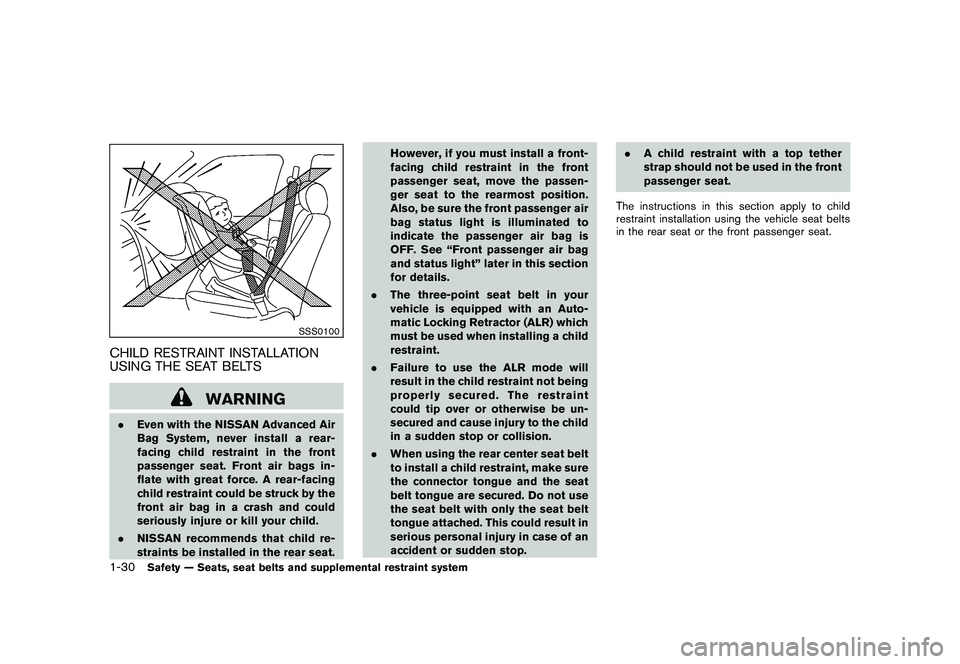
SSS0100
CHILD RESTRAINT INSTALLATION
USING THE SEAT BELTS
WARNING
.Even with the NISSAN Advanced Air
Bag System, never install a rear-
facing child restraint in the front
passenger seat. Front air bags in-
flate with great force. A rear-facing
child restraint could be struck by the
front air bag in a crash and could
seriously injure or kill your child.
. NISSAN recommends that child re-
straints be installed in the rear seat. However, if you must install a front-
facing child restraint in the front
passenger seat, move the passen-
ger seat to the rearmost position.
Also, be sure the front passenger air
bag status light is illuminated to
indicate the passenger air bag is
OFF. See “Front passenger air bag
and status light” later in this section
for details.
. The three-point seat belt in your
vehicle is equipped with an Auto-
matic Locking Retractor (ALR) which
must be used when installing a child
restraint.
. Failure to use the ALR mode will
result in the child restraint not being
properly secured. The restraint
could tip over or otherwise be un-
secured and cause injury to the child
in a sudden stop or collision.
. When using the rear center seat belt
to install a child restraint, make sure
the connector tongue and the seat
belt tongue are secured. Do not use
the seat belt with only the seat belt
tongue attached. This could result in
serious personal injury in case of an
accident or sudden stop. .
A child restraint with a top tether
strap should not be used in the front
passenger seat.
The instructions in this section apply to child
restraint installation using the vehicle seat belts
in the rear seat or the front passenger seat.1-30
Safety — Seats, seat belts and supplemental restraint system
Page 52 of 328
Black plate (48,1)
Model "S35-D" EDITED: 2009/ 9/ 4
7. Check that the retractor is in the ALR modeby trying to pull more seat belt out of the
retractor. If you cannot pull any more seat
belt webbing out of the retractor, the
retractor is in the ALR mode.
8. Check to make sure that the child restraint is properly secured prior to each use. If the
seat belt is not locked, repeat steps 3
through 7.
After the child restraint is removed and the seat
belt fully retracted, the ALR mode (child restraint
mode) is canceled.
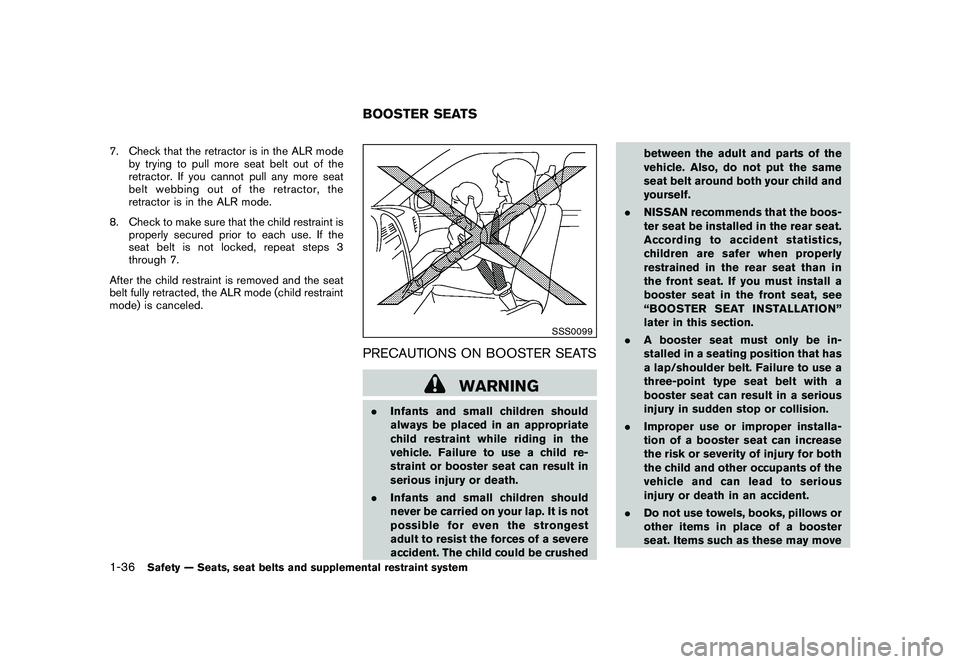
SSS0099
PRECAUTIONS ON BOOSTER SEATS
WARNING
. Infants and small children should
always be placed in an appropriate
child restraint while riding in the
vehicle. Failure to use a child re-
straint or booster seat can result in
serious injury or death.
. Infants and small children should
never be carried on your lap. It is not
possible for even the strongest
adult to resist the forces of a severe
accident. The child could be crushed between the adult and parts of the
vehicle. Also, do not put the same
seat belt around both your child and
yourself.
. NISSAN recommends that the boos-
ter seat be installed in the rear seat.
According to accident statistics,
children are safer when properly
restrained in the rear seat than in
the front seat. If you must install a
booster seat in the front seat, see
“BOOSTER SEAT INSTALLATION”
later in this section.
. A booster seat must only be in-
stalled in a seating position that has
a lap/shoulder belt. Failure to use a
three-point type seat belt with a
booster seat can result in a serious
injury in sudden stop or collision.
. Improper use or improper installa-
tion of a booster seat can increase
the risk or severity of injury for both
the child and other occupants of the
vehicle and can lead to serious
injury or death in an accident.
. Do not use towels, books, pillows or
other items in place of a booster
seat. Items such as these may moveBOOSTER SEATS
1-36
Safety — Seats, seat belts and supplemental restraint system
Page 53 of 328
Black plate (49,1)
Model "S35-D" EDITED: 2009/ 9/ 4
during normal driving or a collision
and result in serious injury or death.
Booster seats are designed to be
used with a lap/shoulder belt. Boos-
ter seats are designed to properly
route the lap and shoulder portions
of the seat belt over the strongest
portions of a child’s body to provide
the maximum protection during a
collision.
. Follow all of the booster seat man-
ufacturer’s instructions for installa-
tion and use. When purchasing a
booster seat, be sure to select one
which will fit your child and vehicle.
It may not be possible to properly
install some types of booster seats
in your vehicle.
. If the booster seat and seat belt is
not used properly, the risk of a child
being injured in a collision or a
sudden stop greatly increases.
. Adjustable seatbacks should be
positioned to fit the booster seat,
but as upright as possible.
. After placing the child in the booster
seat and fastening the seat belt,
make sure the shoulder portion of the belt is away from the child’s face
and neck and the lap portion of the
belt does not cross the abdomen.
. Do not put the shoulder belt behind
the child or under the child’s arm. If
you must install a booster seat in
the front seat, see “BOOSTER SEAT
INSTALLATION” later in this section.
. When your booster seat is not in
use, keep it secured with a seat belt
to prevent it from being thrown
around in case of a sudden stop or
accident.
CAUTION
Remember that a booster seat left in a
closed vehicle can become very hot.
Check the seating surface and buckles
before placing your child in the booster
seat.
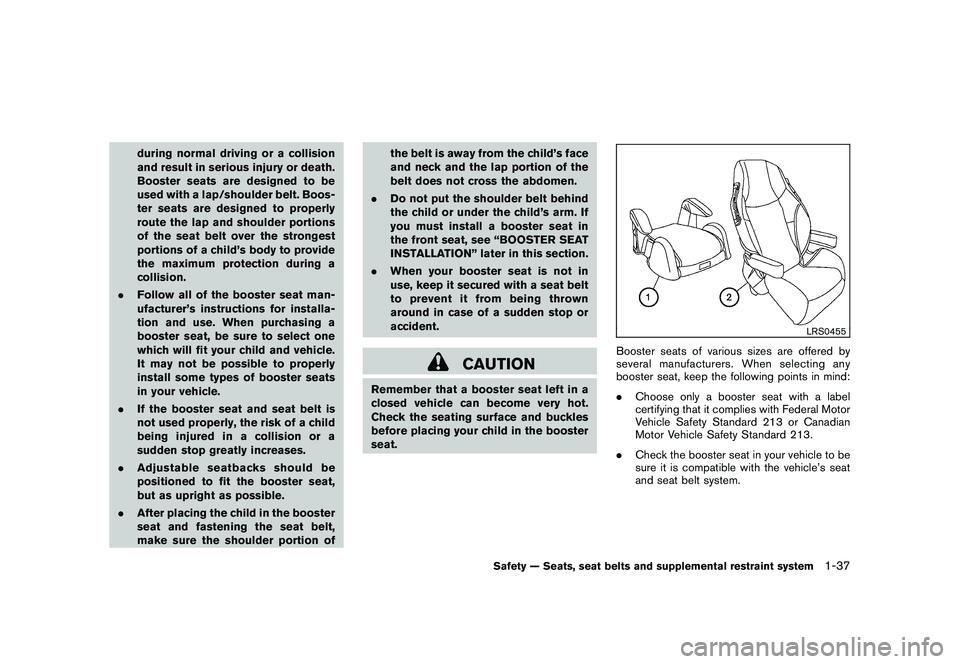
LRS0455
Booster seats of various sizes are offered by
several manufacturers. When selecting any
booster seat, keep the following points in mind:
.Choose only a booster seat with a label
certifying that it complies with Federal Motor
Vehicle Safety Standard 213 or Canadian
Motor Vehicle Safety Standard 213.
. Check the booster seat in your vehicle to be
sure it is compatible with the vehicle’s seat
and seat belt system.
Safety — Seats, seat belts and supplemental restraint system
1-37
Page 54 of 328
Black plate (50,1)
Model "S35-D" EDITED: 2009/ 9/ 4
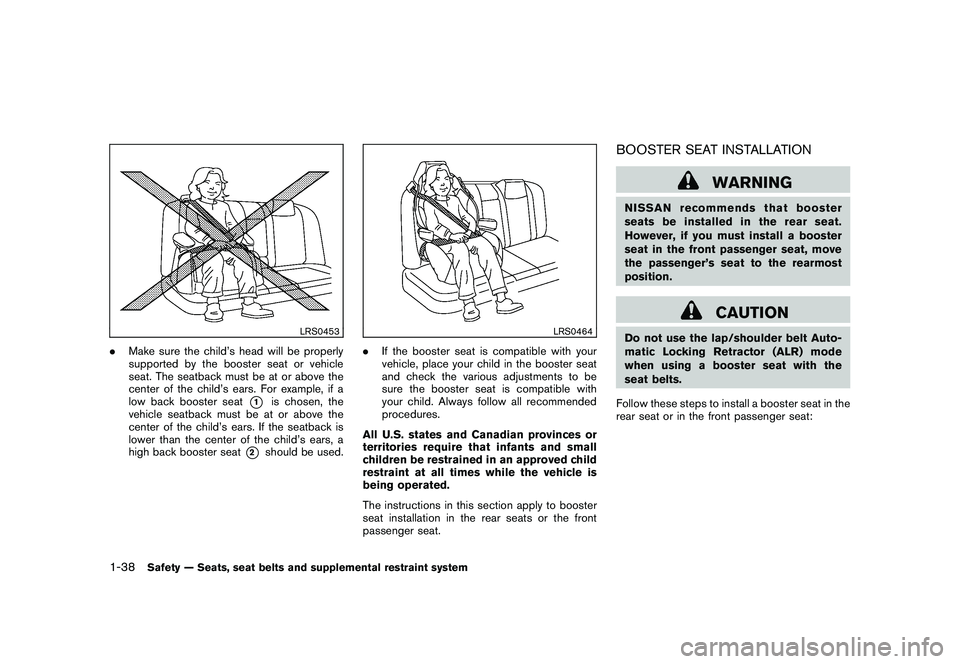
LRS0453
.Make sure the child’s head will be properly
supported by the booster seat or vehicle
seat. The seatback must be at or above the
center of the child’s ears. For example, if a
low back booster seat
*1
is chosen, the
vehicle seatback must be at or above the
center of the child’s ears. If the seatback is
lower than the center of the child’s ears, a
high back booster seat
*2
should be used.
LRS0464
. If the booster seat is compatible with your
vehicle, place your child in the booster seat
and check the various adjustments to be
sure the booster seat is compatible with
your child. Always follow all recommended
procedures.
All U.S. states and Canadian provinces or
territories require that infants and small
children be restrained in an approved child
restraint at all times while the vehicle is
being operated.
The instructions in this section apply to booster
seat installation in the rear seats or the front
passenger seat.
BOOSTER SEAT INSTALLATION
WARNING
NISSAN recommends that booster
seats be installed in the rear seat.
However, if you must install a booster
seat in the front passenger seat, move
the passenger’s seat to the rearmost
position.
CAUTION
Do not use the lap/shoulder belt Auto-
matic Locking Retractor (ALR) mode
when using a booster seat with the
seat belts.
Follow these steps to install a booster seat in the
rear seat or in the front passenger seat:
1-38
Safety — Seats, seat belts and supplemental restraint system
Page 57 of 328
Black plate (53,1)
Model "S35-D" EDITED: 2009/ 9/ 4
head of occupants in front and rear outboard
seating positions in certain side impact or
rollover collisions. In a side impact, the curtain
and rollover air bags are designed to inflate on
the side where the vehicle is impacted. In a
rollover both curtain and rollover air bags are
designed to inflate and remain inflated for a
short period of time.
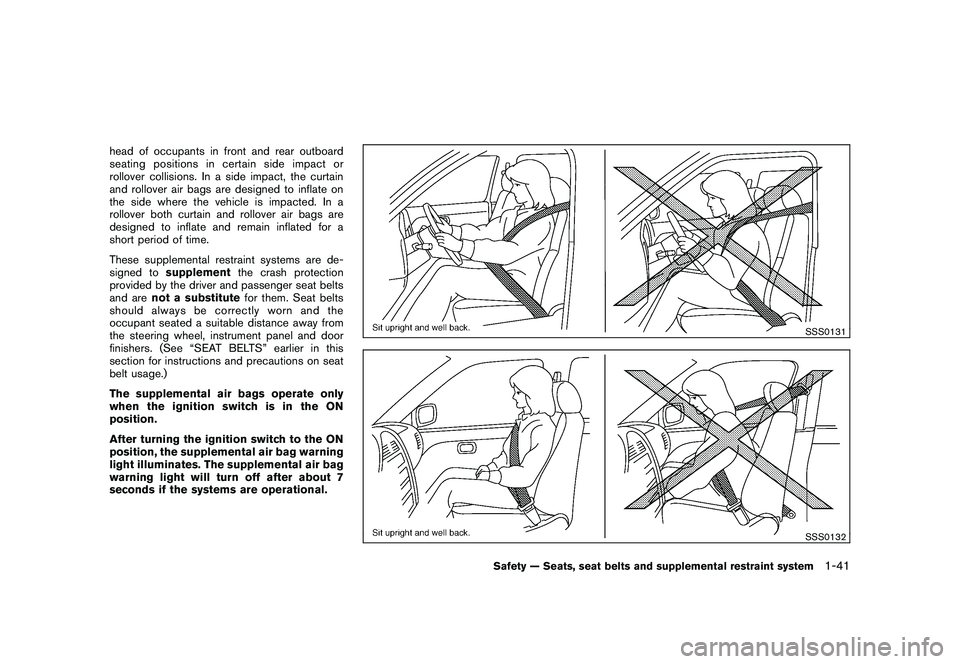
These supplemental restraint systems are de-
signed tosupplement the crash protection
provided by the driver and passenger seat belts
and are not a substitute for them. Seat belts
should always be correctly worn and the
occupant seated a suitable distance away from
the steering wheel, instrument panel and door
finishers. (See “SEAT BELTS” earlier in this
section for instructions and precautions on seat
belt usage.)
The supplemental air bags operate only
when the ignition switch is in the ON
position.
After turning the ignition switch to the ON
position, the supplemental air bag warning
light illuminates. The supplemental air bag
warning light will turn off after about 7
seconds if the systems are operational.
SSS0131SSS0132
Safety — Seats, seat belts and supplemental restraint system
1-41
Page 63 of 328
Black plate (59,1)
Model "S35-D" EDITED: 2009/ 9/ 4
Based on information from the sensors, only one
front air bag may inflate in a crash, depending on
the crash severity and whether the front
occupants are belted or unbelted. Additionally,
the front passenger air bag may be automatically
turned OFF under some conditions, depending
on the information provided by the occupant
classification sensor. If the front passenger air
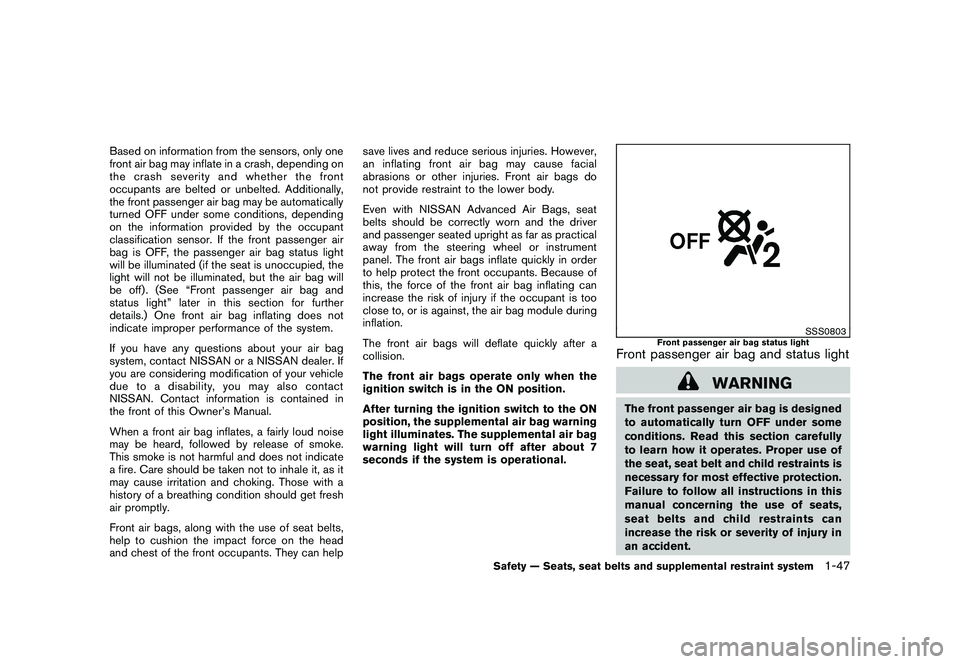
bag is OFF, the passenger air bag status light
will be illuminated (if the seat is unoccupied, the
light will not be illuminated, but the air bag will
be off) . (See “Front passenger air bag and
status light” later in this section for further
details.) One front air bag inflating does not
indicate improper performance of the system.
If you have any questions about your air bag
system, contact NISSAN or a NISSAN dealer. If
you are considering modification of your vehicle
due to a disability, you may also contact
NISSAN. Contact information is contained in
the front of this Owner’s Manual.
When a front air bag inflates, a fairly loud noise
may be heard, followed by release of smoke.
This smoke is not harmful and does not indicate
a fire. Care should be taken not to inhale it, as it
may cause irritation and choking. Those with a
history of a breathing condition should get fresh
air promptly.
Front air bags, along with the use of seat belts,
help to cushion the impact force on the head
and chest of the front occupants. They can helpsave lives and reduce serious injuries. However,
an inflating front air bag may cause facial
abrasions or other injuries. Front air bags do
not provide restraint to the lower body.
Even with NISSAN Advanced Air Bags, seat
belts should be correctly worn and the driver
and passenger seated upright as far as practical
away from the steering wheel or instrument
panel. The front air bags inflate quickly in order
to help protect the front occupants. Because of
this, the force of the front air bag inflating can
increase the risk of injury if the occupant is too
close to, or is against, the air bag module during
inflation.
The front air bags will deflate quickly after a
collision.
The front air bags operate only when the
ignition switch is in the ON position.
After turning the ignition switch to the ON
position, the supplemental air bag warning
light illuminates. The supplemental air bag
warning light will turn off after about 7
seconds if the system is operational.
SSS0803
Front passenger air bag status light
Front passenger air bag and status light
WARNING
The front passenger air bag is designed
to automatically turn OFF under some
conditions. Read this section carefully
to learn how it operates. Proper use of
the seat, seat belt and child restraints is
necessary for most effective protection.
Failure to follow all instructions in this
manual concerning the use of seats,
seat belts and child restraints can
increase the risk or severity of injury in
an accident.
Safety — Seats, seat belts and supplemental restraint system
1-47
Page 64 of 328
Black plate (60,1)
Model "S35-D" EDITED: 2009/ 9/ 4
Status light:
The front passenger air bag status light
is
located on the instrument panel below the air
conditioner controls. The light operates as
follows:
. Unoccupied passenger seat: Thelight
is OFF and the front passenger air bag is
OFF and will not inflate in a crash.
. Passenger’s seat occupied by a small adult,
child or child restraint as outlined in this
section: The
light illuminates to indi-
cate that the front passenger air bag is OFF
and will not inflate in a crash.
. Occupied passenger seat and the passen-
ger meets the conditions outlined in this
section: Thelight is OFF to indicate
that the front passenger air bag is opera-
tional.
Front passenger air bag:
The front passenger air bag is designed to
automatically turn OFF when the vehicle is
operated under some conditions as described
below as permitted by U.S. regulations. If the
front passenger air bag is OFF, it will not inflate
in a crash. The driver air bag and other air bags
in your vehicle are not part of this system.
The purpose of the regulation is to help reduce
the risk of injury or death from an inflating air bag to certain front passenger seat occupants, such
as children, by requiring the air bag to be
automatically turned OFF.
The occupant classification sensor (pattern
sensor) is in the front passenger seat cushion
and is designed to detect an occupant and
objects on the seat. For example, if a child is in
the front passenger seat, the Advanced Air Bag
System is designed to turn the passenger air
bag OFF in accordance with the regulations.
Also, if a child restraint of the type specified in
the regulations is on the seat, the occupant
classification sensor can detect it and cause the
air bag to turn OFF.
Front passenger seat adult occupants who are
properly seated and using the seat belt as
outlined in this manual should not cause the
passenger air bag to be automatically turned
OFF. For small adults it may be turned OFF,
however, if the occupant does not sit in the seat
properly (for example, by not sitting upright, by
sitting on an edge of the seat, or by otherwise
being out of position) , this could cause the
sensor to turn the air bag OFF. Always be sure
to be seated and wearing the seat belt properly
for the most effective protection by the seat belt
and supplemental air bag.
NISSAN recommends that pre-teens and chil-
dren be properly restrained in a rear seat.
NISSAN also recommends that appropriate
child restraints and booster seats be properlyinstalled in a rear seat. If this is not possible, the
occupant classification sensor is designed to
operate as described above to turn the front
passenger air bag OFF for specified child
restraints. Failing to properly secure child
restraints and to use the Automatic Locking
Retractor (ALR) mode (child restraint mode)
may allow the restraint to tip or move in an
accident or sudden stop. This can also result in
the passenger air bag inflating in a crash instead
of being OFF. (See “CHILD RESTRAINTS”
earlierinthissectionforproperuseand
installation.)
If the front passenger seat is not occupied, the
passenger air bag is designed not to inflate in a
crash. However, heavy objects placed on the
seat could result in air bag inflation, because of
the object being detected by the occupant
classification sensor. Other conditions could
also result in air bag inflation, such as if a child is
standing on the seat, or if two children are on the
seat, contrary to the instructions in this manual.
Always be sure that you and all vehicle
occupants are seated and restrained properly.
Using the passenger air bag status light, you can
monitor when the front passenger air bag is
automatically turned OFF with the seat occu-
pied. The light will not illuminate when the front
passenger seat is unoccupied.
If an adult occupant is in the seat but the
passenger air bag status light is illuminated
1-48
Safety — Seats, seat belts and supplemental restraint system
Page 65 of 328
Black plate (61,1)
Model "S35-D" EDITED: 2009/ 9/ 4
(indicating that the air bag is OFF) , it could be
that the person is a small adult, or is not sitting
on the seat properly.
If a child restraint must be used in the front seat,
the passenger air bag status light may or may
not be illuminated, depending on the size of the
child and the type of child restraint being used. If
the air bag status light is not illuminated
(indicating that the air bag might inflate in a
crash) , it could be that the child restraint or seat
belt is not being used properly. Make sure that
the child restraint is installed properly, the seat
belt is used properly and the occupant is
positioned properly. If the air bag status light is
not illuminated, reposition the occupant or child
restraint in a rear seat.
If the passenger air bag status light will not
illuminate even though you believe that the child
restraint, the seat belts and the occupant are
properly positioned, the system may be sensing
an unoccupied seat (in which case the air bag is
OFF) . Your NISSAN dealer can check that the
system is OFF by using a special tool. However,
until you have confirmed with your dealer that
your air bag is working properly, reposition the
occupant or child restraint in a rear seat.
The air bag system and passenger air bag status
light will take a few seconds to register a change
in the passenger seat status. However, if the
seat becomes unoccupied, the air bag status
light will remain off.If a malfunction occurs in the front passenger air
bag system, the supplemental air bag warning
light
, located in the meter and gauges area,
will blink. Have the system checked by a
NISSAN dealer.
Other supplemental front-impact air bag
precautions
WARNING
. Do not place any objects on the
steering wheel pad or on the instru-
ment panel. Also, do not place any
objects between any occupant and
the steering wheel or instrument
panel. Such objects may become
dangerous projectiles and cause
injury if the front air bag inflates.
. Do not place objects with sharp
edges on the seat. Also, do not
place heavy objects on the seat that
will leave permanent impressions in
the seat. Such objects can damage
the seat or occupant classification
sensor (pattern sensor) . This can
affect the operation of the air bag
system and result in serious perso-
nal injury.
. Do not use water or acidic cleaners (hot steam cleaners) on the seat.
This can damage the seat or occu-
pant classification sensor. This can
also affect the operation of the air
bag system and result in serious
personal injury.
. Immediately after inflation, several
front air bag system components
will be hot. Do not touch them; you
may severely burn yourself.
. No unauthorized changes should be
made to any components or wiring
of the supplemental air bag system.
This is to prevent accidental infla-
tion of the supplemental air bag or
damage to the supplemental air bag
system.
. Do not make unauthorized changes
to your vehicle’s electrical system,
suspension system or front end
structure. This could affect proper
operation of the front air bag sys-
tem.
. Tampering with the supplemental
air bag system may result in serious
personal injury. Tampering includes
changes to the steering wheel and
the instrument panel assembly by
Safety — Seats, seat belts and supplemental restraint system
1-49
Page 67 of 328
Black plate (63,1)
Model "S35-D" EDITED: 2009/ 9/ 4
side collisions, although they may inflate if the
forces in another type of collision are similar to
those of a higher severity side impact. They are
designed to inflate on the side where the vehicle
is impacted. They may not inflate in certain side
collisions on the side where the vehicle is
impacted. Curtain and rollover air bags are also
designed to inflate in certain types of rollover
collisions or near rollovers.
Vehicle damage (or lack of it) is not always an
indication of proper side air bag and curtain and
rollover air bag operation.
When the side air bags and curtain and rollover
air bags inflate, a fairly loud noise may be heard,
followed by release of smoke. This smoke is not
harmful and does not indicate a fire. Care should
be taken not to inhale it, as it may cause irritation
and choking. Those with a history of a breathing
condition should get fresh air promptly.
Side air bags, along with the use of seat belts,
help to cushion the impact force on the chest
and pelvic area of the front occupants. Curtain
and rollover air bags help to cushion the impact
force to the head of occupants in the front and
rear outboard seating positions. They can help
save lives and reduce serious injuries. However,
side air bags and curtain and rollover air bags
may cause abrasions or other injuries. Side air
bags and curtain and rollover air bags do not
provide restraint to the lower body.The seat belts should be correctly worn and the
driver and passenger seated upright as far as
practical away from the side air bags. Rear seat
passengers should be seated as far away as
practical from the door finishers and side roof
rails. The side air bags and curtain and rollover
air bags inflate quickly in order to help protect
the occupants in the outboard seating positions.
Because of this, the force of the side air bags
and curtain and rollover air bags inflating can
increase the risk of injury if the occupant is too
close to, or is against, these air bag modules
during inflation. The side air bags and curtain
and rollover air bags will deflate quickly after the
collision is over.
The side air bags and curtain and rollover
air bags operate only when the ignition
switch is in the ON position.
After turning the ignition switch to the ON
position, the supplemental air bag warning
light illuminates. The supplemental air bag
warning light will turn off after about 7
seconds if the systems are operational.
WARNING
.
Do not place any objects near the
seatback of the front seats. Also, do
not place any objects (an umbrella,
bag, etc.) between the front door finisher and the front seat. Such
objects may become dangerous
projectiles and cause injury if a side
air bag inflates.
. Right after inflation, several side air
bag and curtain and rollover air bag
system components will be hot. Do
not touch them; you may severely
burn yourself.
. No unauthorized changes should be
made to any components or wiring
of the side air bag and curtain and
rollover air bag systems. This is to
prevent damage to or accidental
inflation of the side air bag and
curtain and rollover air bag systems.
. Do not make unauthorized changes
to your vehicle’s electrical system,
suspension system or side panel.
This could affect proper operation
of the side air bag and curtain and
rollover air bag systems.
. Tampering with the side air bag
system may result in serious perso-
nal injury. For example, do not
change the front seats by placing
material near the seatbacks or by
installing additional trim material,
Safety — Seats, seat belts and supplemental restraint system
1-51
Page 68 of 328
Black plate (64,1)
Model "S35-D" EDITED: 2009/ 9/ 4
such as seat covers, around the side
air bag.
. Work around and on the side air bag
and curtain and rollover air bag
systems should be done by a
NISSAN dealer. Installation of elec-
trical equipment should also be
done by a NISSAN dealer. The
Supplemental Restraint System
(SRS) wiring harnesses* should not
be modified or disconnected. Un-
authorized electrical test equipment
and probing devices should not be
used on the side air bag and curtain
and rollover supplemental air bag
systems.
* The SRS wiring harness connectors are
yellow and orange for easy identifica-
tion.
When selling your vehicle, we request that you
inform the buyer about the side air bag and
curtain and rollover air bag systems and guide
the buyer to the appropriate sections in this
Owner’s Manual.
SEAT BELTS WITH PRETENSIONERS
(front seats)
WARNING
. The pretensioners cannot be reused
after activation. They must be re-
placed together with the retractor
and buckle as a unit.
. If the vehicle becomes involved in a
frontal collision but a pretensioner
is not activated, be sure to have the
pretensioner system checked and, if
necessary, replaced by a NISSAN
dealer.
. No unauthorized changes should be
made to any components or wiring
of the pretensioner system. This is
to prevent damage to or accidental
activation of the pretensioners.
Tampering with the pretensioner
system may result in serious perso-
nal injury.
. Work around and on the preten-
sioner system should be done by a
NISSAN dealer. Installation of elec-
trical equipment should also be
done by a NISSAN dealer. Un-
authorized electrical test equipment and probing devices should not be
used on the pretensioner system.
. If you need to dispose of a preten-
sioner or scrap the vehicle, contact a
NISSAN dealer. Correct preten-
sioner disposal procedures are set
forthintheappropriateNISSAN
Service Manual. Incorrect disposal
procedures could cause personal
injury.
The pretensioner system activates in conjunc-
tion with the front air bag system. The preten-
sioner system also activates with the curtain and
rollover air bags in certain types of rollover
collisions or near rollovers. Working with the
seat belt retractor, it helps tighten the seat belt
when the vehicle becomes involved in certain
types of collisions, helping to restrain front seat
occupants.
The pretensioner is encased with the seat belt
retractor. These seat belts are used the same
way as conventional seat belts.
When a pretensioner activates, smoke is re-
leased and a loud noise may be heard. The
smoke is not harmful and does not indicate a
fire. Care should be taken not to inhale it, as it
may cause irritation and choking. Those with a
history of a breathing condition should get fresh
air promptly.
1-52
Safety — Seats, seat belts and supplemental restraint system