engine overheat NISSAN ROGUE 2010 Owner´s Manual
[x] Cancel search | Manufacturer: NISSAN, Model Year: 2010, Model line: ROGUE, Model: NISSAN ROGUE 2010Pages: 328, PDF Size: 2.84 MB
Page 294 of 328
Black plate (296,1)
Model "S35-D" EDITED: 2009/ 9/ 4
pumps to be identified by a small, square,
orange and black label with the common
abbreviation or the appropriate percentage for
that region.Aftermarket fuel additivesNISSAN does not recommend the use of any
aftermarket fuel additives (for example, fuel
injector cleaner, octane booster, intake valve
deposit removers, etc.) which are sold commer-
cially. Many of these additives intended for gum,
varnish or deposit removal may contain active
solvent or similar ingredients that can be harmful
to the fuel system and engine.Octane rating tipsUsing unleaded gasoline with an octane
rating lower than recommended can cause
persistent, heavy “spark knock”. (Spark
knock is a metallic rapping noise.) If
severe, this can lead to engine damage. If
you detect a persistent heavy spark knock
even when using gasoline of the stated
octane rating, or if you hear steady spark
knock while holding a steady speed on
level roads, have a NISSAN dealer correct
the condition. Failure to correct the condi-
tion is misuse of the vehicle, for which
NISSAN is not responsible.
Incorrect ignition timing will result in spark
knock, after-run and/or overheating, which may
cause excessive fuel consumption or enginedamage. If any of the above symptoms are
encountered, have your vehicle checked at a
NISSAN dealer.
However, now and then you may notice
light spark knock for a short time while
accelerating or driving up hills. This is not a
cause for concern, because you get the
greatest fuel benefit when there is light
spark knock for a short time under heavy
engine load.
CAUTION
.
Your vehicle is not designed to run
on E-85 fuel. Using E-85 fuel in a
vehicle not specifically designed for
E-85 fuel can damage fuel system
components and is not covered by
the NISSAN new vehicle limited
warranty.
. E-85 is a mixture of approximately
85% fuel ethanol and 15% unleaded
gasoline.
. U.S. government regulations require
ethanol dispensing pumps to be
identified by a small, square, orange
and black label with the common
abbreviation or the appropriate per-
centage for that region.
9-4
Technical and consumer information
Page 308 of 328
Black plate (310,1)
Model "S35-D" EDITED: 2009/ 9/ 4
for proper towing.
For Kro¯
m models:
Do not attach the towing equipment to Kro ¯
m
models. The equipment will contact the exhaust
pipes located on the rear center of the vehicle.MAXIMUM LOAD LIMITS
Maximum trailer loadsNever allow the total trailer load to exceed the
value specified in the “Towing Load/Specifica-
tion” chart. The total trailer load equals trailer
weight plus its cargo weight.
. When towing a trailer load of 1,000 lbs
(454 kg) or more, trailers with a brake
system MUST be used.
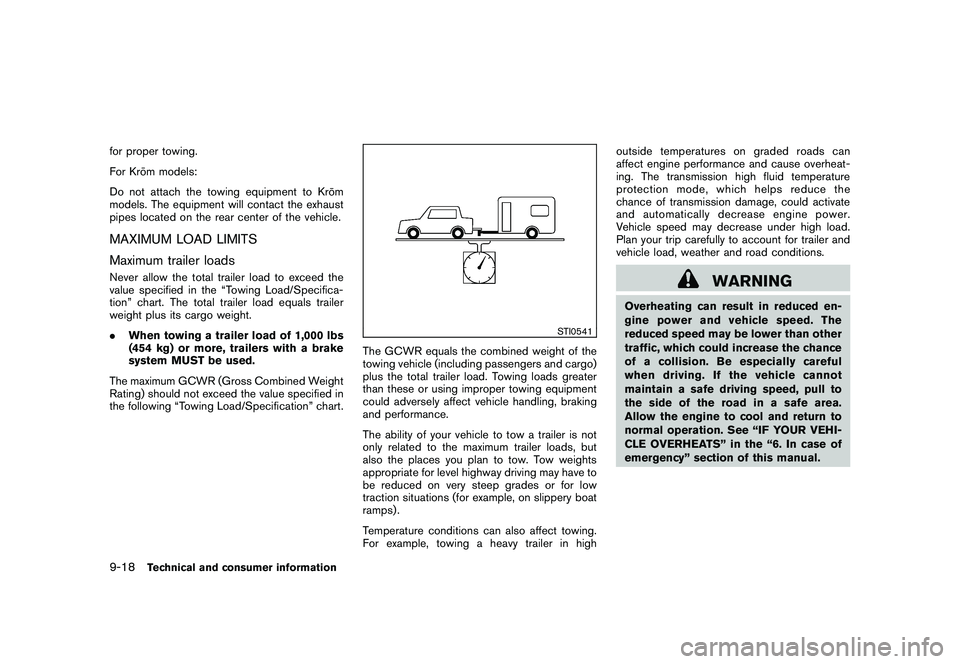
The maximum GCWR (Gross Combined Weight
Rating) should not exceed the value specified in
the following “Towing Load/Specification” chart.
STI0541
The GCWR equals the combined weight of the
towing vehicle (including passengers and cargo)
plus the total trailer load. Towing loads greater
than these or using improper towing equipment
could adversely affect vehicle handling, braking
and performance.
The ability of your vehicle to tow a trailer is not
only related to the maximum trailer loads, but
also the places you plan to tow. Tow weights
appropriate for level highway driving may have to
be reduced on very steep grades or for low
traction situations (for example, on slippery boat
ramps) .
Temperature conditions can also affect towing.
For example, towing a heavy trailer in high outside temperatures on graded roads can
affect engine performance and cause overheat-
ing. The transmission high fluid temperature
protection mode, which helps reduce the
chance of transmission damage, could activate
and automatically decrease engine power.
Vehicle speed may decrease under high load.
Plan your trip carefully to account for trailer and
vehicle load, weather and road conditions.
WARNING
Overheating can result in reduced en-
gine power and vehicle speed. The
reduced speed may be lower than other
traffic, which could increase the chance
of a collision. Be especially careful
when driving. If the vehicle cannot
maintain a safe driving speed, pull to
the side of the road in a safe area.
Allow the engine to cool and return to
normal operation. See “IF YOUR VEHI-
CLE OVERHEATS” in the “6. In case of
emergency” section of this manual.
9-18
Technical and consumer information
Page 314 of 328
Black plate (316,1)
Model "S35-D" EDITED: 2009/ 9/ 4
back up slowly. If possible, have someone
guide you when you are backing up.
Always block the wheels on both vehicle and
trailer when parking. Parking on a slope is not
recommended; however, if you must do so:
CAUTION
If you move the shift selector lever to
the P (Park) position before blocking
the wheels and applying the parking
brake, transmission damage could oc-
cur.
1. Apply and hold the brake pedal.
2. Have someone place blocks on the downhill side of the vehicle and trailer wheels.
3. After the wheel blocks are in place, slowly release the brake pedal until the blocks
absorb the vehicle load.
4. Apply the parking brake.
5. Shift the transmission into P (Park) .
6. Turn off the engine.
To drive away:
1. Apply and hold the brake pedal.
2. Start the engine. 3. Shift the transmission into gear.
4. Release the parking brake.
5. Drive slowly until the vehicle and trailer are
clear from the blocks.
6. Apply and hold the brake pedal.
7. Have someone retrieve and store the blocks.
. When going down a hill, shift into a lower
gear and use the engine braking effect.
When going up a long grade, downshift the
transmission to a lower gear and reduce
speed to reduce chances of engine over-
loading and/or overheating.
. If the engine coolant rises to an extremely
high temperature when the air conditioning
system is on, turn off the air conditioner.
Coolant heat can be additionally vented by
opening the windows, switching the fan
control to high and setting the temperature
control to the HOT position.
. Trailer towing requires more fuel than normal
circumstances.
. Avoid towing a trailer for the first 500 miles
(800 km) .
. Have your vehicle serviced more often than
at intervals specified in the recommended
maintenance schedule in the NISSAN Ser-
vice and Maintenance Guide. .
When making a turn, your trailer wheels will
be closer to the inside of the turn than your
vehicle wheels. To compensate for this,
make a larger than normal turning radius
during the turn.
. Crosswinds and rough roads will adversely
affect vehicle/trailer handling, possibly caus-
ing vehicle sway. When being passed by
larger vehicles, be prepared for possible
changes in crosswinds that could affect
vehicle handling. If swaying does occur,
firmly grip the steering wheel, steer straight
ahead, and immediately (but gradually)
reduce vehicle speed. This combination will
help stabilize the vehicle. Never increase
speed.
Do the following if the trailer begins to sway:
1. Take your foot off the accelerator pedal to allow the vehicle to coast and steer as
straight ahead as the road conditions allow.
This combination will help stabilize the
vehicle.
— Do not correct trailer sway by steering orapplying the brakes.
2. When the trailer sway stops, gently apply the brakes and pull to the side of the road in
a safe area.
3. Try to rearrange the trailer load so it is balanced as described earlier in this section.9-24
Technical and consumer information
Page 315 of 328
Black plate (317,1)
Model "S35-D" EDITED: 2009/ 9/ 4
.Be careful when passing other vehicles.
Passing while towing a trailer requires
considerably more distance than normal
passing. Remember the length of the trailer
must also pass the other vehicle before you
can safely change lanes.
. Down shift the transmission to a lower gear
for engine braking when driving down steep
or long hills. This will help slow the vehicle
without applying the brakes.
. Avoid holding the brake pedal down too
long or too frequently. This could cause the
brakes to overheat, resulting in reduced
braking efficiency.
. Increase your following distance to allow for
greater stopping distances while towing a
trailer. Anticipate stops and brake gradually.
. Do not use cruise control while towing a
trailer.
. Some states or provinces have specific
regulations and speed limits for vehicles
that are towing trailers. Obey the local
speed limits.
. Check your hitch, trailer wiring harness
connections, and trailer wheel lug nuts after
50 miles (80 km) of travel and at every
break.
. When stopped in traffic for long periods of time in hot weather, put the vehicle in the P
(Park) position.
. When launching a boat, don’t allow the
water level to go over the exhaust tail pipe or
rear bumper.
. Make sure you disconnect the trailer lights
before backing the trailer into the water or
the trailer lights may burn out.
When towing a trailer, the transmission
fluid should be changed more frequently.
For additional information, see the “8.
Maintenance and do-it-yourself” section
earlier in this manual.
FLAT TOWINGTowing your vehicle with all four wheels on the
ground is sometimes called flat towing. This
method is sometimes used when towing a
vehicle behind a recreational vehicle, such as a
motor home.
CAUTION
. Failure to follow these guidelines
can result in severe transmission
damage.
. Whenever flat towing your vehicle,
always tow forward, never back-
ward. .
DO NOT tow any continuously vari-
able transmission vehicle with all
four wheels on the ground (flat
towing) . Doing so WILL DAMAGE
internal transmission parts due to
lack of transmission lubrication.
. DO NOT tow an All-Wheel Drive
(AWD) vehicle with any of the
wheels on the ground. Doing so
may cause serious and expensive
damage to the powertrain.
. For emergency towing procedures
refer to “TOWING RECOMMENDED
BY NISSAN (except for Kro ¯
m mod-
els)” in the “6. In case of emer-
gency” section of this manual.
Continuously Variable Transmission
(CVT)All-Wheel Drive (AWD) models:
Do not tow an AWD vehicle with any of the
wheels on the ground.
Two-Wheel Drive (2WD) models:
To tow a vehicle equipped with a Continuously
Variable Transmission (CVT) , an appropriate
vehicle dolly MUSTbe placed under the towed
vehicle’s driving wheels. Alwaysfollow the dollyTechnical and consumer information
9-25
Page 322 of 328
Black plate (2,1)
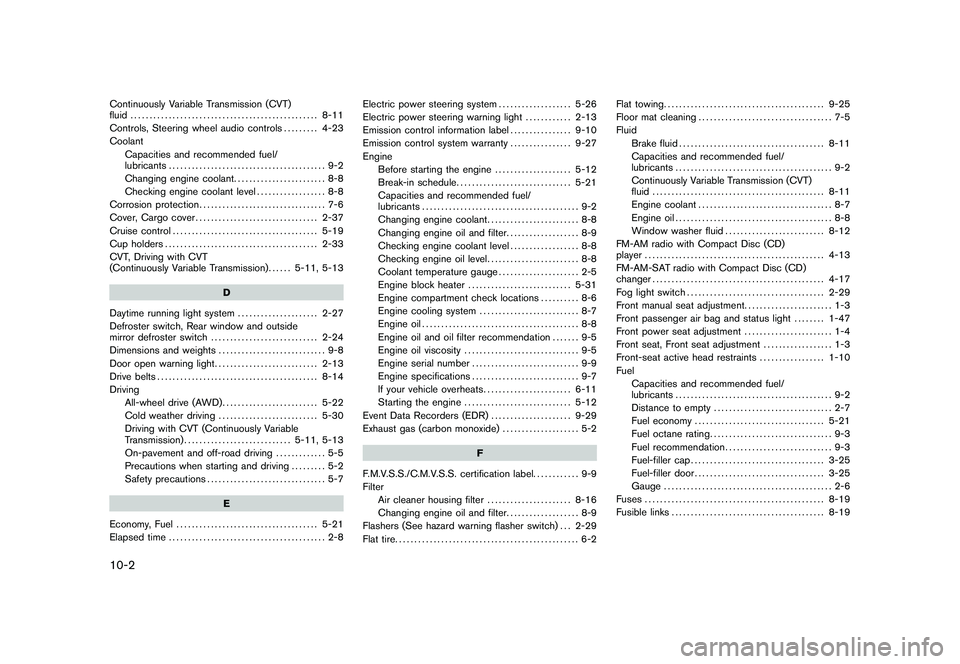
10-2Continuously Variable Transmission (CVT)
fluid................................................. 8-11
Controls, Steering wheel audio controls ......... 4-23
Coolant Capacities and recommended fuel/
lubricants ......................................... 9-2
Changing engine coolant ........................ 8-8
Checking engine coolant level .................. 8-8
Corrosion protection ................................. 7-6
Cover, Cargo cover ................................ 2-37
Cruise control ...................................... 5-19
Cup holders ........................................ 2-33
CVT, Driving with CVT
(Continuously Variable Transmission) ...... 5-11, 5-13
D
Daytime running light system ..................... 2-27
Defroster switch, Rear window and outside
mirror defroster switch ............................ 2-24
Dimensions and weights ............................ 9-8
Door open warning light ........................... 2-13
Drive belts .......................................... 8-14
Driving All-wheel drive (AWD) ......................... 5-22
Cold weather driving .......................... 5-30
Driving with CVT (Continuously Variable
Transmission) ............................ 5-11, 5-13
On-pavement and off-road driving ............. 5-5
Precautions when starting and driving ......... 5-2
Safety precautions ............................... 5-7
E
Economy, Fuel ..................................... 5-21
Elapsed time ......................................... 2-8 Electric power steering system
................... 5-26
Electric power steering warning light ............ 2-13
Emission control information label ................ 9-10
Emission control system warranty ................ 9-27
Engine Before starting the engine .................... 5-12
Break-in schedule .............................. 5-21
Capacities and recommended fuel/
lubricants ......................................... 9-2
Changing engine coolant ........................ 8-8
Changing engine oil and filter ................... 8-9
Checking engine coolant level .................. 8-8
Checking engine oil level ........................ 8-8
Coolant temperature gauge ..................... 2-5
Engine block heater ........................... 5-31
Engine compartment check locations .......... 8-6
Engine cooling system .......................... 8-7
Engine oil ......................................... 8-8
Engine oil and oil filter recommendation ....... 9-5
Engine oil viscosity .............................. 9-5
Engine serial number ............................ 9-9
Engine specifications ............................ 9-7
If your vehicle overheats ....................... 6-11
Starting the engine ............................ 5-12
Event Data Recorders (EDR) ..................... 9-29
Exhaust gas (carbon monoxide) .................... 5-2
F
F.M.V.S.S./C.M.V.S.S. certification label. ........... 9-9
Filter Air cleaner housing filter ...................... 8-16
Changing engine oil and filter ................... 8-9
Flashers (See hazard warning flasher switch) . . . 2-29
Flat tire ................................................ 6-2 Flat towing
.......................................... 9-25
Floor mat cleaning ................................... 7-5
Fluid Brake fluid ...................................... 8-11
Capacities and recommended fuel/
lubricants ......................................... 9-2
Continuously Variable Transmission (CVT)
fluid ............................................. 8-11
Engine coolant ................................... 8-7
Engine oil ......................................... 8-8
Window washer fluid .......................... 8-12
FM-AM radio with Compact Disc (CD)
player ............................................... 4-13
FM-AM-SAT radio with Compact Disc (CD)
changer ............................................. 4-17
Fog light switch .................................... 2-29
Front manual seat adjustment. ...................... 1-3
Front passenger air bag and status light ........ 1-47
Front power seat adjustment ....................... 1-4
Front seat, Front seat adjustment .................. 1-3
Front-seat active head restraints ................. 1-10
Fuel Capacities and recommended fuel/
lubricants ......................................... 9-2
Distance to empty ............................... 2-7
Fuel economy .................................. 5-21
Fuel octane rating ................................ 9-3
Fuel recommendation ............................ 9-3
Fuel-filler cap ................................... 3-25
Fuel-filler door .................................. 3-25
Gauge ............................................ 2-6
Fuses ............................................... 8-19
Fusible links ........................................ 8-19
Model "S35-D" EDITED: 2009/ 9/ 4
Page 324 of 328
Black plate (4,1)
10-4
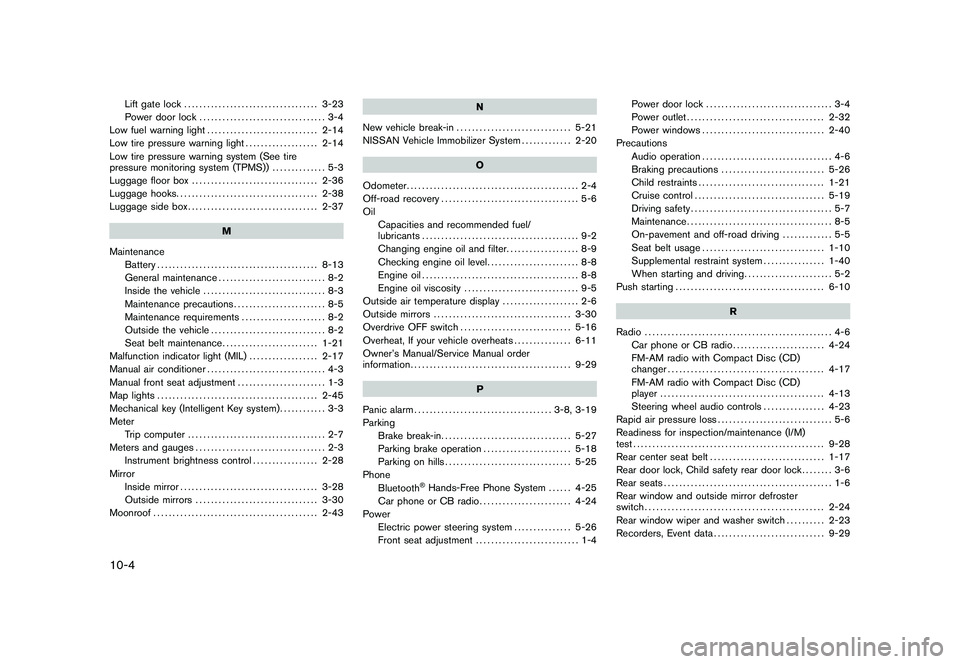
Lift gate lock................................... 3-23
Power door lock ................................. 3-4
Low fuel warning light ............................. 2-14
Low tire pressure warning light ................... 2-14
Low tire pressure warning system (See tire
pressure monitoring system (TPMS)) .............. 5-3
Luggage floor box ................................. 2-36
Luggage hooks ..................................... 2-38
Luggage side box .................................. 2-37
M
Maintenance Battery .......................................... 8-13
General maintenance ............................ 8-2
Inside the vehicle ................................ 8-3
Maintenance precautions ........................ 8-5
Maintenance requirements ...................... 8-2
Outside the vehicle .............................. 8-2
Seat belt maintenance ......................... 1-21
Malfunction indicator light (MIL) .................. 2-17
Manual air conditioner ............................... 4-3
Manual front seat adjustment ....................... 1-3
Map lights .......................................... 2-45
Mechanical key (Intelligent Key system) ............ 3-3
Meter Trip computer .................................... 2-7
Meters and gauges .................................. 2-3
Instrument brightness control ................. 2-28
Mirror Inside mirror .................................... 3-28
Outside mirrors ................................ 3-30
Moonroof ........................................... 2-43 N
New vehicle break-in .............................. 5-21
NISSAN Vehicle Immobilizer System ............. 2-20
O
Odometer ............................................. 2-4
Off-road recovery .................................... 5-6
Oil Capacities and recommended fuel/
lubricants ......................................... 9-2
Changing engine oil and filter ................... 8-9
Checking engine oil level ........................ 8-8
Engine oil ......................................... 8-8
Engine oil viscosity .............................. 9-5
Outside air temperature display .................... 2-6
Outside mirrors .................................... 3-30
Overdrive OFF switch ............................. 5-16
Overheat, If your vehicle overheats ............... 6-11
Owner’s Manual/Service Manual order
information .......................................... 9-29
P
Panic alarm .................................... 3-8, 3-19
Parking Brake break-in .................................. 5-27
Parking brake operation ....................... 5-18
Parking on hills ................................. 5-25
Phone Bluetooth
®Hands-Free Phone System ...... 4-25
Car phone or CB radio ........................ 4-24
Power Electric power steering system ............... 5-26
Front seat adjustment ........................... 1-4 Power door lock
................................. 3-4
Power outlet .................................... 2-32
Power windows ................................ 2-40
Precautions Audio operation .................................. 4-6
Braking precautions ........................... 5-26
Child restraints ................................. 1-21
Cruise control .................................. 5-19
Driving safety ..................................... 5-7
Maintenance ...................................... 8-5
On-pavement and off-road driving ............. 5-5
Seat belt usage ................................ 1-10
Supplemental restraint system ................ 1-40
When starting and driving ....................... 5-2
Push starting ....................................... 6-10
R
Radio ................................................. 4-6
Car phone or CB radio ........................ 4-24
FM-AM radio with Compact Disc (CD)
changer ......................................... 4-17
FM-AM radio with Compact Disc (CD)
player ........................................... 4-13
Steering wheel audio controls ................ 4-23
Rapid air pressure loss .............................. 5-6
Readiness for inspection/maintenance (I/M)
test .................................................. 9-28
Rear center seat belt .............................. 1-17
Rear door lock, Child safety rear door lock ........ 3-6
Rear seats ............................................ 1-6
Rear window and outside mirror defroster
switch ............................................... 2-24
Rear window wiper and washer switch .......... 2-23
Recorders, Event data ............................. 9-29
Model "S35-D" EDITED: 2009/ 9/ 4