cruise control NISSAN ROGUE 2010 Owner´s Manual
[x] Cancel search | Manufacturer: NISSAN, Model Year: 2010, Model line: ROGUE, Model: NISSAN ROGUE 2010Pages: 328, PDF Size: 2.84 MB
Page 13 of 328
Black plate (9,1)
Model "S35-D" EDITED: 2009/ 9/ 4
SIC3470
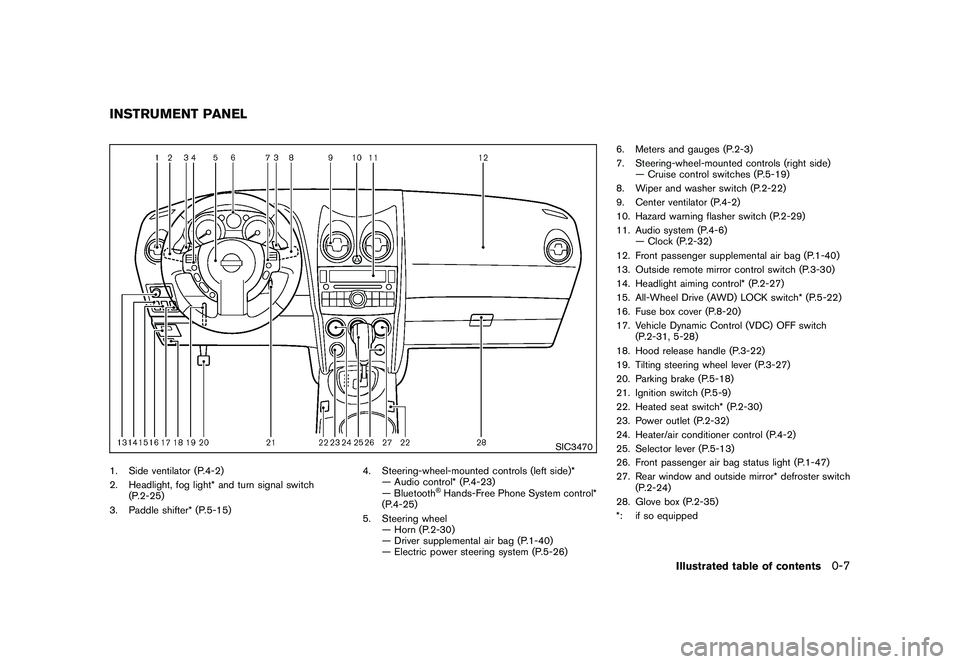
1. Side ventilator (P.4-2)
2. Headlight, fog light* and turn signal switch(P.2-25)
3. Paddle shifter* (P.5-15) 4. Steering-wheel-mounted controls (left side)*
— Audio control* (P.4-23)
— Bluetooth
®Hands-Free Phone System control*
(P.4-25)
5. Steering wheel — Horn (P.2-30)
— Driver supplemental air bag (P.1-40)
— Electric power steering system (P.5-26) 6. Meters and gauges (P.2-3)
7. Steering-wheel-mounted controls (right side)
— Cruise control switches (P.5-19)
8. Wiper and washer switch (P.2-22)
9. Center ventilator (P.4-2)
10. Hazard warning flasher switch (P.2-29)
11. Audio system (P.4-6) — Clock (P.2-32)
12. Front passenger supplemental air bag (P.1-40)
13. Outside remote mirror control switch (P.3-30)
14. Headlight aiming control* (P.2-27)
15. All-Wheel Drive (AWD) LOCK switch* (P.5-22)
16. Fuse box cover (P.8-20)
17. Vehicle Dynamic Control (VDC) OFF switch (P.2-31, 5-28)
18. Hood release handle (P.3-22)
19. Tilting steering wheel lever (P.3-27)
20. Parking brake (P.5-18)
21. Ignition switch (P.5-9)
22. Heated seat switch* (P.2-30)
23. Power outlet (P.2-32)
24. Heater/air conditioner control (P.4-2)
25. Selector lever (P.5-13)
26. Front passenger air bag status light (P.1-47)
27. Rear window and outside mirror* defroster switch (P.2-24)
28. Glove box (P.2-35)
*: if so equipped
INSTRUMENT PANEL
Illustrated table of contents
0-7
Page 74 of 328
Black plate (70,1)
Model "S35-D" EDITED: 2009/ 9/ 4
SIC3470
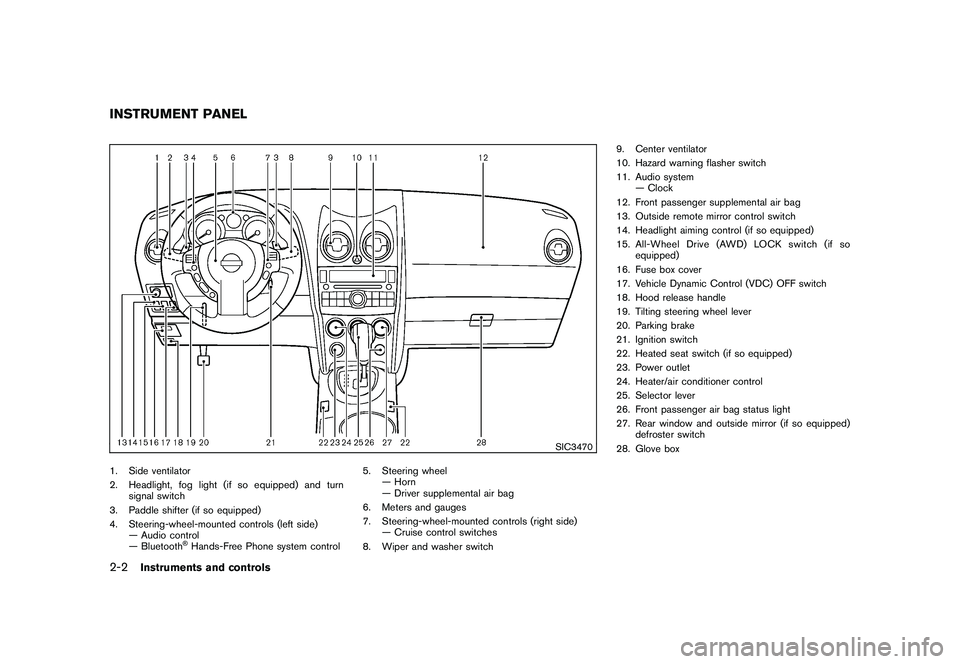
1. Side ventilator
2. Headlight, fog light (if so equipped) and turnsignal switch
3. Paddle shifter (if so equipped)
4. Steering-wheel-mounted controls (left side) — Audio control
— Bluetooth
®Hands-Free Phone system control 5. Steering wheel
— Horn
— Driver supplemental air bag
6. Meters and gauges
7. Steering-wheel-mounted controls (right side) — Cruise control switches
8. Wiper and washer switch 9. Center ventilator
10. Hazard warning flasher switch
11. Audio system
— Clock
12. Front passenger supplemental air bag
13. Outside remote mirror control switch
14. Headlight aiming control (if so equipped)
15. All-Wheel Drive (AWD) LOCK switch (if so equipped)
16. Fuse box cover
17. Vehicle Dynamic Control (VDC) OFF switch
18. Hood release handle
19. Tilting steering wheel lever
20. Parking brake
21. Ignition switch
22. Heated seat switch (if so equipped)
23. Power outlet
24. Heater/air conditioner control
25. Selector lever
26. Front passenger air bag status light
27. Rear window and outside mirror (if so equipped) defroster switch
28. Glove box
INSTRUMENT PANEL2-2
Instruments and controls
Page 83 of 328
Black plate (79,1)
Model "S35-D" EDITED: 2009/ 9/ 4
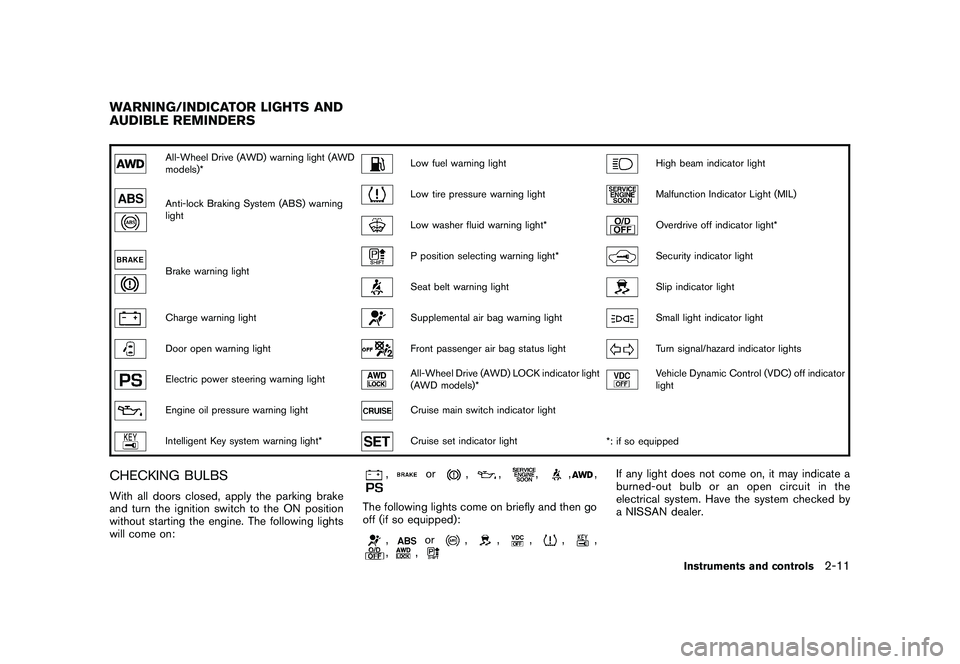
All-Wheel Drive (AWD) warning light (AWD
models)*
Low fuel warning light
High beam indicator light
Anti-lock Braking System (ABS) warning
light
Low tire pressure warning light
Malfunction Indicator Light (MIL)
Low washer fluid warning light*
Overdrive off indicator light*
Brake warning light
P position selecting warning light*
Security indicator light
Seat belt warning light
Slip indicator light
Charge warning light
Supplemental air bag warning light
Small light indicator light
Door open warning light
Front passenger air bag status light
Turn signal/hazard indicator lights
Electric power steering warning light
All-Wheel Drive (AWD) LOCK indicator light
(AWD models)*
Vehicle Dynamic Control (VDC) off indicator
light
Engine oil pressure warning light
Cruise main switch indicator light
Intelligent Key system warning light*
Cruise set indicator light*: if so equipped
CHECKING BULBSWith all doors closed, apply the parking brake
and turn the ignition switch to the ON position
without starting the engine. The following lights
will come on:
,
or
,
,
,
,
,
The following lights come on briefly and then go
off (if so equipped):
,
or
,
,
,
,
,
,
,
If any light does not come on, it may indicate a
burned-out bulb or an open circuit in the
electrical system. Have the system checked by
a NISSAN dealer.
WARNING/INDICATOR LIGHTS AND
AUDIBLE REMINDERS
Instruments and controls
2-11
Page 88 of 328
Black plate (84,1)
Model "S35-D" EDITED: 2009/ 9/ 4
not activate the warning light for the front
passenger.
See “SEAT BELTS” in the “1. Safety — Seats,
seat belts and supplemental restraint system”
section for precautions on seat belt usage.
Supplemental air bag warning light
After turning the ignition switch to the ON
position, the supplemental air bag warning light
will illuminate. The supplemental air bag warning
light will turn off after about 7 seconds if the
supplemental front air bag and supplemental
side air bag, curtain side-impact air bag systems
and/or pretensioner seat belt are operational.
If any of the following conditions occur, the front
air bag, side air bag, curtain and rollover air bag
and pretensioner systems need servicing and
your vehicle must be taken to your nearest
NISSAN dealer.
.The supplemental air bag warning light
remains on after approximately 7 seconds.
. The supplemental air bag warning light
flashes intermittently.
. The supplemental air bag warning light does
not illuminate at all.
Unless checked and repaired, the Supplemental
Restraint Systems and/or the pretensioners may not function properly.
For additional information, see “SUPPLEMEN-
TAL RESTRAINT SYSTEM” in the “1. Safety —
Seats, seat belts and supplemental restraint
system” section.
WARNING
If the supplemental air bag warning
light is on, it could mean that the front
air bag, side air bag, curtain and roll-
over air bag and/or pretensioner sys-
tems will not operate in an accident. To
help avoid injury to yourself or others,
have your vehicle checked by a NISSAN
dealer as soon as possible.INDICATOR LIGHTS
All-Wheel Drive (AWD) LOCK
indicator light (AWD models)
This light illuminates when the ignition switch is
turned to the ON position, and turns off within 1
second.
When selecting the LOCK mode while the
engine is running, this light will illuminate. (See
“ALL-WHEEL DRIVE (AWD)” in the “5. Starting
and driving” section.)
Cruise main switch indicator light
This light illuminates when the cruise control
main switch is pushed. The light turns off when
the main switch is pushed again. When the
cruise main switch indicator light illuminates, the
cruise control system is operational. (See
“CRUISE CONTROL” in the “5. Starting and
driving” section.)
Cruise set indicator light
This light illuminates while the vehicle speed is
controlled by the cruise control system. If the
light blinks while the engine is running, it may
indicate the cruise control system is not
functioning properly. Have the system checked
by a NISSAN dealer. (See “CRUISE CON-
TROL” in the “5. Starting and driving” section.)
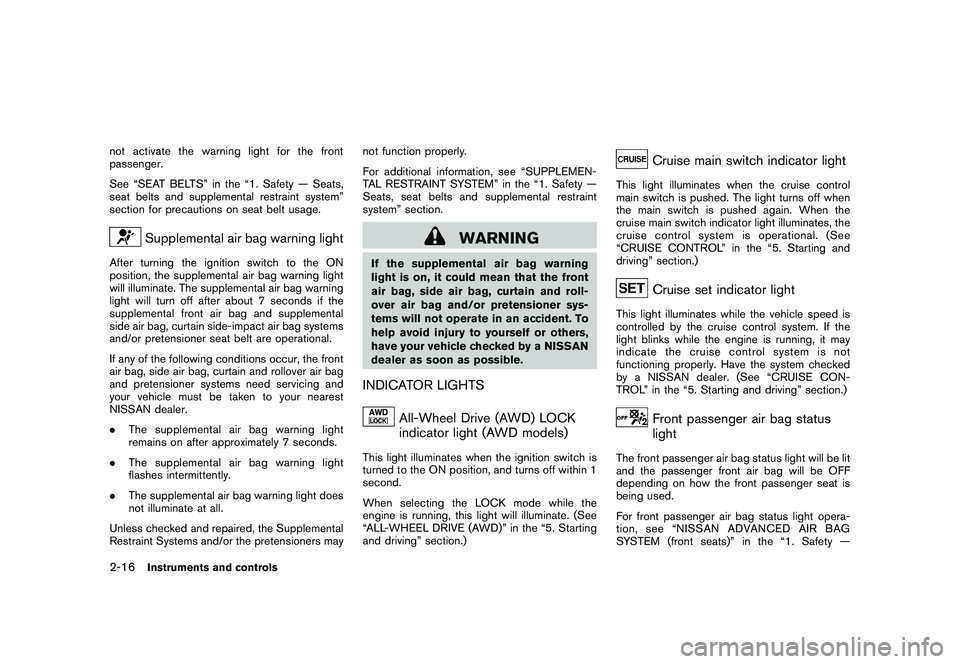
Front passenger air bag status
light
The front passenger air bag status light will be lit
and the passenger front air bag will be OFF
depending on how the front passenger seat is
being used.
For front passenger air bag status light opera-
tion,see“NISSANADVANCEDAIRBAG
SYSTEM (front seats)” in the “1. Safety —
2-16
Instruments and controls
Page 193 of 328
Black plate (16,1)
5 Starting and driving
Model "S35-D" EDITED: 2009/ 9/ 4
Precautions when starting and driving..................... 5-2
Exhaust gas (carbon monoxide) ......................... 5-2
Three-way catalyst .......................................... 5-2
Tire Pressure Monitoring System (TPMS) ............. 5-3
Avoiding collision and rollover ........................... 5-5
On-pavement and off-road driving precautions ...... 5-5
Off-road recovery ........................................... 5-6
Rapid air pressure loss .................................... 5-6
Drinking alcohol/drugs and driving ...................... 5-7
Driving safety precautions ................................ 5-7
Ignition switch ................................................... 5-9
Intelligent Key system (if so equipped) ................ 5-9
Continuously Variable Transmission (CVT) .......... 5-11
Key positions .............................................. 5-11
Before starting the engine .................................. 5-12
Starting the engine ........................................... 5-12
Driving the vehicle ............................................ 5-13
Continuously Variable Transmission (CVT) .......... 5-13
Parking brake .................................................. 5-18
Cruise control ................................................. 5-19
Precautions on cruise control .......................... 5-19
Cruise control operations ............................... 5-19 Break-in schedule
............................................ 5-21
Increasing fuel economy .................................... 5-21
All-Wheel Drive (AWD) (if so equipped) ................ 5-22
All-Wheel Drive (AWD) lock switch operations .... 5-22
AWD warning light ....................................... 5-23
Parking/parking on hills ...................................... 5-25
Electric power steering system ............................ 5-26
Brake system .................................................. 5-26
Braking precautions ...................................... 5-26
Parking brake break-in ................................... 5-27
Anti-lock Braking System (ABS) ...................... 5-27
Vehicle Dynamic Control (VDC) system ................. 5-28
Cold weather driving ......................................... 5-30
Freeing a frozen door lock .............................. 5-30
Anti-freeze .................................................. 5-30
Battery ...................................................... 5-30
Draining of coolant water ............................... 5-30
Tire equipment ............................................ 5-30
Special winter equipment ............................... 5-30
Driving on snow or ice .................................. 5-30
Engine block heater (if so equipped) ................. 5-31
Page 211 of 328
Black plate (211,1)
Model "S35-D" EDITED: 2009/ 9/ 4
PRECAUTIONS ON CRUISE CON-
TROL.If the cruise control system malfunctions, it
will cancel automatically. The SET indicator
light on the meter panel will then blink to
warn the driver.
. If the engine coolant temperature becomes
excessively high, the cruise control system
will cancel automatically.
. If the SET indicator light blinks, turn the
cruise control main switch off and have the
system checked by a NISSAN dealer.
. The SET indicator light may blink when the
cruise control main switch is turned ON
while pushing the RESUME/ACCELERATE,
SET/COAST or CANCEL switch. To prop-
erly set the cruise control system, perform
the following procedures.
WARNING
Do not use the cruise control when
driving under the following conditions:
.when it is not possible to keep the
vehicle at a set speed
. in heavy traffic or in traffic that
varies in speed
. on winding or hilly roads .
on slippery roads (rain, snow, ice,
etc.)
. in very windy areas
Doing so could cause a loss of vehicle
control and result in an accident.
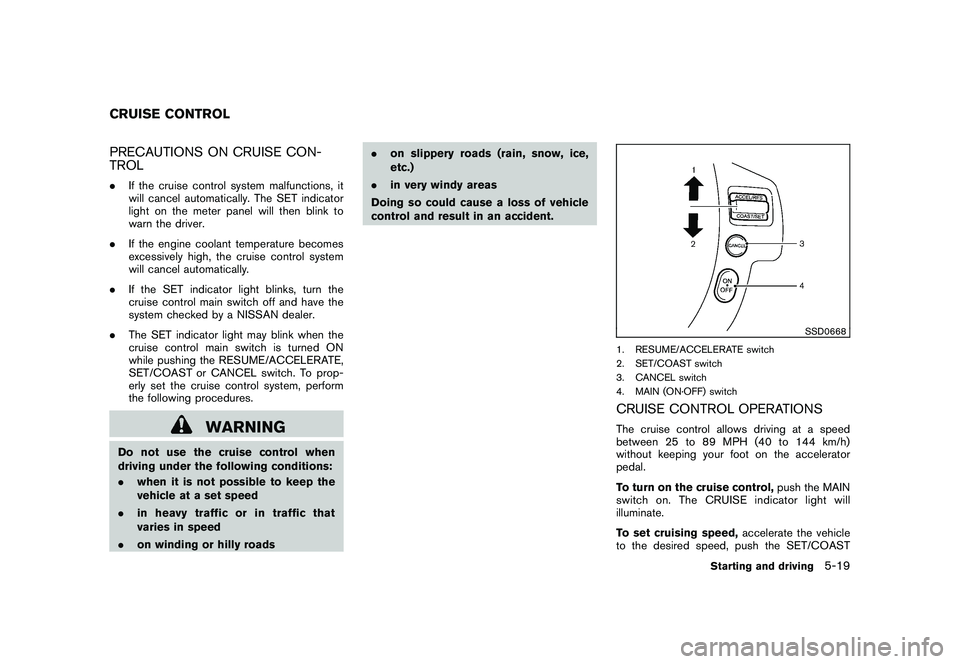
SSD0668
1. RESUME/ACCELERATE switch
2. SET/COAST switch
3. CANCEL switch
4. MAIN (ON·OFF) switchCRUISE CONTROL OPERATIONSThe cruise control allows driving at a speed
between 25 to 89 MPH (40 to 144 km/h)
without keeping your foot on the accelerator
pedal.
To turn on the cruise control, push the MAIN
switch on. The CRUISE indicator light will
illuminate.
To set cruising speed, accelerate the vehicle
to the desired speed, push the SET/COAST
CRUISE CONTROL
Starting and driving
5-19
Page 212 of 328
Black plate (212,1)
Model "S35-D" EDITED: 2009/ 9/ 4
switch and release it. (The SET indicator light in
the instrument panel will illuminate.) Take your
foot off the accelerator pedal. Your vehicle will
maintain the set speed.
.To pass another vehicle, depress the
accelerator pedal. When you release the
pedal, the vehicle will return to the previously
set speed.
. The vehicle may not maintain the set speed
on winding or hilly roads. If this happens,
drive without the cruise control.
To cancel the preset speed, use one of the
following methods:
a) Push the CANCEL switch. The SET indica-
tor light will turn off.
b) Tap the brake pedal. The SET indicator light will turn off.
c) Turn the MAIN switch off. Both the CRUISE and SET indicator lights will turn off.
. If you depress the brake pedal while pushing
the RESUME/ACCELERATE or SET/
COAST switch and reset at the cruising
speed, the cruise control will disengage.
Turn the MAIN switch off once and then turn
it on again.
. The cruise control will automatically cancel if
the vehicle slows more than 8 MPH (12 km/h) below the set speed.
. If you move the selector lever to the N
(Neutral) position, the cruise control will be
canceled.
To reset at a faster cruising speed, use one
of the following methods:
. Depress the accelerator pedal. When the
vehicle attains the desired speed, push and
release the SET/COAST switch.
. Push and hold the RESUME/ACCELERATE
switch. When the vehicle attains the desired
speed, release the switch.
. Push, then quickly release the RESUME/
ACCELERATE switch. Each time you do
this, the set speed will increase by about 1
MPH (1.6 km/h) .
To reset at a slower cruising speed, use one
of the following methods:
. Lightly tap the brake pedal. When the
vehicle attains the desired speed, push the
SET/COAST switch and release it.
. Push and hold the SET/COAST switch.
Release the switch when the vehicle slows
down to the desired speed.
. Push, then quickly release the SET/COAST
switch. Each time you do this, the set speed
will decrease by about 1 MPH (1.6 km/h) . To resume the preset speed,
push and
release the RESUME/ACCELERATE switch.
The vehicle will resume the last set cruising
speed when the vehicle speed is over 25 MPH
(40 km/h) .5-20
Starting and driving
Page 223 of 328
Black plate (223,1)
Model "S35-D" EDITED: 2009/ 9/ 4
will lose even more traction.
. Allow more stopping distance under
these conditions. Braking should be
started sooner than on dry pave-
ment.
. Allow greater following distances
on slippery roads.
. Watch for slippery spots (glare ice) .
These may appear on an otherwise
clear road in shaded areas. If a
patch of ice is seen ahead, brake
before reaching it. Try not to brake
while on the ice, and avoid any
sudden steering maneuvers.
. Do not use cruise control on slip-
pery roads.
. Snow can trap dangerous exhaust
gases under your vehicle. Keep
snow clear of the exhaust pipe and
from around your vehicle.
ENGINE BLOCK HEATER (if so
equipped)Engine block heaters are used to assist in cold
temperature starting.
The engine block heater should be used when
the outside temperature is 20 8F( 7 8C) or lower.
To use the engine block heater1. Turn the engine off.
2. Open the hood and unwrap the engine
block heater cord.
3. Plug the engine block heater cord into a grounded 3-wire, 3-pronged extension cord.
4. Plug the extension cord into a Ground Fault Interrupt (GFI) protected, grounded 110-
volt AC (VAC) outlet.
5. The engine block heater must be plugged in for at least 2 - 4 hours, depending on
outside temperatures, to properly warm the
engine coolant. Use an appropriate timer to
turn the engine block heater on.
6. Before starting the engine, unplug and properly store the cord to keep it away from
moving parts.
WARNING
.Do not use your engine block heater
with an ungrounded electrical sys-
tem or a 2-pronged adapter. You can
be seriously injured by an electrical
shock if you use an ungrounded
connection.
. Disconnect and properly store the
engine block heater cord before starting the engine. Damage to the
cord could result in an electrical
shock and can cause serious injury.
. Use a heavy-duty 3-wire, 3-pronged
extension cord rated for at least
10A. Plug the extension cord into a
Ground Fault Interrupt (GFI) pro-
tected, grounded 110-VAC outlet.
Failure to use the proper extension
cord or a grounded outlet can result
in a fire or electrical shock and
cause serious personal injury.
Starting and driving
5-31
Page 315 of 328
Black plate (317,1)
Model "S35-D" EDITED: 2009/ 9/ 4
.Be careful when passing other vehicles.
Passing while towing a trailer requires
considerably more distance than normal
passing. Remember the length of the trailer
must also pass the other vehicle before you
can safely change lanes.
. Down shift the transmission to a lower gear
for engine braking when driving down steep
or long hills. This will help slow the vehicle
without applying the brakes.
. Avoid holding the brake pedal down too
long or too frequently. This could cause the
brakes to overheat, resulting in reduced
braking efficiency.
. Increase your following distance to allow for
greater stopping distances while towing a
trailer. Anticipate stops and brake gradually.
. Do not use cruise control while towing a
trailer.
. Some states or provinces have specific
regulations and speed limits for vehicles
that are towing trailers. Obey the local
speed limits.
. Check your hitch, trailer wiring harness
connections, and trailer wheel lug nuts after
50 miles (80 km) of travel and at every
break.
. When stopped in traffic for long periods of time in hot weather, put the vehicle in the P
(Park) position.
. When launching a boat, don’t allow the
water level to go over the exhaust tail pipe or
rear bumper.
. Make sure you disconnect the trailer lights
before backing the trailer into the water or
the trailer lights may burn out.
When towing a trailer, the transmission
fluid should be changed more frequently.
For additional information, see the “8.
Maintenance and do-it-yourself” section
earlier in this manual.
FLAT TOWINGTowing your vehicle with all four wheels on the
ground is sometimes called flat towing. This
method is sometimes used when towing a
vehicle behind a recreational vehicle, such as a
motor home.
CAUTION
. Failure to follow these guidelines
can result in severe transmission
damage.
. Whenever flat towing your vehicle,
always tow forward, never back-
ward. .
DO NOT tow any continuously vari-
able transmission vehicle with all
four wheels on the ground (flat
towing) . Doing so WILL DAMAGE
internal transmission parts due to
lack of transmission lubrication.
. DO NOT tow an All-Wheel Drive
(AWD) vehicle with any of the
wheels on the ground. Doing so
may cause serious and expensive
damage to the powertrain.
. For emergency towing procedures
refer to “TOWING RECOMMENDED
BY NISSAN (except for Kro ¯
m mod-
els)” in the “6. In case of emer-
gency” section of this manual.
Continuously Variable Transmission
(CVT)All-Wheel Drive (AWD) models:
Do not tow an AWD vehicle with any of the
wheels on the ground.
Two-Wheel Drive (2WD) models:
To tow a vehicle equipped with a Continuously
Variable Transmission (CVT) , an appropriate
vehicle dolly MUSTbe placed under the towed
vehicle’s driving wheels. Alwaysfollow the dollyTechnical and consumer information
9-25
Page 322 of 328
Black plate (2,1)
10-2Continuously Variable Transmission (CVT)
fluid................................................. 8-11
Controls, Steering wheel audio controls ......... 4-23
Coolant Capacities and recommended fuel/
lubricants ......................................... 9-2
Changing engine coolant ........................ 8-8
Checking engine coolant level .................. 8-8
Corrosion protection ................................. 7-6
Cover, Cargo cover ................................ 2-37
Cruise control ...................................... 5-19
Cup holders ........................................ 2-33
CVT, Driving with CVT
(Continuously Variable Transmission) ...... 5-11, 5-13
D
Daytime running light system ..................... 2-27
Defroster switch, Rear window and outside
mirror defroster switch ............................ 2-24
Dimensions and weights ............................ 9-8
Door open warning light ........................... 2-13
Drive belts .......................................... 8-14
Driving All-wheel drive (AWD) ......................... 5-22
Cold weather driving .......................... 5-30
Driving with CVT (Continuously Variable
Transmission) ............................ 5-11, 5-13
On-pavement and off-road driving ............. 5-5
Precautions when starting and driving ......... 5-2
Safety precautions ............................... 5-7
E
Economy, Fuel ..................................... 5-21
Elapsed time ......................................... 2-8 Electric power steering system
................... 5-26
Electric power steering warning light ............ 2-13
Emission control information label ................ 9-10
Emission control system warranty ................ 9-27
Engine Before starting the engine .................... 5-12
Break-in schedule .............................. 5-21
Capacities and recommended fuel/
lubricants ......................................... 9-2
Changing engine coolant ........................ 8-8
Changing engine oil and filter ................... 8-9
Checking engine coolant level .................. 8-8
Checking engine oil level ........................ 8-8
Coolant temperature gauge ..................... 2-5
Engine block heater ........................... 5-31
Engine compartment check locations .......... 8-6
Engine cooling system .......................... 8-7
Engine oil ......................................... 8-8
Engine oil and oil filter recommendation ....... 9-5
Engine oil viscosity .............................. 9-5
Engine serial number ............................ 9-9
Engine specifications ............................ 9-7
If your vehicle overheats ....................... 6-11
Starting the engine ............................ 5-12
Event Data Recorders (EDR) ..................... 9-29
Exhaust gas (carbon monoxide) .................... 5-2
F
F.M.V.S.S./C.M.V.S.S. certification label. ........... 9-9
Filter Air cleaner housing filter ...................... 8-16
Changing engine oil and filter ................... 8-9
Flashers (See hazard warning flasher switch) . . . 2-29
Flat tire ................................................ 6-2 Flat towing
.......................................... 9-25
Floor mat cleaning ................................... 7-5
Fluid Brake fluid ...................................... 8-11
Capacities and recommended fuel/
lubricants ......................................... 9-2
Continuously Variable Transmission (CVT)
fluid ............................................. 8-11
Engine coolant ................................... 8-7
Engine oil ......................................... 8-8
Window washer fluid .......................... 8-12
FM-AM radio with Compact Disc (CD)
player ............................................... 4-13
FM-AM-SAT radio with Compact Disc (CD)
changer ............................................. 4-17
Fog light switch .................................... 2-29
Front manual seat adjustment. ...................... 1-3
Front passenger air bag and status light ........ 1-47
Front power seat adjustment ....................... 1-4
Front seat, Front seat adjustment .................. 1-3
Front-seat active head restraints ................. 1-10
Fuel Capacities and recommended fuel/
lubricants ......................................... 9-2
Distance to empty ............................... 2-7
Fuel economy .................................. 5-21
Fuel octane rating ................................ 9-3
Fuel recommendation ............................ 9-3
Fuel-filler cap ................................... 3-25
Fuel-filler door .................................. 3-25
Gauge ............................................ 2-6
Fuses ............................................... 8-19
Fusible links ........................................ 8-19
Model "S35-D" EDITED: 2009/ 9/ 4