belt NISSAN ROGUE 2021 Owner´s Manual
[x] Cancel search | Manufacturer: NISSAN, Model Year: 2021, Model line: ROGUE, Model: NISSAN ROGUE 2021Pages: 556, PDF Size: 2.7 MB
Page 467 of 556
WAI0223X
CAUTION
.Do not ground accessories di-
rectly to the battery terminal.
Doing so will bypass the variable
voltage control system and the
vehicle battery may not charge
completely.
. Use electrical accessories with
the engine running to avoid dis-
charging the vehicle battery.
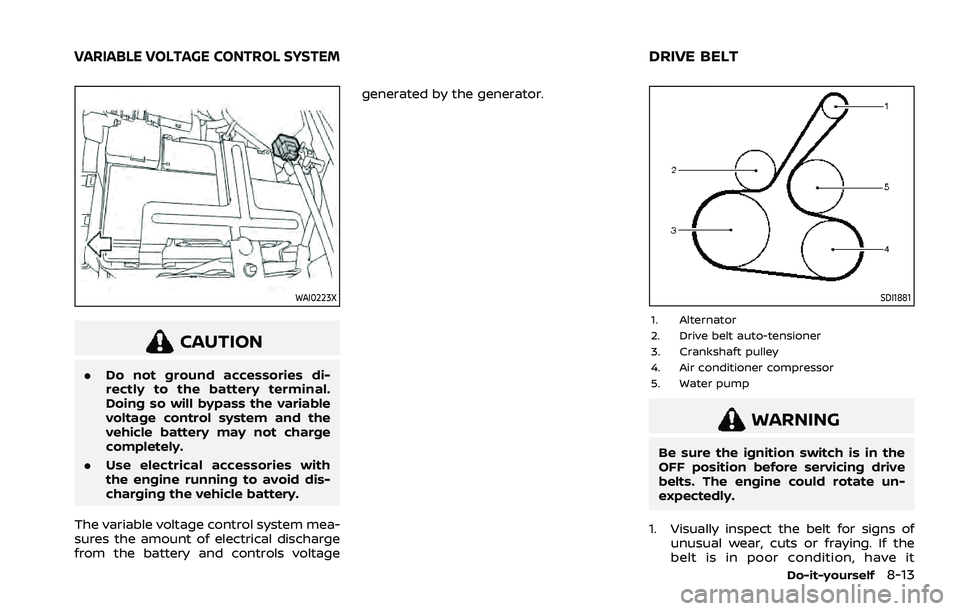
The variable voltage control system mea-
sures the amount of electrical discharge
from the battery and controls voltage generated by the generator.
SDI1881
1. Alternator
2. Drive belt auto-tensioner
3. Crankshaft pulley
4. Air conditioner compressor
5. Water pump
WARNING
Be sure the ignition switch is in the
OFF position before servicing drive
belts. The engine could rotate un-
expectedly.
1. Visually inspect the belt for signs of unusual wear, cuts or fraying. If the
belt is in poor condition, have it
Do-it-yourself8-13
VARIABLE VOLTAGE CONTROL SYSTEMDRIVE BELT
Page 468 of 556
8-14Do-it-yourself
replaced. It is recommended that you
visit a NISSAN dealer for this service.
2. Have the belt condition checked reg- ularly.
WARNING
Be sure the engine and ignition
switch are off and that the parking
brake is applied.
CAUTION
Be sure to use the correct socket to
remove the spark plugs. An incorrect
socket can damage the spark plugs.
SDI2670
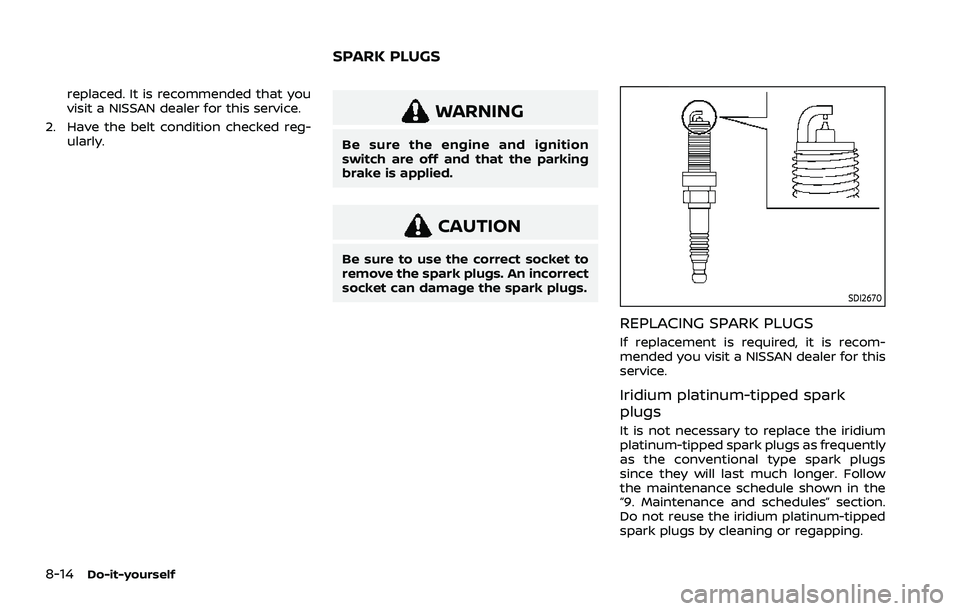
REPLACING SPARK PLUGS
If replacement is required, it is recom-
mended you visit a NISSAN dealer for this
service.
Iridium platinum-tipped spark
plugs
It is not necessary to replace the iridium
platinum-tipped spark plugs as frequently
as the conventional type spark plugs
since they will last much longer. Follow
the maintenance schedule shown in the
“9. Maintenance and schedules” section.
Do not reuse the iridium platinum-tipped
spark plugs by cleaning or regapping.
SPARK PLUGS
Page 489 of 556
Warranty Information Book-
let.
Replacing wheels and tires
When replacing a tire, use the same size,
tread design, speed rating and load
carrying capacity as originally equipped.
(See “Specifications” (P.10-8) for recom-
mended types and sizes of tires and
wheels.)
WARNING
. The use of tires other than those
recommended or the mixed use
of tires of different brands, con-
struction (bias, bias-belted or ra-
dial), or tread patterns can
adversely affect the ride, braking,
handling, VDC system, ground
clearance, body-to-tire clearance,
tire chain clearance, speed-
ometer calibration, headlight
aim and bumper height. Some of
these effects may lead to acci-
dents and could result in serious
personal injury.
. For Two-Wheel Drive (2WD) mod-
els, if your vehicle was originally
equipped with 4 tires that were the same size and you are only
replacing 2 of the 4 tires, install
the new tires on the rear axle.
Placing new tires on the front
axle may cause loss of vehicle
control in some driving condi-
tions and cause an accident and
personal injury.
. If the wheels are changed for any
reason, always replace with
wheels which have the same off-
set dimension. Wheels of a differ-
ent off-set could cause prema-
ture tire wear, degrade vehicle
handling characteristics and/or
interference with the brake
discs/drums. Such interference
can lead to decreased braking
efficiency and/or early brake
pad/shoe wear. See “Wheels and
tires” (P.10-8) of this manual for
wheel off-set dimensions.
. Since the spare tire is not
equipped with the TPMS, when a
spare tire is mounted or a wheel
is replaced, the TPMS will not
function and the low tire pressure
warning light will flash for ap-
proximately 1 minute. The light
will remain on after 1 minute.
Have your tires replaced and/or
TPMS system reset as soon as possible. It is recommended you
visit a NISSAN dealer for these
services.
. Replacing tires with those not
originally specified by NISSAN
could affect the proper operation
of the TPMS.
. The TPMS sensor may be da-
maged if it is not handled cor-
rectly. Be careful when handling
the TPMS sensor.
. When replacing the TPMS sensor,
the ID registration may be re-
quired. It is recommended you
visit a NISSAN dealer for ID regis-
tration.
. Do not use a valve stem cap that
is not specified by NISSAN. The
valve stem cap may become
stuck.
. Be sure that the valve stem caps
are correctly fitted. Otherwise the
valve may be clogged up with dirt
and cause a malfunction or loss
of pressure.
. Do not install a damaged or
deformed wheel or tire even if it
has been repaired. Such wheels
or tires could have structural
damage and could fail without
warning.
Do-it-yourself8-35
Page 490 of 556
8-36Do-it-yourself
.The use of retread tire is not
recommended.
. For additional information re-
garding tires, refer to “Important
Tire Safety Information” (US) or
“Tire Safety Information” (Cana-
da) in the Warranty Information
Booklet.
All-Wheel Drive (AWD) models
CAUTION
.Always use tires of the same size,
brand, construction (bias, bias-
belted or radial), and tread pat-
tern on all four wheels. Failure to
do so may result in a circumfer-
ence difference between tires on
the front and rear axles which will
cause excessive tire wear and
may damage the transmission
and the drivetrain parts.
. Only use spare tires specified for
each AWD model.
If excessive tire wear is found, it is
recommended that all four tires be re-
placed with tires of the same size, brand,
construction and tread pattern. The tire pressure and wheel alignment should
also be checked and corrected as neces-
sary. It is recommended you visit a
NISSAN dealer for this service.
Wheel balance
Unbalanced wheels may affect vehicle
handling and tire life. Even with regular
use, wheels can get out of balance.
Therefore, they should be balanced as
required.
Wheel balance service should be per-
formed with the wheels off the vehicle.
Spin balancing the wheels on the vehi-
cle could lead to mechanical damage.
For additional information regarding tires,
refer to “Important Tire Safety Informa-
tion” (US) or “Tire Safety Information”
(Canada) in the Warranty Information
Booklet.
Care of wheels
See “Cleaning exterior” (P.7-2) for details
about care of the wheels.
Spare tire
Since the spare tire is not equipped with
the TPMS, when a spare tire is mounted
(TEMPORARY USE ONLY), the TPMS will
not function.
Observe the following precautions if the
TEMPORARY USE ONLY spare tire must beused, otherwise your vehicle could be
damaged or involved in an accident.
WARNING
.
The TEMPORARY USE ONLY spare
tire should be used for emer-
gency use. It should be replaced
with the standard tire at the first
opportunity to avoid possible tire
or differential damage.
. Drive carefully while the TEMPOR-
ARY USE ONLY spare tire is in-
stalled. Avoid sharp turns and
abrupt braking while driving.
. Periodically check spare tire in-
flation pressure. Always keep the
pressure of the TEMPORARY USE
ONLY spare tire at 60 psi (420
kPa, 4.2 bar).
. With the TEMPORARY USE ONLY
spare tire installed, do not drive
your vehicle at speeds faster than
50 MPH (80 km/h).
. When driving on roads covered
with snow or ice, the TEMPORARY
USE ONLY spare tire should be
used on the rear wheels and
original tire used on the front
wheels (drive wheels). Use tire
chains only on the front (original)
Page 495 of 556
other corrosive materials, check lubrica-
tion frequently.
Lights*:Clean the headlights on a regular
basis. Make sure that the headlights, stop
lights, tail lights, turn signal lights, and
other lights are all operating properly and
installed securely. Also check headlight
aim.
Road wheel nuts (lug nuts)*: When
checking the tires, make sure no wheel
nuts are missing, and check for any loose
wheel nuts. Tighten if necessary.
Tire rotation*: Rotate tires at the speci-
fied interval shown in the maintenance
schedule.
Tires*: Check the pressure with a gauge
often and always prior to long distance
trips. If necessary, adjust the pressure in
all tires, including the spare (if so
equipped), to the pressure specified.
Check carefully for damage, cuts or
excessive wear.
Tire Pressure Monitoring System (TPMS)
transmitter components: Replace the
TPMS transmitter snap-in type, valve core
and cap when the tires are replaced due
to wear or age.
Wheel alignment and balance: If the
vehicle should pull to either side while
driving on a straight and level road, or if
you detect uneven or abnormal tire wear, there may be a need for wheel alignment.
If the steering wheel or seat vibrates at
normal highway speeds, wheel balancing
may be needed.
For additional information regarding tires,
refer to “Important Tire Safety Informa-
tion” (US) or “Tire Safety Information”
(Canada) in the NISSAN Warranty Infor-
mation Booklet.
Windshield:
Clean the windshield on a
regular basis. Check the windshield at
least every six months for cracks or other
damage. Have a damaged windshield
repaired by a qualified repair facility.
It is recommended that you have a
damaged windshield repaired by a
NISSAN dealer, or a NISSAN Certified
Collision Center. To locate a collision
center in your area, refer to http://colli-
sion.nissanusa.com.
Windshield wiper blades*: Check for
cracks or wear if they do not wipe
properly.
Inside the vehicle
The maintenance items listed here should
be checked on a regular basis, such as
when performing scheduled mainte-
nance, cleaning the vehicle, etc.
Accelerator pedal: Check the pedal for
smooth operation and make sure the pedal does not catch or require uneven
effort. Keep the floor mat away from the
pedal.
Brake pedal:
Check the pedal for smooth
operation. If the brake pedal suddenly
goes down further than normal, the pedal
feels spongy or the vehicle seems to take
longer to stop, have your vehicle checked
immediately. It is recommended you visit
a NISSAN dealer for this service. Keep the
floor mat away from the pedal.
Brakes: Check that the brakes do not pull
the vehicle to one side when applied.
Continuously Variable Transmission
(CVT) P (Park) mechanism: On a fairly
steep hill, check that the vehicle is held
securely with the shift lever in the P (Park)
position without applying any brakes.
Parking brake: Check the parking brake
operation regularly. The vehicle should be
securely held on a fairly steep hill with
only the parking brake applied. If the
parking brake needs adjusted, it is re-
commended you visit a NISSAN dealer for
this service.
Seat belts: Check that all parts of the seat
belt system (for example, buckles, an-
chors, adjusters and retractors) operate
properly and smoothly, and are installed
securely. Check the belt webbing for cuts,
fraying, wear or damage.
Maintenance and schedules9-3
Page 496 of 556
9-4Maintenance and schedules
Seats:Check seat position controls such
as seat adjusters, seatback recliners, etc.
to ensure they operate smoothly and that
all latches lock securely in every position.
Check that the head restraints/headrests
move up and down smoothly and that
the locks (if so equipped) hold securely in
all latched positions.
Steering wheel: Check for changes in the
steering conditions, such as excessive
free play, hard steering or strange noises.
Warning lights and chimes: Make sure
that all warning lights and chimes are
operating properly.
Windshield defroster: Check that the air
comes out of the defroster outlets prop-
erly and in sufficient quantity when oper-
ating the heater or air conditioner.
Windshield wiper and washer*: Check
that the wipers and washers operate
properly and that the wipers do not
streak.
Under the hood and vehicle
The maintenance items listed here should
be checked periodically (for example,
each time you check the engine oil or
refuel).
Battery*: This vehicle is equipped with a
sealed maintenance free battery. It is
recommended that you visit a NISSAN dealer for service.
NOTE:
Care should be taken to avoid situations
that can lead to potential battery dis-
charge and potential no-start condi-
tions such as:
1.
Installation or extended use of elec-
tronic accessories that consume
battery power when the engine is
not running (Phone chargers, GPS,
DVD players, etc.)
2. Vehicle is not driven regularly and/
or only driven short distances.
In these cases, the battery may need to
be charged to maintain battery health.
Brake fluid level*: Make sure that the
brake fluid level is between the MAX and
MIN lines on the reservoir.
Engine coolant level*: Check the coolant
level when the engine is cold.
Engine drive belt*: Make sure that the
drive belt is not frayed, worn, cracked or
oily.
Engine oil level*: Check the level after
parking the vehicle on a level surface and
turning off the engine. Wait more than 10
minutes for the oil to drain back into the
oil pan.
Exhaust system: Make sure there are no
loose supports, cracks or holes. If the sound of the exhaust seems unusual or
there is a smell of exhaust fumes, im-
mediately have the exhaust system in-
spected. It is recommended you visit a
NISSAN dealer for this service. (See “Pre-
cautions when starting and driving” (P.5-
5) for exhaust gas (carbon monoxide).)
Fluid leaks:
Check under the vehicle for
fuel, oil, water or other fluid leaks after the
vehicle has been parked for a while. Water
dripping from the air conditioner after use
is normal. If you should notice any leaks
or if gasoline fumes are evident, check for
the cause and have it corrected immedi-
ately.
Radiator and hoses: Check the front of
the radiator and clean off any dirt, insects,
leaves, etc., that may have accumulated.
Make sure the hoses have no cracks,
deformation, rot or loose connections.
Underbody: The underbody is frequently
exposed to corrosive substances such as
those used on icy roads or to control
dust. It is very important to remove these
substances, otherwise rust will form on
the floor pan, frame, fuel lines and around
the exhaust system. At the end of winter,
the underbody should be thoroughly
flushed with plain water, being careful to
clean those areas where mud and dirt
may accumulate. For additional informa-
tion, see “Cleaning exterior” (P.7-2).
Page 497 of 556
Windshield washer fluid*:Check that
there is adequate fluid in the reservoir.The following descriptions are provided
to give you a better understanding of the
scheduled maintenance items that
should be regularly checked or replaced.
The maintenance schedule indicates at
which mileage/time intervals each item
requires service.
In addition to scheduled maintenance,
your vehicle requires that some items be
checked during normal day-to-day op-
eration. Refer to “General maintenance”
(P.9-2).
Items marked with “*” are recommended
by NISSAN for reliable vehicle operation.
You are not required to perform main-
tenance on these items in order to
maintain the warranties which come with
your vehicle. Other maintenance items
and intervals are required.
When applicable, additional information
can be found in the “8. Do-it-yourself”
section of this manual.
NOTE:
NISSAN does not advocate the use of
non-OEM approved aftermarket flush-
ing systems and strongly advises
against performing these services on a
NISSAN product. Many of the aftermar-
ket flushing systems use non-OEM ap-
proved chemicals or solvents, the use of
which has not been validated by
NISSAN. For recommended fuel, lubricants,
fluids, grease, and refrigerant, refer to
“Capacities and recommended fluids/
lubricants” (P.10-3) of this manual.
EMISSION CONTROL SYSTEM MAIN-
TENANCE
Drive belt*:
Check engine drive belt for wear, fraying
or cracking and for proper tension. Re-
place any damaged drive belt.
Engine air filter:
Replace at specified intervals. When driv-
ing for prolonged periods in dusty condi-
tions, check/replace the filter more
frequently.
Engine coolant*:
Replace coolant at the specified interval.
When adding or replacing coolant, be
sure to use only Genuine NISSAN Long
Life Antifreeze/Coolant (blue) or equiva-
lent with the proper mixture. (Refer to
“Engine cooling system” (P.8-4) to deter-
mine the proper mixture for your area.)
NOTE:
Mixing any other type of coolant or the
use of non-distilled water may reduce
the recommended service interval of
the coolant.
Maintenance and schedules9-5
EXPLANATION OF SCHEDULED
MAINTENANCE ITEMS
Page 503 of 556
35,000 Miles/42 Months/56,000
Km
Standard maintenance:.Perform tire rotation
Severe maintenance:
.Inspect brake pads and rotors.Inspect exhaust system.Inspect steering gear and linkage.Inspect axle and suspension parts.Inspect propeller shaft (AWD models).Inspect drive shaft boots
40,000 Miles/48 Months/64,000
Km
Standard maintenance:.Inspect brake lines and cables.Inspect brake pads and rotors.Inspect CVT fluid.Inspect engine drive belts.Inspect fuel tank vapor vent system.Inspect fuel lines/connections.Inspect exhaust system.Inspect steering gear and linkage.Inspect axle and suspension part.Inspect propeller shaft (AWD models).Inspect differential gear oil (AWD models).Inspect AWD coupling oil (AWD models).Inspect transfer case oil (AWD models).Inspect drive shaft boots.Replace brake fluid.Replace engine oil and filter (1).Perform tire rotation Severe maintenance:
.Inspect brake pads and rotors.Inspect exhaust system.Inspect steering gear and linkage.Inspect axle and suspension parts.Inspect propeller shaft (AWD models).Inspect drive shaft boots.Replace brake fluid
(1) If the oil replacement indicator is displayed,
change the engine oil and filter within two
weeks or less than 500 miles (800 km).
Maintenance and schedules9-11
Page 504 of 556
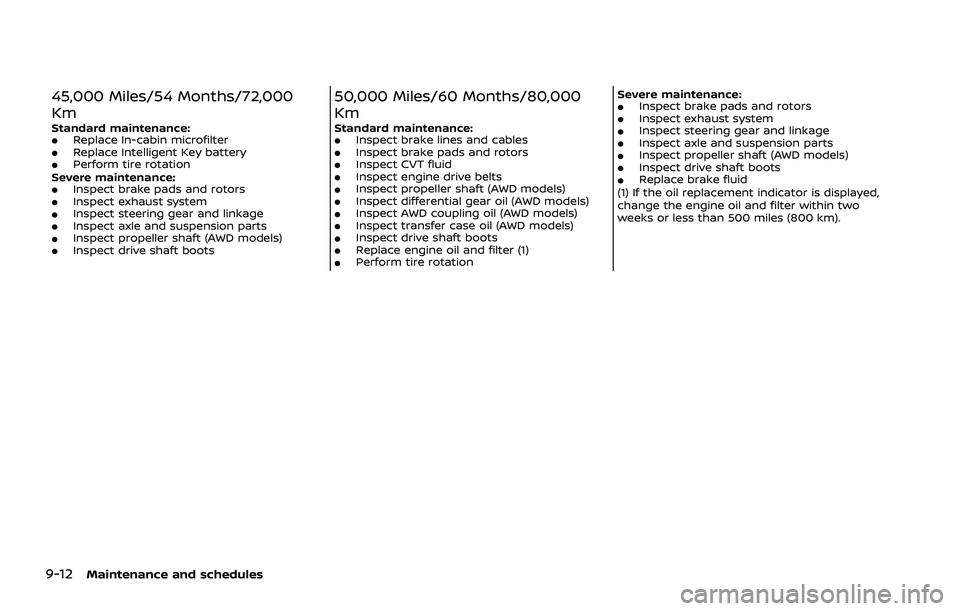
9-12Maintenance and schedules
45,000 Miles/54 Months/72,000
Km
Standard maintenance:.Replace In-cabin microfilter.Replace Intelligent Key battery.Perform tire rotation
Severe maintenance:
.Inspect brake pads and rotors.Inspect exhaust system.Inspect steering gear and linkage.Inspect axle and suspension parts.Inspect propeller shaft (AWD models).Inspect drive shaft boots
50,000 Miles/60 Months/80,000
Km
Standard maintenance:.Inspect brake lines and cables.Inspect brake pads and rotors.Inspect CVT fluid.Inspect engine drive belts.Inspect propeller shaft (AWD models).Inspect differential gear oil (AWD models).Inspect AWD coupling oil (AWD models).Inspect transfer case oil (AWD models).Inspect drive shaft boots.Replace engine oil and filter (1).Perform tire rotation Severe maintenance:
.Inspect brake pads and rotors.Inspect exhaust system.Inspect steering gear and linkage.Inspect axle and suspension parts.Inspect propeller shaft (AWD models).Inspect drive shaft boots.Replace brake fluid
(1) If the oil replacement indicator is displayed,
change the engine oil and filter within two
weeks or less than 500 miles (800 km).
Page 505 of 556
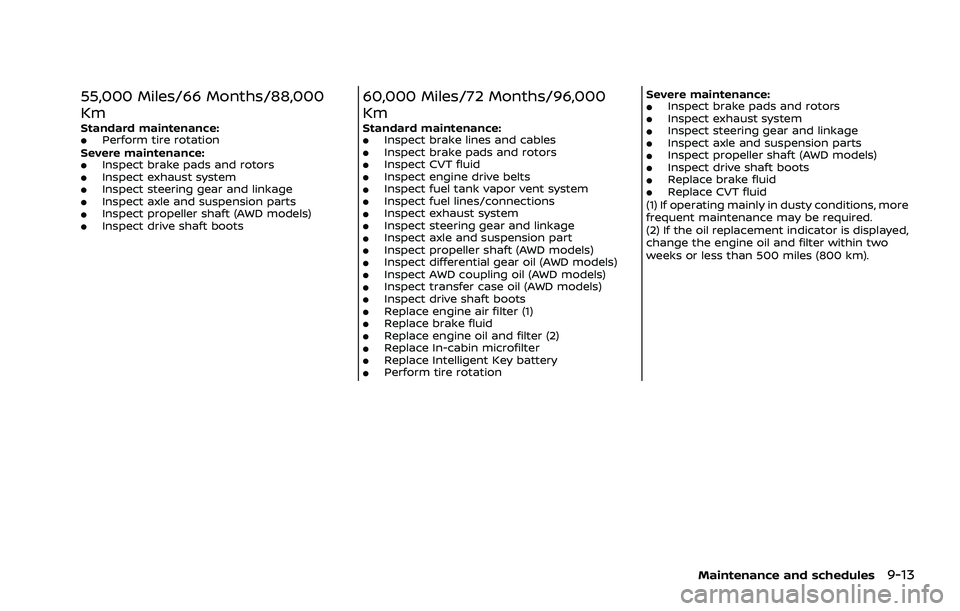
55,000 Miles/66 Months/88,000
Km
Standard maintenance:.Perform tire rotation
Severe maintenance:
.Inspect brake pads and rotors.Inspect exhaust system.Inspect steering gear and linkage.Inspect axle and suspension parts.Inspect propeller shaft (AWD models).Inspect drive shaft boots
60,000 Miles/72 Months/96,000
Km
Standard maintenance:.Inspect brake lines and cables.Inspect brake pads and rotors.Inspect CVT fluid.Inspect engine drive belts.Inspect fuel tank vapor vent system.Inspect fuel lines/connections.Inspect exhaust system.Inspect steering gear and linkage.Inspect axle and suspension part.Inspect propeller shaft (AWD models).Inspect differential gear oil (AWD models).Inspect AWD coupling oil (AWD models).Inspect transfer case oil (AWD models).Inspect drive shaft boots.Replace engine air filter (1).Replace brake fluid.Replace engine oil and filter (2).Replace In-cabin microfilter.Replace Intelligent Key battery.Perform tire rotation Severe maintenance:
.Inspect brake pads and rotors.Inspect exhaust system.Inspect steering gear and linkage.Inspect axle and suspension parts.Inspect propeller shaft (AWD models).Inspect drive shaft boots.Replace brake fluid.Replace CVT fluid
(1) If operating mainly in dusty conditions, more
frequent maintenance may be required.
(2) If the oil replacement indicator is displayed,
change the engine oil and filter within two
weeks or less than 500 miles (800 km).
Maintenance and schedules9-13