maintenance NISSAN ROGUE 2021 Owner´s Manual
[x] Cancel search | Manufacturer: NISSAN, Model Year: 2021, Model line: ROGUE, Model: NISSAN ROGUE 2021Pages: 556, PDF Size: 2.7 MB
Page 148 of 556
2-60Instruments and controls
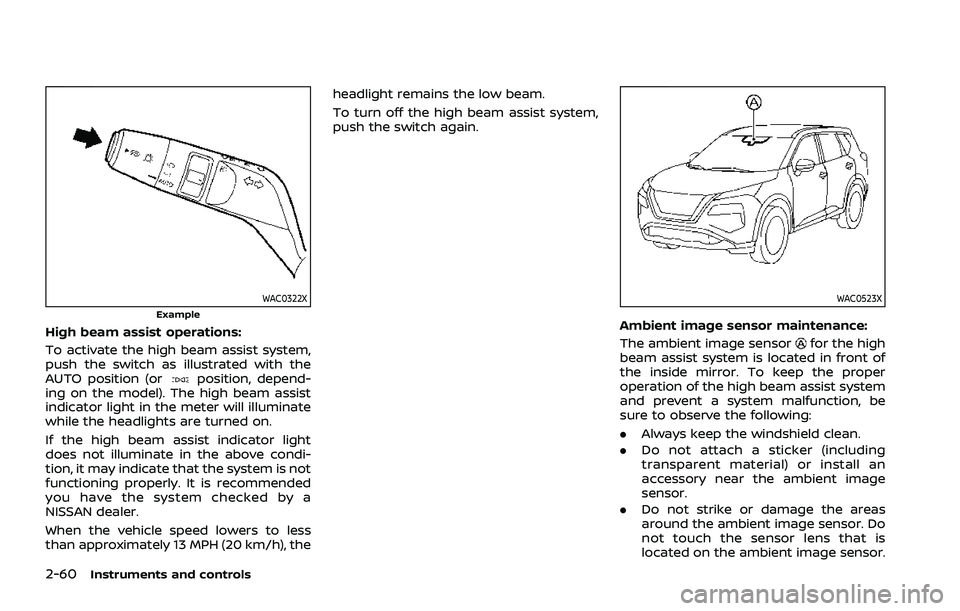
WAC0322XExample
High beam assist operations:
To activate the high beam assist system,
push the switch as illustrated with the
AUTO position (or
position, depend-
ing on the model). The high beam assist
indicator light in the meter will illuminate
while the headlights are turned on.
If the high beam assist indicator light
does not illuminate in the above condi-
tion, it may indicate that the system is not
functioning properly. It is recommended
you have the system checked by a
NISSAN dealer.
When the vehicle speed lowers to less
than approximately 13 MPH (20 km/h), the headlight remains the low beam.
To turn off the high beam assist system,
push the switch again.
WAC0523X
Ambient image sensor maintenance:
The ambient image sensor
for the high
beam assist system is located in front of
the inside mirror. To keep the proper
operation of the high beam assist system
and prevent a system malfunction, be
sure to observe the following:
. Always keep the windshield clean.
. Do not attach a sticker (including
transparent material) or install an
accessory near the ambient image
sensor.
. Do not strike or damage the areas
around the ambient image sensor. Do
not touch the sensor lens that is
located on the ambient image sensor.
Page 215 of 556
4 Monitor, heater, air conditioner, audioand phone systems
NissanConnect® Owner’s Manual .................................... 4-2
RearView Monitor (if so equipped) ................................. 4-2
RearView Monitor system operation ..................... 4-3
How to read the displayed lines ................................ 4-3
Difference between predictive and
actual distances ...................................................................... 4-4
How to park with predictive course lines .......... 4-5
Adjusting the screen ........................................................... 4-7
How to turn on and off predictive
course lines ........................................................................\
......... 4-7
RearView Monitor system limitations .................... 4-7
System maintenance .......................................................... 4-8
Intelligent Around View® Monitor (if
so equipped) ........................................................................\
............. 4-9 Intelligent Around View® Monitor
system operation ................................................................ 4-10
Difference between predictive and
actual distances ................................................................... 4-14
How to park with predictive course lines ....... 4-16
How to switch the display ........................................... 4-17
Adjusting the screen ........................................................ 4-18
Intelligent Around View® Monitor
system limitations .............................................................. 4-19
System maintenance ....................................................... 4-21 Moving Object Detection (MOD) (if
so equipped) ........................................................................\
......... 4-22
MOD system operation ................................................ 4-22
Turning MOD on and off ............................................ 4-24
MOD system limitations .............................................. 4-24
System maintenance .................................................... 4-25
Ventilators ........................................................................\
.............. 4-26 Center ventilators ............................................................ 4-26
Side ventilators .................................................................. 4-26
Rear ventilators .................................................................. 4-26
Heater and air conditioner ................................................ 4-27 Manual air conditioner and heater .................... 4-28
Automatic air conditioner (models without
rear control) ........................................................................\
.. 4-32
Automatic air conditioner (models with
rear control) ........................................................................\
.. 4-35
Operating tips (for automatic
air conditioner) ................................................................... 4-38
Servicing air conditioner ............................................. 4-38
Antenna ........................................................................\
.................... 4-39 Shark fin antenna ............................................................ 4-39
Car phone or CB radio ......................................................... 4-39
Page 222 of 556
4-8Monitor, heater, air conditioner, audio and phone systems
.Objects viewed in the RearView
Monitor differ from actual dis-
tance because a wide-angle lens
is used.
. Objects in the RearView Monitor
will appear visually opposite
compared to when viewed in the
rearview and outside mirrors.
. Use the displayed lines as a re-
ference. The lines are highly af-
fected by the number of
occupants, fuel level, vehicle po-
sition, road conditions and road
grade.
. Make sure that the liftgate is
securely closed when backing up.
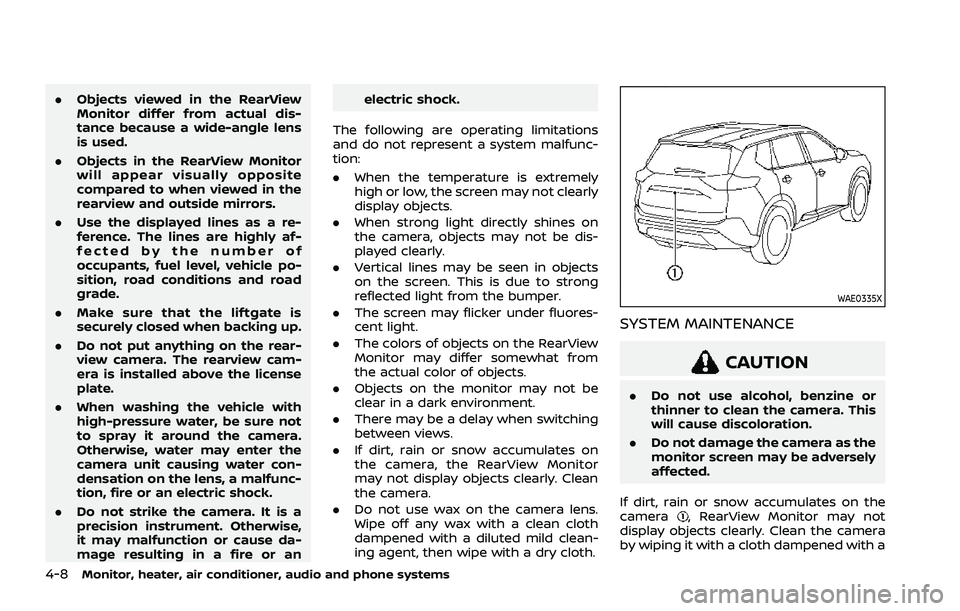
. Do not put anything on the rear-
view camera. The rearview cam-
era is installed above the license
plate.
. When washing the vehicle with
high-pressure water, be sure not
to spray it around the camera.
Otherwise, water may enter the
camera unit causing water con-
densation on the lens, a malfunc-
tion, fire or an electric shock.
. Do not strike the camera. It is a
precision instrument. Otherwise,
it may malfunction or cause da-
mage resulting in a fire or an electric shock.
The following are operating limitations
and do not represent a system malfunc-
tion:
. When the temperature is extremely
high or low, the screen may not clearly
display objects.
. When strong light directly shines on
the camera, objects may not be dis-
played clearly.
. Vertical lines may be seen in objects
on the screen. This is due to strong
reflected light from the bumper.
. The screen may flicker under fluores-
cent light.
. The colors of objects on the RearView
Monitor may differ somewhat from
the actual color of objects.
. Objects on the monitor may not be
clear in a dark environment.
. There may be a delay when switching
between views.
. If dirt, rain or snow accumulates on
the camera, the RearView Monitor
may not display objects clearly. Clean
the camera.
. Do not use wax on the camera lens.
Wipe off any wax with a clean cloth
dampened with a diluted mild clean-
ing agent, then wipe with a dry cloth.
WAE0335X
SYSTEM MAINTENANCE
CAUTION
.Do not use alcohol, benzine or
thinner to clean the camera. This
will cause discoloration.
. Do not damage the camera as the
monitor screen may be adversely
affected.
If dirt, rain or snow accumulates on the
camera
, RearView Monitor may not
display objects clearly. Clean the camera
by wiping it with a cloth dampened with a
Page 235 of 556
WAE0360X
SYSTEM MAINTENANCE
CAUTION
.Do not use alcohol, benzine or
thinner to clean the camera. This
will cause discoloration.
. Do not damage the camera as the
monitor screen may be adversely
affected.
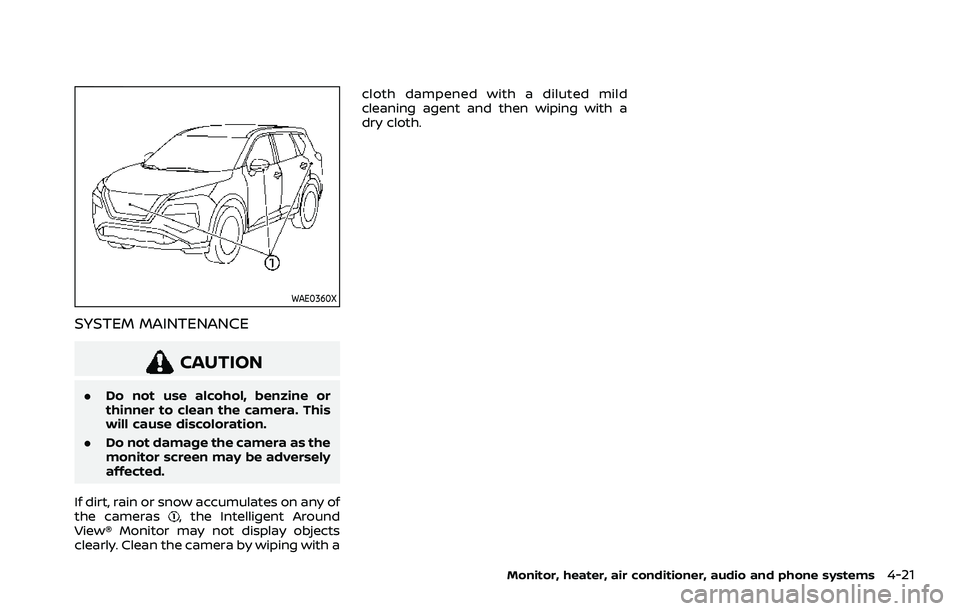
If dirt, rain or snow accumulates on any of
the cameras
, the Intelligent Around
View® Monitor may not display objects
clearly. Clean the camera by wiping with a cloth dampened with a diluted mild
cleaning agent and then wiping with a
dry cloth.
Monitor, heater, air conditioner, audio and phone systems4-21
Page 239 of 556
the muffler, moving shadows, etc.
. The MOD system may not func-
tion properly depending on the
speed, direction, distance or
shape of the moving objects.
. If your vehicle sustains damage
to the parts where the camera is
installed, leaving it misaligned or
bent, the sensing zone may be
altered and the MOD system may
not detect objects properly.
. When the temperature is extre-
mely high or low, the screen may
not display objects clearly. This is
not a malfunction.
NOTE:
The green MOD icon will change to
orange if one of the following has
occurred.
. When the system is malfunctioning.
. When the component temperature
reaches a high level.
. When the rear view camera has
detected a blockage.
If the icon light continues to illuminate
in orange, have the MOD system
checked. It is recommended that you
visit a NISSAN dealer for this service.
WAE0360X
SYSTEM MAINTENANCE
CAUTION
. Do not use alcohol, benzine or
thinner to clean the camera. This
will cause discoloration.
. Do not damage the camera as the
monitor screen may be adversely
affected.
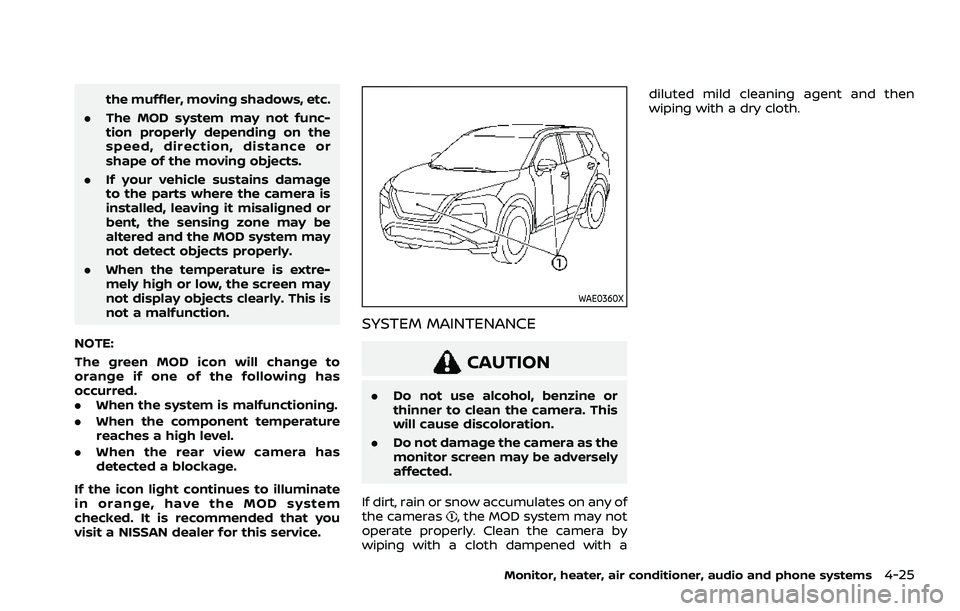
If dirt, rain or snow accumulates on any of
the cameras
, the MOD system may not
operate properly. Clean the camera by
wiping with a cloth dampened with a diluted mild cleaning agent and then
wiping with a dry cloth.
Monitor, heater, air conditioner, audio and phone systems4-25
Page 253 of 556
A NISSAN dealer will be able to service
your environmentally friendly air condi-
tioner system.
In-cabin microfilter
The air conditioner system is equipped
with an in-cabin microfilter. To make sure
the air conditioner heats, defogs, and
ventilates efficiently, replace the filter
according the specified maintenance in-
tervals listed in the "9. Maintenance and
schedules" section. It is recommended to
visit a NISSAN dealer to replace the filter.
The filter should be replaced if the air flow
decreases significantly or if windows fog
up easily when operating the heater or air
conditioner.
SHARK FIN ANTENNA
The shark fin antenna is located on the
rear part of the vehicle roof.
The radio performance may be affected if
cargo carried on the roof blocks the radio
signal. If possible, do not put cargo near
the shark fin antenna.
A build up of ice on the shark fin antenna
can affect radio performance. Remove
the ice to restore radio reception.When installing a car phone or a CB radio
in your vehicle, be sure to observe the
following precautions, otherwise the new
equipment may adversely affect the elec-
tronic control modules and electronic
control system harness.
WARNING
.
A cellular phone should not be
used for any purpose while driv-
ing so full attention may be given
to vehicle operation. Some juris-
dictions prohibit the use of cellu-
lar phones while driving.
. If you must make a call while your
vehicle is in motion, the hands-
free cellular phone operational
mode (if so equipped) is highly
recommended. Exercise extreme
caution at all times so full atten-
tion may be given to vehicle
operation.
. If a conversation in a moving
vehicle requires you to take
notes, pull off the road to a safe
location and stop your vehicle
before doing so.
Monitor, heater, air conditioner, audio and phone systems4-39
ANTENNA CAR PHONE OR CB RADIO
Page 255 of 556
5 Starting and driving
Precautions when starting and driving ...................... 5-5Exhaust gas (carbon monoxide) ................................ 5-5
Three-way catalyst ............................................................... 5-6
Tire Pressure Monitoring System (TPMS) ........... 5-6
Avoiding collision and rollover ................................. 5-10
On-pavement and off-road
driving precautions ........................................................... 5-10
Off-road recovery ............................................................... 5-10
Rapid air pressure loss ................................................... 5-11
Drinking alcohol/drugs and driving ..................... 5-11
Driving safety precautions .......................................... 5-12
Push-button ignition switch ............................................. 5-14 Operating range for engine start function ...... 5-14
Push-button ignition switch operation ............. 5-15
Push-button ignition switch positions .............. 5-16
Emergency engine shut off ........................................ 5-16
Intelligent Key battery discharge ........................... 5-16
Before starting the engine ................................................. 5-17
Starting the engine .................................................................. 5-17 Remote engine start (if so equipped) ................. 5-18
Driving the vehicle .................................................................... 5-19 Continuously Variable
Transmission (CVT) ............................................................ 5-19
Parking brake ........................................................................\
....... 5-25 Automatic operation ........................................................ 5-25 Manual operation ............................................................. 5-27
Automatic brake hold ........................................................... 5-28 How to activate/deactivate the automatic
brake hold function ........................................................ 5-29
How to use the automatic brake
hold function ........................................................................\
5-29
Drive Mode Selector ............................................................... 5-30 OFF-ROAD mode (AWD models) ........................... 5-31
SNOW mode (AWD models) ...................................... 5-32
STANDARD mode (2WD models)/AUTO
mode (AWD models) ....................................................... 5-32
ECO mode ........................................................................\
...... 5-32
SPORT mode ........................................................................\
5-33
Driver Assistance systems ................................................. 5-34 How to enable/disable the systems ................. 5-37
Common troubleshooting guide ......................... 5-39
Traffic Sign Recognition (TSR) (if
so equipped) ........................................................................\
......... 5-43 System operation ............................................................. 5-43
How to enable/disable the TSR system ........ 5-45
System temporarily unavailable ........................... 5-45
System malfunction ....................................................... 5-45
System maintenance .................................................... 5-46
Lane Departure Warning (LDW) ..................................... 5-46 LDW system operation ................................................. 5-47
How to enable/disable the LDW system ....... 5-48
Page 256 of 556
LDW system limitations .................................................. 5-48
System temporarily unavailable ............................. 5-49
System malfunction .......................................................... 5-50
System maintenance ....................................................... 5-50
Intelligent Lane Intervention (I-LI) ................................ 5-51 I-LI system operation ....................................................... 5-52
How to enable/disable the I-LI system ............. 5-53
I-LI system limitations ..................................................... 5-53
System temporarily unavailable ............................. 5-55
System malfunction .......................................................... 5-55
System maintenance ....................................................... 5-56
Blind Spot Warning (BSW) ................................................... 5-57 BSW system operation ................................................... 5-58
How to enable/disable the BSW system .......... 5-59
BSW system limitations .................................................. 5-59
BSW driving situations .................................................... 5-60
System temporarily unavailable ............................. 5-63
System malfunction .......................................................... 5-63
System maintenance ....................................................... 5-64
Intelligent Blind Spot Intervention (I-BSI) (if
so equipped) ........................................................................\
.......... 5-65
I-BSI system operation ................................................... 5-66
How to enable/disable the I-BSI system ......... 5-68
I-BSI system limitations ................................................. 5-68
I-BSI driving situations .................................................... 5-70
System temporarily unavailable ............................. 5-74
System malfunction .......................................................... 5-74
System maintenance ....................................................... 5-75 Rear Cross Traffic Alert (RCTA) ...................................... 5-76
RCTA system operation .............................................. 5-76
How to enable/disable the RCTA system ...... 5-78
RCTA system limitations ............................................. 5-79
System temporarily unavailable ........................... 5-80
System malfunction ....................................................... 5-81
System maintenance .................................................... 5-81
Cruise control (if so equipped) ....................................... 5-82
Precautions on cruise control ................................ 5-82
Cruise control operations .......................................... 5-83
ProPILOT Assist (if so equipped) ................................... 5-84
ProPILOT Assist system operation ..................... 5-86
ProPILOT Assist switches ........................................... 5-88
ProPILOT Assist system display
and indicators ..................................................................... 5-89
Turning the conventional (fixed speed)
cruise control mode ON ............................................. 5-91
Operating ProPILOT Assist ........................................ 5-91
How to enable/disable the
Steering Assist .................................................................... 5-96
How to cancel the ProPILOT
Assist system ....................................................................... 5-97
Intelligent Cruise Control (ICC) .............................. 5-97
Steering Assist ................................................................ 5-113
Conventional (fixed speed) cruise
control mode ................................................................... 5-118
Automatic Emergency Braking (AEB) with
pedestrian detection system ...................................... 5-122 AEB with pedestrian detection
system operation ......................................................... 5-123
Page 257 of 556
Turning the AEB with pedestrian detection
system ON/OFF ................................................................ 5-125
AEB with pedestrian detection
system limitations .......................................................... 5-126
System temporarily unavailable ......................... 5-129
System malfunction ...................................................... 5-130
System maintenance ................................................... 5-130
Intelligent Forward Collision
Warning (I-FCW) ....................................................................... 5-132 I-FCW system operation ............................................ 5-134
Turning the I-FCW system ON/OFF ................. 5-135
I-FCW system limitations .......................................... 5-137
System temporarily unavailable ......................... 5-139
System malfunction ...................................................... 5-139
System maintenance ................................................... 5-139
Intelligent Driver Alertness (I-DA) .............................. 5-141 I-DA system operation ................................................ 5-141
How to enable/disable the I-DA system ...... 5-142
I-DA system limitations .............................................. 5-142
System malfunction ...................................................... 5-143
Rear Automatic Braking (RAB) .................................... 5-143
RAB system operation ................................................ 5-145
Turning the RAB system ON/OFF ...................... 5-145
RAB system limitations .............................................. 5-146
System malfunction ...................................................... 5-147
System maintenance ................................................... 5-148
Break-in schedule ................................................................. 5-149
Fuel Efficient Driving Tips ................................................ 5-149
Increasing fuel economy ................................................. 5-150 Intelligent 4x4 (if so equipped) .................................. 5-151
Parking/parking on hills .................................................. 5-153
Electric power steering .................................................... 5-154
Brake system ........................................................................\
... 5-155
Braking precautions ................................................... 5-155
Brake assist ........................................................................\
....... 5-156 Brake assist ....................................................................... 5-156
Anti-lock Braking System (ABS) ........................ 5-156
Vehicle Dynamic Control (VDC) system .............. 5-157 How to turn off the VDC system ..................... 5-158
Brake Force Distribution ......................................... 5-159
Chassis control ....................................................................... 5-160 Intelligent Trace Control ......................................... 5-160
Active Ride Control ..................................................... 5-160
Hill Start Assist system ..................................................... 5-161
Sonar system (if so equipped) ................................... 5-162 System operation ......................................................... 5-163
How to enable/disable the
sonar system ................................................................... 5-165
Sonar system limitations ....................................... 5-166
System temporarily unavailable ....................... 5-167
System maintenance ................................................ 5-167
Rear Sonar System (RSS) (if so equipped) ........ 5-168 System operation ......................................................... 5-168
How to enable/disable the RSS ........................ 5-170
RSS limitations ................................................................ 5-170
System temporarily unavailable ....................... 5-171
System maintenance ................................................ 5-172
Page 260 of 556
5-6Starting and driving
THREE-WAY CATALYST
The three-way catalyst is an emission
control device installed in the exhaust
system. Exhaust gases in the three-way
catalyst are burned at high temperatures
to help reduce pollutants.
WARNING
.The exhaust gas and the exhaust
system are very hot. Keep people,
animals and flammable materials
away from the exhaust system
components.
. Do not stop or park the vehicle
over flammable materials such as
dry grass, wastepaper or rags.
They may ignite and cause a fire.
CAUTION
.Do not use leaded gasoline. De-
posits from leaded gasoline will
seriously reduce the three-way
catalyst’s ability to help reduce
exhaust pollutants.
. Keep your engine tuned up. Mal-
functions in the ignition, fuel in-
jection, or electrical systems can cause overrich fuel flow into the
three-way catalyst, causing it to
overheat. Do not keep driving if
the engine misfires, or if notice-
able loss of performance or other
unusual operating conditions are
detected. Have the vehicle in-
spected. It is recommended you
visit a NISSAN dealer for this
service.
. Avoid driving with an extremely
low fuel level. Running out of fuel
could cause the engine to misfire,
damaging the three-way catalyst.
. Do not race the engine while
warming it up.
. Do not push or tow your vehicle
to start the engine.
TIRE PRESSURE MONITORING SYS-
TEM (TPMS)
Each tire, including the spare, should be
checked monthly when cold and inflated
to the inflation pressure recommended
by the vehicle manufacturer on the ve-
hicle placard or tire inflation pressure
label. (If your vehicle has tires of a
different size than the size indicated on
the vehicle placard or tire inflation pres-
sure label, you should determine the
proper tire inflation pressure for those tires.)
As an added safety feature, your vehicle
has been equipped with a Tire Pressure
Monitoring System (TPMS) that illumi-
nates a low tire pressure telltale when
one or more of your tires is significantly
under-inflated. Accordingly, when the low
tire pressure telltale illuminates, you
should stop and check your tires as soon
as possible, and inflate them to the
proper pressure. Driving on a significantly
under-inflated tire causes the tire to
overheat and can lead to tire failure.
Under-inflation also reduces fuel effi-
ciency and tire tread life, and may affect
the vehicle’s handling and stopping abil-
ity.
Please note that the TPMS is not a
substitute for proper tire maintenance,
and it is the driver’s responsibility to
maintain correct tire pressure, even if
under-inflation has not reached the level
to trigger illumination of the TPMS low
tire pressure telltale.
Your vehicle has also been equipped with
a TPMS malfunction indicator to indicate
when the system is not operating prop-
erly. The TPMS malfunction indicator is
combined with the low tire pressure tell-
tale. When the system detects a malfunc-
tion, the telltale will flash for
approximately one minute and then re-