towing NISSAN ROGUE 2021 Owner´s Manual
[x] Cancel search | Manufacturer: NISSAN, Model Year: 2021, Model line: ROGUE, Model: NISSAN ROGUE 2021Pages: 556, PDF Size: 2.7 MB
Page 499 of 556
To help ensure smooth, safe and eco-
nomical driving, NISSAN provides two
maintenance schedules that may be
used, depending upon the conditions in
which you usually drive. These schedules
contain both distance and time intervals,
up to 120,000 miles (192,000 km)/96
months. For most people, the odometer
reading will indicate when service is
needed. However, if you drive very little,
your vehicle should be serviced at the
regular time intervals shown in the sche-
dule.
After 120,000 miles (192,000 km)/96
months, continue maintenance at the
same mileage/time intervals.
ADDITIONAL MAINTENANCE ITEMS
FOR SEVERE OPERATING CONDI-
TIONS
Additional maintenance items for se-
vere operating conditions;should be
performed on vehicles that are driven
under especially demanding conditions.
Additional maintenance items should be
performed if you primarily operate your
vehicle under the following conditions:
. Repeated short trips of less than 5
miles (8 km).
. Repeated short trips of less than 10
miles (16 km) with outside tempera-
tures remaining below freezing. .
Operating in hot weather in stop-and-
go “rush hour” traffic.
. Extensive idling and/or low speed
driving for long distances, such as
police, taxi or door-to-door delivery
use.
. Driving in dusty conditions.
. Driving on rough, muddy or salt
spread roads.
. Using a car-top carrier.
. Towing a trailer.
. Using a camper.
If your vehicle is mainly operated under
the severe conditions, follow the severe
maintenance intervals shown in the
maintenance schedule.
OIL CONTROL SYSTEM
Your vehicle is equipped with oil control
system. It calculates engine oil and filter
change intervals based on driving condi-
tions. Driving in the following severe
conditions will shorten the engine oil
and filter change interval.
Maintenance and schedules9-7
MAINTENANCE SCHEDULES
Page 513 of 556

10 Technical and consumer information
Capacities and
recommended fluids/lubricants .................................... 10-3Fuel information .................................................................. 10-4
Engine oil and oil filter recommendation ........ 10-6
Air conditioning system refrigerant and
lubricant recommendations ...................................... 10-7
Specifications ........................................................................\
........ 10-8 Engine ........................................................................\
.................. 10-8
Wheels and tires .................................................................. 10-8
Dimensions and weights .............................................. 10-9
When traveling or registering in
another country ........................................................................\
. 10-9
Vehicle identification .............................................................. 10-9 Vehicle Identification Number (VIN) plate ....... 10-9
Vehicle identification number
(chassis number) ............................................................. 10-10
Engine serial number ................................................... 10-10
F.M.V.S.S./C.M.V.S.S. certification label ............. 10-10
Emission control information label .................. 10-11
Tire and Loading Information label ................. 10-11
Air conditioner specification label ..................... 10-11
Installing front license plate ......................................... 10-12
Vehicle loading information .......................................... 10-13
Terms ........................................................................\
................ 10-13
Vehicle load capacity ................................................... 10-13 Securing the load ......................................................... 10-15
Loading tips ...................................................................... 10-15
Measurement of weights ....................................... 10-16
Towing a trailer ...................................................................... 10-16 Maximum load limits ................................................. 10-17
Maximum Gross Vehicle Weight (GVW)/
maximum Gross Axle Weight (GAW) .............. 10-18
Towing load/specification ..................................... 10-20
Towing safety .................................................................. 10-21
Flat towing ........................................................................\
......... 10-26
Flat towing for All–Wheel Drive vehicle
(if so equipped) ............................................................... 10-26
Flat towing for Front-Wheel Drive vehicle
(if so equipped) ............................................................... 10-26
Uniform tire quality grading ........................................ 10-27 Treadwear ........................................................................\
.. 10-27
Traction AA, A, B and C ........................................... 10-27
Temperature A, B and C ......................................... 10-27
Emission control system warranty ......................... 10-28
Reporting safety defects ................................................ 10-28
Readiness for Inspection/Maintenance
(I/M) test ........................................................................\
............... 10-29
Event Data Recorders (EDR) ......................................... 10-30
Additional data recording (on vehicles
equipped with optional ProPILOT
Assist) ........................................................................\
............. 10-30
Page 519 of 556
Oil viscosity
The engine oil viscosity or thickness
changes with temperature. Because of
this, it is important to select the engine oil
viscosity based on the temperatures at
which the vehicle will be operated before
the next oil change. Choosing an oil
viscosity other than that recommended
could cause serious engine damage.
Selecting the correct oil filter
Your new NISSAN vehicle is equipped with
a high-quality genuine NISSAN oil filter.
When replacing, use a genuine NISSAN oil
filter or its equivalent for the reason
described in “Change intervals”.
Change intervals
The oil and oil filter change intervals for
your engine are based on the use of the
specified quality oils and filters. Using an
engine oil and filter other than the
specified quality, or exceeding recom-
mended oil and filter change intervals
could reduce engine life. Damage to the
engine caused by improper maintenance
or use of incorrect oil and filter quality
and/or viscosity is not covered by the
NISSAN new vehicle limited warranty.
Your engine was filled with a high quality
engine oil when it was built. You do not
have to change the oil before the firstrecommended change interval.
Oil and filter change intervals depend
upon how you use your vehicle. Opera-
tion under the following conditions may
require more frequent oil and filter
changes:
.
repeated short distance driving at
cold outside temperatures
. driving in dusty conditions
. extensive idling
. towing a trailer
. stop and go commuting
(See “9. Maintenance and schedules” sec-
tion.)
AIR CONDITIONING SYSTEM RE-
FRIGERANT AND LUBRICANT RE-
COMMENDATIONS
The air conditioner system in your
NISSAN vehicle must be charged with
the specified refrigerant HFO-1234yf (R-
1234yf) and A/C system oil ND-OIL12
(PAG) or the exact equivalent.
CAUTION
The use of any other refrigerant or oil
will cause severe damage to the air
conditioning system and will require
the replacement of all air conditioner system components.
The refrigerant HFO-1234yf (R-1234yf) in
your NISSAN vehicle will not harm the
earth’s ozone layer. Although this refrig-
erant does not affect the earth’s atmo-
sphere, certain government regulations
require the recovery and recycling of any
refrigerant during automotive air condi-
tioner system service. Air conditioner
system should only be serviced by trained
and certified technicians to ensure proper
and safe operation (SAE J2845). A NISSAN
dealer has the trained technicians and
equipment needed to recover and recycle
your air conditioner system refrigerant.
Only new and SAEJ2842 certified eva-
porator(s) shall be used as replacement
parts.
A damaged or leaking air conditioning
evaporator shall never be repaired or
replaced with one removed from a used
or salvaged vehicle. To replace a da-
maged or leaking evaporator, use only
new and SAE J2842 certified evaporator
(s). It is recommended that you visit a
NISSAN dealer when servicing your air
conditioner system.
Technical and consumer information10-7
Page 528 of 556
10-16Technical and consumer information
WARNING
.Properly secure all cargo
with ropes or straps to help
prevent it from sliding or
shifting. Do not place cargo
higher than the seatbacks.
In a sudden stop or collision,
unsecured cargo could
cause personal injury.
.Do not load your vehicle any
heavier than the GVWR or
the maximum front and rear
GAWRs. If you do, parts of
your vehicle can break, tire
damage could occur, or it
can change the way your
vehicle handles. This could
result in loss of control and
cause personal injury.
.Overloading not only can
shorten the life of your ve-
hicle and the tire, but can
cause unsafe vehicle hand-
ling and longer braking dis-
tances. This may cause a
premature tire failure, whichcould result in a serious
accident and personal in-
jury. Failures caused by
overloading are not covered
by the vehicle’s warranty.
MEASUREMENT OF WEIGHTS
Secure loose items to prevent
weight shifts that could affect the
balance of your vehicle. When the
vehicle is loaded, drive to a scale
and weigh the front and the rear
wheels separately to determine
axle loads. Individual axle loads
should not exceed either of the
Gross Axle Weight Ratings (GAWR).
The total of the axle loads should
not exceed the Gross Vehicle
Weight Rating (GVWR). These rat-
ings are given on the vehicle certi-
fication label. If weight ratings are
exceeded, move or remove items to
bring all weights below the ratings.
WARNING
Overloading or improper loading of a
trailer and its cargo can adversely
affect vehicle handling, braking and
performance and may lead to acci-
dents.
CAUTION
. Do not tow a trailer or haul a
heavy load for the first 500 miles
(800 km). Your engine, axle or
other parts could be damaged.
. For the first 500 miles (800 km)
that you tow a trailer, do not drive
over 50 MPH (80 km/h) and do
not make starts at full throttle.
This helps the engine and other
parts of your vehicle wear in at
the heavier loads.
Your new vehicle was designed to be
used primarily to carry passengers and
cargo. Remember that towing a trailer
places additional loads on your vehicle’s
engine, drivetrain, steering, braking and
other systems.
A NISSAN Towing Guide (U.S. only) is
TOWING A TRAILER
Page 529 of 556
available on the website at
www.nissanusa.com. This guide includes
information on trailer towing capability
and the special equipment required for
proper towing.
MAXIMUM LOAD LIMITS
Maximum trailer loads
Never allow the total trailer load to
exceed the value specified in the “Towing
load/specification” (P.10-20) chart found
in this section. The total trailer load
equals trailer weight plus its cargo
weight.
The maximum Gross Combined Weight
Rating (GCWR) should not exceed the
value specified in the following “Towing
Load/Specification” chart.
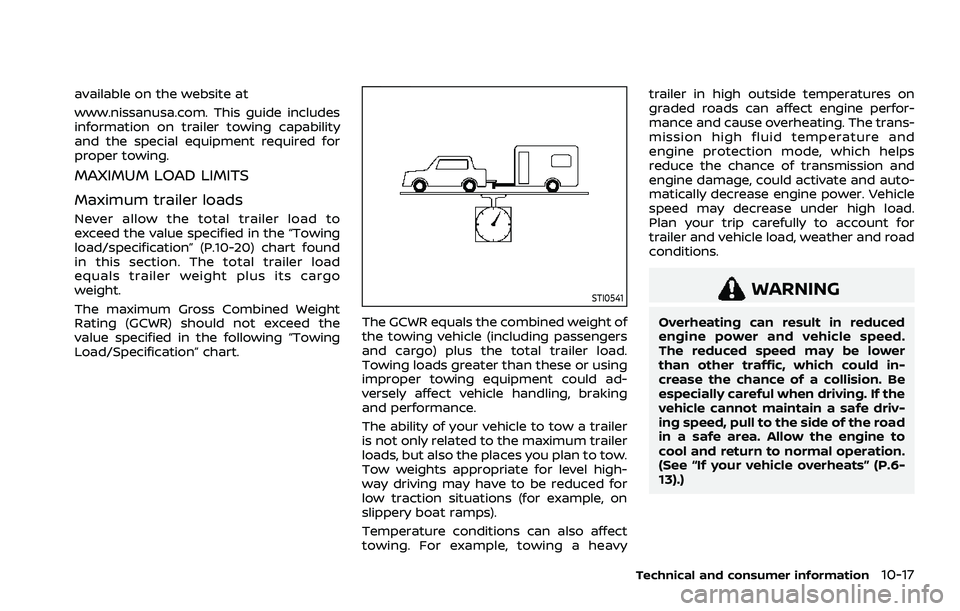
STI0541
The GCWR equals the combined weight of
the towing vehicle (including passengers
and cargo) plus the total trailer load.
Towing loads greater than these or using
improper towing equipment could ad-
versely affect vehicle handling, braking
and performance.
The ability of your vehicle to tow a trailer
is not only related to the maximum trailer
loads, but also the places you plan to tow.
Tow weights appropriate for level high-
way driving may have to be reduced for
low traction situations (for example, on
slippery boat ramps).
Temperature conditions can also affect
towing. For example, towing a heavytrailer in high outside temperatures on
graded roads can affect engine perfor-
mance and cause overheating. The trans-
mission high fluid temperature and
engine protection mode, which helps
reduce the chance of transmission and
engine damage, could activate and auto-
matically decrease engine power. Vehicle
speed may decrease under high load.
Plan your trip carefully to account for
trailer and vehicle load, weather and road
conditions.
WARNING
Overheating can result in reduced
engine power and vehicle speed.
The reduced speed may be lower
than other traffic, which could in-
crease the chance of a collision. Be
especially careful when driving. If the
vehicle cannot maintain a safe driv-
ing speed, pull to the side of the road
in a safe area. Allow the engine to
cool and return to normal operation.
(See “If your vehicle overheats” (P.6-
13).)
Technical and consumer information10-17
Page 530 of 556
10-18Technical and consumer information
CAUTION
Vehicle damage resulting from im-
proper towing procedures is not
covered by NISSAN warranties.
STI0542
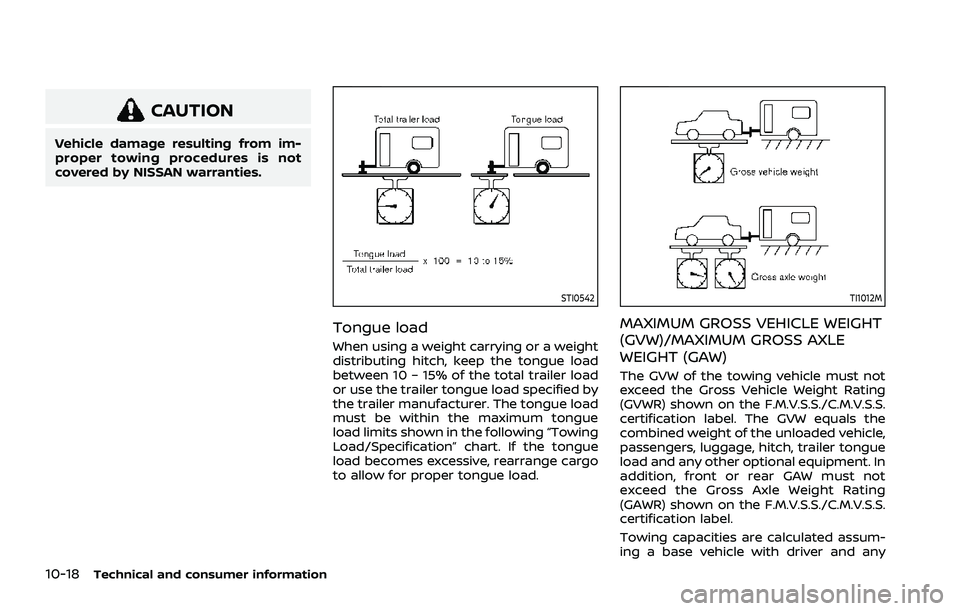
Tongue load
When using a weight carrying or a weight
distributing hitch, keep the tongue load
between 10 – 15% of the total trailer load
or use the trailer tongue load specified by
the trailer manufacturer. The tongue load
must be within the maximum tongue
load limits shown in the following “Towing
Load/Specification” chart. If the tongue
load becomes excessive, rearrange cargo
to allow for proper tongue load.
TI1012M
MAXIMUM GROSS VEHICLE WEIGHT
(GVW)/MAXIMUM GROSS AXLE
WEIGHT (GAW)
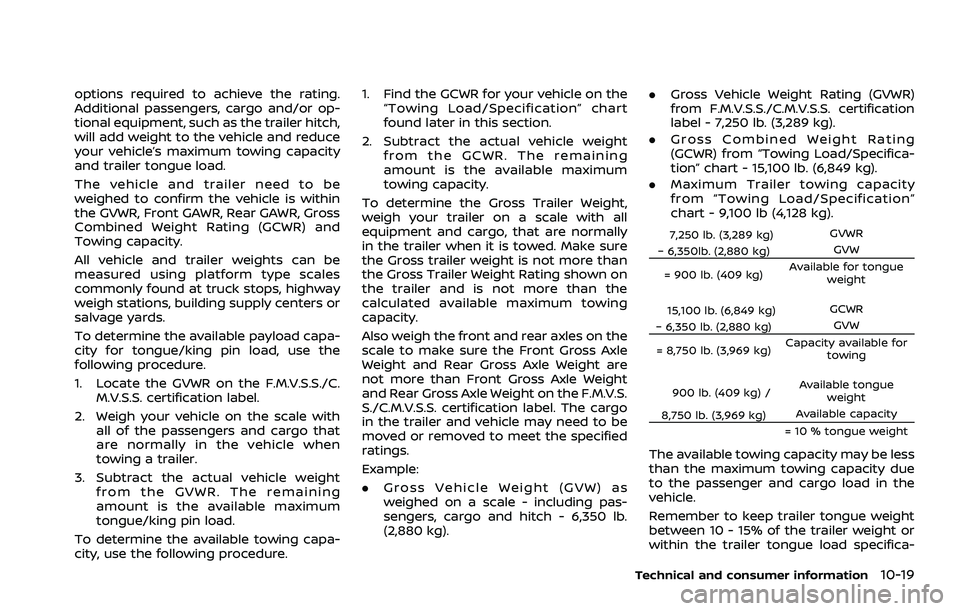
The GVW of the towing vehicle must not
exceed the Gross Vehicle Weight Rating
(GVWR) shown on the F.M.V.S.S./C.M.V.S.S.
certification label. The GVW equals the
combined weight of the unloaded vehicle,
passengers, luggage, hitch, trailer tongue
load and any other optional equipment. In
addition, front or rear GAW must not
exceed the Gross Axle Weight Rating
(GAWR) shown on the F.M.V.S.S./C.M.V.S.S.
certification label.
Towing capacities are calculated assum-
ing a base vehicle with driver and any
Page 531 of 556
options required to achieve the rating.
Additional passengers, cargo and/or op-
tional equipment, such as the trailer hitch,
will add weight to the vehicle and reduce
your vehicle’s maximum towing capacity
and trailer tongue load.
The vehicle and trailer need to be
weighed to confirm the vehicle is within
the GVWR, Front GAWR, Rear GAWR, Gross
Combined Weight Rating (GCWR) and
Towing capacity.
All vehicle and trailer weights can be
measured using platform type scales
commonly found at truck stops, highway
weigh stations, building supply centers or
salvage yards.
To determine the available payload capa-
city for tongue/king pin load, use the
following procedure.
1. Locate the GVWR on the F.M.V.S.S./C.M.V.S.S. certification label.
2. Weigh your vehicle on the scale with all of the passengers and cargo that
are normally in the vehicle when
towing a trailer.
3. Subtract the actual vehicle weight from the GVWR. The remaining
amount is the available maximum
tongue/king pin load.
To determine the available towing capa-
city, use the following procedure. 1. Find the GCWR for your vehicle on the
“Towing Load/Specification” chart
found later in this section.
2. Subtract the actual vehicle weight from the GCWR. The remaining
amount is the available maximum
towing capacity.
To determine the Gross Trailer Weight,
weigh your trailer on a scale with all
equipment and cargo, that are normally
in the trailer when it is towed. Make sure
the Gross trailer weight is not more than
the Gross Trailer Weight Rating shown on
the trailer and is not more than the
calculated available maximum towing
capacity.
Also weigh the front and rear axles on the
scale to make sure the Front Gross Axle
Weight and Rear Gross Axle Weight are
not more than Front Gross Axle Weight
and Rear Gross Axle Weight on the F.M.V.S.
S./C.M.V.S.S. certification label. The cargo
in the trailer and vehicle may need to be
moved or removed to meet the specified
ratings.
Example:
. Gross Vehicle Weight (GVW) as
weighed on a scale - including pas-
sengers, cargo and hitch - 6,350 lb.
(2,880 kg). .
Gross Vehicle Weight Rating (GVWR)
from F.M.V.S.S./C.M.V.S.S. certification
label - 7,250 lb. (3,289 kg).
. Gross Combined Weight Rating
(GCWR) from “Towing Load/Specifica-
tion” chart - 15,100 lb. (6,849 kg).
. Maximum Trailer towing capacity
from “Towing Load/Specification”
chart - 9,100 lb (4,128 kg).
7,250 lb. (3,289 kg) GVWR
− 6,350lb. (2,880 kg) GVW
= 900 lb. (409 kg) Available for tongue
weight
15,100 lb. (6,849 kg) GCWR
− 6,350 lb. (2,880 kg) GVW
= 8,750 lb. (3,969 kg) Capacity available for
towing
900 lb. (409 kg) / Available tongue
weight
8,750 lb. (3,969 kg) Available capacity
= 10 % tongue weight
The available towing capacity may be less
than the maximum towing capacity due
to the passenger and cargo load in the
vehicle.
Remember to keep trailer tongue weight
between 10 - 15% of the trailer weight or
within the trailer tongue load specifica-
Technical and consumer information10-19
Page 532 of 556
10-20Technical and consumer information
tion recommended by the trailer manu-
facturer. If the tongue load becomes
excessive, rearrange the cargo to obtain
the proper tongue load. Do not exceed
the maximum tongue weight specifica-
tion shown in the “Towing load/specifica-
tion” chart even if the calculated available
tongue weight is greater than 15%. If the
calculated tongue weight is less than 10%,
reduce the total trailer weight to match
the available tongue weight.
Always verify that available capacities are
within the required ratings.TOWING LOAD/SPECIFICATION
WARNING
The towing capacities provided in
this manual are for general reference
only. The safe towing capacity of
your vehicle is affected by dealer
and factory installed options and
passenger and cargo loads. You
must weigh the vehicle and trailer
as described in this manual to de-
termine the actual vehicle towing
capacity. Do not exceed the pub-
lished maximum towing capacity, or
the GCWR or the GVWR shown on the
F.M.V.S.S./C.M.V.S.S. certification la-
bel. Doing so can result in an acci-
dent causing serious personal injury
or property damage.
Page 533 of 556
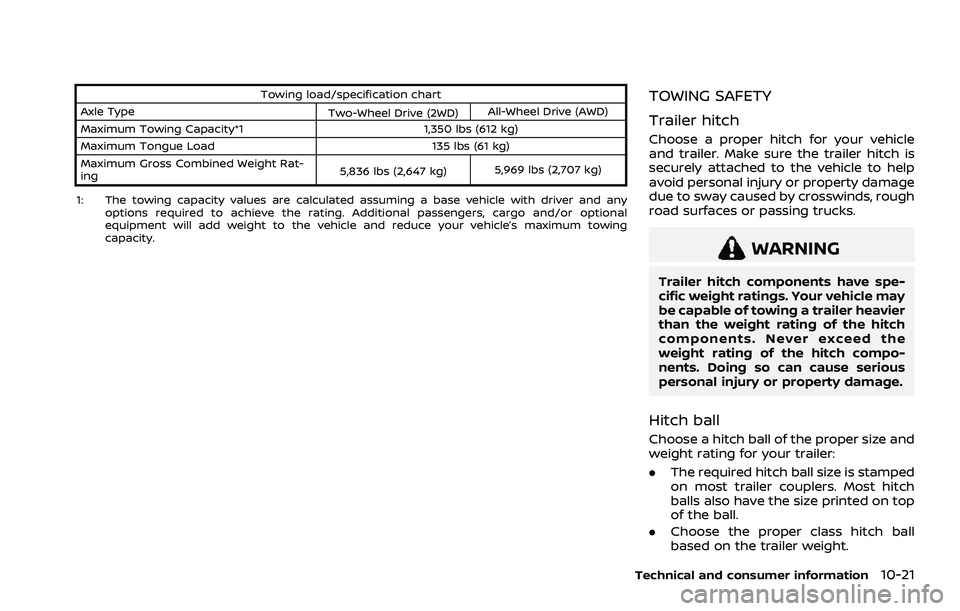
Towing load/specification chart
Axle Type Two-Wheel Drive (2WD)All-Wheel Drive (AWD)
Maximum Towing Capacity*1 1,350 lbs (612 kg)
Maximum Tongue Load 135 lbs (61 kg)
Maximum Gross Combined Weight Rat-
ing 5,836 lbs (2,647 kg)
5,969 lbs (2,707 kg)
1: The towing capacity values are calculated assuming a base vehicle with driver and any options required to achieve the rating. Additional passengers, cargo and/or optional
equipment will add weight to the vehicle and reduce your vehicle’s maximum towing
capacity.TOWING SAFETY
Trailer hitch
Choose a proper hitch for your vehicle
and trailer. Make sure the trailer hitch is
securely attached to the vehicle to help
avoid personal injury or property damage
due to sway caused by crosswinds, rough
road surfaces or passing trucks.
WARNING
Trailer hitch components have spe-
cific weight ratings. Your vehicle may
be capable of towing a trailer heavier
than the weight rating of the hitch
components. Never exceed the
weight rating of the hitch compo-
nents. Doing so can cause serious
personal injury or property damage.
Hitch ball
Choose a hitch ball of the proper size and
weight rating for your trailer:
.The required hitch ball size is stamped
on most trailer couplers. Most hitch
balls also have the size printed on top
of the ball.
. Choose the proper class hitch ball
based on the trailer weight.
Technical and consumer information10-21
Page 534 of 556
10-22Technical and consumer information
.The diameter of the threaded shank of
the hitch ball must be matched to the
ball mount hole diameter. The hitch
ball shank should be no more than
1/16″ smaller than the hole in the ball
mount.
. The threaded shank of the hitch ball
must be long enough to be properly
secured to the ball mount. There
should be at least 2 threads showing
beyond the lock washer and nut.
Ball mount
The hitch ball is attached to the ball
mount and the ball mount is inserted into
the hitch receiver. Choose a proper class
ball mount based on the trailer weight.
Additionally, the ball mount should be
chosen to keep the trailer tongue level
with the ground.
Weight carrying hitches
A weight carrying or “dead weight” ball
mount is one that is designed to carry the
whole amount of tongue weight and
gross weight directly on the ball mount
and on the receiver.
Weight distribution hitch
This type of hitch is also called a “load-
leveling” or “equalizing” hitch. A set of bars
attach to the ball mount and to the trailer
to distribute the tongue weight (hitch
weight) of your trailer. Many vehicles
cannot carry the full tongue weight of a
given trailer, and need some of the
tongue weight transferred through the
frame and pushing down on the front
wheels. This gives stability to the tow
vehicle.
A weight-distributing hitch system (Class
IV) is recommended if you plan to tow
trailers with a maximum weight over
5,000 lbs (2,267 kg). Check with the trailer
and towing equipment manufacturers to
determine if they recommend the use of a
weight-distributing hitch system.
NOTE:
A weight-distributing hitch system may
affect the operation of trailer surge
brakes. If you are considering use of a
weight-distributing hitch system with a
surge brake-equipped trailer, check
with the surge brake, hitch or trailer
manufacturer to determine if and how
this can be done.
Follow the instructions provided by the
manufacturer for installing and using the
weight-distributing hitch system. General set-up instructions are as follows:
1. Park unloaded vehicle on a level sur-
face. With the ignition switch in the ON
position and the doors closed, allow
the vehicle to stand for several min-
utes so that it can level.
2. Measure the height of a reference point on the front and rear bumpers
at the center of the vehicle.
3. Attach the trailer to the vehicle and adjust the hitch equalizers so that the
front bumper height is within 0 - .5
inches (0 - 13 mm) of the reference
height measured in step 2. The rear
bumper should be no higher than the
reference height measured in step 2.
WARNING
Properly adjust the weight distribut-
ing hitch so the rear of the bumper is
no higher than the measured refer-
ence height when the trailer is at-
tached. If the rear bumper is higher
than the measured reference height
when loaded, the vehicle may handle
unpredictably which could cause a
loss of vehicle control and cause
serious personal injury or property
damage.