child restraint NISSAN ROGUE 2021 Owner´s Manual
[x] Cancel search | Manufacturer: NISSAN, Model Year: 2021, Model line: ROGUE, Model: NISSAN ROGUE 2021Pages: 556, PDF Size: 2.7 MB
Page 77 of 556
In addition to the above, certain objects
placed on the front passenger seat may
also cause the light to operate as de-
scribed above depending on their weight.
For additional information related to the
normal operation and troubleshooting of
this occupant classification sensor sys-
tem, please refer to “Normal operation”
(P.1-58) and “Troubleshooting” (P.1-59) in
this section.
Front passenger air bag:
The front passenger air bag is designed
to automatically turn OFF when the
vehicle is operated under some condi-
tions as described below as permitted by
U.S. regulations. If the front passenger air
bag is OFF, it will not inflate in a crash. The
driver air bag and other air bags in your
vehicle are not part of this system.
The purpose of the regulation is to help
reduce the risk of injury or death from an
inflating air bag to certain front passen-
ger seat occupants, such as children, by
requiring the air bag to be automatically
turned OFF. Certain sensors are used to
meet the requirements.
The occupant classification sensor in this
vehicle is a weight sensor. It is designed to
detect an occupant and objects on the
seat by weight. For example, if a child is in
the front passenger seat, the AdvancedAir Bag System is designed to turn the
passenger air bag OFF in accordance
with the regulations. Also, if a child
restraint of the type specified in the
regulations is on the seat, its weight and
the child’s weight can be detected and
cause the air bag to turn OFF.
Front passenger seat adult occupants
who are properly seated and using the
seat belt as outlined in this manual
should not cause the passenger air bag
and front passenger knee air bag to be
automatically turned OFF. For small
adults it may be turned OFF, however, if
the occupant takes his/her weight off the
seat cushion (for example, by not sitting
upright, by sitting on an edge of the seat,
or by otherwise being out of position), this
could cause the sensors to turn the air
bag OFF. Always be sure to be seated and
wearing the seat belt properly for the
most effective protection by the seat belt
and supplemental air bag.
NISSAN recommends that pre-teens and
children be properly restrained in a rear
seat. NISSAN also recommends that ap-
propriate child restraints and booster
seats be properly installed in a rear seat.
If this is not possible, the occupant
classification sensors are designed to
operate as described above to turn the
front passenger air bag and front pas-
senger knee air bag OFF for specified
child restraints as required by the regula-
tions. Failing to properly secure child
restraints and to use the Automatic Lock-
ing Retractor (ALR) mode (child restraint
mode) may allow the restraint to tip or
move in an accident or sudden stop. This
can also result in the passenger air bag
and front passenger knee air bag inflating
in a crash instead of being OFF. (See
“Child restraints” (P.1-23) for proper use
and installation.)
If the front passenger seat is not occu-
pied, the passenger air bag and front
passenger knee air bag are designed not
to inflate in a crash. However, heavy
objects placed on the seat could result
in air bag inflation, because of the object’s
weight detected by the occupant classi-
fication sensors. Other conditions could
also result in air bag inflation, such as if a
child is standing on the seat, or if two
children are on the seat, contrary to the
instructions in this manual. Always be
sure that you and all vehicle occupants
are seated and restrained properly.
Using the front passenger air bag status
light, you can monitor when the front
passenger air bag and front passenger
knee air bag are automatically turned
OFF.
If an adult occupant is in the seat but the
Safety — Seats, seat belts and supplemental restraint system1-57
Page 78 of 556
1-58Safety — Seats, seat belts and supplemental restraint system
front passenger air bag status light is
illuminated (indicating that the front pas-
senger air bag and front passenger knee
air bag are OFF), it could be that the
person is a small adult, or is not sitting on
the seat properly.
If a child restraint must be used in the
front seat, the front passenger air bag
status light may or may not be illumi-
nated, depending on the size of the child
and the type of child restraint being used.
If the front passenger air bag status light
is not illuminated (indicating that the air
bag might inflate in a crash), it could be
that the child restraint or seat belt is not
being used properly. Make sure that the
child restraint is installed properly, the
seat belt is used properly and the occu-
pant is positioned properly. If the front
passenger air bag status light is not
illuminated, reposition the occupant or
child restraint in a rear seat.
If the front passenger air bag status light
will not illuminate even though you be-
lieve that the child restraint, the seat belts
and the occupant are properly positioned,
it is recommended that you take your
vehicle to a NISSAN dealer. A NISSAN
dealer can check the system status by
using a special tool. However, until you
have confirmed with your dealer that
your air bag is working properly, reposi-tion the occupant or child restraint in a
rear seat.
The NISSAN Advanced Air Bag System
and front passenger air bag status light
will take a few seconds to register a
change in the passenger seat status. This
is normal system operation and does not
indicate a malfunction.
If a malfunction occurs in the front
passenger air bag system, the supple-
mental air bag warning light
, located
in the meters and gauges area, will
illuminated (blinking or steadily lit). Have
the system checked. It is recommended
you visit a NISSAN dealer for this service.
Normal operation:
In order for the occupant classification
sensor system to classify the front pas-
senger based on weight, please follow the
precautions and steps outlined below:
Precautions:
. Make sure that there are no objects
weighing over 9.1 lbs (4 kg) hanging on
the seat or placed in the seatback
pocket.
. Make sure that a child restraint or
other object is not pressing against
the rear of the seatback.
. Make sure that a rear passenger is not
pushing or pulling on the back of the
front passenger seat. .
Make sure that the front passenger
seat or seatback is not forced back
against an object on the seat or floor
behind it.
. Make sure that there is no object
placed under the front passenger
seat.
. Make sure that the front passenger
seat head restraint does not contact
the roof when adjusting the front
passenger seat.
Steps:
1. Adjust the seat as outlined. (See “Seats” (P.1-3).) Sit upright, leaning
against the seatback, and centered
on the seat cushion with your feet
comfortably extended to the floor.
2. Make sure there are no objects on your lap.
3. Fasten the seat belt as outlined. (See “Seat belts” (P.1-13).) Front passenger
seat belt buckle status is monitored
by the occupant classification system,
and is used as an input to determine
occupancy status. So, it is highly
recommended that the front passen-
ger fasten their seat belt.
4. Remain in this position for 30 seconds allowing the system to classify the
front passenger before the vehicle is
put into motion.
Page 79 of 556
5. Ensure proper classification by check-ing the front passenger air bag status
light.
NOTE:
This vehicle’s occupant classification
sensor system generally keeps the
classification locked during driving, so
it is important that you confirm that the
front passenger is properly classified
prior to driving. However, the occupant
classification sensor system may recal-
culate the weight of the occupant under
some conditions (both while driving and
when stopped), so the front passenger
seat occupant should continue to re-
main seated as outlined above.
Troubleshooting:
If you think the front passenger air bag
status light is incorrect:
1. If the light is ON with an adult occupying the front passenger seat:
.Occupant is a small adult — the front
passenger air bag status light is func-
tioning as intended. The front passen-
ger air bag and front passenger knee
air bag are suppressed.
However, if the occupant is not a small
adult, then this may be due to the
following conditions that may be interfer-
ing with the weight sensors: .
Occupant is not sitting upright, lean-
ing against the seatback, and cen-
tered on the seat cushion with his/her
feet comfortably extended to the
floor.
. A child restraint or other object press-
ing against the rear of the seatback.
. A rear passenger pushing or pulling
on the back of the front passenger
seat.
. Forcing the front seat or seatback
against an object on the seat or floor
behind it.
. An object placed under the front
passenger seat.
. An object placed between the seat
cushion and center console or be-
tween the seat cushion and the door.
If the vehicle is moving, please come to a
stop when it is safe to do so. Check and
correct any of the above conditions.
Restart the vehicle and wait 1 minute.
NOTE:
A system check will be performed dur-
ing which the front passenger air bag
status light will remain lit for about 7
seconds initially.
If the light is still ON after this, the person
should be advised not to ride in the front
passenger seat and the vehicle should be
checked as soon as possible. It is recom- mended you visit a NISSAN dealer for this
service.
2. If the light is OFF with a small adult, child
or child restraint occupying the front
passenger seat.
This may be due to the following condi-
tions that may be interfering with the
weight sensors:
.Small adult or child is not sitting
upright, leaning against the seatback,
and centered on the seat cushion with
his/her feet comfortably extended to
the floor.
. The child restraint is not properly
installed, as outlined. (See “Child re-
straints” (P.1-23).)
. An object weighing over 9.1 lbs (4 kg)
hanging on the seat or placed in the
seatback pocket.
. A child restraint or other object press-
ing against the rear of the seatback.
. A rear passenger pushing or pulling
on the back of the front passenger
seat.
. Forcing the front seat or seatback
against an object on the seat or floor
behind it.
. An object placed under the front
passenger seat.
. An object placed between the seat
cushion and center console.
Safety — Seats, seat belts and supplemental restraint system1-59
Page 80 of 556
1-60Safety — Seats, seat belts and supplemental restraint system
.The front passenger seat head re-
straint contacting the roof.
If the vehicle is moving, please come to a
stop when it is safe to do so. Check and
correct any of the above conditions.
Restart the vehicle and wait 1 minute.
NOTE:
A system check will be performed dur-
ing which the front passenger air bag
status light will remain lit for about 7
seconds initially.
If the light is still OFF after this, the small
adult, child or child restraint should be
repositioned in the rear seat and it is
recommended that the vehicle should be
checked by a NISSAN dealer as soon as
possible.
3. If the light is OFF with no front passenger and no objects on the front passenger
seat, the vehicle should be checked as
soon as possible. It is recommended you
visit a NISSAN dealer for this service.
Other supplemental front-impact
air bag precautions
WARNING
.Do not place any objects on the
steering wheel pad or on the
instrument panel. Also, do not place any objects between any
occupant and the steering wheel
or instrument panel. Such objects
may become dangerous projec-
tiles and cause injury if the front
air bags inflate.
. Do not place objects with sharp
edges on the seat. Also, do not
place heavy objects on the seat
that will leave permanent impres-
sions in the seat. Such objects
can damage the seat or occupant
classification sensors (weight
sensors). This can affect the op-
eration of the air bag system and
result in serious personal injury.
. Do not use water or acidic clea-
ners (hot steam cleaners) on the
seat. This can damage the seat or
occupant classification sensors.
This can also affect the operation
of the air bag system and result in
serious personal injury.
. Immediately after inflation, sev-
eral front air bag system compo-
nents will be hot. Do not touch
them; you may severely burn
yourself.
. No unauthorized changes should
be made to any components or
wiring of the supplemental air bag system. This is to prevent
accidental inflation of the supple-
mental air bag or damage to the
supplemental air bag system.
. Do not make unauthorized
changes to your vehicle’s electri-
cal system, suspension system or
front end structure. This could
affect proper operation of the
front air bag system.
. Tampering with the front air bag
system may result in serious per-
sonal injury. Tampering includes
changes to the steering wheel
and the instrument panel assem-
bly by placing material over the
steering wheel pad and above the
instrument panel or by installing
additional trim material around
the air bag system.
. Removing or modifying the front
passenger seat may affect the
function of the air bag system
and result in serious personal
injury.
. Modifying or tampering with the
front passenger seat may result
in serious personal injury. For
example, do not change the front
seats by placing material on the
seat cushion or by installing ad-
Page 86 of 556
1-66Safety — Seats, seat belts and supplemental restraint system
SSS1020
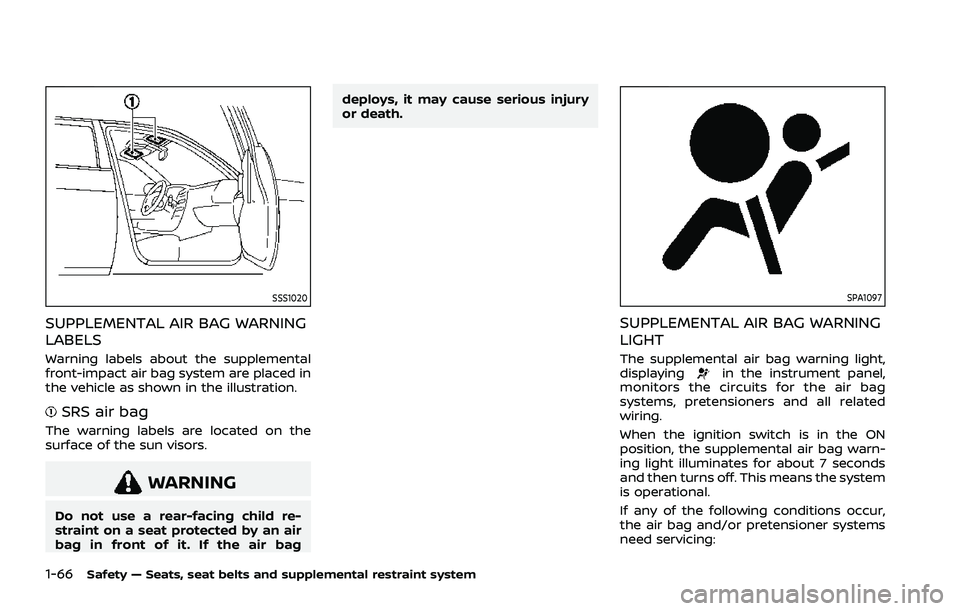
SUPPLEMENTAL AIR BAG WARNING
LABELS
Warning labels about the supplemental
front-impact air bag system are placed in
the vehicle as shown in the illustration.
SRS air bag
The warning labels are located on the
surface of the sun visors.
WARNING
Do not use a rear-facing child re-
straint on a seat protected by an air
bag in front of it. If the air bagdeploys, it may cause serious injury
or death.
SPA1097
SUPPLEMENTAL AIR BAG WARNING
LIGHT
The supplemental air bag warning light,
displayingin the instrument panel,
monitors the circuits for the air bag
systems, pretensioners and all related
wiring.
When the ignition switch is in the ON
position, the supplemental air bag warn-
ing light illuminates for about 7 seconds
and then turns off. This means the system
is operational.
If any of the following conditions occur,
the air bag and/or pretensioner systems
need servicing:
Page 166 of 556
2-78Instruments and controls
WARNING
.Never put anything on the cargo
cover, no matter how small. Any
object on it could cause an injury
in an accident or sudden stop.
. Do not leave the cargo cover in
the vehicle with it disengaged
from the holder.
. The child restraint top tether
strap may be damaged by con-
tact with the cargo cover or items
in the luggage area. Remove the
cargo cover from the vehicle or
secure it in the luggage area. Also
secure any items in the luggage
area. Your child could be seriously
injured or killed in a collision if the
top tether strap is damaged.
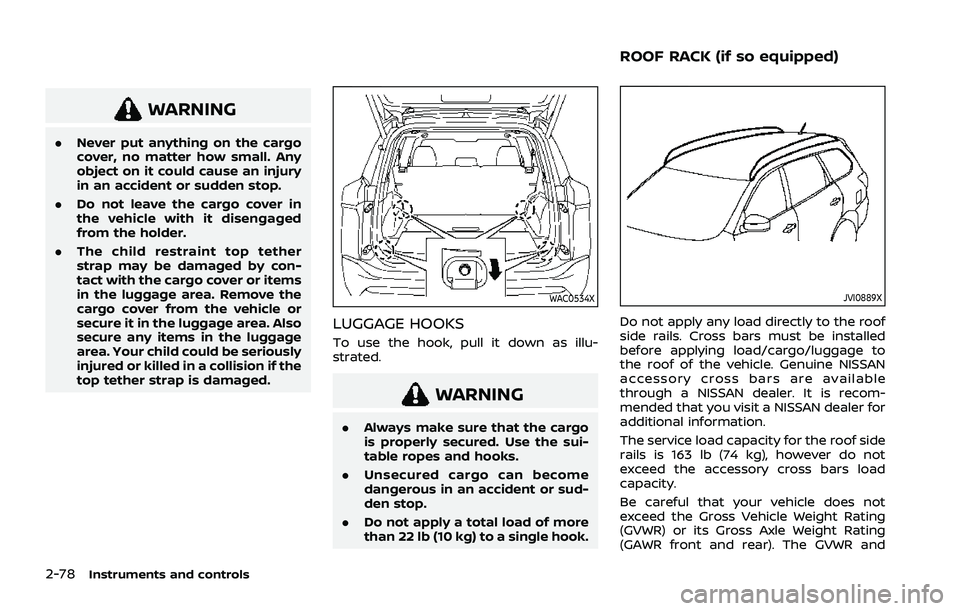
WAC0534X
LUGGAGE HOOKS
To use the hook, pull it down as illu-
strated.
WARNING
.Always make sure that the cargo
is properly secured. Use the sui-
table ropes and hooks.
. Unsecured cargo can become
dangerous in an accident or sud-
den stop.
. Do not apply a total load of more
than 22 lb (10 kg) to a single hook.
JVI0889X
Do not apply any load directly to the roof
side rails. Cross bars must be installed
before applying load/cargo/luggage to
the roof of the vehicle. Genuine NISSAN
accessory cross bars are available
through a NISSAN dealer. It is recom-
mended that you visit a NISSAN dealer for
additional information.
The service load capacity for the roof side
rails is 163 lb (74 kg), however do not
exceed the accessory cross bars load
capacity.
Be careful that your vehicle does not
exceed the Gross Vehicle Weight Rating
(GVWR) or its Gross Axle Weight Rating
(GAWR front and rear). The GVWR and
ROOF RACK (if so equipped)
Page 171 of 556
WARNING
.In an accident you could be
thrown from the vehicle through
an open moonroof. Always use
seat belts and child restraints.
. Do not allow anyone to stand up
or extend any portion of their
body out of the moonroof open-
ing while the vehicle is in motion
or while the moonroof is closing.
CAUTION
.Remove water drops, snow, ice or
sand from the moonroof before
opening.
. Do not place any heavy object on
the moonroof or surrounding
area.
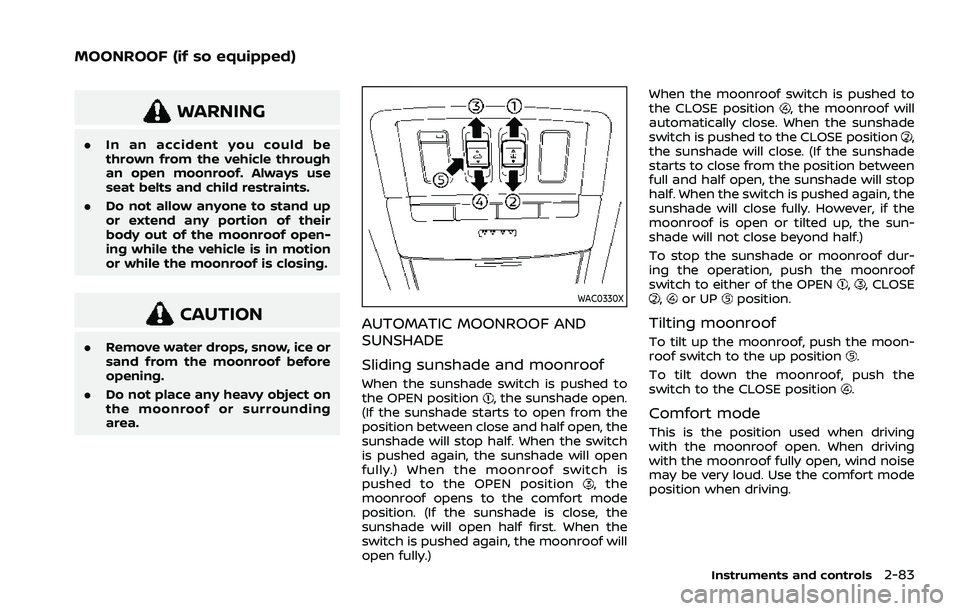
WAC0330X
AUTOMATIC MOONROOF AND
SUNSHADE
Sliding sunshade and moonroof
When the sunshade switch is pushed to
the OPEN position, the sunshade open.
(If the sunshade starts to open from the
position between close and half open, the
sunshade will stop half. When the switch
is pushed again, the sunshade will open
fully.) When the moonroof switch is
pushed to the OPEN position
, the
moonroof opens to the comfort mode
position. (If the sunshade is close, the
sunshade will open half first. When the
switch is pushed again, the moonroof will
open fully.) When the moonroof switch is pushed to
the CLOSE position
, the moonroof will
automatically close. When the sunshade
switch is pushed to the CLOSE position
,
the sunshade will close. (If the sunshade
starts to close from the position between
full and half open, the sunshade will stop
half. When the switch is pushed again, the
sunshade will close fully. However, if the
moonroof is open or tilted up, the sun-
shade will not close beyond half.)
To stop the sunshade or moonroof dur-
ing the operation, push the moonroof
switch to either of the OPEN
,, CLOSE,or UPposition.
Tilting moonroof
To tilt up the moonroof, push the moon-
roof switch to the up position.
To tilt down the moonroof, push the
switch to the CLOSE position
.
Comfort mode
This is the position used when driving
with the moonroof open. When driving
with the moonroof fully open, wind noise
may be very loud. Use the comfort mode
position when driving.
Instruments and controls2-83
MOONROOF (if so equipped)
Page 527 of 556
weight may not safely exceed
the available cargo and luggage
load capacity calculated in Step
4.
Before driving a loaded vehicle,
confirm that you do not exceed
the Gross Vehicle Weight Rating
(GVWR) or the Gross Axle Weight
Rating (GAWR) for your vehicle. (See
“Measurement of weights” (P.10-16).)
Also check tires for proper inflation
pressures. See the Tire and Loading
Information label.
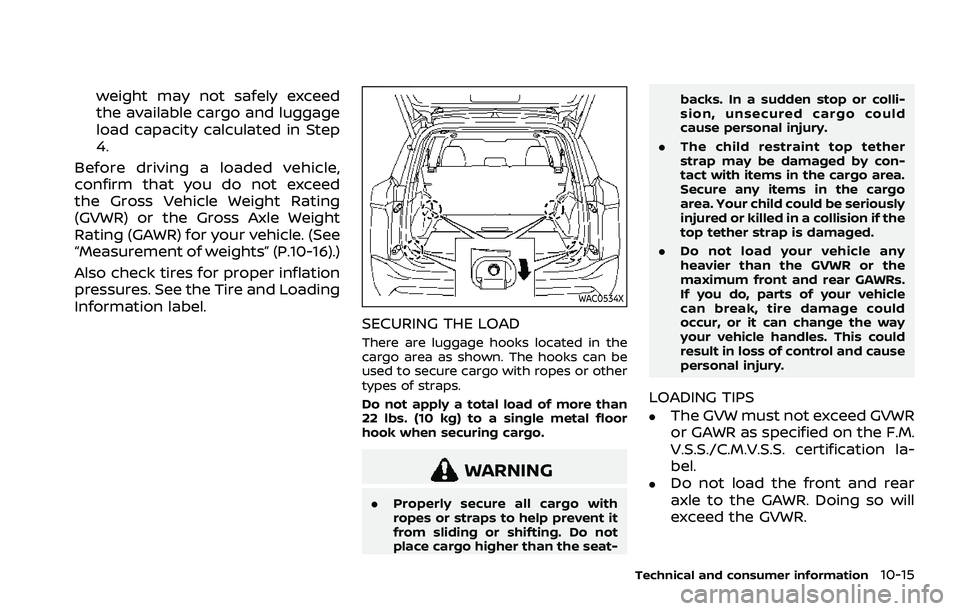
WAC0534X
SECURING THE LOAD
There are luggage hooks located in the
cargo area as shown. The hooks can be
used to secure cargo with ropes or other
types of straps.
Do not apply a total load of more than
22 lbs. (10 kg) to a single metal floor
hook when securing cargo.
WARNING
. Properly secure all cargo with
ropes or straps to help prevent it
from sliding or shifting. Do not
place cargo higher than the seat- backs. In a sudden stop or colli-
sion, unsecured cargo could
cause personal injury.
. The child restraint top tether
strap may be damaged by con-
tact with items in the cargo area.
Secure any items in the cargo
area. Your child could be seriously
injured or killed in a collision if the
top tether strap is damaged.
. Do not load your vehicle any
heavier than the GVWR or the
maximum front and rear GAWRs.
If you do, parts of your vehicle
can break, tire damage could
occur, or it can change the way
your vehicle handles. This could
result in loss of control and cause
personal injury.
LOADING TIPS
.The GVW must not exceed GVWR
or GAWR as specified on the F.M.
V.S.S./C.M.V.S.S. certification la-
bel.
.Do not load the front and rear
axle to the GAWR. Doing so will
exceed the GVWR.
Technical and consumer information10-15
Page 547 of 556
11 Index
A
ABS (Anti-lock Braking System) .................... 5-156
Active Ride Control ................................................. 5-160
Adjustable luggage floor ....................................... 2-72
Advanced Air Bag System .................................... 1-52
Air bag systemAdvanced Air Bag System ............................. 1-52
Driver and front passengersupplemental knee air bag system...... 1-61
Front and rear seat-mounted
side-impact supplemental air
bag system................................................................ 1-63
Front central seat-mounted
side-impact supplemental air
bag system................................................................ 1-63
Front passenger air bag and
status light................................................................. 1-54
Roof-mounted curtain side-impact
supplemental air bag system..................... 1-63
Air bag warning labels ............................................ 1-66
Air bag warning light................................. 1-66, 2-16
Air cleaner housing filter ....................................... 8-15
Air conditioner Air conditioner operation............................... 4-27
Air conditioner service...................................... 4-38
Air conditioner specification label....... 10-11
Air conditioning system refrigerant
and lubricant recommendations............. 4-38
Air conditioning system refrigerant
and oil recommendations ............................. 10-7
Alarm, How to stop alarm (see vehicle
security system)............................................................ 2-51
Alcohol, drugs and driving ................................... 5-11
Alert Rear Door Alert....................................................... 2-65 All-Wheel Drive (AWD) (See
Intelligent 4x4)............................................................ 5-151
Antenna........................................................................\
....... 4-39
Anti-lock Braking System (ABS) .................... 5-156
Anti-lock Braking System (ABS)
warning light ................................................................... 2-17
Appearance care
Exterior appearance care ................................. 7-2
Interior appearance care................................... 7-4
Armrest ........................................................................\
............ 1-9
Audible reminders....................................................... 2-22
AUTO mode...................................................................... 5-32
Automatic Door locks...................................................................... 3-7
Automatic air conditioner
and heater ......................................................... 4-32, 4-35
Automatic brake hold .............................................. 5-28
Automatic Emergency Braking (AEB)
system OFF warning light .................................... 2-17
Automatic Emergency Braking (AEB)
with pedestrian detection system.............. 5-122
Automatic moonroof and sunshade ........... 2-83
Average fuel consumption................................... 2-44
Average speed ............................................................... 2-44
Avoiding collision and rollover.......................... 5-10
AWD (See Intelligent 4x4)................................... 5-151
B
Battery........................................................................\
.......... 8-11 Battery replacement, Intelligent Key ..... 8-20
Battery saver system......................................... 2-61
Variable voltage control system .............. 8-13
Before starting the engine................................... 5-17
Blind Spot Warning (BSW) ..................................... 5-57
Booster seats.................................................................. 1-42 Brake
Anti-lock Braking System (ABS) ............ 5-156
Brake fluid ..................................................................... 8-9
Brake system ....................................................... 5-155
Electronic parking brake system
warning light ............................................................ 2-18
Parking brake .......................................................... 5-25
Warning light............................................................ 2-14
Break-in schedule .................................................... 5-149
Brightness control Instrument panel .................................................. 2-11
Bulb check/instrument panel............................ 2-14
Bulb replacement ........................................................ 8-22
C
Capacities and
recommended fluids/lubricants...................... 10-3
Car phone or CB radio ............................................ 4-39
Card holder....................................................................... 2-77
Cargo cover ..................................................................... 2-77
Cargo light ........................................................................\
2-87
Catalytic converter, Three way catalyst ....... 5-6
Charger USB (Universal Serial Bus)
charging connector............................................ 2-67
Wireless charger .................................................... 2-68
Chassis control........................................................... 5-160
Child restraints .............................................................. 1-23 Booster seats........................................................... 1-42
LATCH system ......................................................... 1-25
Precautions on child restraints................. 1-23
Child safety....................................................................... 1-20
Child safety rear door lock ...................................... 3-7
Page 549 of 556

F
F.M.V.S.S./C.M.V.S.S. certification label ...... 10-10
FilterAir cleaner housing filter ................................ 8-15
Changing engine oil and filter ...................... 8-6
Flashers (See hazard warning
flasher switch).................................................................... 6-2
Flat tire........................................................................\
............. 6-3
Flat towing..................................................................... 10-26
Floor mat cleaning ......................................................... 7-5
Fluid Brake fluid ..................................................................... 8-9
Capacities and
recommended fluids/lubricants............... 10-3
Continuously Variable Transmission
(CVT) fluid....................................................................... 8-8
Engine coolant........................................................... 8-4
Engine oil.....................................................................\
... 8-5
Window washer fluid ............................................ 8-9
Fog light switch ............................................................ 2-62
Forward Driving Aids ................................................ 5-34
Front manual seat adjustment ............................ 1-4
Front passenger air bag and status
light........................................................................\
................. 1-54
Front seat, Front seat adjustment .................... 1-4
Fuel Capacities and
recommended fluids/lubricants............... 10-3
Fuel economy...................................................... 5-150
Fuel information.................................................... 10-4
Fuel octane rating ............................................... 10-4
Fuel-filler door......................................................... 3-29
Gauge........................................................................\
..... 2-10
Fuel Efficient Driving Tips................................... 5-149
Fuses........................................................................\
.............. 8-18 Fusible links...................................................................... 8-18G
Garage mode system............................................... 3-27
Gauge........................................................................\
................ 2-5
Engine coolant temperature gauge......... 2-9
Fuel gauge ................................................................. 2-10
Odometer....................................................................... 2-8
Speedometer .............................................................. 2-8
Tachometer.................................................................. 2-9
General maintenance................................................... 9-2
Glove box ........................................................................\
... 2-75
H
Hazard warning flasher switch ............................ 6-2
Head restraints/headrests....................................... 1-9
Head Up Display (HUD) ............................................ 2-47
Headlights Bulb replacement ................................................. 8-23
Headlight switch ................................................... 2-55
Heated seats ................................................................... 2-63
Heated steering wheel ............................................ 2-63
Heater Heater and air conditioner
operation..................................................................... 4-27
High beam assist ......................................................... 2-59
Hill start assist system ......................................... 5-161
Hood release ................................................................... 3-22
Hook Coat hook................................................................... 2-77
Luggage hook ......................................................... 2-78
Horn........................................................................\
................ 2-63
I
Ignition switch ............................................................... 5-14
Ignition switch positions ....................................... 5-15
Immobilizer system.................................................... 2-51
Indicator Lights..................................................................\
............ 2-17
Vehicle information display.......................... 2-22
indicator light Electronic parking brake warning
light........................................................................\
.......... 2-15
Inside mirror .................................................................... 3-33
Inspection/maintenance (I/M) test ............ 10-29
Instrument brightness control ......................... 2-11
Instrument panel ............................................................. 2-4
Intelligent 4x4 ............................................................. 5-151
Intelligent Around View® Monitor....................... 4-9
Intelligent Auto Headlight system ................. 2-56
Intelligent Blind Spot
Intervention (I-BSI) ...................................................... 5-65
Intelligent Cruise Control (ICC) ......................... 5-97
Intelligent Driver Alertness (I-DA) ................. 5-141
Intelligent Forward Collision Warning
(I-FCW)........................................................................\
........ 5-132
Intelligent Key button operation light ........ 3-17
Intelligent Key system ................................................. 3-7 Key operating range ............................................. 3-9
Key operation .......................................................... 3-11
Remote keyless operation ............................ 3-15
Intelligent Lane Intervention (I-LI) .................. 5-51
Intelligent Trace Control..................................... 5-160
Interior light replacement..................................... 8-23
Interior light switch.................................................... 2-85
Interior lights................................................................... 2-85
ISOFIX child restraint ................................................ 1-25
11-3