stop start NISSAN ROGUE HYBRID 2018 Owners Manual
[x] Cancel search | Manufacturer: NISSAN, Model Year: 2018, Model line: ROGUE HYBRID, Model: NISSAN ROGUE HYBRID 2018Pages: 482, PDF Size: 5.79 MB
Page 10 of 482
HEV Overview
NISSAN PURE DRIVE® Hybrid System.......... HEV-2
Lithium-ion (Li-ion) battery ................... HEV-2
High-voltage cautions ........................ HEV-3
Road accident cautions ...................... HEV-3
Emergency shut-off system ..................HEV-4
Operation of the hybrid system ...............HEV-5
Starting and slow speed driving ...........HEV-5
Medium or high speed driving .............HEV-5
Rapid acceleration .........................HEV-5
Deceleration and braking ..................HEV-6
Stopping ..................................HEV-6
Energy monitors .............................HEV-6
Assist charge gauge .......................HEV-6 Energy Flow (models with Navigation
System)
................................... HEV-7
Fuel Economy .............................HEV-9
Energy/Fuel History
(models with Navigation System) ..........HEV-9
Regenerative brake .......................... HEV-10
Efficient use of your vehicle ...................HEV-11
Approaching Vehicle Sound for Pedestrians
(VSP) system .................................HEV-11
Hybrid vehicle precautions .................. HEV-12
High-voltage components and their
locations ................................. HEV-12
Hybrid vehicle characteristics ............. HEV-13
Page 12 of 482
WARNING
∙ The NISSAN PURE DRIVE® Hybrid Sys-tem uses high voltage up to approxi-
mately 235 volts. The system can be
hot while and af ter starting. Be care-
ful of both the high voltage and the
high temperature. Obey the warning
labels attached to the vehicle.
∙ Never touch, disassemble, remove or replace high-voltage parts, harnesses
and their connectors. High-voltage
harnesses are orange. Touching, dis-
assembling, removing or replacing
those parts and harnesses can cause
severe burns or electric shock that
may result in serious injury or death.
The vehicle high-voltage system has
no user serviceable parts. It is recom-
mended that you visit a NISSAN dealer
for any necessary maintenance. ∙ Never try to remove the service plug
located in the cargo area. The service
plug is used only when the vehicle is
serviced by trained technicians wear-
ing personal protection equipment
and is part of the high-voltage sys-
tem. Touching the service plug can
cause severe burns or electric shock
that may result in serious injury or
death.
WARNING
In case of a collision:
∙ If your vehicle is drivable, pull your ve-hicle off the road, put the transmis-
sion in the P (Park) position, apply the
parking brake and turn the NISSAN
PURE DRIVE® Hybrid System off.
∙ Check to see if there are exposed high-voltage parts and cables. Never
touch the parts and cables. For addi-
tional information on their locations,
refer to “High-voltage components
and their locations” in this section. To
avoid personal injury, never touch
high-voltage wiring, connectors, and
other high-voltage parts, such as the
electric motor inverter and Li-ion bat-
tery. An electric shock may occur if
exposed electric wires are visible
when viewed from inside or outside of
your vehicle. Therefore, never touch
exposed electric wires.
∙ If the vehicle receives a strong impact to the floor while driving, stop the ve-
hicle in a safe location and check the
floor.
HIGH-VOLTAGE CAUTIONS ROAD ACCIDENT CAUTIONS
HEV OverviewHEV-3
Page 14 of 482
To start the NISSAN PURE DRIVE® Hybrid
System, depress the brake pedal and place
the ignition switch in the ON position when
the transmission is in the P (Park) position.
CAUTION
Do not start the system in the N (Neu-
tral) position under cold condition of
the system. Start in the P (Park) position
in that case.
The READY to drive indicator light
flashes until the hybrid system is ready to
drive.
If starting in a low temperature environ-
ment, the flashing time of the READY to
drive indicator light
becomes longer.
It cannot move out from the P (Park) range
during flashing.
When the READY to drive indicator
light
illuminates, the vehicle can be
driven, even if the gasoline engine is not
running.
NOTE:
The gasoline engine starts and stops au-
tomatically. It may stop during decelera-
tion or when the vehicle is stopped. The gasoline engine may automatically
run in the following conditions:
∙ The level of remaining charge in the Li- ion battery is low. The engine runs to
charge the Li-ion battery and to provide
power to drive the vehicle.
∙ The temperature of the engine coolant is low.
∙ When the A/C is used.
∙ When opening the door.
∙ When the engine hood is opened.
∙ When applying the brakes.
∙ Based on driving conditions.
∙ The shif t lever is moved to the P (Park) position, the driver’s seat belt is re-
leased and the driver’s side door is then
opened.
The hybrid system operates as follows
based on driving conditions and the Li-ion
battery charge.
The engine is hard to stop during these
driving conditions:
∙ When the A/C is on and outside tem- perature is high/low. ∙ When repeatedly starting and stopping
the engine.
STARTING AND SLOW SPEED
DRIVING
In some cases, the vehicle can be driven by
the electric motor during extremely slow
speed creep, but the engine starts when
accelerating or releasing the brakes.
MEDIUM OR HIGH SPEED DRIVING
The system automatically controls the
gasoline engine and electric motor in order
to obtain the optimum fuel mileage and
performance, depending on the driving
situation and available Li-ion battery
charge.
When the remaining battery level is low, the
Li-ion battery is charged by the electric
motor that is driven to generate electric
power while the vehicle is driving.
RAPID ACCELERATION
The vehicle is accelerated using both the
gasoline engine and the electric motor de-
pending on the available Li-ion battery
charge.
OPERATION OF THE HYBRID SYSTEM
HEV OverviewHEV-5
Page 20 of 482
Drive your vehicle with smooth accelera-
tion and deceleration.∙ While driving, energy is recovered through the regenerative brake as the
vehicle decelerates. However, for most
efficient use, do not accelerate or decel-
erate your vehicle more than neces-
sary.
∙ Avoid abrupt acceleration and decel- eration.
∙ The power of the Li-ion battery can be checked on the Energy Flow in the cen-
ter display (models with Navigation Sys-
tem) or Li-ion battery status meter in
the vehicle information display. For ad-
ditional information, refer to “Energy
Flow (models with Navigation System)”
in this section or “Vehicle information
display” in the “Instruments and con-
trols” section of this manual. Gradual or
non-abrupt acceleration and decelera-
tion will make more effective use of the
electric power.
∙ When parking, be sure to place the shif t lever in the P (Park) position. While driv-
ing, place the shif t lever in the D (Drive)
position. The VSP system is a function that uses
sound to help alert pedestrians of the
presence of the vehicle when it is being
driven at a low speed in the electric drive
mode under the following conditions:
∙ The sound starts when the vehicle starts accelerating.
∙ The sound stops when the vehicle speed is more than 19 mph (30 km/h)
while accelerating only when the ve-
hicle is powered by the electric motor.
∙ The sound starts when the vehicle speed is less than 16 mph (25 km/h)
while decelerating only when the ve-
hicle is powered by the electric motor.
∙ The sound stops when the vehicle stops.
∙ The sound does not stop with the ve- hicle in the R (Reverse) position even if
the vehicle stops.
The VSP system is automatically turned on
when the vehicle is in the READY to drive
mode. If there is a malfunction in the VSP system,
the VSP OFF indicator light in the meter
illuminates. For additional information, re-
fer to “Approaching Vehicle Sound for Pe-
destrians (VSP) OFF indicator light” in the
“Instruments and controls” section of this
manual.
WARNING
∙ If the sound from the VSP system is
not heard while driving, stop the ve-
hicle in a safe and quiet location. Open
a window, and then place the vehicle
in the R (Reverse) position with the
brake pedal firmly depressed. Check
that the operating sound can be
heard from the front side of the
vehicle.
∙ If the sound cannot be heard, it is rec- ommended that you immediately
contact a NISSAN dealer for
inspection.
EFFICIENT USE OF YOUR VEHICLE APPROACHING VEHICLE SOUND FOR PEDESTRIANS (VSP) SYSTEM
HEV OverviewHEV-11
Page 24 of 482
Noise and vibration
Af ter the hybrid system is activated, the
following noises and vibrations that are
unique to the hybrid system may occur.
The following situations do not indicate a
malfunction:∙ Electric motor noise from the engine compartment
∙ Noise from the rear of the vehicle when the hybrid system activates or deacti-
vates
∙ Noise and vibration when the gasoline engine starts running or stops
∙ Operating noise or electric motor noise when releasing the accelerator pedal or
depressing the brake pedal
∙ Engine noise due to rapid acceleration
∙ Fan noise from the air inlet located on the rear parcel shelf
∙ Noise from the climate control system
HEV OverviewHEV-15
Page 93 of 482
NOTE:
This vehicle’s occupant classification
sensor system generally keeps the clas-
sification locked during driving, so it is
important that you confirm that the
front passenger is properly classified
prior to driving. However, the occupant
classification sensor may recalculate the
weight of the occupant under some con-
ditions (both while driving and when
stopped), so front passenger seat occu-
pants should continue to remain seated
as outlined above.
Troubleshooting
If you think the front passenger air bag
status light is incorrect:1. If the light is ON with an adult occupying the front passenger seat:
∙ Occupant is a small adult — the air bag light is functioning as intended. The
front passenger air bag is suppressed. However, if the occupant is not a small
adult, then this may be due to the following
conditions that may be interfering with the
weight sensors:
∙ Occupant is not sitting upright, leaning against the seatback, and centered on
the seat cushion with his/her feet com-
fortably extended to the floor.
∙ A child restraint or other object pressing against the rear of the seatback.
∙ A rear passenger pushing or pulling on the back of the front passenger seat.
∙ Forcing the front seat or seatback against an object on the seat or floor
behind it.
∙ An object placed under the front pas- senger seat.
∙ An object placed between the seat cushion and center console or between
the seat cushion and the door.
If the vehicle is moving, please come to a
stop when it is safe to do so. Check and
correct any of the above conditions. Re-
start the vehicle and wait 1 minute. NOTE:
A system check will be performed during
which the front passenger air bag status
light will remain lit for about 7 seconds
initially.
If the light is still ON af ter this, the person
should be advised not to ride in the front
passenger seat and the vehicle should be
checked as soon as possible. It is recom-
mended that you visit a NISSAN dealer for
this service.
2. If the light is OFF with a small adult, child or child restraint occupying the
front passenger seat.
This may be due to the following con-
ditions that may be interfering with the
weight sensors:
∙ Small adult or child is not sitting upright, leaning against the seatback, and cen-
tered on the seat cushion with his/her
feet comfortably extended to the floor.
∙ The child restraint is not properly in- stalled, as outlined in the “Child re-
straints” section of this manual.
∙ An object weighing over 9.1 lbs. (4 kg) hanging on the seat or placed in the
seatback pocket.
1-58Safety—Seats, seat belts and supplemental restraint system
Page 94 of 482
∙ A child restraint or other object pressingagainst the rear of the seatback.
∙ A rear passenger pushing or pulling on the back of the front passenger seat.
∙ Forcing the front seat or seatback against an object on the seat or floor
behind it.
∙ An object placed under the front pas- senger seat.
∙ An object placed between the seat cushion and center console.
If the vehicle is moving, please come to a
stop when it is safe to do so. Check and
correct any of the above conditions. Re-
start the vehicle and wait 1 minute.
NOTE:
A system check will be performed during
which the front passenger air bag status
light will remain lit for about 7 seconds
initially.
If the light is still OFF af ter this, the small
adult, child or child restraint should be re-
positioned in the rear seat and the vehicle
should be checked as soon as possible. It is
recommended that you visit a NISSAN
dealer for this service. 3. If the light is OFF with no front passen-
ger and no objects on the front pas-
senger seat, the vehicle should be
checked. It is recommended that you
visit a NISSAN dealer as soon as pos-
sible.
Other supplemental front-impact air
bag precautions
WARNING
∙ Do not place any objects on the steer- ing wheel pad or on the instrument
panel. Also, do not place any objects
between any occupant and the steer-
ing wheel or instrument panel. Such
objects may become dangerous pro-
jectiles and cause injury if the front air
bags inflate.
∙ Immediately af ter inflation, several front air bag system components will
be hot. Do not touch them; you may
severely burn yourself.
∙ No unauthorized changes should be made to any components or wiring of
the supplemental air bag system. This
is to prevent accidental inflation of
the supplemental air bag or damage
to the supplemental air bag system. ∙ Do not make unauthorized changes
to your vehicle’s electrical system,
suspension system or front end struc-
ture. This could affect proper opera-
tion of the front air bag system.
∙ Tampering with the front air bag sys- tem may result in serious personal in-
jury. Tampering includes changes to
the steering wheel and the instru-
ment panel assembly by placing ma-
terial over the steering wheel pad and
above the instrument panel or by in-
stalling additional trim material
around the air bag system.
∙ Removing or modif ying the front pas- senger seat may affect the function of
the air bag and result in serious per-
sonal injury.
Safety—Seats, seat belts and supplemental restraint system1-59
Page 112 of 482
CHECKING LIGHTS
With all doors closed, apply the parking
brake, fasten the seat belts and place the
ignition switch in the ON position without
starting the hybrid system. The following
lights (if so equipped) will come on:
,,,,
The following lights (if so equipped) come
on briefly and then go off:
,,,,,,
If any light fails to come on or operate in a
way other than described, it may indicate a
burned-out bulb and/or a system mal-
function. Have the system checked. It is
recommended that you visit a NISSAN
dealer for this service.
Some indicators and warnings are also dis-
played on the vehicle information display
between the speedometer and tachom-
eter. For additional information, refer to “Ve-
hicle information display” in this section.
WARNING LIGHTS
For additional information, refer to “Vehicle
information display” in this section.
12–volt battery chargewarning light
If this light comes on when the READY to
drive indicator light comes on, it may indi-
cate the charging system is not function-
ing properly. Have your vehicle serviced im-
mediately. It is recommended that you visit
a NISSAN dealer for this service.
CAUTION
The charging system may not be func-
tioning properly if the 12–volt battery
charge warning light comes on while
the hybrid system is running. The hy-
brid system will stop operating when
the 12–volt battery becomes dis-
charged. Immediately stop the vehicle
in a safe place and contact a NISSAN
dealer.
orAnti-lock Braking
System (ABS)
warning light
When the ignition switch is placed in the ON
position, the ABS warning light illuminates
and then turns off. This indicates the ABS is
operational.
If the ABS warning light illuminates while
the hybrid system is running, or while driv-
ing, it may indicate the ABS is not function-
ing properly. Have the system checked. It is
recommended that you visit a NISSAN
dealer for this service.
If an ABS malfunction occurs, the anti-lock
function is turned off. The brake system
then operates normally, but without anti-
lock assistance. For additional information,
refer to “Brake system” in the “Starting and
driving” section of this manual.
Automatic EmergencyBraking (AEB) system
warning light (if so
equipped)
This light comes on when the ignition
switch is placed in the ON position. It turns
off af ter the engine is started.
Instruments and controls2-11
Page 113 of 482
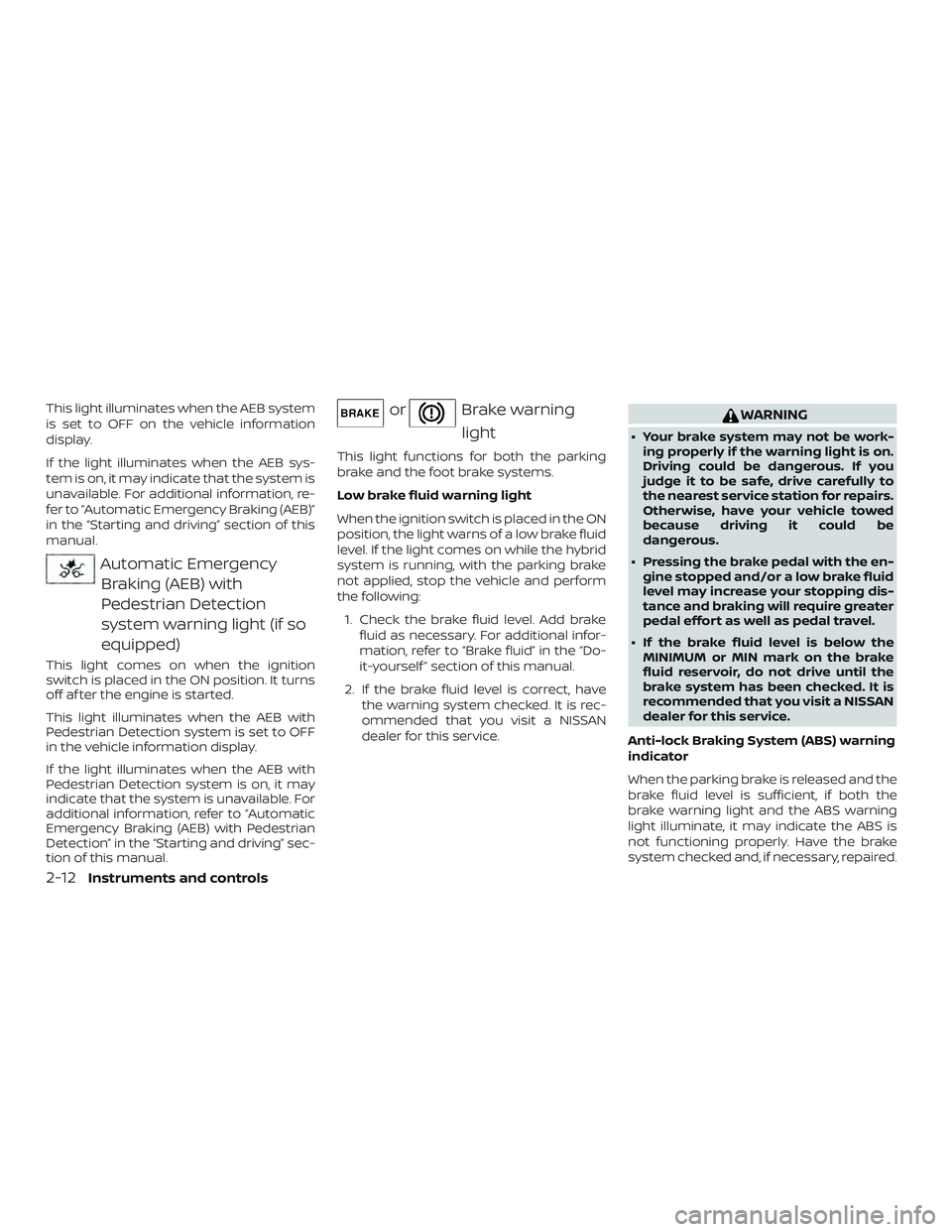
This light illuminates when the AEB system
is set to OFF on the vehicle information
display.
If the light illuminates when the AEB sys-
tem is on, it may indicate that the system is
unavailable. For additional information, re-
fer to “Automatic Emergency Braking (AEB)”
in the “Starting and driving” section of this
manual.
Automatic EmergencyBraking (AEB) with
Pedestrian Detection
system warning light (if so
equipped)
This light comes on when the ignition
switch is placed in the ON position. It turns
off af ter the engine is started.
This light illuminates when the AEB with
Pedestrian Detection system is set to OFF
in the vehicle information display.
If the light illuminates when the AEB with
Pedestrian Detection system is on, it may
indicate that the system is unavailable. For
additional information, refer to “Automatic
Emergency Braking (AEB) with Pedestrian
Detection” in the “Starting and driving” sec-
tion of this manual.
orBrake warning
light
This light functions for both the parking
brake and the foot brake systems.
Low brake fluid warning light
When the ignition switch is placed in the ON
position, the light warns of a low brake fluid
level. If the light comes on while the hybrid
system is running, with the parking brake
not applied, stop the vehicle and perform
the following:
1. Check the brake fluid level. Add brake fluid as necessary. For additional infor-
mation, refer to “Brake fluid” in the “Do-
it-yourself ” section of this manual.
2. If the brake fluid level is correct, have the warning system checked. It is rec-
ommended that you visit a NISSAN
dealer for this service.
WARNING
∙ Your brake system may not be work-ing properly if the warning light is on.
Driving could be dangerous. If you
judge it to be safe, drive carefully to
the nearest service station for repairs.
Otherwise, have your vehicle towed
because driving it could be
dangerous.
∙ Pressing the brake pedal with the en- gine stopped and/or a low brake fluid
level may increase your stopping dis-
tance and braking will require greater
pedal effort as well as pedal travel.
∙ If the brake fluid level is below the MINIMUM or MIN mark on the brake
fluid reservoir, do not drive until the
brake system has been checked. It is
recommended that you visit a NISSAN
dealer for this service.
Anti-lock Braking System (ABS) warning
indicator
When the parking brake is released and the
brake fluid level is sufficient, if both the
brake warning light and the ABS warning
light illuminate, it may indicate the ABS is
not functioning properly. Have the brake
system checked and, if necessary, repaired.
2-12Instruments and controls
Page 114 of 482
It is recommended that you visit a NISSAN
dealer for this service. Avoid high-speed
driving and abrupt braking. For additional
information, refer to “Anti-lock Braking Sys-
tem (ABS) warning light” in this section.
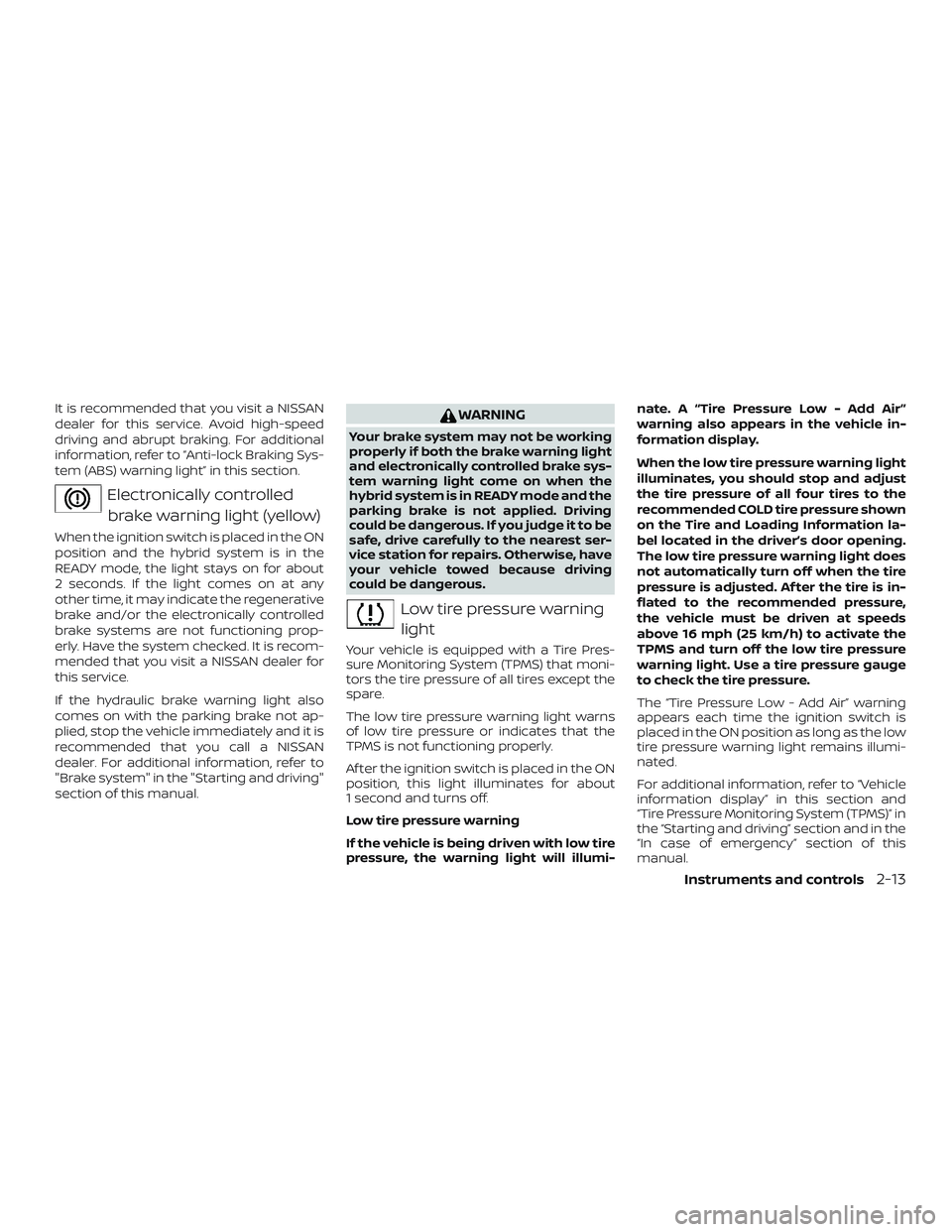
Electronically controlledbrake warning light (yellow)
When the ignition switch is placed in the ON
position and the hybrid system is in the
READY mode, the light stays on for about
2 seconds. If the light comes on at any
other time, it may indicate the regenerative
brake and/or the electronically controlled
brake systems are not functioning prop-
erly. Have the system checked. It is recom-
mended that you visit a NISSAN dealer for
this service.
If the hydraulic brake warning light also
comes on with the parking brake not ap-
plied, stop the vehicle immediately and it is
recommended that you call a NISSAN
dealer. For additional information, refer to
"Brake system" in the "Starting and driving"
section of this manual.
WARNING
Your brake system may not be working
properly if both the brake warning light
and electronically controlled brake sys-
tem warning light come on when the
hybrid system is in READY mode and the
parking brake is not applied. Driving
could be dangerous. If you judge it to be
safe, drive carefully to the nearest ser-
vice station for repairs. Otherwise, have
your vehicle towed because driving
could be dangerous.
Low tire pressure warninglight
Your vehicle is equipped with a Tire Pres-
sure Monitoring System (TPMS) that moni-
tors the tire pressure of all tires except the
spare.
The low tire pressure warning light warns
of low tire pressure or indicates that the
TPMS is not functioning properly.
Af ter the ignition switch is placed in the ON
position, this light illuminates for about
1 second and turns off.
Low tire pressure warning
If the vehicle is being driven with low tire
pressure, the warning light will illumi- nate. A “Tire Pressure Low - Add Air”
warning also appears in the vehicle in-
formation display.
When the low tire pressure warning light
illuminates, you should stop and adjust
the tire pressure of all four tires to the
recommended COLD tire pressure shown
on the Tire and Loading Information la-
bel located in the driver’s door opening.
The low tire pressure warning light does
not automatically turn off when the tire
pressure is adjusted. Af ter the tire is in-
flated to the recommended pressure,
the vehicle must be driven at speeds
above 16 mph (25 km/h) to activate the
TPMS and turn off the low tire pressure
warning light. Use a tire pressure gauge
to check the tire pressure.
The “Tire Pressure Low - Add Air” warning
appears each time the ignition switch is
placed in the ON position as long as the low
tire pressure warning light remains illumi-
nated.
For additional information, refer to “Vehicle
information display” in this section and
“Tire Pressure Monitoring System (TPMS)” in
the “Starting and driving” section and in the
“In case of emergency” section of this
manual.
Instruments and controls2-13