service NISSAN ROGUE SELECT 2015 Owner's Guide
[x] Cancel search | Manufacturer: NISSAN, Model Year: 2015, Model line: ROGUE SELECT, Model: NISSAN ROGUE SELECT 2015Pages: 322, PDF Size: 2.21 MB
Page 282 of 322

9 Technical and consumer information
Capacities and recommended fluids/lubricants ................ 9-2Fuel information ................................................................... 9-3
Engine oil and oil filter recommendation ....................... 9-5
Air conditioning system refrigerant and
lubricant recommendations ............................................... 9-6
Specifications ........................................................................\
..... 9-7
Engine ........................................................................\
............ 9-7
Wheels and tires ................................................................. 9-7
Dimensions and weights ................................................... 9-8
When traveling or registering your vehicle in
another country ........................................................................\
.. 9-8
Vehicle identification ................................................................. 9-8 Vehicle Identification Number (VIN) plate ..................... 9-8
Vehicle identification number (chassis number) .......... 9-9
Engine serial number .......................................................... 9-9
F.M.V.S.S. certification label ............................................. 9-9
Emission control information label ............................... 9-10
Tire and loading information label ................................ 9-10
Air conditioner specification label ................................ 9-10
Installing front license plate ................................................. 9-11 Vehicle loading information ................................................. 9-12
Terms ........................................................................\
......... 9-12
Vehicle load capacity .................................................... 9-13
Securing the load .......................................................... 9-14
Loading tips ..................................................................... 9-15
Measurement of weights .............................................. 9-15
Towing a trailer ....................................................................... 9-16 Maximum load limits ...................................................... 9-16
Maximum Gross Vehicle Weight (GVW)/maximum
Gross Axle Weight (GAW) ......................................... 9-18
Towing load/specification ............................................ 9-20
Towing safety .................................................................. 9-20
Flat towing ....................................................................... 9-24
Uniform tire quality grading ................................................. 9-25 Treadwear ........................................................................\
9-25
Traction AA, A, B and C .............................................. 9-25
Temperature A, B and C .............................................. 9-25
Emission control system warranty ..................................... 9-26
Reporting safety defects ..................................................... 9-26
Readiness for Inspection/Maintenance (I/M) test ......... 9-26
Event Data Recorders (EDR) ............................................. 9-27
Owner’s Manual/Service Manual order information ..... 9-28
Page 284 of 322

FUEL INFORMATION
Use unleaded regular gasoline with an octane
rating of at least 87 AKI (Anti-Knock Index)
number (Research octane number 91) .
CAUTION
.Using a fuel other than that speci-
fied could adversely affect the emis-
sion control system, and may also
affect warranty coverage.
. Under no circumstances should a
leaded gasoline be used, because
this will damage the three-way cat-
alyst.
. Do not use E-15 or E-85 fuel in your
vehicle. Your vehicle is not designed
to run on E-15 or E-85 fuel. Using E-
15 or E-85 fuel in a vehicle not
specifically designed for E-15 or E-
85 fuel can adversely affect the
emission control devices and sys-
tems of the vehicle. Damage caused
by such fuel is not covered by the
NISSAN new vehicle limited war-
ranty.
. U.S. government regulations require
ethanol dispensing pumps to be identified by a small, square, orange
and black label with the common
abbreviation or the appropriate per-
centage for that region.
Gasoline specifications
NISSAN recommends using gasoline that meets
the World-Wide Fuel Charter (WWFC) speci-
fications where it is available. Many of the
automobile manufacturers developed this spe-
cification to improve emission control system
and vehicle performance. Ask your service
station manager if the gasoline meets the
WWFC specifications.
Reformulated gasoline
Some fuel suppliers are now producing refor-
mulated gasolines. These gasolines are specially
designed to reduce vehicle emissions. NISSAN
supports efforts towards cleaner air and sug-
gests that you use reformulated gasoline when
available.
Gasoline containing oxygenates
Some fuel suppliers sell gasoline containing
oxygenates such as ethanol, MTBE and metha-
nol with or without advertising their presence.
NISSAN does not recommend the use of fuels
of which the oxygenate content and the fuel
compatibility for your NISSAN cannot be readilydetermined. If in doubt, ask your service station
manager.
If you use oxygenate-blend gasoline, please take
the following precautions as the usage of such
fuels may cause vehicle performance problems
and/or fuel system damage.
.
The fuel should be unleaded and have
an octane rating no lower than that
recommended for unleaded gasoline.
. If an oxygenate-blend, other than
methanol blend is used, it should
contain no more than 10% oxygenate.
(MTBE may, however, be added up to
15%.)
. E-15 fuel contains more than 10%
oxygenate. E-15 fuel will adversely
affect the emission control devices
and systems of the vehicle and should
not be used. Damage caused by such
fuel is not covered by the NISSAN new
vehicle limited warranty.
. If a methanol blend is used, it should
contain no more than 5% methanol
(methyl alcohol, wood alcohol) . It
should also contain a suitable amount
of appropriate cosolvents and corro-
sion inhibitors. If not properly formu-
lated with appropriate cosolvents and
corrosion inhibitors, such methanol
Technical and consumer information9-3
Page 286 of 322
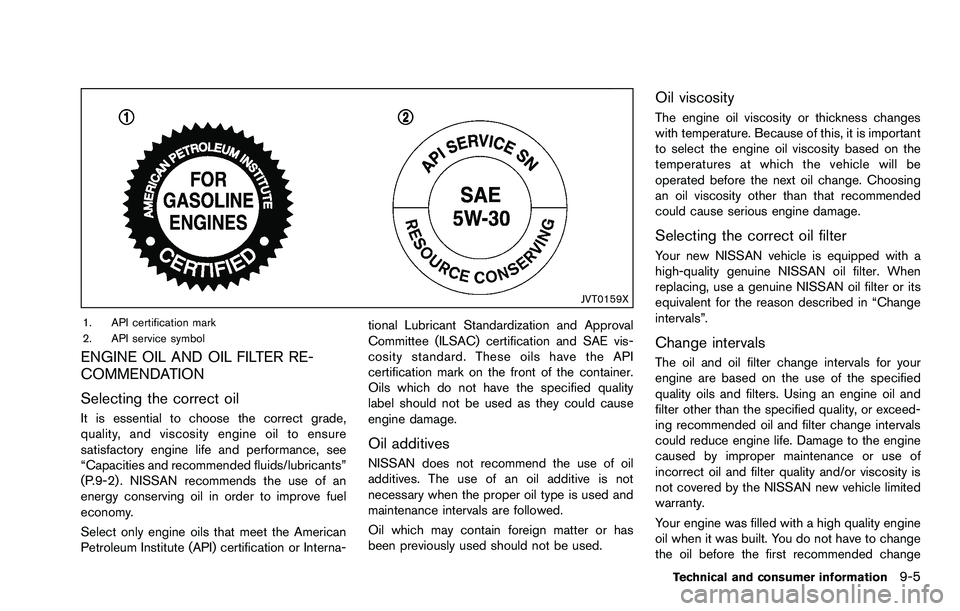
JVT0159X
1. API certification mark
2. API service symbol
ENGINE OIL AND OIL FILTER RE-
COMMENDATION
Selecting the correct oil
It is essential to choose the correct grade,
quality, and viscosity engine oil to ensure
satisfactory engine life and performance, see
“Capacities and recommended fluids/lubricants”
(P.9-2) . NISSAN recommends the use of an
energy conserving oil in order to improve fuel
economy.
Select only engine oils that meet the American
Petroleum Institute (API) certification or Interna-tional Lubricant Standardization and Approval
Committee (ILSAC) certification and SAE vis-
cosity standard. These oils have the API
certification mark on the front of the container.
Oils which do not have the specified quality
label should not be used as they could cause
engine damage.
Oil additives
NISSAN does not recommend the use of oil
additives. The use of an oil additive is not
necessary when the proper oil type is used and
maintenance intervals are followed.
Oil which may contain foreign matter or has
been previously used should not be used.
Oil viscosity
The engine oil viscosity or thickness changes
with temperature. Because of this, it is important
to select the engine oil viscosity based on the
temperatures at which the vehicle will be
operated before the next oil change. Choosing
an oil viscosity other than that recommended
could cause serious engine damage.
Selecting the correct oil filter
Your new NISSAN vehicle is equipped with a
high-quality genuine NISSAN oil filter. When
replacing, use a genuine NISSAN oil filter or its
equivalent for the reason described in “Change
intervals”.
Change intervals
The oil and oil filter change intervals for your
engine are based on the use of the specified
quality oils and filters. Using an engine oil and
filter other than the specified quality, or exceed-
ing recommended oil and filter change intervals
could reduce engine life. Damage to the engine
caused by improper maintenance or use of
incorrect oil and filter quality and/or viscosity is
not covered by the NISSAN new vehicle limited
warranty.
Your engine was filled with a high quality engine
oil when it was built. You do not have to change
the oil before the first recommended change
Technical and consumer information9-5
Page 287 of 322
9-6Technical and consumer information
interval. Oil and filter change intervals depend
upon how you use your vehicle.
Operation under the following conditions may
require more frequent oil and filter changes.
.repeated short distance driving at cold
outside temperatures
. driving in dusty conditions
. extensive idling
. towing a trailer
. stop and go commuting
Refer to the “NISSAN Service and Maintenance
Guide” for the maintenance schedule.
AIR CONDITIONING SYSTEM RE-
FRIGERANT AND LUBRICANT RE-
COMMENDATIONS
The air conditioning system in your
NISSAN vehicle must be charged with the
refrigerant HFC-134a (R-134a) and the oil,
NISSAN A/C system oil Type S or the exact
equivalents.
CAUTION
The use of any other refrigerant or oil
will cause severe damage to the air
conditioning system and will require
the replacement of all air conditioner system components.
The refrigerant HFC-134a (R-134a) in your
NISSAN vehicle will not harm the earth’s ozone
layer. Although this refrigerant does not affect
the earth’s atmosphere, certain governmental
regulations require the recovery and recycling of
any refrigerant during automotive air condition-
ing system service. A NISSAN dealer has the
trained technicians and equipment needed to
recover and recycle your air conditioning system
refrigerant.
Contact a NISSAN dealer when servicing your
air conditioning system.
Page 304 of 322
6. Turn off the engine.
To drive away:
1. Apply and hold the brake pedal.
2. Start the engine.
3. Shift the transmission into gear.
4. Release the parking brake.
5. Drive slowly until the vehicle and trailer areclear from the blocks.
6. Apply and hold the brake pedal.
7. Have someone retrieve and store the blocks.
. When going down a hill, shift into a lower
gear and use the engine braking effect.
When going up a long grade, downshift the
transmission to a lower gear and reduce
speed to reduce chances of engine over-
loading and/or overheating.
. If the engine coolant rises to an extremely
high temperature when the air conditioning
system is on, turn off the air conditioner.
Coolant heat can be additionally vented by
opening the windows, switching the fan
control to high and setting the temperature
control to the HOT position.
. Trailer towing requires more fuel than normal
circumstances.
. Avoid towing a trailer for the first 500 miles
(800 km) . .
Have your vehicle serviced more often than
at intervals specified in the recommended
maintenance schedule in the NISSAN Ser-
vice and Maintenance Guide.
. When making a turn, your trailer wheels will
be closer to the inside of the turn than your
vehicle wheels. To compensate for this,
make a larger than normal turning radius
during the turn.
. Crosswinds and rough roads will adversely
affect vehicle/trailer handling, possibly caus-
ing vehicle sway. When being passed by
larger vehicles, be prepared for possible
changes in crosswinds that could affect
vehicle handling. If swaying does occur,
firmly grip the steering wheel, steer straight
ahead, and immediately (but gradually)
reduce vehicle speed. This combination will
help stabilize the vehicle. Never increase
speed.
Do the following if the trailer begins to sway:
1. Take your foot off the accelerator pedal to allow the vehicle to coast and steer as
straight ahead as the road conditions allow.
This combination will help stabilize the
vehicle.
.Do not correct trailer sway by steering orapplying the brakes. 2. When the trailer sway stops, gently apply
the brakes and pull to the side of the road in
a safe area.
3. Try to rearrange the trailer load so it is balanced as described earlier in this section.
. Be careful when passing other vehicles.
Passing while towing a trailer requires
considerably more distance than normal
passing. Remember the length of the trailer
must also pass the other vehicle before you
can safely change lanes.
. Down shift the transmission to a lower gear
for engine braking when driving down steep
or long hills. This will help slow the vehicle
without applying the brakes.
. Avoid holding the brake pedal down too
long or too frequently. This could cause the
brakes to overheat, resulting in reduced
braking efficiency.
. Increase your following distance to allow for
greater stopping distances while towing a
trailer. Anticipate stops and brake gradually.
. Do not use cruise control (if so equipped)
while towing a trailer.
. Some states or provinces have specific
regulations and speed limits for vehicles
that are towing trailers. Obey the local
speed limits.
Technical and consumer information9-23
Page 306 of 322
DOT (Department Of Transportation) Quality
Grades: All passenger car tires must conform to
federal safety requirements in addition to these
grades.
Quality grades can be found where applicable
on the tire sidewall between tread shoulder and
maximum section width. For example:
Treadwear 200 Traction AA Temperature A
TREADWEAR
The treadwear grade is a comparative rating
based on the wear rate of the tire when tested
under controlled conditions on a specified
government test course. For example, a tire
graded 150 would wear one and one-half
(1 1/2) times as well on the government course
as a tire graded 100. The relative performance
of tires depends upon actual conditions of their
use, however, and may depart significantly from
the norm due to variations in driving habits,
service practices and differences in road char-
acteristics and climate.
TRACTION AA, A, B AND C
The traction grades, from highest to lowest, are
AA, A, B and C. Those grades represent the
tire’s ability to stop on wet pavement as
measured under controlled conditions on spe-
cified government test surfaces of asphalt and
concrete. A tire marked C may have poortraction performance.
WARNING
The traction grade assigned to this tire
is based on straight-ahead braking
traction tests, and does not include
acceleration, cornering, hydroplaning,
or peak traction characteristics.
TEMPERATURE A, B AND C
The temperature grades A (the highest) , B, and
C, representing the tire’s resistance to the
generation of heat and its ability to dissipate
heat when tested under controlled conditions on
a specified indoor laboratory test wheel. Sus-
tained high temperature can cause the material
of the tire to degenerate and reduce tire life, and
excessive temperature can lead to sudden tire
failure. The grade C corresponds to a level of
performance which all passenger car tires must
meet under the Federal Motor Vehicle Safety
Standard No. 109. Grades B and A represent
higher levels of performance on the laboratory
test wheel than the minimum required by law.
WARNING
The temperature grade for this tire is
established for a tire that is properly
inflated and not overloaded. Excessive
speed, under-inflation, or excessive
loading, either separately or in combi-
nation, can cause heat build-up and
possible tire failure.
Technical and consumer information9-25
UNIFORM TIRE QUALITY GRADING
Page 309 of 322
9-28Technical and consumer information
Genuine NISSAN Service Manuals for this
model year and prior can be purchased. A
genuine NISSAN Service Manual is the best
source of service and repair information for your
vehicle. This manual is the same one used by the
factory trained technicians working at NISSAN
dealerships. Genuine NISSAN Owner’s Man-
uals can also be purchased.
For current pricing and availability of genuine
NISSAN Service Manuals,contact:
1-800-450-9491
www.nissan-techinfo.com
For current pricing and availability of genuine
NISSAN Owner’s Manuals, contact:
1-800-247-5321
OWNER’S MANUAL/SERVICE
MANUAL ORDER INFORMATION
Page 312 of 322
10 Index
A
ABS (Anti-lock Braking System) ............................ 5-25
Advanced air bag system ......................................... 1-47
Air bag systemAdvanced air bag system .................................. 1-47
Front passenger air bag and status light ...... 1-48
Front-seat mounted side-impact
supplemental air bag system ............................ 1-51
Roof-mounted curtain side-impact and
rollover supplemental air bag system ............. 1-51
Air bag warning labels .............................................. 1-54
Air bag warning light ..................................... 1-54, 2-14
Air cleaner housing filter ........................................... 8-16
Air conditioner Air conditioner operation ...................................... 4-8
Air conditioner service ....................................... 4-11
Air conditioner specification label ................... 9-10
Air conditioning system refrigerant and
lubricant recommendations ...................... 4-11, 9-6
Alarm, How to stop alarm (see vehicle
security system) .......................................................... 2-26
Alcohol, drugs and driving ......................................... 5-7
All-wheel drive (AWD) .............................................. 5-20
All-wheel drive (AWD) warning light ..................... 2-10
Antenna ......................................................................... 4-38
Anti-lock Braking System (ABS) ............................ 5-25
Anti-lock braking system (ABS) warning light .... 2-10
Appearance care Exterior appearance care ..................................... 7-2
Interior appearance care ....................................... 7-4
Audible reminders ...................................................... 2-16
Audio operation precautions ................................... 4-12
Audio system ............................................................... 4-12 Steering wheel audio controls ......................... 4-37 Automatic
Door locks ................................................................ 3-4
Average speed (MPH or km/h) .............................. 2-22
Avoiding collision and rollover .................................. 5-5
B
Back door (See lift gate) .......................................... 3-10
Battery ........................................................................... 8-13 Battery replacement, Key fob ........................... 8-22
Battery saver system .......................................... 2-30
Key fob battery replacement ............................ 8-22
Before starting the engine ....................................... 5-10
Belts (See drive belts) .............................................. 8-14
Bluetooth
ŠHands-Free Phone System ................ 4-40
Booster seats .............................................................. 1-37
Brake Anti-lock Braking System (ABS) ..................... 5-25
Brake fluid ............................................................. 8-11
Brake system ........................................................ 5-25
Parking brake operation ..................................... 5-16
Warning light ........................................................ 2-11
Break-in schedule ....................................................... 5-19
Brightness control Instrument panel ..................................................... 2-8
Bulb check/instrument panel ................................... 2-10
Bulb replacement ....................................................... 8-24
C
Capacities and recommended fluids/lubricants ... 9-2
Car phone or CB radio ............................................. 4-39
Cargo cover ................................................................. 2-36
Cargo light ................................................................... 2-44
Catalytic converter, Three way catalyst .................. 5-3
CD/CF/USB memory care and cleaning ............. 4-37 Ceiling light .................................................................. 2-43
Child restraints ............................................................ 1-21
Booster seats ....................................................... 1-37
LATCH system ..................................................... 1-23
Precautions on child restraints ........................ 1-21
Child safety .................................................................. 1-19
Child safety rear door lock ........................................ 3-5
Chimes, Audible reminders ...................................... 2-16
Circuit breaker, Fusible link ..................................... 8-20
Cleaning exterior and interior ........................... 7-2, 7-4
Clock ................................................................. 4-23, 4-30
Coat hooks ................................................................... 2-38
Cold weather driving ................................................. 5-28
Compact Disc (CD) player (See
audio system) .................................................. 4-24, 4-32
Console box ................................................................. 2-35
Continuously Variable Transmission
(CVT) fluid .................................................................... 8-11
Controls, Steering wheel audio controls .............. 4-37
Coolant Capacities and
recommended fluids/lubricants ........................... 9-2
Changing engine coolant ..................................... 8-8
Checking engine coolant level ............................ 8-8
Corrosion protection .................................................... 7-6
Cover, Cargo cover ................................................... 2-36
Cruise control .............................................................. 5-17
Cup holders ................................................................. 2-32
CVT, Driving with CVT (Continuously
Variable Transmission) ..................................... 5-9, 5-12D
Defroster switch, Rear window
defroster switch .......................................................... 2-29
Dimensions and weights ............................................ 9-8
Page 315 of 322
10-4
Operation, Indicators for operation ........................ 2-19
Outside air temperature ............................................ 2-17
Outside mirrors ........................................................... 3-14
Overdrive OFF switch ............................................... 5-15
Overheat, If your vehicle overheats ....................... 6-11
Owner’s Manual/Service Manual
order information ......................................................... 9-28
P
Panic alarm .................................................................... 3-7
ParkingBrake break-in ...................................................... 5-25
Parking brake operation ..................................... 5-16
Parking on hills ..................................................... 5-23
Phone Bluetooth
ŠHands-Free Phone System ......... 4-40
Car phone or CB radio ...................................... 4-39
Power Electric power steering system ....................... 5-24
Power door lock ..................................................... 3-3
Power outlet .......................................................... 2-31
Power windows .................................................... 2-39
Precautions Audio operation .................................................... 4-12
Braking precautions ............................................ 5-25
Child restraints ..................................................... 1-21
Cruise control ....................................................... 5-17
Driving safety ........................................................... 5-7
Maintenance ............................................................. 8-5
On-pavement and off-road driving ..................... 5-6
Seat belt usage ....................................................... 1-9
Supplemental restraint system ......................... 1-41
When starting and driving .................................... 5-2
Push starting ................................................................ 6-11
R
Radio ............................................................................. 4-12 Car phone or CB radio ...................................... 4-39
FM-AM radio with Compact Disc
(CD) player ............................................................ 4-22
Steering wheel audio controls ......................... 4-37
Range (distance to empty) ...................................... 2-23
Rapid air pressure loss ............................................... 5-6
Readiness for inspection/maintenance
(I/M) test ....................................................................... 9-26
Rear center seat belt ................................................. 1-15
Rear door lock, Child safety rear door lock .......... 3-5
Rear seats ...................................................................... 1-4
Rear window defroster switch ................................ 2-29
Rear window wiper and washer switch ............... 2-28
RearView Monitor ......................................................... 4-2
Recorders, Event data ............................................... 9-27
Registering your vehicle in another country .......... 9-8
Remote keyless entry system .................................... 3-5
Reporting safety defects .......................................... 9-26
Rollover ........................................................................... 5-5
Roof Roof rack ............................................................... 2-38
S
SafetyChild seat belts .................................................... 1-19
Towing safety ........................................................ 9-20
Satellite radio operation ............................................ 4-31
Seat adjustment Front manual seat adjustment ............................. 1-3
Front seats ............................................................... 1-3
Seat belt(s) Child safety ........................................................... 1-19
Infants ..................................................................... 1-20 Injured persons .................................................... 1-11
Larger children ..................................................... 1-20
Precautions on seat belt usage .......................... 1-9
Pregnant women .................................................. 1-11
Rear center seat belt .......................................... 1-15
Seat belt cleaning .................................................. 7-6
Seat belt extenders ............................................. 1-18
Seat belt hooks .................................................... 1-15
Seat belt maintenance ....................................... 1-18
Seat belt warning light ....................................... 2-13
Seat belts ................................................................. 1-9
Seat belts with pretensioners .......................... 1-52
Shoulder belt height adjustment ..................... 1-14
Small children ....................................................... 1-20
Three-point type .................................................. 1-11
Seat(s) Seats .......................................................................... 1-2
Security system (NISSAN Vehicle Immobilizer
System) , Engine start ................................................ 2-26
Security system, Vehicle security system ............. 2-24
Servicing air conditioner ........................................... 4-11
Settings ......................................................................... 2-23
Shift lever, Shift lock release ................................... 5-16
Shift lock release Transmission ......................................................... 5-16
Shifting CVT (Continuously
Variable Transmission) .............................. 5-9, 5-12
Shoulder belt height adjustment ............................ 1-14
Spare tire ............................................................. 8-38, 9-7
Spark plugs .................................................................. 8-15
Sport mode switch ..................................................... 5-14
Starting Before starting the engine ................................ 5-10
Jump starting ........................................................... 6-9
Precautions when starting and driving ............. 5-2
Push starting ......................................................... 6-11