seat adjustment NISSAN SENTRA 2019 Owner´s Manual
[x] Cancel search | Manufacturer: NISSAN, Model Year: 2019, Model line: SENTRA, Model: NISSAN SENTRA 2019Pages: 461, PDF Size: 5.79 MB
Page 176 of 461
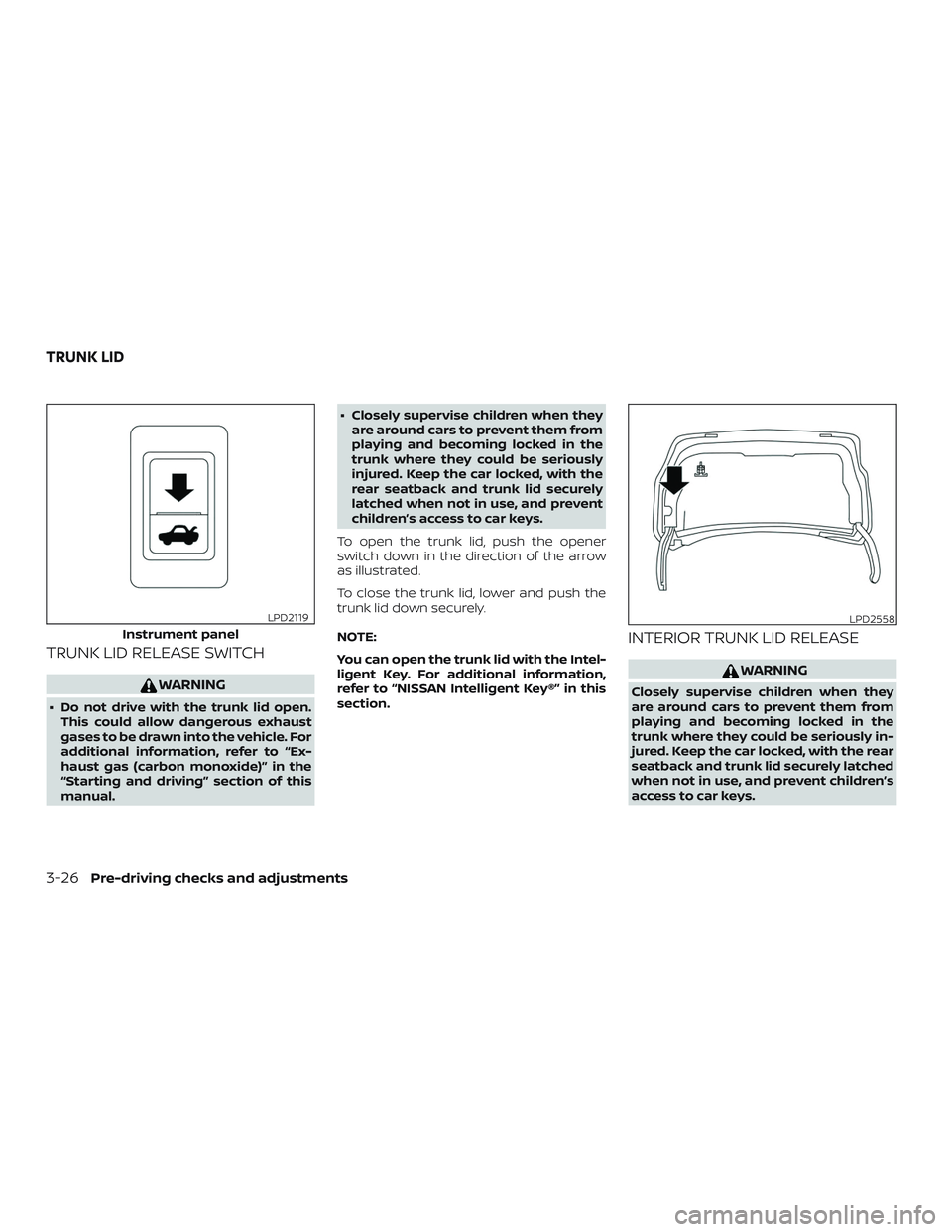
TRUNK LID RELEASE SWITCH
WARNING
∙ Do not drive with the trunk lid open.This could allow dangerous exhaust
gases to be drawn into the vehicle. For
additional information, refer to “Ex-
haust gas (carbon monoxide)” in the
“Starting and driving” section of this
manual. ∙ Closely supervise children when they
are around cars to prevent them from
playing and becoming locked in the
trunk where they could be seriously
injured. Keep the car locked, with the
rear seatback and trunk lid securely
latched when not in use, and prevent
children’s access to car keys.
To open the trunk lid, push the opener
switch down in the direction of the arrow
as illustrated.
To close the trunk lid, lower and push the
trunk lid down securely.
NOTE:
You can open the trunk lid with the Intel-
ligent Key. For additional information,
refer to “NISSAN Intelligent Key®” in this
section.
INTERIOR TRUNK LID RELEASE
WARNING
Closely supervise children when they
are around cars to prevent them from
playing and becoming locked in the
trunk where they could be seriously in-
jured. Keep the car locked, with the rear
seatback and trunk lid securely latched
when not in use, and prevent children’s
access to car keys.
Instrument panel
LPD2119LPD2558
TRUNK LID
3-26Pre-driving checks and adjustments
Page 177 of 461
The interior trunk lid release mechanism
provides a means of escape for children
and adults in the event they become
locked inside the trunk.
To open the trunk from the inside, pull the
illuminated release handle until the lock re-
leases and push up on the trunk lid. The
release handle is made of a material that
glows in the dark af ter a brief exposure to
ambient light.
The handle is located inside the trunk com-
partment on the interior of the trunk lid.
INTERIOR TRUNK ACCESS
The trunk can be accessed from the driv-
er’s side or the passenger side of the rear
seat.1. Move the front seat to the most for- ward position.
2. Pull up on the knob on the rear seat- back.
3. Fold down the driver’s or passenger’s side seatback.
WARNING
∙ Never allow anyone to ride in thecargo area or on the rear seat when it
is in the fold-down position. Use of
these areas by passengers without
proper restraints could result in seri-
ous injury or death in an accident or
sudden stop.
∙ Properly secure all cargo with ropes or straps to help prevent it from sliding
or shif ting. Do not place cargo higher
than the seatbacks. In a sudden stop
or collision, unsecured cargo could
cause personal injury.
∙ When returning the seatbacks to the upright position, be certain they are
completely secured in the latched po-
sition. If they are not completely se-
cured, passengers may be injured in
an accident or sudden stop.
∙ Closely supervise children when they are around cars to prevent them from
playing and becoming locked in the
trunk where they could be seriously
injured. Keep the car locked, with the
rear seatback and trunk lid securely
latched when not in use, and prevent
children’s access to car keys.
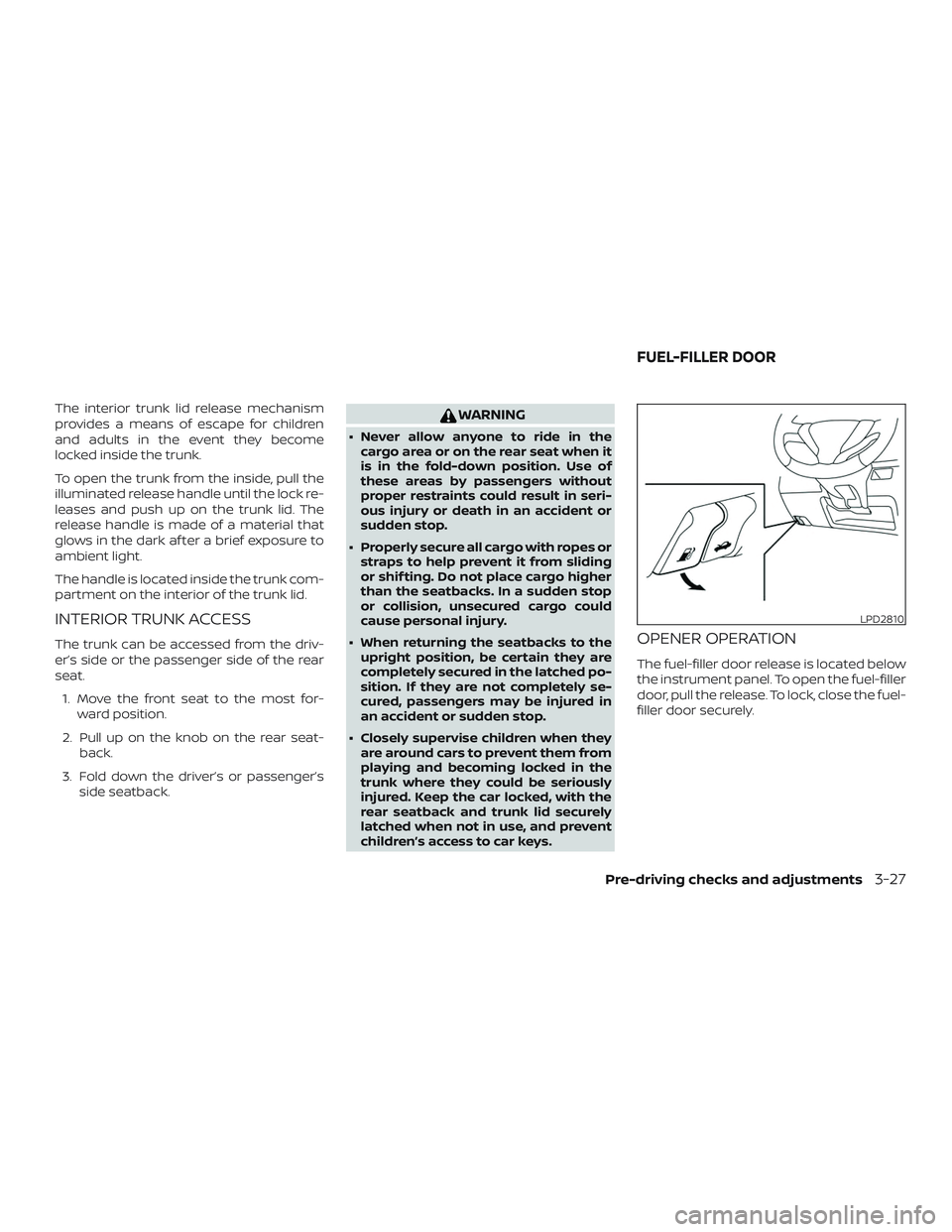
OPENER OPERATION
The fuel-filler door release is located below
the instrument panel. To open the fuel-filler
door, pull the release. To lock, close the fuel-
filler door securely.
LPD2810
FUEL-FILLER DOOR
Pre-driving checks and adjustments3-27
Page 413 of 461
secondary latch keeps the hood from
opening when the primary latch is re-
leased.
When driving in areas using road salt or
other corrosive materials, check lubrica-
tion frequently.
Lights*:Clean the headlights on a regular
basis. Make sure that the headlights, stop
lights, tail lights, turn signal lights, and other
lights are all operating properly and in-
stalled securely. Also check headlight aim.
Road wheel nuts (lug nuts)*: When check-
ing the tires, make sure no wheel nuts are
missing, and check for any loose wheel
nuts. Tighten if necessary.
Tire rotation*: Tires should be rotated ev-
ery 5,000 miles (8,000 km).
Tires*: Check the pressure with a gauge
of ten and always prior to long distance
trips. If necessary, adjust the pressure in all
tires, including the spare, to the pressure
specified. Check carefully for damage, cuts
or excessive wear.
Tire Pressure Monitoring System (TPMS)
transmitter components: Replace the
TPMS transmitter grommet seal, valve core
and cap when the tires are replaced due to
wear or age. Wheel alignment and balance:
If the ve-
hicle should pull to either side while driving
on a straight and level road, or if you detect
uneven or abnormal tire wear, there may
be a need for wheel alignment. If the steer-
ing wheel or seat vibrates at normal high-
way speeds, wheel balancing may be
needed.
For additional information regarding tires,
refer to “Important Tire Safety Information”
(US) or “Tire Safety Information” (Canada) in
the Warranty Information Booklet.
Windshield: Clean the windshield on a
regular basis. Check the windshield at least
every six months for cracks or other dam-
age. Have a damaged windshield repaired
by a qualified repair facility.
Windshield wiper blades*: Check for
cracks or wear if they do not wipe properly.
Inside the vehicle
The maintenance items listed here should
be checked on a regular basis, such as
when performing scheduled maintenance,
cleaning the vehicle, etc.
Accelerator pedal: Check the pedal for
smooth operation and make sure the pedal does not catch or require uneven
effort. Keep the floor mat away from the
pedal.
Brake pedal:
Check the pedal for smooth
operation. If the brake pedal suddenly goes
down further than normal, the pedal feels
spongy or the vehicle seems to take longer
to stop, have your vehicle checked imme-
diately. It is recommended that you visit a
NISSAN dealer for this service. Keep the
floor mat away from the pedal.
Brakes: Check that the brakes do not pull
the vehicle to one side when applied.
Continuously Variable Transmission
(CVT) P (Park) position mechanism (if so
equipped): On a fairly steep hill check that
the vehicle is held securely with the shif t
lever in the P (Park) position without apply-
ing any brakes.
Parking brake: Check the parking brake
operation regularly. The vehicle should be
securely held on a fairly steep hill with only
the parking brake applied. If the parking
brake needs adjustment, it is recom-
mended that you visit a NISSAN dealer for
this service.
Seats: Check seat position controls such
as seat adjusters, seatback recliner, etc., to
Maintenance and schedules9-3
Page 451 of 461
Engine oil viscosity.............10-7
Engine serial number ..........10-12
Engine specifications ...........10-9
Starting the engine ............5-14
Engine Block Heater .............5-78
Engine coolant temperature gauge .....2-7
EventDatarecorders............10-22
Exhaust gas (Carbon monoxide) .......5-2
Explanation of maintenance items .....9-2
Explanation of scheduled maintenance
items .......................9-5
Extended storage switch ..........8-25
Eyeglasscase .................2-53
F
Flashers
(See hazard warning flasher switch) ....6-2
Flattire....................6-3,6-3
Floormatpositioningaid...........7-7
Fluid Brakefluid..................8-12
Capacities and recommended
fuel/lubricants...............10-2
Clutchfluid.................8-12
Continuously Variable Transmission
(CVT) fluid ..................8-11
Engine coolant ...............8-5
Engine oil ...................8-7
F.M.V.S.S. certification label .........10-12
Foglightswitch................2-45
Front air bag system
(See supplemental restraint system) . . .1-50
Front-door pocket ..............2-49
Front power seat adjustment ........1-5Frontseats....................1-2
Fuel
Capacities and recommended
fuel/lubricants...............10-2
Fuel economy ...............5-70
Fuel-filler cap ................3-28
Fuel-filler door lock opener lever ....3-27
Fuel-filler lid .................3-28
Fuel gauge ..................2-8
Fueloctanerating.............10-6
Fuel recommendation ..........10-4
Loose fuel cap warning .......2-6,2-33
Fuel efficient driving tips ...........5-68
Fuel-filler door .................3-27
Fuel gauge ....................2-8
Fuses .......................8-22
Fusiblelinks...................8-23
G
Garage door opener, HomeLink® Universal
Transceiver . .2-62, 2-63, 2-64, 2-65, 2-65, 2-66
Gascap.....................3-28
Gauge Engine coolant temperature gauge. . .2-7
Fuel gauge ..................2-8
Odometer ..................2-5
Speedometer ..............2-4,2-5
Tachometer .................2-7
Trip computer ................2-9
Trip odometer .............2-4,2-5
General maintenance .............9-2
Glovebox....................2-52 H
Hands-free phone system, Bluetooth® . .4-54
Hazardwarningflasherswitch........6-2
Headlight and turn signal switch ......2-40
Headlightcontrolswitch...........2-40
Headlights ...................8-29
Headrestraints..................1-7
Heatedseats..................2-46
Heated seat switches ............2-46
Heater Heater and air conditioner (automatic)
(if so equipped) ..............4-28
Heater and air conditioner controls . .4-21,
4-29
Heater and air conditioner
(manual) ...................4-20
Heater operation ....4-15,4-17,4-22,4-30
Heater and air conditioner (automatic) . .4-28
HomeLink® Universal Transceiver . .2-62, 2-63, 2-64, 2-65, 2-65, 2-66
Hood .......................
3-25
Horn...................... .2-46
I
Ignition switch ..................5-9
Push-button ignition switch .......5-11
Immobilizer system ........2-37,5-10,5-14
Important vehicle information label . . .10-12
In-cabinmicrofilter ..............8-19
Increasing fuel economy ...........5-70
Indicator NISSAN Intelligent Key® battery
discharge indicator ............5-13
11-3
Page 453 of 461
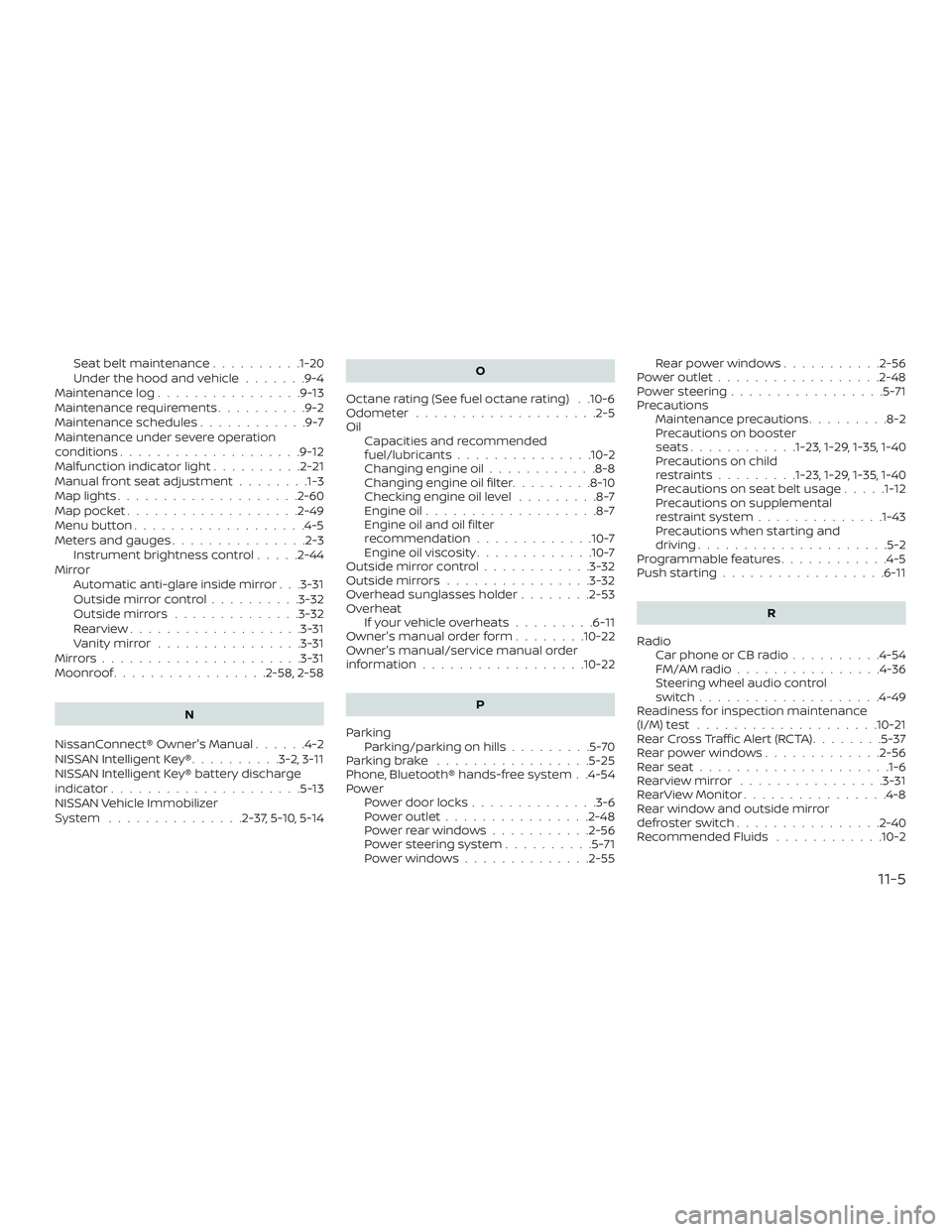
Seat belt maintenance..........1-20
Under the hood and vehicle .......9-4
Maintenance log ................9-13
Maintenance requirements ..........9-2
Maintenance schedules ............9-7
Maintenance under severe operation
conditions....................9-12
Malfunctionindicatorlight..........2-21
Manual front seat adjustment ........1-3
Maplights....................2-60
Map pocket ...................2-49
Menu button ...................4-5
Meters and gauges ...............2-3
Instrument brightness control .....2-44
Mirror Automatic anti-glare inside mirror . . .3-31
Outsidemirrorcontrol..........3-32
Outsidemirrors..............3-32
Rearview...................3-31
Vanitymirror................3-31
Mirrors......................3-31
Moonroof .................2-58,2-58
N
NissanConnect® Owner's Manual ......4-2
NISSAN Intelligent Key® ..........3-2,3-11
NISSAN Intelligent Key® battery discharge
indicator.....................5-13
NISSAN Vehicle Immobilizer
System ...............2-37,5-10,5-14 O
Octane rating (See fuel octane rating) . .10-6
Odometer ....................2-5
Oil Capacities and recommended
fuel/lubricants...............10-2
Changing engine oil ............8-8
Changing engine oil filter .........8-10
Checking engine oil level .........8-7
Engine oil ...................8-7
Engine oil and oil filter
recommendation .............10-7
Engine oil viscosity .............10-7
Outsidemirrorcontrol............3-32
Outsidemirrors................3-32
Overhead sunglasses holder ........2-53
Overheat Ifyourvehicleoverheats.........6-11
Owner's manual order form ........10-22
Owner's manual/service manual order
information..................10-22
P
Parking Parking/parkingonhills.........5-70
Parkingbrake .................5-25
Phone, Bluetooth® hands-free system . .4-54
Power Power door locks ..............3-6
Poweroutlet................2-48
Powerrearwindows...........2-56
Power steering system ..........5-71
Powerwindows..............2-55 Rearpowerwindows...........2-56
Poweroutlet..................2-48
Powersteering.................5-71
Precautions Maintenance precautions .........8-2
Precautions on booster
seats............1-23, 1-29, 1-35, 1-40
Precautions on child
restraints.........1-23, 1-29, 1-35, 1-40
Precautionsonseatbeltusage.....1-12
Precautions on supplemental
restraintsystem..............1-43
Precautions when starting and
driving .....................5-2
Programmable features ............4-5
Push starting ..................6-11
R
Radio Car phone or CB radio ..........4-54
FM/AMradio................4-36
Steering wheel audio control
switch....................4-49
Readiness for inspection maintenance
(I/M) test ....................10-21
RearCrossTrafficAlert(RCTA)........5-37
Rearpowerwindows.............2-56
Rearseat.................... .1-6
Rearviewmirror ................3-31
RearViewMonitor................4-8
Rear window and outside mirror
d
efrosterswitch................2-40
Recommended Fluids ............10-2
11-5
Page 454 of 461
RecordersEventData.................10-22
Refrigerant recommendation ........10-8
Registering a vehicle in another
country .....................10-11
Remote keyless entry system ........3-8
Reporting safety defects (US only) . . . .10-20
S
Safety Child safety rear door lock ........3-7
Childseatbelts .....1-23, 1-29, 1-35, 1-40
Reporting safety defects (US only) . .10-20
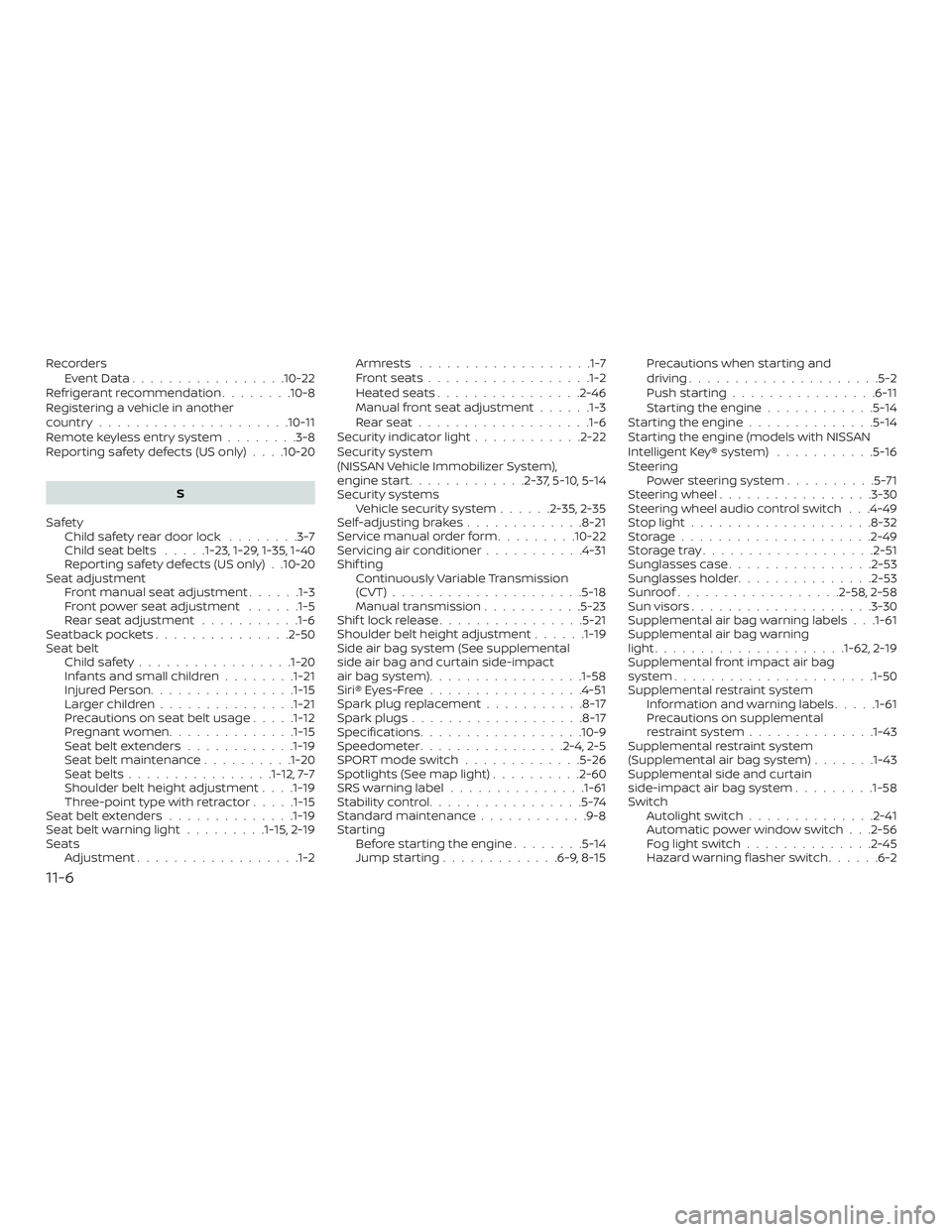
Seat adjustment Front manual seat adjustment ......1-3
Front power seat adjustment ......1-5
Rear seat adjustment ...........1-6
Seatback pockets ...............2-50
Seat belt Childsafety................ .1-20
Infants and small children ........1-21
InjuredPerson............... .1-15
Largerchildren.............. .1-21
Precautions on seat belt usage .....1-12
Pregnant women ..............1-15
Seat belt extenders ............1-19
Seat belt maintenance ..........1-20
Seatbelts................1-12, 7-7
Shoulder belt height adjustment . . . .1-19
Three-pointtypewithretractor.....1-15
Seat belt extenders ..............1-19
Seatbeltwarninglight.........1-15, 2-19
Seats Adjustment ..................1-2 Armrests ...................1-7
Frontseats..................1-2
Heatedseats................2-46
Manual front seat adjustment
......1-3
Rearseat.................. .1-6
Security indicator light ............2-22
Security system
(NISSAN Vehicle Immobilizer System),
engine start.............2-37,5-10,5-14
Security systems Vehicle security system ......2-35,2-35
Self-adjustingbrakes.............8-21
Service manual order form .........10-22
Servicing air conditioner ...........4-31
Shif ting Continuously Variable Transmission
(CVT) .....................5-18
Manual transmission ...........5-23
Shiftlockrelease................5-21
Shoulder belt height adjustment ......1-19
Side air bag system (See supplemental
side air bag and curtain side-impact
airbagsystem)................ .1-58
Siri® Eyes-Free .................4-51
Spark plug replacement ...........8-17
Spark plugs ...................
8-17
Specifications ..................10-9
Speedometer ................2-4,2-5
SPORT mode switch .............5-26
Spotlights(Seemaplight)..........2-60
SRS warning label ...............1-61
Stability control .................5-74
Standard maintenance ............9-8
Starting Before starting the engine ........5-14
Jumpstarting.............6-9,8-15 Precautions when starting and
driving
.....................5-2
Push starting ................6-11
Starting the engine ............5-14
Starting the engine ..............5-14
Starting the engine (models with NISSAN
Intelligent Key® system) ...........5-16
Steering Power steering system ..........5-71
Steering wheel .................3-30
Steering wheel audio control switch . . .4-49
Stoplight....................8-32
Storage.....................2-49
Storagetray...................2-51
Sunglasses case ................2-53
Sunglasses holder ...............2-53
Sunroof ..................2-58, 2-58
Sunvisors....................3-30
Supplemental air bag warning labels . . .1-61
Supplemental air bag warning
light.................... .1-62, 2-19
Supplemental front impact air bag
system..................... .1-50
Supplemental restraint system Information and warning labels .....1-61
Precautions on supplemental
restraintsystem..............1-43
Supplemental restraint system
(Supplemental air bag system) .......1-43
Supplemental side and curtain
side-impact air bag system .........1-58
Switch Autolightswitch..............2-41
Automatic power window switch . . .2-56
Foglightswitch..............2-45
Hazard warning flasher switch ......6-2
11-6