stop start NISSAN SENTRA 2020 Owner´s Manual
[x] Cancel search | Manufacturer: NISSAN, Model Year: 2020, Model line: SENTRA, Model: NISSAN SENTRA 2020Pages: 528, PDF Size: 3.56 MB
Page 417 of 528
TIRE PRESSURE MONITORING
SYSTEM (TPMS)
This vehicle is equipped with TPMS. It moni-
tors tire pressure of all tires except the
spare. When the low tire pressure warning
light is lit, and the “CHECK TIRE PRES” (ve-
hicles without a vehicle information dis-
play) also appears in the trip computer or
the “Tire Pressure Low - Add Air” (vehicles
with a vehicle information display) appears
in the vehicle information display, one or
more of your tires is significantly under-
inflated. If the vehicle is being driven with
low tire pressure, the TPMS will activate and
warn you of it by the low tire pressure warn-
ing light. This system will activate only
when the vehicle is driven at speeds above
16 mph (25 km/h). For additional informa-
tion, refer to “Warning lights, indicator lights
and audible reminders” in the “Instruments
and controls” section, and “Tire Pressure
Monitoring System (TPMS)” in the “Starting
and driving” sections of this manual.
WARNING
• Radio waves could adversely affect
electric medical equipment. Those
who use a pacemaker should contact
the electric medical equipment
manufacturer for the possible influ-
ences before use. •
If the low tire pressure warning light
illuminates while driving, avoid sud-
den steering maneuvers or abrupt
braking, reduce vehicle speed, pull
off the road to a safe location and
stop the vehicle as soon as possible.
Driving with under-inflated tires may
permanently damage the tires and
increase the likelihood of tire failure.
Serious vehicle damage could occur
and may lead to an accident and
could result in serious personal in-
jury. Check the tire pressure for all
four tires. Adjust the tire pressure to
the recommended COLD tire pres-
sure shown on the Tire and Loading
Information label to turn the low tire
pressure warning light OFF. If the
light still illuminates while driving af-
ter adjusting the tire pressure, a tire
may be flat or the TPMS may be mal-
functioning. If you have a flat tire, re-
place it with a spare tire as soon as
possible. If no tire is flat and all tires
are properly inflated, have the ve-
hicle checked. It is recommended
that you visit a NISSAN dealer for this
service. •
When replacing a wheel without
TPMS such as the spare tire, the TPMS
will not function and the low tire
pressure warning light will flash for
approximately one minute. The light
will remain on af ter one minute. Have
your tires replaced and/or TPMS sys-
tem reset as soon as possible. It is
recommended that you visit a
NISSAN dealer for these services.
• Replacing tires with those not origi-
nally specified by NISSAN could af-
fect the proper operation of the
TPMS.
• Do not inject any tire liquid or aerosol
tire sealant into the tires, as this may
cause a malfunction of the tire pres-
sure sensors.
FLAT TIRE
In case of emergency6-3
Page 423 of 528
WARNING
• Always make sure that the spare tire
and jacking equipment are properly
secured af ter use. Such items can be-
come dangerous projectiles in an ac-
cident or sudden stop.
• The spare tire is designed for emer-
gency use. Refer to specific instruc-
tions under the heading “Wheels and
tires” in the “Do-it-yourself ” section
of this manual. To start your engine with a booster battery,
the instructions and precautions below
must be followed.
WARNING
• If done incorrectly, jump starting can
lead to a battery explosion, resulting
in severe injury or death. It could also
damage your vehicle.
• Explosive hydrogen gas is always
present in the vicinity of the battery.
Keep all sparks and flames away
from the battery.
• Do not allow battery fluid to come
into contact with eyes, skin, clothing
or painted surfaces. Battery fluid is a
corrosive sulfuric acid solution which
can cause severe burns. If the fluid
should come into contact with any-
thing, immediately flush the con-
tacted area with water.
• Keep battery out of the reach of
children.
• The booster battery must be rated at
12 volts. Use of an improperly rated
battery can damage your vehicle. •
Whenever working on or near a bat-
tery, always wear suitable eye pro-
tectors (for example, goggles or in-
dustrial safety spectacles) and
remove rings, metal bands, or any
other jewelry. Do not lean over the
battery when jump starting.
• Do not attempt to jump start a frozen
battery. It could explode and cause
serious injury.
• Your vehicle has an automatic engine
cooling fan. It could come on at any
time. Keep hands and other objects
away from it.
JUMP STARTING
In case of emergency6-9
Page 425 of 528
CAUTION
• Do not push start this vehicle. The
three-way catalyst may be
damaged.
• Continuously Variable Transmission
(CVT) models and Manual Transmis-
sion (M/T) cannot be push-started or
tow-started. Attempting to do so
may cause transmission damage.
• For Manual Transmission (M/T) mod-
els, never try to start the vehicle by
towing it. When the engine starts, the
forward surge could cause the ve-
hicle to collide with the tow vehicle. If your vehicle is overheating (indicated by
an extremely high temperature gauge
reading), or if you feel a lack of engine
power, detect abnormal noise, etc., take the
following steps.
WARNING
• Do not continue to drive if your ve-
hicle overheats. Doing so could cause
engine damage or a vehicle fire.
• To avoid the danger of being scalded,
never remove the radiator cap while
the engine is still hot. When the radia-
tor cap is removed, pressurized hot
water will spurt out, possibly causing
serious injury.
• Do not open the hood if steam is
coming out.
1. Move the vehicle safely off the road, ap- ply the parking brake and move the shif t
lever to N (Neutral) (manual transmis-
sion) or to P (Park) (CVT).
Do not stop the engine.
2. Turn off the air conditioner (if so equipped). Open all the windows, move
the heater or air conditioner tempera-
ture control to maximum hot and fan
control to high speed. 3. Get out of the vehicle. Look and listen for
steam or coolant escaping from the ra-
diator before opening the hood. (If
steam or coolant is escaping, turn off
the engine.) Do not open the hood fur-
ther until no steam or coolant can be
seen.
4. Open the engine hood.
WARNING
If steam or water is coming from the
engine, stand clear to prevent getting
burned.
5. Visually check drive belts for damage or looseness. Also check if the cooling fan
is running. The radiator hoses and radia-
tor should not leak water. If coolant is
leaking, the water pump belt is missing
or loose, or the cooling fan does not run,
stop the engine.
WARNING
Be careful not to allow your hands, hair,
jewelry or clothing to come into con-
tact with, or get caught in, engine belts
or the engine cooling fan. The engine
cooling fan can start at any time.
PUSH STARTING IF YOUR VEHICLE OVERHEATS
In case of emergency6-11
Page 447 of 528
CHECKING ENGINE OIL LEVEL
1. Park the vehicle on a level surface andapply the parking brake.
2. Start the engine and let it idle until it reaches operating temperature.
3. Turn off the engine. Wait more than 10
minutes for the oil to drain back into
the oil pan.
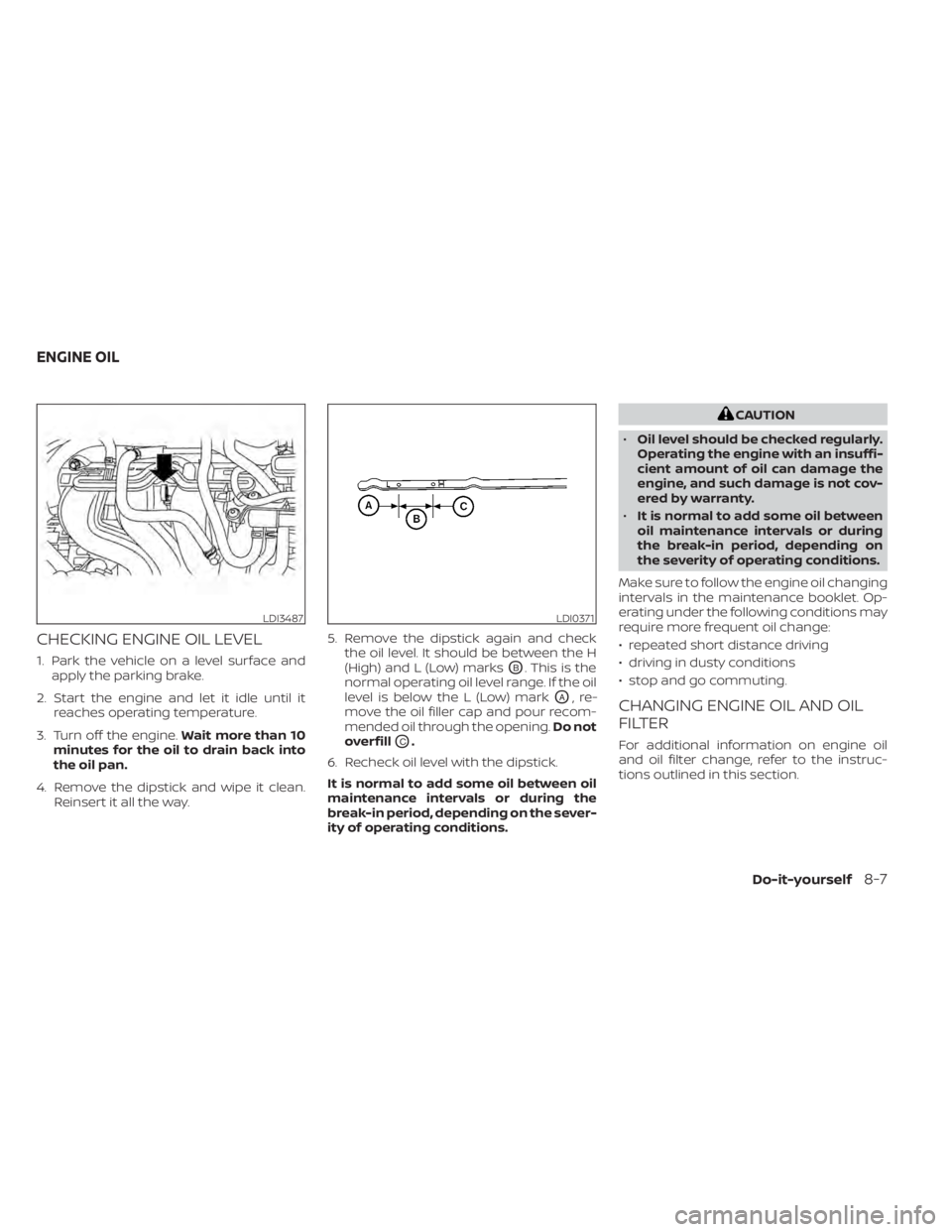
4. Remove the dipstick and wipe it clean. Reinsert it all the way. 5. Remove the dipstick again and check
the oil level. It should be between the H
(High) and L (Low) marksOB. This is the
normal operating oil level range. If the oil
level is below the L (Low) mark
OA,re-
move the oil filler cap and pour recom-
mended oil through the opening. Do not
overfill
OC.
6. Recheck oil level with the dipstick.
It is normal to add some oil between oil
maintenance intervals or during the
break-in period, depending on the sever-
ity of operating conditions.
CAUTION
• Oil level should be checked regularly.
Operating the engine with an insuffi-
cient amount of oil can damage the
engine, and such damage is not cov-
ered by warranty.
• It is normal to add some oil between
oil maintenance intervals or during
the break-in period, depending on
the severity of operating conditions.
Make sure to follow the engine oil changing
intervals in the maintenance booklet. Op-
erating under the following conditions may
require more frequent oil change:
• repeated short distance driving
• driving in dusty conditions
• stop and go commuting.
CHANGING ENGINE OIL AND OIL
FILTER
For additional information on engine oil
and oil filter change, refer to the instruc-
tions outlined in this section.
LDI3487LDI0371
ENGINE OIL
Do-it-yourself8-7
Page 456 of 528
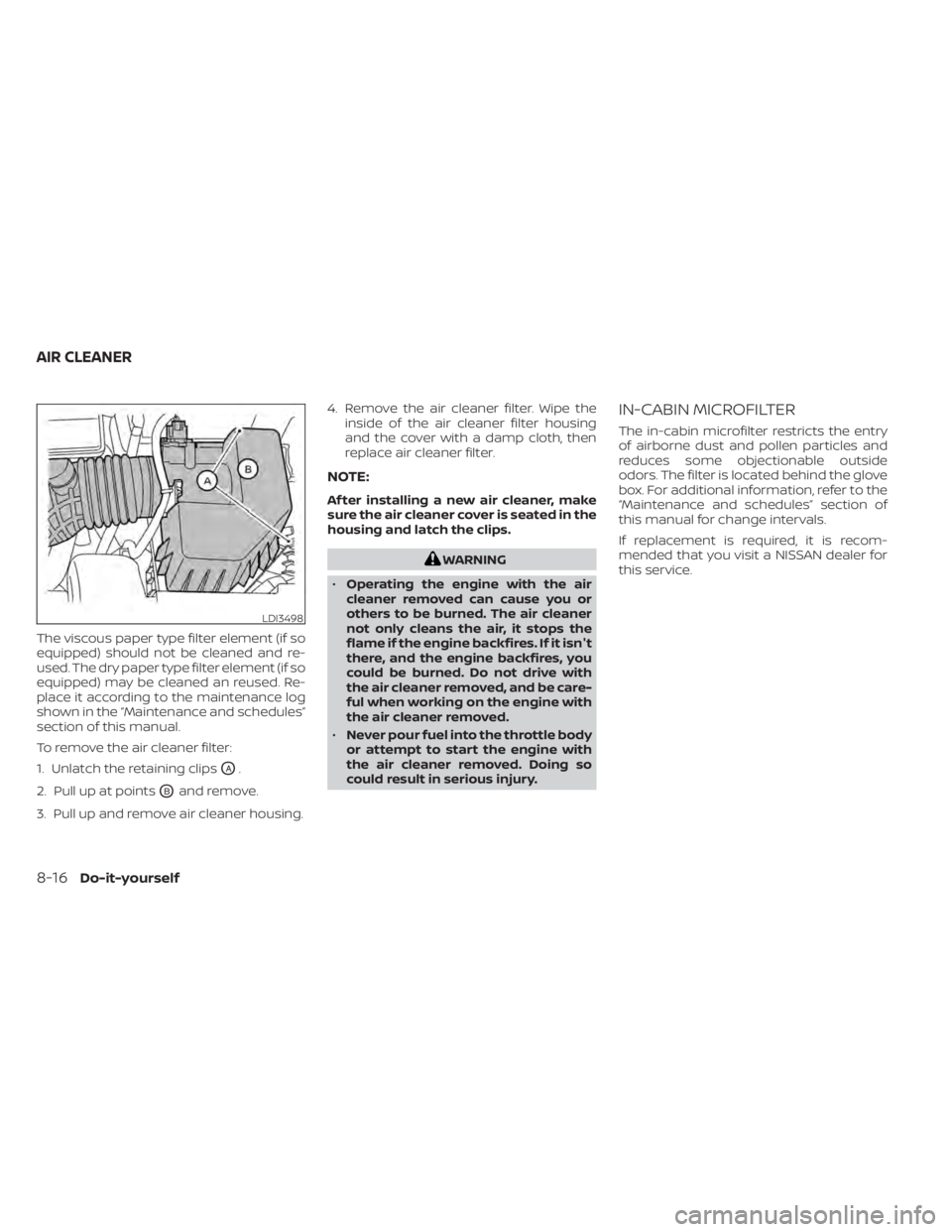
The viscous paper type filter element (if so
equipped) should not be cleaned and re-
used. The dry paper type filter element (if so
equipped) may be cleaned an reused. Re-
place it according to the maintenance log
shown in the “Maintenance and schedules”
section of this manual.
To remove the air cleaner filter:
1. Unlatch the retaining clips
OA.
2. Pull up at points
OBand remove.
3. Pull up and remove air cleaner housing. 4. Remove the air cleaner filter. Wipe the
inside of the air cleaner filter housing
and the cover with a damp cloth, then
replace air cleaner filter.
NOTE:
Af ter installing a new air cleaner, make
sure the air cleaner cover is seated in the
housing and latch the clips.
WARNING
• Operating the engine with the air
cleaner removed can cause you or
others to be burned. The air cleaner
not only cleans the air, it stops the
flame if the engine backfires. If it isn't
there, and the engine backfires, you
could be burned. Do not drive with
the air cleaner removed, and be care-
ful when working on the engine with
the air cleaner removed.
• Never pour fuel into the throttle body
or attempt to start the engine with
the air cleaner removed. Doing so
could result in serious injury.
IN-CABIN MICROFILTER
The in-cabin microfilter restricts the entry
of airborne dust and pollen particles and
reduces some objectionable outside
odors. The filter is located behind the glove
box. For additional information, refer to the
“Maintenance and schedules” section of
this manual for change intervals.
If replacement is required, it is recom-
mended that you visit a NISSAN dealer for
this service.
LDI3498
AIR CLEANER
8-16Do-it-yourself
Page 513 of 528
Manual Transmission (if so
equipped)
• Always tow with the manual transmis-sion in N (Neutral).
• Af ter towing 500 miles (805 km), start and idle the engine with the transmission in N
(Neutral) for two minutes. Failure to idle
the engine af ter every 500 miles (805 km)
of towing may cause damage to internal
transmission parts.
Continuously Variable
Transmission (if so equipped)
To tow a vehicle equipped with a continu-
ously variable transmission, an appropriate
vehicle dolly MUSTbe placed under the
towed vehicle's drive wheels. Alwaysfollow
the dolly manufacturer's recommenda-
tions when using their product. DOT (Department of Transportation) Qual-
ity Grades: All passenger car tires must
conform to federal safety requirements in
addition to these grades.
Quality grades can be found where appli-
cable on the tire sidewall between tread
shoulder and maximum section width. For
example:
Treadwear 200 Traction AA Temperature
A
Treadwear
The treadwear grade is a comparative rat-
ing based on the wear rate of the tire when
tested under controlled conditions on a
specified government test course. For ex-
ample, a tire graded 150 would wear one
and one-half (1 1/2) times as well on the
government course as a tire graded 100.
The relative performance of tires depends
upon the actual conditions of their use,
however, and may depart significantly from
the norm due to variations in driving habits,
service practices and differences in road
characteristics and climate.
Traction AA, A, B and C
The traction grades, from highest to low-
est, are AA, A, B, and C. Those grades repre-
sent the tire's ability to stop on wet pave-ment as measured under controlled
conditions on specified government test
surfaces of asphalt and concrete. A tire
marked C may have poor traction perfor-
mance.
WARNING
The traction grade assigned to this tire
is based on straight-ahead braking
traction tests, and does not include ac-
celeration, cornering, hydroplaning, or
peak traction characteristics.
Temperature A, B and C
The temperature grades are A (the high-
est), B, and C, representing the tire’s resis-
tance to the generation of heat, and its
ability to dissipate heat when tested under
controlled conditions on a specified indoor
laboratory test wheel. Sustained high tem-
perature can cause the material of the tire
to degenerate and reduce tire life, and ex-
cessive temperature can lead to sudden
tire failure. The grade C corresponds to a
level of performance which all passenger
car tires must meet under the Federal Mo-
tor Safety Standard No. 109. Grades B and A
represent higher levels of performance on
the laboratory test wheel than the mini-
mum required by law.
UNIFORM TIRE QUALITY GRADING
Technical and consumer information10-19
Page 517 of 528
11 Index
A
Active Ride Control (ARC).........5-119Air bag (See supplemental restraint
system).....................1-44Air bag system
Front (See supplemental front impact air
bag system)
................1-52Air bag warning labels............1-65Air bag warning light.........1-65, 2-14Air bag warning light,
supplemental..............1-65, 2-14Air cleaner...................8-16Air cleaner housing filter..........8-16Air conditionerAir conditioner operation.....4-35, 4-41Air conditioner service..........4-44Air conditioner specification label. .10-14Air conditioner system refrigerant
recommendations............10-8Air conditioner system refrigerant and oil
recommendations............10-8Heater and air conditioner
controls...............4-33, 4-41Servicing air conditioner........4-44Air flow charts................ .4-37Alarm system (See vehicle security
system)................... .2-52Anchor point locations...........1-28Antenna....................4-64Anti-lock Braking System (ABS)......5-114
Antifreeze...................5-125Armrests.....................1-7Audio system.................4-45AM radio operation............4-51AM radio reception............4-45AM/FM radio............4-49, 4-51Auxiliary (AUX) devices operation. . .4-53Bluetooth® audio.............4-60FM radio operation............4-52FM radio reception............4-45iPod® Player................4-57iPod® player operation..........4-57Radio................... .4-45USB (Universal Serial Bus) Connection
Port.................... .4-54USB Connections.............4-55USB interface...............4-54Autolight switch...............2-56Automatic
Automatic power window switch. . .2-72Automatic anti-glare inside mirror. . . .3-29Automatic door locks.............3-6Automatic Emergency Braking (AEB) with
Pedestrian Detection.........2-9, 5-81
B
Battery.................5- 125, 8-12Charge warning light...........2-10Battery replacement............8-22
Key fob...................8-22NISSAN Intelligent Key®.........8-23Before starting the engine.........5-14Belt (See drive belt)..............8-14Blind Spot Warning (BSW)..........5-35Bluetooth® audio..............4-60Bluetooth® hands-free phone system. .4-67Bluetooth® connections.........4-81Connecting procedure..........4-72Phone indicators.............4-71Text messaging..............4-78Voice commands.............4-73Booster seats.................1-40Brake
Anti-lock Braking System (ABS). . . .5-114Brake fluid.................8-10Brake light (See stop light).......8-26Brake system...............5-114Brake warning light............2-9Brake wear indicators.......2-16,8-18Self-adjusting brakes...........8-18Brake and clutch fluid............8-10Brake Assist.................5-116Brake fluid...................8-10Brake system................5-114Brakes.....................8-18Break-in schedule.............5-109Brightness controlInstrument panel.............2-60Brightness/contrast button.........4-8Bulb check/instrument panel........2-9
Page 520 of 528
Indicator lights and audible reminders
(See warning/indicator lights and audible
reminders)
...................3-16Inside automatic anti-glare mirror. . . .3-29Instrument brightness control.......2-60Instrument panel.............0-6, 2-2Instrument panel dimmer switch.....2-60Intelligent Around View Monitor......4-16Intelligent Cruise Control (ICC).......5-59Intelligent Driver Alertness (I-DA).....5-105Intelligent Forward Collision Warning
(I-FCW)......................5-92Intelligent Key system
Key operating range............3-9Key operation................3-10Mechanical key................3-3Remote keyless entry operation. . . .3-14Troubleshooting guide.......3-18,3-19Warning signals...........3-18,3-19Intelligent Trace Control (I-TC).......5-119Interior light...............2-74,2-75Interior trunk lid release...........3-24iPod® Player................. .4-57ISOFIX child restraints.............1-25
J
Jump starting...............6-9, 8-13
K
Key.........................3-2Key fob battery replacement........8-22
Keyless entry
With Intelligent Key system
(See Intelligent Key system)
.......3-14KeysNISSAN Intelligent Key®........3-2,3-7NISSAN Vehicle Immobilizer System
keys..................... .3-4
L
Labels
Air conditioner specification label. . .10-14C.M.V.S.S. certification label.......10-13Emission control information label. .10-13Engine serial number..........10-13F.M.V.S.S. certification label........10-13Tire and Loading Information label. .10-14Vehicle identification number (VIN). .10-12Vehicle identification number (VIN)
plate.................... .10-12Warning labels (for SRS)..........1-65Lane Departure Warning (LDW).......5-29LATCH (Lower Anchors and Tethers for
CHildren) System...............1-25Launch bar menu...............4-8License plate
Installing the license plate........10-14LightAir bag warning light........1-65, 2-14Brake light (See stop light)........8-26Bulb check/instrument panel......2-9Bulb replacement.............8-26Charge warning light...........2-10
Exterior and Interior lights........8-26Fog light switch...............2-61Fog lights..................8-25Headlight and turn signal switch. . . .2-55Headlight control switch.........2-55Headlights..................8-24Interior light..............2-74,2-75Light bulbs.................8-24Low tire pressure warning light.....2-11Low windshield-washer fluid warning
light................. .2-30, 2-47Spotlights (See map light)........2-75Trunk light..................2-76Warning/indicator lights and audible
reminders..................3-16Lights......................8-24Map lights..................2-75Lock
Child safety rear door lock.........3-7Door locks................. .3-4Fuel-filler door lock opener lever. . . .3-25Glove box lock...............2-67Power door locks..............3-6Trunk lid lock opener lever........3-24Loose fuel cap warning........2-29,2-47Low fuel warning light.........2-29,2-46Low tire pressure warning light.......2-11Low windshield-washer fluid warning
light................... .2-30, 2-47Luggage (See vehicle loading
information)..................10-15
11-4Index
Page 522 of 528
Rear power windows.............2-71Rear seat.....................1-6Rear Sonar System (RSS)..........5-120Rear window and outside mirror defroster
switch..................... .2-55Rearview mirror................3-29RearView Monitor................4-9Recommended Fluids............10-2Recorders
Event Data................ .10-22Refrigerant recommendation.......10-8Registering a vehicle in another
country.................... .10-12Remote Engine Start..........3-20,5-15Reporting safety defects (US only). . . .10-20
S
Safety
Child safety rear door lock.........3-7Child seat belts.....1-23, 1-30, 1-36, 1-41Reporting safety defects (US only). .10-20Seat adjustment
Front manual seat adjustment......1-3Front power seat adjustment.......1-5Rear seat adjustment............1-6Seat beltChild safety..................1-21Infants and small children........1-22Injured person................1-15Larger children...............1-22Precautions on seat belt usage.....1-12Pregnant women..............1-15
Seat belt extenders............1-20Seat belt maintenance..........1-20Seat belts................1-12,7-7Shoulder belt height adjustment. . . .1-19Three-point type with retractor.....1-15Seat belt extenders..............1-20Seat belt warning light.........1-15,2-13Seatback pockets...............2-66SeatsAdjustment..................1-2Armrests....................1-7Front seats..................1-2Heated seats................2-62Manual front seat adjustment......1-3Rear seat.................. .1-6Security system (NISSAN Vehicle Immobilizer
System), engine start.........2-53, 5-14Security systems
Vehicle security system.........2-52Self-adjusting brakes.............8-18Service manual order form........10-22Servicing air conditioner...........4-44Shif t lock release...............5-19Shif tingContinuously Variable Transmission
(CVT)
.....................5-17Manual transmission...........5-22Shoulder belt height adjustment......1-19Siri® Eyes-Free................ .4-64Sonar
Rear system................5-120Spark plug replacement...........8-15Spark plugs...................8-15Specifications................ .10-9
Speedometer................. .2-4Speedometer and odometer........2-4Spotlights (See map light)..........2-75SRS warning label...............1-65Stability control................5-116Standard maintenance.........9-7,9-8Starting
Before starting the engine........5-14Jump starting.............6-9, 8-13Precautions when starting and
driving.................... .5-4Push starting................6-11Starting the engine............5-14Starting the engine..............5-14Starting the engine (models with NISSAN
Intelligent Key® system)...........5-14Steering
Power steering system.........5-113Steering wheel.................3-28Stop light....................8-26Storage.................... .2-66Storage tray..................2-67Sun visors....................3-28Sunglasses case...............2-68Sunglasses holder..............2-68Sunroof...................2-73,7-5Supplemental air bag warning labels. . .1-65Supplemental air bag warning
light................... .1-65, 2-14Supplemental front impact air bag
system..................... .1-52Supplemental restraint system
Information and warning labels.....1-65
11-6Index