light NISSAN TEANA 2008 Service Manual
[x] Cancel search | Manufacturer: NISSAN, Model Year: 2008, Model line: TEANA, Model: NISSAN TEANA 2008Pages: 5121, PDF Size: 69.03 MB
Page 1867 of 5121
![NISSAN TEANA 2008 Service Manual EC-406
< PRECAUTION >[VQ25DE, VQ35DE]
PRECAUTIONS
CAUTION:
Always turn the ignition switch OFF and disconnect the negative battery cable before any repair or
inspection work. The open/short circuit](/img/5/57391/w960_57391-1866.png "NISSAN TEANA 2008 Service Manual EC-406
< PRECAUTION >[VQ25DE, VQ35DE]
PRECAUTIONS
CAUTION:
Always turn the ignition switch OFF and disconnect the negative battery cable before any repair or
inspection work. The open/short circuit")
EC-406
< PRECAUTION >[VQ25DE, VQ35DE]
PRECAUTIONS
CAUTION:
Always turn the ignition switch OFF and disconnect the negative battery cable before any repair or
inspection work. The open/short circuit of related switches, sensors, solenoid valves, etc. will cause
the MI to illuminate.
Always connect and lock the connectors securely after work. A loose (unlocked) connector will
cause the MI to illuminate due to the open circuit. (Be sure the connector is free from water, grease,
dirt, bent terminals, etc.)
Certain systems and components, especially those related to OBD, may use a new style slide-lock-
ing type harness connector. For description and how to disconnect, refer to PG-96, "
Description".
Always to route and secure the harnesses properly after work. The interference of the harness with a
bracket, etc. may cause the MI to illuminate due to the short circuit.
Always connect rubber tubes properly after work. A misconnected or disconnected rubber tube may
cause the MI to illuminate due to the malfunction of the EVAP system or fuel injection system, etc.
Always erase the unnecessary malfunction information (repairs completed) from the ECM and TCM
(Transmission control module) before returning the vehicle to the customer.
General PrecautionsINFOID:0000000003856881
Always use a 12 volt battery as power source.
Never attempt to disconnect battery cables while engine is
running.
Before connecting or disconnecting the ECM harness con-
nector, turn ignition switch OFF and disconnect negative bat-
tery cable. Failure to do so may damage the ECM because
battery voltage is applied to ECM even if ignition switch is
turned OFF.
Before removing parts, turn ignition switch OFF and then dis-
connect battery ground cable.
Never disassemble ECM.
If a battery cable is disconnected, the memory will return to the ECM value.
The ECM will now start to self-control at its initial value. Thus, engine operation can vary slightly in
this case. However, this is not an indication of a malfunction. Never replace parts because of a slight
variation.
If the battery is disconnected, the following emission-related diagnostic information will be lost
within 24 hours.
-Diagnostic trouble codes
-1st trip diagnostic trouble codes
-Freeze frame data
-1st trip freeze frame data
-System readiness test (SRT) codes
-Test values
When connecting ECM harness connector, fasten (B) it
securely with a lever (1) as far as it will go as shown in the fig-
ure.
SEF289H
2: ECM
A : Loosen
PBIB2947E
Page 1868 of 5121
![NISSAN TEANA 2008 Service Manual PRECAUTIONS
EC-407
< PRECAUTION >[VQ25DE, VQ35DE]
C
D
E
F
G
H
I
J
K
L
MA
EC
N
P O
When connecting or disconnecting pin connectors into or
from ECM, never damage pin terminals (bends or break).
Check](/img/5/57391/w960_57391-1867.png "NISSAN TEANA 2008 Service Manual PRECAUTIONS
EC-407
< PRECAUTION >[VQ25DE, VQ35DE]
C
D
E
F
G
H
I
J
K
L
MA
EC
N
P O
When connecting or disconnecting pin connectors into or
from ECM, never damage pin terminals (bends or break).
Check")
PRECAUTIONS
EC-407
< PRECAUTION >[VQ25DE, VQ35DE]
C
D
E
F
G
H
I
J
K
L
MA
EC
N
P O
When connecting or disconnecting pin connectors into or
from ECM, never damage pin terminals (bends or break).
Check that there are not any bends or breaks on ECM pin ter-
minal, when connecting pin connectors.
Securely connect ECM harness connectors.
A poor connection can cause an extremely high (surge) volt-
age to develop in coil and condenser, thus resulting in dam-
age to ICs.
Keep engine control system harness at least 10 cm (4 in) away
from adjacent harness, to prevent engine control system mal-
functions due to receiving external noise, degraded operation
of ICs, etc.
Keep engine control system parts and harness dry.
Before replacing ECM, perform ECM Terminals and Reference
Value inspection and check ECM functions properly. Refer to
EC-357, "
Reference Value".
Handle mass air flow sensor carefully to avoid damage.
Never clean mass air flow sensor with any type of detergent.
Never disassemble electric throttle control actuator.
Even a slight leak in the air intake system can cause serious
incidents.
Never shock or jar the camshaft position sensor (PHASE),
crankshaft position sensor (POS).
After performing each TROUBLE DIAGNOSIS, perform DTC
Confirmation Procedure or Component Function Check.
The DTC should not be displayed in the DTC Confirmation
Procedure if the repair is completed. The Component Func-
tion Check should be a good result if the repair is completed.
PBIB0090E
MEF040D
SAT652J
Page 1882 of 5121
PRECAUTIONS
EM-7
< PRECAUTION >
C
D
E
F
G
H
I
J
K
L
MA
EM
N
P O
Ensure thread and seat surfaces are clean and coated with engine oil.
Precaution for Liquid GasketINFOID:0000000003802233
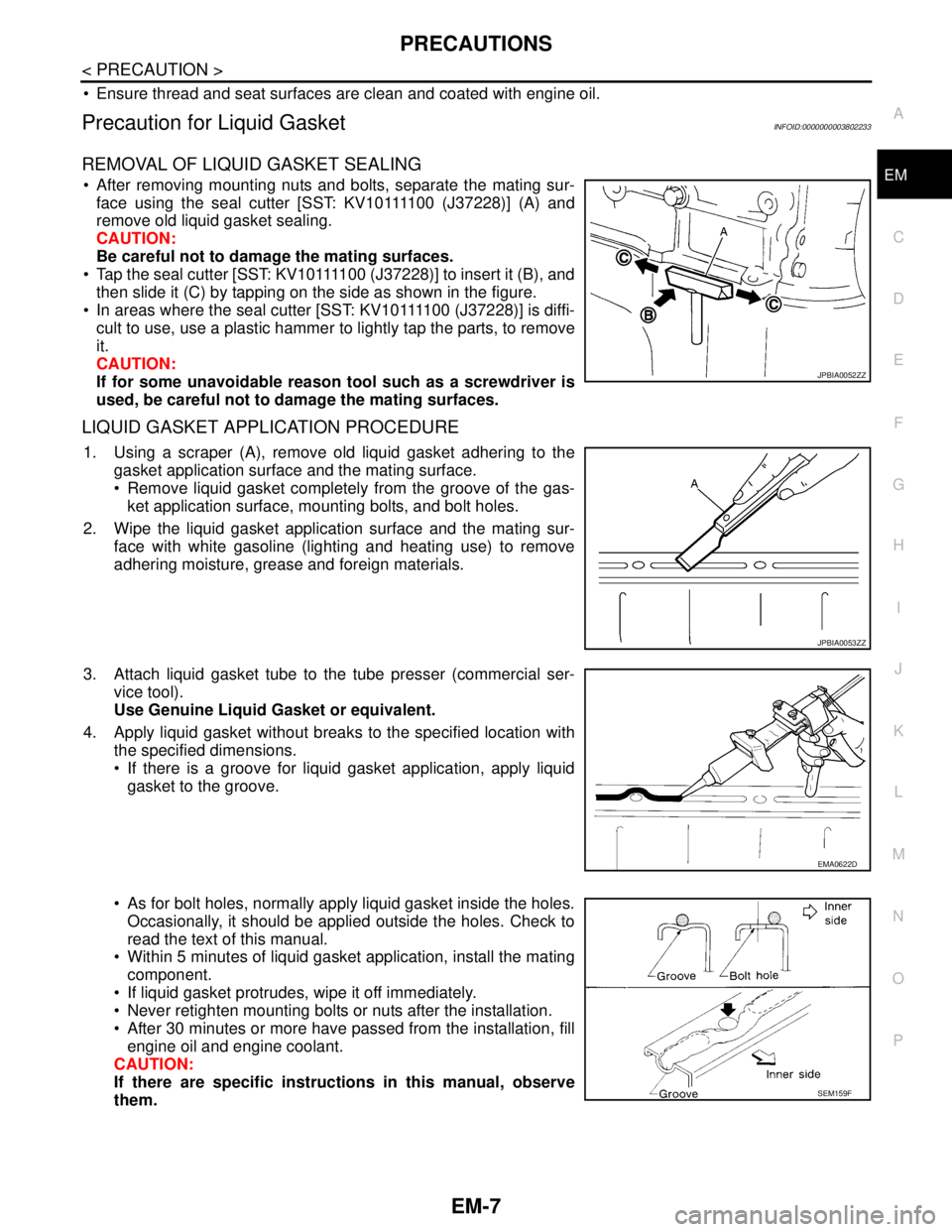
REMOVAL OF LIQUID GASKET SEALING
After removing mounting nuts and bolts, separate the mating sur-
f a c e u s i n g t h e s e a l c u t t e r [ S S T: K V 1 0 1111 0 0 ( J37228)] (A) and
remove old liquid gasket sealing.
CAUTION:
Be careful not to damage the mating surfaces.
Tap the seal cutter [SST: KV10111100 (J37228)] to insert it (B), and
then slide it (C) by tapping on the side as shown in the figure.
In areas where the seal cutter [SST: KV10111100 (J37228)] is diffi-
cult to use, use a plastic hammer to lightly tap the parts, to remove
it.
CAUTION:
If for some unavoidable reason tool such as a screwdriver is
used, be careful not to damage the mating surfaces.
LIQUID GASKET APPLICATION PROCEDURE
1. Using a scraper (A), remove old liquid gasket adhering to the
gasket application surface and the mating surface.
Remove liquid gasket completely from the groove of the gas-
ket application surface, mounting bolts, and bolt holes.
2. Wipe the liquid gasket application surface and the mating sur-
face with white gasoline (lighting and heating use) to remove
adhering moisture, grease and foreign materials.
3. Attach liquid gasket tube to the tube presser (commercial ser-
vice tool).
Use Genuine Liquid Gasket or equivalent.
4. Apply liquid gasket without breaks to the specified location with
the specified dimensions.
If there is a groove for liquid gasket application, apply liquid
gasket to the groove.
As for bolt holes, normally apply liquid gasket inside the holes.
Occasionally, it should be applied outside the holes. Check to
read the text of this manual.
Within 5 minutes of liquid gasket application, install the mating
component.
If liquid gasket protrudes, wipe it off immediately.
Never retighten mounting bolts or nuts after the installation.
After 30 minutes or more have passed from the installation, fill
engine oil and engine coolant.
CAUTION:
If there are specific instructions in this manual, observe
them.
JPBIA0052ZZ
JPBIA0053ZZ
EMA0622D
SEM159F
Page 1931 of 5121
EM-56
< ON-VEHICLE REPAIR >
TIMING CHAIN
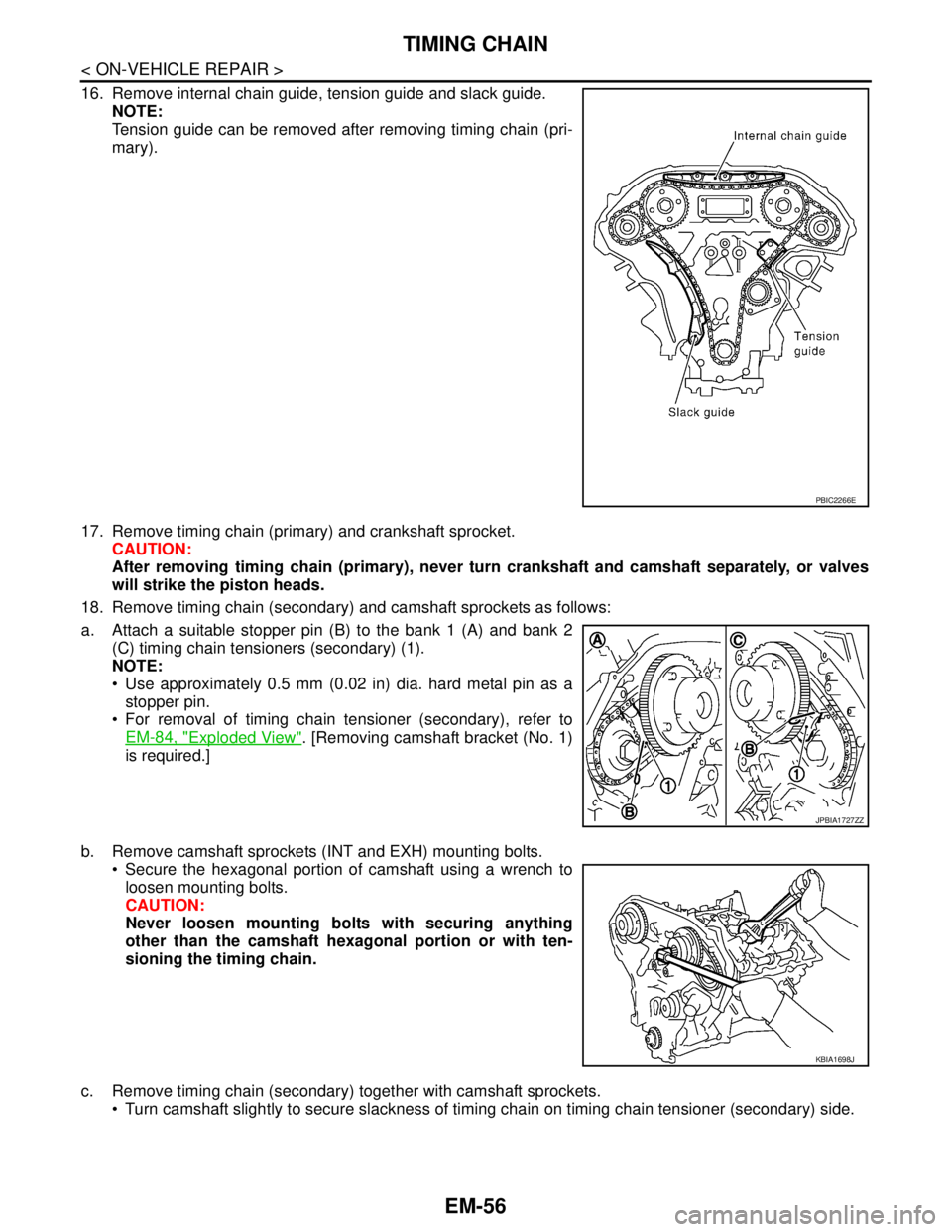
16. Remove internal chain guide, tension guide and slack guide.
NOTE:
Tension guide can be removed after removing timing chain (pri-
mary).
17. Remove timing chain (primary) and crankshaft sprocket.
CAUTION:
After removing timing chain (primary), never turn crankshaft and camshaft separately, or valves
will strike the piston heads.
18. Remove timing chain (secondary) and camshaft sprockets as follows:
a. Attach a suitable stopper pin (B) to the bank 1 (A) and bank 2
(C) timing chain tensioners (secondary) (1).
NOTE:
Use approximately 0.5 mm (0.02 in) dia. hard metal pin as a
stopper pin.
For removal of timing chain tensioner (secondary), refer to
EM-84, "
Exploded View". [Removing camshaft bracket (No. 1)
is required.]
b. Remove camshaft sprockets (INT and EXH) mounting bolts.
Secure the hexagonal portion of camshaft using a wrench to
loosen mounting bolts.
CAUTION:
Never loosen mounting bolts with securing anything
other than the camshaft hexagonal portion or with ten-
sioning the timing chain.
c. Remove timing chain (secondary) together with camshaft sprockets.
Turn camshaft slightly to secure slackness of timing chain on timing chain tensioner (secondary) side.
PBIC2266E
JPBIA1727ZZ
KBIA1698J
Page 1961 of 5121
EM-86
< DISASSEMBLY AND ASSEMBLY >
CAMSHAFT
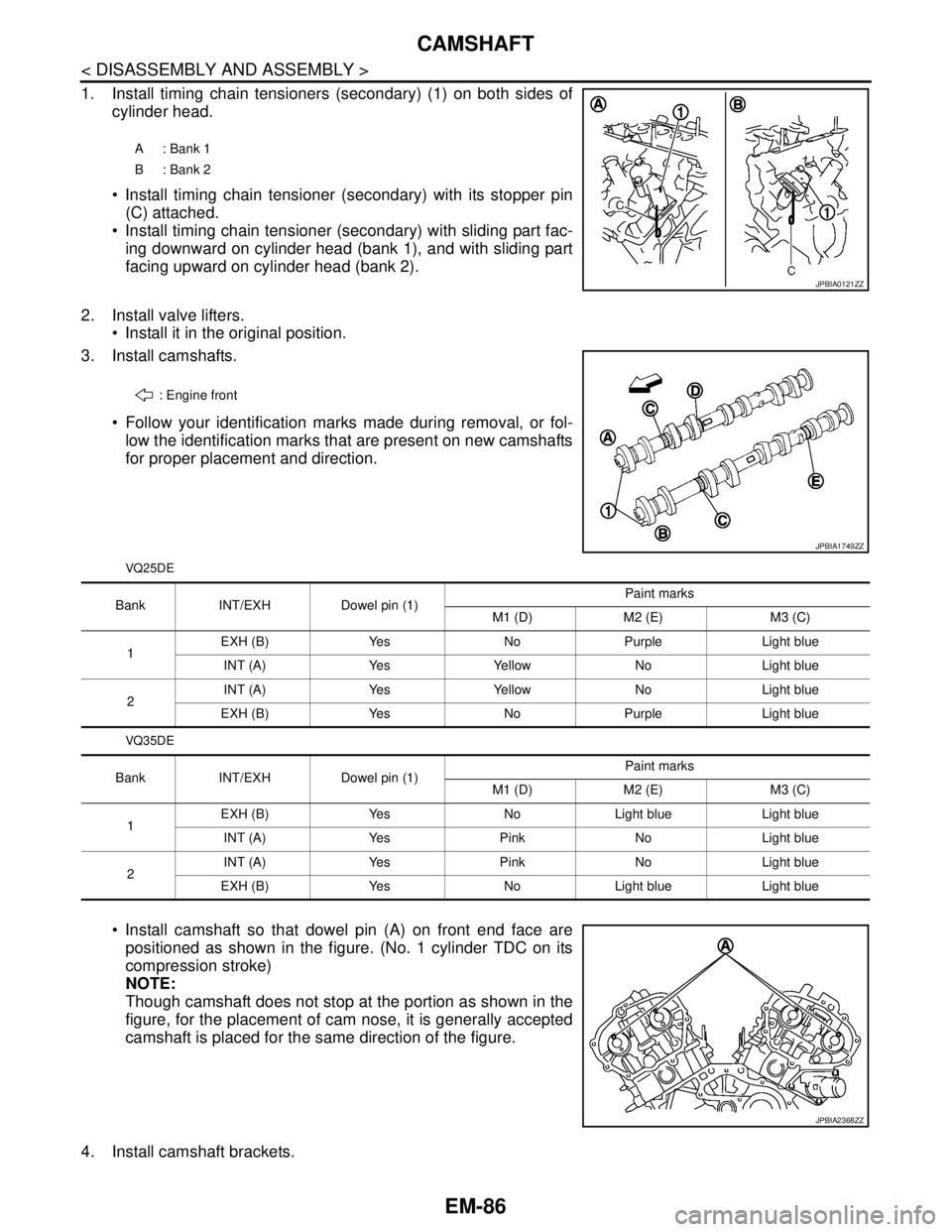
1. Install timing chain tensioners (secondary) (1) on both sides of
cylinder head.
Install timing chain tensioner (secondary) with its stopper pin
(C) attached.
Install timing chain tensioner (secondary) with sliding part fac-
ing downward on cylinder head (bank 1), and with sliding part
facing upward on cylinder head (bank 2).
2. Install valve lifters.
Install it in the original position.
3. Install camshafts.
Follow your identification marks made during removal, or fol-
low the identification marks that are present on new camshafts
for proper placement and direction.
VQ25DE
VQ35DE
Install camshaft so that dowel pin (A) on front end face are
positioned as shown in the figure. (No. 1 cylinder TDC on its
compression stroke)
NOTE:
Though camshaft does not stop at the portion as shown in the
figure, for the placement of cam nose, it is generally accepted
camshaft is placed for the same direction of the figure.
4. Install camshaft brackets.
A: Bank 1
B: Bank 2
JPBIA0121ZZ
: Engine front
JPBIA1749ZZ
Bank INT/EXH Dowel pin (1)Paint marks
M1 (D) M2 (E) M3 (C)
1EXH (B) Yes No Purple Light blue
INT (A) Yes Yellow No Light blue
2INT (A) Yes Yellow No Light blue
EXH (B) Yes No Purple Light blue
Bank INT/EXH Dowel pin (1)Paint marks
M1 (D) M2 (E) M3 (C)
1EXH (B) Yes No Light blue Light blue
INT (A) Yes Pink No Light blue
2INT (A) Yes Pink No Light blue
EXH (B) Yes No Light blue Light blue
JPBIA2368ZZ
Page 1978 of 5121
CYLINDER HEAD
EM-103
< DISASSEMBLY AND ASSEMBLY >
C
D
E
F
G
H
I
J
K
L
MA
EM
N
P O
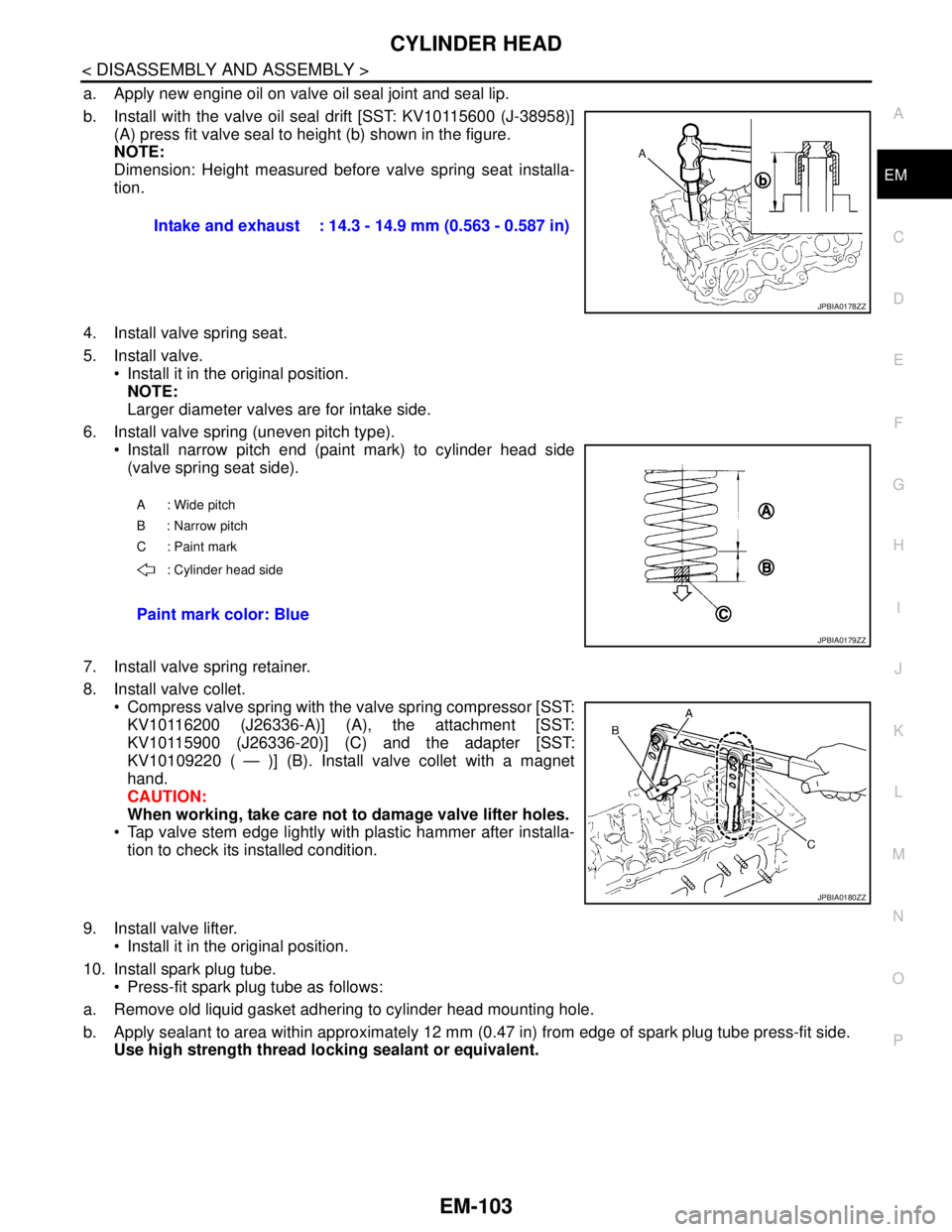
a. Apply new engine oil on valve oil seal joint and seal lip.
b. Install with the valve oil seal drift [SST: KV10115600 (J-38958)]
(A) press fit valve seal to height (b) shown in the figure.
NOTE:
Dimension: Height measured before valve spring seat installa-
tion.
4. Install valve spring seat.
5. Install valve.
Install it in the original position.
NOTE:
Larger diameter valves are for intake side.
6. Install valve spring (uneven pitch type).
Install narrow pitch end (paint mark) to cylinder head side
(valve spring seat side).
7. Install valve spring retainer.
8. Install valve collet.
Compress valve spring with the valve spring compressor [SST:
KV10116200 (J26336-A)] (A), the attachment [SST:
KV10115900 (J26336-20)] (C) and the adapter [SST:
KV10109220 ( — )] (B). Install valve collet with a magnet
hand.
CAUTION:
When working, take care not to damage valve lifter holes.
Tap valve stem edge lightly with plastic hammer after installa-
tion to check its installed condition.
9. Install valve lifter.
Install it in the original position.
10. Install spark plug tube.
Press-fit spark plug tube as follows:
a. Remove old liquid gasket adhering to cylinder head mounting hole.
b. Apply sealant to area within approximately 12 mm (0.47 in) from edge of spark plug tube press-fit side.
Use high strength thread locking sealant or equivalent. Intake and exhaust : 14.3 - 14.9 mm (0.563 - 0.587 in)
JPBIA0178ZZ
A : Wide pitch
B : Narrow pitch
C : Paint mark
: Cylinder head side
Paint mark color: Blue
JPBIA0179ZZ
JPBIA0180ZZ
Page 2001 of 5121
EM-126
< DISASSEMBLY AND ASSEMBLY >
CYLINDER BLOCK
If the calculated value exceeds the limit, select proper connecting rod bearing according to connecting rod
big end diameter and crankshaft pin journal diameter to obtain the specified bearing oil clearance. Refer to
EM-130, "
ConnectingRodBearing".
Method of Using Plastigage
Remove oil and dust on crankshaft pin journal and the surfaces of each bearing completely.
Cut a plastigage slightly shorter than the bearing width, and place it in crankshaft axial direction, avoiding oil
holes.
Install connecting rod bearings to connecting rod and connecting rod bearing cap, and tighten connecting
rod bolts to the specified torque. Refer to EM-110, "
Disassembly and Assembly" for the tightening proce-
dure.
CAUTION:
Never rotate crankshaft.
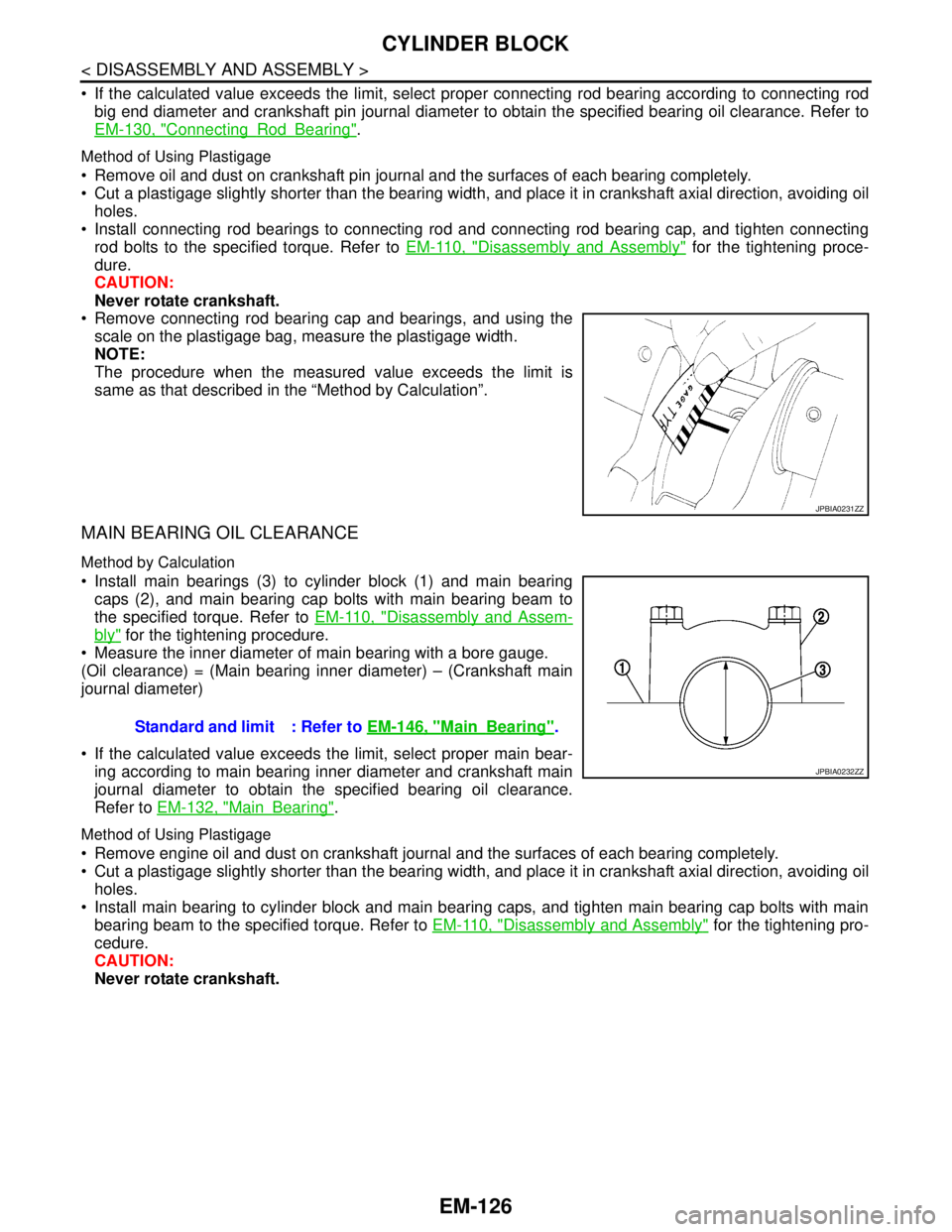
Remove connecting rod bearing cap and bearings, and using the
scale on the plastigage bag, measure the plastigage width.
NOTE:
The procedure when the measured value exceeds the limit is
same as that described in the “Method by Calculation”.
MAIN BEARING OIL CLEARANCE
Method by Calculation
Install main bearings (3) to cylinder block (1) and main bearing
caps (2), and main bearing cap bolts with main bearing beam to
the specified torque. Refer to EM-110, "
Disassembly and Assem-
bly" for the tightening procedure.
Measure the inner diameter of main bearing with a bore gauge.
(Oil clearance) = (Main bearing inner diameter) – (Crankshaft main
journal diameter)
If the calculated value exceeds the limit, select proper main bear-
ing according to main bearing inner diameter and crankshaft main
journal diameter to obtain the specified bearing oil clearance.
Refer to EM-132, "
MainBearing".
Method of Using Plastigage
Remove engine oil and dust on crankshaft journal and the surfaces of each bearing completely.
Cut a plastigage slightly shorter than the bearing width, and place it in crankshaft axial direction, avoiding oil
holes.
Install main bearing to cylinder block and main bearing caps, and tighten main bearing cap bolts with main
bearing beam to the specified torque. Refer to EM-110, "
Disassembly and Assembly" for the tightening pro-
cedure.
CAUTION:
Never rotate crankshaft.
JPBIA0231ZZ
Standard and limit : Refer to EM-146, "MainBearing".
JPBIA0232ZZ
Page 2030 of 5121
EXL-1
DRIVER CONTROLS
C
DE
F
G H
I
J
K
M
SECTION EXL
A
B
EXL
N
O P
CONTENTS
EXTERIOR LIGHTING SYSTEM
XENON TYPE
BASIC INSPECTION ....... .............................
7
DIAGNOSIS AND REPAIR WORKFLOW ..... .....7
Work Flow ........................................................... ......7
INSPECTION AND ADJUSTMENT .....................9
ADDITIONAL SERVICE WHEN REPLACING
CONTROL UNIT .................................................... ......
9
ADDITIONAL SERVICE WHEN REPLACING
CONTROL UNIT : Description ..................................
9
ADDITIONAL SERVICE WHEN REPLACING
CONTROL UNIT : Special Repair Requirement .......
9
CONFIGURATION (HEADLAMP LEVELIZER) .... ......9
CONFIGURATION (HEADLAMP LEVELIZER) :
Description ................................................................
9
CONFIGURATION (HEADLAMP LEVELIZER) :
Special Repair Requirement .....................................
9
SENSOR INITIALIZE ............................................. ......9
SENSOR INITIALIZE : Description .........................10
SENSOR INITIALIZE : Special Repair Require-
ment (HEADLAMP AIMING CONTROL SYSTEM)
....
10
FUNCTION DIAGNOSIS ..............................11
HEADLAMP SYSTEM .................................... ....11
System Diagram .................................................. ....11
System Description .................................................11
Component Parts Location ......................................12
Component Description ..........................................12
AUTO LIGHT SYSTEM ......................................13
System Diagram .................................................. ....13
System Description .................................................13
Component Parts Location ......................................14
Component Description ..........................................14
HEADLAMP AIMING CONTROL SYSTEM
(AUTO) ..............................................................
15
System Diagram .................................................. ....15
System Description ..................................................15
Component Parts Location ......................................16
Component Description ...........................................16
FRONT FOG LAMP SYSTEM ...........................17
System Diagram ......................................................17
System Description ..................................................17
Component Parts Location ......................................18
Component Description ..........................................18
TURN SIGNAL AND HAZARD WARNING
LAMP SYSTEM .................................................
19
System Diagram ......................................................19
System Description ..................................................19
Component Parts Location ......................................20
Component Description ..........................................20
PARKING, LICENSE PLATE AND TAIL
LAMPS SYSTEM ..............................................
21
System Diagram .................................................. ....21
System Description ..................................................21
Component Parts Location ......................................22
Component Description ..........................................22
REAR FOG LAMP SYSTEM .............................23
System Diagram ......................................................23
System Description ..................................................23
Component Parts Location ......................................24
Component Description ..........................................24
EXTERIOR LAMP BATTERY SAVER SYS-
TEM ...................................................................
25
System Diagram ......................................................25
System Description ..................................................25
Component Parts Location ......................................26
Component Description ..........................................26
DIAGNOSIS SYSTEM (BCM) ...........................27
Page 2032 of 5121
EXL-3
C
D
E
F
G
H
I
J
K
MA
B
EXL
N
O
P
TAIL LAMP CIRCUIT .........................................74
Component Function Check ....................................74
Diagnosis Procedure ...............................................74
LICENSE PLATE LAMP CIRCUIT .....................76
Component Function Check ....................................76
Diagnosis Procedure ...............................................76
REAR FOG LAMP CIRCUIT ..............................77
Component Function Check ....................................77
Diagnosis Procedure ...............................................77
HEADLAMP SYSTEM ........................................79
Wiring Diagram - HEADLAMP - ..............................79
AUTO LIGHT SYSTEM ......................................83
Wiring Diagram - AUTO LIGHT SYSTEM - .............83
FRONT FOG LAMP SYSTEM ............................87
Wiring Diagram - FRONT FOG LAMP - ..................87
TURN SIGNAL AND HAZARD WARNING
LAMP SYSTEM ..................................................
90
Wiring Diagram - TURN AND HAZARD WARN-
ING LAMPS - ..........................................................
90
PARKING, LICENSE PLATE AND TAIL
LAMPS SYSTEM ................................................
95
Wiring Diagram - PARKING, LICENSE PLATE
AND TAIL LAMPS - .................................................
95
STOP LAMP .......................................................99
Wiring Diagram - STOP LAMP - .............................99
BACK-UP LAMP ..............................................102
Wiring Diagram - BACK-UP LAMP - .....................102
REAR FOG LAMP SYSTEM ............................105
Wiring Diagram - REAR FOG LAMP - ..................105
ECU DIAGNOSIS .......................................108
BCM (BODY CONTROL MODULE) .................108
Reference Value ...................................................108
Wiring Diagram - BCM - ........................................131
Fail-safe ................................................................137
DTC Inspection Priority Chart .............................139
DTC Index ............................................................140
IPDM E/R (INTELLIGENT POWER DISTRI-
BUTION MODULE ENGINE ROOM) ...............
142
Reference Value ...................................................142
Wiring Diagram - IPDM E/R - ................................150
Fail-safe ................................................................153
DTC Index ............................................................155
AUTO LEVELIZER CONTROL UNIT ...............156
Reference Value ...................................................156
Wiring Diagram — HEADLAMP AIMING CON-
TROL SYSTEM — ................................................
158
Fail-safe ................................................................161
DTC Inspection Priority Chart ...............................162
DTC Index .............................................................163
SYMPTOM DIAGNOSIS ............................164
EXTERIOR LIGHTING SYSTEM SYMPTOMS .164
Symptom Table .....................................................164
NORMAL OPERATING CONDITION .............167
Description .............................................................167
BOTH SIDE HEADLAMPS (HI) ARE NOT
TURNED ON ...................................................
168
Description .............................................................168
Diagnosis Procedure .............................................168
BOTH SIDE HEADLAMPS (LO) ARE NOT
TURNED ON ...................................................
169
Description .............................................................169
Diagnosis Procedure .............................................169
PARKING, LICENSE PLATE AND TAIL
LAMPS ARE NOT TURNED ON .....................
170
Description .............................................................170
Diagnosis Procedure .............................................170
BOTH SIDE FRONT FOG LAMPS ARE NOT
TURNED ON ...................................................
171
Description .............................................................171
Diagnosis Procedure .............................................171
PRECAUTION ............................................172
PRECAUTIONS ...............................................172
Precaution for Supplemental Restraint System
(SRS) "AIR BAG" and "SEAT BELT PRE-TEN-
SIONER" ...............................................................
172
Precautions For Xenon Headlamp Service ...........172
ON-VEHICLE MAINTENANCE ..................173
HEADLAMP AIMING ADJUSTMENT .............173
Description .............................................................173
Aiming Adjustment Procedure (Low Beam) ...........174
Aiming Adjustment Procedure (High Beam) ..........175
FRONT FOG LAMP AIMING ADJUSTMENT .178
Description .............................................................178
Aiming Adjustment Procedure ...............................178
ON-VEHICLE REPAIR ...............................180
FRONT COMBINATION LAMP ......................180
Exploded View .......................................................180
Removal and Installation .......................................181
Replacement .........................................................181
Disassembly and Assembly ...................................182
FRONT FOG LAMP ........................................183
Exploded View .......................................................183
Removal and Installation .......................................183
Replacement .........................................................183
Page 2033 of 5121

EXL-4
OPTICAL SENSOR .........................................185
Exploded View .......................................................185
Removal and Installation .......................................185
LIGHTING & TURN SIGNAL SWITCH ............186
Exploded View .......................................................186
Removal and Installation .......................................186
HAZARD SWITCH ...........................................187
Exploded View .......................................................187
Removal and Installation .......................................187
SIDE TURN SIGNAL LAMP ............................188
Exploded View .......................................................188
Removal and Installation .......................................188
AUTO LEVELIZER CONTROL UNIT ..............190
Exploded View .......................................................190
Removal and Installation .......................................190
REAR COMBINATION LAMP .........................191
Exploded View .......................................................191
Removal and Installation .......................................191
Replacement .........................................................192
HIGH-MOUNTED STOP LAMP .......................193
Exploded View .......................................................193
Removal and Installation .......................................193
REAR FOG LAMP ...........................................194
Exploded View .......................................................194
Removal and Installation .......................................194
Replacement .........................................................194
LICENSE PLATE LAMP ..................................195
Exploded View .......................................................195
Removal and Installation .......................................195
Replacement .........................................................195
SERVICE DATA AND SPECIFICATIONS
(SDS) ..........................................................
197
SERVICE DATA AND SPECIFICATIONS
(SDS) ................................................................
197
Bulb Specifications ................................................197
HALOGEN TYPE
BASIC INSPECTION ..................................
198
DIAGNOSIS AND REPAIR WORKFLOW .......198
Work Flow ..............................................................198
FUNCTION DIAGNOSIS ............................200
HEADLAMP SYSTEM .....................................200
System Diagram ....................................................200
System Description ................................................200
Component Parts Location ....................................201
Component Description ........................................201
AUTO LIGHT SYSTEM ....................................202
System Diagram ....................................................202
System Description ...............................................202
Component Parts Location ...................................203
Component Description ........................................203
FRONT FOG LAMP SYSTEM ..........................204
System Diagram ...................................................204
System Description ...............................................204
Component Parts Location ...................................205
Component Description ........................................205
TURN SIGNAL AND HAZARD WARNING
LAMP SYSTEM ................................................
206
System Diagram ...................................................206
System Description ...............................................206
Component Parts Location ...................................207
Component Description ........................................207
PARKING, LICENSE PLATE AND TAIL
LAMPS SYSTEM ..............................................
208
System Diagram ...................................................208
System Description ...............................................208
Component Parts Location ...................................209
Component Description ........................................209
REAR FOG LAMP SYSTEM ............................210
System Diagram ...................................................210
System Description ...............................................210
Component Parts Location ...................................211
Component Description ........................................211
EXTERIOR LAMP BATTERY SAVER SYS-
TEM ...................................................................
212
System Diagram ...................................................212
System Description ...............................................212
Component Parts Location ...................................213
Component Description ........................................213
DIAGNOSIS SYSTEM (BCM) ...........................214
COMMON ITEM .......................................................214
COMMON ITEM : CONSULT-III Function (BCM -
COMMON ITEM) ..................................................
214
HEADLAMP .............................................................215
HEADLAMP : CONSULT-III Function (BCM -
HEAD LAMP) ........................................................
215
FLASHER ................................................................217
FLASHER : CONSULT-III Function (BCM -
FLASHER) ............................................................
217
DIAGNOSIS SYSTEM (IPDM E/R) ...................219
Diagnosis Description ...........................................219
CONSULT-III Function (IPDM E/R) ......................221
COMPONENT DIAGNOSIS ......................224
POWER SUPPLY AND GROUND CIRCUIT ....224
BCM (BODY CONTROL MODULE) ........................224
BCM (BODY CONTROL MODULE) : Diagnosis
Procedure .............................................................
224