ignition NISSAN TEANA 2008 Service Manual
[x] Cancel search | Manufacturer: NISSAN, Model Year: 2008, Model line: TEANA, Model: NISSAN TEANA 2008Pages: 5121, PDF Size: 69.03 MB
Page 4444 of 5121
STC-16
< ECU DIAGNOSIS >
POWER STEERING CONTROL UNIT
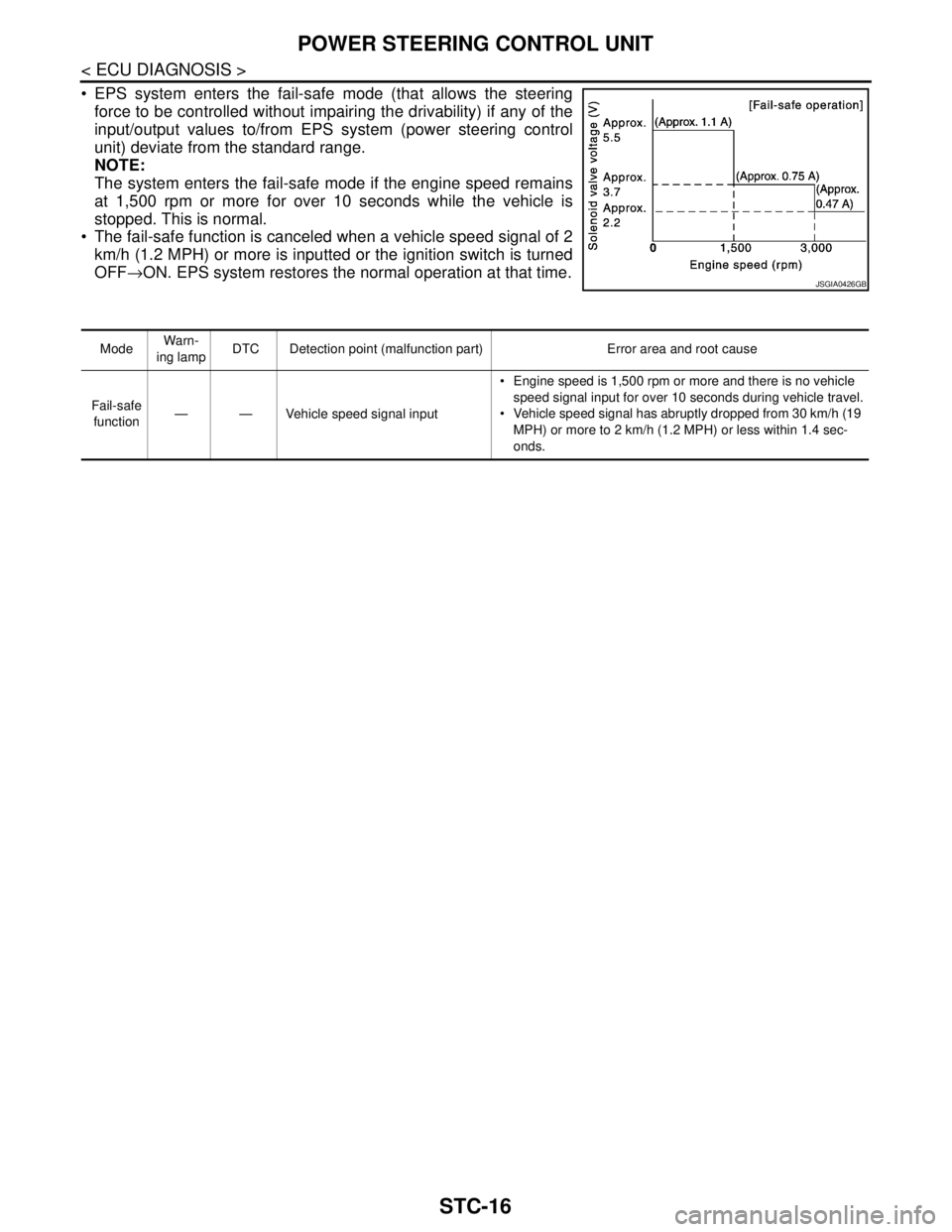
EPS system enters the fail-safe mode (that allows the steering
force to be controlled without impairing the drivability) if any of the
input/output values to/from EPS system (power steering control
unit) deviate from the standard range.
NOTE:
The system enters the fail-safe mode if the engine speed remains
at 1,500 rpm or more for over 10 seconds while the vehicle is
stopped. This is normal.
The fail-safe function is canceled when a vehicle speed signal of 2
km/h (1.2 MPH) or more is inputted or the ignition switch is turned
OFF→ON. EPS system restores the normal operation at that time.
JSGIA0426GB
ModeWarn-
ing lampDTC Detection point (malfunction part) Error area and root cause
Fail-safe
function— — Vehicle speed signal input Engine speed is 1,500 rpm or more and there is no vehicle
speed signal input for over 10 seconds during vehicle travel.
Vehicle speed signal has abruptly dropped from 30 km/h (19
MPH) or more to 2 km/h (1.2 MPH) or less within 1.4 sec-
onds.
Page 4446 of 5121

STC-18
< PRECAUTION >
PRECAUTIONS
PRECAUTION
PRECAUTIONS
Precaution for Supplemental Restraint System (SRS) "AIR BAG" and "SEAT BELT
PRE-TENSIONER"
INFOID:0000000003971959
The Supplemental Restraint System such as “AIR BAG” and “SEAT BELT PRE-TENSIONER”, used along
with a front seat belt, helps to reduce the risk or severity of injury to the driver and front passenger for certain
types of collision. Information necessary to service the system safely is included in the “SRS AIRBAG” and
“SEAT BELT” of this Service Manual.
WARNING:
To avoid rendering the SRS inoperative, which could increase the risk of personal injury or death in
the event of a collision which would result in air bag inflation, all maintenance must be performed by
an authorized NISSAN/INFINITI dealer.
Improper maintenance, including incorrect removal and installation of the SRS, can lead to personal
injury caused by unintentional activation of the system. For removal of Spiral Cable and Air Bag
Module, see the “SRS AIRBAG”.
Never use electrical test equipment on any circuit related to the SRS unless instructed to in this Ser-
vice Manual. SRS wiring harnesses can be identified by yellow and/or orange harnesses or harness
connectors.
Precaution Necessary for Steering Wheel Rotation after Battery Disconnect
INFOID:0000000003893541
NOTE:
Before removing and installing any control units, first turn the push-button ignition switch to the LOCK posi-
tion, then disconnect both battery cables.
After finishing work, confirm that all control unit connectors are connected properly, then re-connect both
battery cables.
Always use CONSULT-III to perform self-diagnosis as a part of each function inspection after finishing work.
If a DTC is detected, perform trouble diagnosis according to self-diagnosis results.
This vehicle is equipped with a push-button ignition switch and a steering lock unit.
If the battery is disconnected or discharged, the steering wheel will lock and cannot be turned.
If turning the steering wheel is required with the battery disconnected or discharged, follow the procedure
below before starting the repair operation.
OPERATION PROCEDURE
1. Connect both battery cables.
NOTE:
Supply power using jumper cables if battery is discharged.
2. Carry the Intelligent Key or insert it to the key slot and turn the push-button ignition switch to ACC position.
(At this time, the steering lock will be released.)
3. Disconnect both battery cables. The steering lock will remain released with both battery cables discon-
nected and the steering wheel can be turned.
4. Perform the necessary repair operation.
5. When the repair work is completed, re-connect both battery cables. With the brake pedal released, turn
the push-button ignition switch from ACC position to ON position, then to LOCK position. (The steering
wheel will lock when the push-button ignition switch is turned to LOCK position.)
6. Perform self-diagnosis check of all control units using CONSULT-III.
Page 4450 of 5121
DIAGNOSIS AND REPAIR WORKFLOW
STR-3
< BASIC INSPECTION >
C
D
E
F
G
H
I
J
K
L
MA
STR
N
P O
NOTE:
If any malfunction is found, immediately disconnect the battery cable from the negative terminal.
1.CHECK ENGINE START
Crank the engine and check that the engine starts.
Does the engine start?
YES >> GO TO 2.
NO >> GO TO 3.
2.CHECK THAT THE STARTER MOTOR STOPS
Check that the starter motor stops after starting the engine.
Does the starter motor stop?
YES >> INSPECTION END
NO >> Replace magnetic switch.
3.CHECK THE ENGINE SPEED WITH CRANKING
Check that the engine turns at cranking.
Does engine turn by cranking?
YES >> GO TO 4.
NO >> GO TO 5.
4.CHECK THE ENGINE SPEED WITH CRANKING
Check that the engine speed is not low at cranking.
Does engine turn normally?
YES >> Check ignition/fuel system.
NO >> Check charge condition, corrosion and connection condition of the battery. Refer to STR-2, "
Work
Flow".
5.CHECK STARTER MOTOR ACTIVATION
Check that the starter motor turns at cranking.
Does starter motor turn?
YES >> GO TO 6.
NO >> GO TO 7.
6.CHECK STARTER MOTOR UNIT
1. Remove starter motor.
2. Check that the gear shaft of starter motor rotates.
Does gear shaft turn?
YES >> Check pinion clutch. Refer to the following.
• VQ25DE models: STR-16, "
VQ25DE : Inspection"
VQ35DE models: STR-22, "VQ35DE : Inspection"
NO >> Check reduction gear, armature and gear shaft.
7.CHECK POWER SUPPLY CIRCUIT
Check the following conditions.
Fuse and fusible link
Charge condition, corrosion and connection condition of the battery. Refer to STR-2, "
Work Flow".
Are these inspection results normal?
YES >> GO TO 8.
NO >> Repair as needed.
8.CHECK STARTING SYSTEM WIRING
Check the following.
“B” terminal circuit. Refer to STR-8, "
Diagnosis Procedure".
“S” terminal circuit. Refer to STR-9, "
Diagnosis Procedure".
Are these inspection results normal?
YES >> GO TO 9.
Page 4451 of 5121
STR-4
< BASIC INSPECTION >
DIAGNOSIS AND REPAIR WORKFLOW
NO >> Repair as needed.
9.CHECK MAGNETIC SWITCH OPERATION SOUND
Check that a magnetic switch operation sound can be heard when the ignition switch is set at the starting posi-
tion.
Does magnetic switch operation sound occur?
YES >> GO TO 10.
NO >> Replace magnetic switch.
10.PINION AND RING GEAR ENGAGEMENT CHECK
Check condition of pinion and ring gear mesh.
Is the inspection result normal?
YES >> GO TO 12.
NO >> GO TO 11.
11 .CHECK STARTER MOTOR UNIT
Check the following.
Adjust pinion movement. Refer to the following.
- VQ25DE models: STR-16, "
VQ25DE : Inspection"
- VQ35DE models: STR-22, "VQ35DE : Inspection"
Check pinion moving mechanism.
Check ring gear.
Are these inspection results normal?
YES >> INSPECTION END
NO >> Repair or replace, if necessary.
12.CHECK STARTER MOTOR UNIT
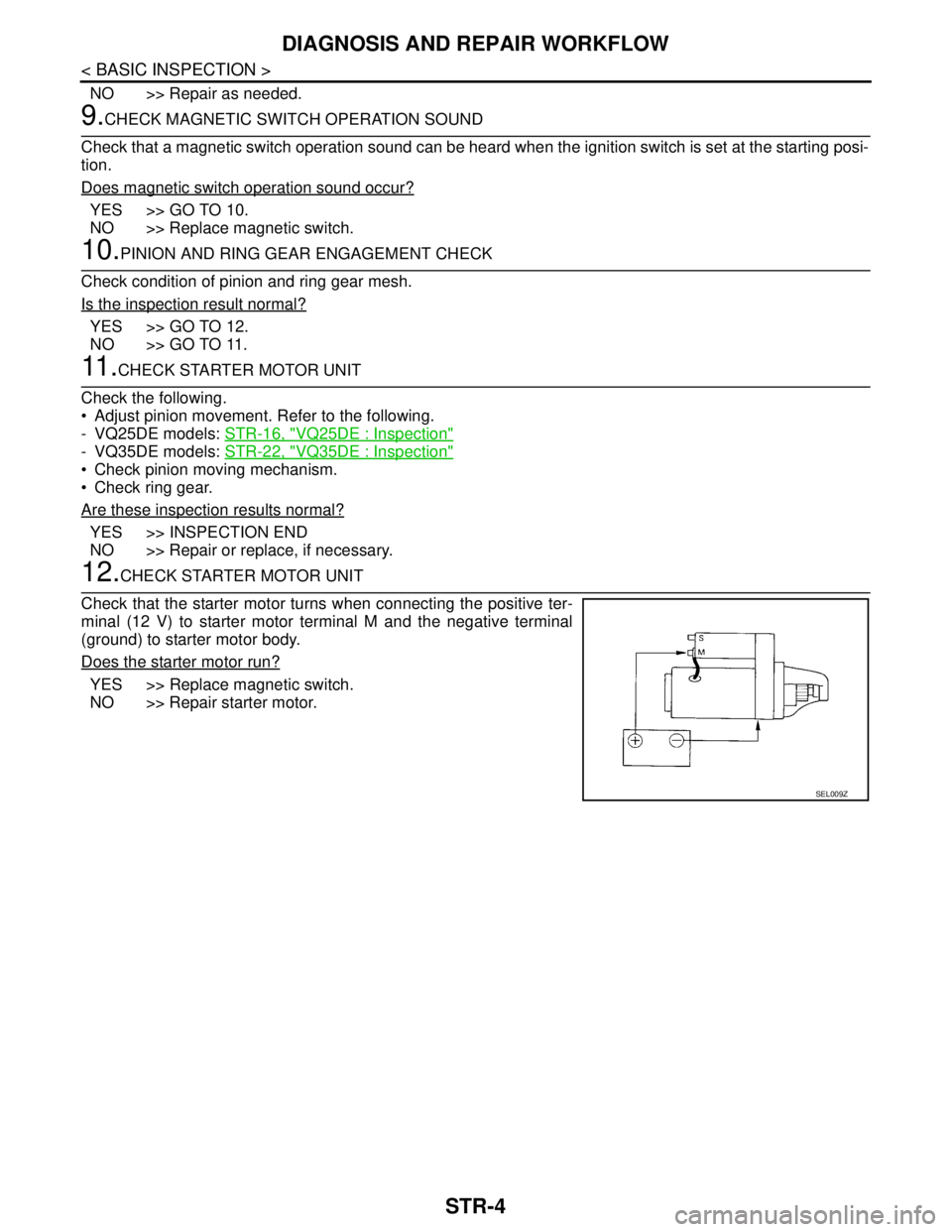
Check that the starter motor turns when connecting the positive ter-
minal (12 V) to starter motor terminal M and the negative terminal
(ground) to starter motor body.
Does the starter motor run?
YES >> Replace magnetic switch.
NO >> Repair starter motor.
SEL009Z
Page 4453 of 5121
STR-6
< FUNCTION DIAGNOSIS >
STARTING SYSTEM
VQ25DE : Component Description
INFOID:0000000003860420
VQ35DE
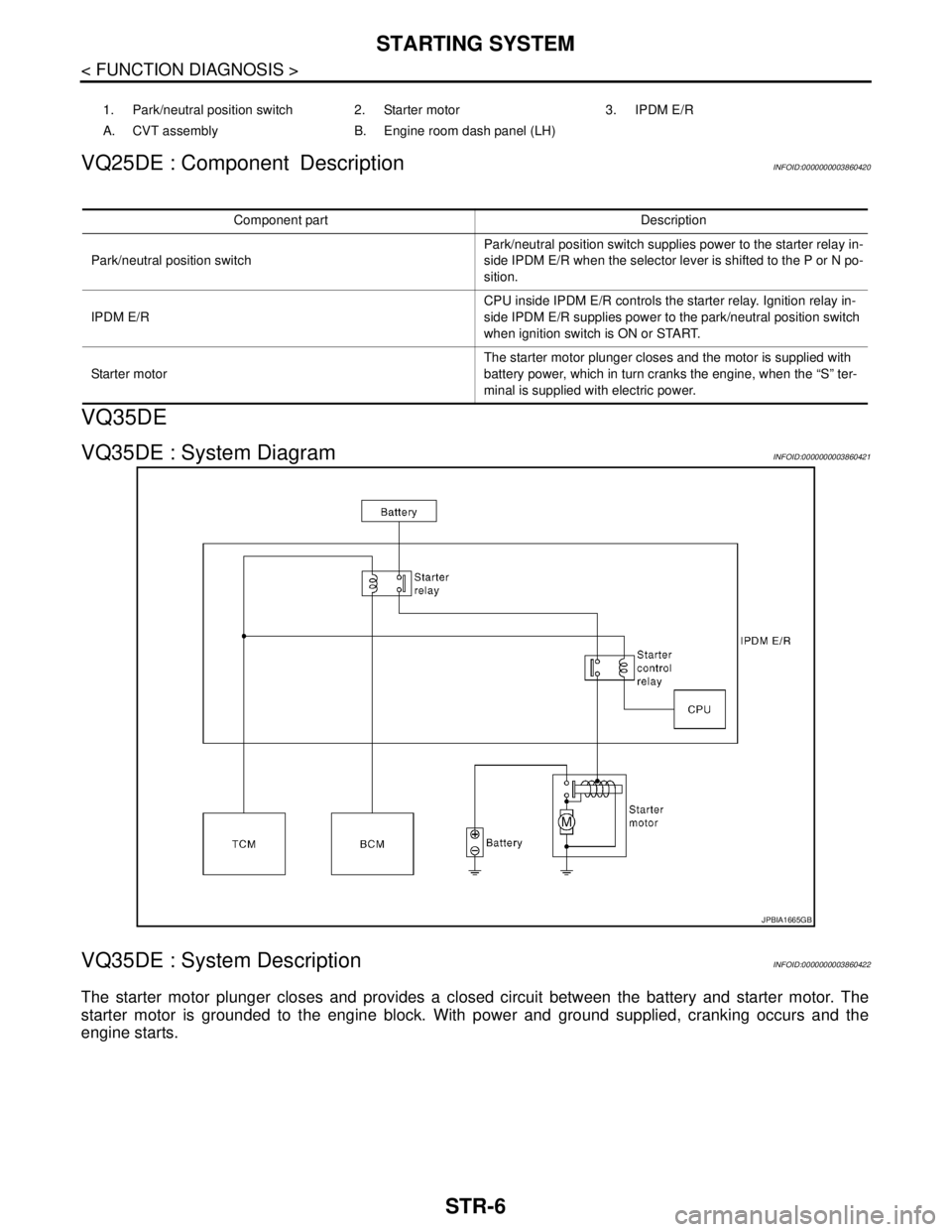
VQ35DE : System DiagramINFOID:0000000003860421
VQ35DE : System DescriptionINFOID:0000000003860422
The starter motor plunger closes and provides a closed circuit between the battery and starter motor. The
starter motor is grounded to the engine block. With power and ground supplied, cranking occurs and the
engine starts.
1. Park/neutral position switch 2. Starter motor 3. IPDM E/R
A. CVT assembly B. Engine room dash panel (LH)
Component part Description
Park/neutral position switchPark/neutral position switch supplies power to the starter relay in-
side IPDM E/R when the selector lever is shifted to the P or N po-
sition.
IPDM E/RCPU inside IPDM E/R controls the starter relay. Ignition relay in-
side IPDM E/R supplies power to the park/neutral position switch
when ignition switch is ON or START.
Starter motorThe starter motor plunger closes and the motor is supplied with
battery power, which in turn cranks the engine, when the “S” ter-
minal is supplied with electric power.
JPBIA1665GB
Page 4455 of 5121
STR-8
< COMPONENT DIAGNOSIS >
B TERMINAL CIRCUIT
COMPONENT DIAGNOSIS
B TERMINAL CIRCUIT
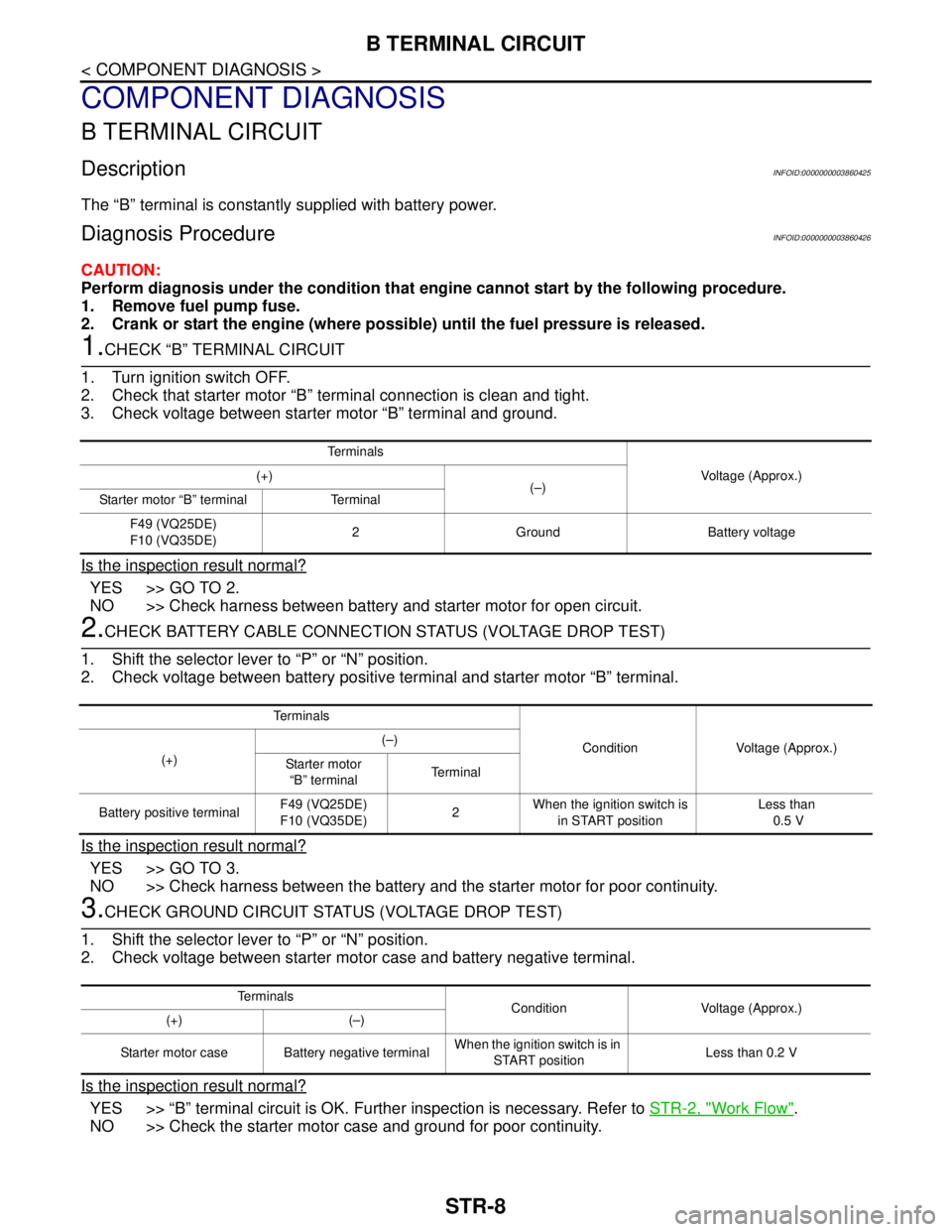
DescriptionINFOID:0000000003860425
The “B” terminal is constantly supplied with battery power.
Diagnosis ProcedureINFOID:0000000003860426
CAUTION:
Perform diagnosis under the condition that engine cannot start by the following procedure.
1. Remove fuel pump fuse.
2. Crank or start the engine (where possible) until the fuel pressure is released.
1.CHECK “B” TERMINAL CIRCUIT
1. Turn ignition switch OFF.
2. Check that starter motor “B” terminal connection is clean and tight.
3. Check voltage between starter motor “B” terminal and ground.
Is the inspection result normal?
YES >> GO TO 2.
NO >> Check harness between battery and starter motor for open circuit.
2.CHECK BATTERY CABLE CONNECTION STATUS (VOLTAGE DROP TEST)
1. Shift the selector lever to “P” or “N” position.
2. Check voltage between battery positive terminal and starter motor “B” terminal.
Is the inspection result normal?
YES >> GO TO 3.
NO >> Check harness between the battery and the starter motor for poor continuity.
3.CHECK GROUND CIRCUIT STATUS (VOLTAGE DROP TEST)
1. Shift the selector lever to “P” or “N” position.
2. Check voltage between starter motor case and battery negative terminal.
Is the inspection result normal?
YES >> “B” terminal circuit is OK. Further inspection is necessary. Refer to STR-2, "Work Flow".
NO >> Check the starter motor case and ground for poor continuity.
Te r m i n a l s
Voltage (Approx.) (+)
(–)
Starter motor “B” terminal Terminal
F49 (VQ25DE)
F10 (VQ35DE)2 Ground Battery voltage
Te r m i n a l s
Condition Voltage (Approx.)
(+)(–)
Starter motor
“B” terminalTerminal
Battery positive terminalF49 (VQ25DE)
F10 (VQ35DE)2 When the ignition switch is
in START positionLess than
0.5 V
Te r m i n a l s
Condition Voltage (Approx.)
(+) (–)
Starter motor case Battery negative terminalWhen the ignition switch is in
START positionLess than 0.2 V
Page 4456 of 5121
S TERMINAL CIRCUIT
STR-9
< COMPONENT DIAGNOSIS >
C
D
E
F
G
H
I
J
K
L
MA
STR
N
P O
S TERMINAL CIRCUIT
DescriptionINFOID:0000000003860427
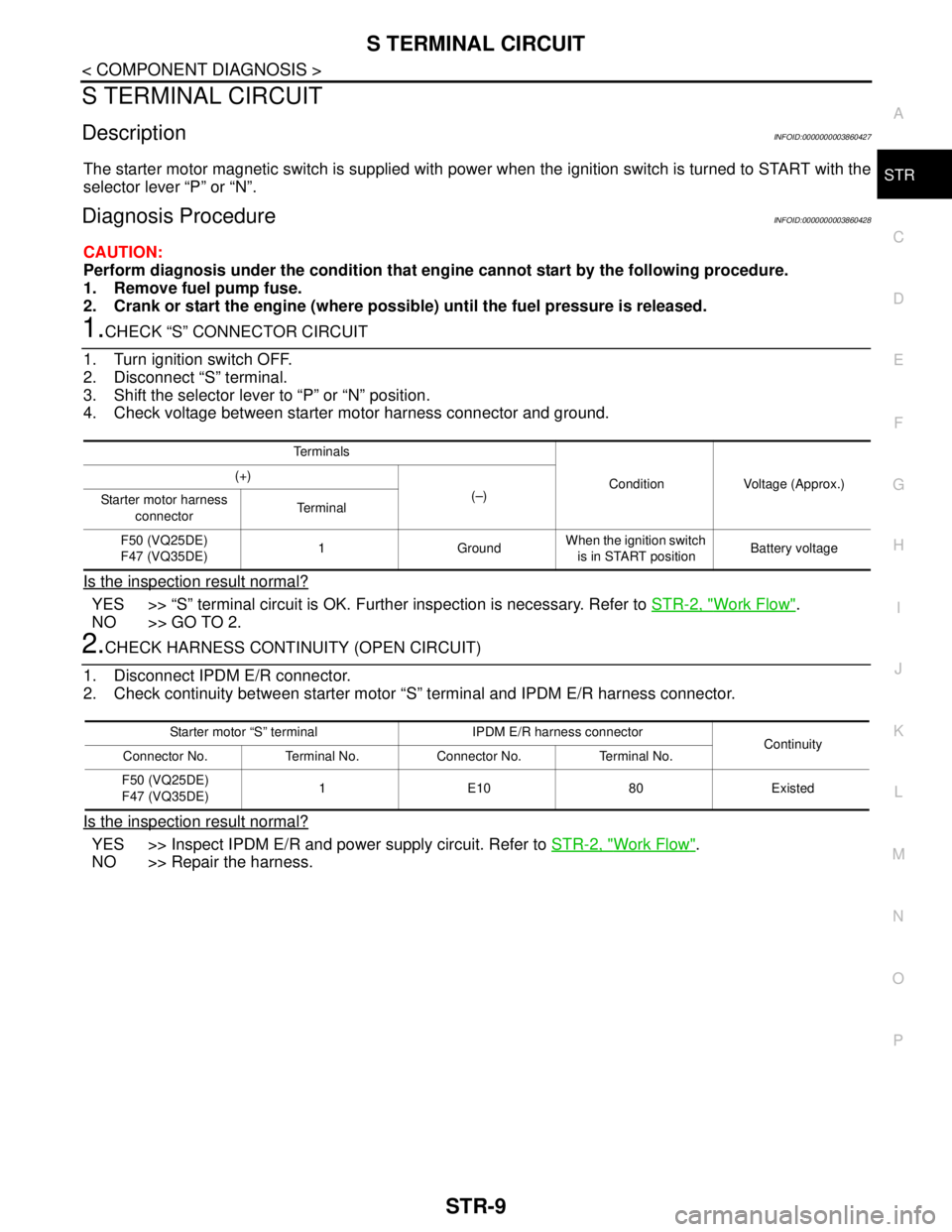
The starter motor magnetic switch is supplied with power when the ignition switch is turned to START with the
selector lever “P” or “N”.
Diagnosis ProcedureINFOID:0000000003860428
CAUTION:
Perform diagnosis under the condition that engine cannot start by the following procedure.
1. Remove fuel pump fuse.
2. Crank or start the engine (where possible) until the fuel pressure is released.
1.CHECK “S” CONNECTOR CIRCUIT
1. Turn ignition switch OFF.
2. Disconnect “S” terminal.
3. Shift the selector lever to “P” or “N” position.
4. Check voltage between starter motor harness connector and ground.
Is the inspection result normal?
YES >> “S” terminal circuit is OK. Further inspection is necessary. Refer to STR-2, "Work Flow".
NO >> GO TO 2.
2.CHECK HARNESS CONTINUITY (OPEN CIRCUIT)
1. Disconnect IPDM E/R connector.
2. Check continuity between starter motor “S” terminal and IPDM E/R harness connector.
Is the inspection result normal?
YES >> Inspect IPDM E/R and power supply circuit. Refer to STR-2, "Work Flow".
NO >> Repair the harness.
Te r m i n a l s
Condition Voltage (Approx.) (+)
(–)
Starter motor harness
connectorTe r m i n a l
F50 (VQ25DE)
F47 (VQ35DE)1 GroundWhen the ignition switch
is in START positionBattery voltage
Starter motor “S” terminal IPDM E/R harness connector
Continuity
Connector No. Terminal No. Connector No. Terminal No.
F50 (VQ25DE)
F47 (VQ35DE)1E1080Existed
Page 4485 of 5121
![NISSAN TEANA 2008 Service Manual TM-12
< BASIC INSPECTION >[CVT: RE0F09B]
INSPECTION AND ADJUSTMENT
INSPECTION AND ADJUSTMENT
ADDITIONAL SERVICE WHEN REPLACING CONTROL UNIT
ADDITIONAL SERVICE WHEN REPLACING CONTROL UNIT : Precaution](/img/5/57391/w960_57391-4484.png "NISSAN TEANA 2008 Service Manual TM-12
< BASIC INSPECTION >[CVT: RE0F09B]
INSPECTION AND ADJUSTMENT
INSPECTION AND ADJUSTMENT
ADDITIONAL SERVICE WHEN REPLACING CONTROL UNIT
ADDITIONAL SERVICE WHEN REPLACING CONTROL UNIT : Precaution")
TM-12
< BASIC INSPECTION >[CVT: RE0F09B]
INSPECTION AND ADJUSTMENT
INSPECTION AND ADJUSTMENT
ADDITIONAL SERVICE WHEN REPLACING CONTROL UNIT
ADDITIONAL SERVICE WHEN REPLACING CONTROL UNIT : Precaution for TCM
and CVT Assembly Replacement
INFOID:0000000003848916
CAUTION:
• Check if new data (Unit ID) are entered correctly after replacing CVT assembly and erasing data in
TCM. (Connect CONSULT-III, and then turn ignition switch OFF.)
When replacing CVT assembly or TCM, refer to the pattern table below and erase the EEPROM in the
TCM if necessary.
EEPROM ERASING PATTERNS
METHOD FOR ERASING THE EEPROM IN THE TCM
1. Turn ignition switch ON.
2. Move selector lever to “R” position.
3. Perform “Self-Diagnostic Results” mode for “TRANSMISSION”.
4. Press the brake pedal and turn the brake switch ON.
5. Press the accelerator pedal (0.5/8 - 4/8 throttle) not to exceed the half, and hold it in the half or less open
position. (This will set the closed throttle position signal to OFF and the wide open throttle position signal
to OFF.)
6. Perform “ERASE”.
7. Wait 3 seconds and then release the accelerator pedal.
8. Turn ignition switch OFF.
METHOD FOR WRITING DATA FROM THE ROM ASSEMBLY IN THE TRANSAXLE
In the following procedure, the TCM reads data from the ROM assembly and writes it to the EEPROM in the
TCM.
1. Erase the EEPROM in the TCM.
2. Move selector lever to “P” position.
3. Turn ignition switch ON.
CHECK METHOD
Standard: About 2 seconds after the ignition switch ON, the CVT indicator lamp lights up for 2 seconds.
Non-standard: Even after the ignition switch ON, the CVT indicator lamp does not light up after 2 seconds or
illuminates immediately.
CAUTION:
Perform in the “P” or “N” position.
Action for Non-standard
Replace the CVT assembly.
Replace the TCM.
CVT assembly TCM Erasing EEPROM in TCM Remarks
Replaced Replaced Not requiredNot required because the EEPROM in the TCM is in
the default state. (CVT assembly must be replaced
first.)
Not replaced Replaced Not requiredNot required because the EEPROM in the TCM is in
the default state.
Replaced Not replaced RequiredRequired because data has been written in the EE-
PROM in the TCM and because the TCM cannot write
data from the ROM assembly in the transmission.
Page 4506 of 5121
![NISSAN TEANA 2008 Service Manual SHIFT LOCK SYSTEM
TM-33
< FUNCTION DIAGNOSIS >[CVT: RE0F09B]
C
E
F
G
H
I
J
K
L
MA
B
TM
N
O
P
SHIFT LOCK SYSTEM
System DescriptionINFOID:0000000003848940
The shift lever cannot be shifted from the “P](/img/5/57391/w960_57391-4505.png "NISSAN TEANA 2008 Service Manual SHIFT LOCK SYSTEM
TM-33
< FUNCTION DIAGNOSIS >[CVT: RE0F09B]
C
E
F
G
H
I
J
K
L
MA
B
TM
N
O
P
SHIFT LOCK SYSTEM
System DescriptionINFOID:0000000003848940
The shift lever cannot be shifted from the “P")
SHIFT LOCK SYSTEM
TM-33
< FUNCTION DIAGNOSIS >[CVT: RE0F09B]
C
E
F
G
H
I
J
K
L
MA
B
TM
N
O
P
SHIFT LOCK SYSTEM
System DescriptionINFOID:0000000003848940
The shift lever cannot be shifted from the “P” position unless the
brake pedal is depressed while the ignition switch is set to ON. The
shift lock is unlocked by turning the shift lock solenoid ON when the
ignition switch is set to ON, the park position switch is turned ON
(selector lever is in “P” position), and the stop lamp switch is turned
ON (brake pedal is depressed) as shown in the operation chart in the
figure. Therefore, the shift lock solenoid receives no ON signal and
the shift lock remains locked if all of the above conditions are not ful-
filled. (However, selector operation is allowed if the shift lock release
button is pressed.)
SHIFT LOCK OPERATION at “P” POSITION
When Brake Pedal Is Not Depressed (No Selector Operation Allowed)
The shift lock solenoid (A) is turned OFF (not energized) and the
solenoid rod (B) is extended with the spring when the brake pedal is
not depressed (no selector operation allowed) with the ignition
switch ON.
The connecting lock lever (C) is located at the position shown in the
figure when the solenoid rod is extended. It prevents the movement
of the detent rod (D). The selector lever cannot be shifted from the
“P” position for this reason.
When Brake Pedal Is Depressed (Shift Operation Allowed)
The shift lock solenoid (A) is turned ON (energized) when the brake
pedal is depressed with the ignition switch ON. The solenoid rod (B)
is compressed by the electromagnetic force. The connecting lock
lever (C) rotates when the solenoid is activated. Therefore, the
detent rod (D) can be moved. The selector lever can be shifted to
other positions for this reason.
“P” POSITION HOLD MECHANISM (IGNITION SWITCH LOCK)
JPDIA0624GB
JPDIA0612ZZ
JPDIA0613ZZ
Page 4507 of 5121
![NISSAN TEANA 2008 Service Manual TM-34
< FUNCTION DIAGNOSIS >[CVT: RE0F09B]
SHIFT LOCK SYSTEM
The shift lock solenoid (A) is not energized when the ignition switch
is in any position other than ON. In this condition, the shift mecha-](/img/5/57391/w960_57391-4506.png "NISSAN TEANA 2008 Service Manual TM-34
< FUNCTION DIAGNOSIS >[CVT: RE0F09B]
SHIFT LOCK SYSTEM
The shift lock solenoid (A) is not energized when the ignition switch
is in any position other than ON. In this condition, the shift mecha-")
TM-34
< FUNCTION DIAGNOSIS >[CVT: RE0F09B]
SHIFT LOCK SYSTEM
The shift lock solenoid (A) is not energized when the ignition switch
is in any position other than ON. In this condition, the shift mecha-
nism is locked and “P” position is held. The operation cannot be per-
formed from “P” position if the brake pedal is depressed with the
ignition switch ON when the operation system of shift lock solenoid is
malfunctioning. However, the lock lever (B) is forcibly rotated and the
shift lock is released when the shift lock release button (C) is
pressed from above. Then the selector operation from “P” position
can be performed.
CAUTION:
Use the shift lock release button only when the selector lever cannot be operated even if the brake
pedal is depressed with the ignition switch ON.
Component Parts LocationINFOID:0000000003848941
Component DescriptionINFOID:0000000003848942
SHIFT LOCK
D : Detent rodJPDIA0614ZZ
1. Stop lamp switch
A. Shift lock release button B. Shift lock solenoid C. Park position switch
JPDIA0753ZZ
Component Function
Shift lock solenoid
TM-103
Lock lever
Detent rod
Park position switch
Shift lock release button