charging NISSAN TEANA 2008 Owner's Manual
[x] Cancel search | Manufacturer: NISSAN, Model Year: 2008, Model line: TEANA, Model: NISSAN TEANA 2008Pages: 5121, PDF Size: 69.03 MB
Page 1798 of 5121
![NISSAN TEANA 2008 Owners Manual FUEL PUMP
EC-337
< COMPONENT DIAGNOSIS >[VQ25DE, VQ35DE]
C
D
E
F
G
H
I
J
K
L
MA
EC
N
P O
FUEL PUMP
DescriptionINFOID:0000000003856843
*: ECM determines the start signal status by the signals of engine](/img/5/57391/w960_57391-1797.png "NISSAN TEANA 2008 Owners Manual FUEL PUMP
EC-337
< COMPONENT DIAGNOSIS >[VQ25DE, VQ35DE]
C
D
E
F
G
H
I
J
K
L
MA
EC
N
P O
FUEL PUMP
DescriptionINFOID:0000000003856843
*: ECM determines the start signal status by the signals of engine")
FUEL PUMP
EC-337
< COMPONENT DIAGNOSIS >[VQ25DE, VQ35DE]
C
D
E
F
G
H
I
J
K
L
MA
EC
N
P O
FUEL PUMP
DescriptionINFOID:0000000003856843
*: ECM determines the start signal status by the signals of engine speed and battery voltage.
The ECM activates the fuel pump for several seconds after the ignition switch is turned ON to improve engine
start ability. If the ECM receives a engine speed signal from the camshaft position sensor (PHASE), it knows
that the engine is rotating, and causes the pump to operate. If the engine speed signal is not received when
the ignition switch is ON, the engine stalls. The ECM stops pump operation and prevents battery discharging,
thereby improving safety. The ECM does not directly drive the fuel pump. It controls the ON/OFF fuel pump
relay, which in turn controls the fuel pump.
Component Function CheckINFOID:0000000003856844
1.CHECK FUEL PUMP FUNCTION
1. Turn ignition switch ON.
2. Pinch fuel feed hose with two fingers.
Is the inspection result normal?
YES >> INSPECTION END
NO >>EC-337, "
Diagnosis Procedure".
Diagnosis ProcedureINFOID:0000000003856845
1.CHECK FUEL PUMP POWER SUPPLY CIRCUIT-I
1. Turn ignition switch OFF.
2. Disconnect ECM harness connector.
3. Turn ignition switch ON.
4. Check the voltage between ECM harness connector and ground.
Is the inspection result normal?
YES >> GO TO 4.
NO >> GO TO 2.
Sensor Input signal to ECM ECM Function Actuator
Crankshaft position sensor (POS)
Camshaft position sensor (PHASE)Engine speed*
Fuel pump controlFuel pump relay
↓
Fuel pump
Battery Battery voltage*
Condition Fuel pump operation
Ignition switch is turned to ON. Operates for 1 second.
Engine running and crankingOperates.
When engine is stopped Stops in 1.5 seconds.
Except as shown aboveSto ps .
: Vehicle front (Illustration shows
the view with intake air duct re-
moved)
Fuel pressure pulsation should be felt on the fuel feed
hose for 1 second after ignition switch is turned ON.
JMBIA1391ZZ
ECM
Ground Voltage
Connector Terminal
F7 14 Ground Battery voltage
Page 2087 of 5121
![NISSAN TEANA 2008 Owners Manual EXL-58
< COMPONENT DIAGNOSIS >[XENON TYPE]
XENON HEADLAMP
XENON HEADLAMP
DescriptionINFOID:0000000003773562
OUTLINE
The lamp light source is by the arch discharge by applying high voltage into the x](/img/5/57391/w960_57391-2086.png "NISSAN TEANA 2008 Owners Manual EXL-58
< COMPONENT DIAGNOSIS >[XENON TYPE]
XENON HEADLAMP
XENON HEADLAMP
DescriptionINFOID:0000000003773562
OUTLINE
The lamp light source is by the arch discharge by applying high voltage into the x")
EXL-58
< COMPONENT DIAGNOSIS >[XENON TYPE]
XENON HEADLAMP
XENON HEADLAMP
DescriptionINFOID:0000000003773562
OUTLINE
The lamp light source is by the arch discharge by applying high voltage into the xenon gas-filled bulb instead
of the halogen bulb filament.
Sight becomes more natural and brighter because the amount of light are gained adequately and the color of
light is sunshine-like white.
The xenon bulb drops the amount of light, repeats blinking, and illuminates in red if the bulb reaches the ser-
vice life.
ILLUMINATION PRINCIPLE
1. Discharging starts in high voltage pulse between bulb elec-
trodes.
2. Xenon gas is activated by current between electrodes. Pale light
is emitted.
3. The luminous tube (bulb) temperature elevates. Evaporated
halide is activated by discharge. The color of light changes into
white.
NOTE:
Brightness and the color of light may change slightly immediately
after the headlamp turned ON until the xenon bulb becomes sta-
ble. This is not malfunction.
Illumination time lag may occur between right and left. This is not
malfunction.
PRECAUTIONS FOR TROUBLE DIAGNOSIS
Representative malfunction examples are; "Light does not turn ON", "Light blinks", and "Brightness is inade-
quate." The cause often be the xenon bulb. Such malfunctions, however, are occurred occasionally by HID
control unit malfunction or lamp case malfunction. Specify the malfunctioning part with diagnosis procedure.
WARNING:
Never touch the harness, HID control unit, the inside and metal part of lamp when turning the head-
lamp ON or operating the lighting switch.
Never work with wet hands.
CAUTION:
Never perform HID control unit circuit diagnosis with a circuit tester or an equivalent.
Temporarily install the headlamps on the vehicle. Connect the battery to the connector (vehicle side)
when checking ON/OFF status.
Disconnect the battery negative terminal before disconnecting the lamp socket connector or the har-
ness connector.
Check for fusing of the fusible link(s), open around connector, short, disconnection if the symptom
is caused by electric error.
NOTE:
Turn the switch OFF once before turning ON, if the ON/OFF is inoperative.
The xenon bulb drops the amount of light, repeats blinking, and illuminates in red if the bulb reaches the ser-
vice life.
Diagnosis ProcedureINFOID:0000000003773563
1.CHECK XENON BULB
Install the normal bulb to the applicable headlamp. Check that the lighting switch is turned ON.
Is the headlamp turned ON?
YES >> Replace the xenon bulb.
NO >> GO TO 2.
2.CHECK HID CONTROL UNIT
Install the normal HID control unit to the applicable headlamp. Check that the lighting switch is turned ON.
Is the headlamp turned ON?
JPLIA0421GB
Page 2455 of 5121
FRONT DRIVE SHAFT
FAX-27
< ON-VEHICLE REPAIR >
C
E
F
G
H
I
J
K
L
MA
B
FA X
N
O
P
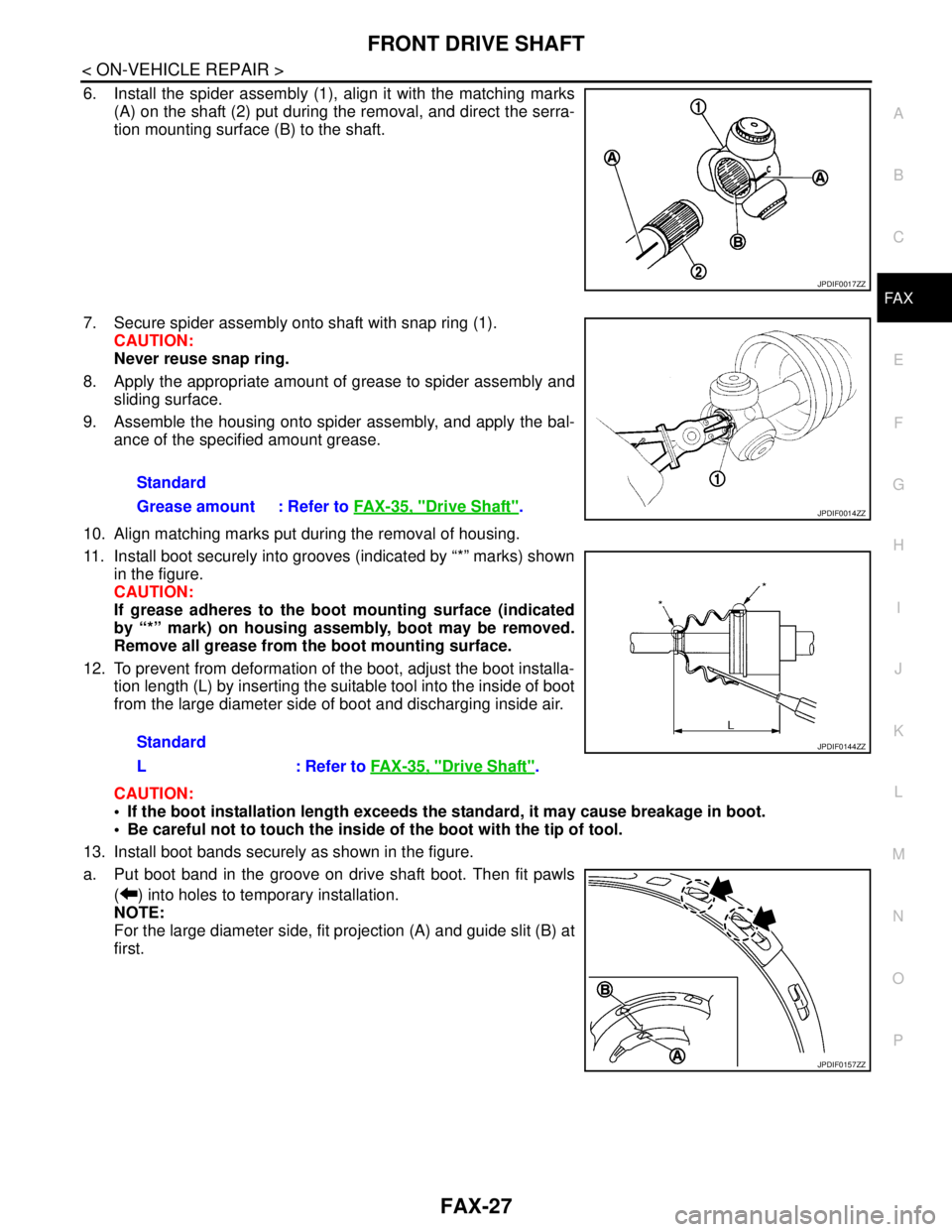
6. Install the spider assembly (1), align it with the matching marks
(A) on the shaft (2) put during the removal, and direct the serra-
tion mounting surface (B) to the shaft.
7. Secure spider assembly onto shaft with snap ring (1).
CAUTION:
Never reuse snap ring.
8. Apply the appropriate amount of grease to spider assembly and
sliding surface.
9. Assemble the housing onto spider assembly, and apply the bal-
ance of the specified amount grease.
10. Align matching marks put during the removal of housing.
11. Install boot securely into grooves (indicated by “*” marks) shown
in the figure.
CAUTION:
If grease adheres to the boot mounting surface (indicated
by “*” mark) on housing assembly, boot may be removed.
Remove all grease from the boot mounting surface.
12. To prevent from deformation of the boot, adjust the boot installa-
tion length (L) by inserting the suitable tool into the inside of boot
from the large diameter side of boot and discharging inside air.
CAUTION:
If the boot installation length exceeds the standard, it may cause breakage in boot.
Be careful not to touch the inside of the boot with the tip of tool.
13. Install boot bands securely as shown in the figure.
a. Put boot band in the groove on drive shaft boot. Then fit pawls
( ) into holes to temporary installation.
NOTE:
For the large diameter side, fit projection (A) and guide slit (B) at
first.
JPDIF0017ZZ
Standard
Grease amount : Refer to FAX-35, "
Drive Shaft".
Standard
L : Refer to FAX-35, "
Drive Shaft".
JPDIF0014ZZ
JPDIF0144ZZ
JPDIF0157ZZ
Page 2458 of 5121
FAX-30
< ON-VEHICLE REPAIR >
FRONT DRIVE SHAFT
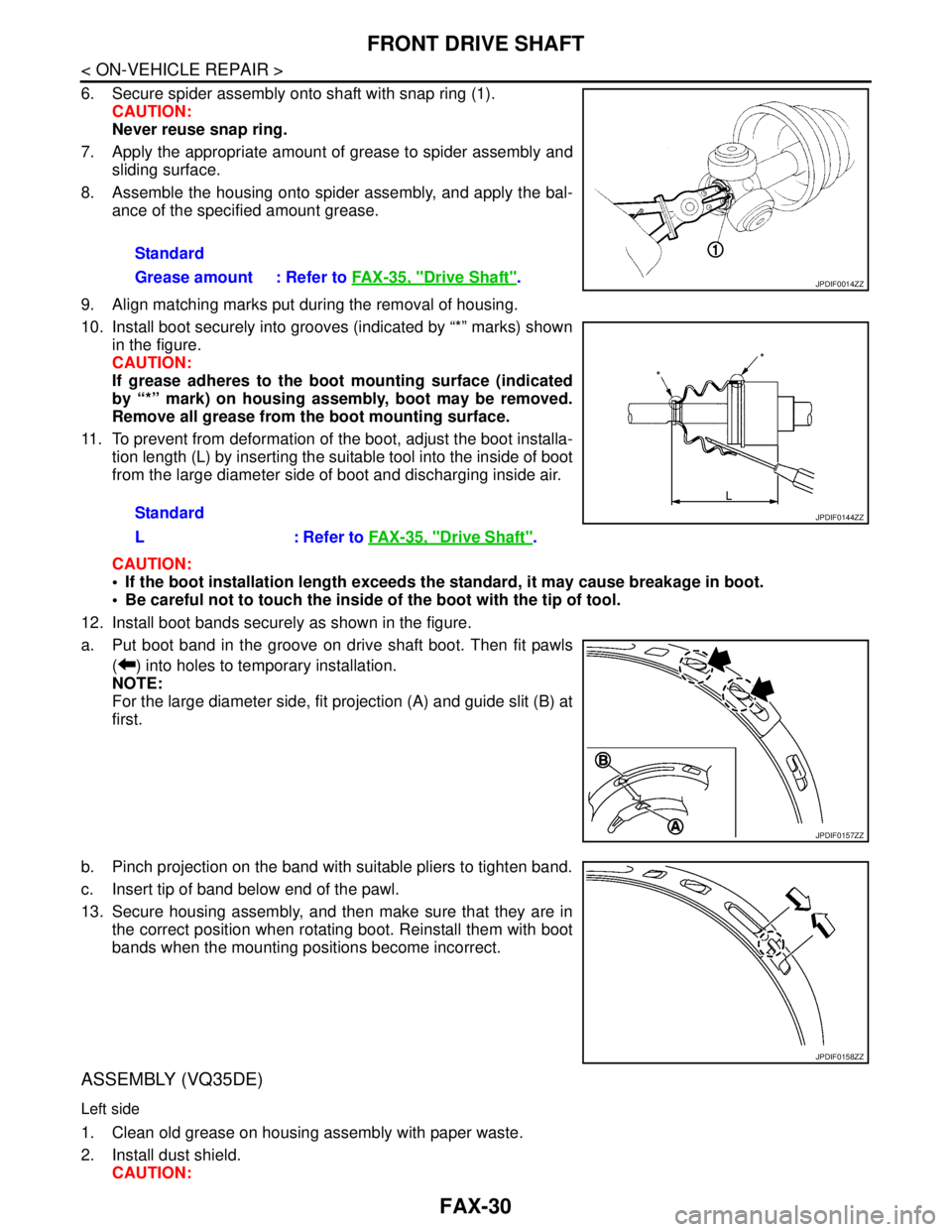
6. Secure spider assembly onto shaft with snap ring (1).
CAUTION:
Never reuse snap ring.
7. Apply the appropriate amount of grease to spider assembly and
sliding surface.
8. Assemble the housing onto spider assembly, and apply the bal-
ance of the specified amount grease.
9. Align matching marks put during the removal of housing.
10. Install boot securely into grooves (indicated by “*” marks) shown
in the figure.
CAUTION:
If grease adheres to the boot mounting surface (indicated
by “*” mark) on housing assembly, boot may be removed.
Remove all grease from the boot mounting surface.
11. To prevent from deformation of the boot, adjust the boot installa-
tion length (L) by inserting the suitable tool into the inside of boot
from the large diameter side of boot and discharging inside air.
CAUTION:
If the boot installation length exceeds the standard, it may cause breakage in boot.
Be careful not to touch the inside of the boot with the tip of tool.
12. Install boot bands securely as shown in the figure.
a. Put boot band in the groove on drive shaft boot. Then fit pawls
( ) into holes to temporary installation.
NOTE:
For the large diameter side, fit projection (A) and guide slit (B) at
first.
b. Pinch projection on the band with suitable pliers to tighten band.
c. Insert tip of band below end of the pawl.
13. Secure housing assembly, and then make sure that they are in
the correct position when rotating boot. Reinstall them with boot
bands when the mounting positions become incorrect.
ASSEMBLY (VQ35DE)
Left side
1. Clean old grease on housing assembly with paper waste.
2. Install dust shield.
CAUTION:Standard
Grease amount : Refer to FAX-35, "
Drive Shaft".
Standard
L: Refer to FAX-35, "
Drive Shaft".
JPDIF0014ZZ
JPDIF0144ZZ
JPDIF0157ZZ
JPDIF0158ZZ
Page 2459 of 5121
FRONT DRIVE SHAFT
FAX-31
< ON-VEHICLE REPAIR >
C
E
F
G
H
I
J
K
L
MA
B
FA X
N
O
P
Never reuse dust shield.
3. Install circular clip.
CAUTION:
Never reuse circular clip.
4. Apply balance of the specified amount grease to housing assembly.
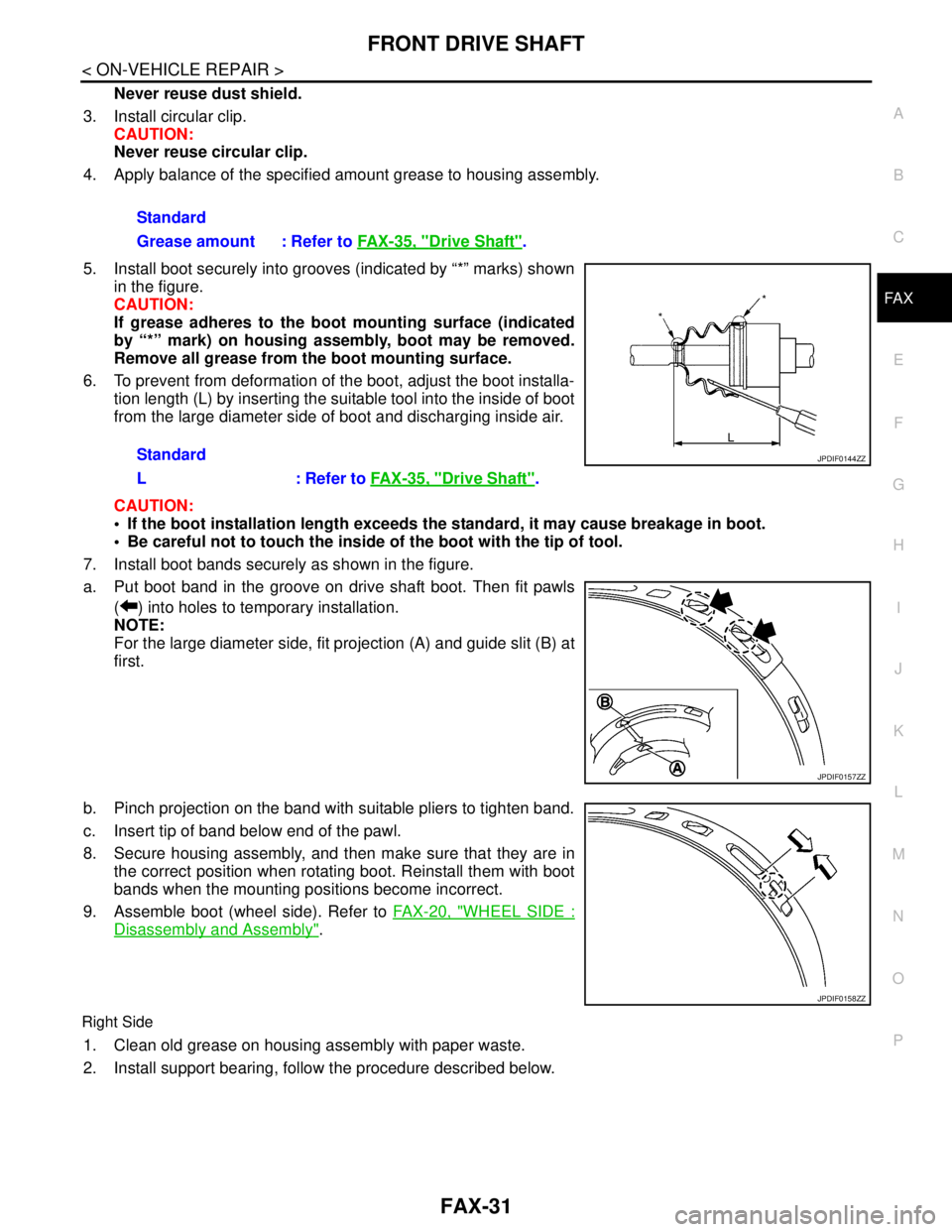
5. Install boot securely into grooves (indicated by “*” marks) shown
in the figure.
CAUTION:
If grease adheres to the boot mounting surface (indicated
by “*” mark) on housing assembly, boot may be removed.
Remove all grease from the boot mounting surface.
6. To prevent from deformation of the boot, adjust the boot installa-
tion length (L) by inserting the suitable tool into the inside of boot
from the large diameter side of boot and discharging inside air.
CAUTION:
If the boot installation length exceeds the standard, it may cause breakage in boot.
Be careful not to touch the inside of the boot with the tip of tool.
7. Install boot bands securely as shown in the figure.
a. Put boot band in the groove on drive shaft boot. Then fit pawls
( ) into holes to temporary installation.
NOTE:
For the large diameter side, fit projection (A) and guide slit (B) at
first.
b. Pinch projection on the band with suitable pliers to tighten band.
c. Insert tip of band below end of the pawl.
8. Secure housing assembly, and then make sure that they are in
the correct position when rotating boot. Reinstall them with boot
bands when the mounting positions become incorrect.
9. Assemble boot (wheel side). Refer to FAX-20, "
WHEEL SIDE :
Disassembly and Assembly".
Right Side
1. Clean old grease on housing assembly with paper waste.
2. Install support bearing, follow the procedure described below. Standard
Grease amount : Refer to FAX-35, "
Drive Shaft".
Standard
L : Refer to FAX-35, "
Drive Shaft".
JPDIF0144ZZ
JPDIF0157ZZ
JPDIF0158ZZ
Page 2460 of 5121
FAX-32
< ON-VEHICLE REPAIR >
FRONT DRIVE SHAFT
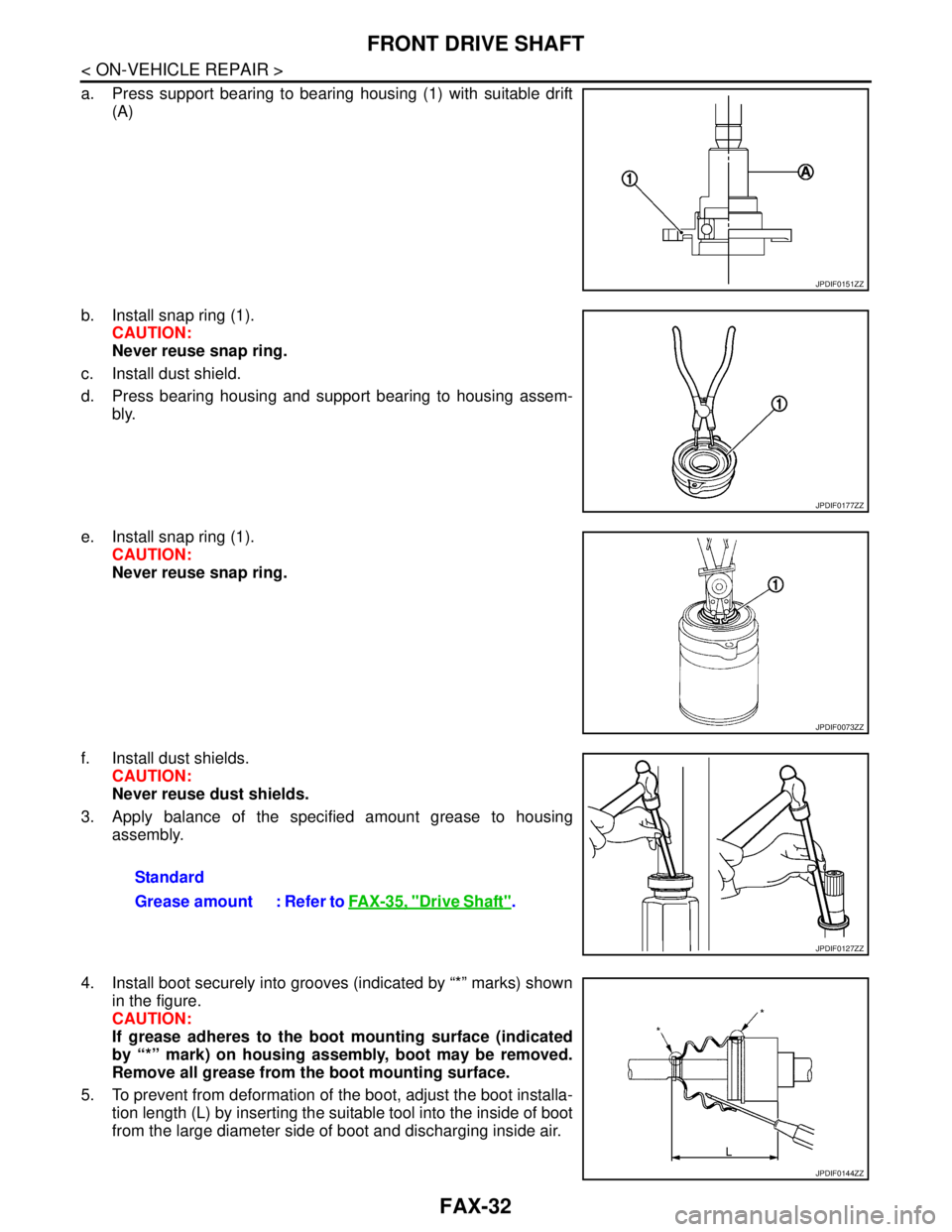
a. Press support bearing to bearing housing (1) with suitable drift
(A)
b. Install snap ring (1).
CAUTION:
Never reuse snap ring.
c. Install dust shield.
d. Press bearing housing and support bearing to housing assem-
bly.
e. Install snap ring (1).
CAUTION:
Never reuse snap ring.
f. Install dust shields.
CAUTION:
Never reuse dust shields.
3. Apply balance of the specified amount grease to housing
assembly.
4. Install boot securely into grooves (indicated by “*” marks) shown
in the figure.
CAUTION:
If grease adheres to the boot mounting surface (indicated
by “*” mark) on housing assembly, boot may be removed.
Remove all grease from the boot mounting surface.
5. To prevent from deformation of the boot, adjust the boot installa-
tion length (L) by inserting the suitable tool into the inside of boot
from the large diameter side of boot and discharging inside air.
JPDIF0151ZZ
JPDIF0177ZZ
JPDIF0073ZZ
Standard
Grease amount : Refer to FAX-35, "
Drive Shaft".
JPDIF0127ZZ
JPDIF0144ZZ
Page 2584 of 5121
PRECAUTIONS
HA-15
< PRECAUTION >
C
D
E
F
G
H
J
K
L
MA
B
HA
N
O
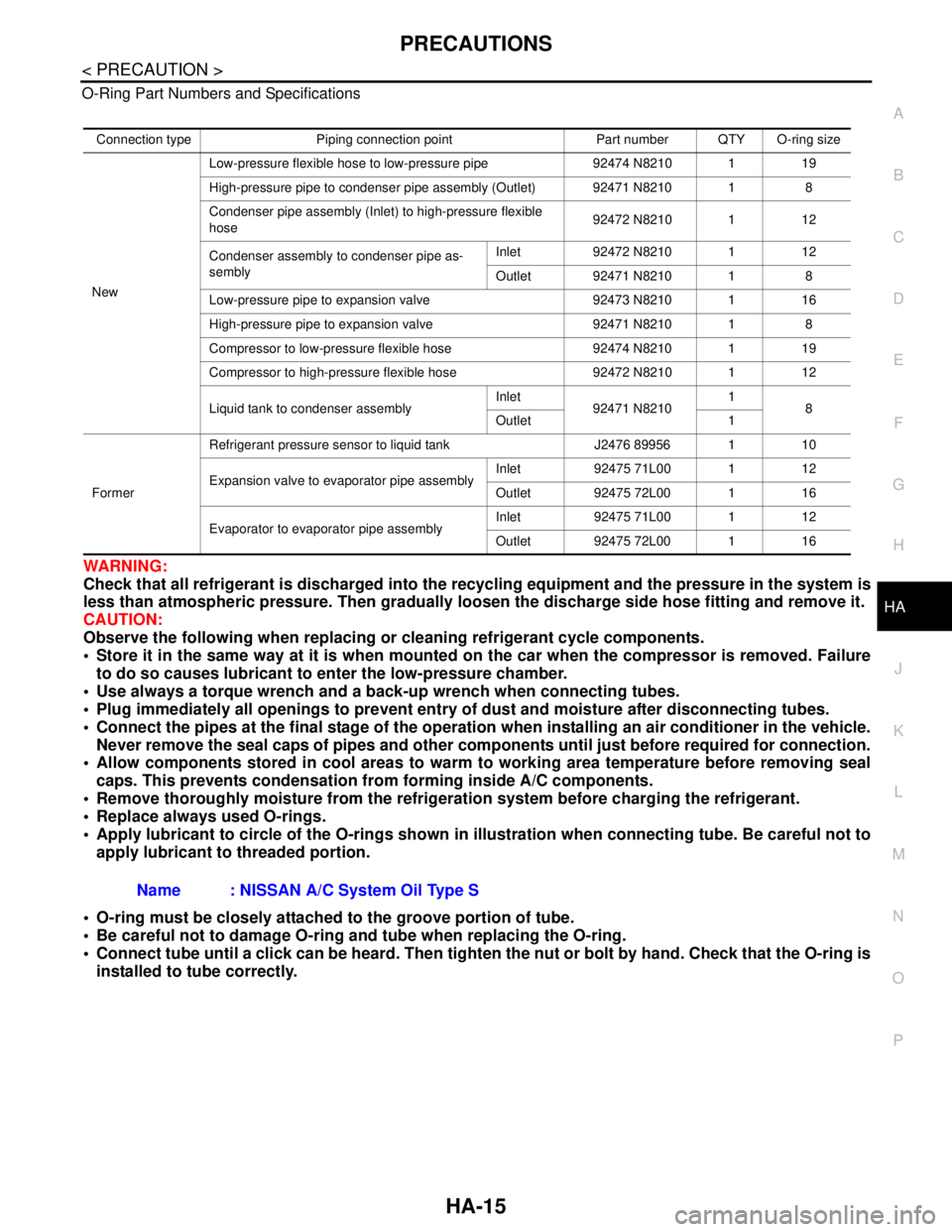
P O-Ring Part Numbers and Specifications
WARNING:
Check that all refrigerant is discharged into the recycling equipment and the pressure in the system is
less than atmospheric pressure. Then gradually loosen the discharge side hose fitting and remove it.
CAUTION:
Observe the following when replacing or cleaning refrigerant cycle components.
Store it in the same way at it is when mounted on the car when the compressor is removed. Failure
to do so causes lubricant to enter the low-pressure chamber.
Use always a torque wrench and a back-up wrench when connecting tubes.
Plug immediately all openings to prevent entry of dust and moisture after disconnecting tubes.
Connect the pipes at the final stage of the operation when installing an air conditioner in the vehicle.
Never remove the seal caps of pipes and other components until just before required for connection.
Allow components stored in cool areas to warm to working area temperature before removing seal
caps. This prevents condensation from forming inside A/C components.
Remove thoroughly moisture from the refrigeration system before charging the refrigerant.
Replace always used O-rings.
Apply lubricant to circle of the O-rings shown in illustration when connecting tube. Be careful not to
apply lubricant to threaded portion.
O-ring must be closely attached to the groove portion of tube.
Be careful not to damage O-ring and tube when replacing the O-ring.
Connect tube until a click can be heard. Then tighten the nut or bolt by hand. Check that the O-ring is
installed to tube correctly.
Connection type Piping connection point Part number QTY O-ring size
NewLow-pressure flexible hose to low-pressure pipe 92474 N8210 1 19
High-pressure pipe to condenser pipe assembly (Outlet) 92471 N8210 1 8
Condenser pipe assembly (Inlet) to high-pressure flexible
hose92472 N8210 1 12
Condenser assembly to condenser pipe as-
semblyInlet 92472 N8210 1 12
Outlet 92471 N8210 1 8
Low-pressure pipe to expansion valve 92473 N8210 1 16
High-pressure pipe to expansion valve 92471 N8210 1 8
Compressor to low-pressure flexible hose 92474 N8210 1 19
Compressor to high-pressure flexible hose 92472 N8210 1 12
Liquid tank to condenser assemblyInlet
92471 N82101
8
Outlet 1
FormerRefrigerant pressure sensor to liquid tank J2476 89956 1 10
Expansion valve to evaporator pipe assemblyInlet 92475 71L00 1 12
Outlet 92475 72L00 1 16
Evaporator to evaporator pipe assemblyInlet 92475 71L00 1 12
Outlet 92475 72L00 1 16
Name : NISSAN A/C System Oil Type S
Page 2586 of 5121
PRECAUTIONS
HA-17
< PRECAUTION >
C
D
E
F
G
H
J
K
L
MA
B
HA
N
O
P
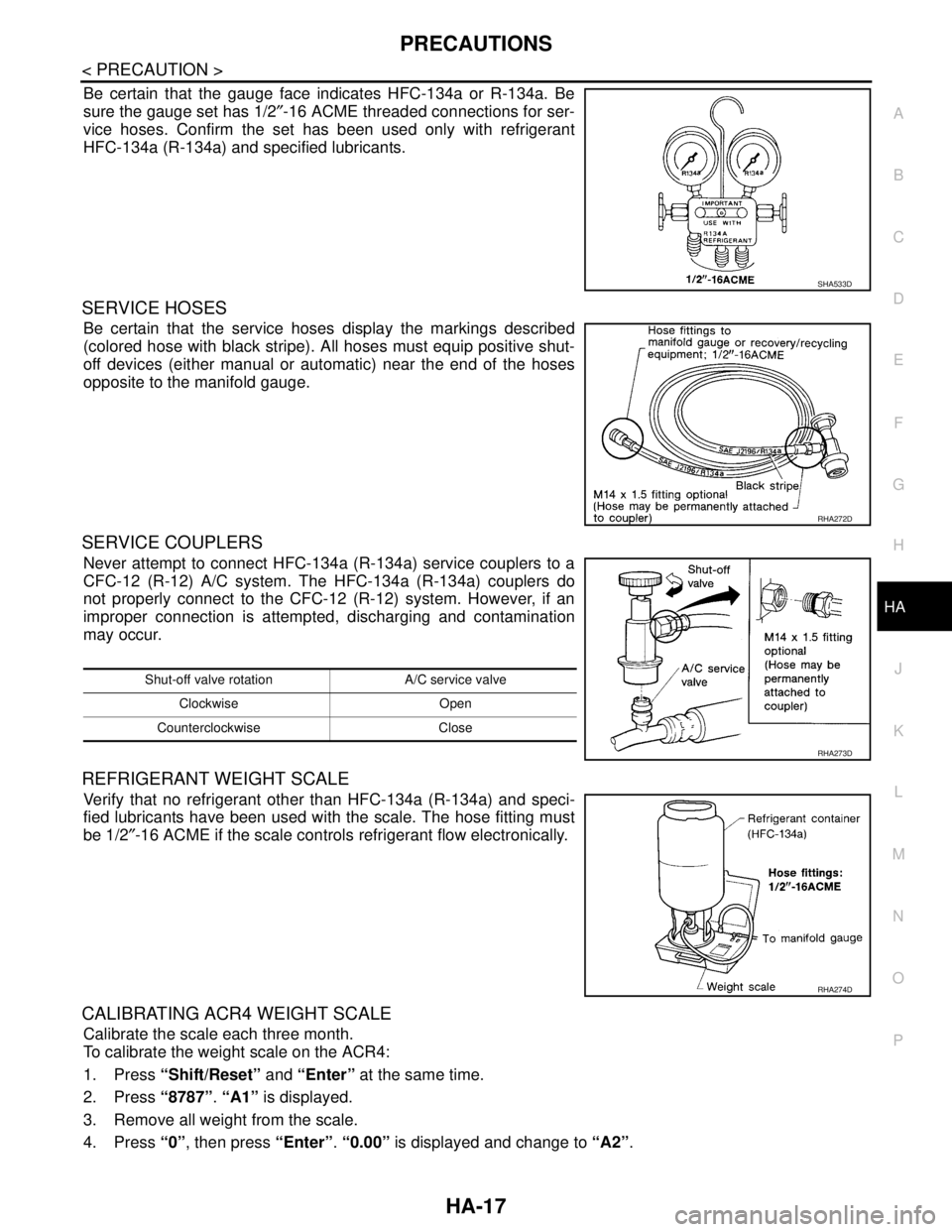
Be certain that the gauge face indicates HFC-134a or R-134a. Be
sure the gauge set has 1/2″-16 ACME threaded connections for ser-
vice hoses. Confirm the set has been used only with refrigerant
HFC-134a (R-134a) and specified lubricants.
SERVICE HOSES
Be certain that the service hoses display the markings described
(colored hose with black stripe). All hoses must equip positive shut-
off devices (either manual or automatic) near the end of the hoses
opposite to the manifold gauge.
SERVICE COUPLERS
Never attempt to connect HFC-134a (R-134a) service couplers to a
CFC-12 (R-12) A/C system. The HFC-134a (R-134a) couplers do
not properly connect to the CFC-12 (R-12) system. However, if an
improper connection is attempted, discharging and contamination
may occur.
REFRIGERANT WEIGHT SCALE
Verify that no refrigerant other than HFC-134a (R-134a) and speci-
fied lubricants have been used with the scale. The hose fitting must
be 1/2″-16 ACME if the scale controls refrigerant flow electronically.
CALIBRATING ACR4 WEIGHT SCALE
Calibrate the scale each three month.
To calibrate the weight scale on the ACR4:
1. Press “Shift/Reset” and “Enter” at the same time.
2. Press “8787”. “A1” is displayed.
3. Remove all weight from the scale.
4. Press “0”, then press “Enter”. “0.00” is displayed and change to “A2”.
SHA533D
RHA272D
Shut-off valve rotation A/C service valve
Clockwise Open
Counterclockwise Close
RHA273D
RHA274D
Page 2587 of 5121

HA-18
< PRECAUTION >
PRECAUTIONS
5. Place a known weight (dumbbell or similar weight), between 4.5 and 8.6 kg (10 and 19 lb.) on the center
of the weight scale.
6. Enter the known weight using four digits. (Example 10 lb. = 10.00, 10.5 lb. = 10.50)
7. Press “Enter”— the display returns to the vacuum mode.
8. Press “Shift/Reset” and “Enter” at the same time.
9. Press “6”— the known weight on the scale is displayed.
10. Remove the known weight from the scale. “0.00” is displayed.
11. Press “Shift/Reset” to return the ACR4 to the program mode.
CHARGING CYLINDER
Using a charging cylinder is not recommended. Refrigerant may be vented into air from cylinder’s top valve
when filling the cylinder with refrigerant. Also, the accuracy of the cylinder is generally less than that of an
electronic scale or of quality recycle/recharge equipment.
Page 2590 of 5121
PREPARATION
HA-21
< PREPARATION >
C
D
E
F
G
H
J
K
L
MA
B
HA
N
O
P
PREPARATION
PREPARATION
Special Service ToolINFOID:0000000003795893
HFC-134a (R-134a) Service Tool and Equipment Never mix HFC-134a (R-134a) refrigerant and/or its specified lubricant with CFC-12 (R-12) refrigerant and/
or its lubricant.
Separate and non-interchangeable service equipment must be used for handling each type of refrigerant/
lubricant.
Refrigerant container fittings, service hose fittings and service equipment fittings (equipment which handles
refrigerant and/or lubricant) are different between CFC-12 (R-12) and HFC-134a (R-134a). This is to avoid
mixed use of the refrigerants/lubricant.
Never use adapters that convert one size fitting to another: refrigerant/lubricant contamination occurs and
compressor malfunction may result.
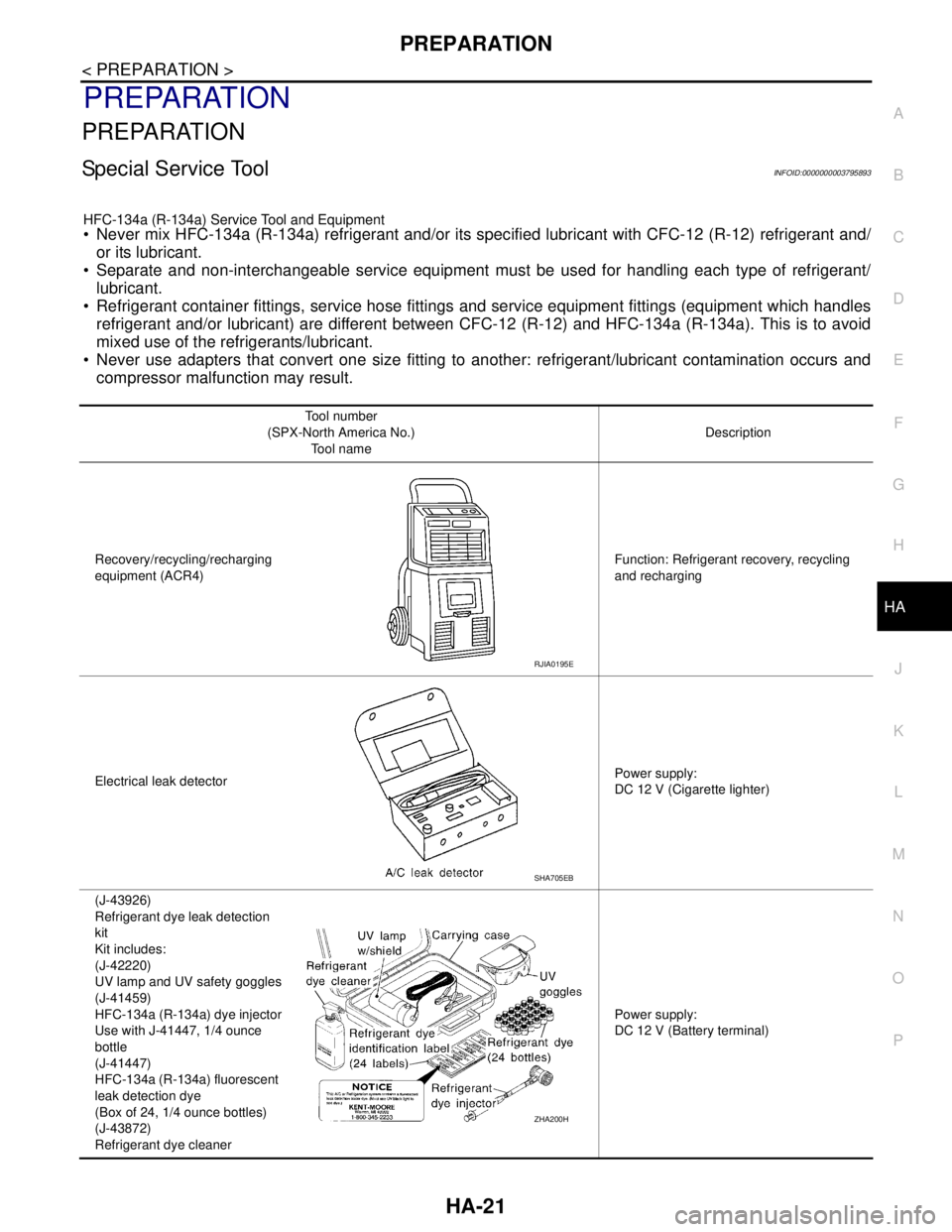
Tool number
(SPX-North America No.)
Tool nameDescription
Recovery/recycling/recharging
equipment (ACR4)Function: Refrigerant recovery, recycling
and recharging
Electrical leak detectorPower supply:
DC 12 V (Cigarette lighter)
(J-43926)
Refrigerant dye leak detection
kit
Kit includes:
(J-42220)
UV lamp and UV safety goggles
(J-41459)
HFC-134a (R-134a) dye injector
Use with J-41447, 1/4 ounce
bottle
(J-41447)
HFC-134a (R-134a) fluorescent
leak detection dye
(Box of 24, 1/4 ounce bottles)
(J-43872)
Refrigerant dye cleanerPower supply:
DC 12 V (Battery terminal)
RJIA0195E
SHA705EB
ZHA200H