charging NISSAN TEANA 2008 User Guide
[x] Cancel search | Manufacturer: NISSAN, Model Year: 2008, Model line: TEANA, Model: NISSAN TEANA 2008Pages: 5121, PDF Size: 69.03 MB
Page 1113 of 5121
CHG
CHARGING SYSTEM
CHG-15
< COMPONENT DIAGNOSIS >
C
D
E
F
G
H
I
J
K
L B A
O
P N
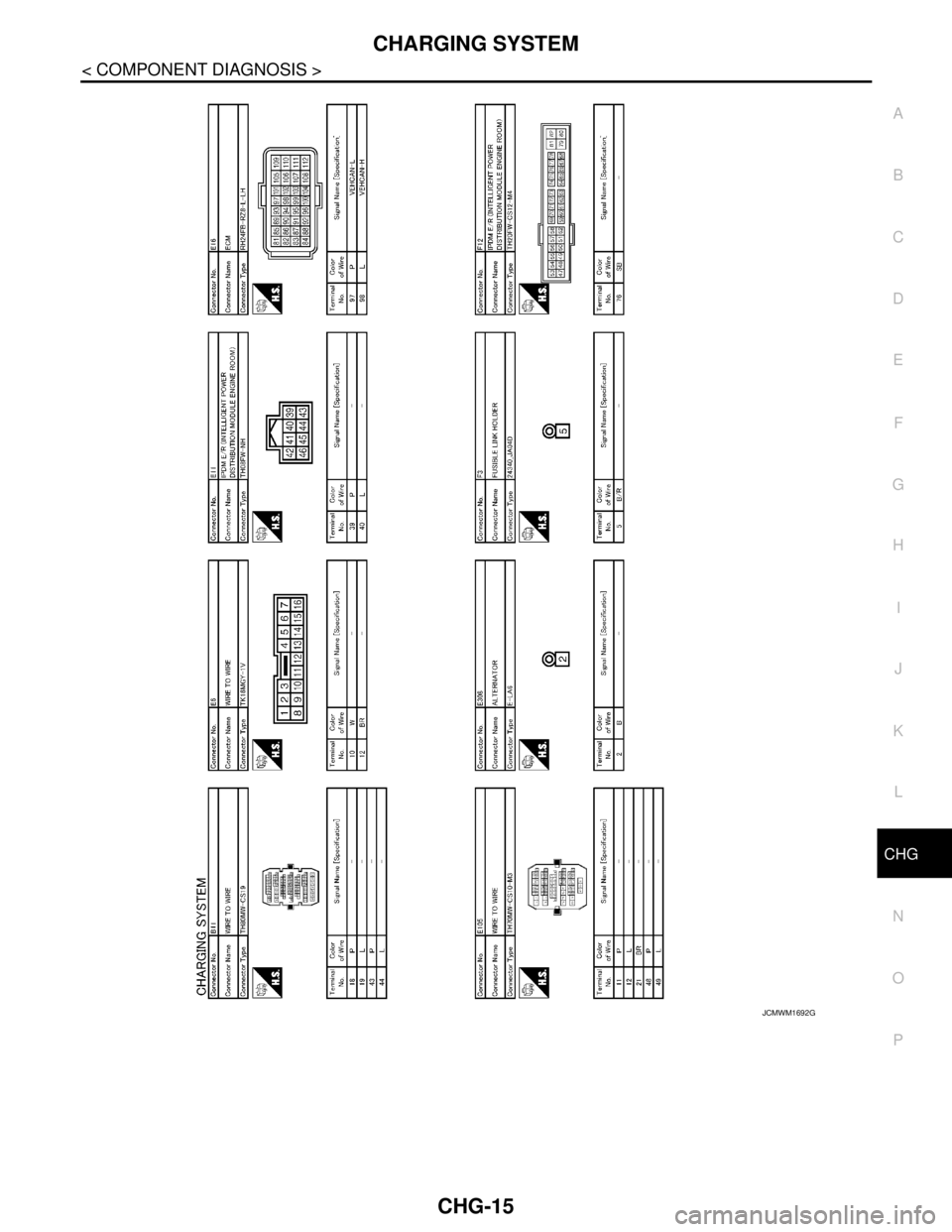
JCMWM1692GB
Page 1114 of 5121
CHG-16
< COMPONENT DIAGNOSIS >
CHARGING SYSTEM
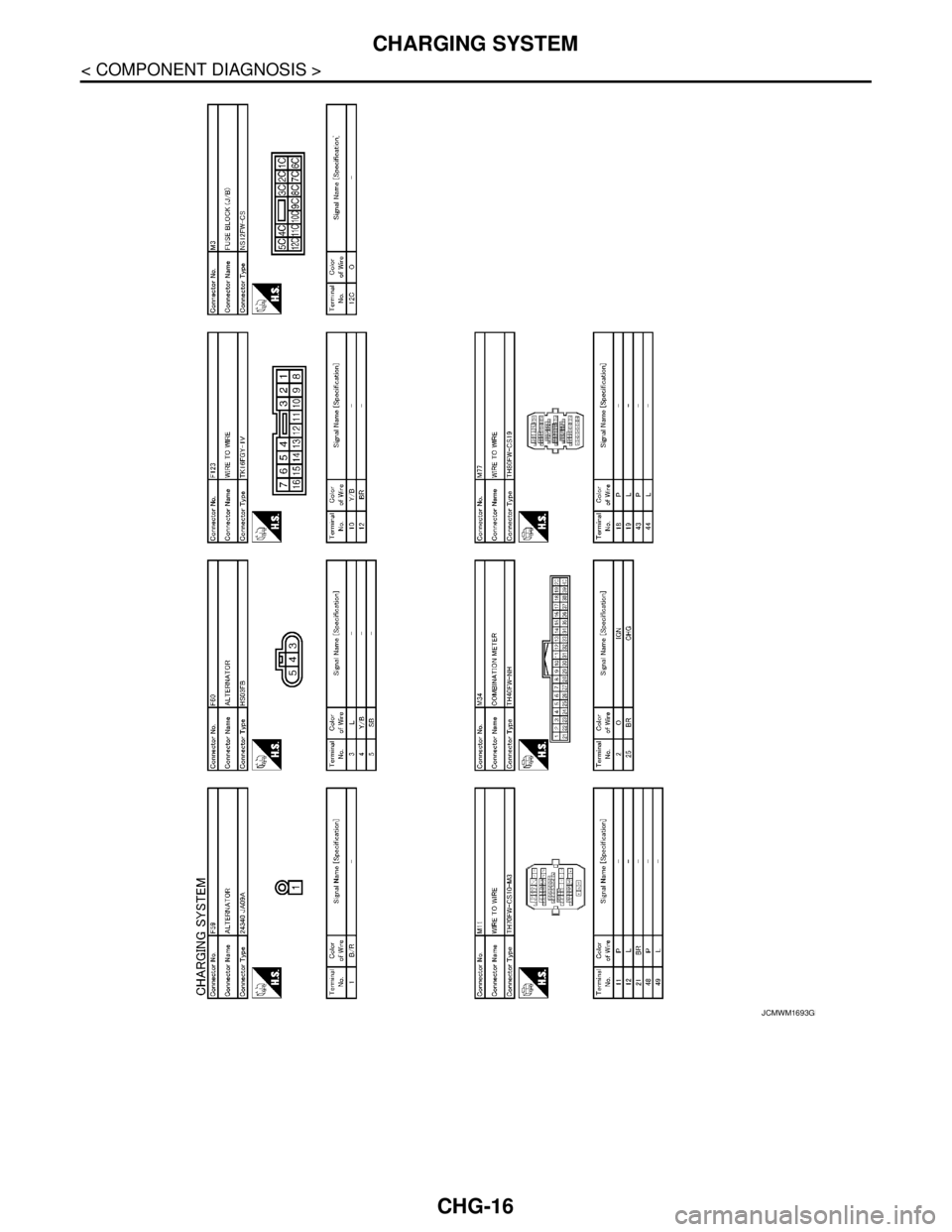
JCMWM1693GB
Page 1115 of 5121
CHG
CHARGING SYSTEM
CHG-17
< SYMPTOM DIAGNOSIS >
C
D
E
F
G
H
I
J
K
L B A
O
P N
SYMPTOM DIAGNOSIS
CHARGING SYSTEM
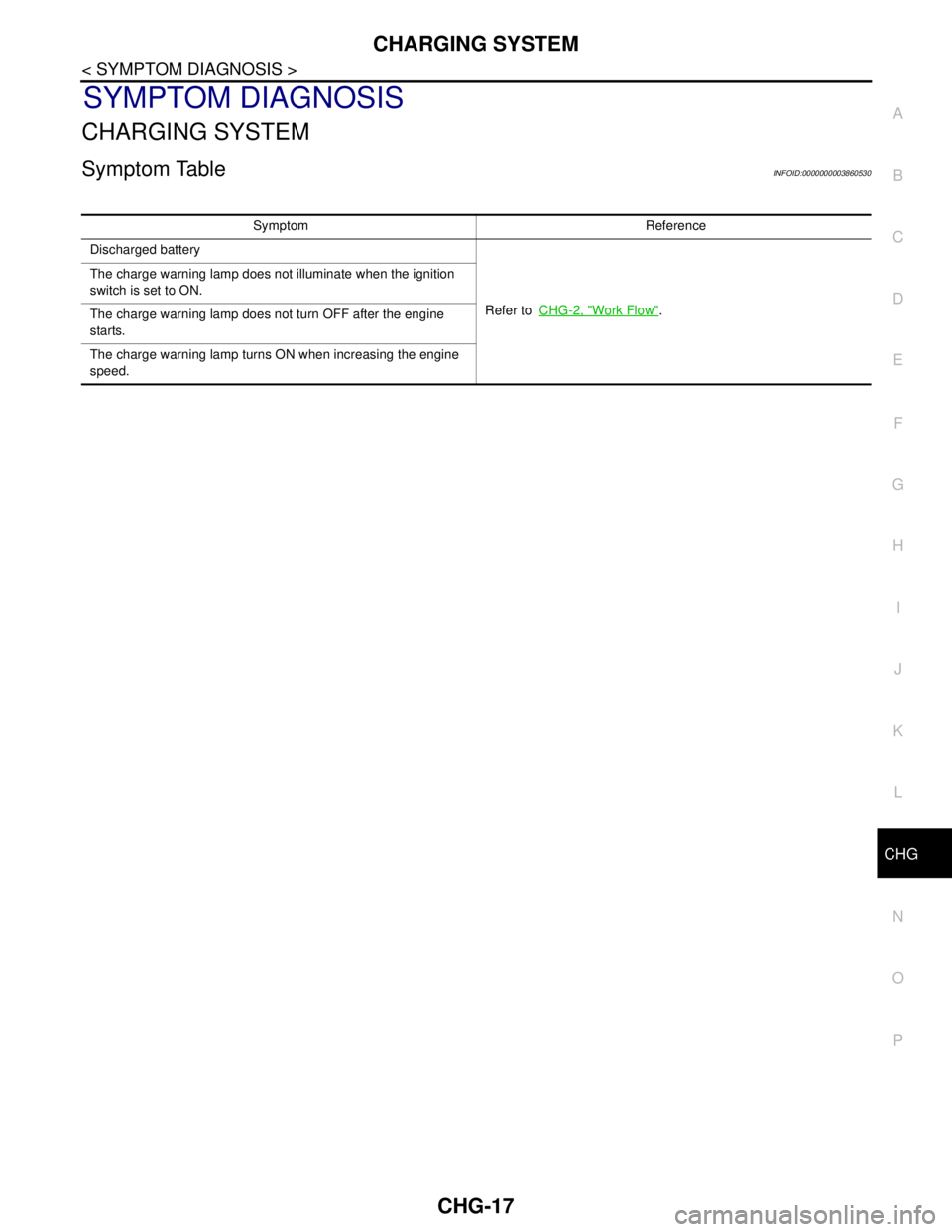
Symptom TableINFOID:0000000003860530
Symptom Reference
Discharged battery
Refer to CHG-2, "
Work Flow". The charge warning lamp does not illuminate when the ignition
switch is set to ON.
The charge warning lamp does not turn OFF after the engine
starts.
The charge warning lamp turns ON when increasing the engine
speed.
Page 1118 of 5121
CHG-20
< ON-VEHICLE MAINTENANCE >
CHARGING SYSTEM PRELIMINARY INSPECTION
ON-VEHICLE MAINTENANCE
CHARGING SYSTEM PRELIMINARY INSPECTION
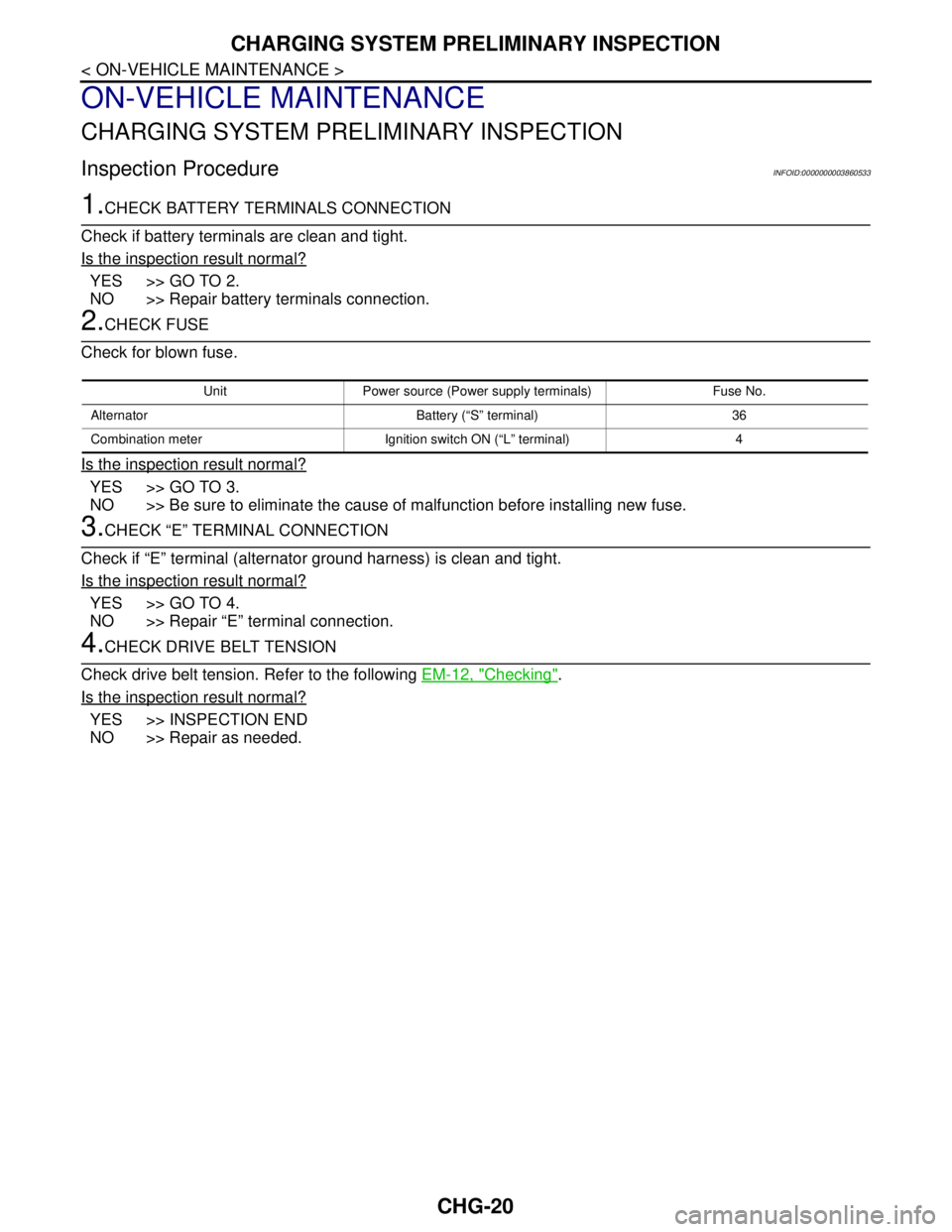
Inspection ProcedureINFOID:0000000003860533
1.CHECK BATTERY TERMINALS CONNECTION
Check if battery terminals are clean and tight.
Is the inspection result normal?
YES >> GO TO 2.
NO >> Repair battery terminals connection.
2.CHECK FUSE
Check for blown fuse.
Is the inspection result normal?
YES >> GO TO 3.
NO >> Be sure to eliminate the cause of malfunction before installing new fuse.
3.CHECK “E” TERMINAL CONNECTION
Check if “E” terminal (alternator ground harness) is clean and tight.
Is the inspection result normal?
YES >> GO TO 4.
NO >> Repair “E” terminal connection.
4.CHECK DRIVE BELT TENSION
Check drive belt tension. Refer to the following EM-12, "
Checking".
Is the inspection result normal?
YES >> INSPECTION END
NO >> Repair as needed.
Unit Power source (Power supply terminals) Fuse No.
Alternator Battery (“S” terminal) 36
Combination meter Ignition switch ON (“L” terminal) 4
Page 1149 of 5121
CO-26
< ON-VEHICLE REPAIR >
WATER OUTLET AND WATER PIPING
5. Remove CVT fluid charging pipe and CVT fluid level gauge. Refer to TM-332, "Exploded View" (VQ25DE)
or TM-168, "
Exploded View" (VQ35DE).
6. Move CVT control cable aside. Refer to TM-319, "
Exploded View" (VQ25DE) or TM-157, "Exploded View"
(VQ35DE).
7. Remove vacuum pipe (front) mounting bolt from water outlet. Refer to EM-67, "
Exploded View".
8. Remove radiator hose (upper) from water outlet.
9. Remove water hoses and heater hoses.
10. Disconnect harness connectors, and move harness to aside.
11. Remove engine coolant temperature sensor as necessary.
CAUTION:
Be careful not to damage engine coolant temperature sensor.
12. Remove water outlet, heater pipe, water bypass pipe and water connector.
INSTALLATION
Note the following, and install in the reverse order of removal.
Securely insert each hose, and install clamp at a position where it does not interfere with the pipe bulge.
When inserting water bypass pipe and heater pipe into water connector, apply neutral detergent to O-ring.
InspectionINFOID:0000000003793187
INSPECTION AFTER INSTALLATION
Check for leakage of engine coolant using the radiator cap tester adapter (commercial service tool) and the
radiator cap tester (commercial service tool). Refer to CO-8, "
Inspection".
Start and warm up the engine. Visually check that there is no leakage of engine coolant.
Page 1555 of 5121
![NISSAN TEANA 2008 User Guide EC-94
< FUNCTION DIAGNOSIS >[VQ25DE, VQ35DE]
VARIABLE INDUCTION AIR SYSTEM
In the medium speed range, the power valves are closed. Under this condition, the pressure waves of the
exhaust stroke do not](/img/5/57391/w960_57391-1554.png "NISSAN TEANA 2008 User Guide EC-94
< FUNCTION DIAGNOSIS >[VQ25DE, VQ35DE]
VARIABLE INDUCTION AIR SYSTEM
In the medium speed range, the power valves are closed. Under this condition, the pressure waves of the
exhaust stroke do not")
EC-94
< FUNCTION DIAGNOSIS >[VQ25DE, VQ35DE]
VARIABLE INDUCTION AIR SYSTEM
In the medium speed range, the power valves are closed. Under this condition, the pressure waves of the
exhaust stroke do not disturb the pressure waves of the intake stroke of each opposite bank. Therefore, charg-
ing efficiency is increased together with the effect of the long intake passage.
However, in the high speed range, the power valves are open. Under this condition, the pressure waves of
intake stroke are resonant with those of each opposite bank exhaust stroke. Therefore, charging efficiency is
also increased.
In addition, both valves (valves 1 and 2 for VQ35DE engine and a valve for VQ25DE engine) are opened or
closed in other ranges mentioned above. Thus maximum charging efficiency is obtained for the various driving
conditions.
VACUUM HOSE DRAWING (VQ35DE engine)
VACUUM HOSE DRAWING (VQ25DE engine)
1. Power valve actuator 1 2. VIAS control solenoid valve 1 3. VIAS control solenoid valve 2
4. Power valve actuator 2 5. Intake manifold collector
JMBIA0172ZZ
Page 1719 of 5121
![NISSAN TEANA 2008 User Guide EC-258
< COMPONENT DIAGNOSIS >[VQ25DE, VQ35DE]
P1550 BATTERY CURRENT SENSOR
P1550 BATTERY CURRENT SENSOR
DescriptionINFOID:0000000003856732
The power generation voltage variable control enables fuel c](/img/5/57391/w960_57391-1718.png "NISSAN TEANA 2008 User Guide EC-258
< COMPONENT DIAGNOSIS >[VQ25DE, VQ35DE]
P1550 BATTERY CURRENT SENSOR
P1550 BATTERY CURRENT SENSOR
DescriptionINFOID:0000000003856732
The power generation voltage variable control enables fuel c")
EC-258
< COMPONENT DIAGNOSIS >[VQ25DE, VQ35DE]
P1550 BATTERY CURRENT SENSOR
P1550 BATTERY CURRENT SENSOR
DescriptionINFOID:0000000003856732
The power generation voltage variable control enables fuel consumption to be decreased by reducing the
engine load which is caused by the power generation of the generator. The battery current sensor is installed
to the battery cable at the negative terminal. The sensor measures the charging/discharging current of the bat-
tery. Based on the sensor signal, ECM judges whether or not the power generation voltage variable control is
performed. When performing the power generation voltage variable control, ECM calculates the target power
generation voltage based on the sensor signal. And ECM sends the calculated value as the power generation
command value to IPDM E/R. For the details of the power generation voltage variable control, refer to CHG-5,
"System Description".
CAUTION:
Never connect the electrical component or the ground wire directly to the battery terminal. The con-
nection causes the malfunction of the power generation voltage variable control, and then the battery
discharge may occur.
DTC LogicINFOID:0000000003856733
DTC DETECTION LOGIC
NOTE:
If DTC P1550 is displayed with DTC P0643, first perform the trouble diagnosis for DTC P0643. Refer to
EC-243, "
DTC Logic".
DTC CONFIRMATION PROCEDURE
1.PRECONDITIONING
If DTC Confirmation Procedure has been previously conducted, always turn ignition switch OFF and at wait
least 10 seconds before conducting the next test.
TESTING CONDITION:
Before performing the following procedure, confirm that battery voltage is more than 8 V at idle.
>> GO TO 2.
2.PERFORM DTC CONFIRMATION PROCEDURE
1. Start engine and wait at least 10 seconds.
2. Check 1st trip DTC.
Is 1st trip DTC detected?
YES >> Go to EC-258, "Diagnosis Procedure".
NO >> INSPECTION END
Diagnosis ProcedureINFOID:0000000003856734
1.CHECK GROUND CONNECTION
1. Turn ignition switch OFF.
2. Check ground connection E38. Refer to Ground Inspection in GI-37, "
Circuit Inspection".
Is the inspection result normal?
YES >> GO TO 2.
NO >> Repair or replace ground connection.
2.CHECK BATTERY CURRENT SENSOR POWER SUPPLY CIRCUIT
1. Disconnect battery current sensor harness connector.
2. Turn ignition switch ON.
3. Check the voltage between battery current sensor harness connector and ground.
DTC No. Trouble diagnosis name DTC detecting condition Possible cause
P1550Battery current sensor circuit
range/performanceThe output voltage of the battery current
sensor remains within the specified
range while engine is running. Harness or connectors
(The sensor circuit is open or shorted.)
Battery current sensor
Page 1722 of 5121
![NISSAN TEANA 2008 User Guide P1551, P1552 BATTERY CURRENT SENSOR
EC-261
< COMPONENT DIAGNOSIS >[VQ25DE, VQ35DE]
C
D
E
F
G
H
I
J
K
L
MA
EC
N
P O
P1551, P1552 BATTERY CURRENT SENSOR
DescriptionINFOID:0000000003858133
The power gene](/img/5/57391/w960_57391-1721.png "NISSAN TEANA 2008 User Guide P1551, P1552 BATTERY CURRENT SENSOR
EC-261
< COMPONENT DIAGNOSIS >[VQ25DE, VQ35DE]
C
D
E
F
G
H
I
J
K
L
MA
EC
N
P O
P1551, P1552 BATTERY CURRENT SENSOR
DescriptionINFOID:0000000003858133
The power gene")
P1551, P1552 BATTERY CURRENT SENSOR
EC-261
< COMPONENT DIAGNOSIS >[VQ25DE, VQ35DE]
C
D
E
F
G
H
I
J
K
L
MA
EC
N
P O
P1551, P1552 BATTERY CURRENT SENSOR
DescriptionINFOID:0000000003858133
The power generation voltage variable control enables fuel consumption to be decreased by reducing the
engine load which is caused by the power generation of the generator. The battery current sensor is installed
to the battery cable at the negative terminal. The sensor measures the charging/discharging current of the bat-
tery. Based on the sensor signal, ECM judges whether or not the power generation voltage variable control is
performed. When performing the power generation voltage variable control, ECM calculates the target power
generation voltage based on the sensor signal. And ECM sends the calculated value as the power generation
command value to IPDM E/R. For the details of the power generation voltage variable control, refer to CHG-5,
"System Description".
CAUTION:
Never connect the electrical component or the ground wire directly to the battery terminal. The con-
nection causes the malfunction of the power generation voltage variable control, and then the battery
discharge may occur.
DTC LogicINFOID:0000000003856737
DTC DETECTION LOGIC
NOTE:
If DTC P1551 or P1552 is displayed with DTC P0643, first perform the trouble diagnosis for DTC P0643.
Refer to EC-243, "
DTC Logic".
DTC CONFIRMATION PROCEDURE
1.PRECONDITIONING
If DTC Confirmation Procedure has been previously conducted, always turn ignition switch OFF and wait at
least 10 seconds before conducting the next test.
TESTING CONDITION:
Before performing the following procedure, confirm that battery voltage is more than 8 V with ignition
switch ON
>> GO TO 2.
2.PERFORM DTC CONFIRMATION PROCEDURE
1. Turn ignition switch ON and wait at least 10 seconds.
2. Check 1st trip DTC.
Is 1st trip DTC detected?
YES >> Go to EC-261, "Diagnosis Procedure".
NO >> INSPECTION END
Diagnosis ProcedureINFOID:0000000003858135
1.CHECK GROUND CONNECTION
1. Turn ignition switch OFF.
2. Check ground connection E38. Refer to Ground Inspection in GI-37, "
Circuit Inspection".
Is the inspection result normal?
YES >> GO TO 2.
NO >> Repair or replace ground connection.
2.CHECK BATTERY CURRENT SENSOR POWER SUPPLY CIRCUIT
DTC No. Trouble diagnosis name DTC detecting condition Possible cause
P1551Battery current sensor circuit
low inputAn excessively low voltage from the sen-
sor is sent to ECM. Harness or connectors
(The sensor circuit is open or shorted.)
Battery current sensor
P1552Battery current sensor circuit
high inputAn excessively high voltage from the sen-
sor is sent to ECM.
Page 1725 of 5121
![NISSAN TEANA 2008 User Guide EC-264
< COMPONENT DIAGNOSIS >[VQ25DE, VQ35DE]
P1553 BATTERY CURRENT SENSOR
P1553 BATTERY CURRENT SENSOR
DescriptionINFOID:0000000003858136
The power generation voltage variable control enables fuel c](/img/5/57391/w960_57391-1724.png "NISSAN TEANA 2008 User Guide EC-264
< COMPONENT DIAGNOSIS >[VQ25DE, VQ35DE]
P1553 BATTERY CURRENT SENSOR
P1553 BATTERY CURRENT SENSOR
DescriptionINFOID:0000000003858136
The power generation voltage variable control enables fuel c")
EC-264
< COMPONENT DIAGNOSIS >[VQ25DE, VQ35DE]
P1553 BATTERY CURRENT SENSOR
P1553 BATTERY CURRENT SENSOR
DescriptionINFOID:0000000003858136
The power generation voltage variable control enables fuel consumption to be decreased by reducing the
engine load which is caused by the power generation of the generator. The battery current sensor is installed
to the battery cable at the negative terminal. The sensor measures the charging/discharging current of the bat-
tery. Based on the sensor signal, ECM judges whether or not the power generation voltage variable control is
performed. When performing the power generation voltage variable control, ECM calculates the target power
generation voltage based on the sensor signal. And ECM sends the calculated value as the power generation
command value to IPDM E/R. For the details of the power generation voltage variable control, refer to CHG-5,
"System Description".
CAUTION:
Never connect the electrical component or the ground wire directly to the battery terminal. The con-
nection causes the malfunction of the power generation voltage variable control, and then the battery
discharge may occur.
DTC LogicINFOID:0000000003856741
DTC DETECTION LOGIC
NOTE:
If DTC P1553 is displayed with DTC P0643, first perform the trouble diagnosis for DTC P0643. Refer to
EC-243, "
DTC Logic".
DTC CONFIRMATION PROCEDURE
1.PRECONDITIONING
If DTC Confirmation Procedure has been previously conducted, always turn ignition switch OFF and wait at
least 10 seconds before conducting the next test.
TESTING CONDITION:
Before performing the following procedure, confirm that battery voltage is more than 8 V at idle.
>> GO TO 2.
2.PERFORM DTC CONFIRMATION PROCEDURE
1. Start engine and wait at least 10 seconds.
2. Check 1st trip DTC.
Is 1st trip DTC detected?
YES >> Go to EC-264, "Diagnosis Procedure".
NO >> INSPECTION END
Diagnosis ProcedureINFOID:0000000003858137
1.CHECK GROUND CONNECTION
1. Turn ignition switch OFF.
2. Check ground connection E38. Refer to Ground Inspection in GI-37, "
Circuit Inspection".
Is the inspection result normal?
YES >> GO TO 2.
NO >> Repair or replace ground connection.
2.CHECK BATTERY CURRENT SENSOR POWER SUPPLY CIRCUIT
1. Disconnect battery current sensor harness connector.
2. Turn ignition switch ON.
3. Check the voltage between battery current sensor harness connector and ground.
DTC No. Trouble diagnosis name DTC detecting condition Possible cause
P1553Battery current sensor perfor-
manceThe signal voltage transmitted from the
sensor to ECM is higher than the amount
of the maximum power generation. Harness or connectors
(The sensor circuit is open or shorted.)
Battery current sensor
Page 1728 of 5121
![NISSAN TEANA 2008 User Guide P1554 BATTERY CURRENT SENSOR
EC-267
< COMPONENT DIAGNOSIS >[VQ25DE, VQ35DE]
C
D
E
F
G
H
I
J
K
L
MA
EC
N
P O
P1554 BATTERY CURRENT SENSOR
DescriptionINFOID:0000000003858139
The power generation voltage](/img/5/57391/w960_57391-1727.png "NISSAN TEANA 2008 User Guide P1554 BATTERY CURRENT SENSOR
EC-267
< COMPONENT DIAGNOSIS >[VQ25DE, VQ35DE]
C
D
E
F
G
H
I
J
K
L
MA
EC
N
P O
P1554 BATTERY CURRENT SENSOR
DescriptionINFOID:0000000003858139
The power generation voltage")
P1554 BATTERY CURRENT SENSOR
EC-267
< COMPONENT DIAGNOSIS >[VQ25DE, VQ35DE]
C
D
E
F
G
H
I
J
K
L
MA
EC
N
P O
P1554 BATTERY CURRENT SENSOR
DescriptionINFOID:0000000003858139
The power generation voltage variable control enables fuel consumption to be decreased by reducing the
engine load which is caused by the power generation of the generator. The battery current sensor is installed
to the battery cable at the negative terminal. The sensor measures the charging/discharging current of the bat-
tery. Based on the sensor signal, ECM judges whether or not the power generation voltage variable control is
performed. When performing the power generation voltage variable control, ECM calculates the target power
generation voltage based on the sensor signal. And ECM sends the calculated value as the power generation
command value to IPDM E/R. For the details of the power generation voltage variable control, refer to CHG-5,
"System Description".
CAUTION:
Never connect the electrical component or the ground wire directly to the battery terminal. The con-
nection causes the malfunction of the power generation voltage variable control, and then the battery
discharge may occur.
DTC LogicINFOID:0000000003856745
DTC DETECTION LOGIC
NOTE:
If DTC P1554 is displayed with DTC P0643, first perform the trouble diagnosis for DTC P0643. Refer to
EC-243, "
DTC Logic".
DTC CONFIRMATION PROCEDURE
1.PERFORM COMPONENT FUNCTION CHECK
Perform component function check. Refer to EC-267, "
Component Function Check".
NOTE:
Use component function check to check the overall function of the battery current sensor circuit. During this
check, a 1st trip DTC might not be confirmed.
Is the inspection result normal?
YES >> INSPECTION END
NO >> Go to EC-268, "
Diagnosis Procedure".
Component Function CheckINFOID:0000000003856746
1.PRECONDITIONING
TESTING CONDITION:
Before performing the following procedure, confirm that battery voltage is more than 12.8 V at idle.
Before performing the following procedure, confirm that all load switches and A/C switch are turned
OFF.
>> GO TO 2.
2.PERFORM COMPONENT FUNCTION CHECK
With CONSULT-III
1. Start engine and let it idle.
2. Select “BAT CUR SEN” in “DATA MONITOR” mode with CONSULT-III.
3. Check “BAT CUR SEN” indication for 10 seconds.
“BAT CUR SEN” should be above 2,300 mV at least once.
Without CONSULT-III
1. Start engine and let it idle.
2. Check voltage between ECM harness connector terminals under the following conditions.
DTC No. Trouble diagnosis name DTC detecting condition Possible cause
P1554Battery current sensor perfor-
manceThe output voltage of the battery current
sensor is lower than the specified value
while the battery voltage is high enough. Harness or connectors
(The sensor circuit is open or shorted.)
Battery current sensor