cvt NISSAN TEANA 2008 Owner's Manual
[x] Cancel search | Manufacturer: NISSAN, Model Year: 2008, Model line: TEANA, Model: NISSAN TEANA 2008Pages: 5121, PDF Size: 69.03 MB
Page 1849 of 5121
![NISSAN TEANA 2008 Owners Manual EC-388
< ECU DIAGNOSIS >[VQ25DE, VQ35DE]
ECM
DTC Inspection Priority Chart
INFOID:0000000003856871
If some DTCs are displayed at the same time, perform inspections one by one based on the following pr](/img/5/57391/w960_57391-1848.png "NISSAN TEANA 2008 Owners Manual EC-388
< ECU DIAGNOSIS >[VQ25DE, VQ35DE]
ECM
DTC Inspection Priority Chart
INFOID:0000000003856871
If some DTCs are displayed at the same time, perform inspections one by one based on the following pr")
EC-388
< ECU DIAGNOSIS >[VQ25DE, VQ35DE]
ECM
DTC Inspection Priority Chart
INFOID:0000000003856871
If some DTCs are displayed at the same time, perform inspections one by one based on the following priority
chart.
P2119 Electric throttle control ac-
tuator(When electric throttle control actuator does not function properly due to the return spring
malfunction:)
ECM controls the electric throttle actuator by regulating the throttle opening around the
idle position. The engine speed will not rise more than 2,000 rpm.
(When throttle valve opening angle in fail-safe mode is not in specified range:)
ECM controls the electric throttle control actuator because of regulating the throttle open-
ing to 20 degrees or less.
(When ECM detects the throttle valve is stuck open:)
While the vehicle is being driver, it slows down gradually by fuel cut. After the vehicle
stops, the engine stalls.
The engine can restart in N or P position, and engine speed will not exceed 1,000 rpm or
more.
P2122
P2123
P2127
P2128
P2138Accelerator pedal position
sensorThe ECM controls the electric throttle control actuator in regulating the throttle opening in
order for the idle position to be within +10 degrees.
The ECM regulates the opening speed of the throttle valve to be slower than the normal
condition.
So, the acceleration will be poor. DTC No. Detected items Engine operating condition in fail-safe mode
Priority Detected items (DTC)
1 U1000 U1001 CAN communication line
P0102 P0103 Mass air flow sensor
P0112 P0113 Intake air temperature sensor
P0117 P0118 Engine coolant temperature sensor
P0122 P0123 P0222 P0223 P1225 P1226 P2135 Throttle position sensor
P0327 P0328 P0332 P0333 Knock sensor
P0335 Crankshaft position sensor (POS)
P0340 P0345 Camshaft position sensor (PHASE)
P0500 Vehicle speed sensor
P0605 P0607 ECM
P0643 Sensor power supply
P0705 P0850 Park/Neutral position (PNP) switch
P1550 P1551 P1552 P1553 P1554 Battery current sensor
P1610 - P1615 NATS
P1700 CVT control system
P2122 P2123 P2127 P2128 P2138 Accelerator pedal position sensor
Page 1850 of 5121
![NISSAN TEANA 2008 Owners Manual ECM
EC-389
< ECU DIAGNOSIS >[VQ25DE, VQ35DE]
C
D
E
F
G
H
I
J
K
L
MA
EC
N
P O
DTC IndexINFOID:0000000003856872
×:Applicable —: Not applicable
2 P0031 P0032 P0051 P0052 Air fuel ratio (A/F) sensor](/img/5/57391/w960_57391-1849.png "NISSAN TEANA 2008 Owners Manual ECM
EC-389
< ECU DIAGNOSIS >[VQ25DE, VQ35DE]
C
D
E
F
G
H
I
J
K
L
MA
EC
N
P O
DTC IndexINFOID:0000000003856872
×:Applicable —: Not applicable
2 P0031 P0032 P0051 P0052 Air fuel ratio (A/F) sensor")
ECM
EC-389
< ECU DIAGNOSIS >[VQ25DE, VQ35DE]
C
D
E
F
G
H
I
J
K
L
MA
EC
N
P O
DTC IndexINFOID:0000000003856872
×:Applicable —: Not applicable
2 P0031 P0032 P0051 P0052 Air fuel ratio (A/F) sensor 1 heater
P0037 P0038 P0057 P0058 Heated oxygen sensor 2 heater
P0075 P0081 Intake valve timing control solenoid valve
P0130 P0131 P0132 P0133 P0150 P0151 P0152 P0153 P2A00 P2A03 Air fuel ratio (A/F) sensor 1
P0137 P0138 P0139 P0157 P0158 P0159 Heated oxygen sensor 2
P0444 EVAP canister purge volume control solenoid valve
P0550 Power steering pressure sensor
P0603 ECM power supply
P0710 P0715 P0720 P0740 P0744 P0745 P0746 P0776 P0778 P0840 P0845 P1740 CVT related sensors, solenoid valves
and switches
P1217 Engine over temperature (OVERHEAT)
P1720 Vehicle speed sensor
P1777 P1778 CVT step motor
P1800 P1801 VIAS control solenoid valve
P1805 Brake switch
P2100 P2103 Throttle control motor relay
P2101 Electric throttle control function
P2118 Throttle control motor
3 P0011 P0021 Intake valve timing control
P0171 P0172 P0174 P0175 Fuel injection system function
P0300 - P0306 Misfire
P0420 P0430 Three way catalyst function
P1212 TCS communication line
P1564 ASCD steering switch
P1572 ASCD brake switch
P1574 ASCD vehicle speed sensor
P1715 Primary speed sensor
P2119 Electric throttle control actuator Priority Detected items (DTC)
Items
(CONSULT-III screen terms)DTC*
1
SRT code Trip MIReference
page CONSULT-III
GST*
2ECM*3
CAN COMM CIRCUIT U1000
1000*4—1×EC-135
CAN COMM CIRCUIT U1001
1001*4—2 —EC-135
NO DTC IS DETECTED.
FURTHER TESTING
MAY BE REQUIRED.P0000 0000——
Flashing*6—
INT/V TIM CONT-B1 P0011 0011 — 2 —EC-136
INT/V TIM CONT-B2 P0021 0021 — 2 —EC-136
A/F SEN1 HTR (B1) P0031 0031 — 2×EC-140
A/F SEN1 HTR (B1) P0032 0032 — 2×EC-140
HO2S2 HTR (B1) P0037 0037 — 2×EC-143
HO2S2 HTR (B1) P0038 0038 — 2×EC-143
A/F SEN1 HTR (B2) P0051 0051 — 2×EC-140
A/F SEN1 HTR (B2) P0052 0052 — 2×EC-140
HO2S2 HTR (B2) P0057 0057 — 2×EC-143
HO2S2 HTR (B2) P0058 0058 — 2×EC-143
INT/V TIM V/CIR-B1 P0075 0075 — 2×EC-146
INT/V TIM V/CIR-B2 P0081 0081 — 2×EC-146
MAF SEN/CIRCUIT-B1 P0102 0102 — 1×EC-149
MAF SEN/CIRCUIT-B1 P0103 0103 — 1×EC-149
Page 1852 of 5121
![NISSAN TEANA 2008 Owners Manual ECM
EC-391
< ECU DIAGNOSIS >[VQ25DE, VQ35DE]
C
D
E
F
G
H
I
J
K
L
MA
EC
N
P OPURG VOLUME CONT/V P0444 0444 — 2×EC-231
VEH SPEED SEN/CIRC*5P0500 0500 — 2×EC-234
PW ST P SEN/CIRC P0550 0550 — 2 â](/img/5/57391/w960_57391-1851.png "NISSAN TEANA 2008 Owners Manual ECM
EC-391
< ECU DIAGNOSIS >[VQ25DE, VQ35DE]
C
D
E
F
G
H
I
J
K
L
MA
EC
N
P OPURG VOLUME CONT/V P0444 0444 — 2×EC-231
VEH SPEED SEN/CIRC*5P0500 0500 — 2×EC-234
PW ST P SEN/CIRC P0550 0550 — 2 â")
ECM
EC-391
< ECU DIAGNOSIS >[VQ25DE, VQ35DE]
C
D
E
F
G
H
I
J
K
L
MA
EC
N
P OPURG VOLUME CONT/V P0444 0444 — 2×EC-231
VEH SPEED SEN/CIRC*5P0500 0500 — 2×EC-234
PW ST P SEN/CIRC P0550 0550 — 2 —EC-236
ECM BACK UP/CIRCUIT P0603 0603 — 2×EC-238
ECM P0605 0605 — 1 or 2× or —EC-240
ECM P0607 0607 — 1×EC-242
SENSOR POWER/CIRC P0643 0643 — 1×EC-243
PNP SW/CIRC P0705 0705 — 2×TM-47
ATF TEMP SEN/CIRC P0710 0710 — 1×TM-50
INPUT SPD SEN/CIRC P0715 0715 — 2×TM-52
VEH SPD SEN/CIR AT*5P0720 0720 — 2×TM-55
TCC SOLENOID/CIRC P0740 0740 — 2×TM-62
A/T TCC S/V FNCTN P0744 0744 — 2×TM-64
L/PRESS SOL/CIRC P0745 0745 — 2×TM-66
PRS CNT SOL/A FCTN P0746 0746 — 1×TM-68
PRS CNT SOL/B FCTN P0776 0776 — 2×TM-70
PRS CNT SOL/B CIRC P0778 0778 — 2×TM-72
TR PRS SENS/A CIRC P0840 0840 — 2×TM-74
TR PRS SENS/B CIRC P0845 0845 — 2×TM-80
P-N POS SW/CIRCUIT P0850 0850 — 2×EC-245
TCS/CIRC P1212 1212 — 2 —EC-249
ENG OVER TEMP P1217 1217 — 1×EC-250
CTP LEARNING-B1 P1225 1225 — 2 —EC-254
CTP LEARNING-B1 P1226 1226 — 2 —EC-256
BAT CURRENT SENSOR P1550 1550 — 2 —EC-258
BAT CURRENT SENSOR P1551 1551 — 2 —EC-261
BAT CURRENT SENSOR P1552 1552 — 2 —EC-261
BAT CURRENT SENSOR P1553 1553 — 2 —EC-264
BAT CURRENT SENSOR P1554 1554 — 2 —EC-267
ASCD SW P1564 1564 — 1 —EC-270
ASCD BRAKE SW P1572 1572 — 1 —EC-273
ASCD VHL SPD SEN P1574 1574 — 1 —EC-278
LOCK MODE P1610 1610 — 2 —SEC-31
ID DISCORD IMM-ECM P1611 1611 — 2 —SEC-32
CHAIN OF ECM-IMMU P1612 1612 — 2 —SEC-34
CHAIN OF IMMU-KEY P1614 1614 — 2 —SEC-35
DIFFERENCE OF KEY P1615 1615 — 2 —SEC-38
CVT C/U FUNCT P1700 1700 — 1 —EC-280
IN PULY SPEED P1715 1715 — 2 —EC-281
V/SP SEN(A/T OUT) P1720 1720 — 2 —EC-283
LU-SLCT SOL/CIRC P1740 1740 — 2×TM-94
STEP MOTR CIRC P1777 1777 — 1×TM-97
Items
(CONSULT-III screen terms)DTC*
1
SRT code Trip MIReference
page CONSULT-III
GST*
2ECM*3
Page 1866 of 5121
![NISSAN TEANA 2008 Owners Manual PRECAUTIONS
EC-405
< PRECAUTION >[VQ25DE, VQ35DE]
C
D
E
F
G
H
I
J
K
L
MA
EC
N
P O
PRECAUTION
PRECAUTIONS
Precaution for Supplemental Restraint System (SRS) "AIR BAG" and "SEAT BELT
PRE-TENSIONER"
INF](/img/5/57391/w960_57391-1865.png "NISSAN TEANA 2008 Owners Manual PRECAUTIONS
EC-405
< PRECAUTION >[VQ25DE, VQ35DE]
C
D
E
F
G
H
I
J
K
L
MA
EC
N
P O
PRECAUTION
PRECAUTIONS
Precaution for Supplemental Restraint System (SRS) \"AIR BAG\" and \"SEAT BELT
PRE-TENSIONER\"
INF")
PRECAUTIONS
EC-405
< PRECAUTION >[VQ25DE, VQ35DE]
C
D
E
F
G
H
I
J
K
L
MA
EC
N
P O
PRECAUTION
PRECAUTIONS
Precaution for Supplemental Restraint System (SRS) "AIR BAG" and "SEAT BELT
PRE-TENSIONER"
INFOID:0000000003960684
The Supplemental Restraint System such as “AIR BAG” and “SEAT BELT PRE-TENSIONER”, used along
with a front seat belt, helps to reduce the risk or severity of injury to the driver and front passenger for certain
types of collision. Information necessary to service the system safely is included in the “SRS AIRBAG” and
“SEAT BELT” of this Service Manual.
WARNING:
To avoid rendering the SRS inoperative, which could increase the risk of personal injury or death in
the event of a collision which would result in air bag inflation, all maintenance must be performed by
an authorized NISSAN/INFINITI dealer.
Improper maintenance, including incorrect removal and installation of the SRS, can lead to personal
injury caused by unintentional activation of the system. For removal of Spiral Cable and Air Bag
Module, see the “SRS AIRBAG”.
Never use electrical test equipment on any circuit related to the SRS unless instructed to in this Ser-
vice Manual. SRS wiring harnesses can be identified by yellow and/or orange harnesses or harness
connectors.
Precautions For Xenon Headlamp ServiceINFOID:0000000003856878
WARNING:
Comply with the following warnings to prevent any serious accident.
Disconnect the battery cable (negative terminal) or the power supply fuse before installing, remov-
ing, or touching the xenon headlamp (bulb included). The xenon headlamp contains high-voltage
generated parts.
Never work with wet hands.
Check the xenon headlamp ON-OFF status after assembling it to the vehicle. Never turn the xenon
headlamp ON in other conditions. Connect the power supply to the vehicle-side connector.
(Turning it ON outside the lamp case may cause fire or visual impairments.)
Never touch the bulb glass immediately after turning it OFF. It is extremely hot.
CAUTION:
Comply with the following cautions to prevent any error and malfunction.
Install the xenon bulb securely. (Insufficient bulb socket installation may melt the bulb, the connec-
tor, the housing, etc. by high-voltage leakage or corona discharge.)
Never perform HID circuit inspection with a tester.
Never touch the xenon bulb glass with hands. Never put oil and grease on it.
Dispose of the used xenon bulb after packing it in thick vinyl without breaking it.
Never wipe out dirt and contamination with organic solvent (thinner, gasoline, etc.).
Precaution for Procedure without Cowl Top CoverINFOID:0000000003856879
When performing the procedure after removing cowl top cover, cover
the lower end of windshield with urethane, etc.
On Board Diagnostic (OBD) System of Engine and CVTINFOID:0000000003856880
The ECM has an on board diagnostic system. It will illuminate the malfunction indicator MI to warn the driver of
a malfunction causing emission deterioration.
PIIB3706J
Page 1941 of 5121

EM-66
< ON-VEHICLE REPAIR >
TIMING CHAIN
Use procedure below to check for fuel leakage.
- Turn ignition switch “ON” (with engine stopped). With fuel pressure applied to fuel piping, check for fuel leak-
age at connection points.
- Start engine. With engine speed increased, check again for fuel leakage at connection points.
Run engine to check for unusual noise and vibration.
NOTE:
If hydraulic pressure inside chain tensioner drops after removal/installation, slack in guide may generate a
pounding noise during and just after the engine start. However, this does not indicate an unusualness. Noise
will stop after hydraulic pressure rises.
Warm up engine thoroughly to check there is no leakage of fuel, or any oil/fluids including engine oil and
engine coolant.
Bleed air from lines and hoses of applicable lines, such as in cooling system.
After cooling down engine, again check oil/fluid levels including engine oil and engine coolant. Refill to the
specified level, if necessary.
Summary of the inspection items:
*: Transmission/transaxle/CVT fluid, power steering fluid, brake fluid, etc.Items Before starting engine Engine running After engine stopped
Engine coolant Level Leakage Level
Engine oil Level Leakage Level
Other oils and fluid* Level Leakage Level
Fuel Leakage Leakage Leakage
Page 1943 of 5121
EM-68
< REMOVAL AND INSTALLATION >
ENGINE ASSEMBLY
Place chocks at front and back of rear wheels.
For engines not equipped with engine slingers, attach proper slingers and bolts described in PARTS
CATALOG.
CAUTION:
Always be careful to work safely, avoid forceful or uninstructed operations.
Never start working until exhaust system and engine coolant are cool enough.
If items or work required are not covered by the engine section, refer to the applicable sections.
Always use the support point specified for lifting.
Use either 2-pole lift type or separate type lift as best you can. If board-on type is used for unavoid-
able reasons, support at the rear axle jacking point with transmission jack or similar tool before
starting work, in preparation for the backward shift of center of gravity.
For supporting points for lifting and jacking point at rear axle, refer to GI-30, "
Garage Jack and
Safety Stand and 2-Pole Lift".
REMOVAL
Outline
At first, remove the engine and the transaxle assembly with front suspension member downward. Then sepa-
rate the engine and the transaxle.
Preparation
1. Release fuel pressure. Refer to EC-411, "Inspection".
2. Drain engine coolant. Refer to CO-8, "
Draining".
CAUTION:
Perform this step when the engine is cold.
Never spill engine coolant on drive belt.
3. Remove the following parts:
Engine cover: Refer to EM-24, "
Exploded View".
Front road wheel and tires
Splash guards (RH and LH): Refer to EXT-22, "
FENDER PROTECTOR : Exploded View".
Air duct (inlet), air cleaner cases (upper and lower) with mass air flow sensor and air duct assembly:
Refer to EM-26, "
Exploded View".
Battery and battery tray: Refer to PG-109, "
Removal and Installation".
Drive belt: Refer to EM-12, "
Removal and Installation".
Reservoir tank of radiator. Refer to CO-13, "
Exploded View".
Front wiper arm: Refer to WW-105, "
Exploded View".
4. Disconnect engine room harness at the TCM, ECM and other sides.
CAUTION:
To keep clean harness connector and avoid damage and foreign materials, cover them completely
with plastic bags or something similar.
5. Remove battery bracket with ECM and TCM.
6. Remove extension cowl top. Refer to EXT-20, "
Exploded View".
Engine Room
1. Disconnect heater hoses. Refer to CO-25, "Exploded View".
Install plug to avoid leakage of engine coolant.
2. Remove EVAP hose. Refer to EM-28, "
Exploded View".
3. Disconnect fuel feed hose quick connector at fuel tube side. Refer to EM-44, "
Exploded View".
Install plug to avoid leakage of fuel.
4. Disconnect transaxle shift control cable at transaxle side. Refer to TM-319, "
Exploded View" (VQ25DE) or
TM-157, "
Exploded View" (VQ35DE).
5. Disconnect brake booster vacuum hose at engine side. Refer to EM-28, "
Exploded View".
6. Disconnect ground cable.
7. Disconnect A/C compressor piping at A/C compressor side. Refer to HA-36, "
Exploded View".
8. Disconnect suction hoses of power steering oil pump at reservoir tank side. Refer to ST-34, "
Exploded
View".
Install plug to avoid leakage of power steering fluid.
9. Disconnect CVT fluid cooler hoses from radiator. Refer to CO-13, "
Exploded View".
Page 1950 of 5121
ENGINE ASSEMBLY
EM-75
< REMOVAL AND INSTALLATION >
C
D
E
F
G
H
I
J
K
L
MA
EM
N
P O
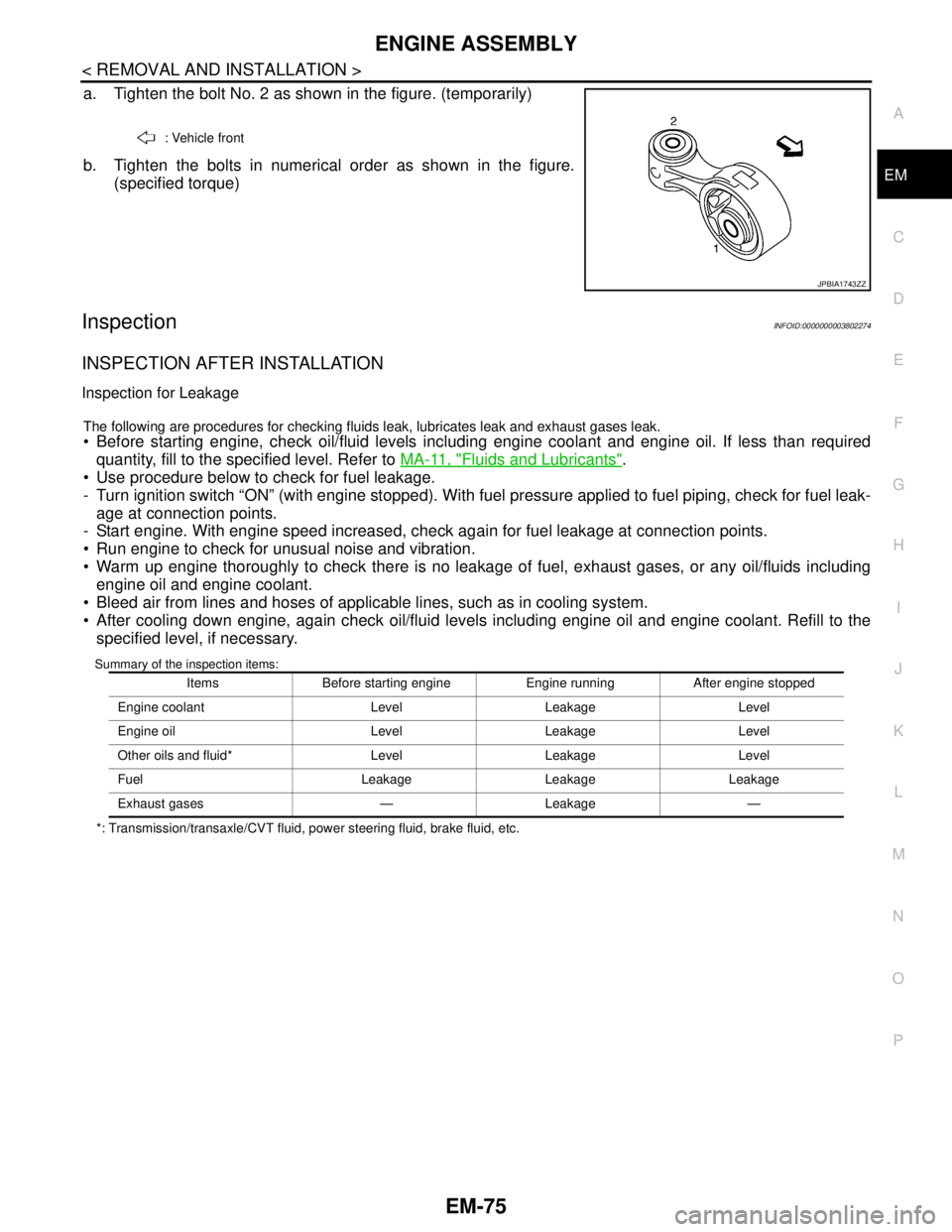
a. Tighten the bolt No. 2 as shown in the figure. (temporarily)
b. Tighten the bolts in numerical order as shown in the figure.
(specified torque)
InspectionINFOID:0000000003802274
INSPECTION AFTER INSTALLATION
Inspection for Leakage
The following are procedures for checking fluids leak, lubricates leak and exhaust gases leak.
Before starting engine, check oil/fluid levels including engine coolant and engine oil. If less than required
quantity, fill to the specified level. Refer to MA-11, "
Fluids and Lubricants".
Use procedure below to check for fuel leakage.
- Turn ignition switch “ON” (with engine stopped). With fuel pressure applied to fuel piping, check for fuel leak-
age at connection points.
- Start engine. With engine speed increased, check again for fuel leakage at connection points.
Run engine to check for unusual noise and vibration.
Warm up engine thoroughly to check there is no leakage of fuel, exhaust gases, or any oil/fluids including
engine oil and engine coolant.
Bleed air from lines and hoses of applicable lines, such as in cooling system.
After cooling down engine, again check oil/fluid levels including engine oil and engine coolant. Refill to the
specified level, if necessary.
Summary of the inspection items:
*: Transmission/transaxle/CVT fluid, power steering fluid, brake fluid, etc.: Vehicle front
JPBIA1743ZZ
Items Before starting engine Engine running After engine stopped
Engine coolant Level Leakage Level
Engine oil Level Leakage Level
Other oils and fluid* Level Leakage Level
Fuel Leakage Leakage Leakage
Exhaust gases — Leakage —
Page 1967 of 5121
EM-92
< DISASSEMBLY AND ASSEMBLY >
CAMSHAFT
b. Disconnect ignition coil and injector harness connectors. Refer to EM-49, "Exploded View" and EM-44,
"Exploded View".
3. Remove intake valve timing control solenoid valve. Refer to EM-79, "
Exploded View".
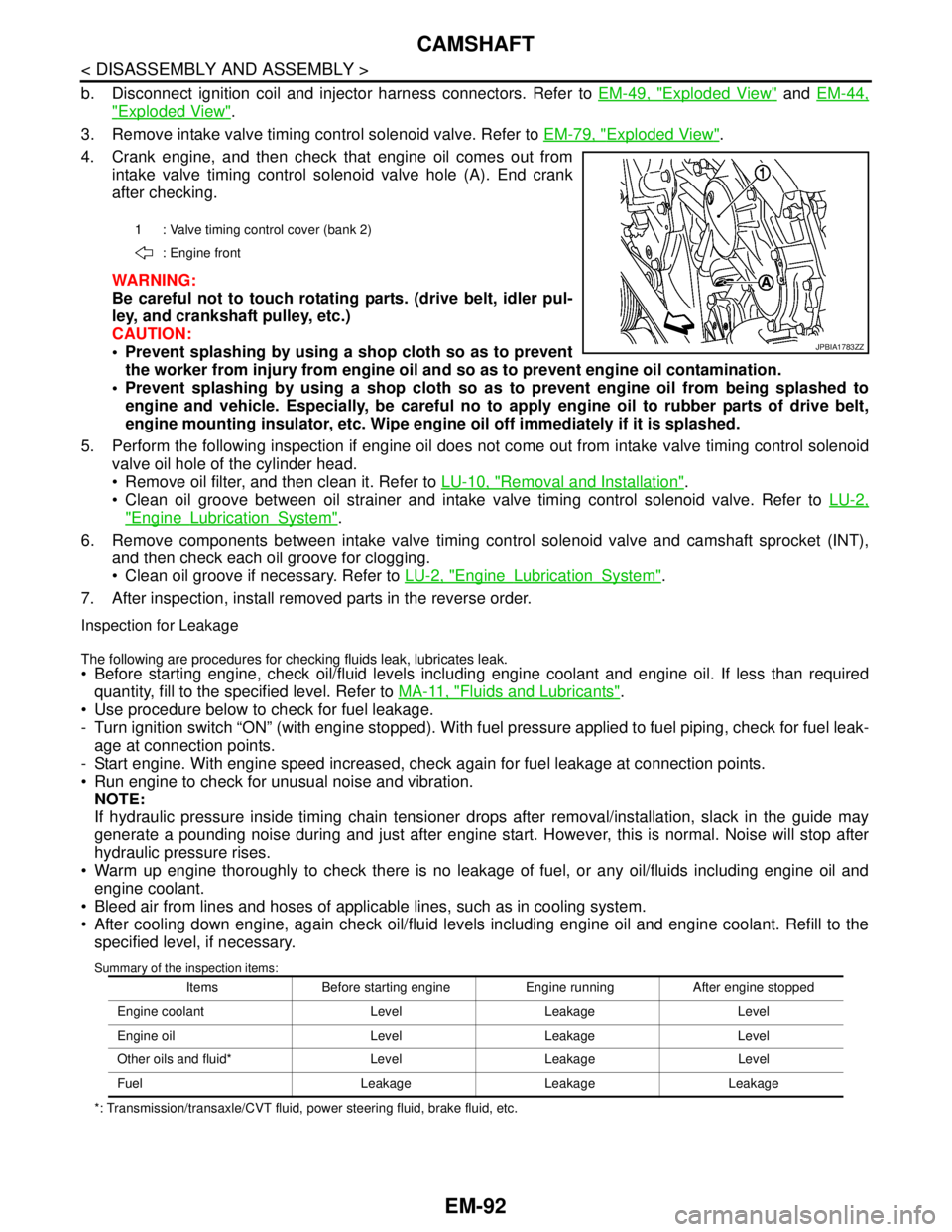
4. Crank engine, and then check that engine oil comes out from
intake valve timing control solenoid valve hole (A). End crank
after checking.
WARNING:
Be careful not to touch rotating parts. (drive belt, idler pul-
ley, and crankshaft pulley, etc.)
CAUTION:
Prevent splashing by using a shop cloth so as to prevent
the worker from injury from engine oil and so as to prevent engine oil contamination.
Prevent splashing by using a shop cloth so as to prevent engine oil from being splashed to
engine and vehicle. Especially, be careful no to apply engine oil to rubber parts of drive belt,
engine mounting insulator, etc. Wipe engine oil off immediately if it is splashed.
5. Perform the following inspection if engine oil does not come out from intake valve timing control solenoid
valve oil hole of the cylinder head.
Remove oil filter, and then clean it. Refer to LU-10, "
Removal and Installation".
Clean oil groove between oil strainer and intake valve timing control solenoid valve. Refer to LU-2,
"EngineLubricationSystem".
6. Remove components between intake valve timing control solenoid valve and camshaft sprocket (INT),
and then check each oil groove for clogging.
Clean oil groove if necessary. Refer to LU-2, "
EngineLubricationSystem".
7. After inspection, install removed parts in the reverse order.
Inspection for Leakage
The following are procedures for checking fluids leak, lubricates leak. Before starting engine, check oil/fluid levels including engine coolant and engine oil. If less than required
quantity, fill to the specified level. Refer to MA-11, "
Fluids and Lubricants".
Use procedure below to check for fuel leakage.
- Turn ignition switch “ON” (with engine stopped). With fuel pressure applied to fuel piping, check for fuel leak-
age at connection points.
- Start engine. With engine speed increased, check again for fuel leakage at connection points.
Run engine to check for unusual noise and vibration.
NOTE:
If hydraulic pressure inside timing chain tensioner drops after removal/installation, slack in the guide may
generate a pounding noise during and just after engine start. However, this is normal. Noise will stop after
hydraulic pressure rises.
Warm up engine thoroughly to check there is no leakage of fuel, or any oil/fluids including engine oil and
engine coolant.
Bleed air from lines and hoses of applicable lines, such as in cooling system.
After cooling down engine, again check oil/fluid levels including engine oil and engine coolant. Refill to the
specified level, if necessary.
Summary of the inspection items:
*: Transmission/transaxle/CVT fluid, power steering fluid, brake fluid, etc.1 : Valve timing control cover (bank 2)
: Engine front
JPBIA1783ZZ
Items Before starting engine Engine running After engine stopped
Engine coolant Level Leakage Level
Engine oil Level Leakage Level
Other oils and fluid* Level Leakage Level
Fuel Leakage Leakage Leakage
Page 1981 of 5121
EM-106
< DISASSEMBLY AND ASSEMBLY >
CYLINDER HEAD
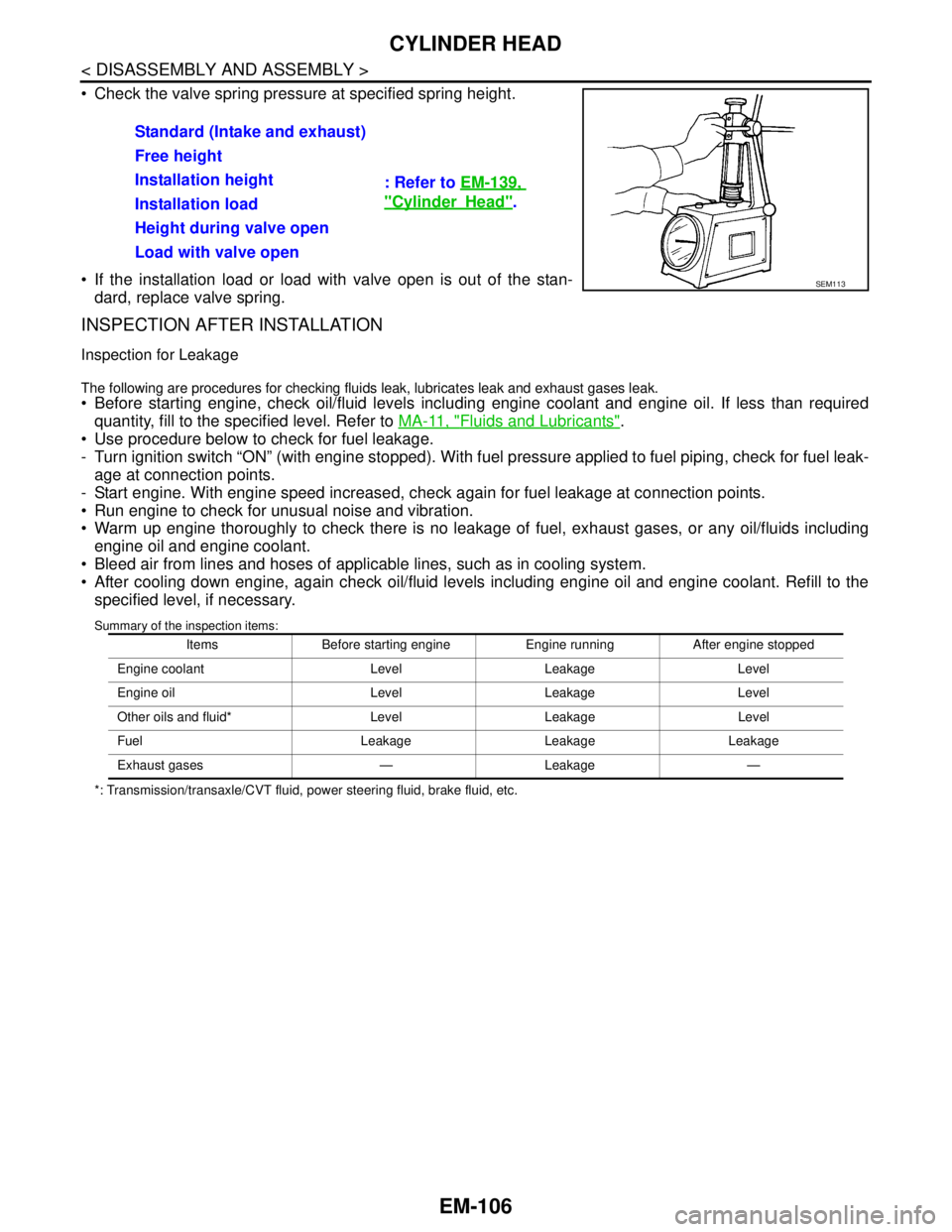
Check the valve spring pressure at specified spring height.
If the installation load or load with valve open is out of the stan-
dard, replace valve spring.
INSPECTION AFTER INSTALLATION
Inspection for Leakage
The following are procedures for checking fluids leak, lubricates leak and exhaust gases leak.
Before starting engine, check oil/fluid levels including engine coolant and engine oil. If less than required
quantity, fill to the specified level. Refer to MA-11, "
Fluids and Lubricants".
Use procedure below to check for fuel leakage.
- Turn ignition switch “ON” (with engine stopped). With fuel pressure applied to fuel piping, check for fuel leak-
age at connection points.
- Start engine. With engine speed increased, check again for fuel leakage at connection points.
Run engine to check for unusual noise and vibration.
Warm up engine thoroughly to check there is no leakage of fuel, exhaust gases, or any oil/fluids including
engine oil and engine coolant.
Bleed air from lines and hoses of applicable lines, such as in cooling system.
After cooling down engine, again check oil/fluid levels including engine oil and engine coolant. Refill to the
specified level, if necessary.
Summary of the inspection items:
*: Transmission/transaxle/CVT fluid, power steering fluid, brake fluid, etc.
Standard (Intake and exhaust)
: Refer to EM-139,
"CylinderHead". Free height
Installation height
Installation load
Height during valve open
Load with valve open
SEM113
Items Before starting engine Engine running After engine stopped
Engine coolant Level Leakage Level
Engine oil Level Leakage Level
Other oils and fluid* Level Leakage Level
Fuel Leakage Leakage Leakage
Exhaust gases — Leakage —
Page 2446 of 5121
FAX-18
< ON-VEHICLE REPAIR >
FRONT DRIVE SHAFT
LEFT SIDE
LEFT SIDE : Removal and InstallationINFOID:0000000003811084
REMOVAL
1. Remove tires.
2. Remove wheel sensor and sensor harness. Refer to BRC-57, "
FRONT WHEEL SENSOR : Exploded
View" (without VDC), BRC-151, "FRONT WHEEL SENSOR : Exploded View" (with VDC).
3. Remove lock plate of brake hose from strut assembly. Refer to BR-19, "
FRONT : Exploded View".
4. Remove caliper assembly. Hang caliper assembly not to interfere with work. Refer to BR-34, "
BRAKE
CALIPER ASSEMBLY : Exploded View".
5. Remove disc rotor. Refer to BR-35, "
BRAKE CALIPER ASSEMBLY : Removal and Installation".
6. Remove cotter pin, and then loosen wheel hub lock nut. Refer to FA X - 8 , "
Exploded View".
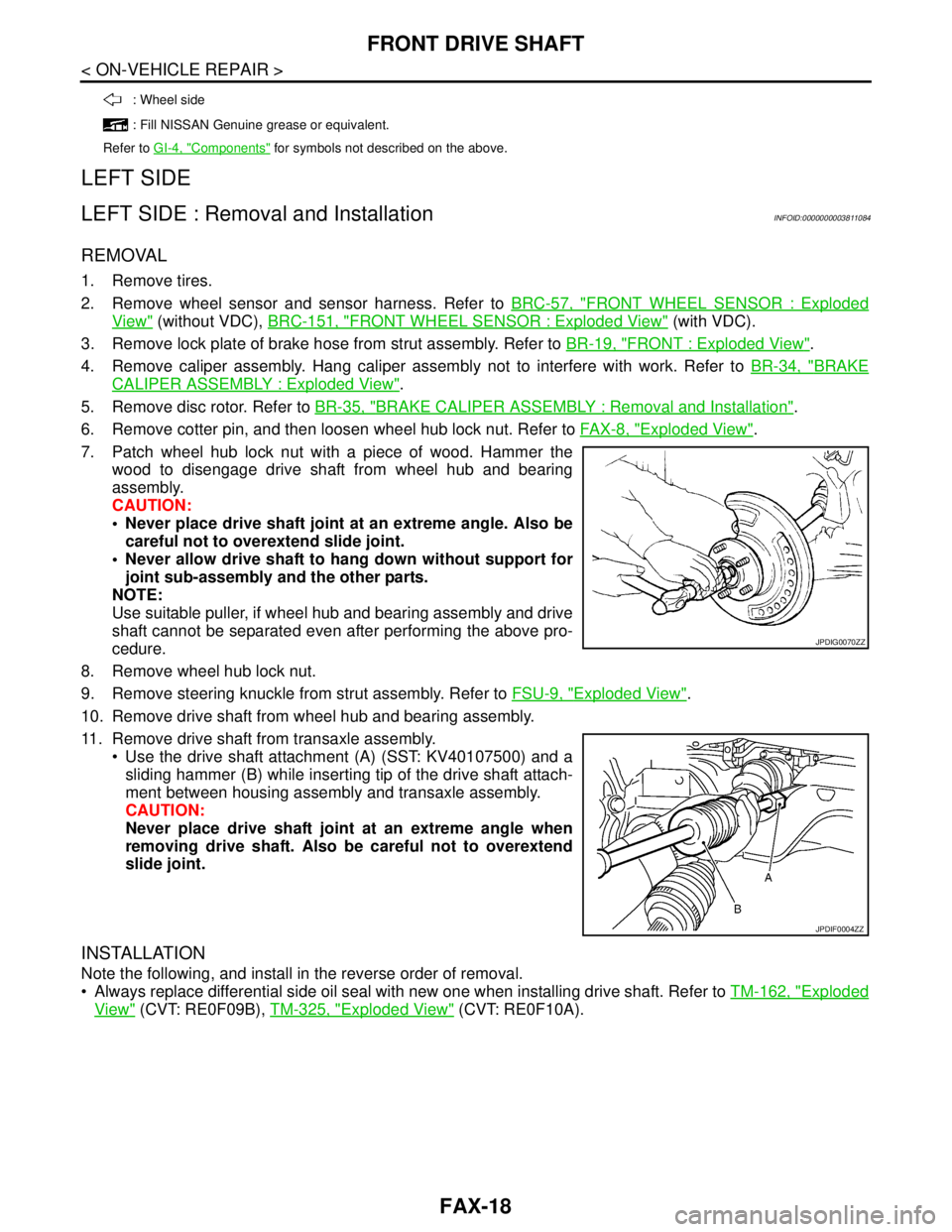
7. Patch wheel hub lock nut with a piece of wood. Hammer the
wood to disengage drive shaft from wheel hub and bearing
assembly.
CAUTION:
Never place drive shaft joint at an extreme angle. Also be
careful not to overextend slide joint.
Never allow drive shaft to hang down without support for
joint sub-assembly and the other parts.
NOTE:
Use suitable puller, if wheel hub and bearing assembly and drive
shaft cannot be separated even after performing the above pro-
cedure.
8. Remove wheel hub lock nut.
9. Remove steering knuckle from strut assembly. Refer to FSU-9, "
Exploded View".
10. Remove drive shaft from wheel hub and bearing assembly.
11. Remove drive shaft from transaxle assembly.
Use the drive shaft attachment (A) (SST: KV40107500) and a
sliding hammer (B) while inserting tip of the drive shaft attach-
ment between housing assembly and transaxle assembly.
CAUTION:
Never place drive shaft joint at an extreme angle when
removing drive shaft. Also be careful not to overextend
slide joint.
INSTALLATION
Note the following, and install in the reverse order of removal.
Always replace differential side oil seal with new one when installing drive shaft. Refer to TM-162, "
Exploded
View" (CVT: RE0F09B), TM-325, "Exploded View" (CVT: RE0F10A).
: Wheel side
: Fill NISSAN Genuine grease or equivalent.
Refer to GI-4, "
Components" for symbols not described on the above.
JPDIG0070ZZ
JPDIF0004ZZ