Condition NISSAN TEANA 2008 Service Manual
[x] Cancel search | Manufacturer: NISSAN, Model Year: 2008, Model line: TEANA, Model: NISSAN TEANA 2008Pages: 5121, PDF Size: 69.03 MB
Page 1879 of 5121
EM-4
< SYMPTOM DIAGNOSIS >
NOISE, VIBRATION AND HARSHNESS (NVH) TROUBLESHOOTING
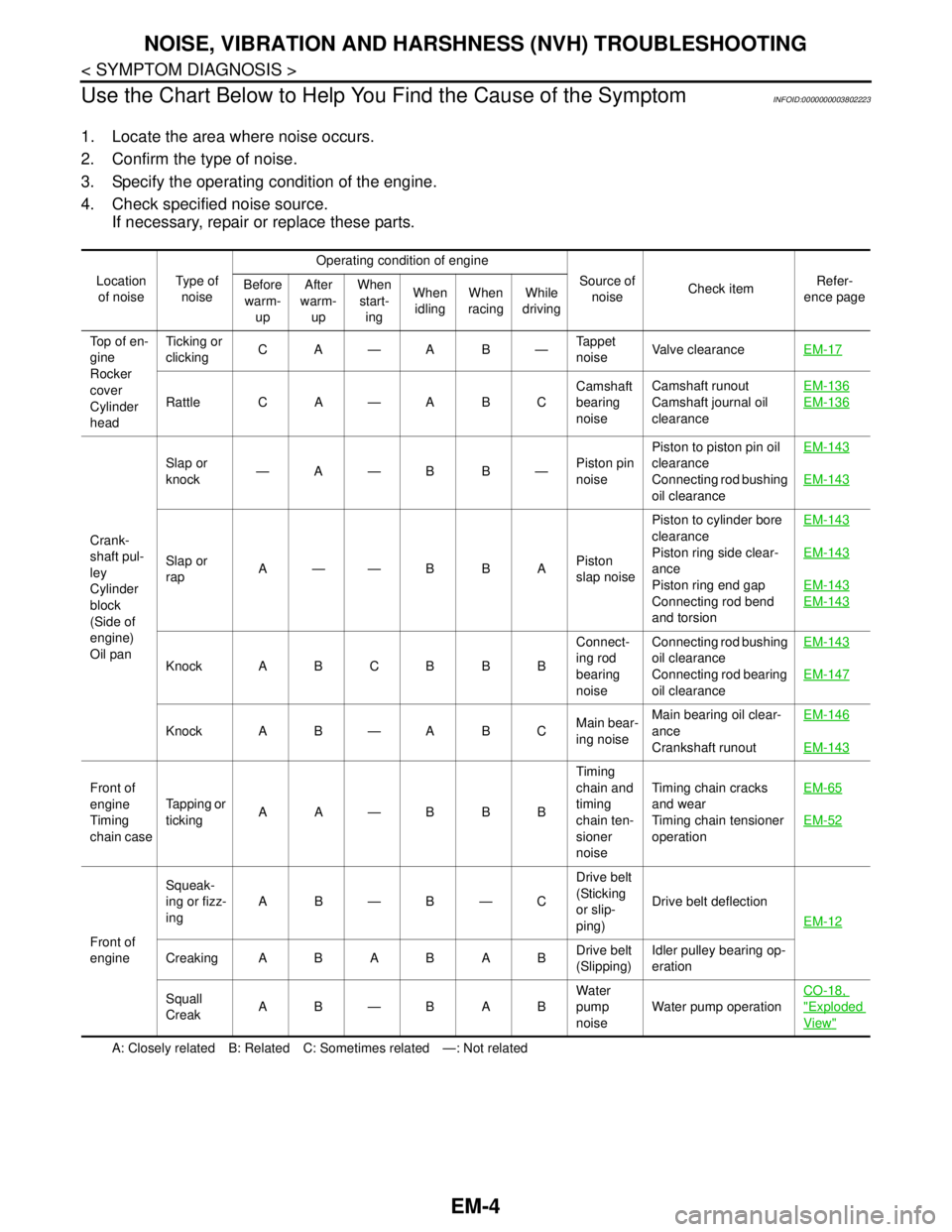
Use the Chart Below to Help You Find the Cause of the Symptom
INFOID:0000000003802223
1. Locate the area where noise occurs.
2. Confirm the type of noise.
3. Specify the operating condition of the engine.
4. Check specified noise source.
If necessary, repair or replace these parts.
A: Closely related B: Related C: Sometimes related —: Not related Location
of noiseType of
noiseOperating condition of engine
Source of
noiseCheck itemRefer-
ence page Before
warm-
upAfter
warm-
upWhen
start-
ingWhen
idlingWhen
racingWhile
driving
Top of en-
gine
Rocker
cover
Cylinder
headTicking or
clickingCA—AB—Tappet
noiseValve clearanceEM-17
Rattle C A — A B CCamshaft
bearing
noiseCamshaft runout
Camshaft journal oil
clearanceEM-136EM-136
Crank-
shaft pul-
ley
Cylinder
block
(Side of
engine)
Oil panSlap or
knock—A—B B—Piston pin
noisePiston to piston pin oil
clearance
Connecting rod bushing
oil clearanceEM-143
EM-143
Slap or
rapA——B B APiston
slap noisePiston to cylinder bore
clearance
Piston ring side clear-
ance
Piston ring end gap
Connecting rod bend
and torsionEM-143EM-143
EM-143
EM-143
Knock A B C B B BConnect-
ing rod
bearing
noiseConnecting rod bushing
oil clearance
Connecting rod bearing
oil clearanceEM-143EM-147
Knock A B — A B CMain bear-
ing noiseMain bearing oil clear-
ance
Crankshaft runoutEM-146
EM-143
Front of
engine
Timing
chain caseTapping or
tickingAA—BBBTiming
chain and
timing
chain ten-
sioner
noiseTiming chain cracks
and wear
Timing chain tensioner
operationEM-65
EM-52
Front of
engineSqueak-
ing or fizz-
ingAB—B—CDrive belt
(Sticking
or slip-
ping)Drive belt deflection
EM-12
CreakingABABABDrive belt
(Slipping)Idler pulley bearing op-
eration
Squall
CreakAB—BABWater
pump
noiseWater pump operationCO-18,
"Exploded
View"
Page 1886 of 5121
PREPARATION
EM-11
< PREPARATION >
C
D
E
F
G
H
I
J
K
L
MA
EM
N
P O
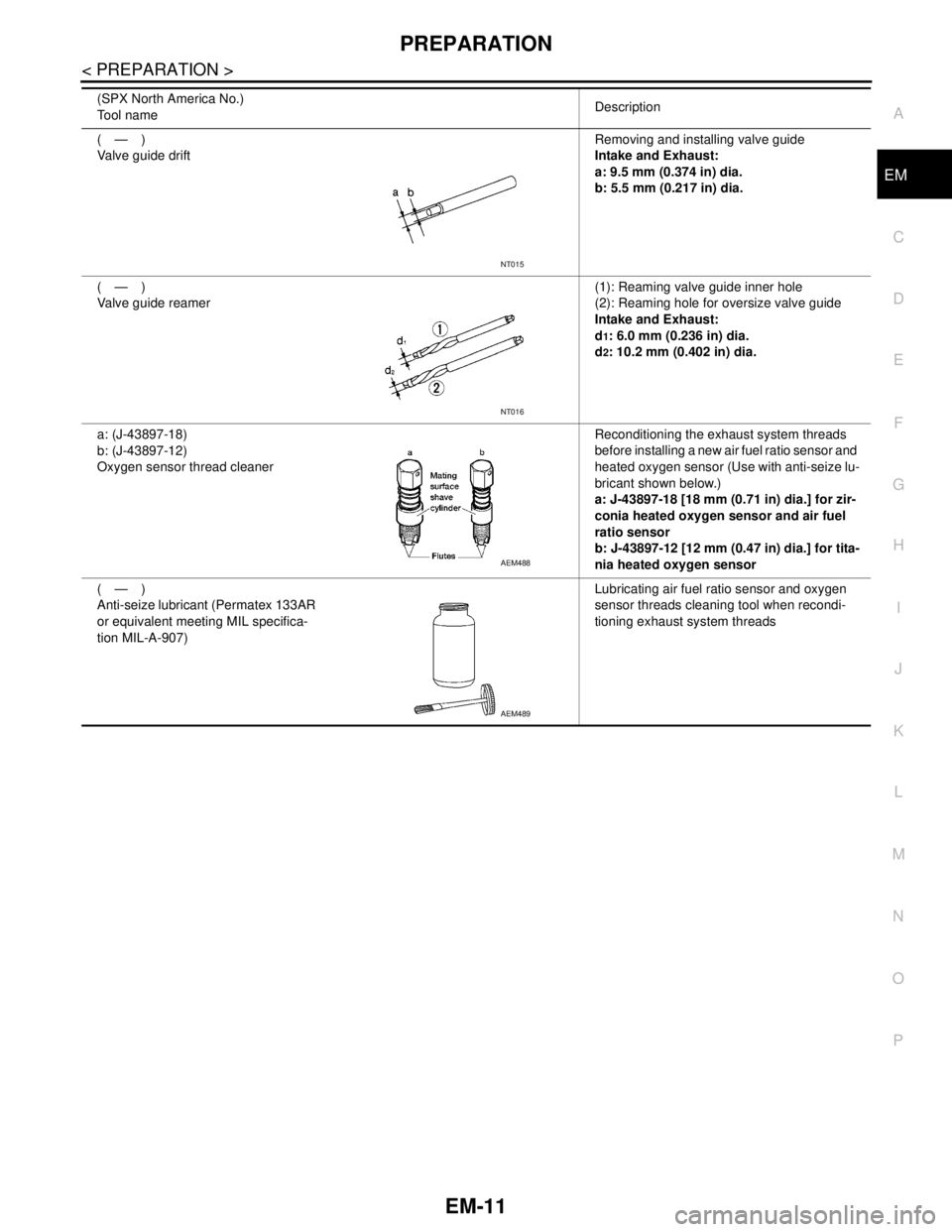
(—)
Valve guide driftRemoving and installing valve guide
Intake and Exhaust:
a: 9.5 mm (0.374 in) dia.
b: 5.5 mm (0.217 in) dia.
(—)
Valve guide reamer(1): Reaming valve guide inner hole
(2): Reaming hole for oversize valve guide
Intake and Exhaust:
d
1: 6.0 mm (0.236 in) dia.
d
2: 10.2 mm (0.402 in) dia.
a: (J-43897-18)
b: (J-43897-12)
Oxygen sensor thread cleanerReconditioning the exhaust system threads
before installing a new air fuel ratio sensor and
heated oxygen sensor (Use with anti-seize lu-
bricant shown below.)
a: J-43897-18 [18 mm (0.71 in) dia.] for zir-
conia heated oxygen sensor and air fuel
ratio sensor
b: J-43897-12 [12 mm (0.47 in) dia.] for tita-
nia heated oxygen sensor
(—)
Anti-seize lubricant (Permatex 133AR
or equivalent meeting MIL specifica-
tion MIL-A-907)Lubricating air fuel ratio sensor and oxygen
sensor threads cleaning tool when recondi-
tioning exhaust system threads (SPX North America No.)
Tool nameDescription
NT015
NT016
AEM488
AEM489
Page 1891 of 5121
EM-16
< ON-VEHICLE MAINTENANCE >
SPARK PLUG
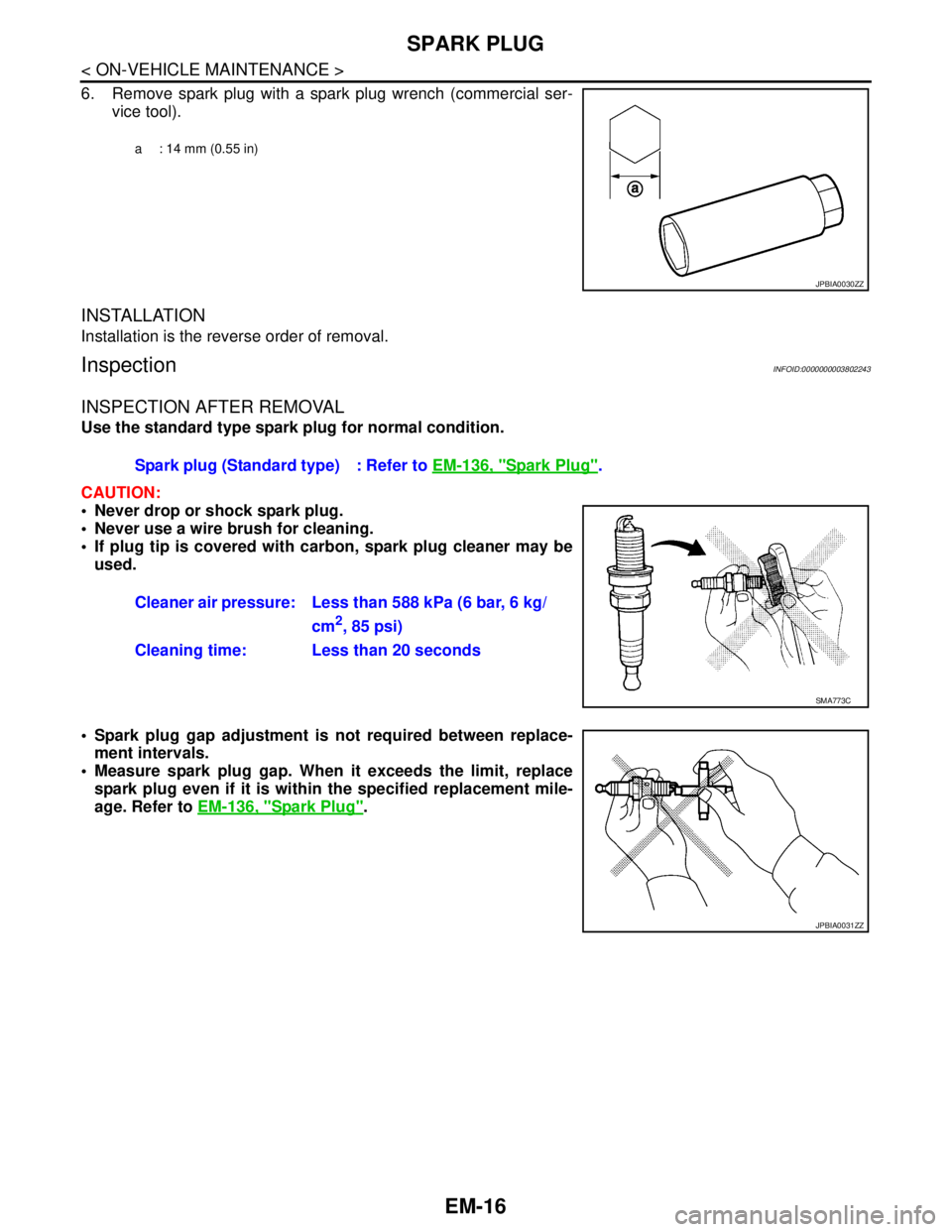
6. Remove spark plug with a spark plug wrench (commercial ser-
vice tool).
INSTALLATION
Installation is the reverse order of removal.
InspectionINFOID:0000000003802243
INSPECTION AFTER REMOVAL
Use the standard type spark plug for normal condition.
CAUTION:
Never drop or shock spark plug.
Never use a wire brush for cleaning.
If plug tip is covered with carbon, spark plug cleaner may be
used.
Spark plug gap adjustment is not required between replace-
ment intervals.
Measure spark plug gap. When it exceeds the limit, replace
spark plug even if it is within the specified replacement mile-
age. Refer to EM-136, "
Spark Plug".
a : 14 mm (0.55 in)
JPBIA0030ZZ
Spark plug (Standard type) : Refer to EM-136, "Spark Plug".
Cleaner air pressure: Less than 588 kPa (6 bar, 6 kg/
cm
2, 85 psi)
Cleaning time: Less than 20 seconds
SMA773C
JPBIA0031ZZ
Page 1892 of 5121
CAMSHAFT VALVE CLEARANCE
EM-17
< ON-VEHICLE MAINTENANCE >
C
D
E
F
G
H
I
J
K
L
MA
EM
N
P O
CAMSHAFT VALVE CLEARANCE
Inspection and AdjustmentINFOID:0000000003802244
INSPECTION
Perform inspection as follows after removal, installation or replacement of camshaft or valve-related parts, or if
there is unusual engine conditions regarding valve clearance.
In cases of removing/installing or replacing camshaft and valve-
related parts, or of unusual engine conditions due to changes in
valve clearance (found malfunctions during stating, idling or causing
noise), perform inspection as follows:
1. Remove rocker covers (bank 1 and bank 2). Refer to EM-49, "
Exploded View".
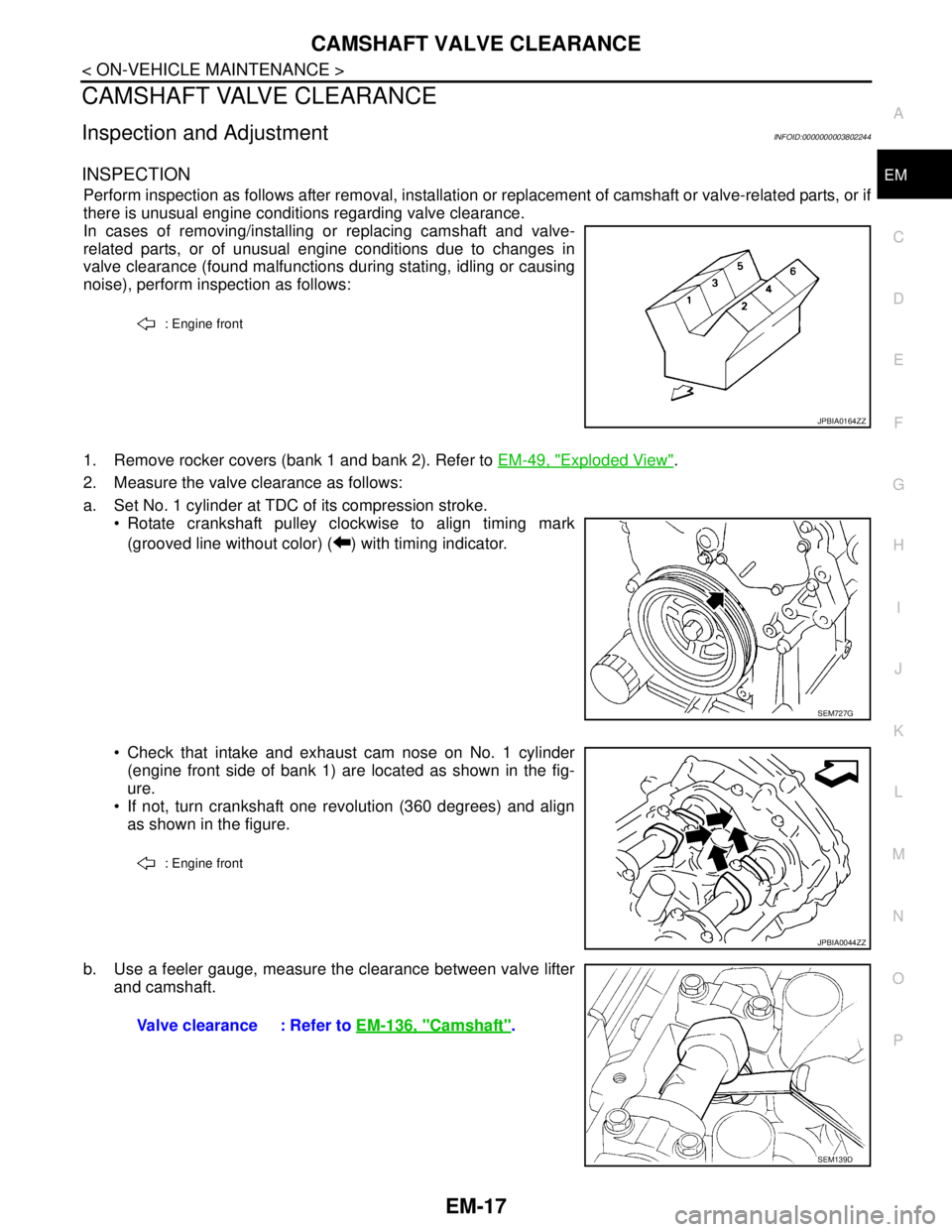
2. Measure the valve clearance as follows:
a. Set No. 1 cylinder at TDC of its compression stroke.
Rotate crankshaft pulley clockwise to align timing mark
(grooved line without color) ( ) with timing indicator.
Check that intake and exhaust cam nose on No. 1 cylinder
(engine front side of bank 1) are located as shown in the fig-
ure.
If not, turn crankshaft one revolution (360 degrees) and align
as shown in the figure.
b. Use a feeler gauge, measure the clearance between valve lifter
and camshaft.
: Engine front
JPBIA0164ZZ
SEM727G
: Engine front
JPBIA0044ZZ
Valve clearance : Refer to EM-136, "Camshaft".
SEM139D
Page 1921 of 5121
EM-46
< ON-VEHICLE REPAIR >
FUEL INJECTOR AND FUEL TUBE
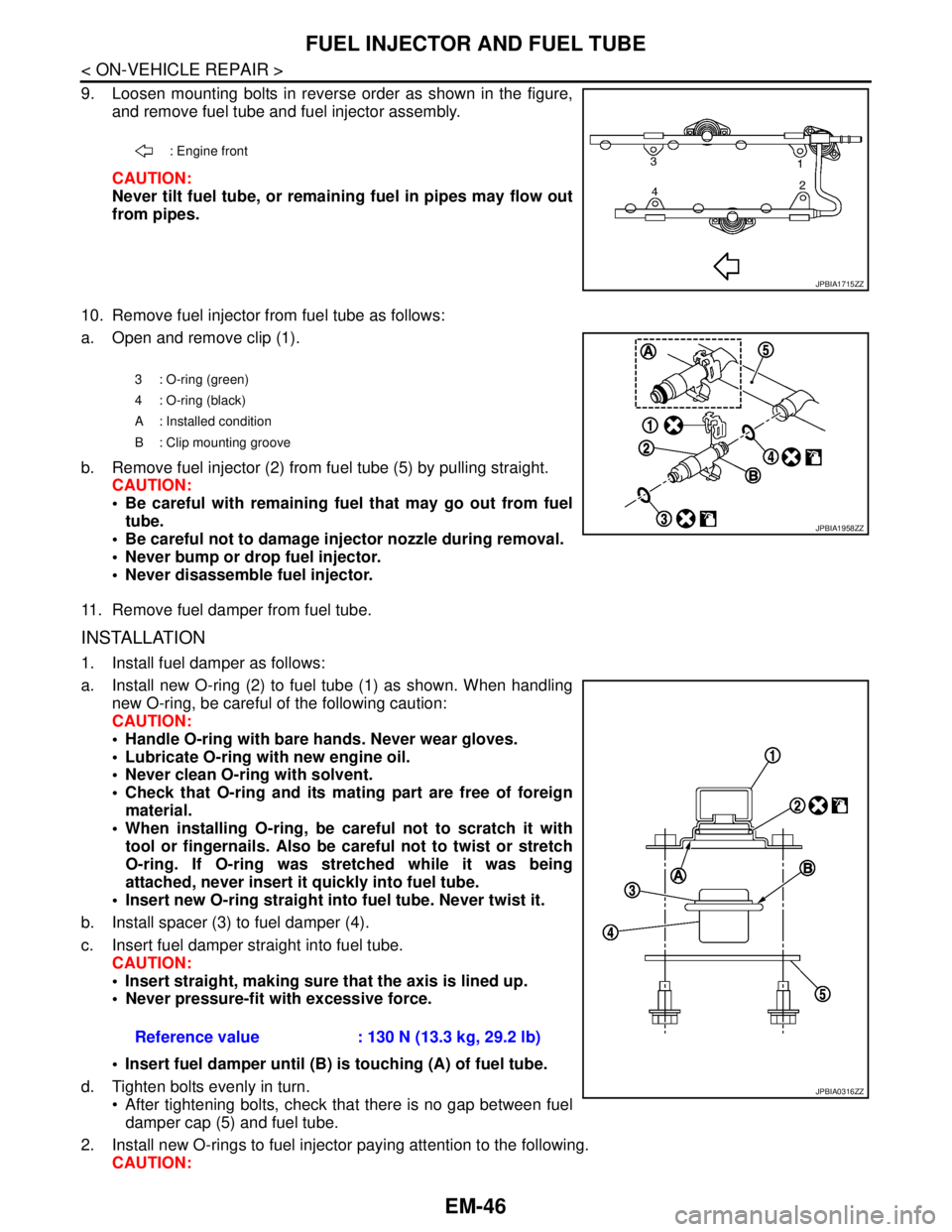
9. Loosen mounting bolts in reverse order as shown in the figure,
and remove fuel tube and fuel injector assembly.
CAUTION:
Never tilt fuel tube, or remaining fuel in pipes may flow out
from pipes.
10. Remove fuel injector from fuel tube as follows:
a. Open and remove clip (1).
b. Remove fuel injector (2) from fuel tube (5) by pulling straight.
CAUTION:
Be careful with remaining fuel that may go out from fuel
tube.
Be careful not to damage injector nozzle during removal.
Never bump or drop fuel injector.
Never disassemble fuel injector.
11. Remove fuel damper from fuel tube.
INSTALLATION
1. Install fuel damper as follows:
a. Install new O-ring (2) to fuel tube (1) as shown. When handling
new O-ring, be careful of the following caution:
CAUTION:
Handle O-ring with bare hands. Never wear gloves.
Lubricate O-ring with new engine oil.
Never clean O-ring with solvent.
Check that O-ring and its mating part are free of foreign
material.
When installing O-ring, be careful not to scratch it with
tool or fingernails. Also be careful not to twist or stretch
O-ring. If O-ring was stretched while it was being
attached, never insert it quickly into fuel tube.
Insert new O-ring straight into fuel tube. Never twist it.
b. Install spacer (3) to fuel damper (4).
c. Insert fuel damper straight into fuel tube.
CAUTION:
Insert straight, making sure that the axis is lined up.
Never pressure-fit with excessive force.
Insert fuel damper until (B) is touching (A) of fuel tube.
d. Tighten bolts evenly in turn.
After tightening bolts, check that there is no gap between fuel
damper cap (5) and fuel tube.
2. Install new O-rings to fuel injector paying attention to the following.
CAUTION:
: Engine front
JPBIA1715ZZ
3 : O-ring (green)
4 : O-ring (black)
A : Installed condition
B : Clip mounting groove
JPBIA1958ZZ
Reference value : 130 N (13.3 kg, 29.2 lb)
JPBIA0316ZZ
Page 1923 of 5121
EM-48
< ON-VEHICLE REPAIR >
FUEL INJECTOR AND FUEL TUBE
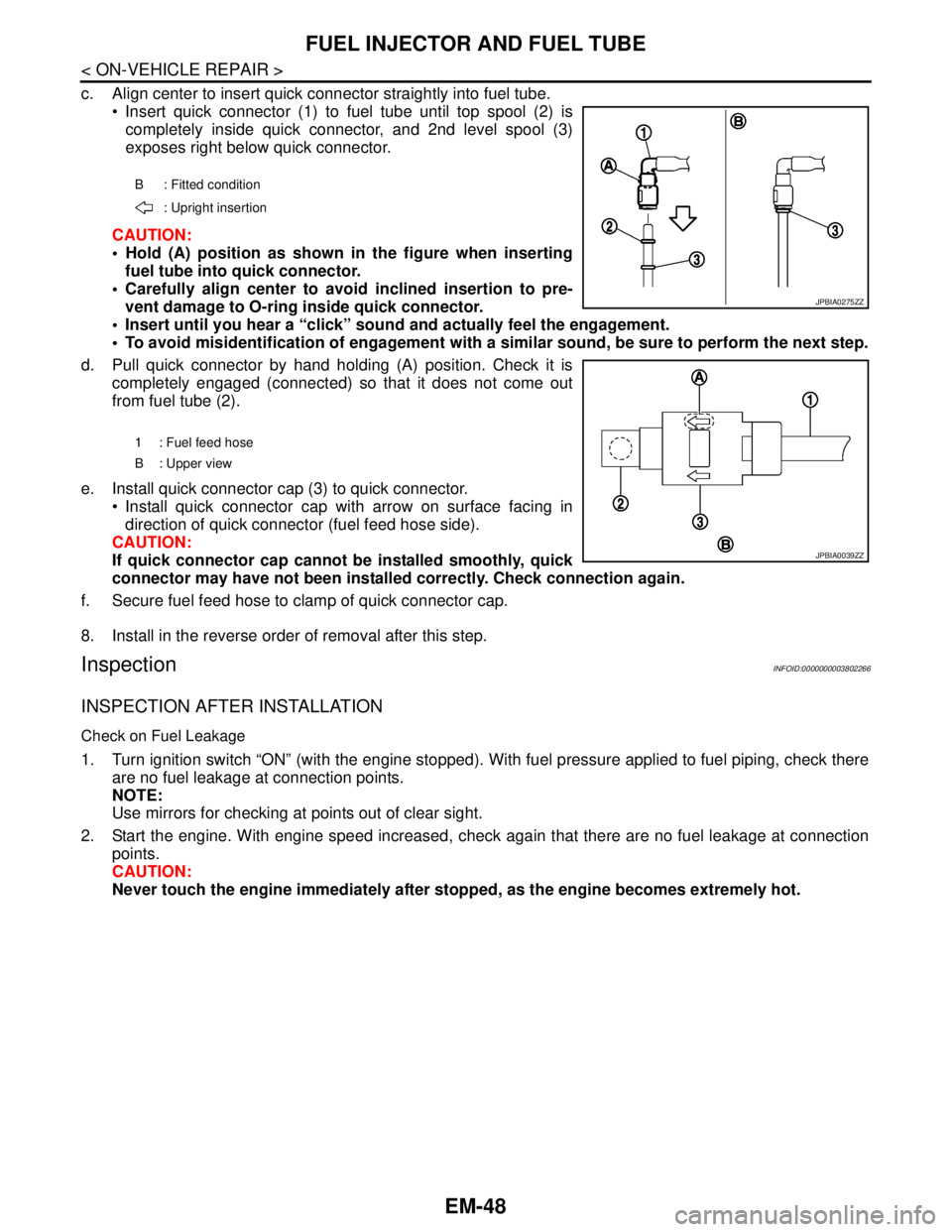
c. Align center to insert quick connector straightly into fuel tube.
Insert quick connector (1) to fuel tube until top spool (2) is
completely inside quick connector, and 2nd level spool (3)
exposes right below quick connector.
CAUTION:
Hold (A) position as shown in the figure when inserting
fuel tube into quick connector.
Carefully align center to avoid inclined insertion to pre-
vent damage to O-ring inside quick connector.
Insert until you hear a “click” sound and actually feel the engagement.
To avoid misidentification of engagement with a similar sound, be sure to perform the next step.
d. Pull quick connector by hand holding (A) position. Check it is
completely engaged (connected) so that it does not come out
from fuel tube (2).
e. Install quick connector cap (3) to quick connector.
Install quick connector cap with arrow on surface facing in
direction of quick connector (fuel feed hose side).
CAUTION:
If quick connector cap cannot be installed smoothly, quick
connector may have not been installed correctly. Check connection again.
f. Secure fuel feed hose to clamp of quick connector cap.
8. Install in the reverse order of removal after this step.
InspectionINFOID:0000000003802266
INSPECTION AFTER INSTALLATION
Check on Fuel Leakage
1. Turn ignition switch “ON” (with the engine stopped). With fuel pressure applied to fuel piping, check there
are no fuel leakage at connection points.
NOTE:
Use mirrors for checking at points out of clear sight.
2. Start the engine. With engine speed increased, check again that there are no fuel leakage at connection
points.
CAUTION:
Never touch the engine immediately after stopped, as the engine becomes extremely hot.
B : Fitted condition
: Upright insertion
1 : Fuel feed hose
B : Upper view
JPBIA0275ZZ
JPBIA0039ZZ
Page 1937 of 5121
EM-62
< ON-VEHICLE REPAIR >
TIMING CHAIN
CAUTION:
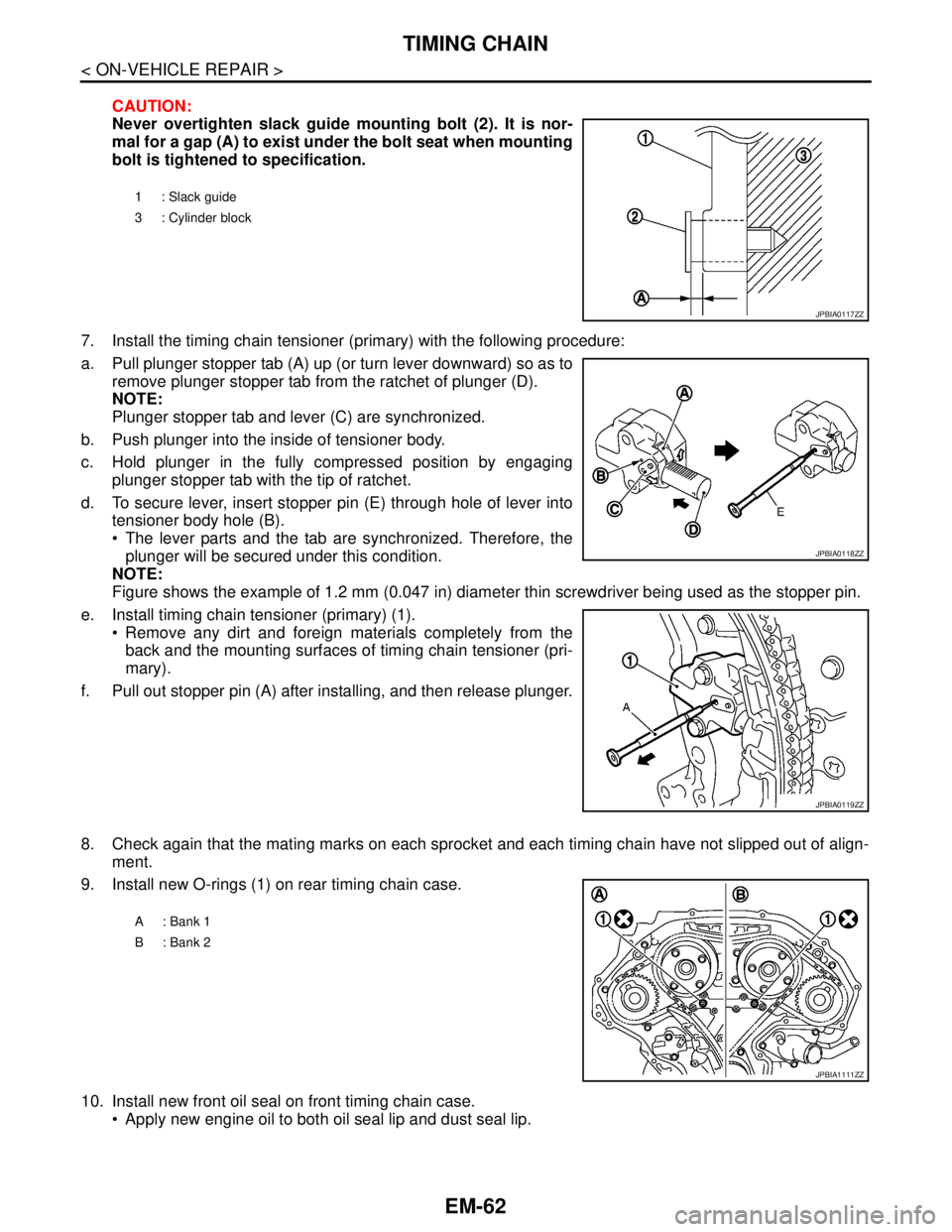
Never overtighten slack guide mounting bolt (2). It is nor-
mal for a gap (A) to exist under the bolt seat when mounting
bolt is tightened to specification.
7. Install the timing chain tensioner (primary) with the following procedure:
a. Pull plunger stopper tab (A) up (or turn lever downward) so as to
remove plunger stopper tab from the ratchet of plunger (D).
NOTE:
Plunger stopper tab and lever (C) are synchronized.
b. Push plunger into the inside of tensioner body.
c. Hold plunger in the fully compressed position by engaging
plunger stopper tab with the tip of ratchet.
d. To secure lever, insert stopper pin (E) through hole of lever into
tensioner body hole (B).
The lever parts and the tab are synchronized. Therefore, the
plunger will be secured under this condition.
NOTE:
Figure shows the example of 1.2 mm (0.047 in) diameter thin screwdriver being used as the stopper pin.
e. Install timing chain tensioner (primary) (1).
Remove any dirt and foreign materials completely from the
back and the mounting surfaces of timing chain tensioner (pri-
mary).
f. Pull out stopper pin (A) after installing, and then release plunger.
8. Check again that the mating marks on each sprocket and each timing chain have not slipped out of align-
ment.
9. Install new O-rings (1) on rear timing chain case.
10. Install new front oil seal on front timing chain case.
Apply new engine oil to both oil seal lip and dust seal lip.
1 : Slack guide
3 : Cylinder block
JPBIA0117ZZ
JPBIA0118ZZ
JPBIA0119ZZ
A: Bank 1
B: Bank 2
JPBIA1111ZZ
Page 1944 of 5121
ENGINE ASSEMBLY
EM-69
< REMOVAL AND INSTALLATION >
C
D
E
F
G
H
I
J
K
L
MA
EM
N
P O
10. Remove starter motor. Refer to STR-15, "VQ25DE : Exploded View" (VQ25DE) or STR-20, "VQ35DE :
Exploded View" (VQ35DE).
Vehicle Underbody
1. Remove front drive shafts (RH and LH). Refer to FAX-16, "Exploded View".
2. Remove exhaust front tube. Refer to EX-5, "
Exploded View".
3. Remove heat insulator.
4. Disconnect steering lower joint at power steering gear assembly side, and release steering lower shaft.
Refer to ST-16, "
Exploded View".
5. Disconnect front stabilizer connecting rod. Refer to FSU-14, "
Exploded View".
6. Remove strut assembly and steering knuckle fixing nuts and bolts. Refer to FSU-9, "
Exploded View" and
FA X - 8 , "
Exploded View".
7. Remove front wheel sensor (RH and LH) for ABS from steering knuckle. Refer to BRC-57, "
FRONT
WHEEL SENSOR : Exploded View".
8. Remove front brake caliper assembly with piping connected, and temporarily secure it to aside for vehicle
side. Refer to BR-34, "
BRAKE CALIPER ASSEMBLY : Exploded View".
9. Disconnect power steering piping at a point between vehicle and engine. Refer to ST-34, "
Exploded
View".
Install plug to avoid leakage of power steering fluid.
10. Remove rear plate cover from oil pan (upper). Then remove bolts fixing drive plate to torque converter.
Refer to EM-38, "
Exploded View" and TM-332, "Removal and Installation" (VQ25DE) or TM-168,
"Removal and Installation" (VQ35DE).
11. Remove transaxle joint bolts which pierce at oil pan (upper) lower rear side. Refer to EM-38, "
Exploded
View".
12. Remove crankshaft position sensor (POS). Refer to EM-38, "
Exploded View".
CAUTION:
Handle carefully to avoid dropping and shocks.
Never disassemble.
Never allow metal powder to adhere to magnetic part at sensor tip.
Never place sensors in a location where they are exposed to magnetism.
Removal
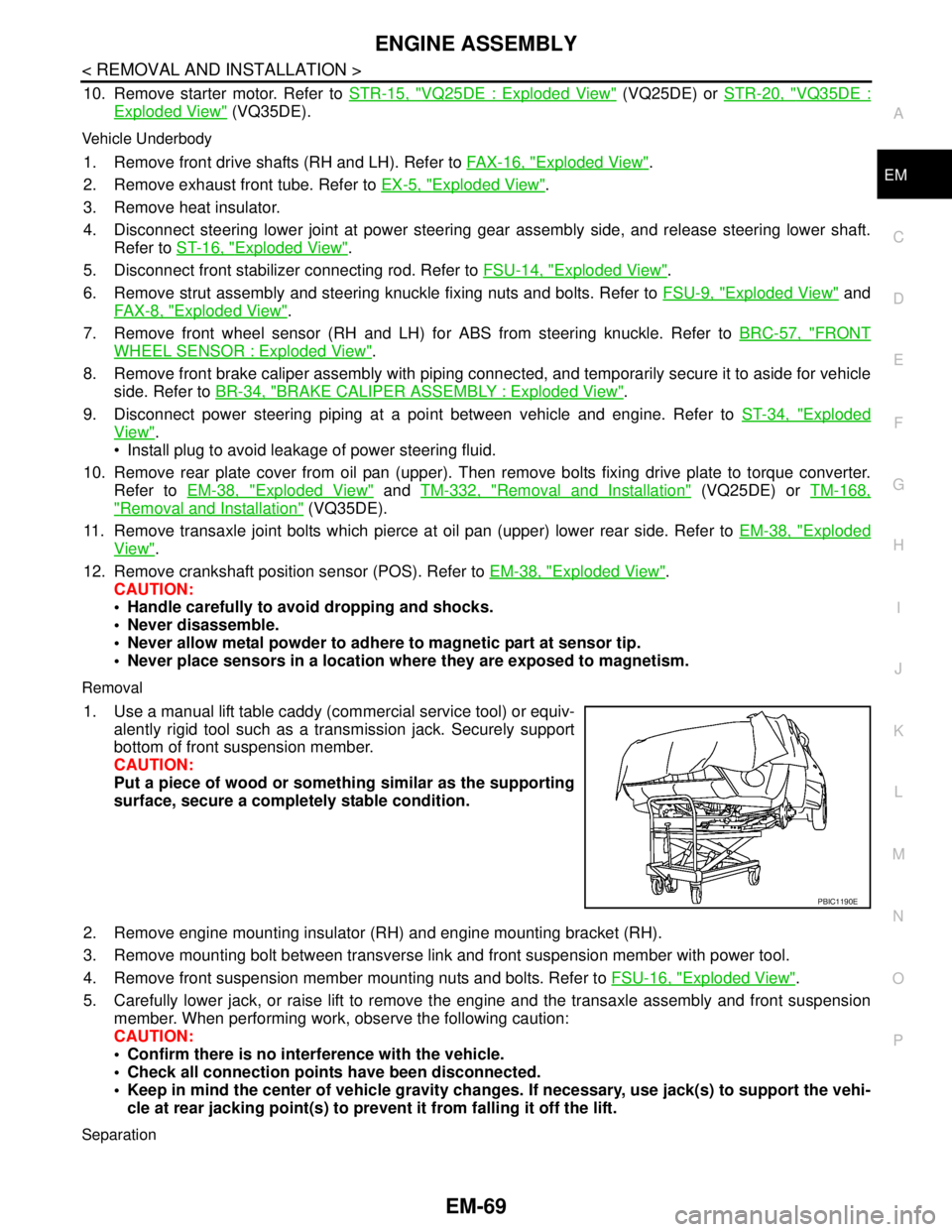
1. Use a manual lift table caddy (commercial service tool) or equiv-
alently rigid tool such as a transmission jack. Securely support
bottom of front suspension member.
CAUTION:
Put a piece of wood or something similar as the supporting
surface, secure a completely stable condition.
2. Remove engine mounting insulator (RH) and engine mounting bracket (RH).
3. Remove mounting bolt between transverse link and front suspension member with power tool.
4. Remove front suspension member mounting nuts and bolts. Refer to FSU-16, "
Exploded View".
5. Carefully lower jack, or raise lift to remove the engine and the transaxle assembly and front suspension
member. When performing work, observe the following caution:
CAUTION:
Confirm there is no interference with the vehicle.
Check all connection points have been disconnected.
Keep in mind the center of vehicle gravity changes. If necessary, use jack(s) to support the vehi-
cle at rear jacking point(s) to prevent it from falling it off the lift.
Separation
PBIC1190E
Page 1978 of 5121
CYLINDER HEAD
EM-103
< DISASSEMBLY AND ASSEMBLY >
C
D
E
F
G
H
I
J
K
L
MA
EM
N
P O
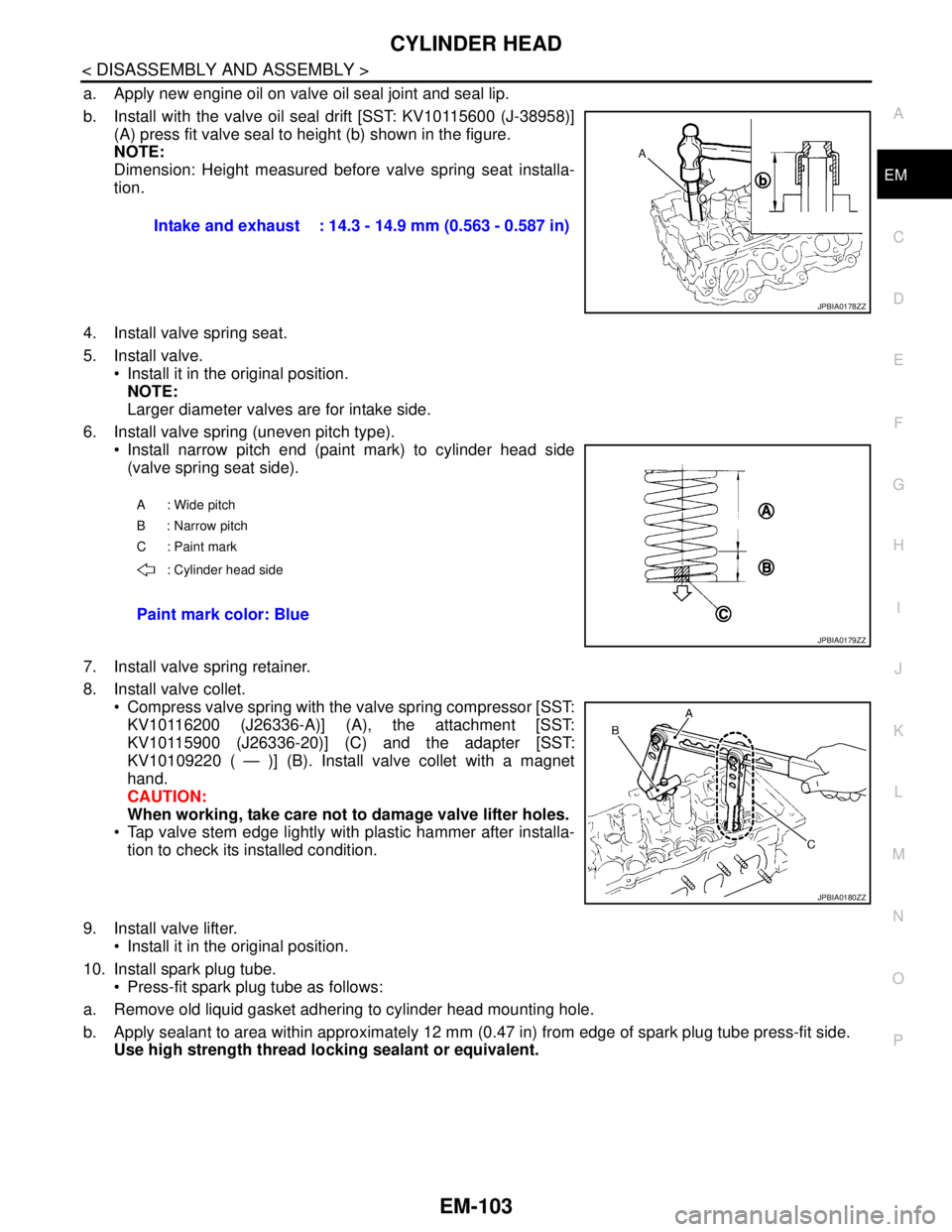
a. Apply new engine oil on valve oil seal joint and seal lip.
b. Install with the valve oil seal drift [SST: KV10115600 (J-38958)]
(A) press fit valve seal to height (b) shown in the figure.
NOTE:
Dimension: Height measured before valve spring seat installa-
tion.
4. Install valve spring seat.
5. Install valve.
Install it in the original position.
NOTE:
Larger diameter valves are for intake side.
6. Install valve spring (uneven pitch type).
Install narrow pitch end (paint mark) to cylinder head side
(valve spring seat side).
7. Install valve spring retainer.
8. Install valve collet.
Compress valve spring with the valve spring compressor [SST:
KV10116200 (J26336-A)] (A), the attachment [SST:
KV10115900 (J26336-20)] (C) and the adapter [SST:
KV10109220 ( — )] (B). Install valve collet with a magnet
hand.
CAUTION:
When working, take care not to damage valve lifter holes.
Tap valve stem edge lightly with plastic hammer after installa-
tion to check its installed condition.
9. Install valve lifter.
Install it in the original position.
10. Install spark plug tube.
Press-fit spark plug tube as follows:
a. Remove old liquid gasket adhering to cylinder head mounting hole.
b. Apply sealant to area within approximately 12 mm (0.47 in) from edge of spark plug tube press-fit side.
Use high strength thread locking sealant or equivalent. Intake and exhaust : 14.3 - 14.9 mm (0.563 - 0.587 in)
JPBIA0178ZZ
A : Wide pitch
B : Narrow pitch
C : Paint mark
: Cylinder head side
Paint mark color: Blue
JPBIA0179ZZ
JPBIA0180ZZ
Page 1980 of 5121
CYLINDER HEAD
EM-105
< DISASSEMBLY AND ASSEMBLY >
C
D
E
F
G
H
I
J
K
L
MA
EM
N
P O
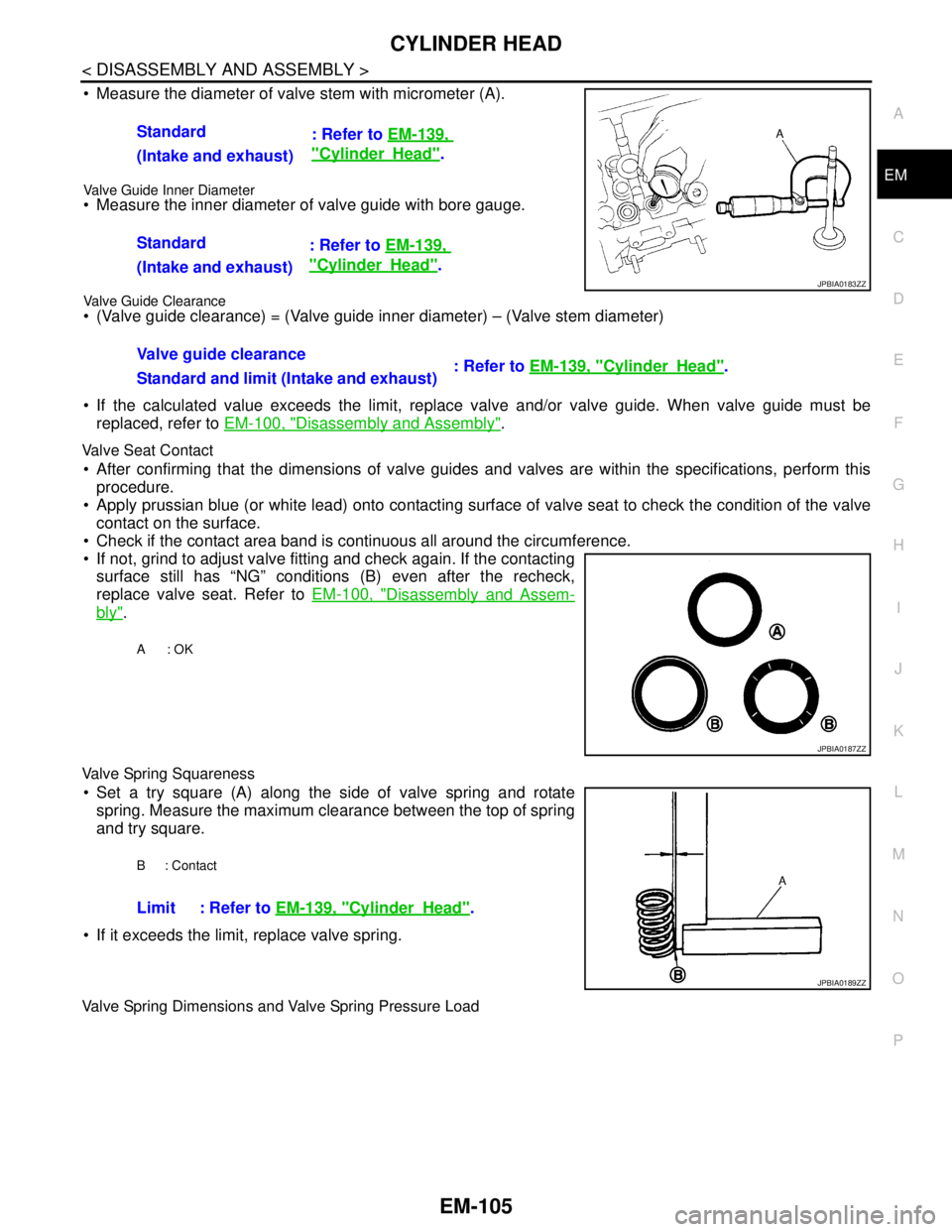
Measure the diameter of valve stem with micrometer (A).
Valve Guide Inner Diameter Measure the inner diameter of valve guide with bore gauge.
Valve Guide Clearance (Valve guide clearance) = (Valve guide inner diameter) – (Valve stem diameter)
If the calculated value exceeds the limit, replace valve and/or valve guide. When valve guide must be
replaced, refer to EM-100, "
Disassembly and Assembly".
Valve Seat Contact
After confirming that the dimensions of valve guides and valves are within the specifications, perform this
procedure.
Apply prussian blue (or white lead) onto contacting surface of valve seat to check the condition of the valve
contact on the surface.
Check if the contact area band is continuous all around the circumference.
If not, grind to adjust valve fitting and check again. If the contacting
surface still has “NG” conditions (B) even after the recheck,
replace valve seat. Refer to EM-100, "
Disassembly and Assem-
bly".
Valve Spring Squareness
Set a try square (A) along the side of valve spring and rotate
spring. Measure the maximum clearance between the top of spring
and try square.
If it exceeds the limit, replace valve spring.
Valve Spring Dimensions and Valve Spring Pressure Load
Standard
: Refer to EM-139,
"CylinderHead".
(Intake and exhaust)
Standard
: Refer to EM-139,
"CylinderHead".
(Intake and exhaust)
Valve guide clearance
: Refer to EM-139, "
CylinderHead".
Standard and limit (Intake and exhaust)
JPBIA0183ZZ
A: OK
JPBIA0187ZZ
B: Contact
Limit : Refer to EM-139, "CylinderHead".
JPBIA0189ZZ