instrument panel NISSAN TEANA 2014 User Guide
[x] Cancel search | Manufacturer: NISSAN, Model Year: 2014, Model line: TEANA, Model: NISSAN TEANA 2014Pages: 4801, PDF Size: 51.2 MB
Page 933 of 4801
SQUEAK AND RATTLE TROUBLE DIAGNOSESDLK-165
< SYMPTOM DIAGNOSIS >
C
D E
F
G H
I
J
L
M A
B
DLK
N
O P
If the noise can be duplicated easily during the test drive, to help identify the source of the noise, try to dupli-
cate the noise with the vehicle stopped by doing one or all of the following:
1) Close a door.
2) Tap or push/pull around the area where the noise appears to be coming from.
3) Rev the engine.
4) Use a floor jack to recreate vehicle “twist”.
5) At idle, apply engine load (electrical load, half-clutch on M/T model, drive position on CVT and A/T models).
6) Raise the vehicle on a hoist and hit a tire with a rubber hammer.
• Drive the vehicle and attempt to duplicate the conditions the customer states exist when the noise occurs.
• If it is difficult to duplicate the noise, drive the vehicle slowly on an undulating or rough road to stress the vehicle body.
CHECK RELATED SERVICE BULLETINS
After verifying the customer concern or symptom, che ck ASIST for Technical Service Bulletins (TSBs) related
to that concern or symptom.
If a TSB relates to the symptom, follow the procedure to repair the noise.
LOCATE THE NOISE AND IDENTIFY THE ROOT CAUSE
1. Narrow down the noise to a general area. To help pi npoint the source of the noise, use a listening tool
(Chassis Ear: J-39570, Engine Ear: J-39565 and mechanic's stethoscope).
2. Narrow down the noise to a more specific area and identify the cause of the noise by: • removing the components in the area that you suspect the noise is coming from.
Do not use too much force when removing clips and fasteners, otherwise clips and fasteners can be
broken or lost during the repair, resulting in the creation of new noise.
• tapping or pushing/pulling the component that you suspect is causing the noise.
Do not tap or push/pull the component with excessive force, otherwise the noise will be eliminated only
temporarily.
• feeling for a vibration with your hand by touching the component(s) that you suspect is (are) causing the
noise.
• placing a piece of paper between components that you suspect are causing the noise.
• looking for loose components and contact marks. Refer to DLK-165, "Generic Squeak and Rattle Troubleshooting"
.
REPAIR THE CAUSE
• If the cause is a loose component, tighten the component securely.
• If the cause is insufficient clearance between components:
- separate components by repositioning or loos ening and retightening the component, if possible.
- insulate components with a suitable insulator such as urethane pads, foam blocks, felt cloth tape or urethane tape. A NISSAN Squeak and Rattle Kit (J-50397) is av ailable through your authorized NISSAN Parts Depart-
ment.
CAUTION:
Do not use excessive force as many components are constructed of plastic and may be damaged.
NOTE:
• Always check with the Parts Department for the latest parts information.
• The materials contained in the NISSAN Squeak and Rattle Kit (J-50397) are listed on the inside cover of the
kit; and can each be ordered seperately as needed.
• The following materials not found in the kit can also be used to repair squeaks and rattles.
- SILICONE GREASE: Use instead of UHMW tape that will be visible or does not fit. The silicone grease will
only last a few months.
- SILICONE SPRAY: Use when grease cannot be applied.
- DUCT TAPE: Use to eliminate movement.
CONFIRM THE REPAIR
Confirm that the cause of a noise is repaired by test driving the vehicle. Operate the vehicle under the same
conditions as when the noise originally occurred. Refer to the notes on the Diagnostic Worksheet.
Generic Squeak and Rattle TroubleshootingINFOID:0000000009889730
Refer to Table of Contents for specific component removal and installation information.
INSTRUMENT PANEL
Most incidents are caused by contact and movement between:
Revision: November 20132014 Altima NAMRevision: November 20132014 Altima NAM
Page 934 of 4801

DLK-166
< SYMPTOM DIAGNOSIS >
SQUEAK AND RATTLE TROUBLE DIAGNOSES
1. Cluster lid A and the instrument panel
2. Acrylic lens and combination meter housing
3. Instrument panel to front pillar finisher
4. Instrument panel to windshield
5. Instrument panel pins
6. Wiring harnesses behind the combination meter
7. A/C defroster duct and duct joint
These incidents can usually be located by tapping or moving the components to duplicate the noise or by
pressing on the components while driving to stop the noise. Most of these incidents can be repaired by apply-
ing felt cloth tape or silicone spray (in hard to reach areas). Urethane pads can be used to insulate wiring har-
ness.
CAUTION:
Do not use silicone spray to isolate a squeak or ra ttle. If you saturate the area with silicone, you will
not be able to recheck the repair.
CENTER CONSOLE
Components to pay attention to include:
1. Shift selector assembly cover to finisher
2. A/C control unit and cluster lid C
3. Wiring harnesses behind audio and A/C control unit
The instrument panel repair and isolation pr ocedures also apply to the center console.
DOORS
Pay attention to the:
1. Finisher and inner panel making a slapping noise
2. Inside handle escutcheon to door finisher
3. Wiring harnesses tapping
4. Door striker out of alignment causing a popping noise on starts and stops
Tapping or moving the components or pressing on them wh ile driving to duplicate the conditions can isolate
many of these incidents. You can usually insulate the areas with felt cloth tape or insulator foam blocks from
the NISSAN Squeak and Rattle Kit (J-50397) to repair the noise.
TRUNK
Trunk noises are often caused by a loose jack or loose items put into the trunk by the owner.
In addition look for:
1. Trunk lid bumpers out of adjustment
2. Trunk lid striker out of adjustment
3. The trunk lid torsion bars knocking together
4. A loose license plate or bracket
Most of these incidents can be repaired by adjusting, se curing or insulating the item(s) or component(s) caus-
ing the noise.
SUNROOF/HEADLINING
Noises in the sunroof/headlining area c an often be traced to one of the following:
1. Sunroof lid, rail, linkage or seals making a rattle or light knocking noise
2. Sun visor shaft shaking in the holder
3. Front or rear windshield touching headlining and squeaking
Again, pressing on the components to stop the noise while duplicating the conditions can isolate most of these
incidents. Repairs usually consist of insulating with felt cloth tape.
OVERHEAD CONSOLE (FRONT AND REAR)
Overhead console noises are often caused by the c onsole panel clips not being engaged correctly. Most of
these incidents are repaired by pushing up on the c onsole at the clip locations until the clips engage.
In addition look for:
1. Loose harness or harness connectors.
2. Front console map/reading lamp lens loose.
Revision: November 20132014 Altima NAMRevision: November 20132014 Altima NAM
Page 995 of 4801
TRUNK LID OPENER SWITCHDLK-227
< REMOVAL AND INSTALLATION >
C
D E
F
G H
I
J
L
M A
B
DLK
N
O P
TRUNK LID OPENER SWITCH
Removal and InstallationINFOID:0000000009461979
REMOVAL
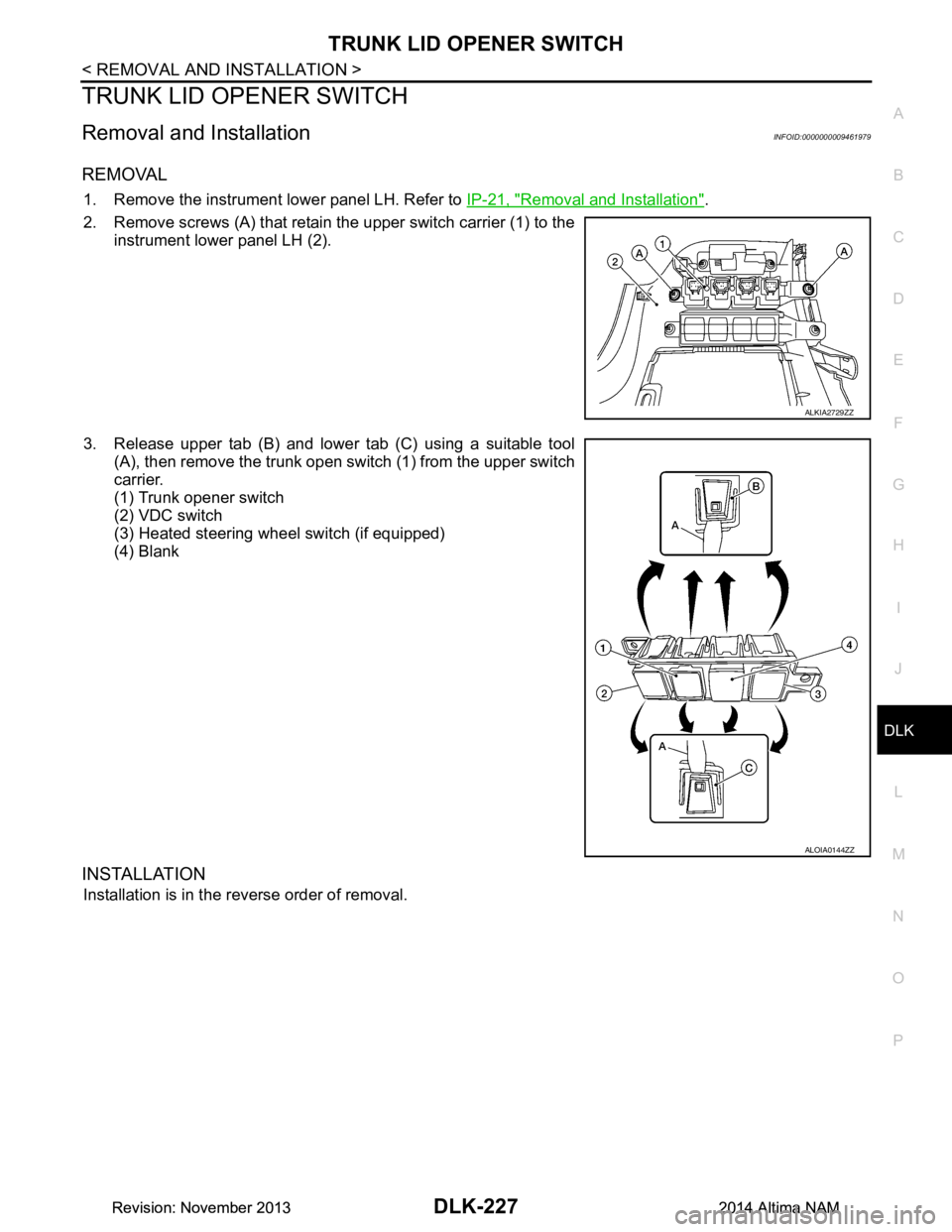
1. Remove the instrument lower panel LH. Refer to IP-21, "Removal and Installation".
2. Remove screws (A) that retain the upper switch carrier (1) to the instrument lower panel LH (2).
3. Release upper tab (B) and lower tab (C) using a suitable tool (A), then remove the trunk open switch (1) from the upper switch
carrier.
(1) Trunk opener switch
(2) VDC switch
(3) Heated steering wheel switch (if equipped)
(4) Blank
INSTALLATION
Installation is in the reverse order of removal.
ALKIA2729ZZ
ALOIA0144ZZ
Revision: November 20132014 Altima NAMRevision: November 20132014 Altima NAM
Page 1024 of 4801
![NISSAN TEANA 2014 User Guide
EC-24
< SYSTEM DESCRIPTION >[QR25DE]
COMPONENT PARTS
A. Instrument panel area B. Periphery of pedals C. Inside fuel tank area
D. Behind fuel tank
: Vehicle front
No. Component Function Combination m](/img/5/57390/w960_57390-1023.png "NISSAN TEANA 2014 User Guide
EC-24
< SYSTEM DESCRIPTION >[QR25DE]
COMPONENT PARTS
A. Instrument panel area B. Periphery of pedals C. Inside fuel tank area
D. Behind fuel tank
: Vehicle front
No. Component Function Combination m")
EC-24
< SYSTEM DESCRIPTION >[QR25DE]
COMPONENT PARTS
A. Instrument panel area B. Periphery of pedals C. Inside fuel tank area
D. Behind fuel tank
: Vehicle front
No. Component Function Combination meter Malfunction indicator lamp (MIL)
EC-36, "Malfunction Indicator lamp (MIL)"
Information displayEC-37, "Information Display"
ASCD steering switch EC-37, "ASCD Steering Switch"
Stop lamp switch
EC-36, "Stop Lamp Switch & Brake Pedal Position Switch"
Brake pedal position switch
Accelerator pedal position sensor EC-25, "Accelerator Pedal Position Sensor"
Fuel level sensor unit and fuel pumpEC-26, "Fuel Level Sensor Unit and Fuel Pump"
Fuel tank temperature sensorEC-27, "Fuel Tank Temperature Sensor"
EVAP control system pressure sensorEC-35, "EVAP Control System Pressure Sensor"
EVAP canister vent control valve EC-35, "EVAP Canister Vent Control Valve"
EVAP canisterEC-34, "EVAP Canister"
ALBIA0806ZZ
Revision: November 20132014 Altima NAMRevision: November 20132014 Altima NAM
Page 1074 of 4801
![NISSAN TEANA 2014 User Guide
EC-74
< SYSTEM DESCRIPTION >[QR25DE]
DIAGNOSIS SYSTEM (ECM)
PERMANENT DTC SET TIMING
The setting timing of permanent DTC is stored in EC
M with the lighting of MIL when a DTC is confirmed.
DIAGNOSIS](/img/5/57390/w960_57390-1073.png "NISSAN TEANA 2014 User Guide
EC-74
< SYSTEM DESCRIPTION >[QR25DE]
DIAGNOSIS SYSTEM (ECM)
PERMANENT DTC SET TIMING
The setting timing of permanent DTC is stored in EC
M with the lighting of MIL when a DTC is confirmed.
DIAGNOSIS")
EC-74
< SYSTEM DESCRIPTION >[QR25DE]
DIAGNOSIS SYSTEM (ECM)
PERMANENT DTC SET TIMING
The setting timing of permanent DTC is stored in EC
M with the lighting of MIL when a DTC is confirmed.
DIAGNOSIS DESCRIPTION : Malfunction Indicator Lamp (MIL)INFOID:0000000009462118
When emission-related ECU detects a malfunction in the emission
control systems components and/or the powertrain control compo-
nents (which affect vehicle emissions), it turns on/blinks MIL to
inform the driver that a malfunction has been detected.
1. The MIL illuminates when ignition switch is turned ON (engine is not running).
NOTE:
Check the MIL circuit if MIL does not illuminate. Refer to EC-
517, "Diagnosis Procedure".
2. When the engine is started, the MIL should go off.
NOTE:
If MIL continues to illuminate/blink, perform self-diagnoses and
inspect/repair accordingly because an emission-rela ted ECU has detected a malfunction in the emission
control systems components and/or the powertrain cont rol components (which affect vehicle emissions).
On Board Diagnosis FunctionINFOID:0000000009462119
ON BOARD DIAGNOSIS ITEM
The on board diagnostic system has the following functions.
BULB CHECK MODE
Description
This function allows damage inspection in the MIL bulb (blown, open circuit, etc.).
Operation Procedure
1. Turn ignition switch ON.
2. The MIL on the instrument panel should stay ON. If it remains OFF, check MIL circuit. Refer to EC-517, "Diagnosis Procedure"
.
SRT STATUS MODE
Description
This function allows to read if ECM has completed t he self-diagnoses of major emission control systems and
components. For SRT, refer to EC-72, "DIAGNOSIS DESCRIPTION : System Readiness Test (SRT) Code"
.
Operation Procedure
1. Turn ignition switch ON and wait 20 seconds.
2. SRT status is indicated as shown blow. • ECM continues to illuminate MIL if all SRT codes are set.
JSBIA1315ZZ
Diagnostic test mode Function
Bulb check MIL can be checked.
SRT status ECM can read if SRT codes are set.
Malfunction warning If ECM detects a malfunction, it illuminates or blinks MIL to inform the driver that a malfunction has been detected.
Self-diagnostic results DTCs or 1st trip DTCs stored in ECM can be read.
Accelerator pedal released po-
sition learning ECM can learn the accelerator pedal released position. Refer to
EC-177, "Work Procedure"
.
Throttle valve closed position
learning ECM can learn the throttle valve closed position. Refer to
EC-178, "Work Procedure"
.
Idle air volume learning ECM can learn the idle air volume. Refer to EC-179, "Work Procedure"
.
Mixture ratio self -learning value
clear Mixture ratio self-learning value can be erased. Refer to
EC-181, "Work Procedure"
.
Revision: November 20132014 Altima NAMRevision: November 20132014 Altima NAM
Page 1551 of 4801
![NISSAN TEANA 2014 User Guide
COMPONENT PARTSEC-551
< SYSTEM DESCRIPTION > [VQ35DE]
C
D E
F
G H
I
J
K L
M A
EC
NP
O
A. Instrument panel
periphery (driver
side) B. Pedal periphery C. Inside fuel tank periphery
D. Behind fuel ta](/img/5/57390/w960_57390-1550.png "NISSAN TEANA 2014 User Guide
COMPONENT PARTSEC-551
< SYSTEM DESCRIPTION > [VQ35DE]
C
D E
F
G H
I
J
K L
M A
EC
NP
O
A. Instrument panel
periphery (driver
side) B. Pedal periphery C. Inside fuel tank periphery
D. Behind fuel ta")
COMPONENT PARTSEC-551
< SYSTEM DESCRIPTION > [VQ35DE]
C
D E
F
G H
I
J
K L
M A
EC
NP
O
A. Instrument panel
periphery (driver
side) B. Pedal periphery C. Inside fuel tank periphery
D. Behind fuel tank periphery :Vehicle front
No. Component Function
1. Combination meter Malfunction indicator lamp (MIL)
EC-560, "Malfunction Indicator lamp (MIL)"
Information displayThe operation mode of the ASCD is indicated on the information
display in the combination meter.
ECM transmits the status signal to the combination meter via CAN
communication according to ASCD operation.
2. ASCD steering switch EC-553, "ASCD Steering Switch"
3. Stop lamp switchEC-562, "Stop Lamp Switch & Brake Pedal Position Switch"
4. Brake pedal position switch EC-562, "Stop Lamp Switch & Brake Pedal Position Switch"
5. Accelerator pedal position sensor EC-552, "Accelerator Pedal Position Sensor"
6. Fuel level sensor unit and fuel pumpEC-558, "Fuel Level Sensor Unit and Fuel Pump (With Fuel Tank Temperature Sensor)"
7. Fuel tank temperature sensorEC-558, "Fuel Level Sensor Unit and Fuel Pump (With Fuel Tank Temperature Sensor)"
ALBIA0806ZZ
Revision: November 20132014 Altima NAMRevision: November 20132014 Altima NAM
Page 1598 of 4801
![NISSAN TEANA 2014 User Guide
EC-598
< SYSTEM DESCRIPTION >[VQ35DE]
DIAGNOSIS SYSTEM (ECM)
PERMANENT DTC SET TIMING
The setting timing of permanent DTC is stored in EC
M with the lighting of MIL when a DTC is confirmed.
DIAGNOSIS](/img/5/57390/w960_57390-1597.png "NISSAN TEANA 2014 User Guide
EC-598
< SYSTEM DESCRIPTION >[VQ35DE]
DIAGNOSIS SYSTEM (ECM)
PERMANENT DTC SET TIMING
The setting timing of permanent DTC is stored in EC
M with the lighting of MIL when a DTC is confirmed.
DIAGNOSIS")
EC-598
< SYSTEM DESCRIPTION >[VQ35DE]
DIAGNOSIS SYSTEM (ECM)
PERMANENT DTC SET TIMING
The setting timing of permanent DTC is stored in EC
M with the lighting of MIL when a DTC is confirmed.
DIAGNOSIS DESCRIPTION : Malfunction Indicator Lamp (MIL)INFOID:0000000009462539
• When detecting a DTC that affects exhaust gas, the exhaust emis-
sion-related control module transmits a malfunction indicator lamp
signal to ECM via CAN communication line.
ECM prioritizes (MIL: ON/blink) the signal received from the
exhaust emission-related control module and the ECM-stored DTC
that affects exhaust gas and transmits a malfunction indicator lamp
signal to the combination meter via CAN communication line.
The combination meter turns ON or blinks the MIL, according to
the signal transmitted from ECM, and alerts the driver of malfunc-
tion detection.
• Control modules that a DTC of MIL ON/Blink is stored (Control module varies among DTCs.):
-ECM
-TCM
1. The MIL illuminates when ignition switch is turned ON (engine is not running). NOTE:
Check the MIL circuit if MIL does not illuminate. Refer to EC-973, "Component Function Check"
.
2. When the engine is started, the MIL should go off. NOTE:
If MIL remains ON or continues blinking, a DTC(s) t hat affects exhaust gas is detected. In this case, Self
diagnosis is required for performing inspection and repair.
On Board Diagn osis FunctionINFOID:0000000009462540
ON BOARD DIAGNOSIS ITEM
The on board diagnostic system has the following functions.
BULB CHECK MODE
Description
This function allows damage inspection in the MIL bulb (blown, open circuit, etc.).
Operation Procedure
1. Turn ignition switch ON.
2. The MIL on the instrument panel should stay ON.
If it remains OFF, check MIL circuit. Refer to EC-973, "Diagnosis Procedure"
.
SRT STATUS MODE
Description
JSBIA1315ZZ
Diagnostic test mode Function
Bulb check MIL can be checked.
SRT status ECM can read if SRT codes are set.
Malfunction warning If ECM detects a malfunction, it illuminates or blinks MIL to inform the driver that a malfunction has been detected.
Self-diagnostic results DTCs or 1st trip DTCs stored in ECM can be read.
Accelerator pedal released po-
sition learning ECM can learn the accelerator pedal released position. Refer to
EC-681, "Description"
.
Throttle valve closed position
learning ECM can learn the throttle valve closed position. Refer to
EC-682, "Description"
.
Idle air volume learning ECM can learn the idle air volume. Refer to EC-683, "Description"
.
Mixture ratio self -learning value
clear Mixture ratio self-learning value can be erased. Refer to
EC-685, "Description"
.
Revision: November 20132014 Altima NAMRevision: November 20132014 Altima NAM
Page 2426 of 4801

EXT-12
< PERIODIC MAINTENANCE >
SQUEAK AND RATTLE TROUBLE DIAGNOSES
INSTRUMENT PANEL
Most incidents are caused by contact and movement between:
1. Cluster lid A and the instrument panel
2. Acrylic lens and combination meter housing
3. Instrument panel to front pillar finisher
4. Instrument panel to windshield
5. Instrument panel pins
6. Wiring harnesses behind the combination meter
7. A/C defroster duct and duct joint
These incidents can usually be located by tapping or moving the components to duplicate the noise or by
pressing on the components while driving to stop the noise. Most of these incidents can be repaired by apply-
ing felt cloth tape or silicone spray (in hard to reach areas). Urethane pads can be used to insulate wiring har-
ness.
CAUTION:
Do not use silicone spray to isolate a squeak or ra ttle. If you saturate the area with silicone, you will
not be able to recheck the repair.
CENTER CONSOLE
Components to pay attention to include:
1. Shift selector assembly cover to finisher
2. A/C control unit and cluster lid C
3. Wiring harnesses behind audio and A/C control unit
The instrument panel repair and isolation pr ocedures also apply to the center console.
DOORS
Pay attention to the:
1. Finisher and inner panel making a slapping noise
2. Inside handle escutcheon to door finisher
3. Wiring harnesses tapping
4. Door striker out of alignment causing a popping noise on starts and stops
Tapping or moving the components or pressing on them wh ile driving to duplicate the conditions can isolate
many of these incidents. You can usually insulate the areas with felt cloth tape or insulator foam blocks from
the NISSAN Squeak and Rattle Kit (J-50397) to repair the noise.
TRUNK
Trunk noises are often caused by a loose jack or loose items put into the trunk by the owner.
In addition look for:
1. Trunk lid bumpers out of adjustment
2. Trunk lid striker out of adjustment
3. The trunk lid torsion bars knocking together
4. A loose license plate or bracket
Most of these incidents can be repaired by adjusting, se curing or insulating the item(s) or component(s) caus-
ing the noise.
SUNROOF/HEADLINING
Noises in the sunroof/headlining area c an often be traced to one of the following:
1. Sunroof lid, rail, linkage or seals making a rattle or light knocking noise
2. Sun visor shaft shaking in the holder
3. Front or rear windshield touching headlining and squeaking
Again, pressing on the components to stop the noise while duplicating the conditions can isolate most of these
incidents. Repairs usually consist of insulating with felt cloth tape.
OVERHEAD CONSOLE (FRONT AND REAR)
Overhead console noises are often caused by the c onsole panel clips not being engaged correctly. Most of
these incidents are repaired by pushing up on the c onsole at the clip locations until the clips engage.
In addition look for:
Revision: November 20132014 Altima NAM
Page 2572 of 4801
GI-44
< BASIC INSPECTION >
SERVICE INFORMATION FOR ELECTRICAL INCIDENT
lowing section illustrates ways to simulate the conditions/environment under which the owner experiences an
electrical incident.
The section is broken into the six following topics:• Vehicle vibration
• Heat sensitive
• Freezing
• Water intrusion
• Electrical load
• Cold or hot start up
Get a thorough description of the incident from the customer . It is important for simulating the conditions of the
problem.
VEHICLE VIBRATION
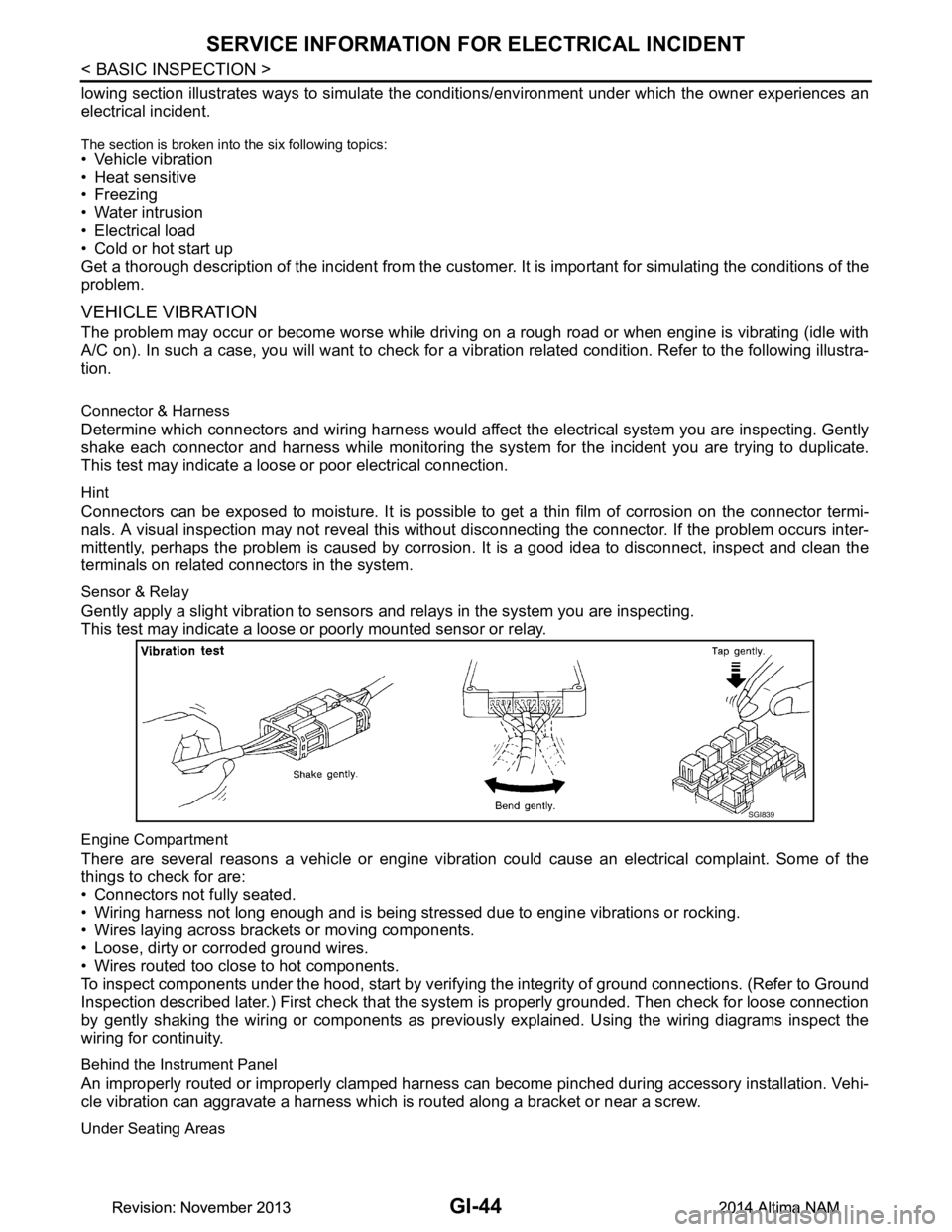
The problem may occur or become worse while driving on a rough road or when engine is vibrating (idle with
A/C on). In such a case, you will want to check for a vi bration related condition. Refer to the following illustra-
tion.
Connector & Harness
Determine which connectors and wiring harness would affect the electrical system you are inspecting. Gently
shake each connector and harness while monitoring the sy stem for the incident you are trying to duplicate.
This test may indicate a loose or poor electrical connection.
Hint
Connectors can be exposed to moisture. It is possible to get a thin film of corrosion on the connector termi-
nals. A visual inspection may not reveal this without disconnecting the connector. If the problem occurs inter-
mittently, perhaps the problem is caused by corrosion. It is a good idea to disconnect, inspect and clean the
terminals on related connectors in the system.
Sensor & Relay
Gently apply a slight vibration to sensors and relays in the system you are inspecting.
This test may indicate a loose or poorly mounted sensor or relay.
Engine Compartment
There are several reasons a vehicle or engine vibration could cause an electrical complaint. Some of the
things to check for are:
• Connectors not fully seated.
• Wiring harness not long enough and is being stressed due to engine vibrations or rocking.
• Wires laying across brackets or moving components.
• Loose, dirty or corroded ground wires.
• Wires routed too close to hot components.
To inspect components under the hood, start by verifyi ng the integrity of ground connections. (Refer to Ground
Inspection described later.) First check that the system is properly grounded. Then check for loose connection
by gently shaking the wiring or components as previous ly explained. Using the wiring diagrams inspect the
wiring for continuity.
Behind the Instrument Panel
An improperly routed or improperly clamped harness can become pinched during accessory installation. Vehi-
cle vibration can aggravate a harness which is routed along a bracket or near a screw.
Under Seating Areas
SGI839
Revision: November 20132014 Altima NAMRevision: November 20132014 Altima NAM
Page 2587 of 4801
SQUEAK AND RATTLE TROUBLE DIAGNOSESGW-7
< SYMPTOM DIAGNOSIS >
C
D E
F
G H
I
J
L
M A
B
GW
N
O P
INSTRUMENT PANEL
Most incidents are caused by contact and movement between:
1. Cluster lid A and the instrument panel
2. Acrylic lens and combination meter housing
3. Instrument panel to front pillar finisher
4. Instrument panel to windshield
5. Instrument panel pins
6. Wiring harnesses behind the combination meter
7. A/C defroster duct and duct joint
These incidents can usually be located by tapping or moving the components to duplicate the noise or by
pressing on the components while driving to stop the noi se. Most of these incidents can be repaired by apply-
ing felt cloth tape or silicone spray (in hard to reach areas). Urethane pads can be used to insulate wiring har-
ness.
CAUTION:
Do not use silicone spray to isolate a squeak or ra ttle. If you saturate the area with silicone, you will
not be able to recheck the repair.
CENTER CONSOLE
Components to pay attention to include:
1. Shift selector assembly cover to finisher
2. A/C control unit and cluster lid C
3. Wiring harnesses behind audio and A/C control unit
The instrument panel repair and isolation pr ocedures also apply to the center console.
DOORS
Pay attention to the:
1. Finisher and inner panel making a slapping noise
2. Inside handle escutcheon to door finisher
3. Wiring harnesses tapping
4. Door striker out of alignment causing a popping noise on starts and stops
Tapping or moving the components or pressing on them wh ile driving to duplicate the conditions can isolate
many of these incidents. You can usually insulate the ar eas with felt cloth tape or insulator foam blocks from
the NISSAN Squeak and Rattle Kit (J-50397) to repair the noise.
TRUNK
Trunk noises are often caused by a loose jack or loose items put into the trunk by the owner.
In addition look for:
1. Trunk lid bumpers out of adjustment
2. Trunk lid striker out of adjustment
3. The trunk lid torsion bars knocking together
4. A loose license plate or bracket
Most of these incidents can be repaired by adjusting, se curing or insulating the item(s) or component(s) caus-
ing the noise.
SUNROOF/HEADLINING
Noises in the sunroof/headlining area can often be traced to one of the following:
1. Sunroof lid, rail, linkage or seals making a rattle or light knocking noise
2. Sun visor shaft shaking in the holder
3. Front or rear windshield touching headlining and squeaking
Again, pressing on the components to stop the noise while duplicating the conditions can isolate most of these
incidents. Repairs usually consist of insulating with felt cloth tape.
OVERHEAD CONSOLE (FRONT AND REAR)
Overhead console noises are often caused by the cons ole panel clips not being engaged correctly. Most of
these incidents are repaired by pushing up on the c onsole at the clip locations until the clips engage.
In addition look for:
Revision: November 20132014 Altima NAM