heating NISSAN TEANA 2014 Owner's Guide
[x] Cancel search | Manufacturer: NISSAN, Model Year: 2014, Model line: TEANA, Model: NISSAN TEANA 2014Pages: 4801, PDF Size: 51.2 MB
Page 1804 of 4801
![NISSAN TEANA 2014 Owners Guide
EC-804
< DTC/CIRCUIT DIAGNOSIS >[VQ35DE]
P0196 EOT SENSOR
4. Check resistance between engine oi
l temperature sensor termi-
nals by heating with hot wate r as shown in the figure.
Is the inspection r](/img/5/57390/w960_57390-1803.png "NISSAN TEANA 2014 Owners Guide
EC-804
< DTC/CIRCUIT DIAGNOSIS >[VQ35DE]
P0196 EOT SENSOR
4. Check resistance between engine oi
l temperature sensor termi-
nals by heating with hot wate r as shown in the figure.
Is the inspection r")
EC-804
< DTC/CIRCUIT DIAGNOSIS >[VQ35DE]
P0196 EOT SENSOR
4. Check resistance between engine oi
l temperature sensor termi-
nals by heating with hot wate r as shown in the figure.
Is the inspection result normal?
YES >> INSPECTION END
NO >> Replace engine oil temperature sensor. Refer to EC-
548, "ENGINE CONTROL SYSTEM : Component Parts Location".
Terminals Condition Resistance (k Ω)
1 and 2 Temperature [ °C ( °F)] 20 (68) 2.37 - 2.63
50 (122) 0.68 - 1.00
90 (194) 0.236 - 0.260
JMBIA0080ZZ
Revision: November 20132014 Altima NAMRevision: November 20132014 Altima NAM
Page 1806 of 4801
![NISSAN TEANA 2014 Owners Guide
EC-806
< DTC/CIRCUIT DIAGNOSIS >[VQ35DE]
P0197, P0198 EOT SENSOR
Is the inspection result normal?
YES >> GO TO 3.
NO >> Repair open circuit, short to ground or short to power in harness or connector](/img/5/57390/w960_57390-1805.png "NISSAN TEANA 2014 Owners Guide
EC-806
< DTC/CIRCUIT DIAGNOSIS >[VQ35DE]
P0197, P0198 EOT SENSOR
Is the inspection result normal?
YES >> GO TO 3.
NO >> Repair open circuit, short to ground or short to power in harness or connector")
EC-806
< DTC/CIRCUIT DIAGNOSIS >[VQ35DE]
P0197, P0198 EOT SENSOR
Is the inspection result normal?
YES >> GO TO 3.
NO >> Repair open circuit, short to ground or short to power in harness or connectors.
3.CHECK ENGINE OIL TEMPERATURE SENSOR
Check engine oil temperature sensor. Refer to EC-806, "Component Inspection"
.
Is the inspection result normal?
YES >> Check intermittent incident. Refer to GI-43, "Intermittent Incident".
NO >> Replace engine oil temperature sensor. Refer to EC-548, "ENGINE CONTROL SYSTEM : Com-
ponent Parts Location".
Component InspectionINFOID:0000000009462662
1.CHECK ENGINE OIL TEMPERATURE SENSOR
1. Turn ignition switch OFF.
2. Disconnect engine oil temperature sensor harness connector.
3. Remove engine oil temperature sensor. Refer to EC-548, "ENGINE CONTROL SYSTEM : Component
Parts Location".
4. Check resistance between engine oi l temperature sensor termi-
nals by heating with hot wate r as shown in the figure.
Is the inspection result normal?
YES >> INSPECTION END
NO >> Replace engine oil temperature sensor. Refer to EC-
548, "ENGINE CONTROL SYSTEM : Component Parts Location".
Terminals Condition Resistance (k Ω)
1 and 2 Temperature [ °C ( °F)] 20 (68) 2.37 - 2.63
50 (122) 0.68 - 1.00
90 (194) 0.236 - 0.260
JMBIA0080ZZ
Revision: November 20132014 Altima NAMRevision: November 20132014 Altima NAM
Page 1809 of 4801
![NISSAN TEANA 2014 Owners Guide
P0300, P0301, P0302, P0303, P0304, P0305, P0306 MISFIRE
EC-809
< DTC/CIRCUIT DIAGNOSIS > [VQ35DE]
C
D E
F
G H
I
J
K L
M A
EC
NP
O
P0300, P0301, P0302, P0303,
P0304, P0305, P0306 MISFIRE
DTC LogicIN](/img/5/57390/w960_57390-1808.png "NISSAN TEANA 2014 Owners Guide
P0300, P0301, P0302, P0303, P0304, P0305, P0306 MISFIRE
EC-809
< DTC/CIRCUIT DIAGNOSIS > [VQ35DE]
C
D E
F
G H
I
J
K L
M A
EC
NP
O
P0300, P0301, P0302, P0303,
P0304, P0305, P0306 MISFIRE
DTC LogicIN")
P0300, P0301, P0302, P0303, P0304, P0305, P0306 MISFIRE
EC-809
< DTC/CIRCUIT DIAGNOSIS > [VQ35DE]
C
D E
F
G H
I
J
K L
M A
EC
NP
O
P0300, P0301, P0302, P0303,
P0304, P0305, P0306 MISFIRE
DTC LogicINFOID:0000000009462666
DTC DETECTION LOGIC
When a misfire occurs, engine speed will fluctuate. If the engine speed fluctuates enough to cause the crank-
shaft position (CKP) sensor (POS) signal to vary , ECM can determine that a misfire is occurring.
The misfire detection logic consists of the following two conditions.
1. One Trip Detection Logic (Three Way Catalyst Damage) On the 1st trip, when a misfire condition occurs that can damage the three way catalyst (TWC) due to
overheating, the MIL will blink.
When a misfire condition occurs, the ECM monitors the CKP sensor signal every 200 engine revolutions
for a change.
When the misfire condition decreases to a level t hat will not damage the TWC, the MIL will turn off.
If another misfire condition occurs that can damage the TWC on a second trip, the MIL will blink.
When the misfire condition decreases to a level t hat will not damage the TWC, the MIL will remain on.
If another misfire condition occurs that can damage the TWC, the MIL will begin to blink again.
2. Two Trip Detection Logic (Exhaust quality deterioration) For misfire conditions that will not damage the TWC (but will affect vehicle emissions), the MIL will only
illuminate when the misfire is detected on a second tr ip. During this condition, the ECM monitors the CKP
sensor signal every 1,000 engine revolutions.
A misfire malfunction can be detected in any one cylinder or in multiple cylinders.
DTC CONFIRMATION PROCEDURE
1.PRECONDITIONING
If DTC Confirmation Procedure has been previously conducted, always perform the following procedure
before conducting the next test.
1. Turn ignition switch OFF and wait at least 10 seconds.
2. Turn ignition switch ON.
3. Turn ignition switch OFF and wait at least 10 seconds.
>> GO TO 2.
2.PERFORM DTC CONFIRMATION PROCEDURE-I
1. Start engine and warm it up to normal operating temperature.
2. Turn ignition switch OFF and wait at least 10 seconds.
3. Turn ignition switch ON.
4. Turn ignition switch OFF and wait at least 10 seconds.
5. Restart engine and let it idle for approximately 15 minutes.
6. Check 1st trip DTC.
Is 1st trip DTC detected?
Sensor Input signal to ECM ECM function
Crankshaft position sensor (POS) Engine speed On board diagnosis of misfire
DTC No. Trouble diagnosis name DTC detecting condition Possible cause
P0300 Multiple cylinder misfires detected Multiple cylinders misfire. • Improper spark plug • Insufficient compression
• Incorrect fuel pressure
• The fuel injector circuit is open or shorted
• Fuel injector
• Intake air leakage
• The ignition signal circuit is open or shorted
• Lack of fuel
• Signal plate
• A/F sensor 1
• Incorrect PCV hose connection
P0301 No. 1 cylinder misfire detected No. 1 cylinder misfires.
P0302 No. 2 cylinder misfire detected No. 2 cylinder misfires.
P0303 No. 3 cylinder misfire detected No. 3 cylinder misfires.
P0304 No. 4 cylinder misfire detected No. 4 cylinder misfires.
P0305 No. 5 cylinder misfire detected No. 5 cylinder misfires.
P0306 No. 6 cylinder misfire detected No. 6 cylinder misfires.
Revision: November 20132014 Altima NAMRevision: November 20132014 Altima NAM
Page 1873 of 4801
![NISSAN TEANA 2014 Owners Guide
P050A, P050E COLD START CONTROLEC-873
< DTC/CIRCUIT DIAGNOSIS > [VQ35DE]
C
D E
F
G H
I
J
K L
M A
EC
NP
O
P050A, P050E COLD START CONTROL
DescriptionINFOID:0000000009462723
ECM controls ignition timi](/img/5/57390/w960_57390-1872.png "NISSAN TEANA 2014 Owners Guide
P050A, P050E COLD START CONTROLEC-873
< DTC/CIRCUIT DIAGNOSIS > [VQ35DE]
C
D E
F
G H
I
J
K L
M A
EC
NP
O
P050A, P050E COLD START CONTROL
DescriptionINFOID:0000000009462723
ECM controls ignition timi")
P050A, P050E COLD START CONTROLEC-873
< DTC/CIRCUIT DIAGNOSIS > [VQ35DE]
C
D E
F
G H
I
J
K L
M A
EC
NP
O
P050A, P050E COLD START CONTROL
DescriptionINFOID:0000000009462723
ECM controls ignition timing and engine idle speed when engine is started with pre-warming up condition.
This control promotes the activation of three way ca talyst by heating the catalyst and reduces emissions.
DTC LogicINFOID:0000000009462724
DTC DETECTION LOGIC
NOTE:
If DTC P050A, P050E is displayed with other DTC, first perform the trouble diagnosis for other DTC.
DTC CONFIRMATION PROCEDURE
1.PRECONDITIONING
If DTC Confirmation Procedure has been previously conducted, always perform the following procedure
before conducting the next test.
1. Turn ignition switch OFF and wait at least 10 seconds.
2. Turn ignition switch ON.
3. Turn ignition switch OFF and wait at least 10 seconds.
TESTING CONDITION:
Before performing the following procedure, confirm that battery voltage is more than 11 V at idle.
>> GO TO 2.
2.PERFORM DTC CONFIRMATION PROCEDURE-I
With CONSULT
1. Turn ignition switch OFF and wait at least 10 seconds.
2. Turn ignition switch ON.
3. Select “DATA MONITOR” mode with CONSULT.
4. Check the indication of “COOLAN TEMP/S”.
With GST
Follow the procedure “With CONSULT” above.
Is the value of
“COOLAN TEMP/S” between 4°C (39°F) and 36°C (97°F)?
YES >> GO TO 3.
NO-1 [If it is below 4 °C (39 °F)]>>Warm up the engine until the value of “COOLAN TEMP/S” reaches 4 °C
(39 °F) or more. Retry from step 1.
NO-2 [If it is above 36 °C (97 °F)]>>Cool engine down to less than 36 °C (97 °F). Retry from step 1.
3.PERFORM DTC CONFIRMATION PROCEDURE-II
With CONSULT
1. Set the select lever in N range.
2. Start the engine and warm up in idle with the value of “COOLAN TEMP/S” between 4°C (39 °F) and 40 °C
(104 °F) for more than 15 seconds.
3. Check 1st trip DTC.
With GST
Follow the procedure “With CONSULT” above.
Is 1st trip DTC detected?
YES >> Proceed to EC-874, "Diagnosis Procedure".
DTC No. Trouble diagnosis name DTC detecting condition Possible cause
P050A Cold start idle air control system
performance ECM does not control engine idle speed properly
when engine is started with pre-warming up con-
dition. • Lack of intake air volume
• Fuel injection system
•ECM
P050E Cold start engine exhaust temper-
ature too low The temperature of the catalyst inlet does not
rise to the proper temperature when the engine
is started with pre-warming up condition.
Revision: November 20132014 Altima NAMRevision: November 20132014 Altima NAM
Page 1894 of 4801
![NISSAN TEANA 2014 Owners Guide
EC-894
< DTC/CIRCUIT DIAGNOSIS >[VQ35DE]
P1217 ENGINE OVER TEMPERATURE
>> Repair or replace malfunctioning part.
4.CHECK RADIATOR CAP
Check radiator cap. Refer to CO-35, "System Inspection"
.
Is the](/img/5/57390/w960_57390-1893.png "NISSAN TEANA 2014 Owners Guide
EC-894
< DTC/CIRCUIT DIAGNOSIS >[VQ35DE]
P1217 ENGINE OVER TEMPERATURE
>> Repair or replace malfunctioning part.
4.CHECK RADIATOR CAP
Check radiator cap. Refer to CO-35, \"System Inspection\"
.
Is the")
EC-894
< DTC/CIRCUIT DIAGNOSIS >[VQ35DE]
P1217 ENGINE OVER TEMPERATURE
>> Repair or replace malfunctioning part.
4.CHECK RADIATOR CAP
Check radiator cap. Refer to CO-35, "System Inspection"
.
Is the inspection result normal?
YES >> GO TO 5.
NO >> Replace radiator cap. Refer to CO-40, "Exploded View"
.
5.CHECK THERMOSTAT
Check thermostat. Refer to CO-49, "Removal and Installation"
.
Is the inspection result normal?
YES >> GO TO 6.
NO >> Replace thermostat. Refer to CO-49, "Removal and Installation"
.
6.CHECK ENGINE COOLANT TEMPERATURE SENSOR
Refer to EC-741, "Component Inspection"
.
Is the inspection result normal?
YES >> GO TO 7.
NO >> Replace engine coolant temperature sensor. Refer to CO-51, "Exploded View"
.
7.OVERHEATING CAUSE ANALYSIS
If the cause cannot be isolated, check the CO-33, "Troubleshooting Chart"
.
>> INSPECTION END
Revision: November 20132014 Altima NAMRevision: November 20132014 Altima NAM
Page 2573 of 4801
SERVICE INFORMATION FOR ELECTRICAL INCIDENTGI-45
< BASIC INSPECTION >
C
D E
F
G H
I
J
K L
M B
GI
N
O P
An unclamped or loose harness can cause wiring to be pinched by seat components (such as slide guides)
during vehicle vibration. If the wiring runs under s eating areas, inspect wire routing for possible damage or
pinching.
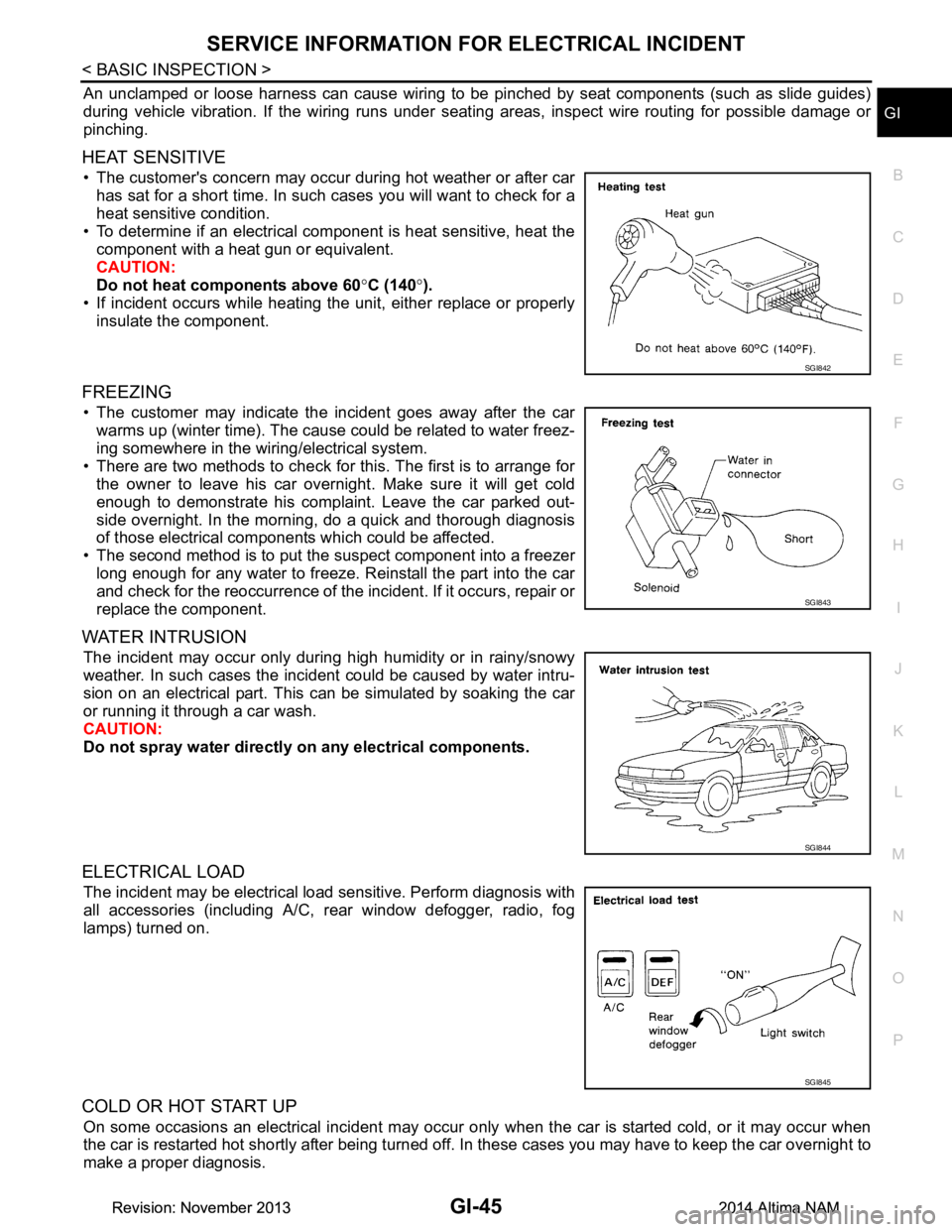
HEAT SENSITIVE
• The customer's concern may occur during hot weather or after car has sat for a short time. In such cases you will want to check for a
heat sensitive condition.
• To determine if an electrical component is heat sensitive, heat the component with a heat gun or equivalent.
CAUTION:
Do not heat components above 60 °C (140 °).
• If incident occurs while heating t he unit, either replace or properly
insulate the component.
FREEZING
• The customer may indicate the incident goes away after the car warms up (winter time). The cause could be related to water freez-
ing somewhere in the wiring/electrical system.
• There are two methods to check for this. The first is to arrange for the owner to leave his car overnight. Make sure it will get cold
enough to demonstrate his complaint. Leave the car parked out-
side overnight. In the morning, do a quick and thorough diagnosis
of those electrical components which could be affected.
• The second method is to put the suspect component into a freezer long enough for any water to freeze. Reinstall the part into the car
and check for the reoccurrence of the incident. If it occurs, repair or
replace the component.
WATER INTRUSION
The incident may occur only during high humidity or in rainy/snowy
weather. In such cases the incident could be caused by water intru-
sion on an electrical part. This c an be simulated by soaking the car
or running it through a car wash.
CAUTION:
Do not spray water directly on any electrical components.
ELECTRICAL LOAD
The incident may be electrical load sensitive. Perform diagnosis with
all accessories (including A/C, rear window defogger, radio, fog
lamps) turned on.
COLD OR HOT START UP
On some occasions an electrical incident may occur only when the car is started cold, or it may occur when
the car is restarted hot shortly after being turned off. In these cases you may have to keep the car overnight to
make a proper diagnosis.
SGI842
SGI843
SGI844
SGI845
Revision: November 20132014 Altima NAMRevision: November 20132014 Altima NAM
Page 2608 of 4801

HA-2
LOW-PRESSURE PIPE ............................................35
LOW-PRESSURE PIPE : Removal and Installa-
tion ....................................................................... ...
35
HIGH-PRESSURE PIPE ......................................... ...36
HIGH-PRESSURE PIPE : Removal and Installa-
tion ....................................................................... ...
36
CONDENSER ....................................................38
Exploded View ..................................................... ...38
CONDENSER ......................................................... ...38
CONDENSER : Removal and Installation ..............38
LIQUID TANK ......................................................... ...38
LIQUID TANK : Removal and Installation ...............38
REFRIGERANT PRESSURE SENSOR ....................39
REFRIGERANT PRESSURE SENSOR : Remov-
al and Installation ................................................. ...
39
HEATING AND COOLING UNIT ASSEMBLY ...40
Exploded View ..................................................... ...40
HEATING AND COOLING UNIT ASSEMBLY ....... ...40
HEATING AND COOLING UNIT ASSEMBLY :
Removal and Installation .........................................
41
HEATER CORE ...................................................... ...41
HEATER CORE : Removal and Installation ............42
EVAPORATOR ....................................................... ...42
EVAPORATOR : Removal and Installation .............42
EXPANSION VALVE .............................................. ...42
EXPANSION VALVE : Removal and Installation
for Expansion Valve ............................................. ...
42
SERVICE DATA AND SPECIFICATIONS
(SDS) ............... ...........................................
43
SERVICE DATA AND SPECIFICATIONS
(SDS) .............................................................. ...
43
Service Data and Specification (SDS) ....................43
Revision: November 20132014 Altima NAM
Page 2611 of 4801
PRECAUTIONSHA-5
< PRECAUTION >
C
D E
F
G H
J
K L
M A
B
HA
N
O P
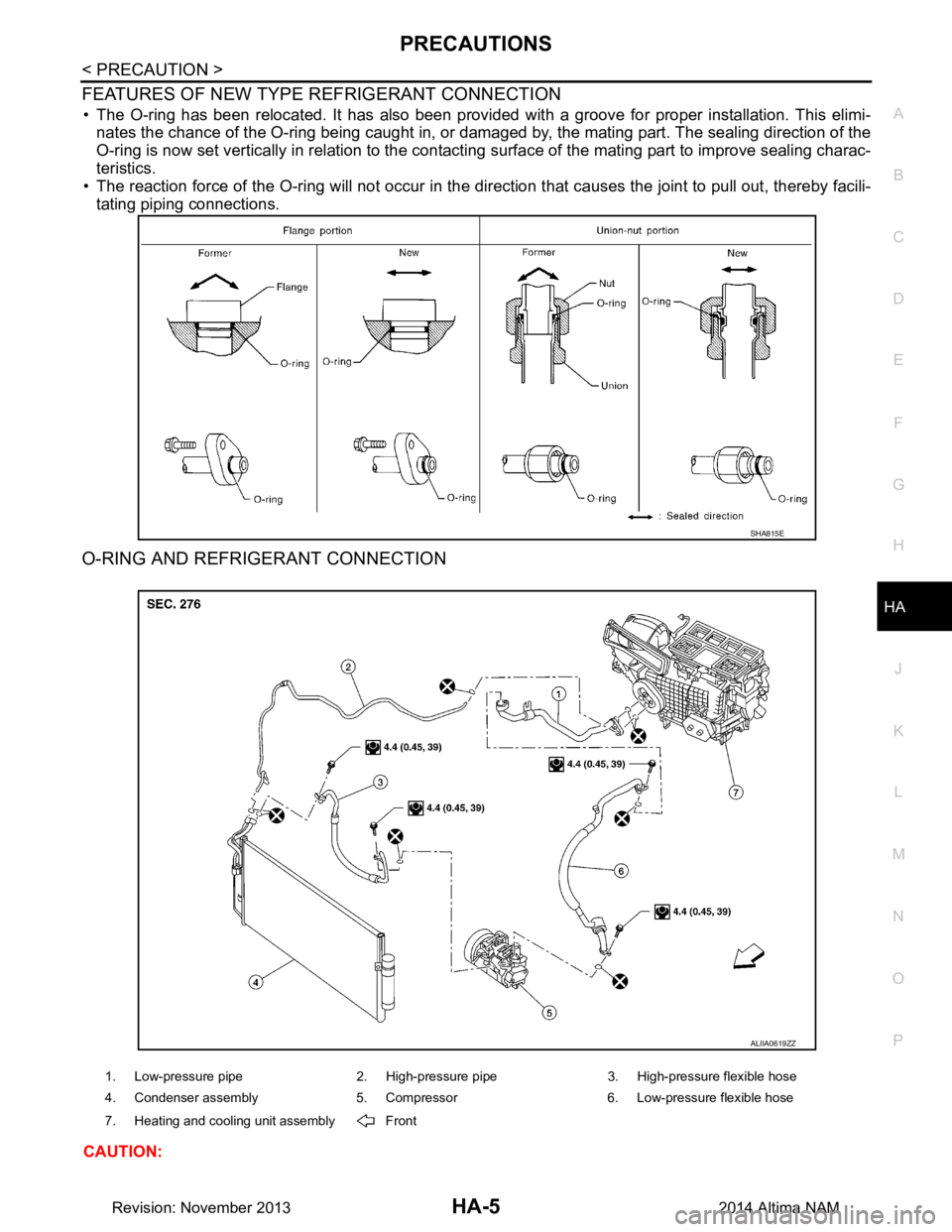
FEATURES OF NEW TYPE REFRIGERANT CONNECTION
• The O-ring has been relocated. It has also been provided with a groove for proper installation. This elimi- nates the chance of the O-ring being caught in, or damaged by, the mating part. The sealing direction of the
O-ring is now set vertically in relation to the contacti ng surface of the mating part to improve sealing charac-
teristics.
• The reaction force of the O-ring will not occur in the dire ction that causes the joint to pull out, thereby facili-
tating piping connections.
O-RING AND REFRIGERANT CONNECTION
CAUTION:
SHA815E
1. Low-pressure pipe 2. High-pressure pipe 3. High-pressure flexible hose
4. Condenser assembly 5. Compressor 6. Low-pressure flexible hose
7. Heating and cooling unit assembly Front
ALIIA0619ZZ
Revision: November 20132014 Altima NAM
Page 2620 of 4801
HA-14
< SYSTEM DESCRIPTION >
REFRIGERATION SYSTEM
The refrigerant system is also protected by a pressure relief valve, located in the rear head of the compressor.
When the pressure of refrigerant in the system increases to an abnormal level [more than 3,727 kPa (38 kg/
cm
2, 540 psi)], the release port on the pressure relief valve automatically opens and releases refrigerant into
the atmosphere.
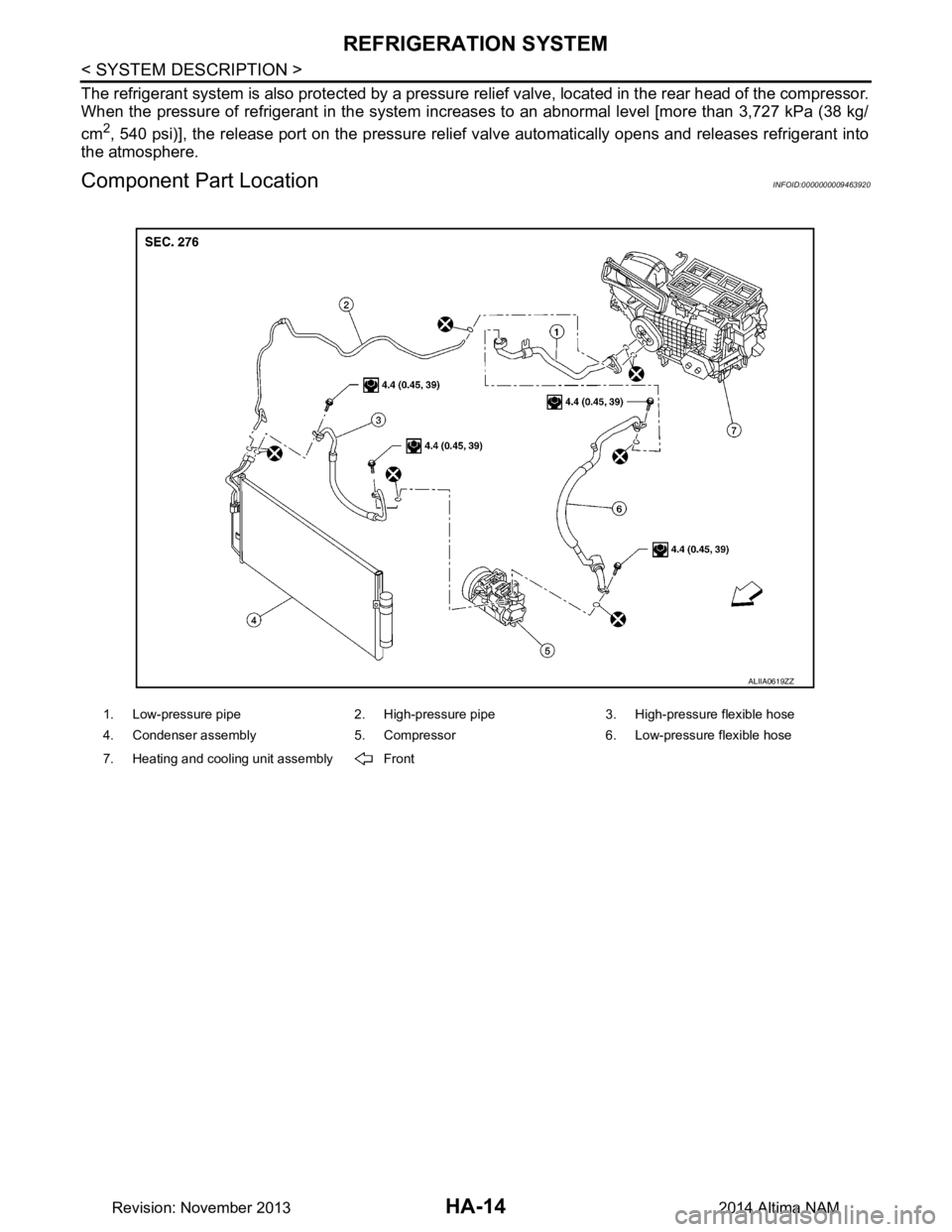
Component Part LocationINFOID:0000000009463920
1. Low-pressure pipe 2. High-pressure pipe 3. High-pressure flexible hose
4. Condenser assembly 5. Compressor 6. Low-pressure flexible hose
7. Heating and cooling unit assembly Front
ALIIA0619ZZ
Revision: November 20132014 Altima NAM
Page 2623 of 4801
HEATER AND AIR CONDITIONING SYSTEM SYMPTOMS
HA-17
< SYMPTOM DIAGNOSIS >
C
D E
F
G H
J
K L
M A
B
HA
N
O P
SYMPTOM DIAGNOSIS
HEATER AND AIR CONDITIONING SYSTEM SYMPTOMS
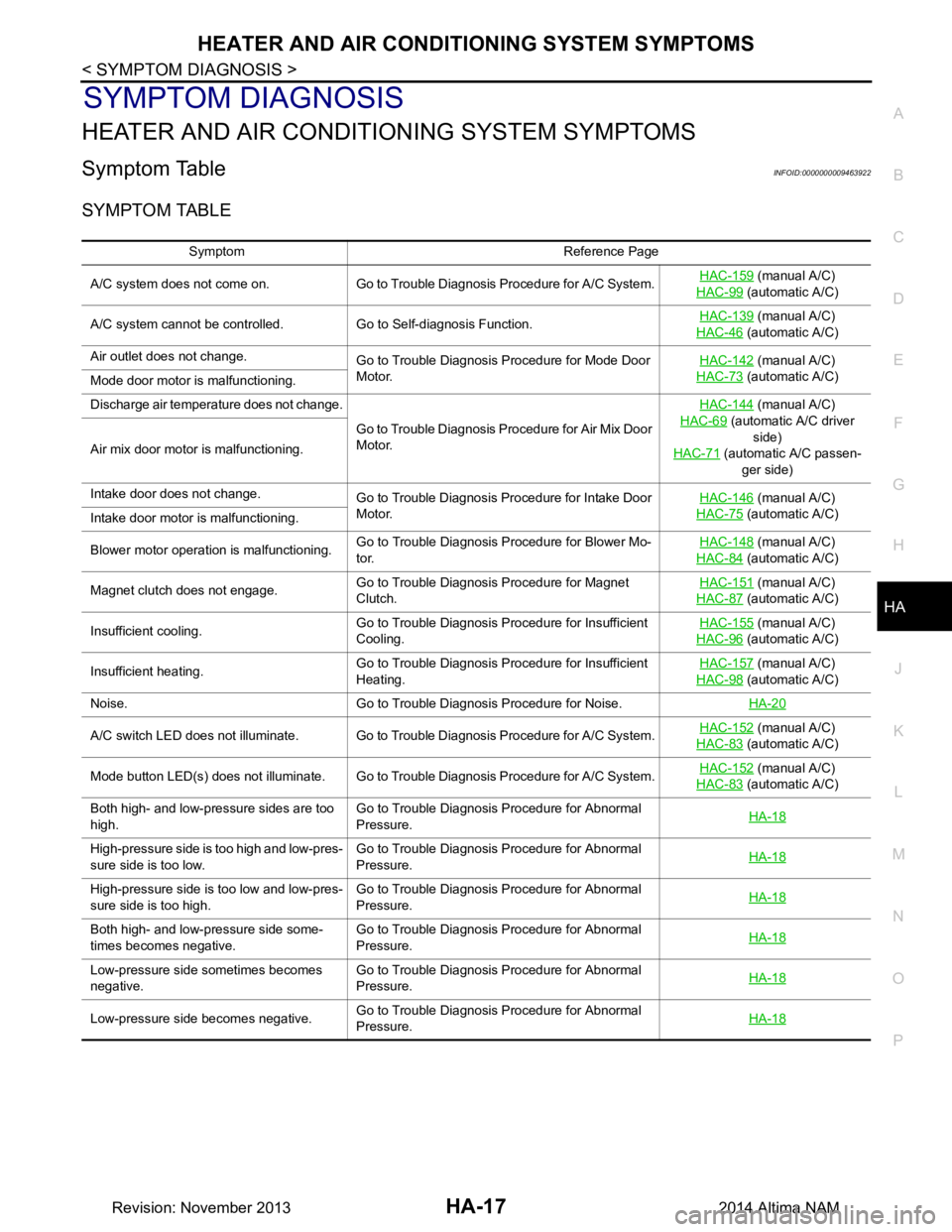
Symptom TableINFOID:0000000009463922
SYMPTOM TABLE
Symptom Reference Page
A/C system does not come on. Go to Trouble Diagnosis Procedure for A/C System. HAC-159
(manual A/C)
HAC-99
(automatic A/C)
A/C system cannot be controlled. Go to Self-diagnosis Function. HAC-139
(manual A/C)
HAC-46
(automatic A/C)
Air outlet does not change. Go to Trouble Diagnosis Procedure for Mode Door
Motor. HAC-142
(manual A/C)
HAC-73
(automatic A/C)
Mode door motor is malfunctioning.
Discharge air temperature does not change.
Go to Trouble Diagnosis Procedure for Air Mix Door
Motor. HAC-144
(manual A/C)
HAC-69
(automatic A/C driver side)
HAC-71
(automatic A/C passen-
ger side)
Air mix door motor is malfunctioning.
Intake door does not change.
Go to Trouble Diagnosis Procedure for Intake Door
Motor. HAC-146
(manual A/C)
HAC-75
(automatic A/C)
Intake door motor is malfunctioning.
Blower motor operation is malfunctioning. Go to Trouble Diagnosis Procedure for Blower Mo-
tor. HAC-148
(manual A/C)
HAC-84
(automatic A/C)
Magnet clutch does not engage. Go to Trouble Diagnosis Procedure for Magnet
Clutch. HAC-151
(manual A/C)
HAC-87
(automatic A/C)
Insufficient cooling. Go to Trouble Diagnosis Procedure for Insufficient
Cooling. HAC-155
(manual A/C)
HAC-96
(automatic A/C)
Insufficient heating. Go to Trouble Diagnosis Procedure for Insufficient
Heating. HAC-157
(manual A/C)
HAC-98
(automatic A/C)
Noise. Go to Trouble Diagnosis Procedure for Noise. HA-20
A/C switch LED does not illuminate. Go to Trouble Diagnosis Procedure for A/C System.HAC-152 (manual A/C)
HAC-83
(automatic A/C)
Mode button LED(s) does not illuminate. Go to Trouble Diagnosis Procedure for A/C System. HAC-152
(manual A/C)
HAC-83
(automatic A/C)
Both high- and low-pressure sides are too
high. Go to Trouble Diagnosis Procedure for Abnormal
Pressure. HA-18
High-pressure side is too high and low-pres-
sure side is too low. Go to Trouble Diagnosis Procedure for Abnormal
Pressure. HA-18
High-pressure side is too low and low-pres-
sure side is too high. Go to Trouble Diagnosis Procedure for Abnormal
Pressure. HA-18
Both high- and low-pressure side some-
times becomes negative. Go to Trouble Diagnosis Procedure for Abnormal
Pressure. HA-18
Low-pressure side sometimes becomes
negative. Go to Trouble Diagnosis Procedure for Abnormal
Pressure. HA-18
Low-pressure side becomes negative.
Go to Trouble Diagnosis Procedure for Abnormal
Pressure. HA-18
Revision: November 20132014 Altima NAM