battery NISSAN TEANA 2014 Service Manual
[x] Cancel search | Manufacturer: NISSAN, Model Year: 2014, Model line: TEANA, Model: NISSAN TEANA 2014Pages: 4801, PDF Size: 51.2 MB
Page 2162 of 4801
![NISSAN TEANA 2014 Service Manual
EM-164
< REMOVAL AND INSTALLATION >[VQ35DE]
FUEL INJECTOR AND FUEL TUBE
6. Remove the electric throttle cont
rol actuator bolts in the reverse
order as shown and remove the electric throttle control](/img/5/57390/w960_57390-2161.png "NISSAN TEANA 2014 Service Manual
EM-164
< REMOVAL AND INSTALLATION >[VQ35DE]
FUEL INJECTOR AND FUEL TUBE
6. Remove the electric throttle cont
rol actuator bolts in the reverse
order as shown and remove the electric throttle control")
EM-164
< REMOVAL AND INSTALLATION >[VQ35DE]
FUEL INJECTOR AND FUEL TUBE
6. Remove the electric throttle cont
rol actuator bolts in the reverse
order as shown and remove the electric throttle control actuator
and position aside.
CAUTION:
• Handle carefully to avoid any shock to the electric throttle
control actuator.
• Do not disassemble.
7. Remove intake manifold collector. Refer to EM-146, "Removal and Installation"
.
8. When separating fuel feed hose and fuel tube connection, disconnect quick connector as follows:
a. Remove quick connector cap from quick connector.
b. Disconnect quick connector from fuel tube as follows: CAUTION:
Disconnect quick connector by using the quick connector release (commercial service tool: J-
45488), not by picking out retainer tabs.
i. With the sleeve side of quick connector release fa cing to quick connector, install the quick connector
release onto fuel tube.
ii. Insert the quick connector release (A) into quick connector (2) until sleeve (B) contacts and goes no further. Hold quick connec-
tor release on that position.
CAUTION:
Inserting quick connector re lease hard will not disconnect
quick connector. Hold qui ck connector release where it
contacts and goes no further.
iii. Draw and pull out quick connector straight from fuel tube (1). CAUTION:
• Do not reuse O-ring.
• Pull quick connector (E) ho lding position (D) as shown.
• Do not pull with lateral force applied. O-ring inside quick connector may be damaged.
• Prepare container and cloth beforehand as fuel will leak out.
• Avoid fire and sparks.
• Keep parts away from heat source. Especially, be careful when welding is performed around
them.
• Do not expose parts to battery electrolyte or other acids.
• Do not bend or twist connection between quick connector and fuel feed hose (with damper) dur-
ing installati on/removal.
• To keep clean the connecting portion and to avoid dam-
age and foreign materials, cover them completely with
plastic bags, etc. (A) or something similar.
9. Disconnect harness connector from fuel injector.
SEM711G
(C) : Insert and retain
JPBIA0033ZZ
JPBIA0035ZZ
Revision: November 20132014 Altima NAM
Page 2173 of 4801
![NISSAN TEANA 2014 Service Manual
FRONT TIMING CHAIN CASEEM-175
< REMOVAL AND INSTALLATION > [VQ35DE]
C
D E
F
G H
I
J
K L
M A
EM
NP
O
REMOVAL
1. Remove engine under cover. Refer to
EXT-28, "Removal and Installation".
2. Drain the](/img/5/57390/w960_57390-2172.png "NISSAN TEANA 2014 Service Manual
FRONT TIMING CHAIN CASEEM-175
< REMOVAL AND INSTALLATION > [VQ35DE]
C
D E
F
G H
I
J
K L
M A
EM
NP
O
REMOVAL
1. Remove engine under cover. Refer to
EXT-28, \"Removal and Installation\".
2. Drain the")
FRONT TIMING CHAIN CASEEM-175
< REMOVAL AND INSTALLATION > [VQ35DE]
C
D E
F
G H
I
J
K L
M A
EM
NP
O
REMOVAL
1. Remove engine under cover. Refer to
EXT-28, "Removal and Installation".
2. Drain the engine coolant from the radiator. Refer to MA-23, "ENGINE COOLANT : Changing Engine Cool-
ant".
3. Drain the engine oil. Refer to MA-27, "ENGINE OIL : Changing Engine Oil"
.
4. Drain the power steering fluid. Refer to ST-30, "Draining and Refilling"
.
5. Remove engine room cover. Refer to EM-143, "Removal and Installation"
.
6. Remove front air duct. Refer to EM-144, "Removal and Installation"
.
7. Remove battery tray. Refer to PG-74, "Removal and Installation (Battery Tray)"
.
8. Remove the hood ledge covers (LH/RH).
9. Remove cowl top and cowl top extension. Refer to EXT-24, "Removal and Installation"
.
10. Remove upper radiator hose.
11. Disconnect engine coolant reservoir hose from t he radiator and remove engine coolant reservoir.
12. Remove cooling fan assembly. Refer to CO-42, "Removal and Installation"
.
13. Disconnect lower radiator hose from engine.
14. Remove the radiator. Refer to CO-41, "Removal and Installation"
.
15. Disconnect the power steering fluid reservoir tank hose from the power steering pump and fluid cooler and
remove the power steering fluid reservoir tank. Refer to ST-38, "Exploded View"
.
16. Remove the front RH wheel and tire. Refer to MA-39, "WHEELS : Adjustment"
.
17. Remove the fender protector side cover (RH). Refer to EXT-26, "FENDER PROTECTOR : Removal and
Installation".
18. Remove the drive belt. Refer to EM-134, "Removal and Installation"
.
19. Remove the rocker covers, if necessary. Refer to EM-168, "Removal and Installation LH"
and EM-169,
"Removal and Installation RH".
NOTE:
Necessary only when removing timing chains.
20. If removing the timing chains, obtain compression TDC of No. 1 cylinder as follows:
a. Rotate crankshaft pulley clockwise to align timing mark (grooved line without color) with timing indicator.
b. Check that intake and exhaust camshaft lobes on No. 1 cylinder (right bank of engine) are located as shown.
• If not, turn the crankshaft one revolution (360 °) and align as
shown.
21. Remove the access plate and lock the ring gear using Tool. CAUTION:
JMBIA1135GB
SEM418G
Tool number : — (J-50288)
Revision: November 20132014 Altima NAM
Page 2215 of 4801
![NISSAN TEANA 2014 Service Manual
ENGINE MOUNTEM-217
< REMOVAL AND INSTALLATION > [VQ35DE]
C
D E
F
G H
I
J
K L
M A
EM
NP
O
ENGINE MOUNT
ENGINE MOUNT (FRONT)
ENGINE MOUNT (FRONT) : Removal and InstallationINFOID:0000000009460578
WARN](/img/5/57390/w960_57390-2214.png "NISSAN TEANA 2014 Service Manual
ENGINE MOUNTEM-217
< REMOVAL AND INSTALLATION > [VQ35DE]
C
D E
F
G H
I
J
K L
M A
EM
NP
O
ENGINE MOUNT
ENGINE MOUNT (FRONT)
ENGINE MOUNT (FRONT) : Removal and InstallationINFOID:0000000009460578
WARN")
ENGINE MOUNTEM-217
< REMOVAL AND INSTALLATION > [VQ35DE]
C
D E
F
G H
I
J
K L
M A
EM
NP
O
ENGINE MOUNT
ENGINE MOUNT (FRONT)
ENGINE MOUNT (FRONT) : Removal and InstallationINFOID:0000000009460578
WARNING:
• Situate the vehicle on a flat and solid surface.
• Place chocks at front and back of rear wheels.
• Always work safely.
• Do not start work until the engine an d exhaust system are cooled completely.
CAUTION:
Do not damage or spill oil on the engine mount insulator (front).
NOTE:
When removing components such as hoses, tubes/lines, etc. , cap or plug openings to prevent fluid from spill-
ing.
REMOVAL
1. Remove the air cleaner assembly, front air duct, and air duct hose and resonator assembly. Refer to EM-
144, "Removal and Installation".
2. Remove the battery and battery tray assembly. Refer to PG-74, "Removal and Installation (Battery Tray)"
.
3. Remove the engine under cover. Refer to EXT-28, "Removal and Installation"
.
4. Remove the fender protector side covers (RH/LH). Refer to EXT-26, "FENDER PROTECTOR : Removal
and Installation".
5. Partially remove the fender protectors (RH/LH). Refer to EXT-26, "FENDER PROTECTOR : Removal and
Installation".
6. Remove the radiator. Refer to CO-41, "Removal and Installation"
.
7. Remove the cooling fan shroud and motor assembly. Refer to CO-42, "Removal and Installation"
.
8. Remove the exhaust manifold heat shield (LH). Refer to EM-153, "Removal and Installation (RH)"
.
9. Support the engine (1) and transaxle (2) using a suitable jack (A) as shown.
CAUTION:
• Position a suitable jack under the engine and transaxle
assembly as shown.
• Do not damage the front exhau st tube or transaxle oil pan
with the jack.
10. Disconnect the engine mounting insulator (front) vacuum hose.
11. Remove the engine mounting insulator (front) nut (A).
ALBIA0894GB
AWBIA1241GB
Revision: November 20132014 Altima NAM
Page 2219 of 4801
![NISSAN TEANA 2014 Service Manual
ENGINE ASSEMBLYEM-221
< UNIT REMOVAL AND INSTALLATION > [VQ35DE]
C
D E
F
G H
I
J
K L
M A
EM
NP
O
• Do not damage the edge of the crankshaft
position sensor (POS) or the ring gear teeth.
REMOVAL](/img/5/57390/w960_57390-2218.png "NISSAN TEANA 2014 Service Manual
ENGINE ASSEMBLYEM-221
< UNIT REMOVAL AND INSTALLATION > [VQ35DE]
C
D E
F
G H
I
J
K L
M A
EM
NP
O
• Do not damage the edge of the crankshaft
position sensor (POS) or the ring gear teeth.
REMOVAL")
ENGINE ASSEMBLYEM-221
< UNIT REMOVAL AND INSTALLATION > [VQ35DE]
C
D E
F
G H
I
J
K L
M A
EM
NP
O
• Do not damage the edge of the crankshaft
position sensor (POS) or the ring gear teeth.
REMOVAL
NOTE:
When removing components such as hoses, tubes/lines, etc. , cap or plug openings to prevent fluid from spill-
ing.
1. Remove hood assembly. Refer to DLK-170, "HOOD ASSEMBLY : Removal and Installation"
.
2. Release fuel pressure. Refer to FL-5, "Inspection"
.
3. Drain engine coolant. Refer to CO-36, "Changing Engine Coolant"
.
4. Drain power steering fluid. Refer to ST-30, "Draining and Refilling"
.
5. Remove front wheels and tires (RH/LH). Refer to WT-55, "Adjustment"
.
6. Remove fender protector side covers (RH/LH). Refer to EXT-26, "FENDER PROTECTOR : Removal and
Installation".
7. Remove the engine under cover. Refer to EXT-17, "Removal and Installation"
.
8. Remove the engine room cover. Refer to EM-143, "Removal and Installation"
.
9. Remove air duct hose and resonator assembly and air cleaner case assembly with mass air flow sensor.
Refer to EM-144, "Removal and Installation"
.
10. Remove battery and battery tray. Refer to PG-74, "Removal and Installation (Battery Tray)"
.
11. Remove transmission control module. Refer to TM-183, "Removal and Installation"
.
12. Remove cowl top. Refer to EXT-24, "Removal and Installation"
.
13. Remove strut brace using power tools. Refer to FSU-19, "Exploded View"
.
14. Remove IPDM E/R. Refer to PCS-32, "Removal and Installation"
.
15. Remove the following parts: • EVAP vacuum hose
• Brake booster vacuum hose
• Heater hoses (engine side)
16. Disconnect transaxle shift control cables. Refer to TM-380, "Removal and Installation"
.
17. Remove upper and lower radiator hoses.
18. Disconnect CVT fluid cooler hoses.
19. Remove power steering reservoir, suction hose and high pressure hose.
20. Disconnect fuel hose quick connection at vehicle piping side. Refer to EM-163, "Removal and Installa-
tion".
21. Remove the front exhaust tube using power tools. Refer to EX-10, "Exploded View"
.
22. Discharge and recover the R134a refrigerant. Refer to HA-23, "Recycle Refrigerant"
.
23. Remove the A/C compressor using power tools. Refer to HA-30, "COMPRESSOR : Removal and Installa-
tion".
24. Install engine slingers into front of LH cylinder head and rear of RH cylinder head.
• (A): RH cylinder head
ALBIA0262GB
Revision: November 20132014 Altima NAM
Page 2257 of 4801
![NISSAN TEANA 2014 Service Manual
EX-2
< PRECAUTION >[QR25DE]
PRECAUTIONS
PRECAUTION
PRECAUTIONS
Precaution for Supplemental Restraint Syst
em (SRS) "AIR BAG" and "SEAT BELT
PRE-TENSIONER"
INFOID:0000000009951692
The Supplemental Re](/img/5/57390/w960_57390-2256.png "NISSAN TEANA 2014 Service Manual
EX-2
< PRECAUTION >[QR25DE]
PRECAUTIONS
PRECAUTION
PRECAUTIONS
Precaution for Supplemental Restraint Syst
em (SRS) \"AIR BAG\" and \"SEAT BELT
PRE-TENSIONER\"
INFOID:0000000009951692
The Supplemental Re")
EX-2
< PRECAUTION >[QR25DE]
PRECAUTIONS
PRECAUTION
PRECAUTIONS
Precaution for Supplemental Restraint Syst
em (SRS) "AIR BAG" and "SEAT BELT
PRE-TENSIONER"
INFOID:0000000009951692
The Supplemental Restraint System such as “A IR BAG” and “SEAT BELT PRE-TENSIONER”, used along
with a front seat belt, helps to reduce the risk or severi ty of injury to the driver and front passenger for certain
types of collision. Information necessary to service the system safely is included in the SR and SB section of
this Service Manual.
WARNING:
• To avoid rendering the SRS inopera tive, which could increase the risk of personal injury or death in
the event of a collision which would result in air bag inflation, all maintenance must be performed by
an authorized NISS AN/INFINITI dealer.
• Improper maintenance, including in correct removal and installation of the SRS, can lead to personal
injury caused by unintent ional activation of the system. For re moval of Spiral Cable and Air Bag
Module, see the SR section.
• Do not use electrical test equipmen t on any circuit related to the SRS unless instructed to in this
Service Manual. SRS wiring harn esses can be identified by yellow and/or orange harnesses or har-
ness connectors.
PRECAUTIONS WHEN USING POWER TOOLS (AIR OR ELECTRIC) AND HAMMERS
WARNING:
• When working near the Airbag Diagnosis Sensor Unit or other Airbag System sensors with the Igni-
tion ON or engine running, DO NOT use air or electri c power tools or strike near the sensor(s) with a
hammer. Heavy vibration could activate the sensor( s) and deploy the air bag(s), possibly causing
serious injury.
• When using air or electric power tools or hammers , always switch the Ignition OFF, disconnect the
battery and wait at least three minutes before performing any service.
Revision: November 20132014 Altima NAM
Page 2262 of 4801
![NISSAN TEANA 2014 Service Manual
PRECAUTIONSEX-7
< PRECAUTION > [VQ35DE]
C
D E
F
G H
I
J
K L
M A
EX
NP
O
PRECAUTION
PRECAUTIONS
Precaution for Supplemental
Restraint System (SRS) "AIR BAG" and "SEAT BELT
PRE-TENSIONER"
INFOID:000](/img/5/57390/w960_57390-2261.png "NISSAN TEANA 2014 Service Manual
PRECAUTIONSEX-7
< PRECAUTION > [VQ35DE]
C
D E
F
G H
I
J
K L
M A
EX
NP
O
PRECAUTION
PRECAUTIONS
Precaution for Supplemental
Restraint System (SRS) \"AIR BAG\" and \"SEAT BELT
PRE-TENSIONER\"
INFOID:000")
PRECAUTIONSEX-7
< PRECAUTION > [VQ35DE]
C
D E
F
G H
I
J
K L
M A
EX
NP
O
PRECAUTION
PRECAUTIONS
Precaution for Supplemental
Restraint System (SRS) "AIR BAG" and "SEAT BELT
PRE-TENSIONER"
INFOID:0000000009951693
The Supplemental Restraint System such as “A IR BAG” and “SEAT BELT PRE-TENSIONER”, used along
with a front seat belt, helps to reduce the risk or severi ty of injury to the driver and front passenger for certain
types of collision. Information necessary to service t he system safely is included in the SR and SB section of
this Service Manual.
WARNING:
• To avoid rendering the SRS inoper ative, which could increase the risk of personal injury or death in
the event of a collision which would result in air bag inflation, all maintenance must be performed by
an authorized NISSAN/INFINITI dealer.
• Improper maintenance, including in correct removal and installation of the SRS, can lead to personal
injury caused by unintentional act ivation of the system. For removal of Spiral Cable and Air Bag
Module, see the SR section.
• Do not use electrical test equipm ent on any circuit related to the SRS unless instructed to in this
Service Manual. SRS wiring harnesses can be identi fied by yellow and/or orange harnesses or har-
ness connectors.
PRECAUTIONS WHEN USING POWER TOOLS (AIR OR ELECTRIC) AND HAMMERS
WARNING:
• When working near the Airbag Diagnosis Sensor Un it or other Airbag System sensors with the Igni-
tion ON or engine running, DO NOT use air or el ectric power tools or strike near the sensor(s) with a
hammer. Heavy vibration could activate the sensor( s) and deploy the air bag(s), possibly causing
serious injury.
• When using air or electric power tools or hammers , always switch the Ignition OFF, disconnect the
battery and wait at least three mi nutes before performing any service.
Revision: November 20132014 Altima NAM
Page 2267 of 4801

EXL-1
DRIVER CONTROLS
C
D E
F
G H
I
J
K
M
SECTION EXL
A
B
EXL
N
O P
CONTENTS
EXTERIOR LIGHTING SYSTEM
PRECAUTION ................ ...............................4
PRECAUTIONS .............................................. .....4
Precaution for Supplemental Restraint System
(SRS) "AIR BAG" and "SEAT BELT PRE-TEN-
SIONER" ............................................................. ......
4
General precautions for service operations ..............4
Precaution for Work ............................................ ......5
PREPARATION ............................................6
PREPARATION .............................................. .....6
Special Service Tool ........................................... ......6
SYSTEM DESCRIPTION ..............................7
COMPONENT PARTS ................................... .....7
Component Parts Location .................................. ......7
Component Description ............................................8
SYSTEM ..............................................................9
HEADLAMP SYSTEM .................................................9
HEADLAMP SYSTEM : Syst em Diagram .................9
HEADLAMP SYSTEM : System Description ....... ......9
AUTO LIGHT SYSTEM .............................................10
AUTO LIGHT SYSTEM : System Diagram ......... ....10
AUTO LIGHT SYSTEM : System Description .........10
DAYTIME RUNNING LIGHT SYSTEM ......................10
DAYTIME RUNNING LIGHT SYSTEM : System
Diagram ............................................................... ....
11
DAYTIME RUNNING LIGHT SYSTEM : System
Description .......................................................... ....
11
FRONT FOG LAMP SYSTEM ...................................11
FRONT FOG LAMP SYSTEM : System Diagram ....11
FRONT FOG LAMP SYSTEM : System Descrip-
tion ...................................................................... ....
11
TURN SIGNAL AND HAZARD WARNING LAMPS ....11
TURN SIGNAL AND HAZARD WARNING
LAMPS : System Diagram .......................................
12
TURN SIGNAL AND HAZARD WARNING
LAMPS : System Descripti on ..................................
12
PARKING, LICENSE PLATE AND TAIL LAMPS . ....12
PARKING, LICENSE PLATE AND TAIL LAMPS :
System Diagram .................................................. ....
12
PARKING, LICENSE PLATE AND TAIL LAMPS :
System Description .............................................. ....
12
COMBINATION SWITCH READING SYSTEM .........12
COMBINATION SWITCH READING SYSTEM :
System Diagram .................................................. ....
13
COMBINATION SWITCH READING SYSTEM :
System Description .............................................. ....
13
DIAGNOSIS SYSTEM (BCM) ...........................17
COMMON ITEM ..................................................... ....17
COMMON ITEM : CONSULT Function (BCM -
COMMON ITEM) ................................................. ....
17
HEADLAMP ........................................................... ....18
HEADLAMP : CONSULT Function (BCM - HEAD-
LAMP) .................................................................. ....
18
FLASHER ............................................................... ....19
FLASHER : CONSULT Function (BCM - FLASH-
ER) ...................................................................... ....
19
COMB SW .............................................................. ....20
COMB SW : CONSULT Function (BCM - COMB
SW) ...................................................................... ....
20
BATTERY SAVER ................................................. ....20
BATTERY SAVER : CONSULT Function (BCM -
BATTERY SAVER) ............. .....................................
20
DIAGNOSIS SYSTEM (IPDM E/R) ...................22
Diagnosis Description .......................................... ....22
CONSULT Function (IPDM E/R) .............................23
Revision: November 20132014 Altima NAMRevision: November 20132014 Altima NAM
Page 2270 of 4801
EXL-4
< PRECAUTION >
PRECAUTIONS
PRECAUTION
PRECAUTIONS
Precaution for Supplemental Restraint System (SRS) "AIR BAG" and "SEAT BELT
PRE-TENSIONER"
INFOID:0000000009951582
The Supplemental Restraint System such as “A IR BAG” and “SEAT BELT PRE-TENSIONER”, used along
with a front seat belt, helps to reduce the risk or severi ty of injury to the driver and front passenger for certain
types of collision. Information necessary to service the system safely is included in the SR and SB section of
this Service Manual.
WARNING:
• To avoid rendering the SRS inopera tive, which could increase the risk of personal injury or death in
the event of a collision which would result in air bag inflation, all maintenance must be performed by
an authorized NISS AN/INFINITI dealer.
• Improper maintenance, including in correct removal and installation of the SRS, can lead to personal
injury caused by unintent ional activation of the system. For re moval of Spiral Cable and Air Bag
Module, see the SR section.
• Do not use electrical test equipmen t on any circuit related to the SRS unless instructed to in this
Service Manual. SRS wiring harn esses can be identified by yellow and/or orange harnesses or har-
ness connectors.
PRECAUTIONS WHEN USING POWER TOOLS (AIR OR ELECTRIC) AND HAMMERS
WARNING:
• When working near the Airbag Diagnosis Sensor Unit or other Airbag System sensors with the Igni-
tion ON or engine running, DO NOT use air or electri c power tools or strike near the sensor(s) with a
hammer. Heavy vibration could activate the sensor( s) and deploy the air bag(s), possibly causing
serious injury.
• When using air or electric power tools or hammers , always switch the Ignition OFF, disconnect the
battery and wait at least three minutes before performing any service.
General precautions fo r service operationsINFOID:0000000009463538
• Do not work with wet hands.
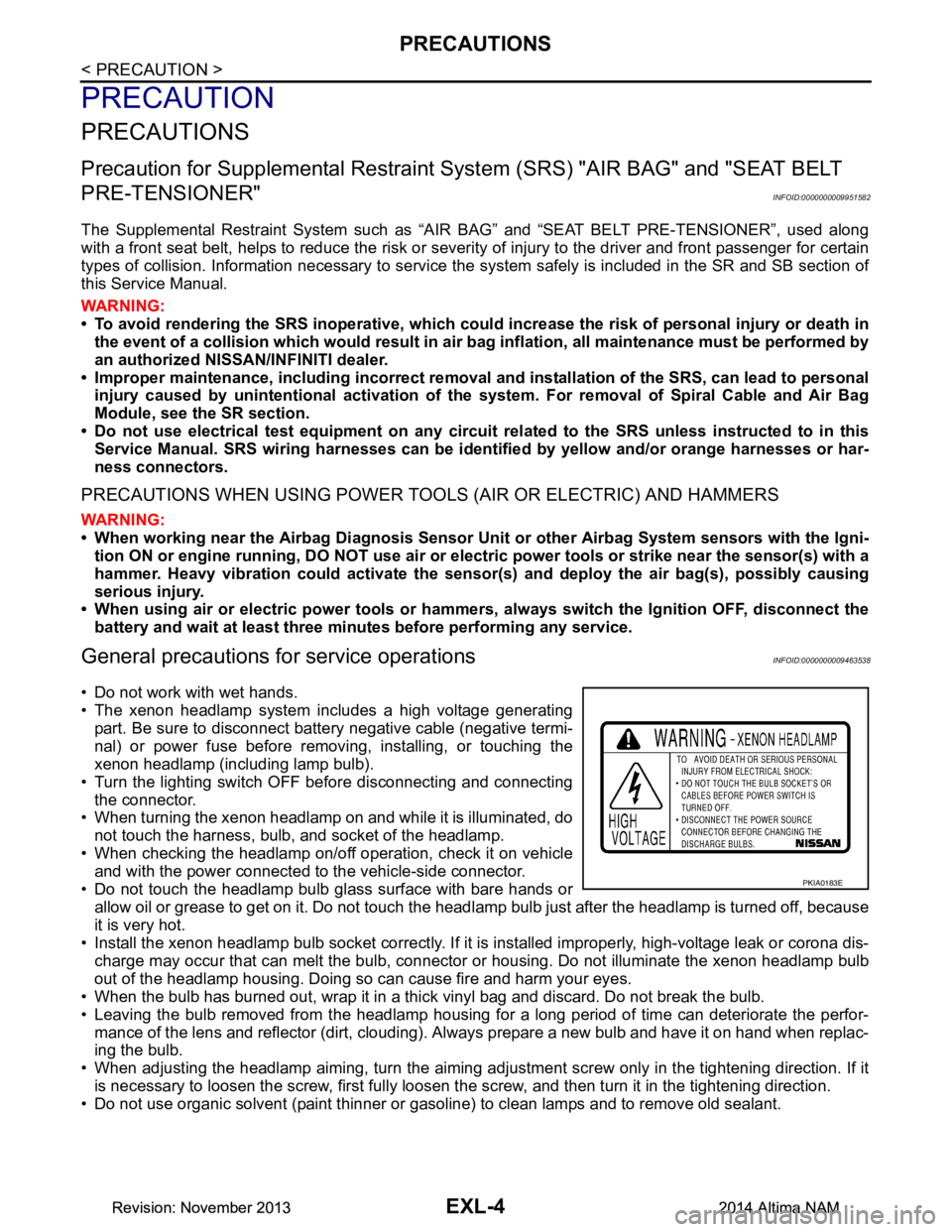
• The xenon headlamp system includes a high voltage generating
part. Be sure to disconnect batte ry negative cable (negative termi-
nal) or power fuse before removing, installing, or touching the
xenon headlamp (including lamp bulb).
• Turn the lighting switch OFF before disconnecting and connecting the connector.
• When turning the xenon headlamp on and while it is illuminated, do
not touch the harness, bulb, and socket of the headlamp.
• When checking the headlamp on/off operation, check it on vehicle and with the power connected to the vehicle-side connector.
• Do not touch the headlamp bulb glass surface with bare hands or allow oil or grease to get on it. Do not touch the headl amp bulb just after the headlamp is turned off, because
it is very hot.
• Install the xenon headlamp bulb socket co rrectly. If it is installed improperly, high-voltage leak or corona dis-
charge may occur that can melt the bulb, connector or housing. Do not illuminate the xenon headlamp bulb
out of the headlamp housing. Doing so can cause fire and harm your eyes.
• When the bulb has burned out, wrap it in a thick vinyl bag and discard. Do not break the bulb.
• Leaving the bulb removed from the headlamp housing for a long period of time can deteriorate the perfor- mance of the lens and reflector (dirt, clouding). Al ways prepare a new bulb and have it on hand when replac-
ing the bulb.
• When adjusting the headlamp aiming, turn the aiming adjus tment screw only in the tightening direction. If it
is necessary to loosen the screw, first fully loosen the screw, and then turn it in the tightening direction.
• Do not use organic solvent (paint thinner or gasoline) to clean lamps and to remove old sealant.
PKIA0183E
Revision: November 20132014 Altima NAMRevision: November 20132014 Altima NAM
Page 2275 of 4801
SYSTEMEXL-9
< SYSTEM DESCRIPTION >
C
D E
F
G H
I
J
K
M A
B
EXL
N
O P
SYSTEM
HEADLAMP SYSTEM
HEADLAMP SYSTEM : System DiagramINFOID:0000000009463543
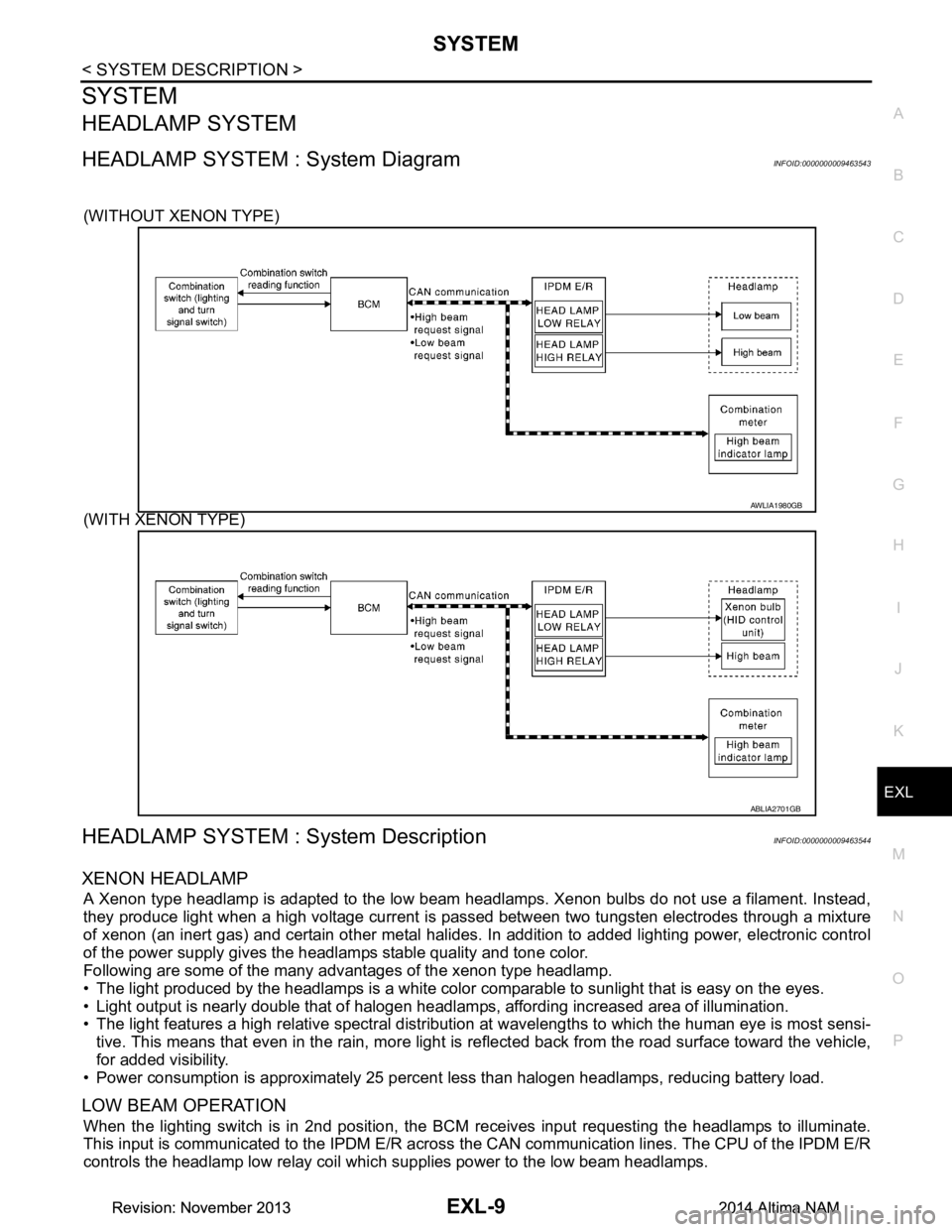
(WITHOUT XENON TYPE)
(WITH XENON TYPE)
HEADLAMP SYSTEM : System DescriptionINFOID:0000000009463544
XENON HEADLAMP
A Xenon type headlamp is adapted to the low beam headlamps. Xenon bulbs do not use a filament. Instead,
they produce light when a high voltage current is pa ssed between two tungsten electrodes through a mixture
of xenon (an inert gas) and certain other metal halides. In addition to added lighting power, electronic control
of the power supply gives the headlamps stable quality and tone color.
Following are some of the many advantages of the xenon type headlamp.
• The light produced by the headlamps is a white color comparable to sunlight that is easy on the eyes.
• Light output is nearly double that of halogen headl amps, affording increased area of illumination.
• The light features a high relative spectral distributi on at wavelengths to which the human eye is most sensi-
tive. This means that even in the rain, more light is reflected back from the road surface toward the vehicle,
for added visibility.
• Power consumption is approximately 25 percent less than halogen headlamps, reducing battery load.
LOW BEAM OPERATION
When the lighting switch is in 2nd position, the BCM receives input requesting the headlamps to illuminate.
This input is communicated to the IPDM E/R across the CAN communication lines. The CPU of the IPDM E/R
controls the headlamp low relay coil which supplies power to the low beam headlamps.
AWLIA1980GB
ABLIA2701GB
Revision: November 20132014 Altima NAMRevision: November 20132014 Altima NAM
Page 2276 of 4801
EXL-10
< SYSTEM DESCRIPTION >
SYSTEM
HIGH BEAM OPERATION/FLASH-TO-PASS OPERATION
With the lighting switch in the 2nd position and placed in HIGH position, the BCM receives input requesting the
headlamp high beams to illuminate. The flash to pass f eature can be used any time and also sends a signal to
the BCM. This input is communicated to the IPDM E/R across the CAN communication lines. The CPU of the
combination meter controls the ON/OFF status off the HIGH BEAM indicator. The CPU of the IPDM E/R con-
trols the headlamp high relay coil which supplies power to the high beam headlamps.
The combination meter receives a high beam request signal (ON) through the CAN communication lines and
turns the high beam indicator lamp ON.
EXTERIOR LAMP BATTERY SAVER CONTROL
With the combination switch (lighting and turn signal switch) in the 2nd position and the ignition switch is
turned from ON or ACC to OFF, the battery saver feature is activated.
Under this condition, the headlamps remain illuminated fo r a period of time, unless the lighting switch position
is changed. If the lighting switch position is changed, then the headlamps are turned off.
AUTO LIGHT SYSTEM
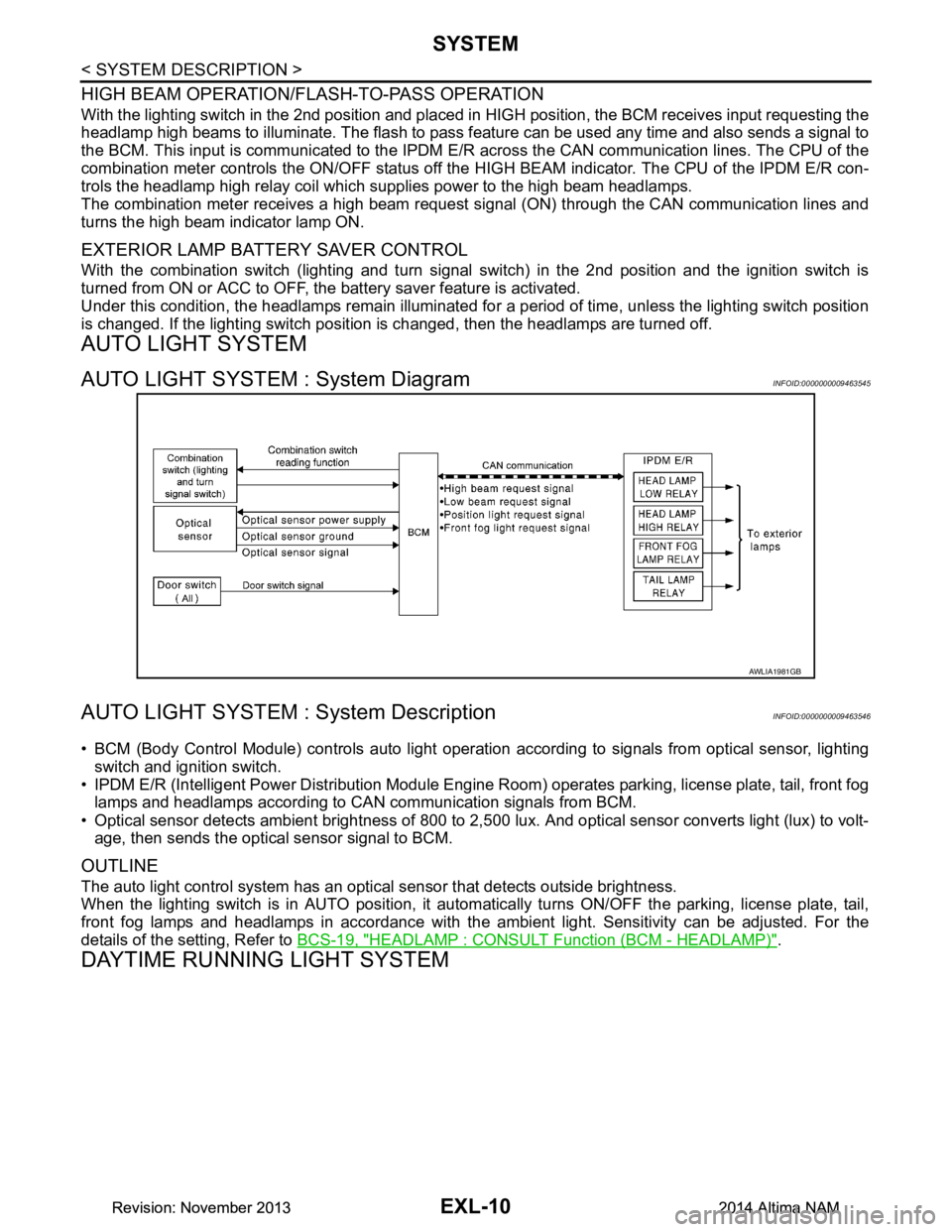
AUTO LIGHT SYSTEM : System DiagramINFOID:0000000009463545
AUTO LIGHT SYSTEM : System DescriptionINFOID:0000000009463546
• BCM (Body Control Module) controls auto light operati on according to signals from optical sensor, lighting
switch and ignition switch.
• IPDM E/R (Intelligent Power Distribution Module Engine R oom) operates parking, license plate, tail, front fog
lamps and headlamps according to CAN communication signals from BCM.
• Optical sensor detects ambient brightness of 800 to 2,500 lux. And optical sensor converts light (lux) to volt-
age, then sends the optical sensor signal to BCM.
OUTLINE
The auto light control system has an optical sensor that detects outside brightness.
When the lighting switch is in AUTO position, it autom atically turns ON/OFF the parking, license plate, tail,
front fog lamps and headlamps in accordance with the am bient light. Sensitivity can be adjusted. For the
details of the setting, Refer to BCS-19, "HEADLAMP : CONSULT Function (BCM - HEADLAMP)"
.
DAYTIME RUNNING LIGHT SYSTEM
AWLIA1981GB
Revision: November 20132014 Altima NAMRevision: November 20132014 Altima NAM