Condition NISSAN TERRANO 2002 Service Repair Manual
[x] Cancel search | Manufacturer: NISSAN, Model Year: 2002, Model line: TERRANO, Model: NISSAN TERRANO 2002Pages: 1767, PDF Size: 41.51 MB
Page 1208 of 1767
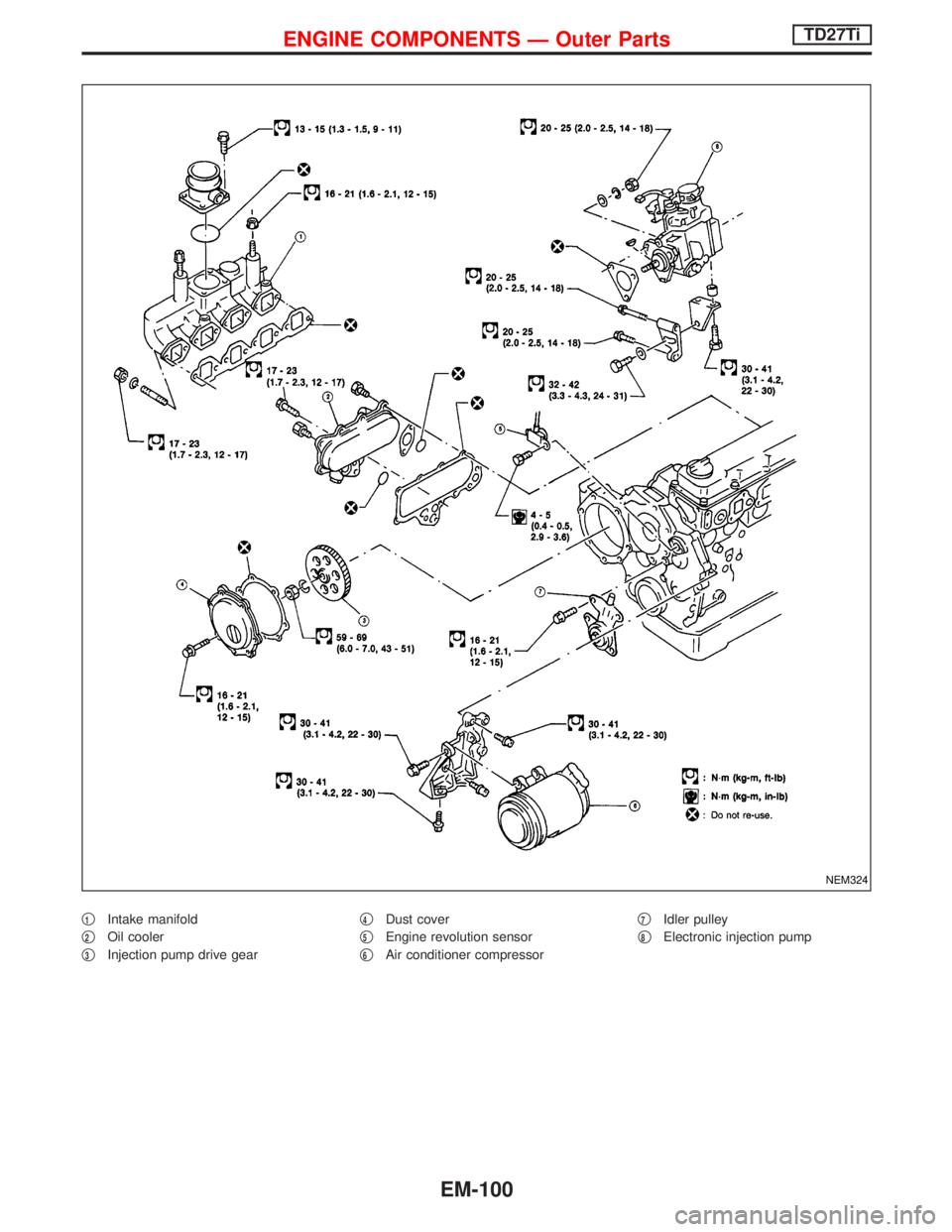
q1Intake manifold
q
2Oil cooler
q
3Injection pump drive gearq
4Dust cover
q
5Engine revolution sensor
q
6Air conditioner compressorq
7Idler pulley
q
8Electronic injection pump
NEM324
ENGINE COMPONENTS Ð Outer PartsTD27Ti
EM-100
Page 1217 of 1767
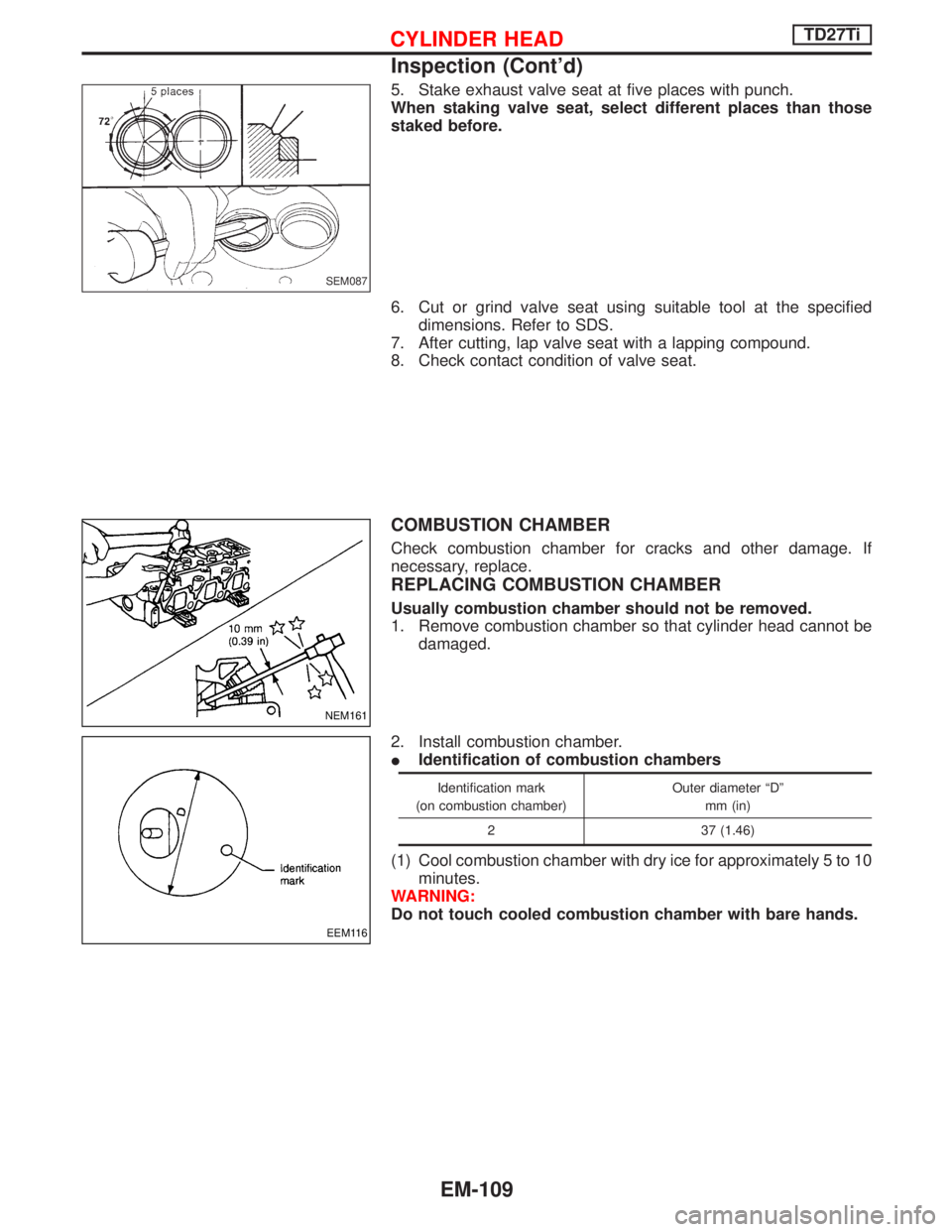
5. Stake exhaust valve seat at five places with punch.
When staking valve seat, select different places than those
staked before.
6. Cut or grind valve seat using suitable tool at the specified
dimensions. Refer to SDS.
7. After cutting, lap valve seat with a lapping compound.
8. Check contact condition of valve seat.
COMBUSTION CHAMBER
Check combustion chamber for cracks and other damage. If
necessary, replace.
REPLACING COMBUSTION CHAMBER
Usually combustion chamber should not be removed.
1. Remove combustion chamber so that cylinder head cannot be
damaged.
2. Install combustion chamber.
IIdentification of combustion chambers
Identification mark
(on combustion chamber)Outer diameter ªDº
mm (in)
2 37 (1.46)
(1) Cool combustion chamber with dry ice for approximately 5 to 10
minutes.
WARNING:
Do not touch cooled combustion chamber with bare hands.
SEM087
NEM161
EEM116
CYLINDER HEADTD27Ti
Inspection (Cont'd)
EM-109
Page 1227 of 1767
Removal and Installation
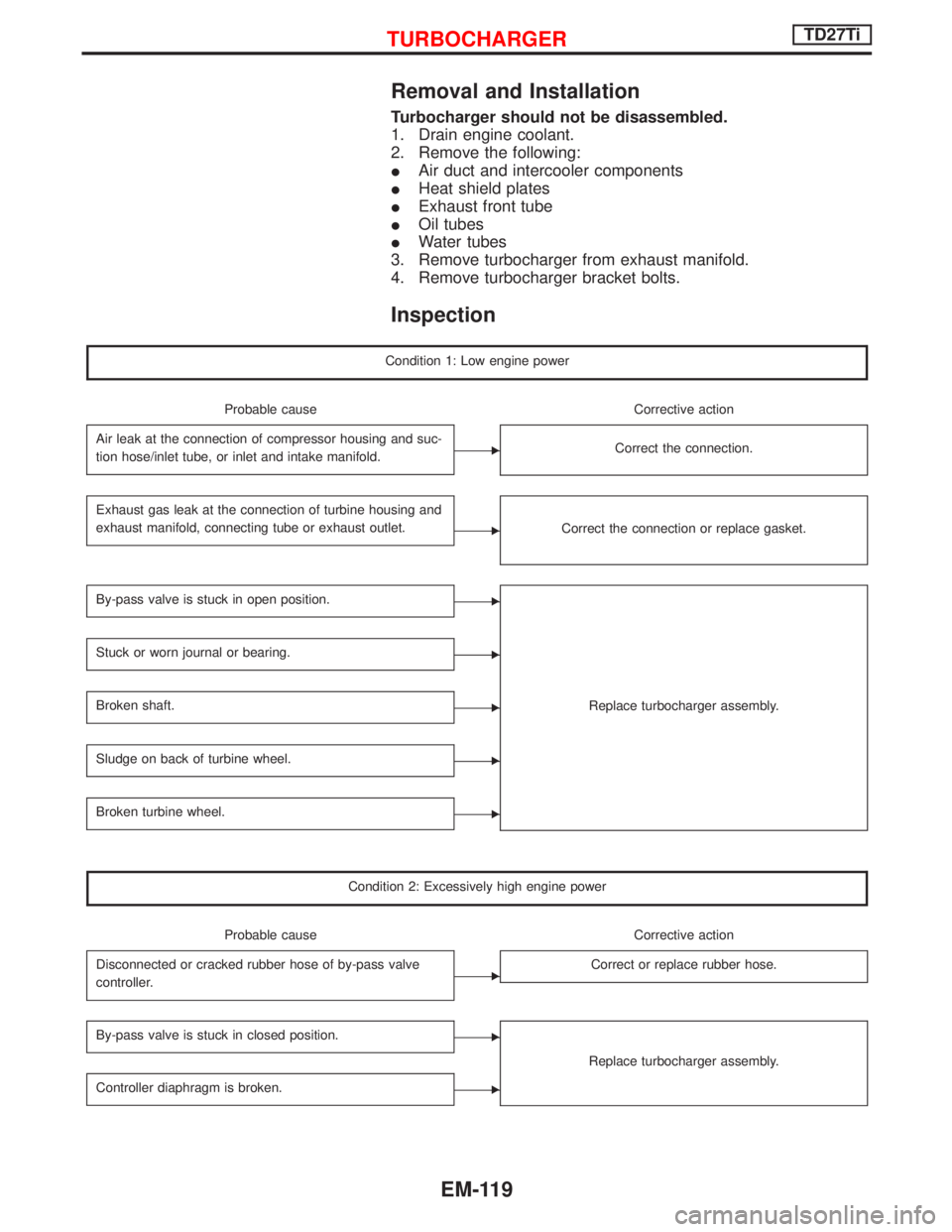
Turbocharger should not be disassembled.
1. Drain engine coolant.
2. Remove the following:
IAir duct and intercooler components
IHeat shield plates
IExhaust front tube
IOil tubes
IWater tubes
3. Remove turbocharger from exhaust manifold.
4. Remove turbocharger bracket bolts.
Inspection
Condition 1: Low engine power
Probable cause Corrective action
Air leak at the connection of compressor housing and suc-
tion hose/inlet tube, or inlet and intake manifold.
ECorrect the connection.
Exhaust gas leak at the connection of turbine housing and
exhaust manifold, connecting tube or exhaust outlet.
ECorrect the connection or replace gasket.
By-pass valve is stuck in open position.E
Replace turbocharger assembly.
Stuck or worn journal or bearing.E
Broken shaft.E
Sludge on back of turbine wheel.E
Broken turbine wheel.E
Condition 2: Excessively high engine power
Probable cause Corrective action
Disconnected or cracked rubber hose of by-pass valve
controller.
ECorrect or replace rubber hose.
By-pass valve is stuck in closed position.E
Replace turbocharger assembly.
Controller diaphragm is broken.E
TURBOCHARGERTD27Ti
EM-119
Page 1228 of 1767
Condition 3: Excessively high oil consumption, or exhaust shows pale blue smoke
Probable cause Corrective action
Oil leak at the connection of lubricating oil passage.
ECorrect the connection.
Oil leak at oil seal of turbine.E
Replace turbocharger assembly.Oil leak at oil seal of compressor.E
Worn journal or bearing.E
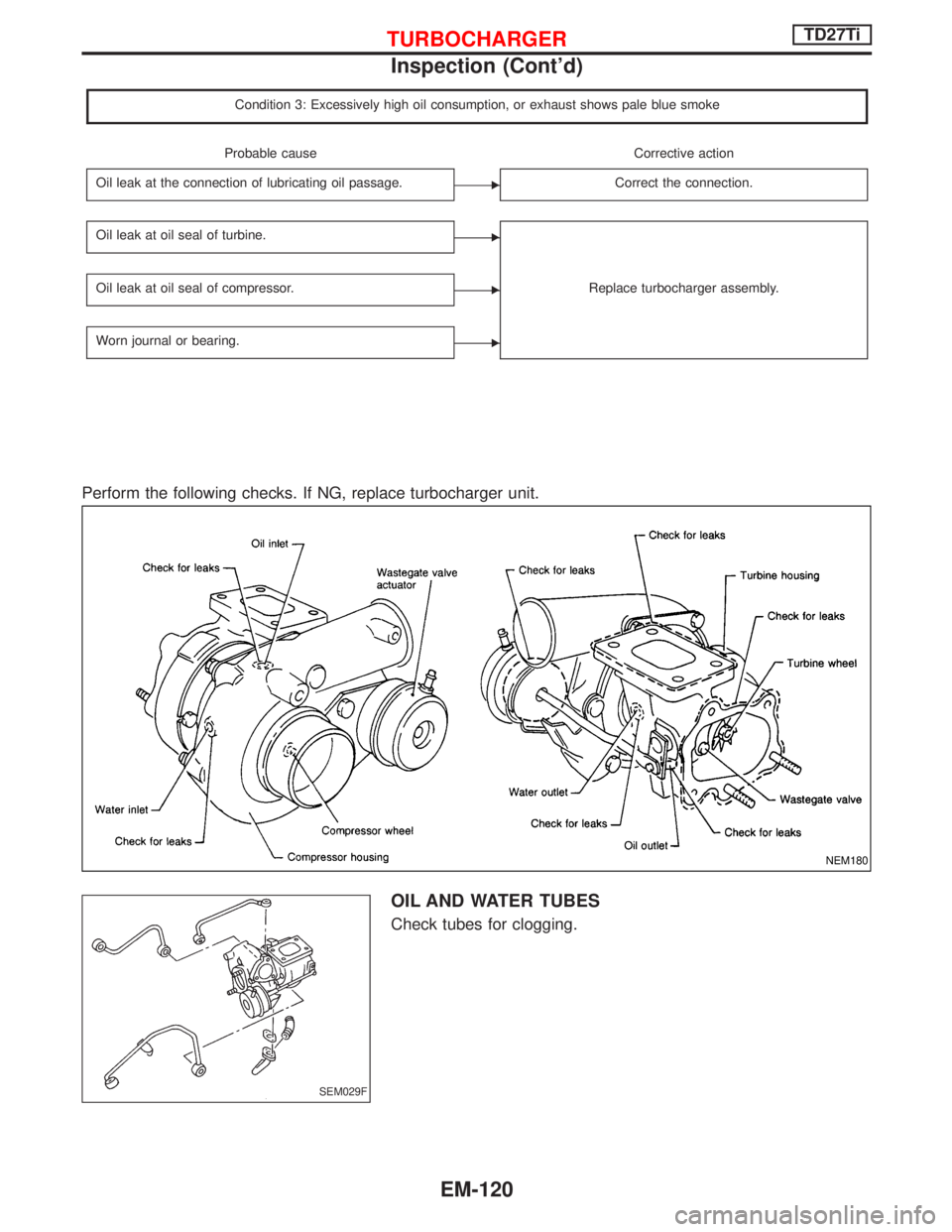
Perform the following checks. If NG, replace turbocharger unit.
OIL AND WATER TUBES
Check tubes for clogging.
NEM180
SEM029F
TURBOCHARGERTD27Ti
Inspection (Cont'd)
EM-120
Page 1260 of 1767
(1) When installing each rubber part, final tightening must be car-
ried out under unladen condition * with tires on ground.
* Fuel, radiator coolant and engine oil full. Spare tire, jack,
hand tools and mats in designated positions.
(2) When removing each suspension part, check wheel alignment
and adjust if necessary.
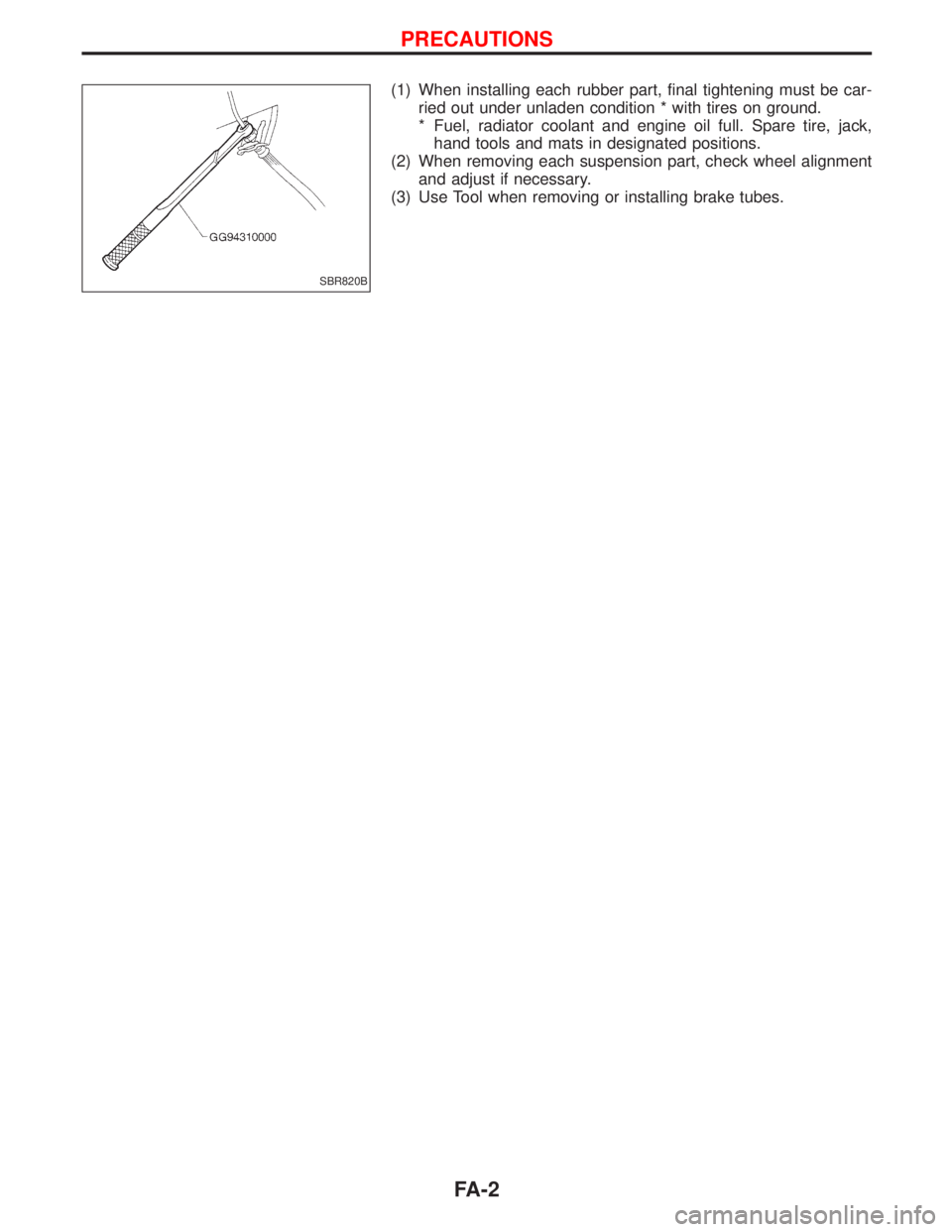
(3) Use Tool when removing or installing brake tubes.
SBR820B
PRECAUTIONS
FA-2
Page 1272 of 1767
Removal and Installation
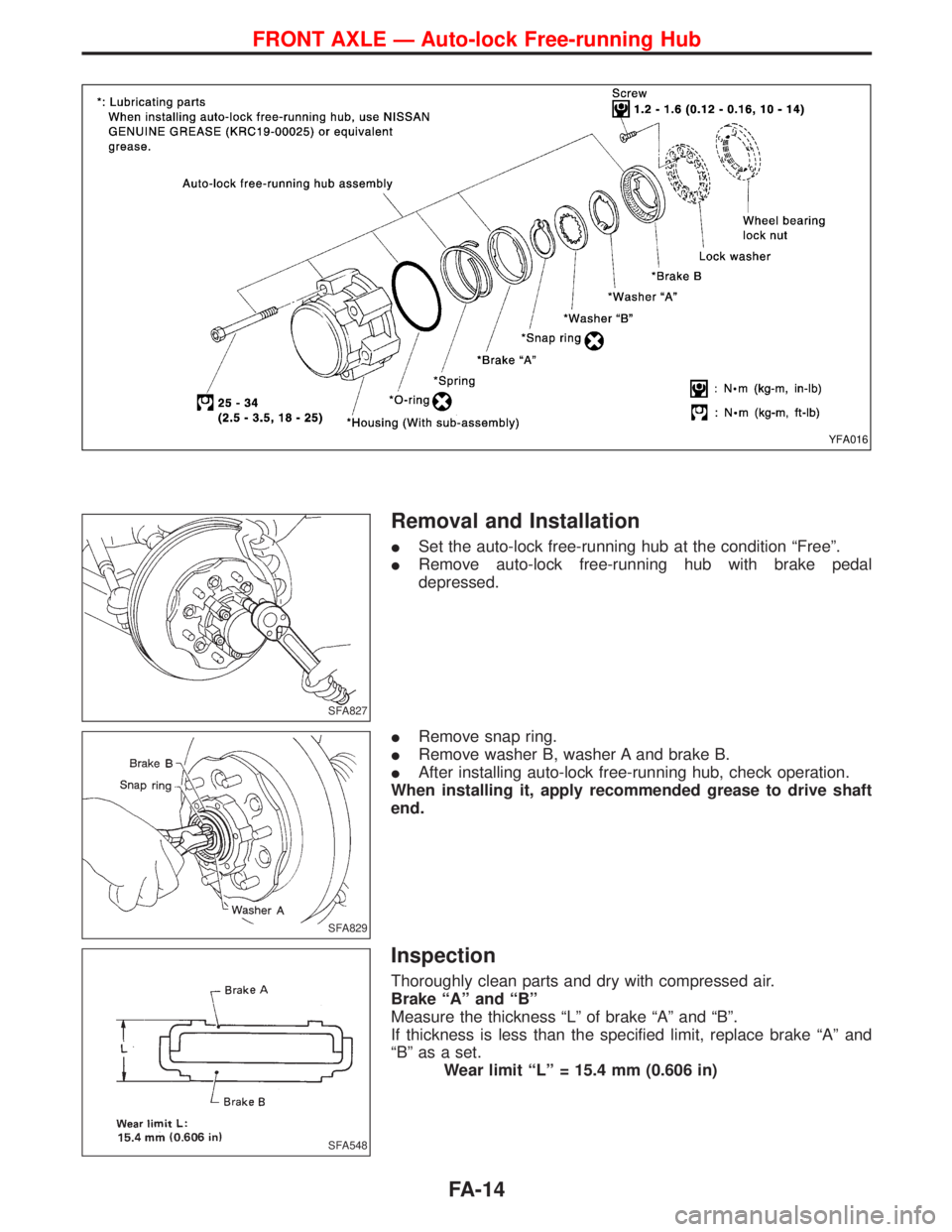
ISet the auto-lock free-running hub at the condition ªFreeº.
IRemove auto-lock free-running hub with brake pedal
depressed.
IRemove snap ring.
IRemove washer B, washer A and brake B.
IAfter installing auto-lock free-running hub, check operation.
When installing it, apply recommended grease to drive shaft
end.
Inspection
Thoroughly clean parts and dry with compressed air.
Brake ªAº and ªBº
Measure the thickness ªLº of brake ªAº and ªBº.
If thickness is less than the specified limit, replace brake ªAº and
ªBº as a set.
Wear limit ªLº = 15.4 mm (0.606 in)
YFA016
SFA827
SFA829
SFA548
FRONT AXLE Ð Auto-lock Free-running Hub
FA-14
Page 1273 of 1767
Trouble-shooting
Noise occurring in the auto hub under any of the conditions
described is not indicative of a problem. Noise can be eliminated
by properly operating the transfer lever of the vehicle.
Noise
Was the transfer lever shifted from
the ª2Hº to the ª4Hº position while
the vehicle was operated at a
speed greater than 40 km/h (25
MPH)?
No
EYe s
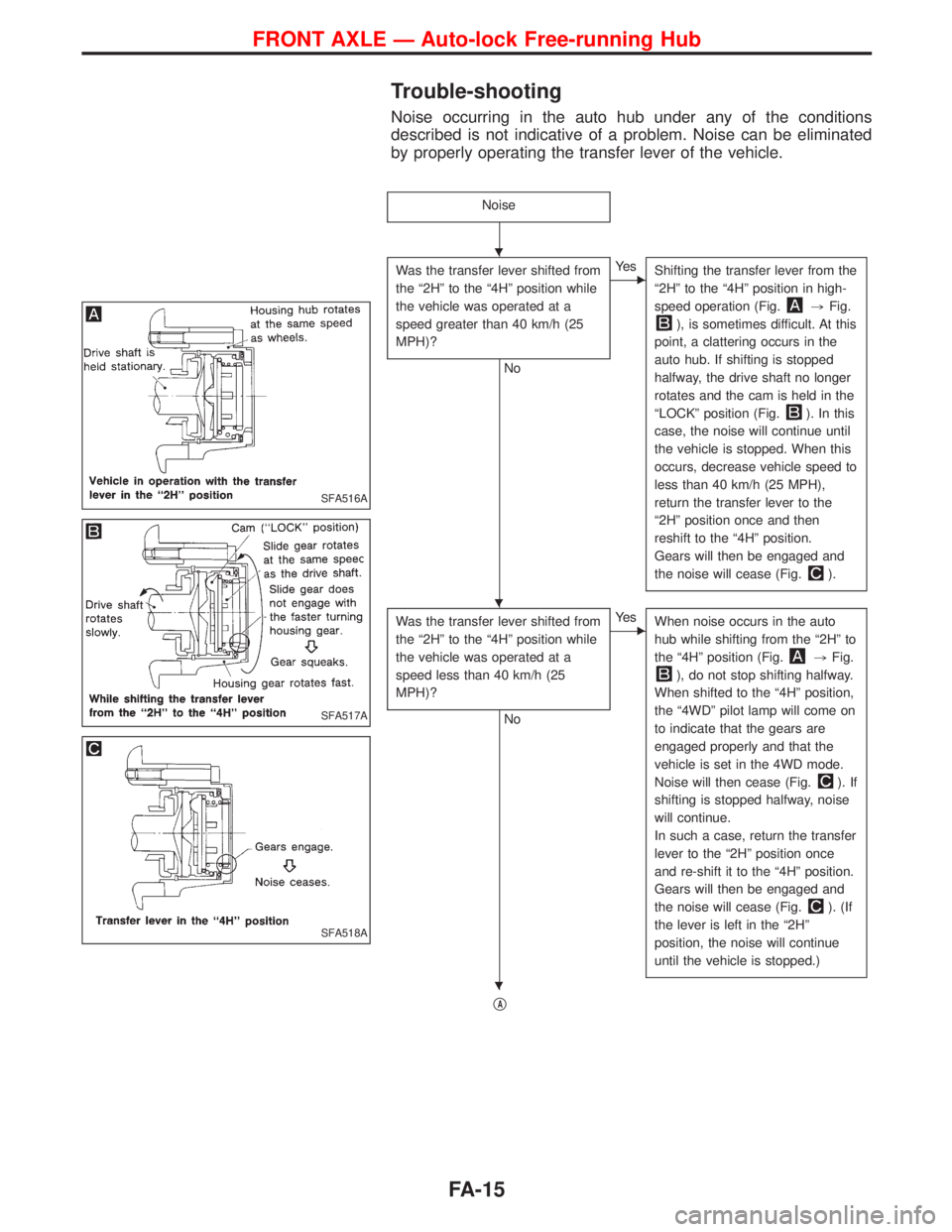
Shifting the transfer lever from the
ª2Hº to the ª4Hº position in high-
speed operation (Fig.
,Fig.
), is sometimes difficult. At this
point, a clattering occurs in the
auto hub. If shifting is stopped
halfway, the drive shaft no longer
rotates and the cam is held in the
ªLOCKº position (Fig.
). In this
case, the noise will continue until
the vehicle is stopped. When this
occurs, decrease vehicle speed to
less than 40 km/h (25 MPH),
return the transfer lever to the
ª2Hº position once and then
reshift to the ª4Hº position.
Gears will then be engaged and
the noise will cease (Fig.
).
Was the transfer lever shifted from
the ª2Hº to the ª4Hº position while
the vehicle was operated at a
speed less than 40 km/h (25
MPH)?
No
EYe s
When noise occurs in the auto
hub while shifting from the ª2Hº to
the ª4Hº position (Fig.
,Fig.
), do not stop shifting halfway.
When shifted to the ª4Hº position,
the ª4WDº pilot lamp will come on
to indicate that the gears are
engaged properly and that the
vehicle is set in the 4WD mode.
Noise will then cease (Fig.
). If
shifting is stopped halfway, noise
will continue.
In such a case, return the transfer
lever to the ª2Hº position once
and re-shift it to the ª4Hº position.
Gears will then be engaged and
the noise will cease (Fig.
). (If
the lever is left in the ª2Hº
position, the noise will continue
until the vehicle is stopped.)
qA
SFA516A
SFA517A
SFA518A
H
H
H
FRONT AXLE Ð Auto-lock Free-running Hub
FA-15
Page 1274 of 1767
qA
Was the vehicle started after the
transfer lever was shifted from the
ª2Hº to the ª4Hº or ª4Lº position?
No
EYe s
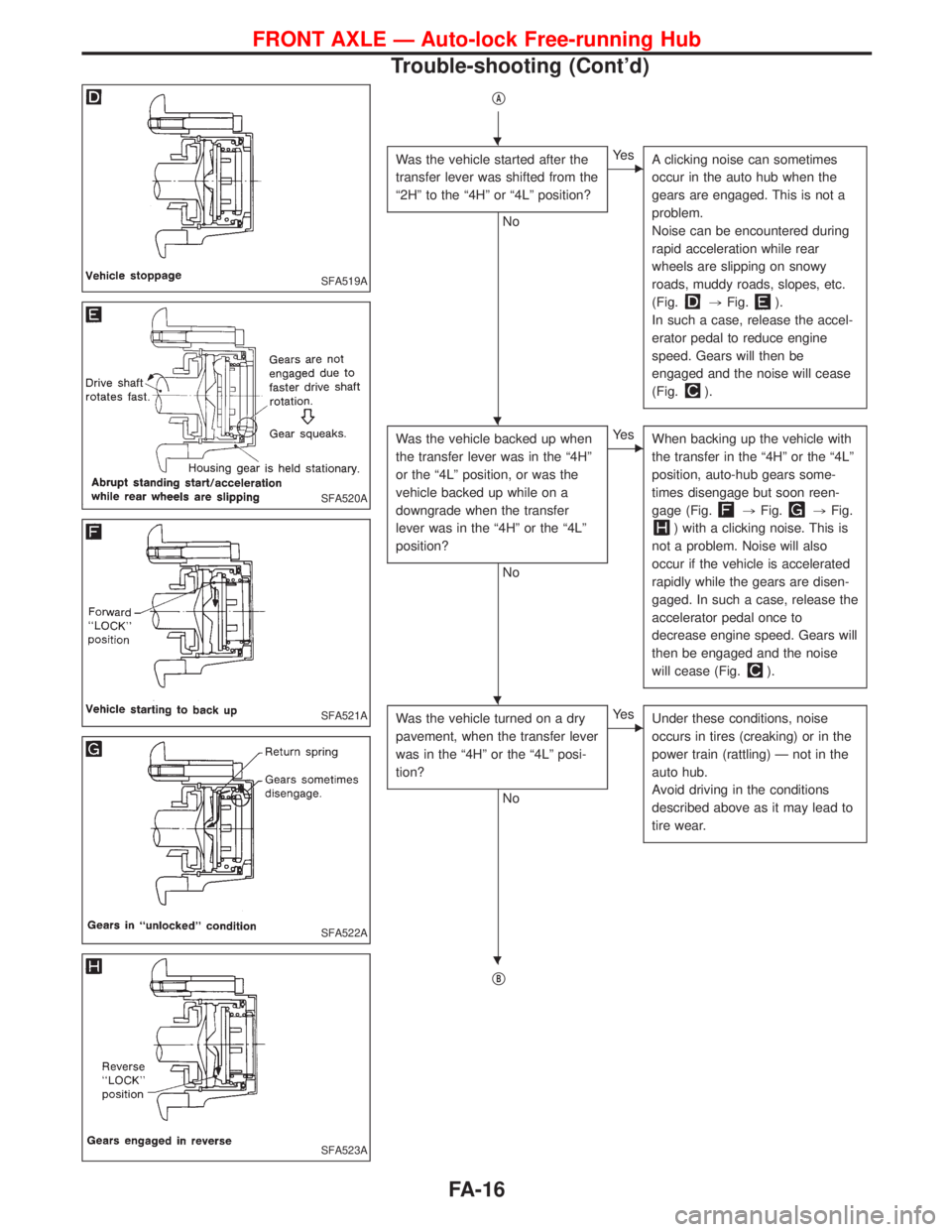
A clicking noise can sometimes
occur in the auto hub when the
gears are engaged. This is not a
problem.
Noise can be encountered during
rapid acceleration while rear
wheels are slipping on snowy
roads, muddy roads, slopes, etc.
(Fig.
,Fig.).
In such a case, release the accel-
erator pedal to reduce engine
speed. Gears will then be
engaged and the noise will cease
(Fig.
).
Was the vehicle backed up when
the transfer lever was in the ª4Hº
or the ª4Lº position, or was the
vehicle backed up while on a
downgrade when the transfer
lever was in the ª4Hº or the ª4Lº
position?
No
EYe s
When backing up the vehicle with
the transfer in the ª4Hº or the ª4Lº
position, auto-hub gears some-
times disengage but soon reen-
gage (Fig.
,Fig.,Fig.
) with a clicking noise. This is
not a problem. Noise will also
occur if the vehicle is accelerated
rapidly while the gears are disen-
gaged. In such a case, release the
accelerator pedal once to
decrease engine speed. Gears will
then be engaged and the noise
will cease (Fig.
).
Was the vehicle turned on a dry
pavement, when the transfer lever
was in the ª4Hº or the ª4Lº posi-
tion?
No
EYe s
Under these conditions, noise
occurs in tires (creaking) or in the
power train (rattling) Ð not in the
auto hub.
Avoid driving in the conditions
described above as it may lead to
tire wear.
qB
SFA519A
SFA520A
SFA521A
SFA522A
SFA523A
H
H
H
H
FRONT AXLE Ð Auto-lock Free-running Hub
Trouble-shooting (Cont'd)
FA-16
Page 1275 of 1767
qB
Was the vehicle moved in one
direction after the vehicle was
driven in another direction when
the transfer lever was in the ª4Hº
or the ª4Lº position and then
returned to the ª2Hº position?
No
EYe s
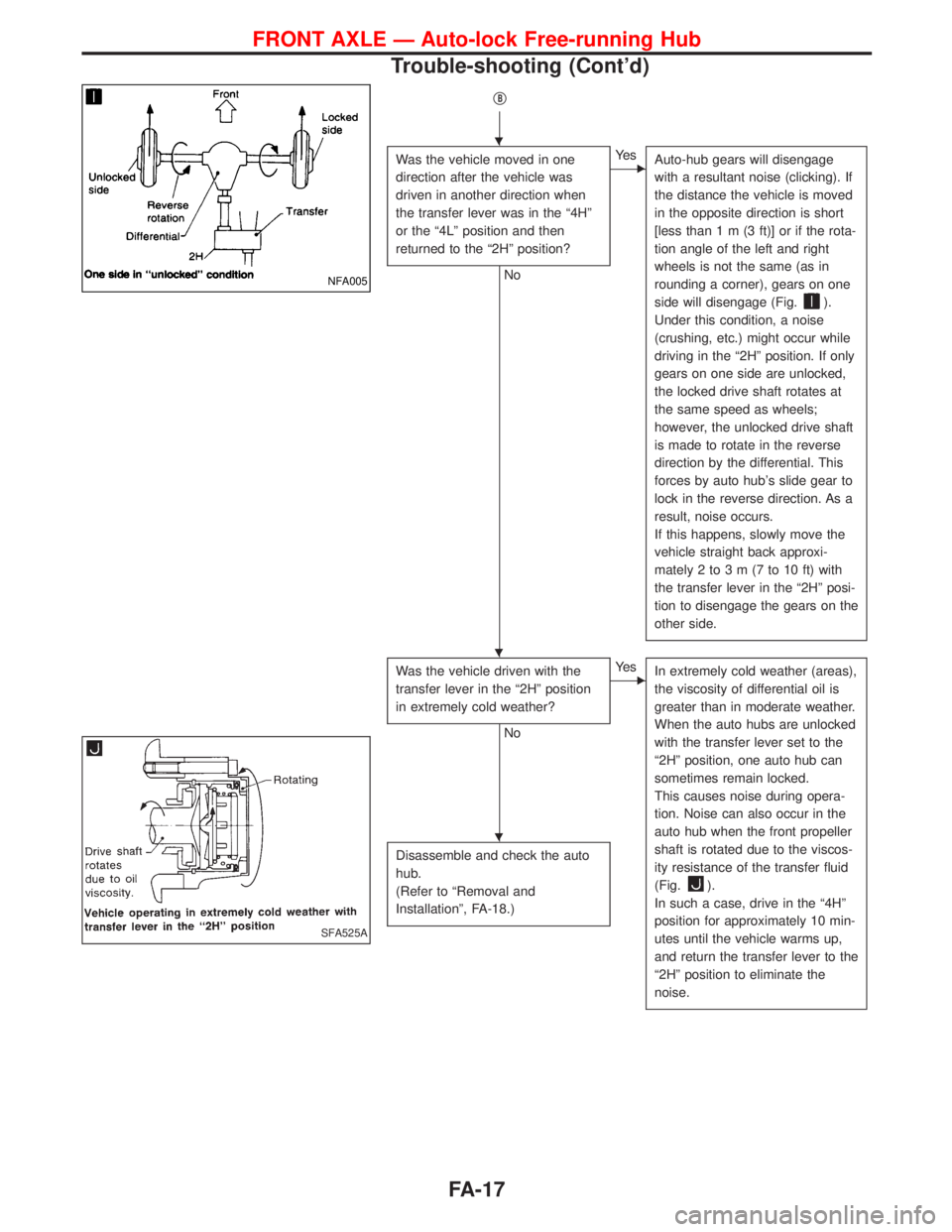
Auto-hub gears will disengage
with a resultant noise (clicking). If
the distance the vehicle is moved
in the opposite direction is short
[less than1m(3ft)] or if the rota-
tion angle of the left and right
wheels is not the same (as in
rounding a corner), gears on one
side will disengage (Fig.
).
Under this condition, a noise
(crushing, etc.) might occur while
driving in the ª2Hº position. If only
gears on one side are unlocked,
the locked drive shaft rotates at
the same speed as wheels;
however, the unlocked drive shaft
is made to rotate in the reverse
direction by the differential. This
forces by auto hub's slide gear to
lock in the reverse direction. As a
result, noise occurs.
If this happens, slowly move the
vehicle straight back approxi-
mately 2 to3m(7to10ft)with
the transfer lever in the ª2Hº posi-
tion to disengage the gears on the
other side.
Was the vehicle driven with the
transfer lever in the ª2Hº position
in extremely cold weather?
No
EYe s
In extremely cold weather (areas),
the viscosity of differential oil is
greater than in moderate weather.
When the auto hubs are unlocked
with the transfer lever set to the
ª2Hº position, one auto hub can
sometimes remain locked.
This causes noise during opera-
tion. Noise can also occur in the
auto hub when the front propeller
shaft is rotated due to the viscos-
ity resistance of the transfer fluid
(Fig.
).
In such a case, drive in the ª4Hº
position for approximately 10 min-
utes until the vehicle warms up,
and return the transfer lever to the
ª2Hº position to eliminate the
noise.
Disassemble and check the auto
hub.
(Refer to ªRemoval and
Installationº, FA-18.)
NFA005
SFA525A
H
H
H
FRONT AXLE Ð Auto-lock Free-running Hub
Trouble-shooting (Cont'd)
FA-17
Page 1292 of 1767
INSTALLATION
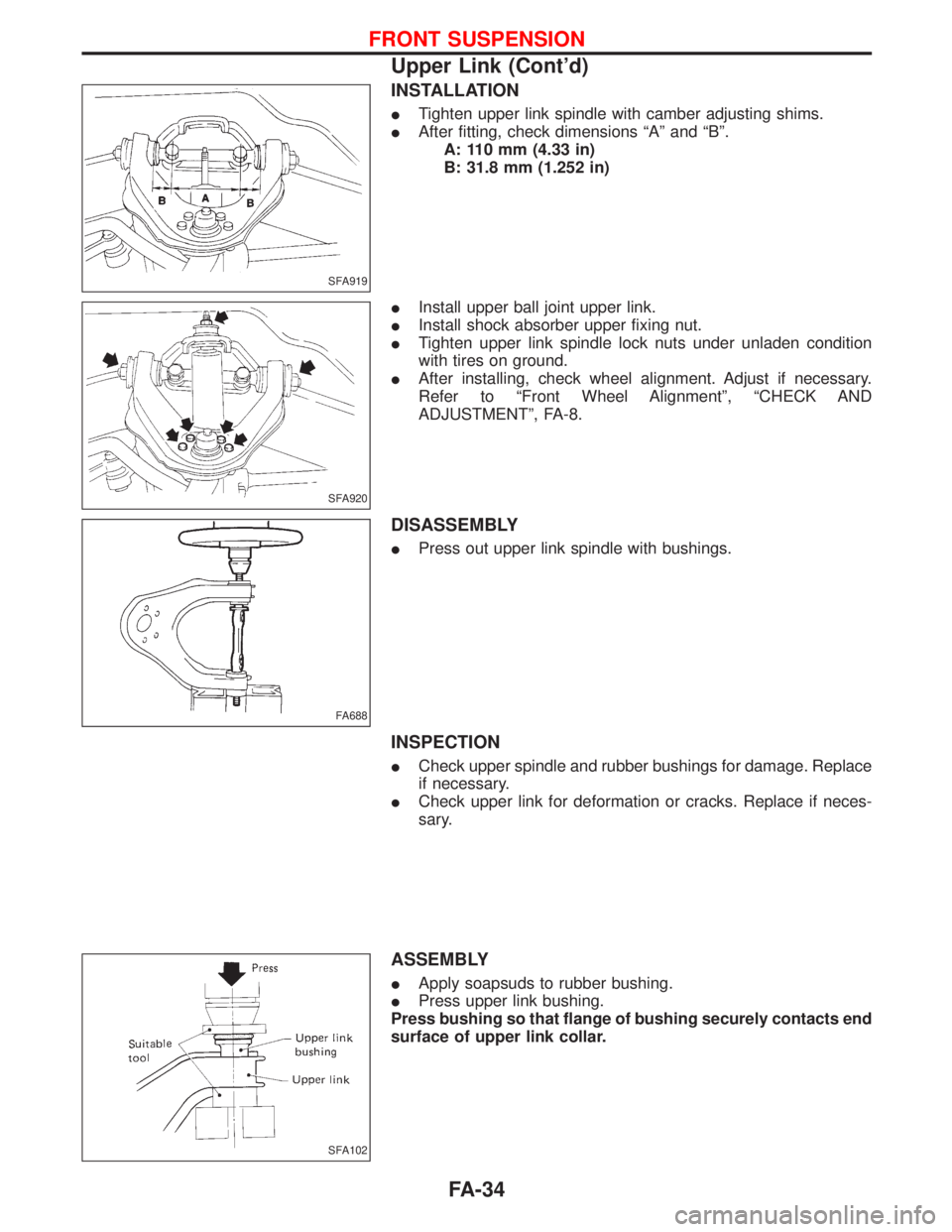
ITighten upper link spindle with camber adjusting shims.
IAfter fitting, check dimensions ªAº and ªBº.
A: 110 mm (4.33 in)
B: 31.8 mm (1.252 in)
IInstall upper ball joint upper link.
IInstall shock absorber upper fixing nut.
ITighten upper link spindle lock nuts under unladen condition
with tires on ground.
IAfter installing, check wheel alignment. Adjust if necessary.
Refer to ªFront Wheel Alignmentº, ªCHECK AND
ADJUSTMENTº, FA-8.
DISASSEMBLY
IPress out upper link spindle with bushings.
INSPECTION
ICheck upper spindle and rubber bushings for damage. Replace
if necessary.
ICheck upper link for deformation or cracks. Replace if neces-
sary.
ASSEMBLY
IApply soapsuds to rubber bushing.
IPress upper link bushing.
Press bushing so that flange of bushing securely contacts end
surface of upper link collar.
SFA919
SFA920
FA688
SFA102
FRONT SUSPENSION
Upper Link (Cont'd)
FA-34