unit NISSAN TERRANO 2002 Service Repair Manual
[x] Cancel search | Manufacturer: NISSAN, Model Year: 2002, Model line: TERRANO, Model: NISSAN TERRANO 2002Pages: 1767, PDF Size: 41.51 MB
Page 1549 of 1767
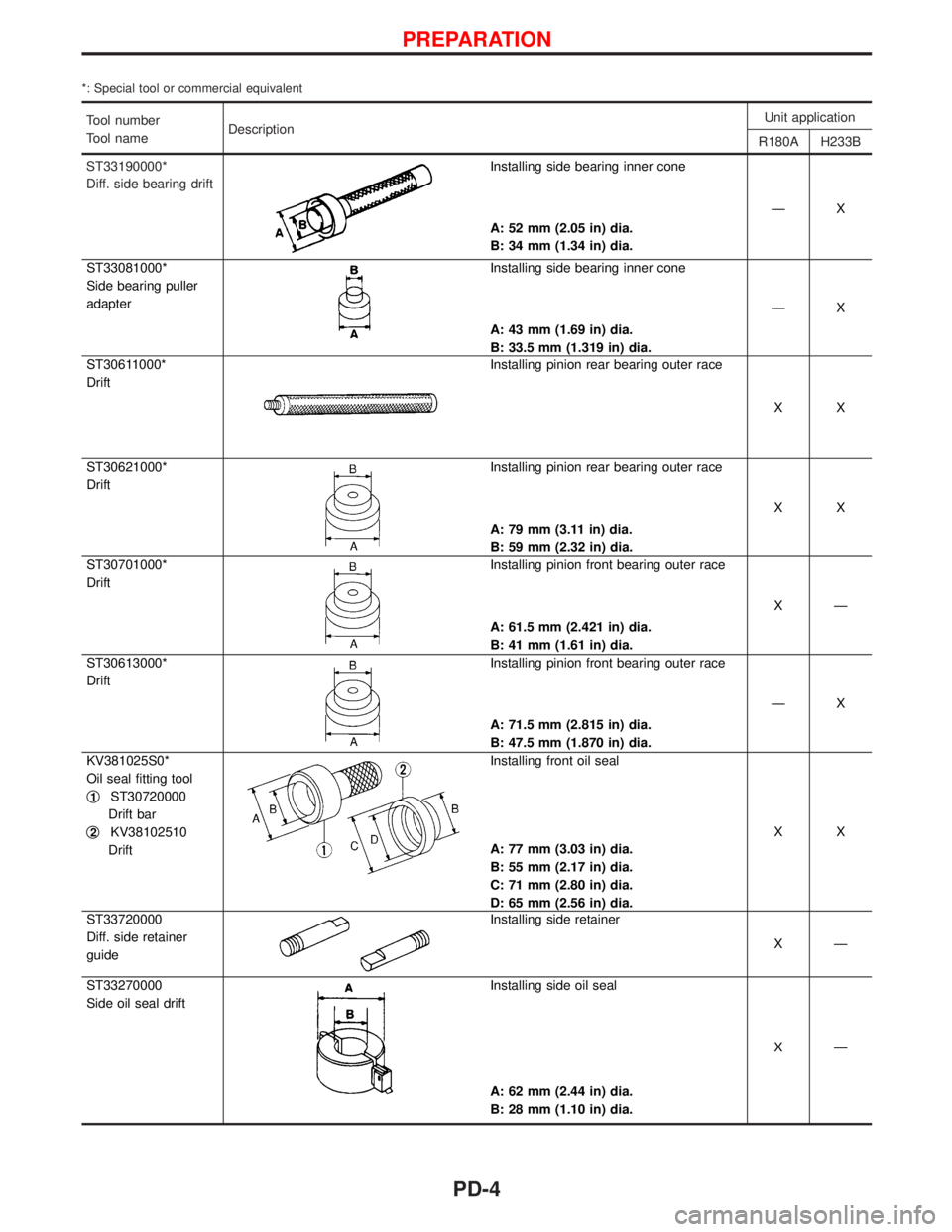
*: Special tool or commercial equivalent
Tool number
Tool nameDescriptionUnit application
R180A H233B
ST33190000*
Diff. side bearing drift
Installing side bearing inner cone
A: 52 mm (2.05 in) dia.
B: 34 mm (1.34 in) dia.ÐX
ST33081000*
Side bearing puller
adapter
Installing side bearing inner cone
A: 43 mm (1.69 in) dia.
B: 33.5 mm (1.319 in) dia.ÐX
ST30611000*
Drift
Installing pinion rear bearing outer race
XX
ST30621000*
Drift
Installing pinion rear bearing outer race
A: 79 mm (3.11 in) dia.
B: 59 mm (2.32 in) dia.XX
ST30701000*
Drift
Installing pinion front bearing outer race
A: 61.5 mm (2.421 in) dia.
B: 41 mm (1.61 in) dia.XÐ
ST30613000*
Drift
Installing pinion front bearing outer race
A: 71.5 mm (2.815 in) dia.
B: 47.5 mm (1.870 in) dia.ÐX
KV381025S0*
Oil seal fitting tool
q
1ST30720000
Drift bar
q
2KV38102510
Drift
Installing front oil seal
A: 77 mm (3.03 in) dia.
B: 55 mm (2.17 in) dia.
C: 71 mm (2.80 in) dia.
D: 65 mm (2.56 in) dia.XX
ST33720000
Diff. side retainer
guide
Installing side retainer
XÐ
ST33270000
Side oil seal drift
Installing side oil seal
A: 62 mm (2.44 in) dia.
B: 28 mm (1.10 in) dia.XÐ
PREPARATION
PD-4
Page 1551 of 1767
On-Vehicle Service
PROPELLER SHAFT VIBRATION
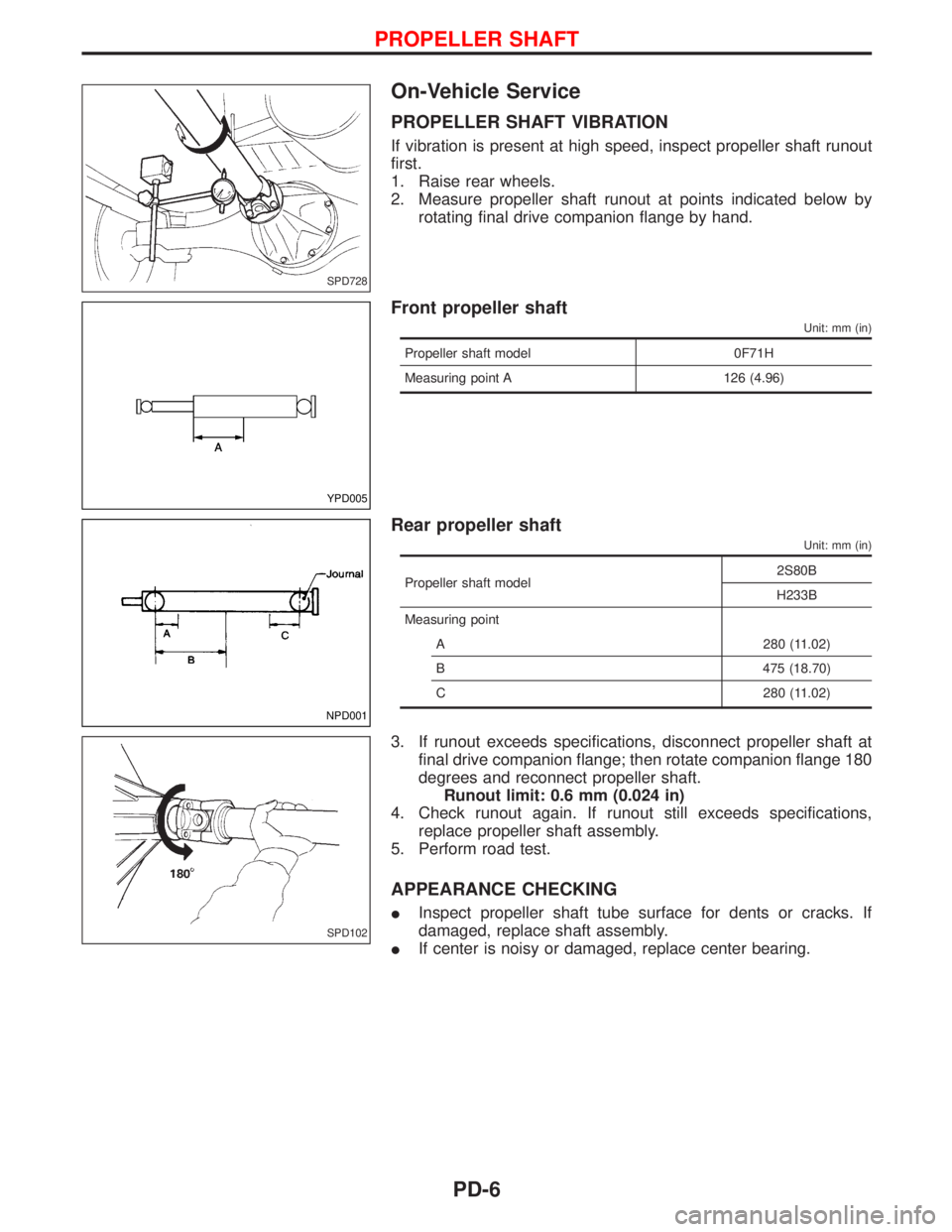
If vibration is present at high speed, inspect propeller shaft runout
first.
1. Raise rear wheels.
2. Measure propeller shaft runout at points indicated below by
rotating final drive companion flange by hand.
Front propeller shaft
Unit: mm (in)
Propeller shaft model 0F71H
Measuring point A 126 (4.96)
Rear propeller shaft
Unit: mm (in)
Propeller shaft model2S80B
H233B
Measuring point
A 280 (11.02)
B 475 (18.70)
C 280 (11.02)
3. If runout exceeds specifications, disconnect propeller shaft at
final drive companion flange; then rotate companion flange 180
degrees and reconnect propeller shaft.
Runout limit: 0.6 mm (0.024 in)
4. Check runout again. If runout still exceeds specifications,
replace propeller shaft assembly.
5. Perform road test.
APPEARANCE CHECKING
IInspect propeller shaft tube surface for dents or cracks. If
damaged, replace shaft assembly.
IIf center is noisy or damaged, replace center bearing.
SPD728
YPD005
NPD001
SPD102
PROPELLER SHAFT
PD-6
Page 1602 of 1767
Propeller Shaft
GENERAL SPECIFICATIONS
Unit: mm (in)
MODEL ALL H/T WAGON
Portion Front Rear
Propeller shaft
model0F71H 2S80B
Number of joints 2
Coupling
method with
transmissionFlange type Sleeve type
Types of journal
bearingsSolid type (dis-
assembly type)Solid type
Shaft length
(Spider to spi-
der) mm (in)542 (21.34) 725 (28.54) 925 (36.42)
Shaft outer
diameter mm (in)65 (2.56) 65 (2.56)
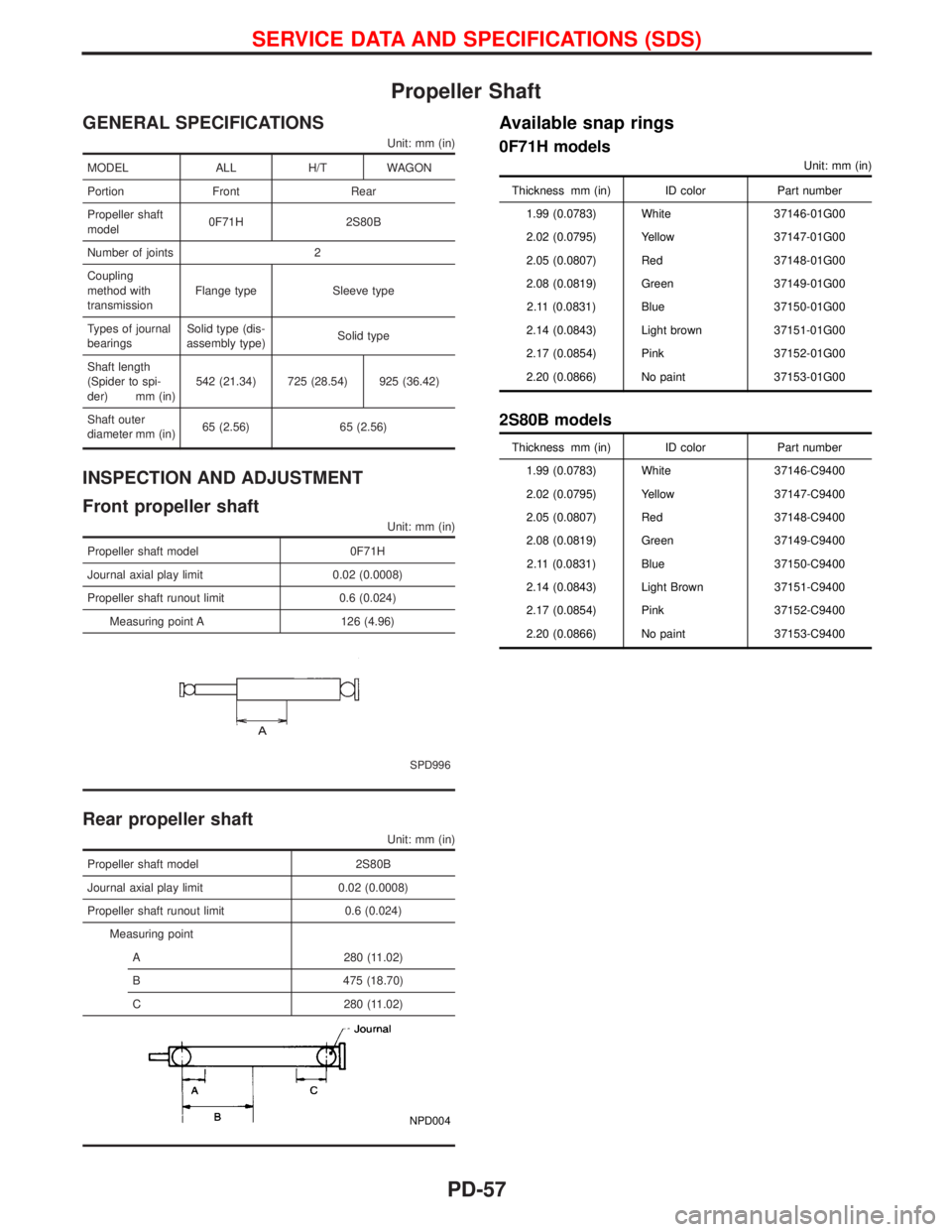
INSPECTION AND ADJUSTMENT
Front propeller shaft
Unit: mm (in)
Propeller shaft model 0F71H
Journal axial play limit 0.02 (0.0008)
Propeller shaft runout limit 0.6 (0.024)
Measuring point A 126 (4.96)
SPD996
Rear propeller shaft
Unit: mm (in)
Propeller shaft model 2S80B
Journal axial play limit 0.02 (0.0008)
Propeller shaft runout limit 0.6 (0.024)
Measuring point
A 280 (11.02)
B 475 (18.70)
C 280 (11.02)
NPD004
Available snap rings
0F71H models
Unit: mm (in)
Thickness mm (in) ID color Part number
1.99 (0.0783) White 37146-01G00
2.02 (0.0795) Yellow 37147-01G00
2.05 (0.0807) Red 37148-01G00
2.08 (0.0819) Green 37149-01G00
2.11 (0.0831) Blue 37150-01G00
2.14 (0.0843) Light brown 37151-01G00
2.17 (0.0854) Pink 37152-01G00
2.20 (0.0866) No paint 37153-01G00
2S80B models
Thickness mm (in) ID color Part number
1.99 (0.0783) White 37146-C9400
2.02 (0.0795) Yellow 37147-C9400
2.05 (0.0807) Red 37148-C9400
2.08 (0.0819) Green 37149-C9400
2.11 (0.0831) Blue 37150-C9400
2.14 (0.0843) Light Brown 37151-C9400
2.17 (0.0854) Pink 37152-C9400
2.20 (0.0866) No paint 37153-C9400
SERVICE DATA AND SPECIFICATIONS (SDS)
PD-57
Page 1622 of 1767
RESTRAINT SYSTEM
SECTION
RS
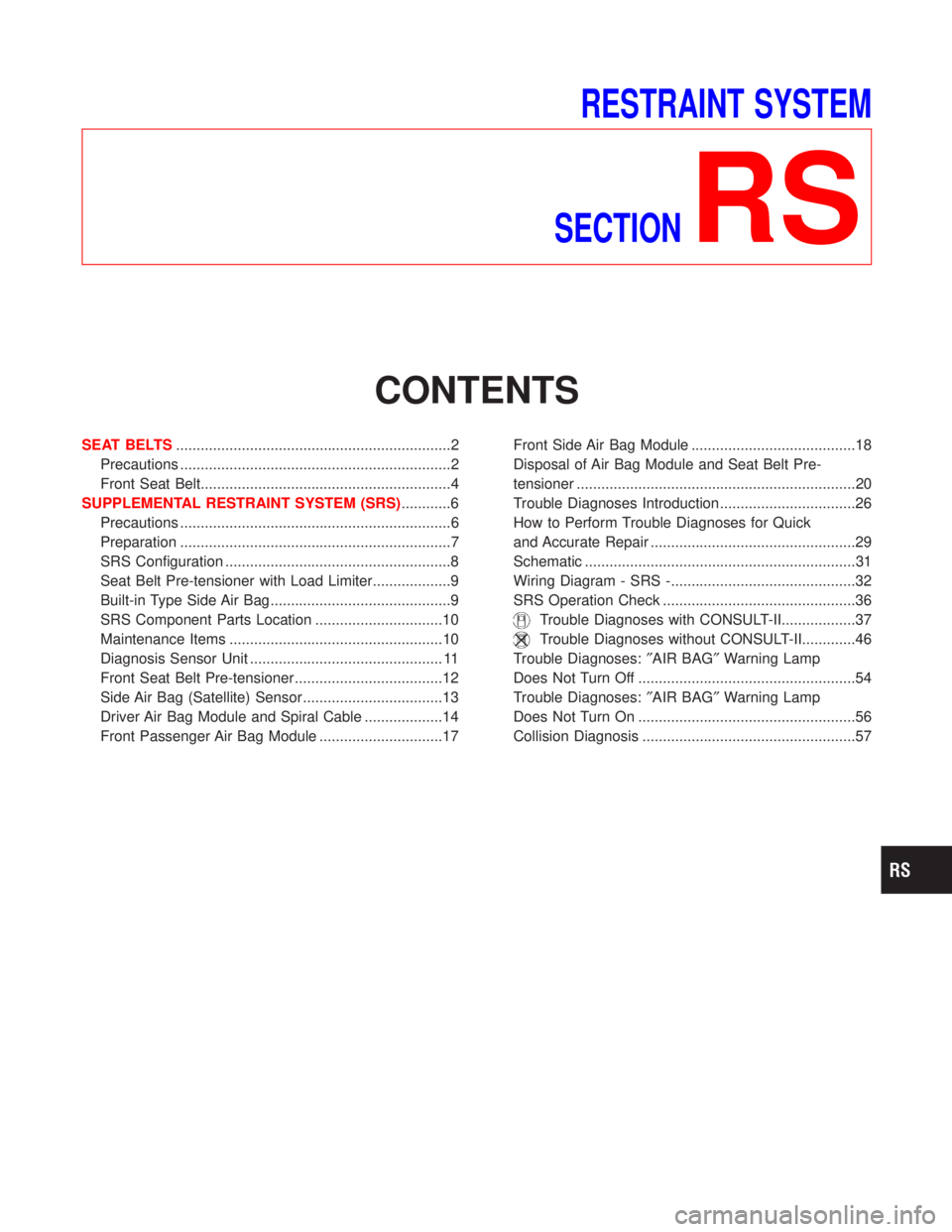
CONTENTS
SEAT BELTS...................................................................2
Precautions ..................................................................2
Front Seat Belt.............................................................4
SUPPLEMENTAL RESTRAINT SYSTEM (SRS)............6
Precautions ..................................................................6
Preparation ..................................................................7
SRS Configuration .......................................................8
Seat Belt Pre-tensioner with Load Limiter...................9
Built-in Type Side Air Bag............................................9
SRS Component Parts Location ...............................10
Maintenance Items ....................................................10
Diagnosis Sensor Unit ............................................... 11
Front Seat Belt Pre-tensioner ....................................12
Side Air Bag (Satellite) Sensor ..................................13
Driver Air Bag Module and Spiral Cable ...................14
Front Passenger Air Bag Module ..............................17Front Side Air Bag Module ........................................18
Disposal of Air Bag Module and Seat Belt Pre-
tensioner ....................................................................20
Trouble Diagnoses Introduction.................................26
How to Perform Trouble Diagnoses for Quick
and Accurate Repair ..................................................29
Schematic ..................................................................31
Wiring Diagram - SRS -.............................................32
SRS Operation Check ...............................................36
Trouble Diagnoses with CONSULT-II..................37
Trouble Diagnoses without CONSULT-II.............46
Trouble Diagnoses:²AIR BAG²Warning Lamp
Does Not Turn Off .....................................................54
Trouble Diagnoses:²AIR BAG²Warning Lamp
Does Not Turn On .....................................................56
Collision Diagnosis ....................................................57
Page 1623 of 1767
Precautions
SUPPLEMENTAL RESTRAINT SYSTEM (SRS) ªAIR BAGº AND ªSEAT BELT
PRE-TENSIONERº
The Supplemental Restraint System such as ªAIR BAGº and ªSEAT BELT PRE-TENSIONERº used along with
a seat belt, helps to reduce the risk or severity of injury to the driver and front passenger for certain types of
collision. The SRS composition which is available to NISSAN MODEL R20 is as follows (The composition
varies according to the destination and optional equipment.):
IFor a frontal collision
The Supplemental Restraint System consists of driver air bag module (located in the center of the steer-
ing wheel), front passenger air bag module (located on the instrument panel on passenger side), front seat
belt pre-tensioners, a diagnosis sensor unit, warning lamp, wiring harness and spiral cable.
IFor a side collision
The Supplemental Restraint System consists of front side air bag module (located in the outer side of front
seat), side air bag (satellite) sensor, diagnosis sensor unit (one of components of air bags for a frontal
collision), wiring harness, warning lamp (one of components of air bags for a frontal collision).
WARNING:
ITo avoid rendering the SRS inoperative, which could increase the risk of personal injury or death
in the event of a collision which would result in air bag inflation, all maintenance should be per-
formed by an authorized NISSAN dealer.
IImproper maintenance, including incorrect removal and installation of the SRS, can lead to per-
sonal injury caused by unintentional activation of the system.
IDo not use electrical test equipment on any circuit related to the SRS unless instructed to in this
Service Manual. Spiral cable and wiring harnesses covered with yellow insulation tape either just
before the harness connectors or for the complete harness are related to the SRS.
Precaution for Seat Belt Service
CAUTION:
IBefore removing the seat belt pre-tensioner assembly, turn the ignition switch off, disconnect both
battery cables and wait at least 3 minutes.
IDo not use electrical test equipment for seat belt pre-tensioner connector.
IAfter replacing or reinstalling seat belt pre-tensioner assembly, or reconnecting seat belt pre-ten-
sioner connector, check the system function. Refer to ªSRS Operation Checkº for details. (RS-36)
IDo not disassemble buckle or seat belt assembly.
IReplace anchor bolts if they are deformed or worn out.
INever oil tongue and buckle.
IIf any component of seat belt assembly is questionable, do not repair. Replace the whole seat belt
assembly.
IIf webbing is cut, frayed, or damaged, replace seat belt assembly.
IWhen replacing seat belt assembly, use a genuine seat belt assembly.
After A Collision
WARNING:
Inspect all seat belt assemblies including retractors and attaching hardware after any collision.
NISSAN recommends that all seat belt assemblies in use during a collision be replaced unless the
collision was minor and the belts show no damage and continue to operate properly. Failure to do so
could result in serious personal injury in an accident. Seat belt assemblies not in use during a colli-
sion should also be replaced if either damage or improper operation is noted. Seat belt pre-tensioner
should be replaced even if the seat belts are not in use during a frontal collision in which the air bags
are deployed.
Replace any seat belt assembly if:
IThe seat belt was in use at the time of a collision (except for minor collisions and the belts, retractors and
buckles show no damage and continue to operate properly).
IThe seat belt was damaged in an accident. (i.e. torn webbing, bent retractor or guide, etc.)
IThe seat belt attaching point was damaged in an accident. Inspect the seat belt attaching area for dam-
age or distortion and repair as necessary before installing a new seat belt assembly.
IAnchor bolts are deformed or worn out.
SEAT BELTS
RS-2
Page 1627 of 1767
Precautions
SUPPLEMENTAL RESTRAINT SYSTEM (SRS) ªAIR BAGº AND ªSEAT BELT
PRE-TENSIONERº
The Supplemental Restraint System such as ªAIR BAGº and ªSEAT BELT PRE-TENSIONERº used along with
a seat belt, helps to reduce the risk or severity of injury to the driver and front passenger for certain types of
collision. The SRS composition which is available to NISSAN MODEL R20 is as follows (The composition
varies according to the destination and optional equipment.):
IFor a frontal collision
The Supplemental Restraint System consists of driver air bag module (located in the center of the steer-
ing wheel), front passenger air bag module (located on the instrument panel on passenger side), front seat
belt pre-tensioners, a diagnosis sensor unit, warning lamp, wiring harness and spiral cable.
IFor a side collision
The Supplemental Restraint System consists of front side air bag module (located in the outer side of front
seat), side air bag (satellite) sensor, diagnosis sensor unit (one of components of air bags for a frontal
collision), wiring harness, warning lamp (one of components of air bags for a frontal collision).
WARNING:
ITo avoid rendering the SRS inoperative, which could increase the risk of personal injury or death
in the event of a collision which would result in air bag inflation, all maintenance should be per-
formed by an authorized NISSAN dealer.
IImproper maintenance, including incorrect removal and installation of the SRS, can lead to per-
sonal injury caused by unintentional activation of the system.
IDo not use electrical test equipment on any circuit related to the SRS unless instructed to in this
Service Manual. Spiral cable and wiring harnesses covered with yellow insulation tape either just
before the harness connectors or for the complete harness are related to the SRS.
PRECAUTIONS FOR SRS ªAIR BAGº AND ªSEAT BELT PRE-TENSIONERº SERVICE
IDo not use electrical test equipment to check SRS circuits unless instructed to in this Service Manual.
IBefore servicing the SRS, turn ignition switch ªOFFº, disconnect both battery cables and wait at least 3
minutes.
For approximately 3 minutes after the cables are removed, it is still possible for the air bag and seat belt
pre-tensioner to deploy. Therefore, do not work on any SRS connectors or wires until at least 3 minutes
have passed.
IDiagnosis sensor unit must always be installed with their arrow marks ª+º pointing towards the front of
the vehicle for proper operation. Also check diagnosis sensor unit for cracks, deformities or rust before
installation and replace as required.
IThe spiral cable must be aligned with the neutral position since its rotations are limited. Do not attempt to
turn steering wheel or column after removal of steering gear.
IHandle air bag module carefully. Always place driver and front passenger air bag modules with the pad
side facing upward and place front side air bag module (built-in type) standing with stud bolt side setting
bottom.
IConduct self-diagnosis to check entire SRS for proper function after replacing any components.
IAfter air bag inflates, the front instrument panel assembly should be replaced if damaged.
WIRING DIAGRAMS AND TROUBLE DIAGNOSIS
When you read wiring diagrams, refer to the following:
IGI-10, ªHOW TO READ WIRING DIAGRAMSº
IEL-6, ªPOWER SUPPLY ROUTINGº for power distribution circuit
When you perform trouble diagnosis, refer to the following:
IGI-25, ªHOW TO FOLLOW TEST GROUPS IN TROUBLE DIAGNOSISº
IGI-22, ªHOW TO PERFORM EFFICIENT DIAGNOSES FOR AN ELECTRICAL INCIDENTº
SUPPLEMENTAL RESTRAINT SYSTEM (SRS)
RS-6
Page 1628 of 1767
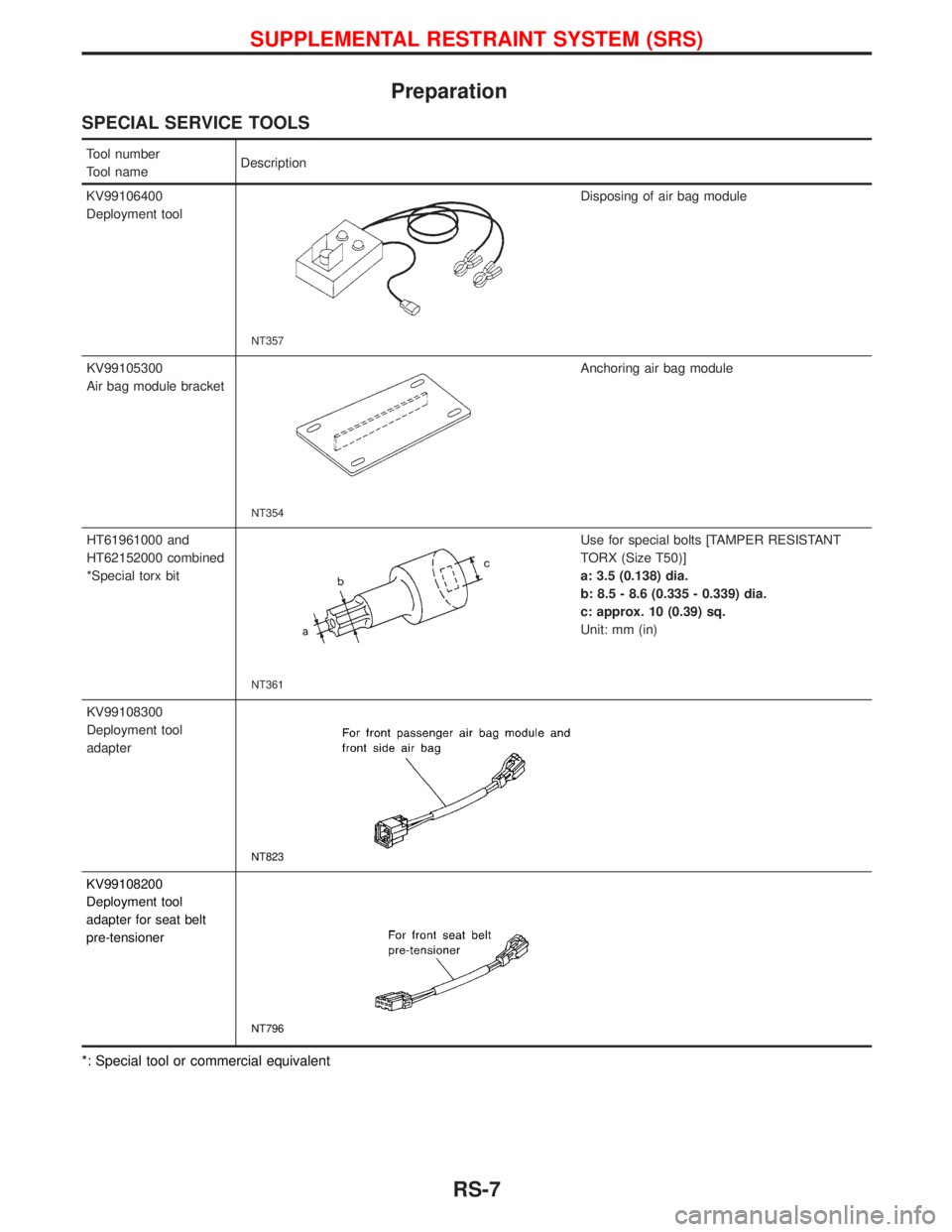
Preparation
SPECIAL SERVICE TOOLS
Tool number
Tool nameDescription
KV99106400
Deployment tool
NT357
Disposing of air bag module
KV99105300
Air bag module bracket
NT354
Anchoring air bag module
HT61961000 and
HT62152000 combined
*Special torx bit
NT361
Use for special bolts [TAMPER RESISTANT
TORX (Size T50)]
a: 3.5 (0.138) dia.
b: 8.5 - 8.6 (0.335 - 0.339) dia.
c: approx. 10 (0.39) sq.
Unit: mm (in)
KV99108300
Deployment tool
adapter
NT823
KV99108200
Deployment tool
adapter for seat belt
pre-tensioner
NT796
*: Special tool or commercial equivalent
SUPPLEMENTAL RESTRAINT SYSTEM (SRS)
RS-7
Page 1629 of 1767
COMMERCIAL SERVICE TOOL
Tool name Description
Tamper resistant torx
socket
NT757
Size: T30
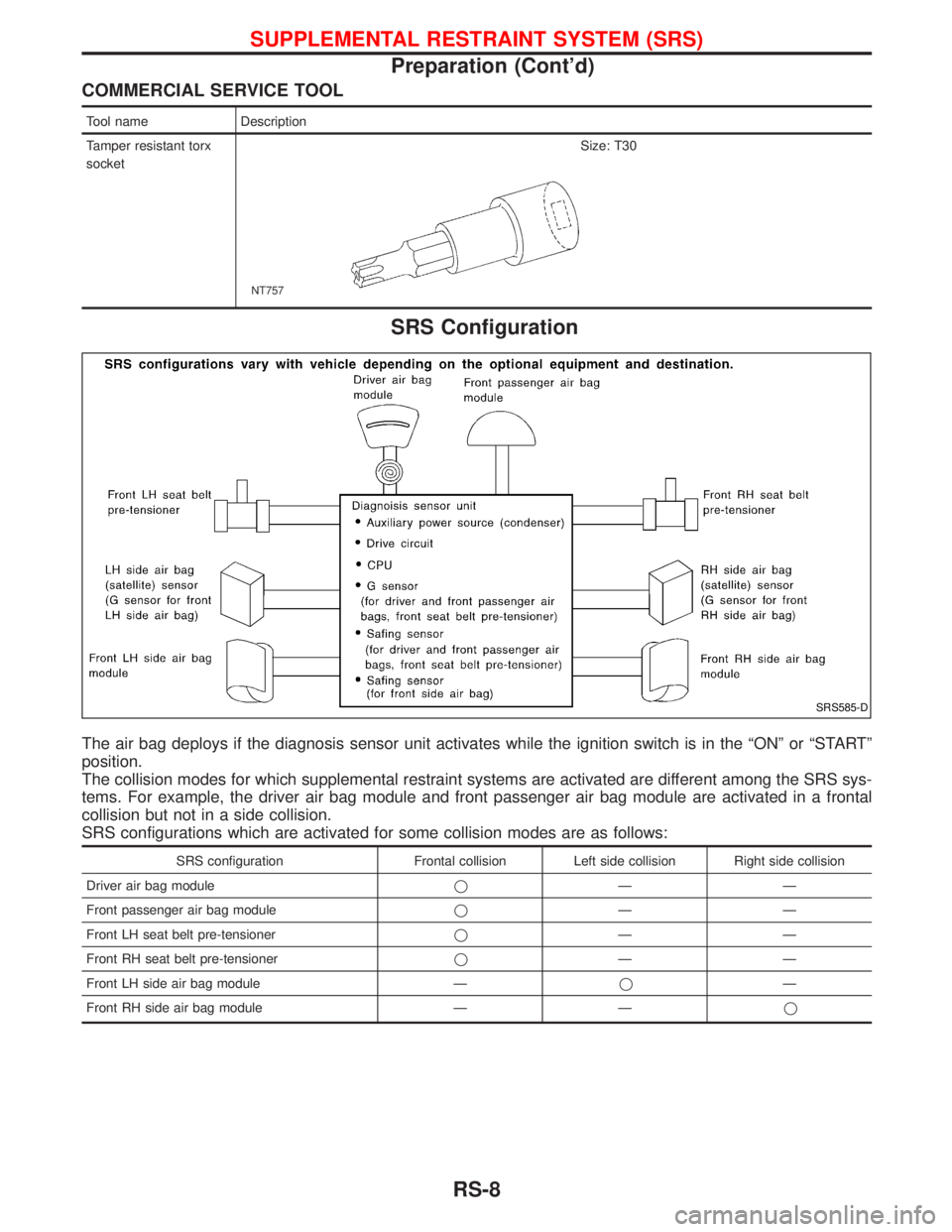
SRS Configuration
The air bag deploys if the diagnosis sensor unit activates while the ignition switch is in the ªONº or ªSTARTº
position.
The collision modes for which supplemental restraint systems are activated are different among the SRS sys-
tems. For example, the driver air bag module and front passenger air bag module are activated in a frontal
collision but not in a side collision.
SRS configurations which are activated for some collision modes are as follows:
SRS configuration Frontal collision Left side collision Right side collision
Driver air bag moduleqÐÐ
Front passenger air bag moduleqÐÐ
Front LH seat belt pre-tensionerqÐÐ
Front RH seat belt pre-tensionerqÐÐ
Front LH side air bag module ÐqÐ
Front RH side air bag module Ð Ðq
SRS585-D
SUPPLEMENTAL RESTRAINT SYSTEM (SRS)
Preparation (Cont'd)
RS-8
Page 1631 of 1767
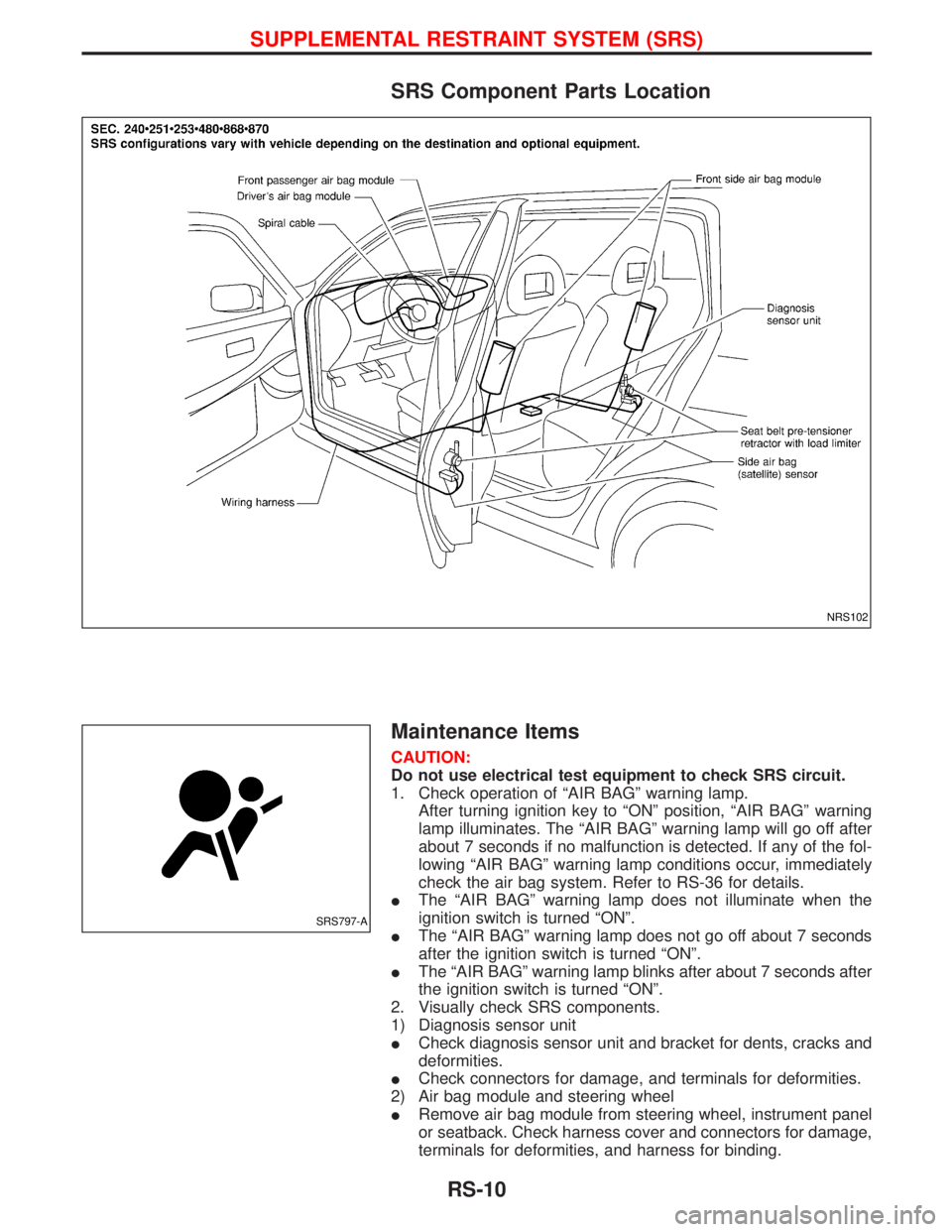
SRS Component Parts Location
Maintenance Items
CAUTION:
Do not use electrical test equipment to check SRS circuit.
1. Check operation of ªAIR BAGº warning lamp.
After turning ignition key to ªONº position, ªAIR BAGº warning
lamp illuminates. The ªAIR BAGº warning lamp will go off after
about 7 seconds if no malfunction is detected. If any of the fol-
lowing ªAIR BAGº warning lamp conditions occur, immediately
check the air bag system. Refer to RS-36 for details.
IThe ªAIR BAGº warning lamp does not illuminate when the
ignition switch is turned ªONº.
IThe ªAIR BAGº warning lamp does not go off about 7 seconds
after the ignition switch is turned ªONº.
IThe ªAIR BAGº warning lamp blinks after about 7 seconds after
the ignition switch is turned ªONº.
2. Visually check SRS components.
1) Diagnosis sensor unit
ICheck diagnosis sensor unit and bracket for dents, cracks and
deformities.
ICheck connectors for damage, and terminals for deformities.
2) Air bag module and steering wheel
IRemove air bag module from steering wheel, instrument panel
or seatback. Check harness cover and connectors for damage,
terminals for deformities, and harness for binding.
NRS102
SRS797-A
SUPPLEMENTAL RESTRAINT SYSTEM (SRS)
RS-10
Page 1632 of 1767
IInstall driver air bag module to steering wheel to check fit or
alignment with the wheel.
ICheck steering wheel for excessive free play.
IInstall front passenger air bag module to instrument panel to
check fit or alignment with the instrument panel.
IInstall front side air bag module to seatback to check fit and
alignment with the seat.
3) Spiral cable
ICheck spiral cable for dents, cracks, or deformities.
ICheck connectors and protective tape for damage.
ICheck steering wheel for noise, binding or heavy operation.
4) Main harness, body harness, side air bag module sub-harness
ICheck connectors for poor connections, damage, and terminals
for deformities.
ICheck harnesses for binding, chafing or cut.
5) Front seat belt pre-tensioner
ICheck harness cover and connectors for damage, terminals for
deformities, and harness for binding.
ICheck belts for damage and anchors for loose mounting.
ICheck retractor for smooth operation.
IPerform self-diagnosis for seat belt pre-tensioner using ªAIR
BAGº warning lamp or CONSULT-II.
Refer to ªSRS Operation Checkº for details. (RS-36)
6) Side air bag (satellite) sensor
ICheck side air bag (satellite) sensor (including bracket portion)
for dents, cracks or deformities.
ICheck connectors for damage, and terminals for deformities.
CAUTION:
Replace previously used special bolts and ground bolt with
new ones.
Diagnosis Sensor Unit
REMOVAL AND INSTALLATION
CAUTION:
IBefore servicing SRS, turn the ignition switch off, discon-
nect both battery cables and wait at least 3 minutes.
IThe special bolts are coated with bonding agent while the
other bolt is for ground. Do not use old bolts after removal;
replace with new ones.
ICheck diagnosis sensor unit for proper installation.
ICheck diagnosis sensor unit to ensure it is free of
deformities, dents, cracks or rust. If they show any visible
signs of damage, replace them with new ones.
ICheck diagnosis sensor unit brackets to ensure they are
free of deformities or rust.
IReplace diagnosis sensor unit if it has been dropped or
sustained an impact.
IAfter replacement of diagnosis sensor unit, perform self-
diagnosis for SRS. Refer to ªSRS Operation Checkº for
details. (RS-36)
1. Disconnect driver, front passenger and front side air bag mod-
ule connectors. Also, disconnect front seat belt pre-tensioner
connector.
2. Remove console box. Refer to BT-22, ªINSTRUMENT PANEL
ASSEMBLYº.
3. Disconnect diagnosis sensor unit connector.
4. Remove ground bolt and also remove special bolts using the
TAMPER RESISTANT TORX (Size T50), from diagnosis sen-
sor unit.
Then remove the diagnosis sensor unit.
SUPPLEMENTAL RESTRAINT SYSTEM (SRS)
Maintenance Items (Cont'd)
RS-11