steering system NISSAN TERRANO 2002 Service Owner's Manual
[x] Cancel search | Manufacturer: NISSAN, Model Year: 2002, Model line: TERRANO, Model: NISSAN TERRANO 2002Pages: 1767, PDF Size: 41.51 MB
Page 1476 of 1767
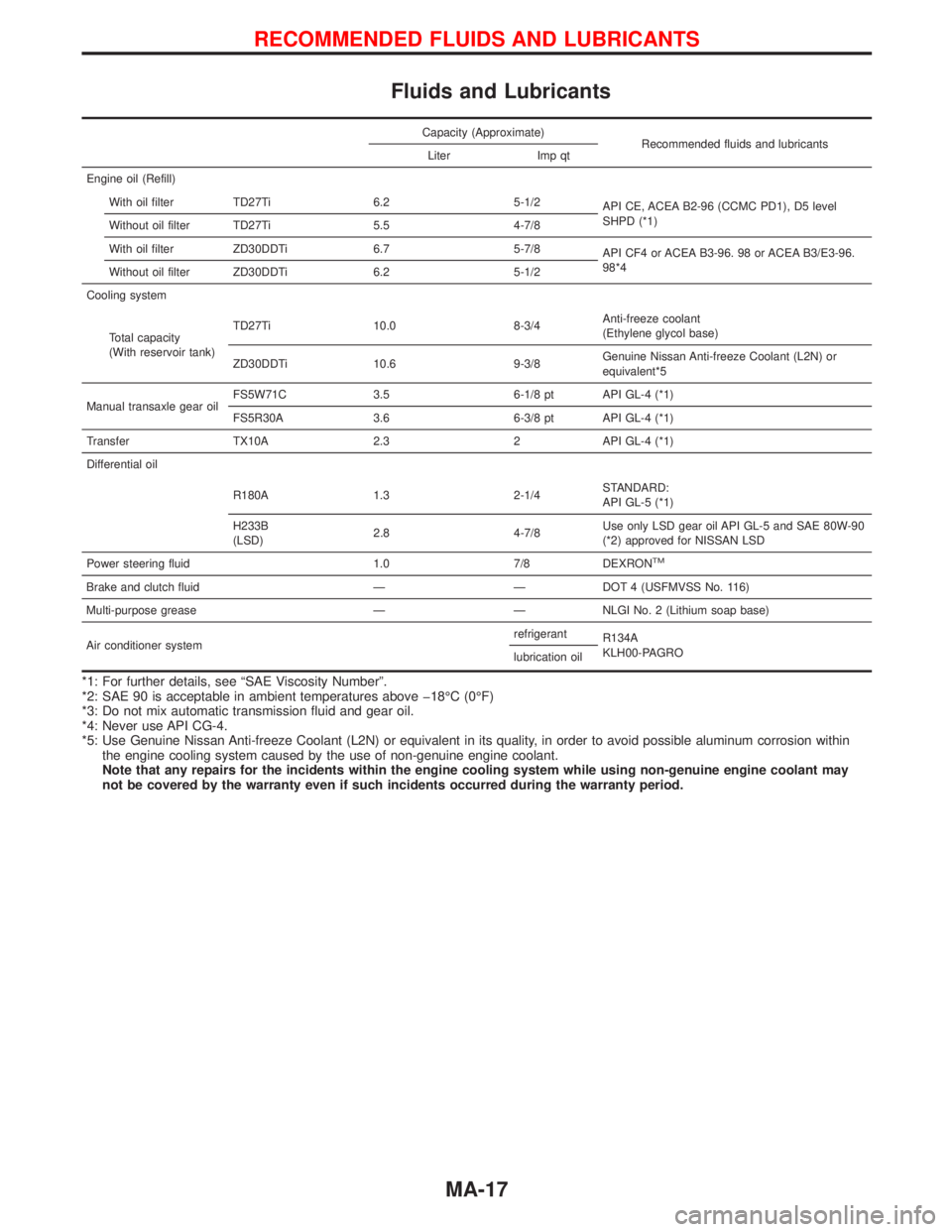
Fluids and Lubricants
Capacity (Approximate)
Recommended fluids and lubricants
Liter Imp qt
Engine oil (Refill)
With oil filter TD27Ti 6.2 5-1/2
API CE, ACEA B2-96 (CCMC PD1), D5 level
SHPD (*1)
Without oil filter TD27Ti 5.5 4-7/8
With oil filter ZD30DDTi 6.7 5-7/8
API CF4 or ACEA B3-96. 98 or ACEA B3/E3-96.
98*4
Without oil filter ZD30DDTi 6.2 5-1/2
Cooling system
Total capacity
(With reservoir tank)TD27Ti 10.0 8-3/4Anti-freeze coolant
(Ethylene glycol base)
ZD30DDTi 10.6 9-3/8Genuine Nissan Anti-freeze Coolant (L2N) or
equivalent*5
Manual transaxle gear oilFS5W71C 3.5 6-1/8 pt API GL-4 (*1)
FS5R30A 3.6 6-3/8 pt API GL-4 (*1)
Transfer TX10A 2.3 2 API GL-4 (*1)
Differential oil
R180A 1.3 2-1/4STANDARD:
API GL-5 (*1)
H233B
(LSD)2.8 4-7/8Use only LSD gear oil API GL-5 and SAE 80W-90
(*2) approved for NISSAN LSD
Power steering fluid 1.0 7/8 DEXRON
TM
Brake and clutch fluid Ð Ð DOT 4 (USFMVSS No. 116)
Multi-purpose grease Ð Ð NLGI No. 2 (Lithium soap base)
Air conditioner systemrefrigerant
R134A
KLH00-PAGRO
lubrication oil
*1: For further details, see ªSAE Viscosity Numberº.
*2: SAE 90 is acceptable in ambient temperatures above þ18ÉC (0ÉF)
*3: Do not mix automatic transmission fluid and gear oil.
*4: Never use API CG-4.
*5: Use Genuine Nissan Anti-freeze Coolant (L2N) or equivalent in its quality, in order to avoid possible aluminum corrosion within
the engine cooling system caused by the use of non-genuine engine coolant.
Note that any repairs for the incidents within the engine cooling system while using non-genuine engine coolant may
not be covered by the warranty even if such incidents occurred during the warranty period.
RECOMMENDED FLUIDS AND LUBRICANTS
MA-17
Page 1502 of 1767
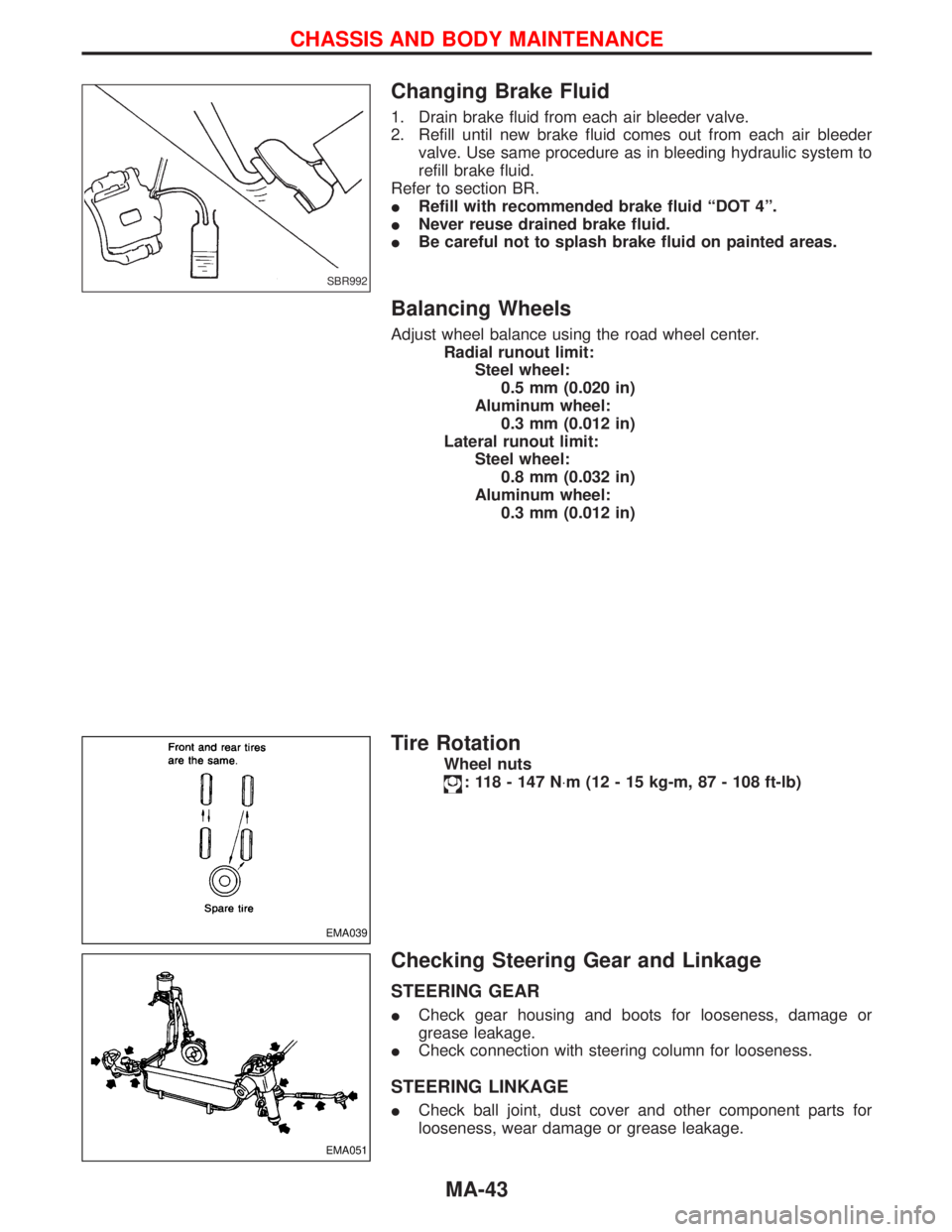
Changing Brake Fluid
1. Drain brake fluid from each air bleeder valve.
2. Refill until new brake fluid comes out from each air bleeder
valve. Use same procedure as in bleeding hydraulic system to
refill brake fluid.
Refer to section BR.
IRefill with recommended brake fluid ªDOT 4º.
INever reuse drained brake fluid.
IBe careful not to splash brake fluid on painted areas.
Balancing Wheels
Adjust wheel balance using the road wheel center.
Radial runout limit:
Steel wheel:
0.5 mm (0.020 in)
Aluminum wheel:
0.3 mm (0.012 in)
Lateral runout limit:
Steel wheel:
0.8 mm (0.032 in)
Aluminum wheel:
0.3 mm (0.012 in)
Tire Rotation
Wheel nuts
: 118 - 147 N×m (12 - 15 kg-m, 87 - 108 ft-lb)
Checking Steering Gear and Linkage
STEERING GEAR
ICheck gear housing and boots for looseness, damage or
grease leakage.
ICheck connection with steering column for looseness.
STEERING LINKAGE
ICheck ball joint, dust cover and other component parts for
looseness, wear damage or grease leakage.
SBR992
EMA039
EMA051
CHASSIS AND BODY MAINTENANCE
MA-43
Page 1507 of 1767
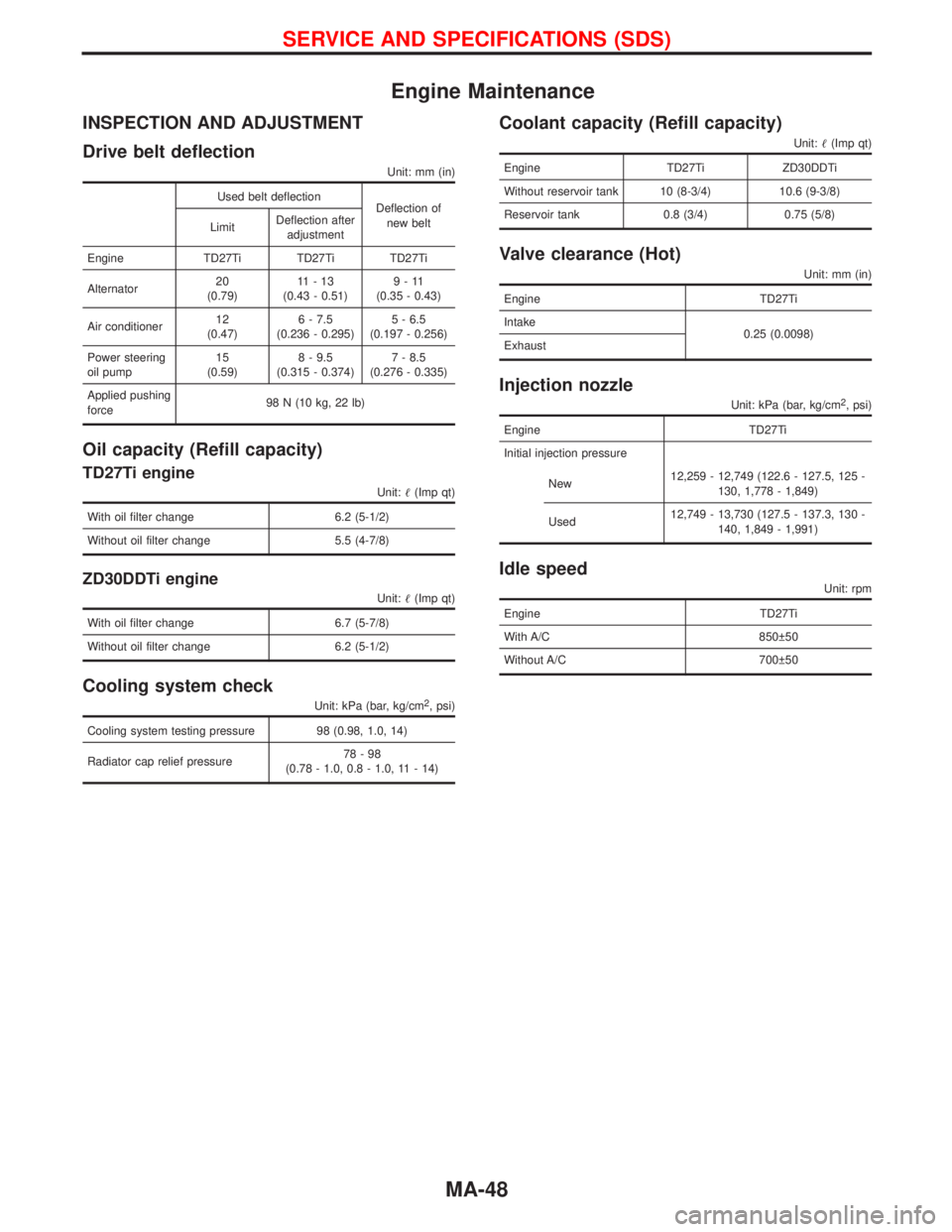
Engine Maintenance
INSPECTION AND ADJUSTMENT
Drive belt deflection
Unit: mm (in)
Used belt deflection
Deflection of
new belt
LimitDeflection after
adjustment
Engine TD27Ti TD27Ti TD27Ti
Alternator20
(0.79)11-13
(0.43 - 0.51)9-11
(0.35 - 0.43)
Air conditioner12
(0.47)6 - 7.5
(0.236 - 0.295)5 - 6.5
(0.197 - 0.256)
Power steering
oil pump15
(0.59)8 - 9.5
(0.315 - 0.374)7 - 8.5
(0.276 - 0.335)
Applied pushing
force98 N (10 kg, 22 lb)
Oil capacity (Refill capacity)
TD27Ti engine
Unit:(Imp qt)
With oil filter change 6.2 (5-1/2)
Without oil filter change 5.5 (4-7/8)
ZD30DDTi engine
Unit:(Imp qt)
With oil filter change 6.7 (5-7/8)
Without oil filter change 6.2 (5-1/2)
Cooling system check
Unit: kPa (bar, kg/cm2, psi)
Cooling system testing pressure 98 (0.98, 1.0, 14)
Radiator cap relief pressure78-98
(0.78 - 1.0, 0.8 - 1.0, 11 - 14)
Coolant capacity (Refill capacity)
Unit:(Imp qt)
Engine TD27Ti ZD30DDTi
Without reservoir tank 10 (8-3/4) 10.6 (9-3/8)
Reservoir tank 0.8 (3/4) 0.75 (5/8)
Valve clearance (Hot)
Unit: mm (in)
Engine TD27Ti
Intake
0.25 (0.0098)
Exhaust
Injection nozzle
Unit: kPa (bar, kg/cm2, psi)
Engine TD27Ti
Initial injection pressure
New12,259 - 12,749 (122.6 - 127.5, 125 -
130, 1,778 - 1,849)
Used12,749 - 13,730 (127.5 - 137.3, 130 -
140, 1,849 - 1,991)
Idle speed
Unit: rpm
Engine TD27Ti
With A/C 850 50
Without A/C 700 50
SERVICE AND SPECIFICATIONS (SDS)
MA-48
Page 1627 of 1767
Precautions
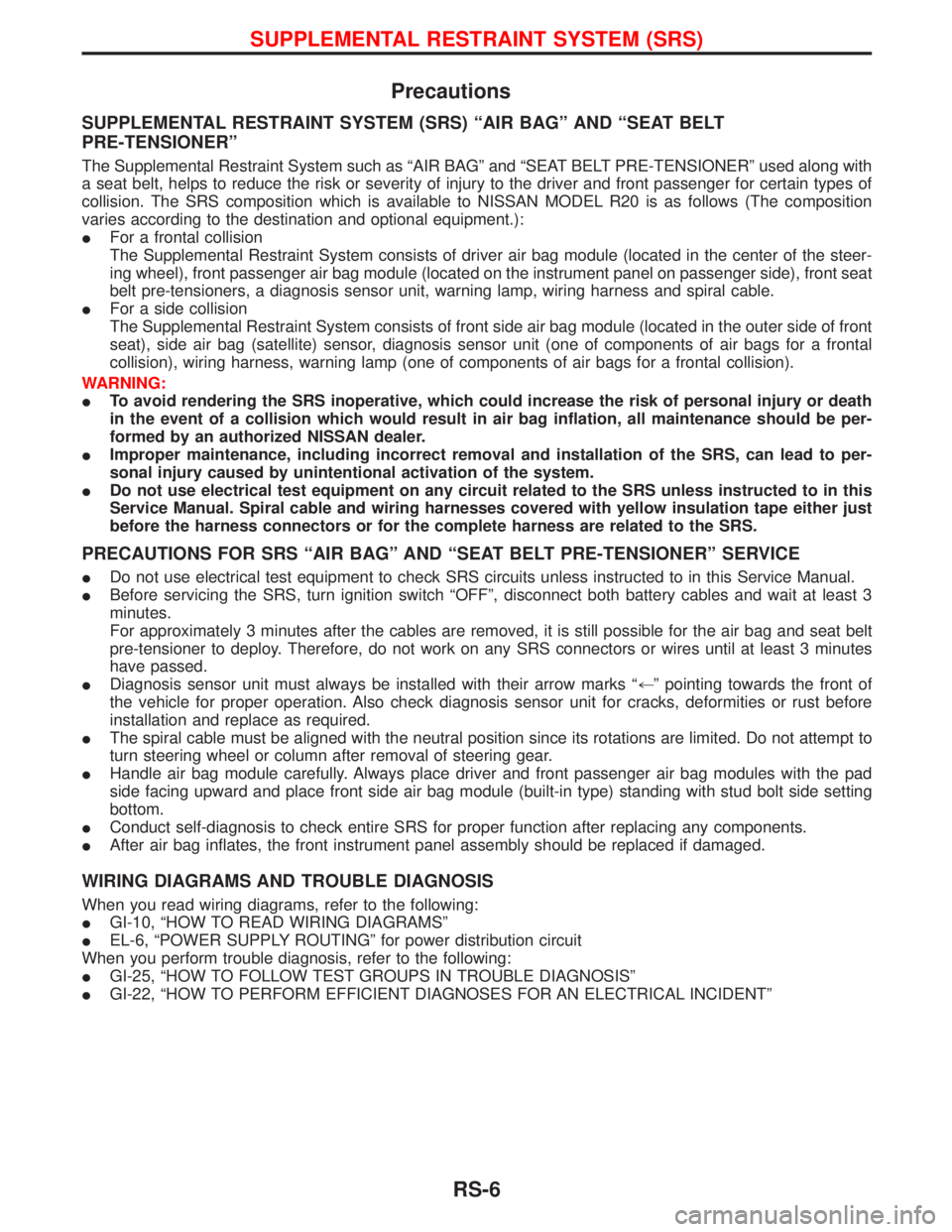
SUPPLEMENTAL RESTRAINT SYSTEM (SRS) ªAIR BAGº AND ªSEAT BELT
PRE-TENSIONERº
The Supplemental Restraint System such as ªAIR BAGº and ªSEAT BELT PRE-TENSIONERº used along with
a seat belt, helps to reduce the risk or severity of injury to the driver and front passenger for certain types of
collision. The SRS composition which is available to NISSAN MODEL R20 is as follows (The composition
varies according to the destination and optional equipment.):
IFor a frontal collision
The Supplemental Restraint System consists of driver air bag module (located in the center of the steer-
ing wheel), front passenger air bag module (located on the instrument panel on passenger side), front seat
belt pre-tensioners, a diagnosis sensor unit, warning lamp, wiring harness and spiral cable.
IFor a side collision
The Supplemental Restraint System consists of front side air bag module (located in the outer side of front
seat), side air bag (satellite) sensor, diagnosis sensor unit (one of components of air bags for a frontal
collision), wiring harness, warning lamp (one of components of air bags for a frontal collision).
WARNING:
ITo avoid rendering the SRS inoperative, which could increase the risk of personal injury or death
in the event of a collision which would result in air bag inflation, all maintenance should be per-
formed by an authorized NISSAN dealer.
IImproper maintenance, including incorrect removal and installation of the SRS, can lead to per-
sonal injury caused by unintentional activation of the system.
IDo not use electrical test equipment on any circuit related to the SRS unless instructed to in this
Service Manual. Spiral cable and wiring harnesses covered with yellow insulation tape either just
before the harness connectors or for the complete harness are related to the SRS.
PRECAUTIONS FOR SRS ªAIR BAGº AND ªSEAT BELT PRE-TENSIONERº SERVICE
IDo not use electrical test equipment to check SRS circuits unless instructed to in this Service Manual.
IBefore servicing the SRS, turn ignition switch ªOFFº, disconnect both battery cables and wait at least 3
minutes.
For approximately 3 minutes after the cables are removed, it is still possible for the air bag and seat belt
pre-tensioner to deploy. Therefore, do not work on any SRS connectors or wires until at least 3 minutes
have passed.
IDiagnosis sensor unit must always be installed with their arrow marks ª+º pointing towards the front of
the vehicle for proper operation. Also check diagnosis sensor unit for cracks, deformities or rust before
installation and replace as required.
IThe spiral cable must be aligned with the neutral position since its rotations are limited. Do not attempt to
turn steering wheel or column after removal of steering gear.
IHandle air bag module carefully. Always place driver and front passenger air bag modules with the pad
side facing upward and place front side air bag module (built-in type) standing with stud bolt side setting
bottom.
IConduct self-diagnosis to check entire SRS for proper function after replacing any components.
IAfter air bag inflates, the front instrument panel assembly should be replaced if damaged.
WIRING DIAGRAMS AND TROUBLE DIAGNOSIS
When you read wiring diagrams, refer to the following:
IGI-10, ªHOW TO READ WIRING DIAGRAMSº
IEL-6, ªPOWER SUPPLY ROUTINGº for power distribution circuit
When you perform trouble diagnosis, refer to the following:
IGI-25, ªHOW TO FOLLOW TEST GROUPS IN TROUBLE DIAGNOSISº
IGI-22, ªHOW TO PERFORM EFFICIENT DIAGNOSES FOR AN ELECTRICAL INCIDENTº
SUPPLEMENTAL RESTRAINT SYSTEM (SRS)
RS-6
Page 1631 of 1767
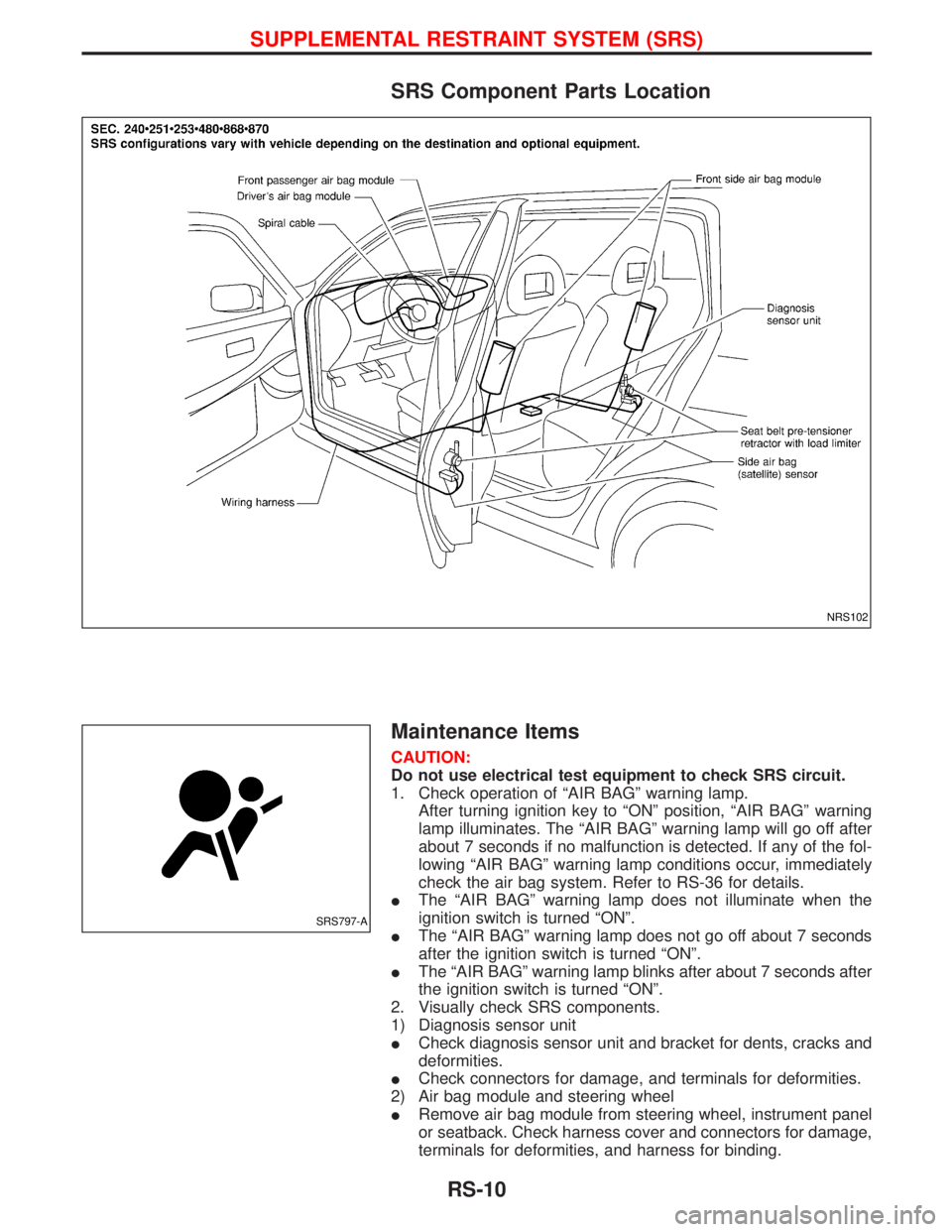
SRS Component Parts Location
Maintenance Items
CAUTION:
Do not use electrical test equipment to check SRS circuit.
1. Check operation of ªAIR BAGº warning lamp.
After turning ignition key to ªONº position, ªAIR BAGº warning
lamp illuminates. The ªAIR BAGº warning lamp will go off after
about 7 seconds if no malfunction is detected. If any of the fol-
lowing ªAIR BAGº warning lamp conditions occur, immediately
check the air bag system. Refer to RS-36 for details.
IThe ªAIR BAGº warning lamp does not illuminate when the
ignition switch is turned ªONº.
IThe ªAIR BAGº warning lamp does not go off about 7 seconds
after the ignition switch is turned ªONº.
IThe ªAIR BAGº warning lamp blinks after about 7 seconds after
the ignition switch is turned ªONº.
2. Visually check SRS components.
1) Diagnosis sensor unit
ICheck diagnosis sensor unit and bracket for dents, cracks and
deformities.
ICheck connectors for damage, and terminals for deformities.
2) Air bag module and steering wheel
IRemove air bag module from steering wheel, instrument panel
or seatback. Check harness cover and connectors for damage,
terminals for deformities, and harness for binding.
NRS102
SRS797-A
SUPPLEMENTAL RESTRAINT SYSTEM (SRS)
RS-10
Page 1632 of 1767
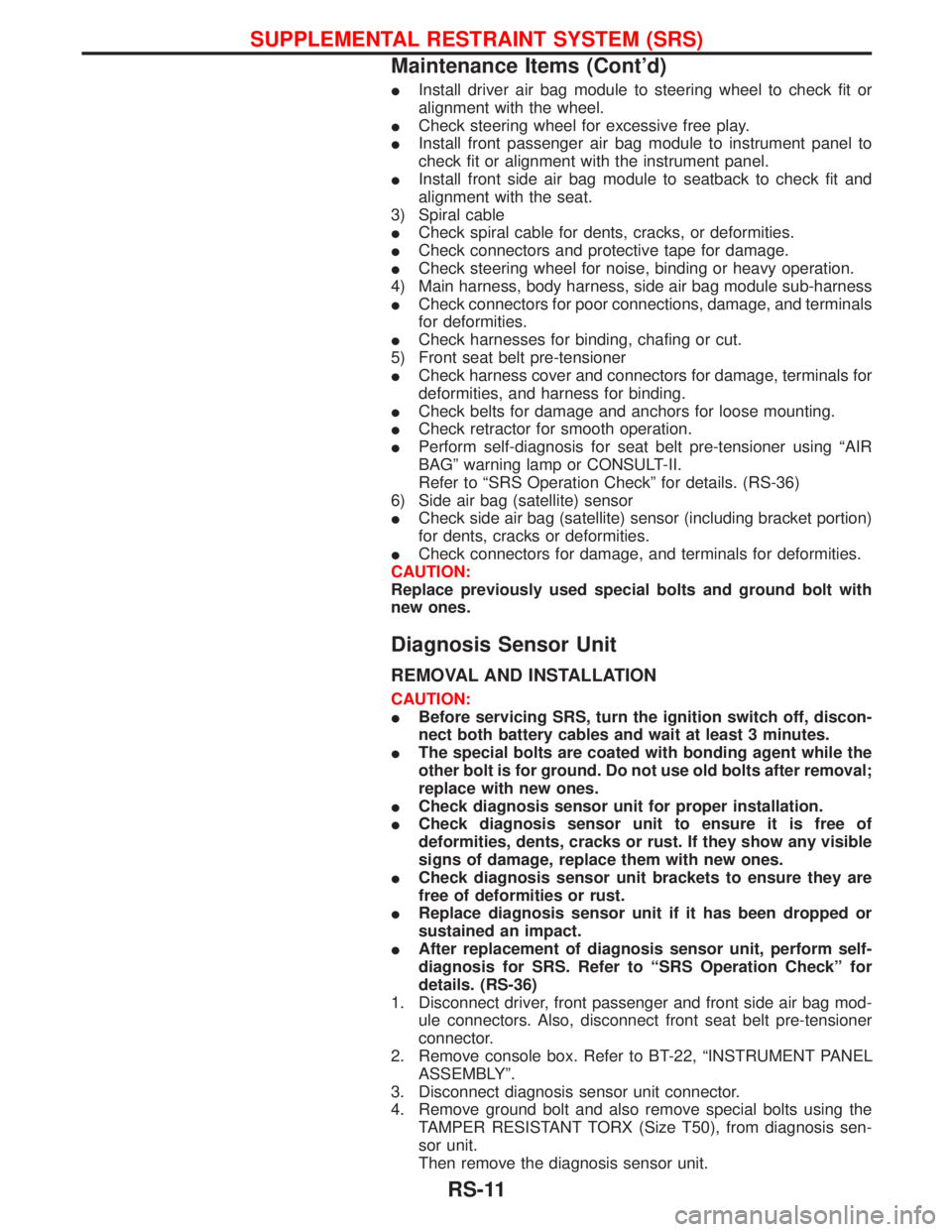
IInstall driver air bag module to steering wheel to check fit or
alignment with the wheel.
ICheck steering wheel for excessive free play.
IInstall front passenger air bag module to instrument panel to
check fit or alignment with the instrument panel.
IInstall front side air bag module to seatback to check fit and
alignment with the seat.
3) Spiral cable
ICheck spiral cable for dents, cracks, or deformities.
ICheck connectors and protective tape for damage.
ICheck steering wheel for noise, binding or heavy operation.
4) Main harness, body harness, side air bag module sub-harness
ICheck connectors for poor connections, damage, and terminals
for deformities.
ICheck harnesses for binding, chafing or cut.
5) Front seat belt pre-tensioner
ICheck harness cover and connectors for damage, terminals for
deformities, and harness for binding.
ICheck belts for damage and anchors for loose mounting.
ICheck retractor for smooth operation.
IPerform self-diagnosis for seat belt pre-tensioner using ªAIR
BAGº warning lamp or CONSULT-II.
Refer to ªSRS Operation Checkº for details. (RS-36)
6) Side air bag (satellite) sensor
ICheck side air bag (satellite) sensor (including bracket portion)
for dents, cracks or deformities.
ICheck connectors for damage, and terminals for deformities.
CAUTION:
Replace previously used special bolts and ground bolt with
new ones.
Diagnosis Sensor Unit
REMOVAL AND INSTALLATION
CAUTION:
IBefore servicing SRS, turn the ignition switch off, discon-
nect both battery cables and wait at least 3 minutes.
IThe special bolts are coated with bonding agent while the
other bolt is for ground. Do not use old bolts after removal;
replace with new ones.
ICheck diagnosis sensor unit for proper installation.
ICheck diagnosis sensor unit to ensure it is free of
deformities, dents, cracks or rust. If they show any visible
signs of damage, replace them with new ones.
ICheck diagnosis sensor unit brackets to ensure they are
free of deformities or rust.
IReplace diagnosis sensor unit if it has been dropped or
sustained an impact.
IAfter replacement of diagnosis sensor unit, perform self-
diagnosis for SRS. Refer to ªSRS Operation Checkº for
details. (RS-36)
1. Disconnect driver, front passenger and front side air bag mod-
ule connectors. Also, disconnect front seat belt pre-tensioner
connector.
2. Remove console box. Refer to BT-22, ªINSTRUMENT PANEL
ASSEMBLYº.
3. Disconnect diagnosis sensor unit connector.
4. Remove ground bolt and also remove special bolts using the
TAMPER RESISTANT TORX (Size T50), from diagnosis sen-
sor unit.
Then remove the diagnosis sensor unit.
SUPPLEMENTAL RESTRAINT SYSTEM (SRS)
Maintenance Items (Cont'd)
RS-11
Page 1635 of 1767
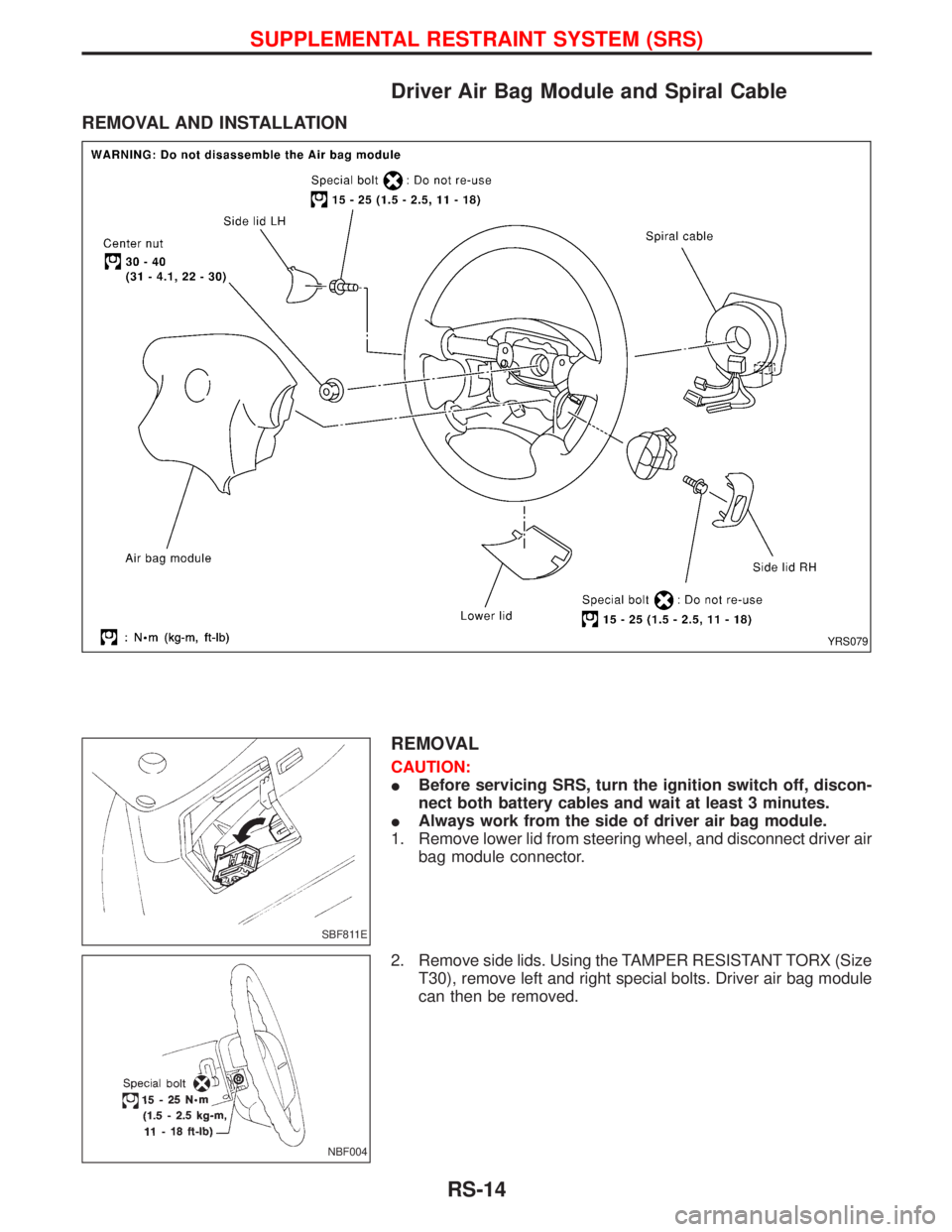
Driver Air Bag Module and Spiral Cable
REMOVAL AND INSTALLATION
REMOVAL
CAUTION:
IBefore servicing SRS, turn the ignition switch off, discon-
nect both battery cables and wait at least 3 minutes.
IAlways work from the side of driver air bag module.
1. Remove lower lid from steering wheel, and disconnect driver air
bag module connector.
2. Remove side lids. Using the TAMPER RESISTANT TORX (Size
T30), remove left and right special bolts. Driver air bag module
can then be removed.
YRS079
SBF811E
NBF004
SUPPLEMENTAL RESTRAINT SYSTEM (SRS)
RS-14
Page 1636 of 1767
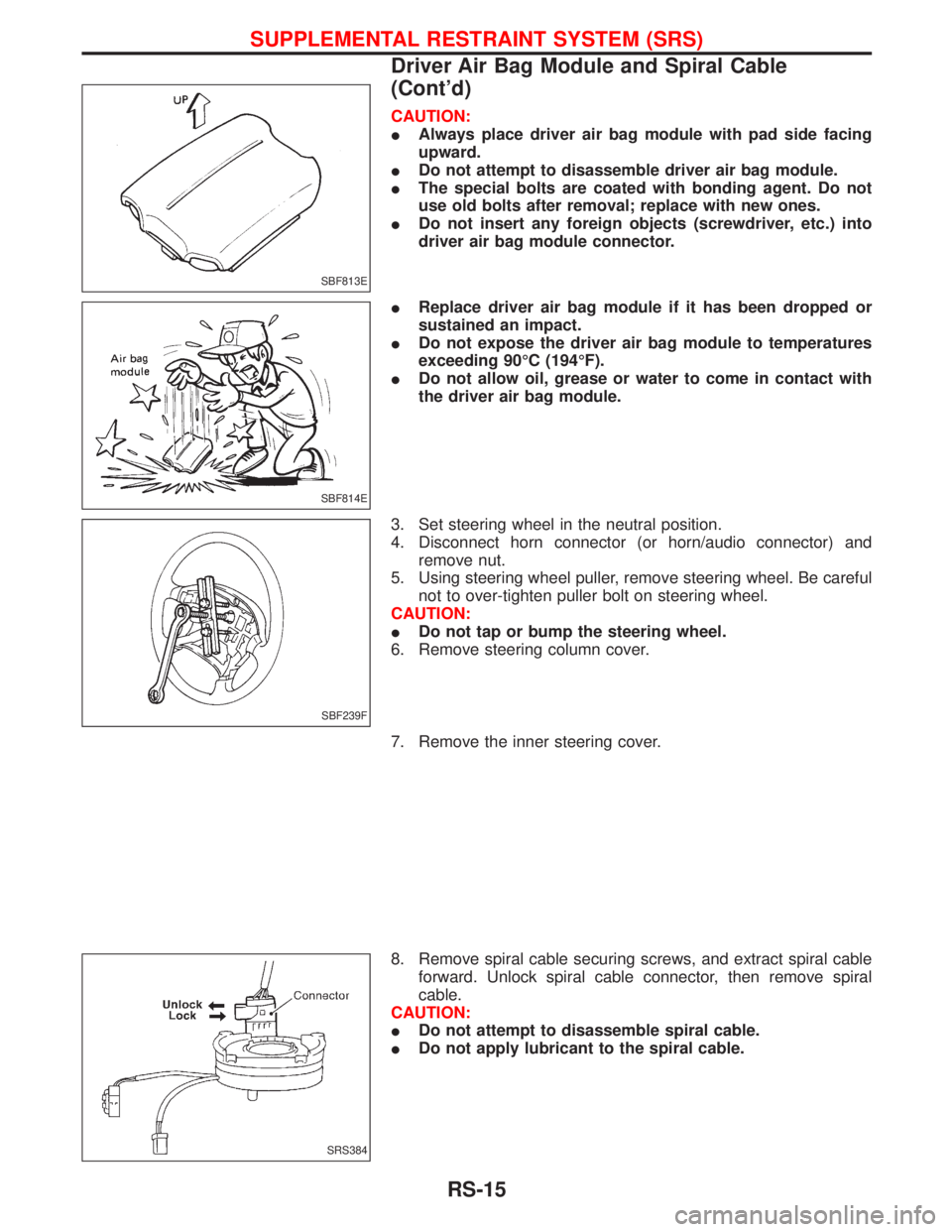
CAUTION:
IAlways place driver air bag module with pad side facing
upward.
IDo not attempt to disassemble driver air bag module.
IThe special bolts are coated with bonding agent. Do not
use old bolts after removal; replace with new ones.
IDo not insert any foreign objects (screwdriver, etc.) into
driver air bag module connector.
IReplace driver air bag module if it has been dropped or
sustained an impact.
IDo not expose the driver air bag module to temperatures
exceeding 90ÉC (194ÉF).
IDo not allow oil, grease or water to come in contact with
the driver air bag module.
3. Set steering wheel in the neutral position.
4. Disconnect horn connector (or horn/audio connector) and
remove nut.
5. Using steering wheel puller, remove steering wheel. Be careful
not to over-tighten puller bolt on steering wheel.
CAUTION:
IDo not tap or bump the steering wheel.
6. Remove steering column cover.
7. Remove the inner steering cover.
8. Remove spiral cable securing screws, and extract spiral cable
forward. Unlock spiral cable connector, then remove spiral
cable.
CAUTION:
IDo not attempt to disassemble spiral cable.
IDo not apply lubricant to the spiral cable.
SBF813E
SBF814E
SBF239F
SRS384
SUPPLEMENTAL RESTRAINT SYSTEM (SRS)
Driver Air Bag Module and Spiral Cable
(Cont'd)
RS-15
Page 1637 of 1767
INSTALLATION
1. Set the front wheels in the straight-ahead position.
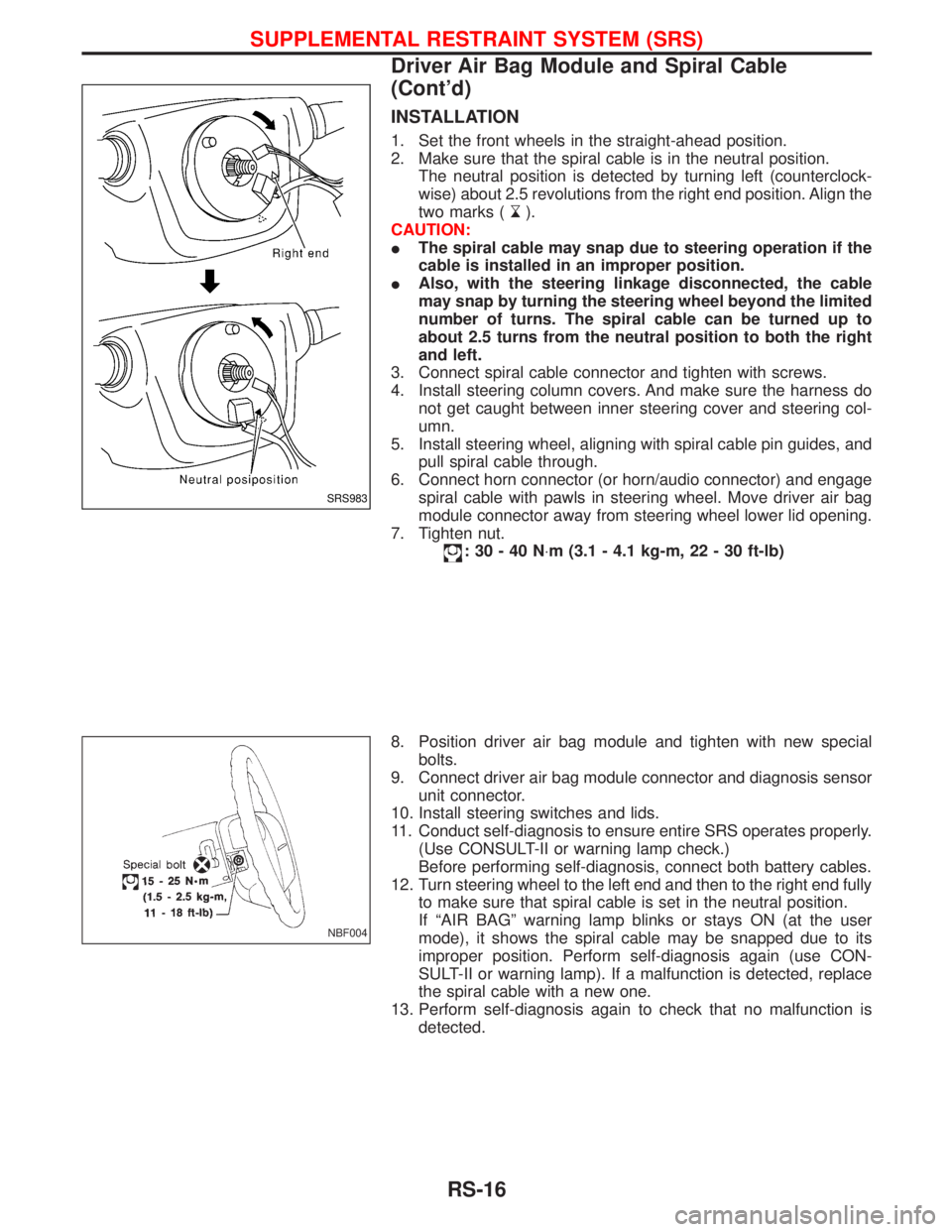
2. Make sure that the spiral cable is in the neutral position.
The neutral position is detected by turning left (counterclock-
wise) about 2.5 revolutions from the right end position. Align the
two marks (
).
CAUTION:
IThe spiral cable may snap due to steering operation if the
cable is installed in an improper position.
IAlso, with the steering linkage disconnected, the cable
may snap by turning the steering wheel beyond the limited
number of turns. The spiral cable can be turned up to
about 2.5 turns from the neutral position to both the right
and left.
3. Connect spiral cable connector and tighten with screws.
4. Install steering column covers. And make sure the harness do
not get caught between inner steering cover and steering col-
umn.
5. Install steering wheel, aligning with spiral cable pin guides, and
pull spiral cable through.
6. Connect horn connector (or horn/audio connector) and engage
spiral cable with pawls in steering wheel. Move driver air bag
module connector away from steering wheel lower lid opening.
7. Tighten nut.
:30-40N×m (3.1 - 4.1 kg-m, 22 - 30 ft-lb)
8. Position driver air bag module and tighten with new special
bolts.
9. Connect driver air bag module connector and diagnosis sensor
unit connector.
10. Install steering switches and lids.
11. Conduct self-diagnosis to ensure entire SRS operates properly.
(Use CONSULT-II or warning lamp check.)
Before performing self-diagnosis, connect both battery cables.
12. Turn steering wheel to the left end and then to the right end fully
to make sure that spiral cable is set in the neutral position.
If ªAIR BAGº warning lamp blinks or stays ON (at the user
mode), it shows the spiral cable may be snapped due to its
improper position. Perform self-diagnosis again (use CON-
SULT-II or warning lamp). If a malfunction is detected, replace
the spiral cable with a new one.
13. Perform self-diagnosis again to check that no malfunction is
detected.
SRS983
NBF004
SUPPLEMENTAL RESTRAINT SYSTEM (SRS)
Driver Air Bag Module and Spiral Cable
(Cont'd)
RS-16
Page 1639 of 1767
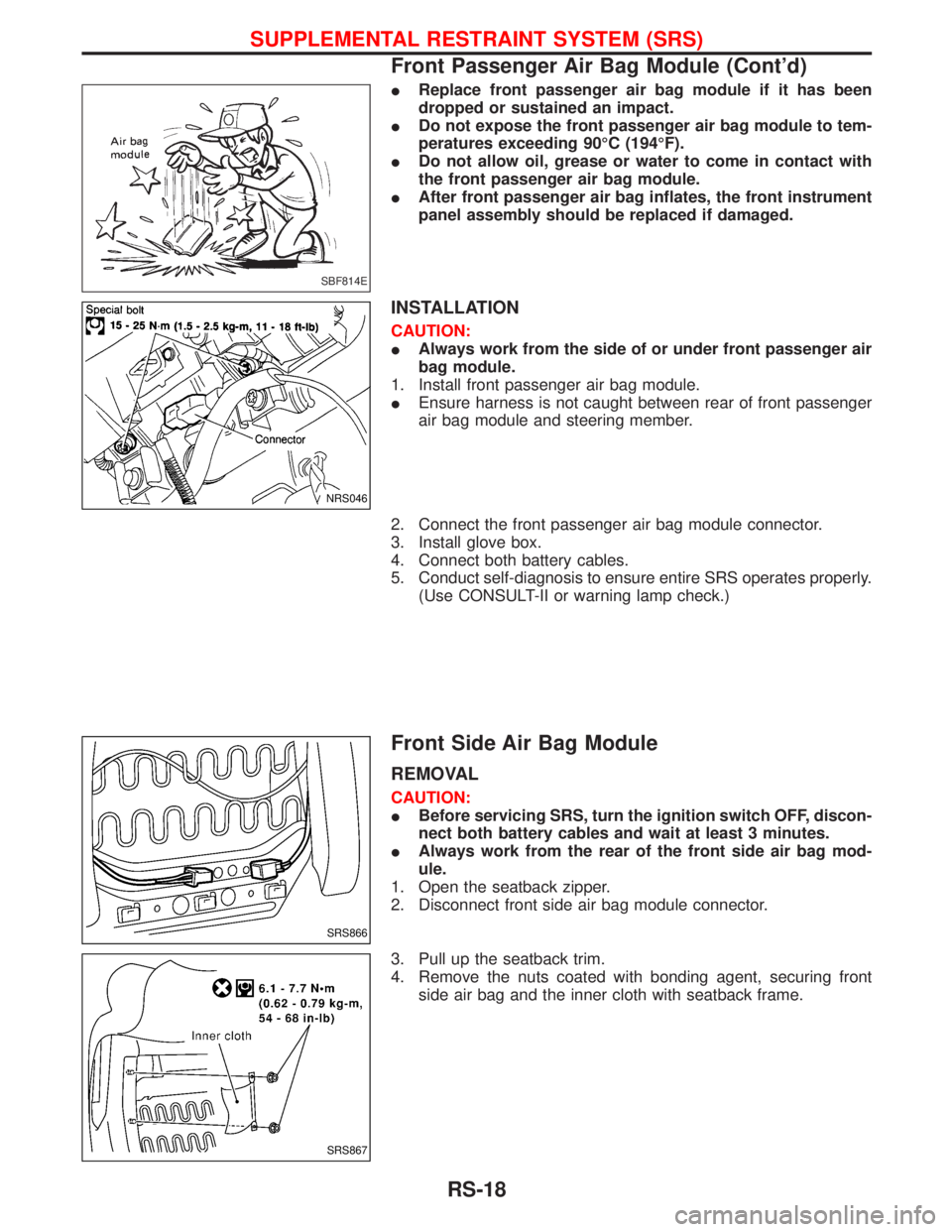
IReplace front passenger air bag module if it has been
dropped or sustained an impact.
IDo not expose the front passenger air bag module to tem-
peratures exceeding 90ÉC (194ÉF).
IDo not allow oil, grease or water to come in contact with
the front passenger air bag module.
IAfter front passenger air bag inflates, the front instrument
panel assembly should be replaced if damaged.
INSTALLATION
CAUTION:
IAlways work from the side of or under front passenger air
bag module.
1. Install front passenger air bag module.
IEnsure harness is not caught between rear of front passenger
air bag module and steering member.
2. Connect the front passenger air bag module connector.
3. Install glove box.
4. Connect both battery cables.
5. Conduct self-diagnosis to ensure entire SRS operates properly.
(Use CONSULT-II or warning lamp check.)
Front Side Air Bag Module
REMOVAL
CAUTION:
IBefore servicing SRS, turn the ignition switch OFF, discon-
nect both battery cables and wait at least 3 minutes.
IAlways work from the rear of the front side air bag mod-
ule.
1. Open the seatback zipper.
2. Disconnect front side air bag module connector.
3. Pull up the seatback trim.
4. Remove the nuts coated with bonding agent, securing front
side air bag and the inner cloth with seatback frame.
SBF814E
NRS046
SRS866
SRS867
SUPPLEMENTAL RESTRAINT SYSTEM (SRS)
Front Passenger Air Bag Module (Cont'd)
RS-18