ECU NISSAN TERRANO 2004 Service Owners Manual
[x] Cancel search | Manufacturer: NISSAN, Model Year: 2004, Model line: TERRANO, Model: NISSAN TERRANO 2004Pages: 1833, PDF Size: 53.42 MB
Page 1299 of 1833
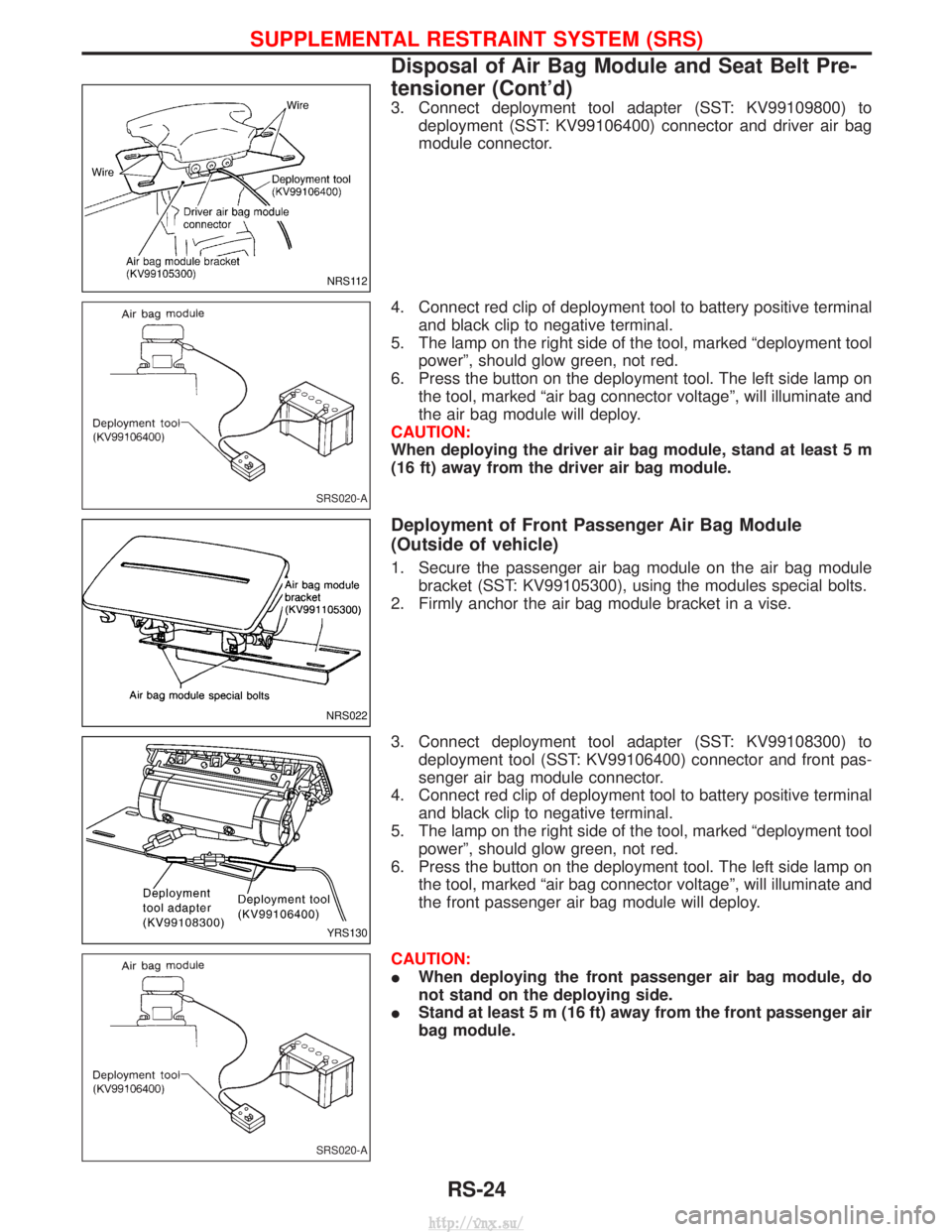
3. Connect deployment tool adapter (SST: KV99109800) todeployment (SST: KV99106400) connector and driver air bag
module connector.
4. Connect red clip of deployment tool to battery positive terminal and black clip to negative terminal.
5. The lamp on the right side of the tool, marked ªdeployment tool powerº, should glow green, not red.
6. Press the button on the deployment tool. The left side lamp on the tool, marked ªair bag connector voltageº, will illuminate and
the air bag module will deploy.
CAUTION:
When deploying the driver air bag module, stand at least 5 m
(16 ft) away from the driver air bag module.
Deployment of Front Passenger Air Bag Module
(Outside of vehicle)
1. Secure the passenger air bag module on the air bag module bracket (SST: KV99105300), using the modules special bolts.
2. Firmly anchor the air bag module bracket in a vise.
3. Connect deployment tool adapter (SST: KV99108300) to deployment tool (SST: KV99106400) connector and front pas-
senger air bag module connector.
4. Connect red clip of deployment tool to battery positive terminal and black clip to negative terminal.
5. The lamp on the right side of the tool, marked ªdeployment tool powerº, should glow green, not red.
6. Press the button on the deployment tool. The left side lamp on the tool, marked ªair bag connector voltageº, will illuminate and
the front passenger air bag module will deploy.
CAUTION:
I When deploying the front passenger air bag module, do
not stand on the deploying side.
I Stand at least 5 m (16 ft) away from the front passenger air
bag module.
NRS112
SRS020-A
NRS022
YRS130
SRS020-A
SUPPLEMENTAL RESTRAINT SYSTEM (SRS)
Disposal of Air Bag Module and Seat Belt Pre-
tensioner (Cont'd)
RS-24
http://vnx.su/
Page 1300 of 1833
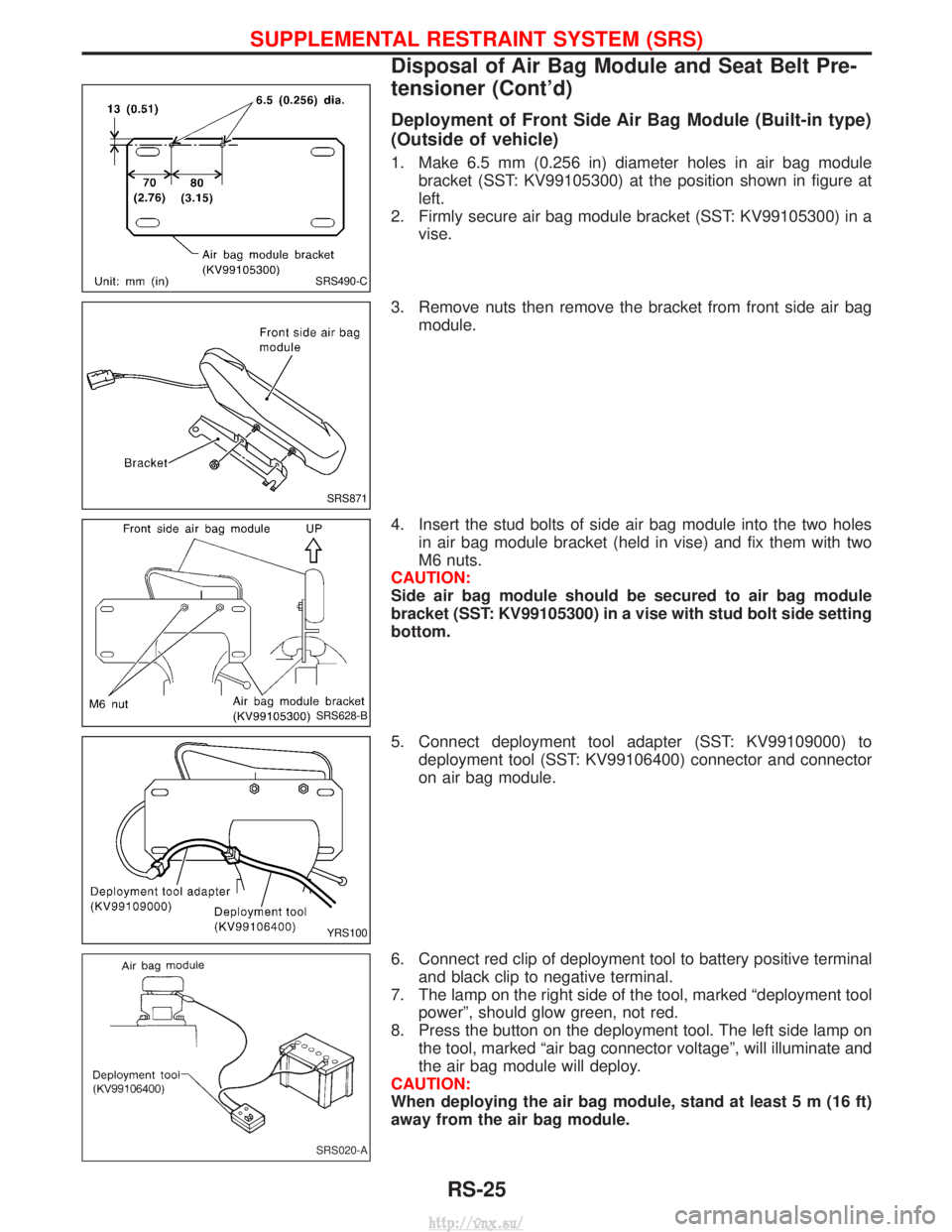
Deployment of Front Side Air Bag Module (Built-in type)
(Outside of vehicle)
1. Make 6.5 mm (0.256 in) diameter holes in air bag modulebracket (SST: KV99105300) at the position shown in figure at
left.
2. Firmly secure air bag module bracket (SST: KV99105300) in a vise.
3. Remove nuts then remove the bracket from front side air bag module.
4. Insert the stud bolts of side air bag module into the two holes in air bag module bracket (held in vise) and fix them with two
M6 nuts.
CAUTION:
Side air bag module should be secured to air bag module
bracket (SST: KV99105300) in a vise with stud bolt side setting
bottom.
5. Connect deployment tool adapter (SST: KV99109000) to deployment tool (SST: KV99106400) connector and connector
on air bag module.
6. Connect red clip of deployment tool to battery positive terminal and black clip to negative terminal.
7. The lamp on the right side of the tool, marked ªdeployment tool powerº, should glow green, not red.
8. Press the button on the deployment tool. The left side lamp on the tool, marked ªair bag connector voltageº, will illuminate and
the air bag module will deploy.
CAUTION:
When deploying the air bag module, stand at least 5 m (16 ft)
away from the air bag module.
SRS490-C
SRS871
SRS628-B
YRS100
SRS020-A
SUPPLEMENTAL RESTRAINT SYSTEM (SRS)
Disposal of Air Bag Module and Seat Belt Pre-
tensioner (Cont'd)
RS-25
http://vnx.su/
Page 1301 of 1833
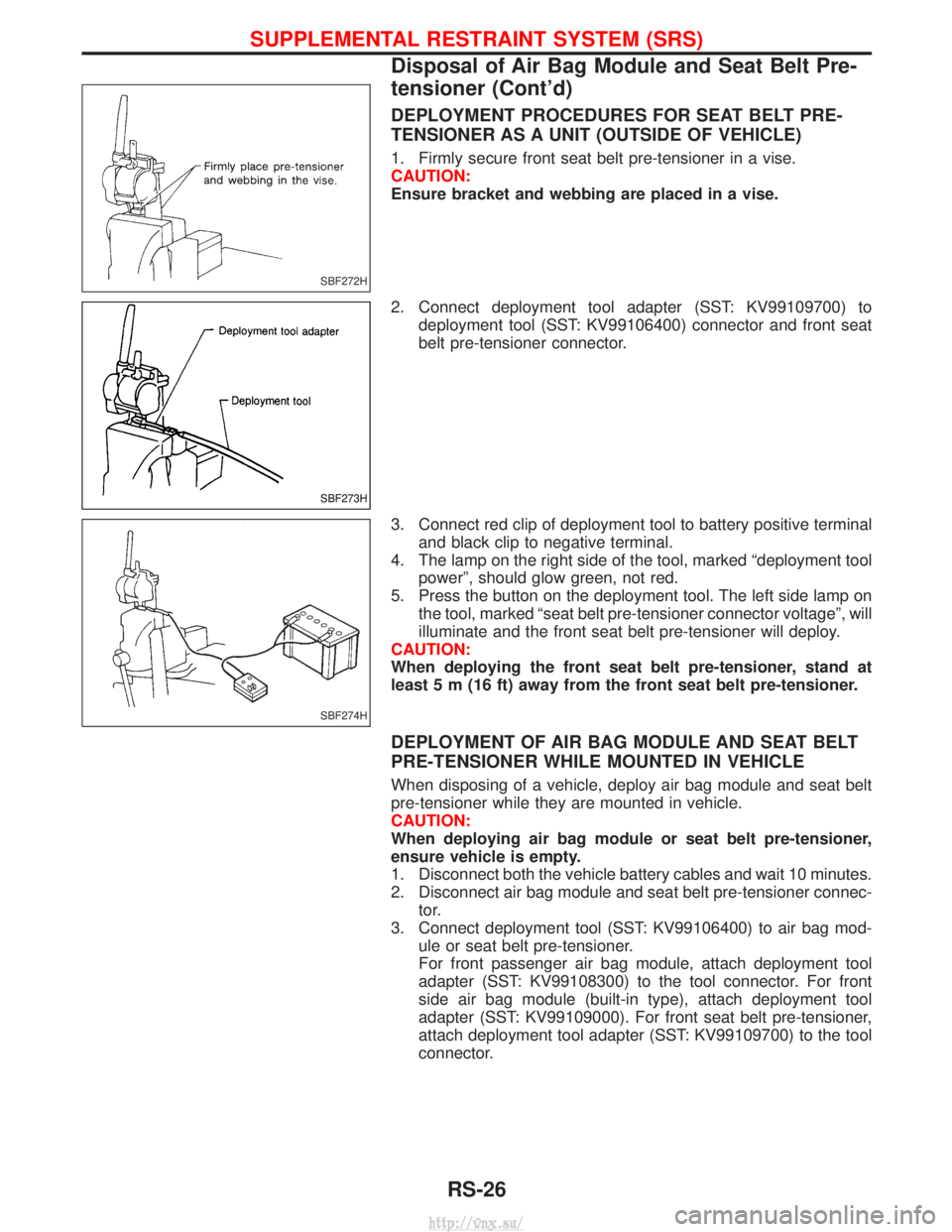
DEPLOYMENT PROCEDURES FOR SEAT BELT PRE-
TENSIONER AS A UNIT (OUTSIDE OF VEHICLE)
1. Firmly secure front seat belt pre-tensioner in a vise.
CAUTION:
Ensure bracket and webbing are placed in a vise.
2. Connect deployment tool adapter (SST: KV99109700) todeployment tool (SST: KV99106400) connector and front seat
belt pre-tensioner connector.
3. Connect red clip of deployment tool to battery positive terminal and black clip to negative terminal.
4. The lamp on the right side of the tool, marked ªdeployment tool powerº, should glow green, not red.
5. Press the button on the deployment tool. The left side lamp on the tool, marked ªseat belt pre-tensioner connector voltageº, will
illuminate and the front seat belt pre-tensioner will deploy.
CAUTION:
When deploying the front seat belt pre-tensioner, stand at
least 5 m (16 ft) away from the front seat belt pre-tensioner.
DEPLOYMENT OF AIR BAG MODULE AND SEAT BELT
PRE-TENSIONER WHILE MOUNTED IN VEHICLE
When disposing of a vehicle, deploy air bag module and seat belt
pre-tensioner while they are mounted in vehicle.
CAUTION:
When deploying air bag module or seat belt pre-tensioner,
ensure vehicle is empty.
1. Disconnect both the vehicle battery cables and wait 10 minutes.
2. Disconnect air bag module and seat belt pre-tensioner connec- tor.
3. Connect deployment tool (SST: KV99106400) to air bag mod- ule or seat belt pre-tensioner.
For front passenger air bag module, attach deployment tool
adapter (SST: KV99108300) to the tool connector. For front
side air bag module (built-in type), attach deployment tool
adapter (SST: KV99109000). For front seat belt pre-tensioner,
attach deployment tool adapter (SST: KV99109700) to the tool
connector.
SBF272H
SBF273H
SBF274H
SUPPLEMENTAL RESTRAINT SYSTEM (SRS)
Disposal of Air Bag Module and Seat Belt Pre-
tensioner (Cont'd)
RS-26
http://vnx.su/
Page 1303 of 1833
Trouble Diagnoses Introduction
CAUTION:
IDo not use electrical test equipment on any circuit related to the SRS unless instructed to in this
Service Manual. Spiral cable and wiring harnesses covered with yellow insulation tape either just
before the harness connectors or for the complete harness are related to the SRS.
I Do not attempt to repair, splice or modify the SRS wiring harness. If the harness is damaged,
replace it with a new one.
I Keep ground portion clean.
DIAGNOSIS FUNCTION
The SRS self-diagnosis results can be read by using ªAIR BAGº warning lamp and/or CONSULT-II. The read-
ing of these results is accomplished using one of two modes Ð ªUser modeº and ªDiagnosis modeº.
The User mode is exclusively prepared for the customer (driver). This mode warns the driver of a system
malfunction through the operation of the ªAIR BAGº warning lamp.
The Diagnosis mode allows the technician to locate and inspect the malfunctioning part.
The mode applications for the ªAIR BAGº warning lamp and CONSULT-II are as follows:
User mode Diagnosis mode Display type
ªAIR BAGº warning lamp X X ON-OFF operation
CONSULT-II Ð X Monitoring
NOTE:
Seat belt pre-tensioner malfunction is indicated by ªAIR BAGº warning lamp.
DIAGNOSIS MODE FOR CONSULT-II
I ªSELF-DIAG [CURRENT]º
A current self-diagnosis result (also indicated by the number of warning lamp flashes in the Diagnosis
mode) is displayed on the CONSULT-II screen in real time. This refers to a malfunctioning part requiring
repairs.
I ªSELF-DIAG [PAST]º
Diagnosis results previously stored in the memory are displayed on the CONSULT-II screen. The stored
results are not erased until memory erasing is executed.
I ªTROUBLE DIAG RECORDº
With TROUBLE DIAG RECORD, diagnosis results previously erased by a reset operation can be displayed
on the CONSULT-II screen.
I ªECU DISCRIMINATED NO.º
The diagnosis sensor unit for each vehicle model is assigned with its own, individual classification num-
ber (refer to the table below). This number will be displayed on the CONSULT-II screen. When replacing
the diagnosis sensor unit, refer to the part number for the compatibility. After installation, replacement with
a correct unit can be checked by confirming this classification number on the CONSULT-II screen.
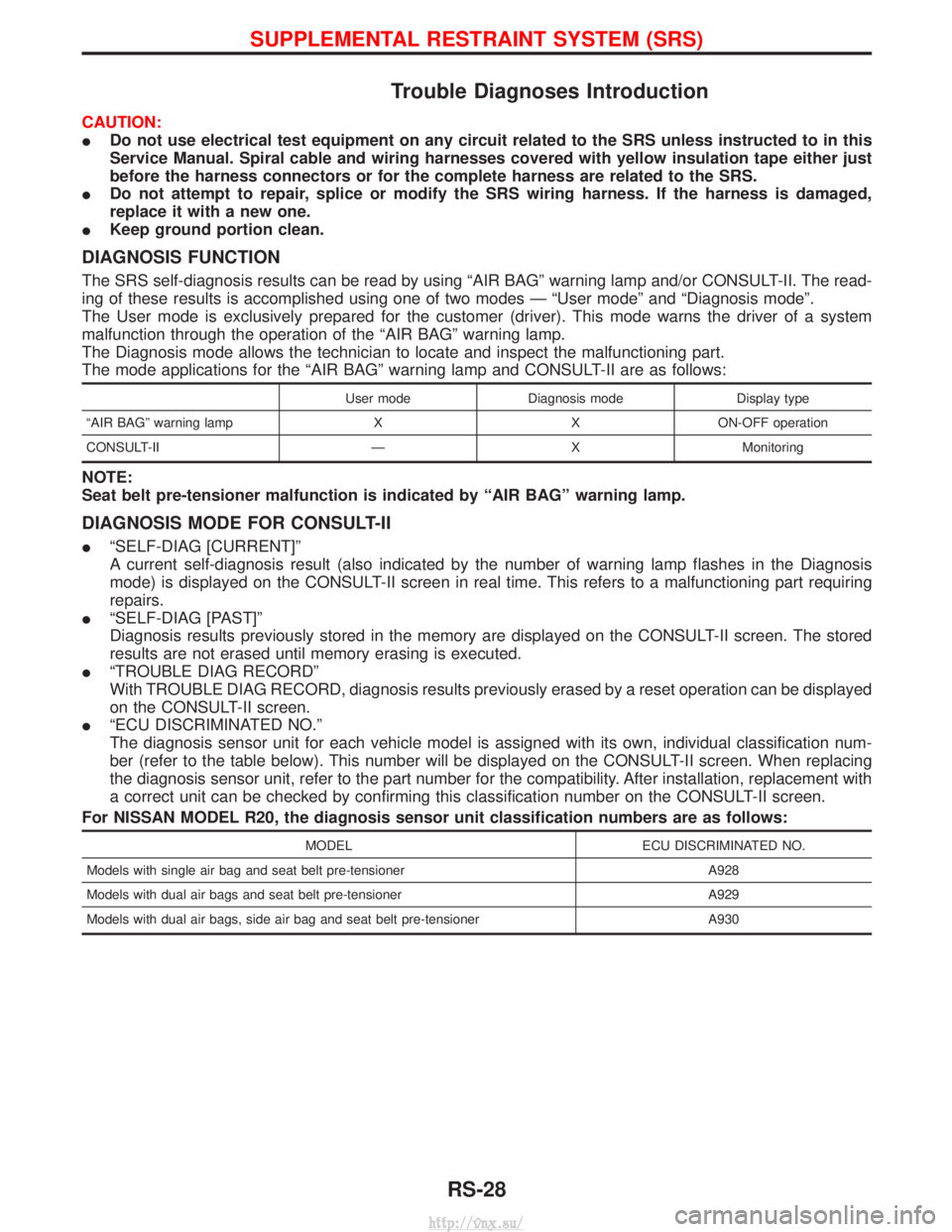
For NISSAN MODEL R20, the diagnosis sensor unit classification numbers are as follows:
MODEL ECU DISCRIMINATED NO.
Models with single air bag and seat belt pre-tensioner A928
Models with dual air bags and seat belt pre-tensioner A929
Models with dual air bags, side air bag and seat belt pre-tensioner A930
SUPPLEMENTAL RESTRAINT SYSTEM (SRS)
RS-28
http://vnx.su/
Page 1335 of 1833
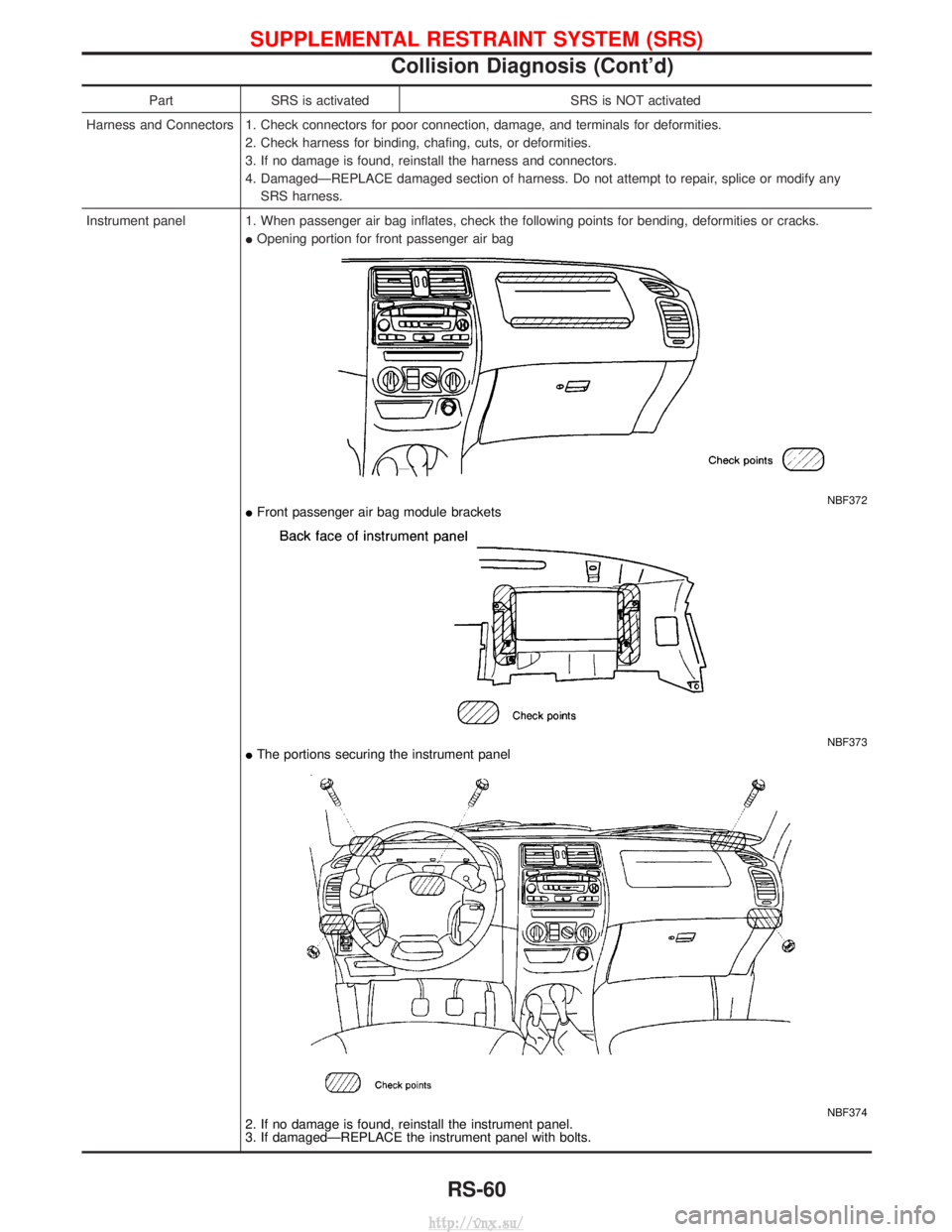
PartSRS is activated SRS is NOT activated
Harness and Connectors 1. Check connectors for poor connection, damage, and terminals for deformities. 2. Check harness for binding, chafing, cuts, or deformities.
3. If no damage is found, reinstall the harness and connectors.
4. DamagedÐREPLACE damaged section of harness. Do not attempt to repair, splice or modify anySRS harness.
Instrument panel 1. When passenger air bag inflates, check the following points for bending, deformities or cracks. IOpening portion for front passenger air bag
NBF372IFront passenger air bag module brackets
NBF373IThe portions securing the instrument panel
NBF3742. If no damage is found, reinstall the instrument panel.
3. If damagedÐREPLACE the instrument panel with bolts.
SUPPLEMENTAL RESTRAINT SYSTEM (SRS)
Collision Diagnosis (Cont'd)
RS-60
http://vnx.su/
Page 1377 of 1833
Removal and Installation
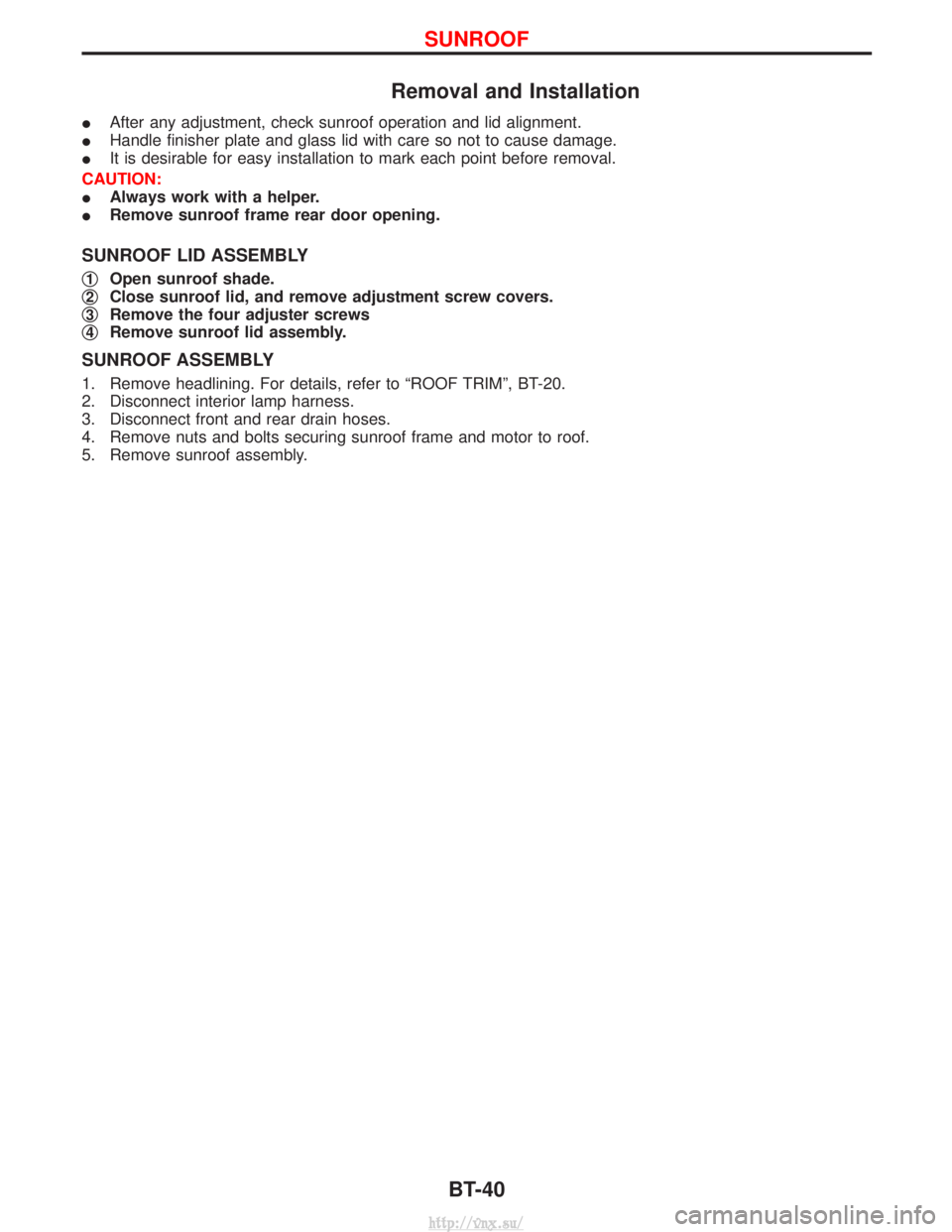
IAfter any adjustment, check sunroof operation and lid alignment.
I Handle finisher plate and glass lid with care so not to cause damage.
I It is desirable for easy installation to mark each point before removal.
CAUTION:
I Always work with a helper.
I Remove sunroof frame rear door opening.
SUNROOF LID ASSEMBLY
q1Open sunroof shade.
q
2Close sunroof lid, and remove adjustment screw covers.
q
3Remove the four adjuster screws
q
4Remove sunroof lid assembly.
SUNROOF ASSEMBLY
1. Remove headlining. For details, refer to ªROOF TRIMº, BT-20.
2. Disconnect interior lamp harness.
3. Disconnect front and rear drain hoses.
4. Remove nuts and bolts securing sunroof frame and motor to roof.
5. Remove sunroof assembly.
SUNROOF
BT-40
http://vnx.su/
Page 1379 of 1833
Removal and Installation
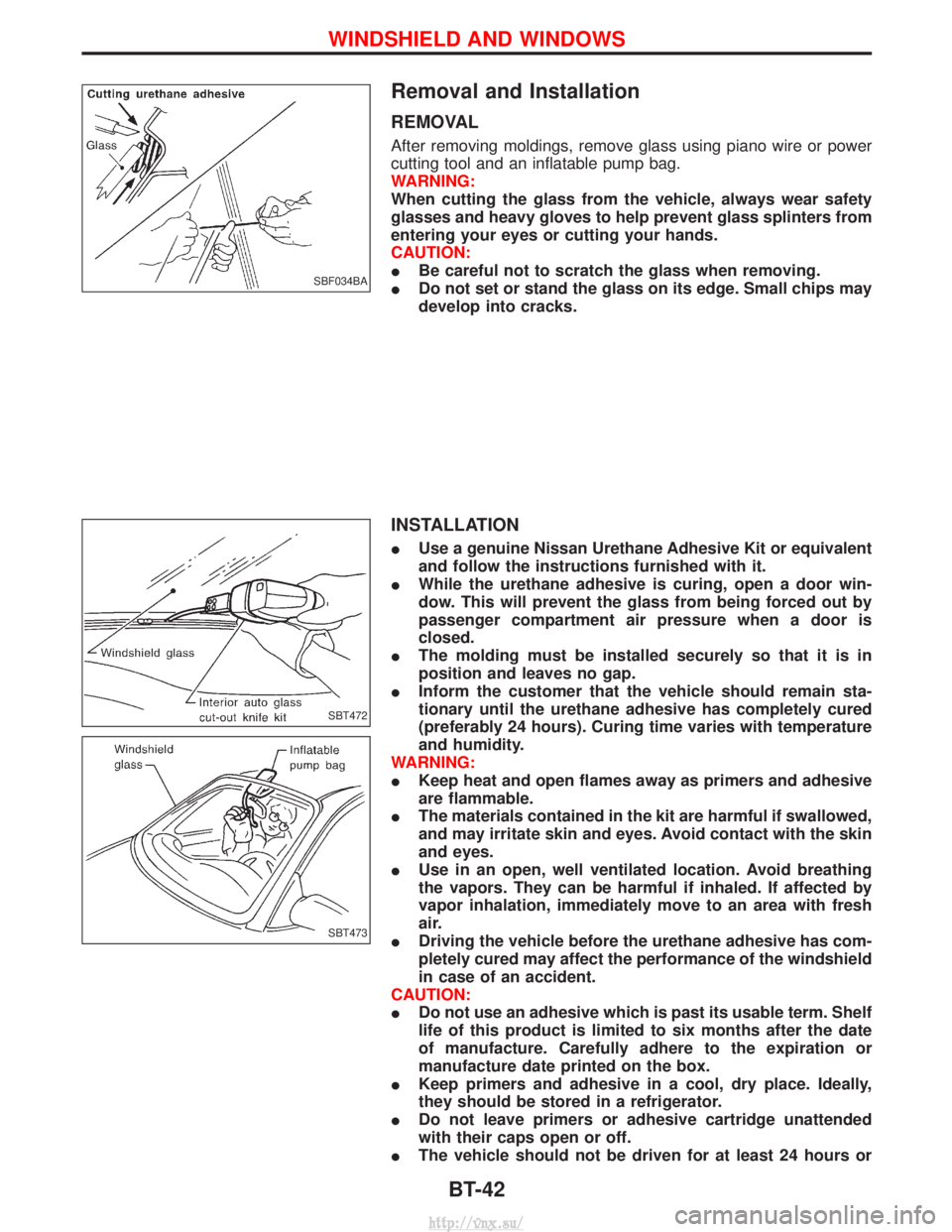
REMOVAL
After removing moldings, remove glass using piano wire or power
cutting tool and an inflatable pump bag.
WARNING:
When cutting the glass from the vehicle, always wear safety
glasses and heavy gloves to help prevent glass splinters from
entering your eyes or cutting your hands.
CAUTION:
IBe careful not to scratch the glass when removing.
I Do not set or stand the glass on its edge. Small chips may
develop into cracks.
INSTALLATION
IUse a genuine Nissan Urethane Adhesive Kit or equivalent
and follow the instructions furnished with it.
I While the urethane adhesive is curing, open a door win-
dow. This will prevent the glass from being forced out by
passenger compartment air pressure when a door is
closed.
I The molding must be installed securely so that it is in
position and leaves no gap.
I Inform the customer that the vehicle should remain sta-
tionary until the urethane adhesive has completely cured
(preferably 24 hours). Curing time varies with temperature
and humidity.
WARNING:
I Keep heat and open flames away as primers and adhesive
are flammable.
I The materials contained in the kit are harmful if swallowed,
and may irritate skin and eyes. Avoid contact with the skin
and eyes.
I Use in an open, well ventilated location. Avoid breathing
the vapors. They can be harmful if inhaled. If affected by
vapor inhalation, immediately move to an area with fresh
air.
I Driving the vehicle before the urethane adhesive has com-
pletely cured may affect the performance of the windshield
in case of an accident.
CAUTION:
I Do not use an adhesive which is past its usable term. Shelf
life of this product is limited to six months after the date
of manufacture. Carefully adhere to the expiration or
manufacture date printed on the box.
I Keep primers and adhesive in a cool, dry place. Ideally,
they should be stored in a refrigerator.
I Do not leave primers or adhesive cartridge unattended
with their caps open or off.
I The vehicle should not be driven for at least 24 hours or
SBF034BA
SBT472
SBT473
WINDSHIELD AND WINDOWS
BT-42
http://vnx.su/
Page 1385 of 1833
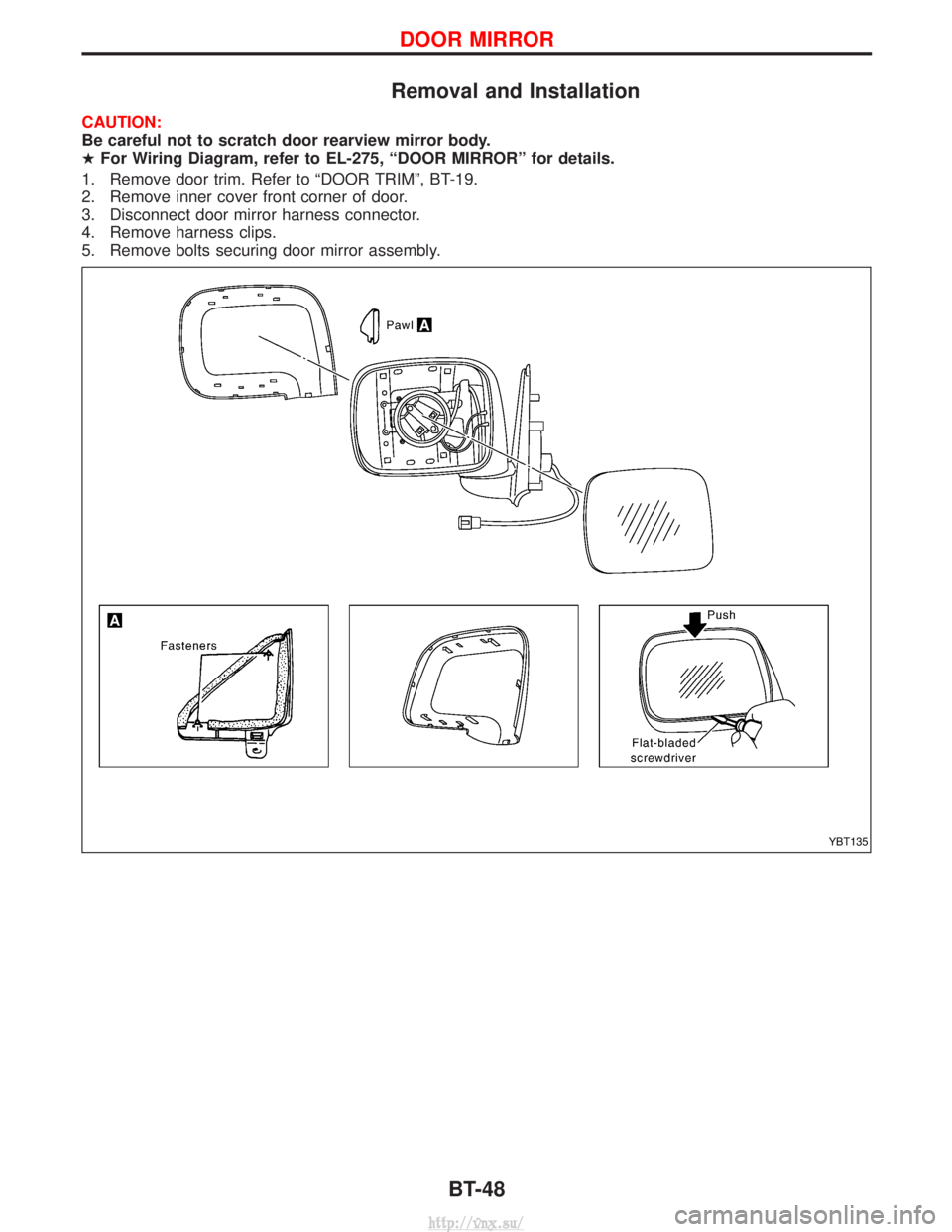
Removal and Installation
CAUTION:
Be careful not to scratch door rearview mirror body.
HFor Wiring Diagram, refer to EL-275, ªDOOR MIRRORº for details.
1. Remove door trim. Refer to ªDOOR TRIMº, BT-19.
2. Remove inner cover front corner of door.
3. Disconnect door mirror harness connector.
4. Remove harness clips.
5. Remove bolts securing door mirror assembly.
YBT135
DOOR MIRROR
BT-48
http://vnx.su/
Page 1412 of 1833
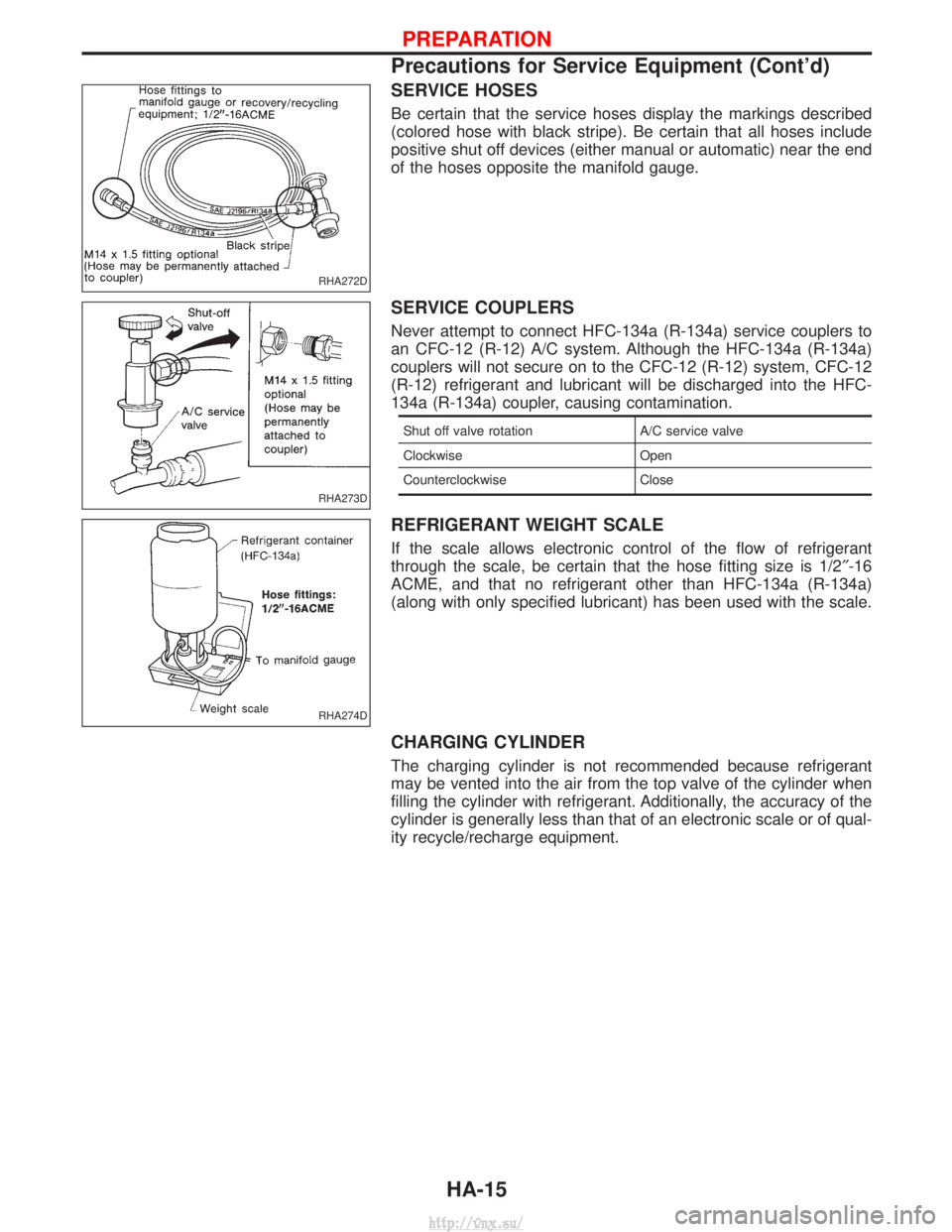
SERVICE HOSES
Be certain that the service hoses display the markings described
(colored hose with black stripe). Be certain that all hoses include
positive shut off devices (either manual or automatic) near the end
of the hoses opposite the manifold gauge.
SERVICE COUPLERS
Never attempt to connect HFC-134a (R-134a) service couplers to
an CFC-12 (R-12) A/C system. Although the HFC-134a (R-134a)
couplers will not secure on to the CFC-12 (R-12) system, CFC-12
(R-12) refrigerant and lubricant will be discharged into the HFC-
134a (R-134a) coupler, causing contamination.
Shut off valve rotationA/C service valve
Clockwise Open
Counterclockwise Close
REFRIGERANT WEIGHT SCALE
If the scale allows electronic control of the flow of refrigerant
through the scale, be certain that the hose fitting size is 1/2 ²-16
ACME, and that no refrigerant other than HFC-134a (R-134a)
(along with only specified lubricant) has been used with the scale.
CHARGING CYLINDER
The charging cylinder is not recommended because refrigerant
may be vented into the air from the top valve of the cylinder when
filling the cylinder with refrigerant. Additionally, the accuracy of the
cylinder is generally less than that of an electronic scale or of qual-
ity recycle/recharge equipment.
RHA272D
RHA273D
RHA274D
PREPARATION
Precautions for Service Equipment (Cont'd)
HA-15
http://vnx.su/
Page 1471 of 1833
![NISSAN TERRANO 2004 Service Owners Manual TypeCurrent (A)
075 [YUASA type code] 300
110D26R(L) 300
95E41R(L) 300
067 [YUASA type code] 325
130E41R(L) 330
096 [YUASA type code] 375
096L [YUASA type code] 375
010S [YUASA type code] 360
A: SLOW](/img/5/57394/w960_57394-1470.png "NISSAN TERRANO 2004 Service Owners Manual TypeCurrent (A)
075 [YUASA type code] 300
110D26R(L) 300
95E41R(L) 300
067 [YUASA type code] 325
130E41R(L) 330
096 [YUASA type code] 375
096L [YUASA type code] 375
010S [YUASA type code] 360
A: SLOW")
TypeCurrent (A)
075 [YUASA type code] 300
110D26R(L) 300
95E41R(L) 300
067 [YUASA type code] 325
130E41R(L) 330
096 [YUASA type code] 375
096L [YUASA type code] 375
010S [YUASA type code] 360
A: SLOW CHARGE
*1: SC-4*2: SC-7
SEL756W
BATTERY
Battery Test and Charging Chart (Cont'd)
SC-8
http://vnx.su/