check engine light NISSAN TERRANO 2004 Service User Guide
[x] Cancel search | Manufacturer: NISSAN, Model Year: 2004, Model line: TERRANO, Model: NISSAN TERRANO 2004Pages: 1833, PDF Size: 53.42 MB
Page 591 of 1833
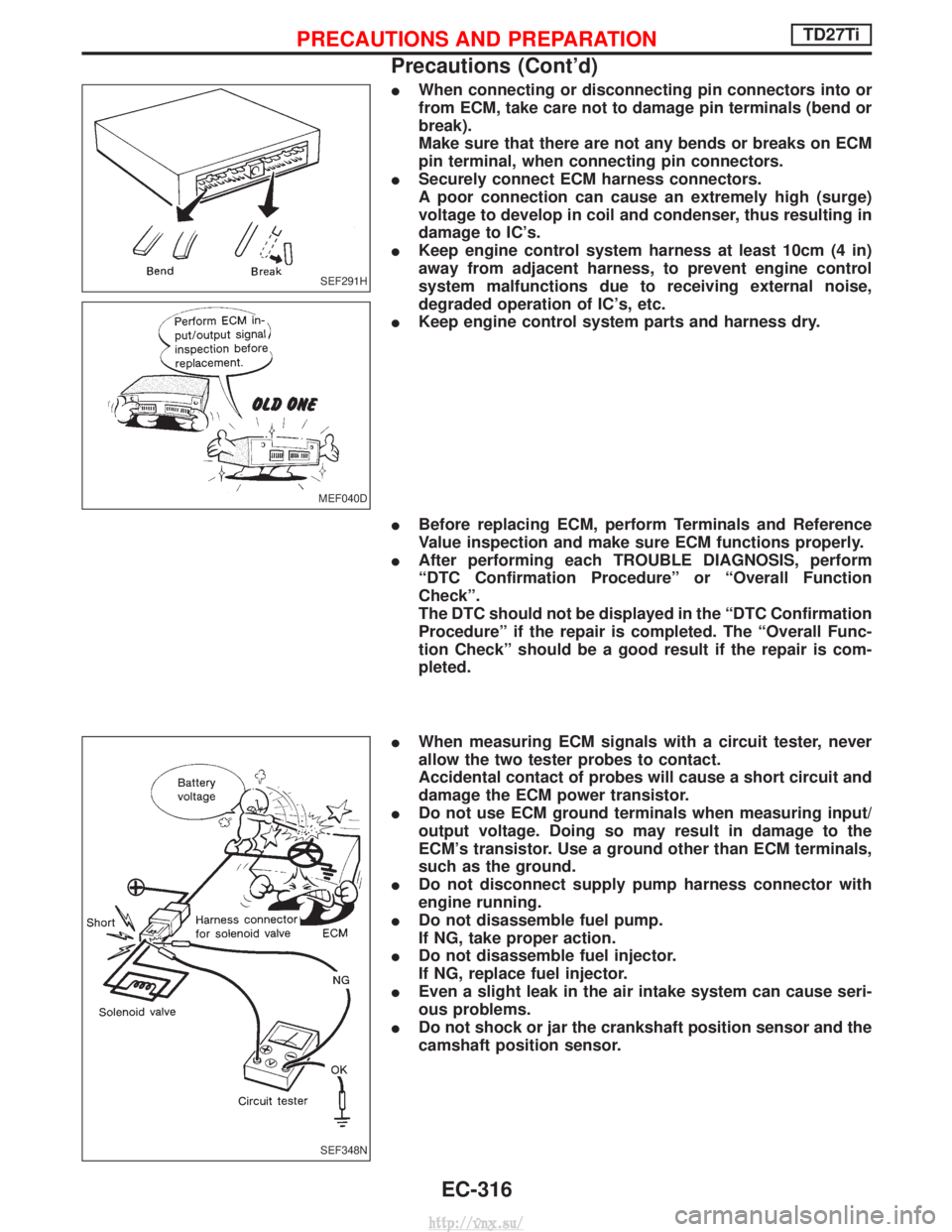
IWhen connecting or disconnecting pin connectors into or
from ECM, take care not to damage pin terminals (bend or
break).
Make sure that there are not any bends or breaks on ECM
pin terminal, when connecting pin connectors.
I Securely connect ECM harness connectors.
A poor connection can cause an extremely high (surge)
voltage to develop in coil and condenser, thus resulting in
damage to IC's.
I Keep engine control system harness at least 10cm (4 in)
away from adjacent harness, to prevent engine control
system malfunctions due to receiving external noise,
degraded operation of IC's, etc.
I Keep engine control system parts and harness dry.
I Before replacing ECM, perform Terminals and Reference
Value inspection and make sure ECM functions properly.
I After performing each TROUBLE DIAGNOSIS, perform
ªDTC Confirmation Procedureº or ªOverall Function
Checkº.
The DTC should not be displayed in the ªDTC Confirmation
Procedureº if the repair is completed. The ªOverall Func-
tion Checkº should be a good result if the repair is com-
pleted.
I When measuring ECM signals with a circuit tester, never
allow the two tester probes to contact.
Accidental contact of probes will cause a short circuit and
damage the ECM power transistor.
I Do not use ECM ground terminals when measuring input/
output voltage. Doing so may result in damage to the
ECM's transistor. Use a ground other than ECM terminals,
such as the ground.
I Do not disconnect supply pump harness connector with
engine running.
I Do not disassemble fuel pump.
If NG, take proper action.
I Do not disassemble fuel injector.
If NG, replace fuel injector.
I Even a slight leak in the air intake system can cause seri-
ous problems.
I Do not shock or jar the crankshaft position sensor and the
camshaft position sensor.
SEF291H
MEF040D
SEF348N
PRECAUTIONS AND PREPARATIONTD27Ti
Precautions (Cont'd)
EC-316
http://vnx.su/
Page 620 of 1833
How to Erase DTC (Without CONSULT-II)
1. If the ignition switch stays ªONº after repair work, be sure to turn ignition switch ªOFFº once. Wait at least5 seconds and then turn it ªONº (engine stopped) again.
2. Change the diagnostic test mode from Mode II to Mode I by using the data link connector. (See EC-346.)
The emission related diagnostic information in the ECM can be erased by changing the diagnostic test mode.
I If the battery is disconnected, the emission-related diagnostic information will be lost after approx.
24 hours.
I Erasing the emission-related diagnostic information using CONSULT-II is easier and quicker than
switching the diagnostic test mode using the data link connector.
Malfunction Indicator (MI)
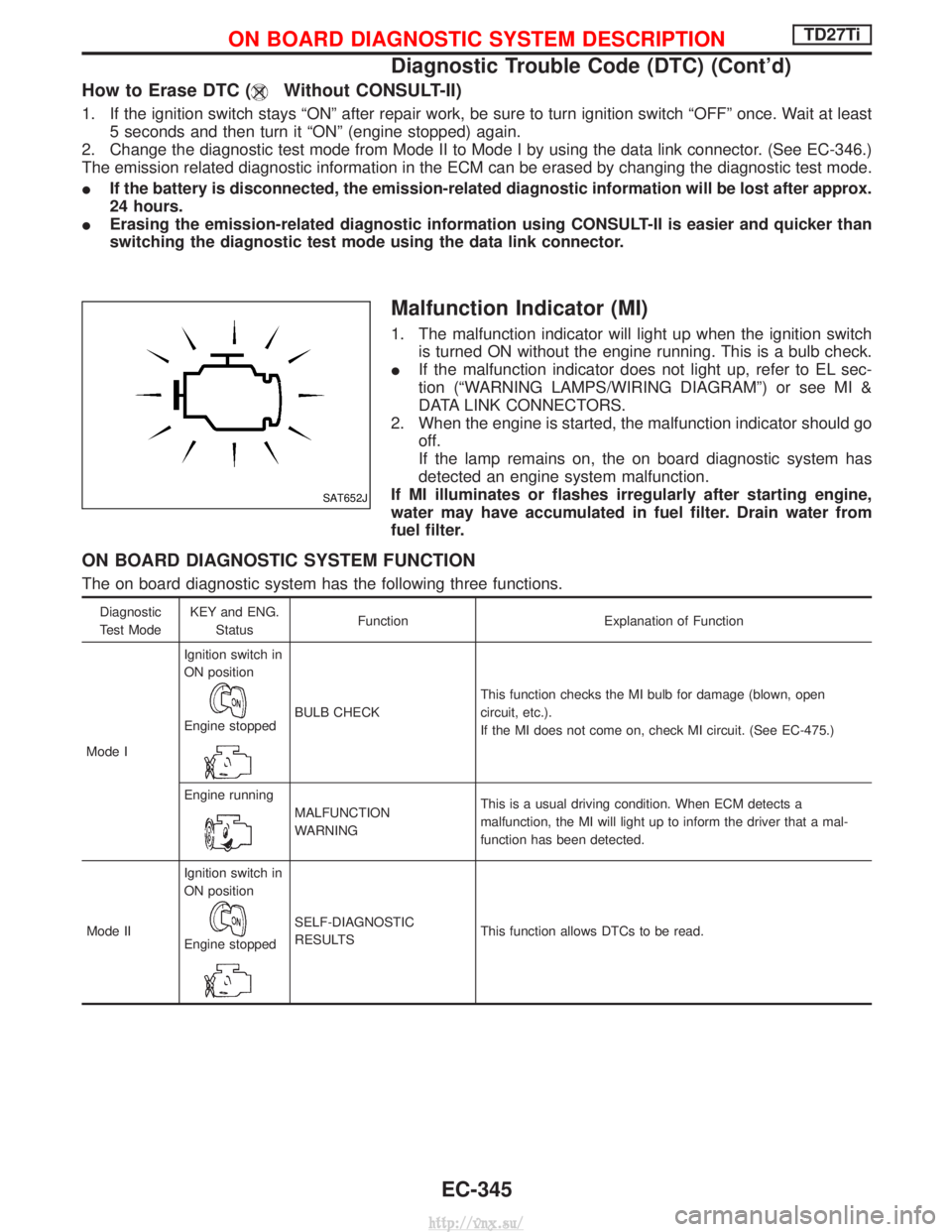
1. The malfunction indicator will light up when the ignition switch
is turned ON without the engine running. This is a bulb check.
I If the malfunction indicator does not light up, refer to EL sec-
tion (ªWARNING LAMPS/WIRING DIAGRAMº) or see MI &
DATA LINK CONNECTORS.
2. When the engine is started, the malfunction indicator should go off.
If the lamp remains on, the on board diagnostic system has
detected an engine system malfunction.
If MI illuminates or flashes irregularly after starting engine,
water may have accumulated in fuel filter. Drain water from
fuel filter.
ON BOARD DIAGNOSTIC SYSTEM FUNCTION
The on board diagnostic system has the following three functions.
Diagnostic
Test Mode KEY and ENG.
Status Function Explanation of Function
Mode I Ignition switch in
ON position
Engine stoppedBULB CHECK
This function checks the MI bulb for damage (blown, open
circuit, etc.).
If the MI does not come on, check MI circuit. (See EC-475.)
Engine running
MALFUNCTION
WARNING This is a usual driving condition. When ECM detects a
malfunction, the MI will light up to inform the driver that a mal-
function has been detected.
Mode II Ignition switch in
ON position
Engine stopped
SELF-DIAGNOSTIC
RESULTS
This function allows DTCs to be read.
SAT652J
ON BOARD DIAGNOSTIC SYSTEM DESCRIPTIONTD27Ti
Diagnostic Trouble Code (DTC) (Cont'd)
EC-345
http://vnx.su/
Page 702 of 1833
Component Description
Malfunction Indicator (MI) is located on the instrument panel. When the ignition switch is turned ON without
engine running, MI will light up. This is a bulb check. When the engine is started, MI should go off. If MI remains
on, the on board diagnostic system has detected an engine system malfunction.
On Board Diagnosis Logic
DTC No.Trouble diagnosis name DTC detecting condition Possible cause
P0650
0907 Malfunction indicator (MI) control cir-
cuit I
An excessively high voltage is sent
to ECM through the MI circuit
under the condition that calls for MI
light up.
I An excessively low voltage is sent
to ECM through the MI circuit
under the condition that calls for MI
not to light up. I
Harness or connectors
(MI circuit is open or shorted.)
I MI
DTC Confirmation Procedure
NOTE:
If ªDTC Confirmation Procedureº has been previously
conducted, always turn ignition switch ªOFFº and wait at least
10 seconds before conducting the next test.
WITH CONSULT-II
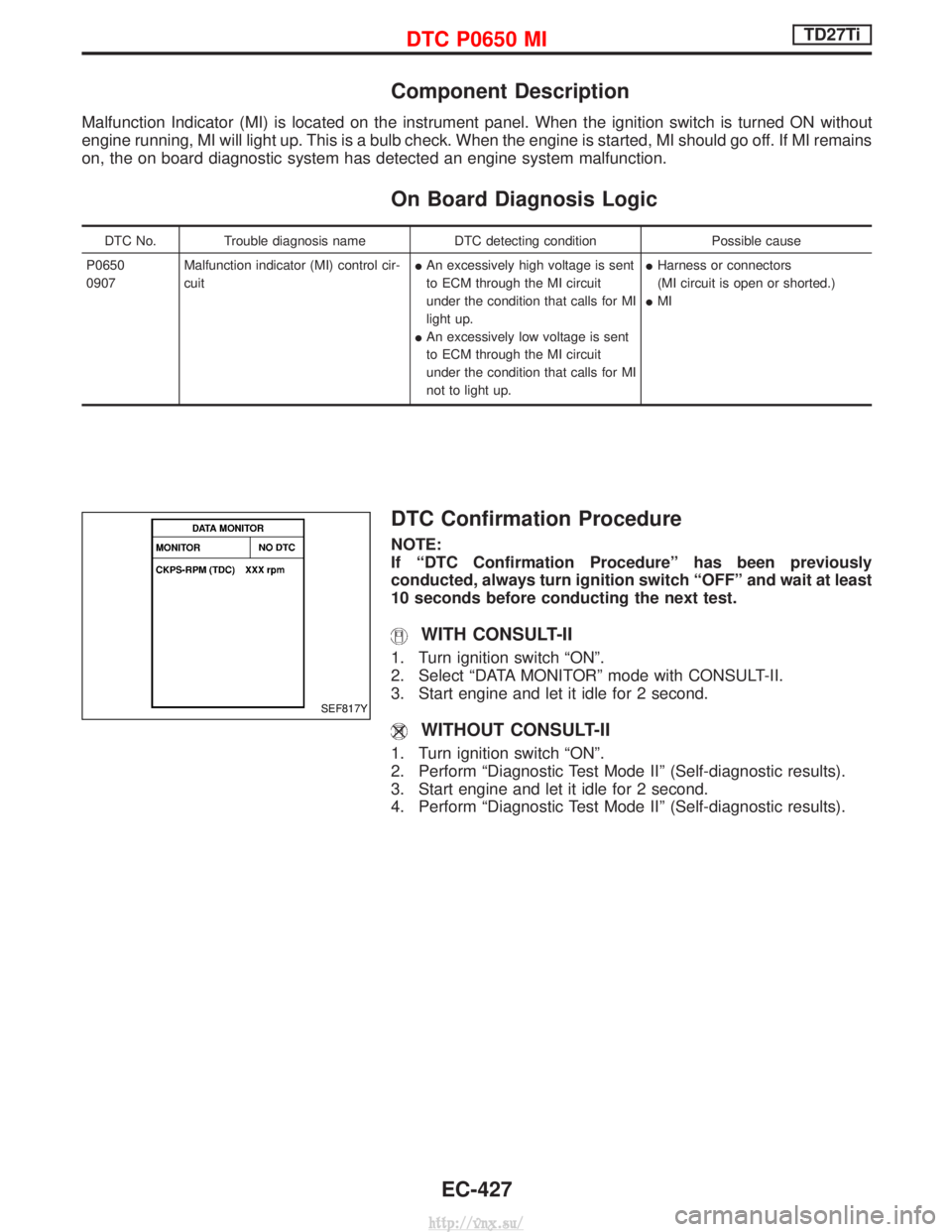
1. Turn ignition switch ªONº.
2. Select ªDATA MONITORº mode with CONSULT-II.
3. Start engine and let it idle for 2 second.
WITHOUT CONSULT-II
1. Turn ignition switch ªONº.
2. Perform ªDiagnostic Test Mode IIº (Self-diagnostic results).
3. Start engine and let it idle for 2 second.
4. Perform ªDiagnostic Test Mode IIº (Self-diagnostic results).
SEF817Y
DTC P0650 MITD27Ti
EC-427
http://vnx.su/
Page 753 of 1833
Removal and Installation
CAUTION:
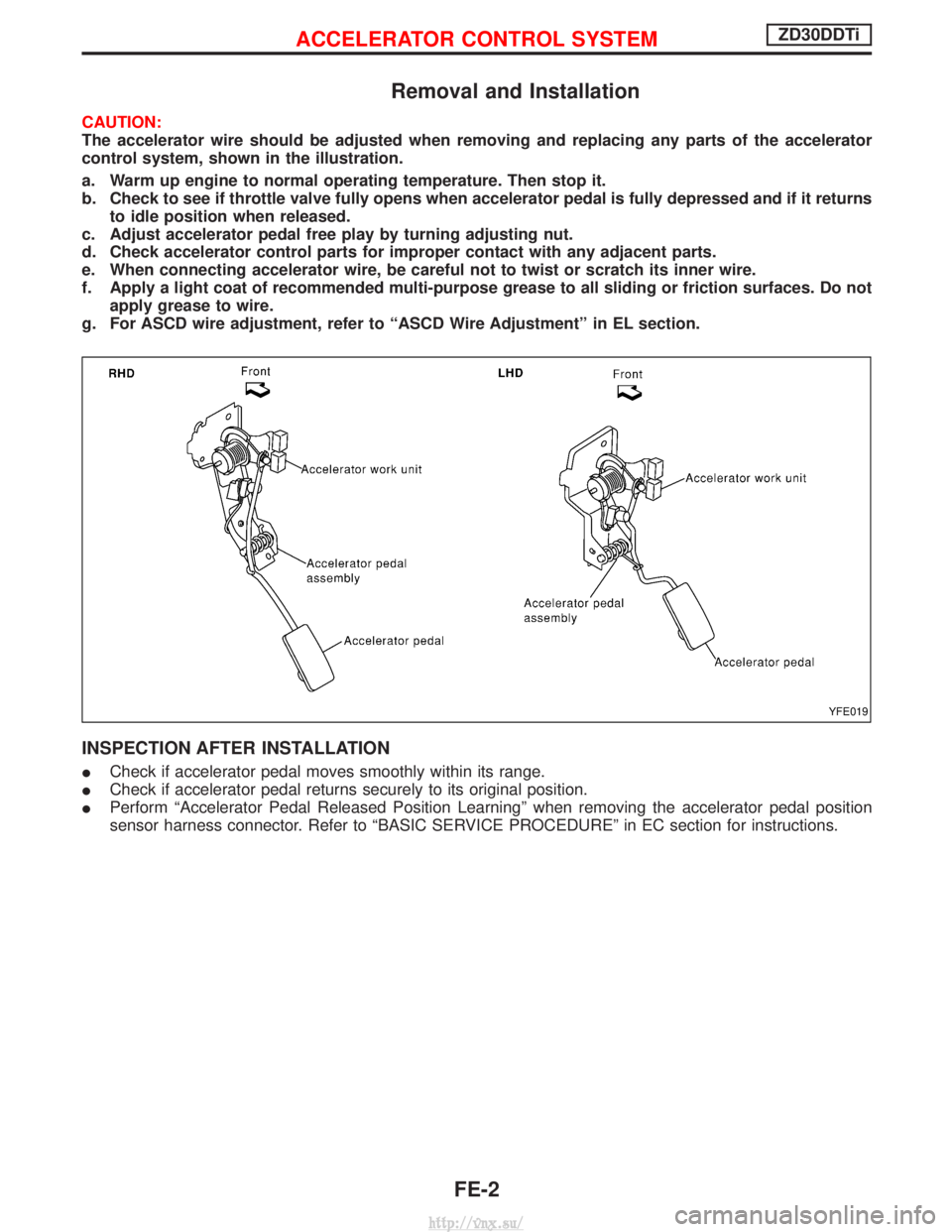
The accelerator wire should be adjusted when removing and replacing any parts of the accelerator
control system, shown in the illustration.
a. Warm up engine to normal operating temperature. Then stop it.
b. Check to see if throttle valve fully opens when accelerator pedal is fully depressed and if it returnsto idle position when released.
c. Adjust accelerator pedal free play by turning adjusting nut.
d. Check accelerator control parts for improper contact with any adjacent parts.
e. When connecting accelerator wire, be careful not to twist or scratch its inner wire.
f. Apply a light coat of recommended multi-purpose grease to all sliding or friction surfaces. Do not apply grease to wire.
g. For ASCD wire adjustment, refer to ªASCD Wire Adjustmentº in EL section.
INSPECTION AFTER INSTALLATION
I Check if accelerator pedal moves smoothly within its range.
I Check if accelerator pedal returns securely to its original position.
I Perform ªAccelerator Pedal Released Position Learningº when removing the accelerator pedal position
sensor harness connector. Refer to ªBASIC SERVICE PROCEDUREº in EC section for instructions.
YFE019
ACCELERATOR CONTROL SYSTEMZD30DDTi
FE-2
http://vnx.su/
Page 833 of 1833
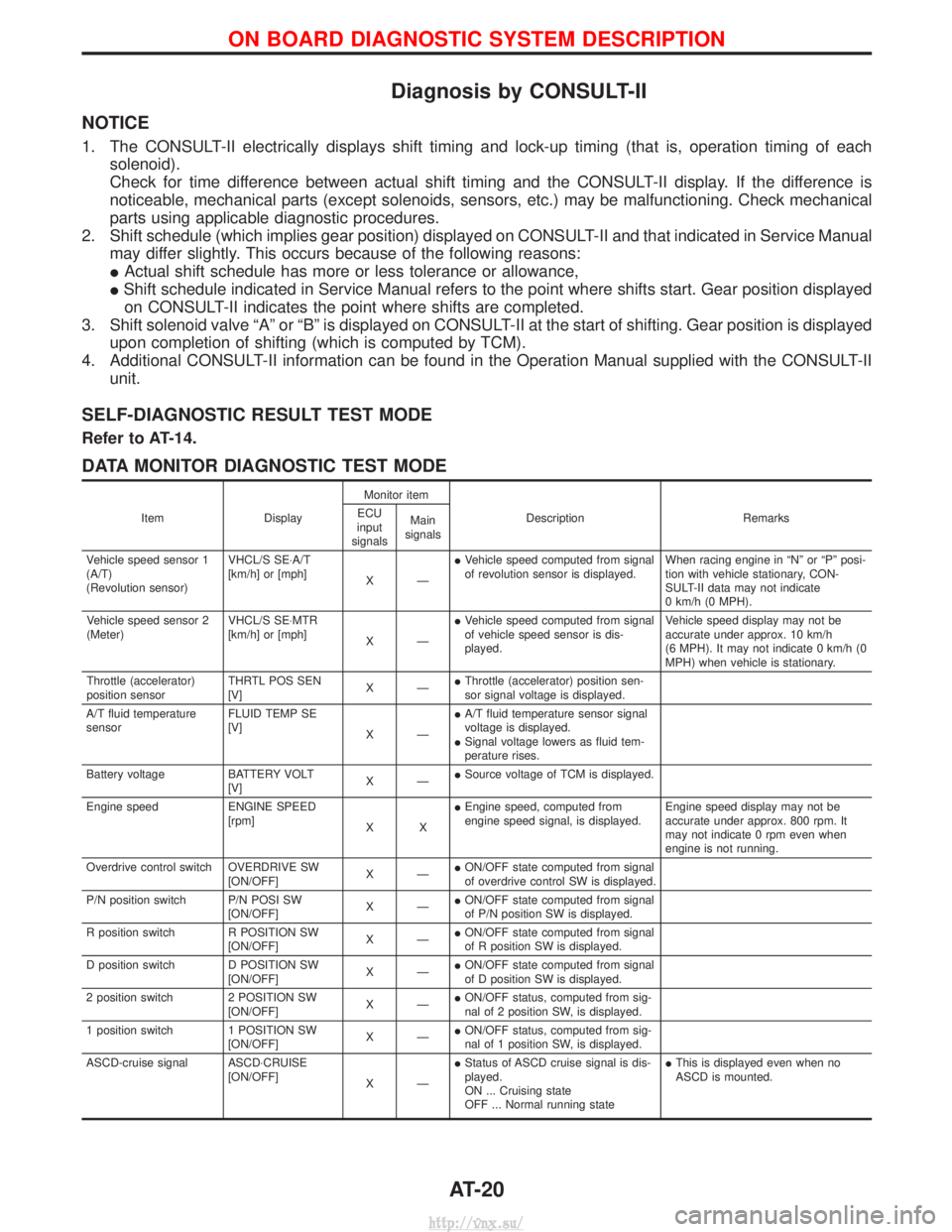
Diagnosis by CONSULT-II
NOTICE
1. The CONSULT-II electrically displays shift timing and lock-up timing (that is, operation timing of eachsolenoid).
Check for time difference between actual shift timing and the CONSULT-II display. If the difference is
noticeable, mechanical parts (except solenoids, sensors, etc.) may be malfunctioning. Check mechanical
parts using applicable diagnostic procedures.
2. Shift schedule (which implies gear position) displayed on CONSULT-II and that indicated in Service Manual may differ slightly. This occurs because of the following reasons:
IActual shift schedule has more or less tolerance or allowance,
I Shift schedule indicated in Service Manual refers to the point where shifts start. Gear position displayed
on CONSULT-II indicates the point where shifts are completed.
3. Shift solenoid valve ªAº or ªBº is displayed on CONSULT-II at the start of shifting. Gear position is displayed upon completion of shifting (which is computed by TCM).
4. Additional CONSULT-II information can be found in the Operation Manual supplied with the CONSULT-II unit.
SELF-DIAGNOSTIC RESULT TEST MODE
Refer to AT-14.
DATA MONITOR DIAGNOSTIC TEST MODE
Item DisplayMonitor item
Description Remarks
ECU
input
signals Main
signals
Vehicle speed sensor 1
(A/T)
(Revolution sensor) VHCL/S SE×A/T
[km/h] or [mph]
XÐI
Vehicle speed computed from signal
of revolution sensor is displayed. When racing engine in ªNº or ªPº posi-
tion with vehicle stationary, CON-
SULT-II data may not indicate
0 km/h (0 MPH).
Vehicle speed sensor 2
(Meter) VHCL/S SE×MTR
[km/h] or [mph]
XÐI
Vehicle speed computed from signal
of vehicle speed sensor is dis-
played. Vehicle speed display may not be
accurate under approx. 10 km/h
(6 MPH). It may not indicate 0 km/h (0
MPH) when vehicle is stationary.
Throttle (accelerator)
position sensor THRTL POS SEN
[V]
XÐI
Throttle (accelerator) position sen-
sor signal voltage is displayed.
A/T fluid temperature
sensor FLUID TEMP SE
[V]
XÐI
A/T fluid temperature sensor signal
voltage is displayed.
I Signal voltage lowers as fluid tem-
perature rises.
Battery voltage BATTERY VOLT [V]XÐI
Source voltage of TCM is displayed.
Engine speed ENGINE SPEED [rpm]XXI
Engine speed, computed from
engine speed signal, is displayed. Engine speed display may not be
accurate under approx. 800 rpm. It
may not indicate 0 rpm even when
engine is not running.
Overdrive control switch OVERDRIVE SW [ON/OFF]XÐI
ON/OFF state computed from signal
of overdrive control SW is displayed.
P/N position switch P/N POSI SW [ON/OFF]XÐI
ON/OFF state computed from signal
of P/N position SW is displayed.
R position switch R POSITION SW [ON/OFF]XÐI
ON/OFF state computed from signal
of R position SW is displayed.
D position switch D POSITION SW [ON/OFF]XÐI
ON/OFF state computed from signal
of D position SW is displayed.
2 position switch 2 POSITION SW [ON/OFF]XÐI
ON/OFF status, computed from sig-
nal of 2 position SW, is displayed.
1 position switch 1 POSITION SW [ON/OFF]XÐI
ON/OFF status, computed from sig-
nal of 1 position SW, is displayed.
ASCD-cruise signal ASCD×CRUISE [ON/OFF]XÐI
Status of ASCD cruise signal is dis-
played.
ON ... Cruising state
OFF ... Normal running state I
This is displayed even when no
ASCD is mounted.
ON BOARD DIAGNOSTIC SYSTEM DESCRIPTION
AT-20
http://vnx.su/
Page 837 of 1833
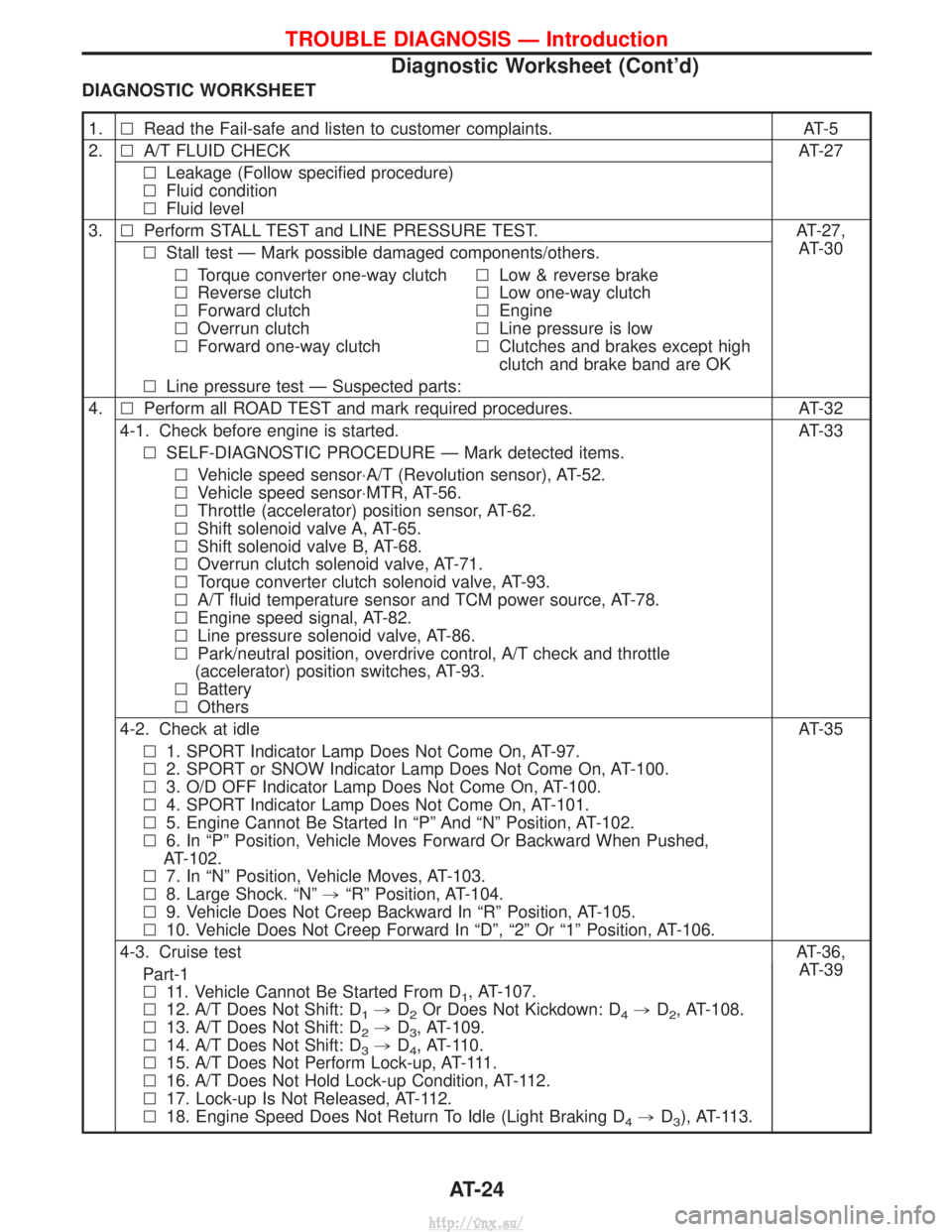
DIAGNOSTIC WORKSHEET
1.lRead the Fail-safe and listen to customer complaints. AT-5
2. lA/T FLUID CHECK AT-27
l Leakage (Follow specified procedure)
l Fluid condition
l Fluid level
3. lPerform STALL TEST and LINE PRESSURE TEST. AT-27,
AT-30
l Stall test Ð Mark possible damaged components/others.
l Torque converter one-way clutch
l Reverse clutch
l Forward clutch
l Overrun clutch
l Forward one-way clutch l
Low & reverse brake
l Low one-way clutch
l Engine
l Line pressure is low
l Clutches and brakes except high
clutch and brake band are OK
l Line pressure test Ð Suspected parts:
4. lPerform all ROAD TEST and mark required procedures. AT-32
4-1. Check before engine is started. AT-33 l SELF-DIAGNOSTIC PROCEDURE Ð Mark detected items.
l Vehicle speed sensor×A/T (Revolution sensor), AT-52.
l Vehicle speed sensor×MTR, AT-56.
l Throttle (accelerator) position sensor, AT-62.
l Shift solenoid valve A, AT-65.
l Shift solenoid valve B, AT-68.
l Overrun clutch solenoid valve, AT-71.
l Torque converter clutch solenoid valve, AT-93.
l A/T fluid temperature sensor and TCM power source, AT-78.
l Engine speed signal, AT-82.
l Line pressure solenoid valve, AT-86.
l Park/neutral position, overdrive control, A/T check and throttle
(accelerator) position switches, AT-93.
l Battery
l Others
4-2. Check at idle AT-35 l 1. SPORT Indicator Lamp Does Not Come On, AT-97.
l 2. SPORT or SNOW Indicator Lamp Does Not Come On, AT-100.
l 3. O/D OFF Indicator Lamp Does Not Come On, AT-100.
l 4. SPORT Indicator Lamp Does Not Come On, AT-101.
l 5. Engine Cannot Be Started In ªPº And ªNº Position, AT-102.
l 6. In ªPº Position, Vehicle Moves Forward Or Backward When Pushed,
AT-102.
l 7. In ªNº Position, Vehicle Moves, AT-103.
l 8. Large Shock. ªNº ,ªRº Position, AT-104.
l 9. Vehicle Does Not Creep Backward In ªRº Position, AT-105.
l 10. Vehicle Does Not Creep Forward In ªDº, ª2º Or ª1º Position, AT-106.
4-3. Cruise test AT-36,
AT-39
Part-1
l 11. Vehicle Cannot Be Started From D
1, AT-107.
l 12. A/T Does Not Shift: D
1,D2Or Does Not Kickdown: D4,D2, AT-108.
l 13. A/T Does Not Shift: D
2,D3, AT-109.
l 14. A/T Does Not Shift: D
3,D4, AT-110.
l 15. A/T Does Not Perform Lock-up, AT-111.
l 16. A/T Does Not Hold Lock-up Condition, AT-112.
l 17. Lock-up Is Not Released, AT-112.
l 18. Engine Speed Does Not Return To Idle (Light Braking D
4,D3), AT-113.
TROUBLE DIAGNOSIS Ð Introduction
Diagnostic Worksheet (Cont'd)
AT-24
http://vnx.su/
Page 840 of 1833
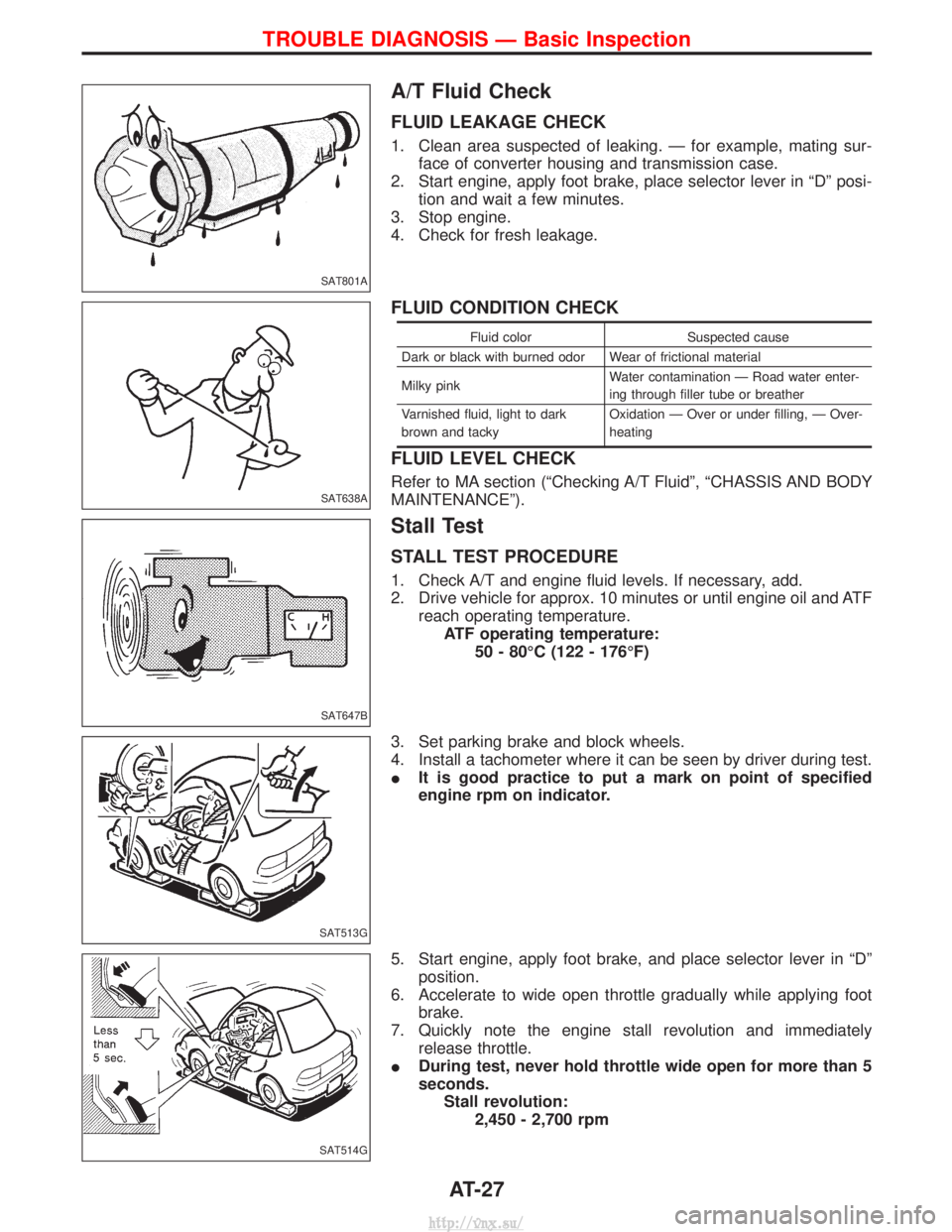
A/T Fluid Check
FLUID LEAKAGE CHECK
1. Clean area suspected of leaking. Ð for example, mating sur-face of converter housing and transmission case.
2. Start engine, apply foot brake, place selector lever in ªDº posi- tion and wait a few minutes.
3. Stop engine.
4. Check for fresh leakage.
FLUID CONDITION CHECK
Fluid color Suspected cause
Dark or black with burned odor Wear of frictional material
Milky pink Water contamination Ð Road water enter-
ing through filler tube or breather
Varnished fluid, light to dark
brown and tacky Oxidation Ð Over or under filling, Ð Over-
heating
FLUID LEVEL CHECK
Refer to MA section (ªChecking A/T Fluidº, ªCHASSIS AND BODY
MAINTENANCEº).
Stall Test
STALL TEST PROCEDURE
1. Check A/T and engine fluid levels. If necessary, add.
2. Drive vehicle for approx. 10 minutes or until engine oil and ATF
reach operating temperature.ATF operating temperature: 50 - 80ÉC (122 - 176ÉF)
3. Set parking brake and block wheels.
4. Install a tachometer where it can be seen by driver during test.
I It is good practice to put a mark on point of specified
engine rpm on indicator.
5. Start engine, apply foot brake, and place selector lever in ªDº position.
6. Accelerate to wide open throttle gradually while applying foot brake.
7. Quickly note the engine stall revolution and immediately release throttle.
I During test, never hold throttle wide open for more than 5
seconds.
Stall revolution: 2,450 - 2,700 rpm
SAT801A
SAT638A
SAT647B
SAT513G
SAT514G
TROUBLE DIAGNOSIS Ð Basic Inspection
AT-27
http://vnx.su/
Page 926 of 1833
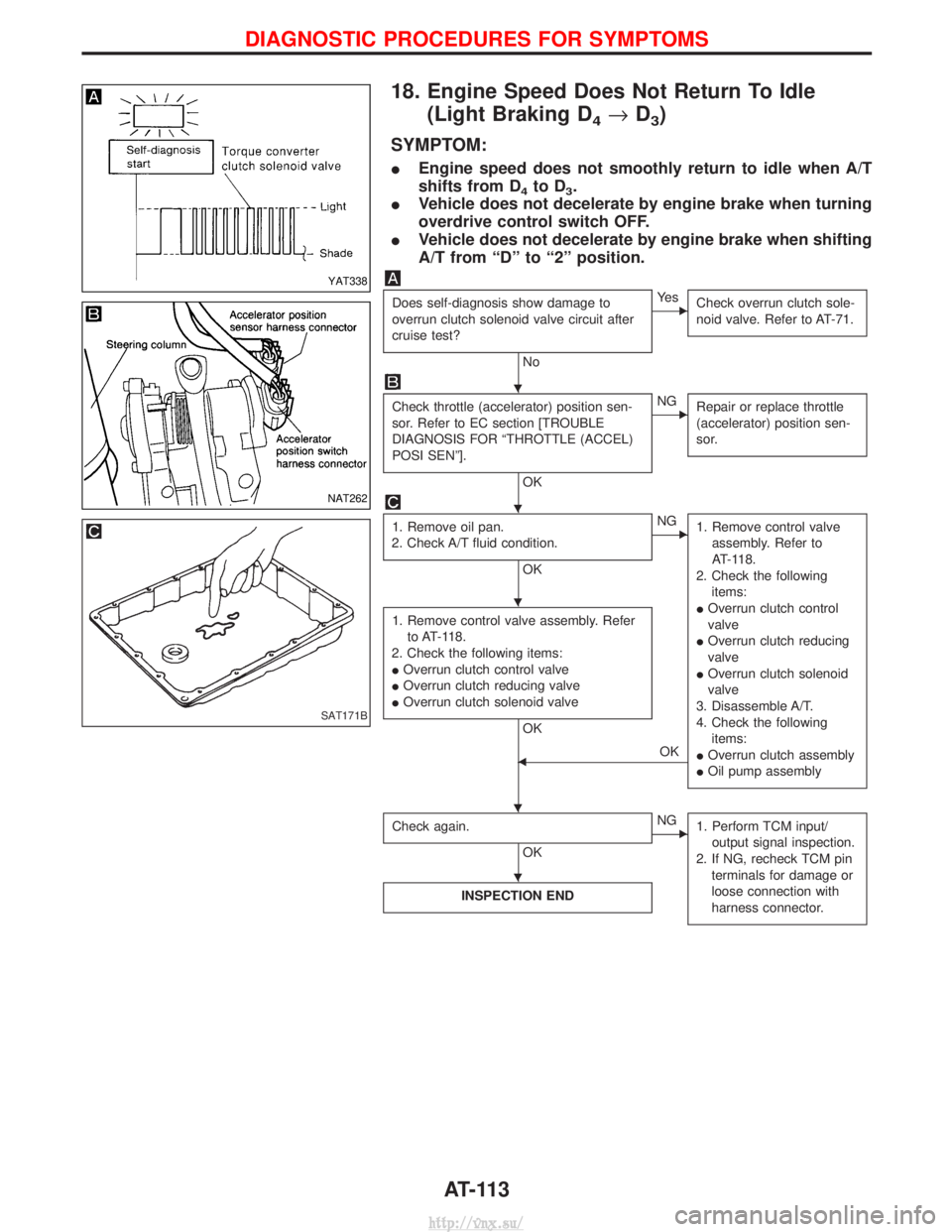
18. Engine Speed Does Not Return To Idle(Light Braking D
4®D3)
SYMPTOM:
I Engine speed does not smoothly return to idle when A/T
shifts from D
4to D3.
I Vehicle does not decelerate by engine brake when turning
overdrive control switch OFF.
I Vehicle does not decelerate by engine brake when shifting
A/T from ªDº to ª2º position.
Does self-diagnosis show damage to
overrun clutch solenoid valve circuit after
cruise test?
No
EYe s
Check overrun clutch sole-
noid valve. Refer to AT-71.
Check throttle (accelerator) position sen-
sor. Refer to EC section [TROUBLE
DIAGNOSIS FOR ªTHROTTLE (ACCEL)
POSI SENº].
OK
ENGRepair or replace throttle
(accelerator) position sen-
sor.
1. Remove oil pan.
2. Check A/T fluid condition.
OK
ENG 1. Remove control valve
assembly. Refer to
AT-118.
2. Check the following items:
I Overrun clutch control
valve
I Overrun clutch reducing
valve
I Overrun clutch solenoid
valve
3. Disassemble A/T.
4. Check the following items:
I Overrun clutch assembly
I Oil pump assembly
1. Remove control valve assembly. Refer
to AT-118.
2. Check the following items:
I Overrun clutch control valve
I Overrun clutch reducing valve
I Overrun clutch solenoid valve
OK
FOK
Check again.
OK
ENG 1. Perform TCM input/
output signal inspection.
2. If NG, recheck TCM pin terminals for damage or
loose connection with
harness connector.
INSPECTION END
YAT338
NAT262
SAT171B
H
H
H
HH
H
DIAGNOSTIC PROCEDURES FOR SYMPTOMS
AT-113
http://vnx.su/
Page 930 of 1833
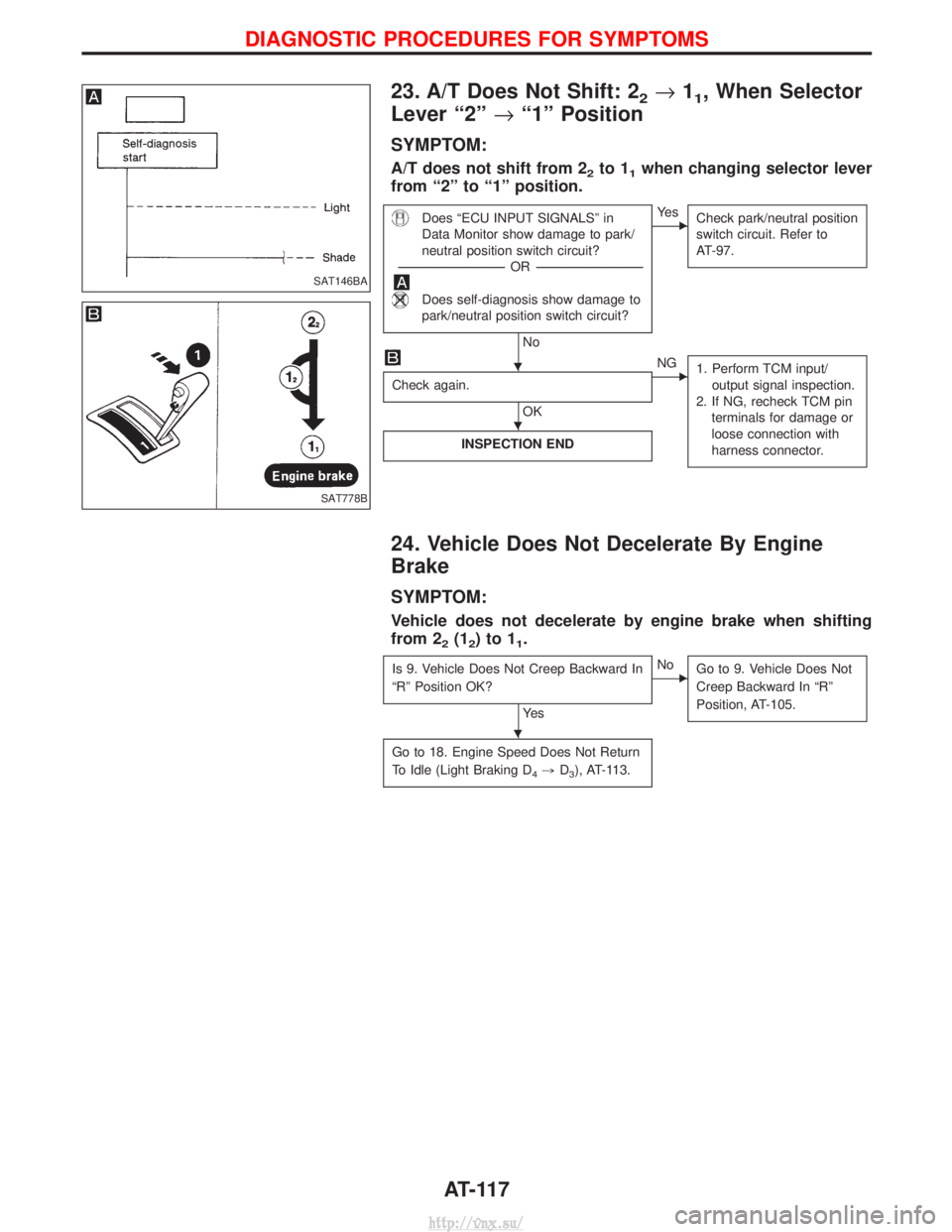
23. A/T Does Not Shift: 22®11, When Selector
Lever ª2º ®ª1º Position
SYMPTOM:
A/T does not shift from 22to 11when changing selector lever
from ª2º to ª1º position.
Does ªECU INPUT SIGNALSº in
Data Monitor show damage to park/
neutral position switch circuit?
---------------------------------------------------------------------------------------------------------------------- -OR -----------------------------------------------------------------------------------------------------------------------
Does self-diagnosis show damage to
park/neutral position switch circuit?
No
EYe s
Check park/neutral position
switch circuit. Refer to
AT-97.
Check again.
OK
ENG1. Perform TCM input/
output signal inspection.
2. If NG, recheck TCM pin terminals for damage or
loose connection with
harness connector.
INSPECTION END
24. Vehicle Does Not Decelerate By Engine
Brake
SYMPTOM:
Vehicle does not decelerate by engine brake when shifting
from 2
2(12)to11.
Is 9. Vehicle Does Not Creep Backward In
ªRº Position OK?
Ye s
ENo Go to 9. Vehicle Does Not
Creep Backward In ªRº
Position, AT-105.
Go to 18. Engine Speed Does Not Return
To Idle (Light Braking D
4,D3), AT-113.
SAT146BA
SAT778B
H
H
H
DIAGNOSTIC PROCEDURES FOR SYMPTOMS
AT-117
http://vnx.su/
Page 936 of 1833
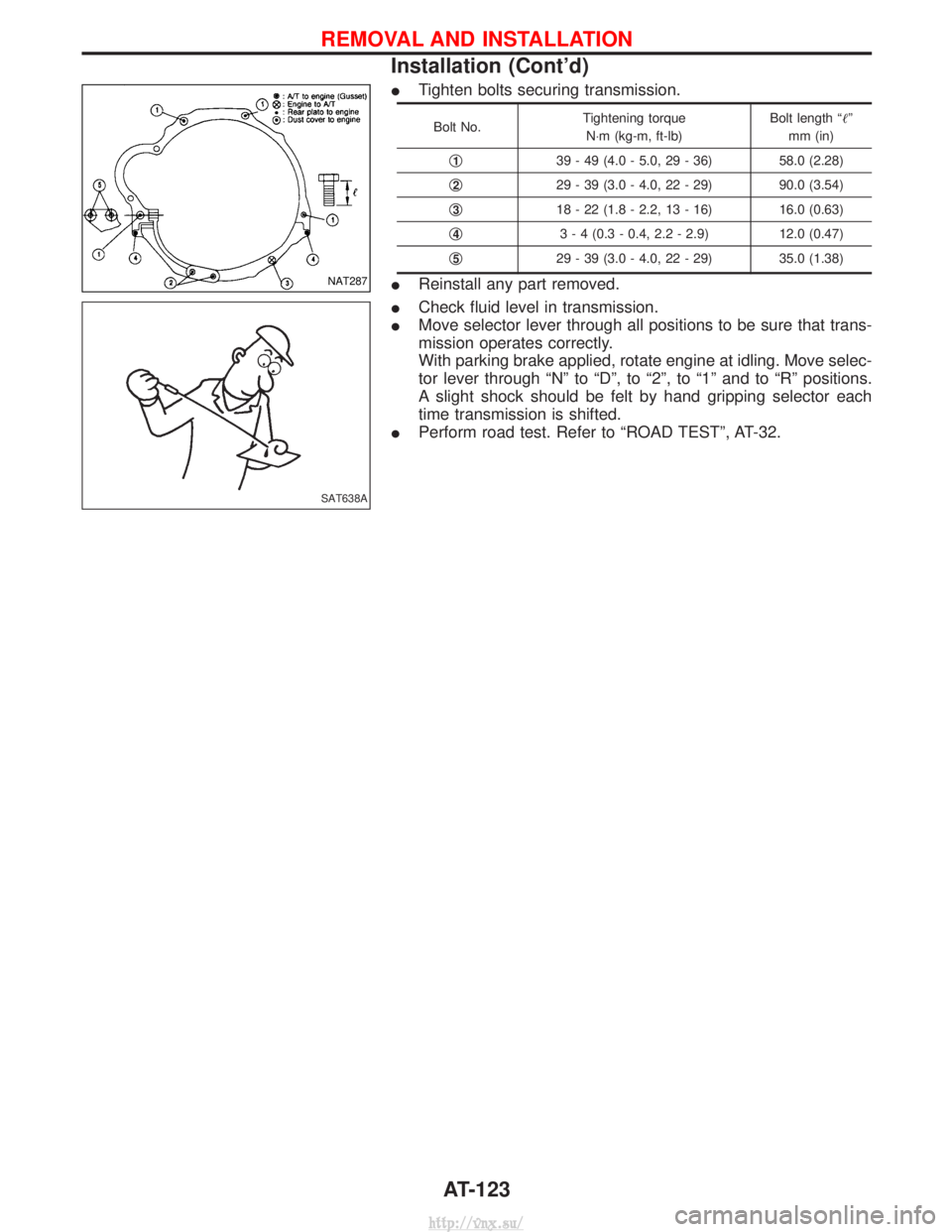
ITighten bolts securing transmission.
Bolt No. Tightening torque
N×m (kg-m, ft-lb) Bolt length ªº
mm (in)
q
139 - 49 (4.0 - 5.0, 29 - 36) 58.0 (2.28)
q
229 - 39 (3.0 - 4.0, 22 - 29) 90.0 (3.54)
q
318 - 22 (1.8 - 2.2, 13 - 16) 16.0 (0.63)
q
43 - 4 (0.3 - 0.4, 2.2 - 2.9) 12.0 (0.47)
q
529 - 39 (3.0 - 4.0, 22 - 29) 35.0 (1.38)
IReinstall any part removed.
I Check fluid level in transmission.
I Move selector lever through all positions to be sure that trans-
mission operates correctly.
With parking brake applied, rotate engine at idling. Move selec-
tor lever through ªNº to ªDº, to ª2º, to ª1º and to ªRº positions.
A slight shock should be felt by hand gripping selector each
time transmission is shifted.
I Perform road test. Refer to ªROAD TESTº, AT-32.NAT287
SAT638A
REMOVAL AND INSTALLATION
Installation (Cont'd)
AT-123
http://vnx.su/