sensor NISSAN TERRANO 2004 Service Repair Manual
[x] Cancel search | Manufacturer: NISSAN, Model Year: 2004, Model line: TERRANO, Model: NISSAN TERRANO 2004Pages: 1833, PDF Size: 53.42 MB
Page 1010 of 1833
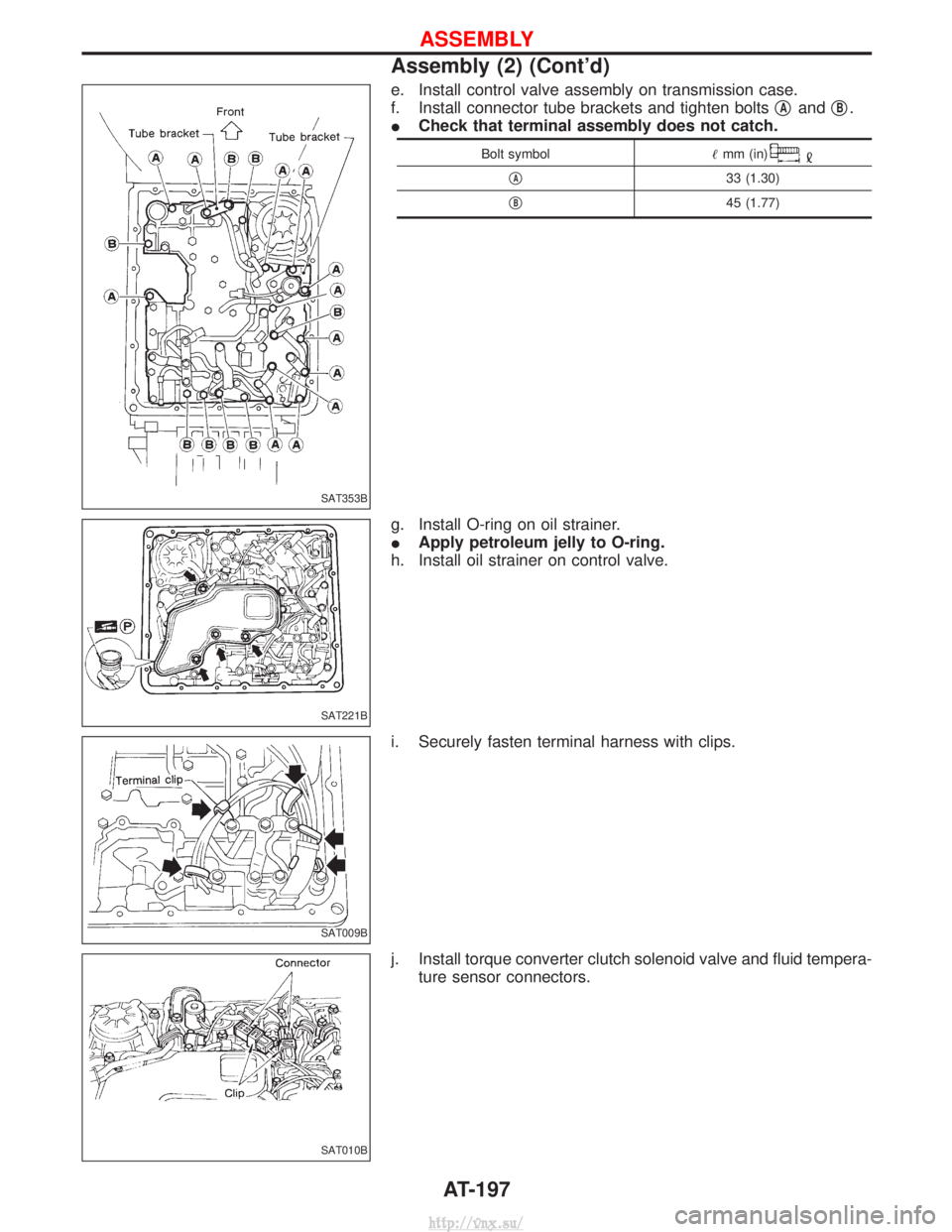
e. Install control valve assembly on transmission case.
f. Install connector tube brackets and tighten boltsq
AandqB.
I Check that terminal assembly does not catch.
Bolt symbol mm (in)
qA33 (1.30)
q
B45 (1.77)
g. Install O-ring on oil strainer.
I Apply petroleum jelly to O-ring.
h. Install oil strainer on control valve.
i. Securely fasten terminal harness with clips.
j. Install torque converter clutch solenoid valve and fluid tempera- ture sensor connectors.
SAT353B
SAT221B
SAT009B
SAT010B
ASSEMBLY
Assembly (2) (Cont'd)
AT-197
http://vnx.su/
Page 1158 of 1833
Removal
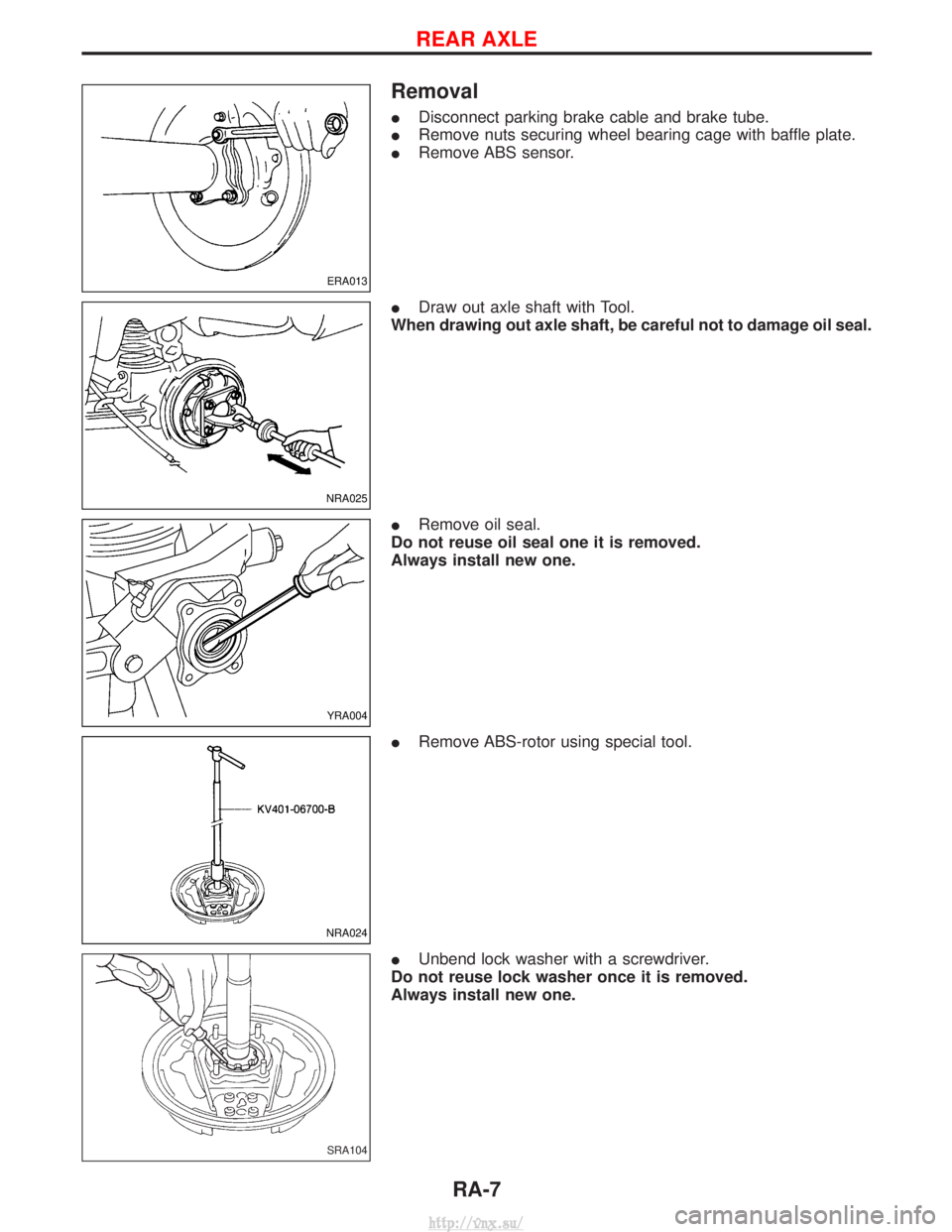
IDisconnect parking brake cable and brake tube.
I Remove nuts securing wheel bearing cage with baffle plate.
I Remove ABS sensor.
I Draw out axle shaft with Tool.
When drawing out axle shaft, be careful not to damage oil seal.
I Remove oil seal.
Do not reuse oil seal one it is removed.
Always install new one.
I Remove ABS-rotor using special tool.
I Unbend lock washer with a screwdriver.
Do not reuse lock washer once it is removed.
Always install new one.
ERA013
NRA025
YRA004
NRA024
SRA104
REAR AXLE
RA-7
http://vnx.su/
Page 1161 of 1833
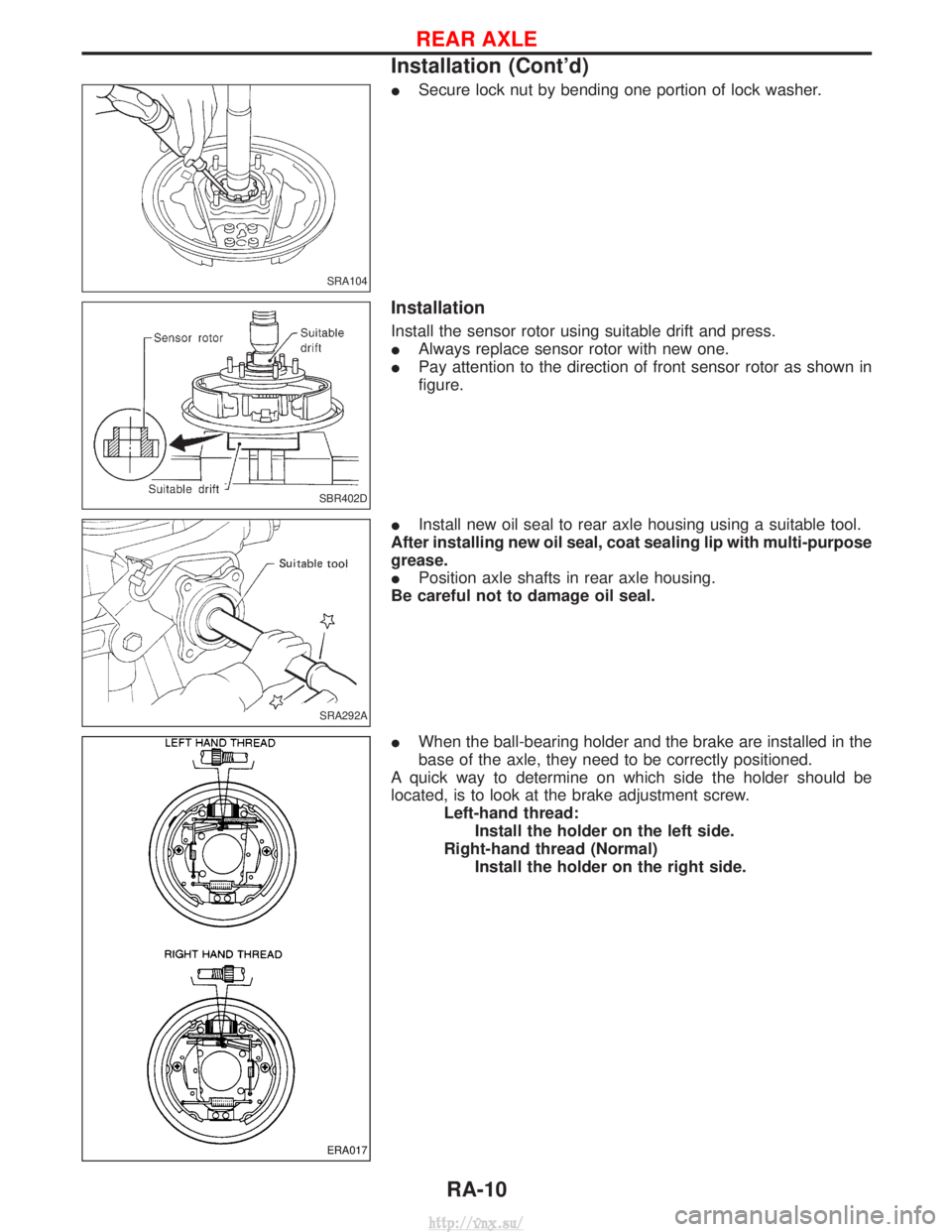
ISecure lock nut by bending one portion of lock washer.
Installation
Install the sensor rotor using suitable drift and press.
IAlways replace sensor rotor with new one.
I Pay attention to the direction of front sensor rotor as shown in
figure.
I Install new oil seal to rear axle housing using a suitable tool.
After installing new oil seal, coat sealing lip with multi-purpose
grease.
I Position axle shafts in rear axle housing.
Be careful not to damage oil seal.
I When the ball-bearing holder and the brake are installed in the
base of the axle, they need to be correctly positioned.
A quick way to determine on which side the holder should be
located, is to look at the brake adjustment screw. Left-hand thread:Install the holder on the left side.
Right-hand thread (Normal) Install the holder on the right side.
SRA104
SBR402D
SRA292A
ERA017
REAR AXLE
Installation (Cont'd)
RA-10
http://vnx.su/
Page 1162 of 1833
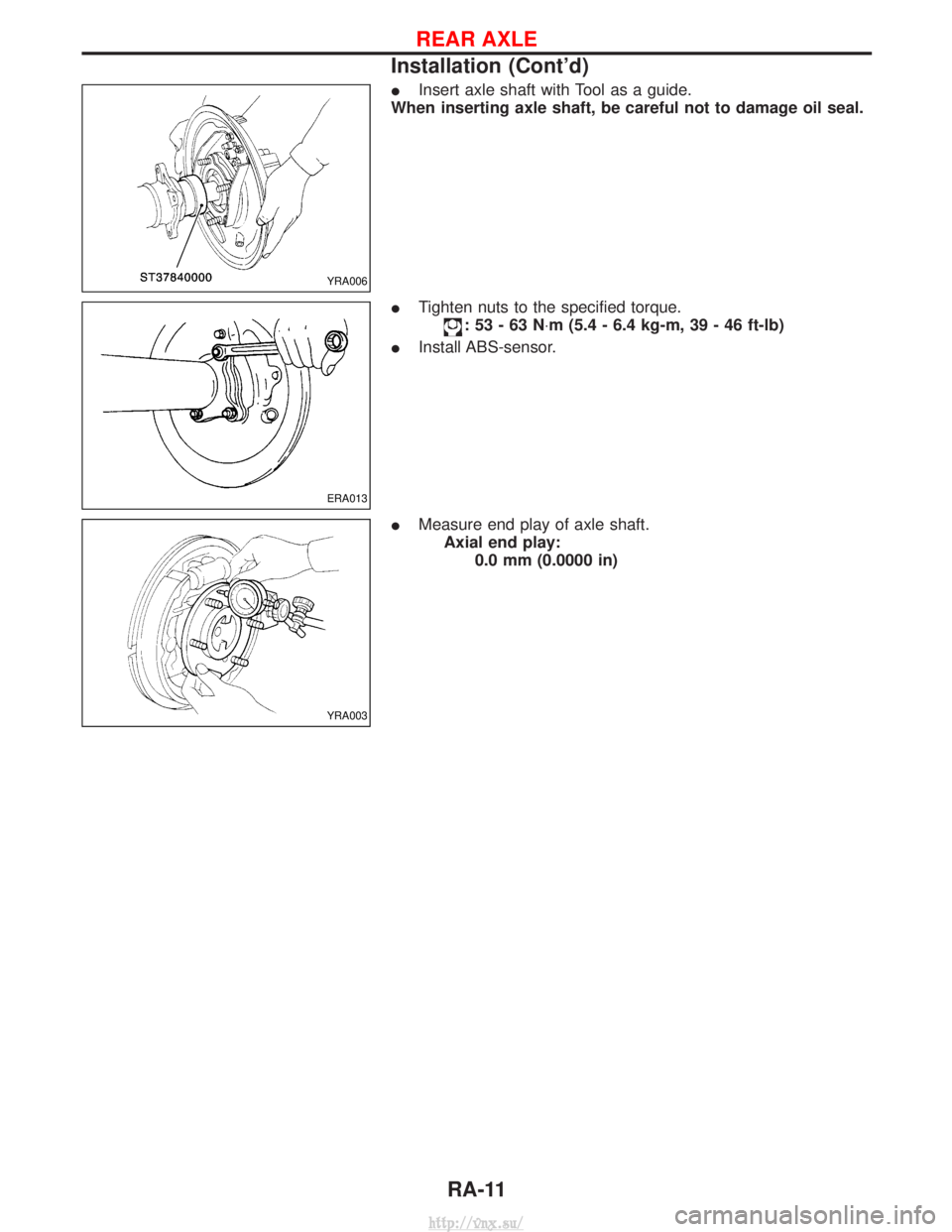
IInsert axle shaft with Tool as a guide.
When inserting axle shaft, be careful not to damage oil seal.
I Tighten nuts to the specified torque.
:53-63N ×m (5.4 - 6.4 kg-m, 39 - 46 ft-lb)
I Install ABS-sensor.
I Measure end play of axle shaft.
Axial end play: 0.0 mm (0.0000 in)
YRA006
ERA013
YRA003
REAR AXLE
Installation (Cont'd)
RA-11
http://vnx.su/
Page 1169 of 1833
Diagnostic Procedure 3 (ABS actuator solenoid
valve and solenoid valve relay) .................................72
Diagnostic Procedure 4 (Wheel sensor or rotor) ......74
Diagnostic Procedure 5 (Motor Relay or motor) .......76
Diagnostic Procedure 7 (Low voltage) ......................78
Diagnostic Procedure 8 (G sensor) ...........................79
Diagnostic Procedure 9 (Control unit) .......................80
Diagnostic Procedure 10 (Pedal vibration and
noise) ........................................................................\
.81
Diagnostic Procedure 11 (Long stopping
distance) ....................................................................81Diagnostic Procedure 12 (Unexpected pedal
action) ........................................................................\
82
Diagnostic Procedure 13 ...........................................83
Diagnostic Procedure 14 ...........................................83
Electrical Components Inspection .............................84
SERVICE DATA AND SPECIFICATIONS (SDS) ..........85
General Specifications ...............................................85
Inspection and Adjustment ........................................86
CONTENTS(Cont'd)
BR-2
http://vnx.su/
Page 1170 of 1833
Supplement Restraint System (SRS) ªAIR BAGº
and ªSEAT BELT PRE-TENSIONERº
The Supplemental Restraint System ªAir Bagº and ªSeat Belt Pre-tensionerº, used along with a seat belt, help
to reduce the risk or severity or injury to the driver and front passenger in a collision. The Supplemental
Restraint System consists of an air bag module (located in the center of the steering wheel and on the instru-
ment panel on the passenger side, where fitted), seat belt pre-tensioners, a diagnosis sensor unit, warning
lamp, wiring harness and spiral cable. Information necessary to service the system safely is included in the
BT sectionof this Service Manual.
WARNING:
I To avoid rendering the SRS inoperative (which could increase the risk of personal injury or death
in the event of a collision which would result in air bag inflation), all maintenance must be per-
formed by an authorized NISSAN dealer.
I Improper maintenance, including incorrect removal and installation of the SRS, can lead to per-
sonal injury caused by unintentional activation of the system.
I Do not use electrical test equipment on any circuit related to the SRS unless instructed to in this
Service Manual. SRS wiring harnesses (except ªSEAT BELT-TENSIONERº connector) can be iden-
tified with yellow harness connector and with yellow harness protector or yellow insulation tape
before the harness connectors.
Precautions
IUse only ªDOT 4º fluid from a sealed container.
I Never reuse drained brake fluid.
I Be careful not to splash brake fluid on painted areas; it
may cause paint damage. If brake fluid is splashed on
painted areas, wash it away with water immediately.
I To clean master cylinder parts, disc brake caliper parts or
wheel cylinder parts, use clean brake fluid.
I Never use mineral oils such as Petrol or kerosene. They
will ruin rubber parts of hydraulic system.
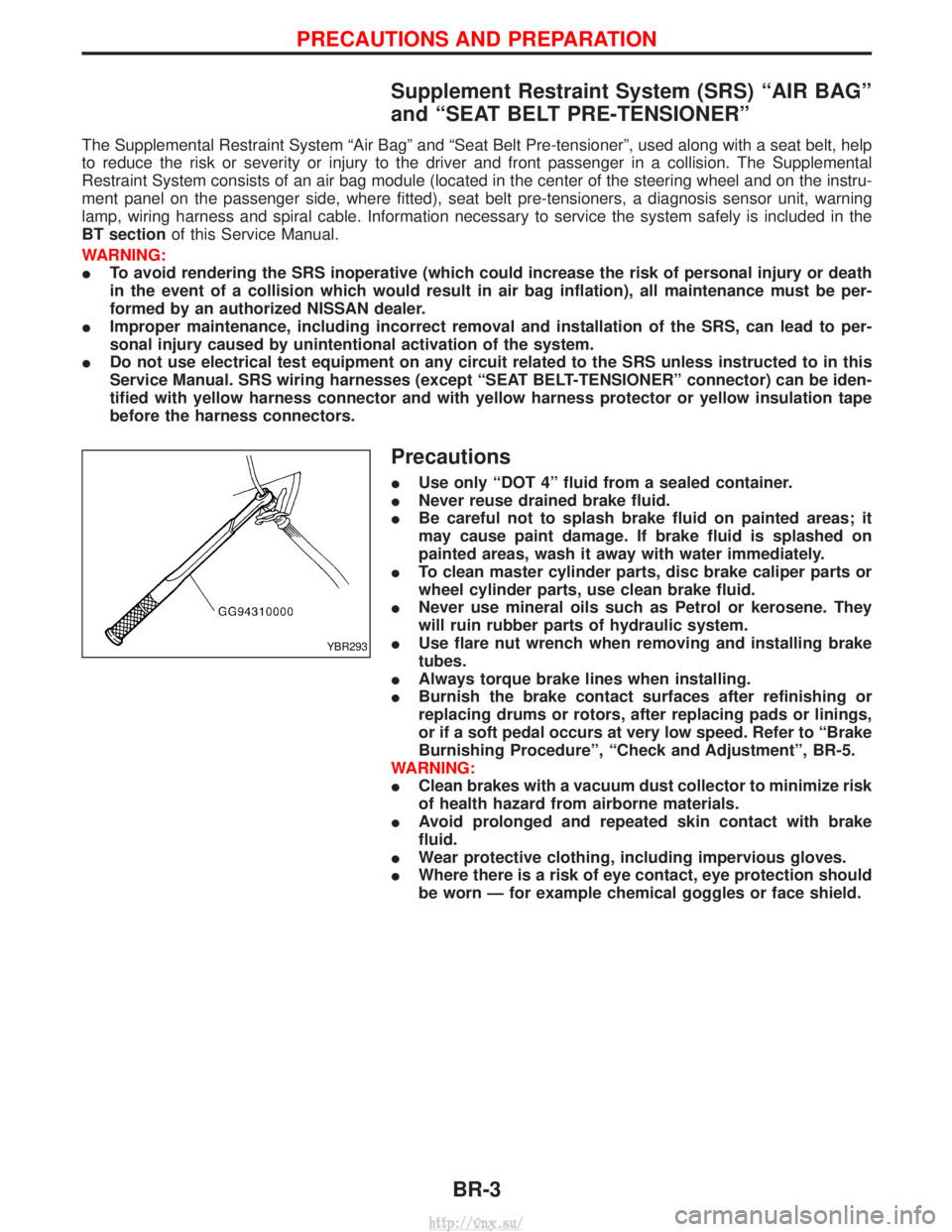
I Use flare nut wrench when removing and installing brake
tubes.
I Always torque brake lines when installing.
I Burnish the brake contact surfaces after refinishing or
replacing drums or rotors, after replacing pads or linings,
or if a soft pedal occurs at very low speed. Refer to ªBrake
Burnishing Procedureº, ªCheck and Adjustmentº, BR-5.
WARNING:
I Clean brakes with a vacuum dust collector to minimize risk
of health hazard from airborne materials.
I Avoid prolonged and repeated skin contact with brake
fluid.
I Wear protective clothing, including impervious gloves.
I Where there is a risk of eye contact, eye protection should
be worn Ð for example chemical goggles or face shield.
YBR293
PRECAUTIONS AND PREPARATION
BR-3
http://vnx.su/
Page 1171 of 1833
Preparation
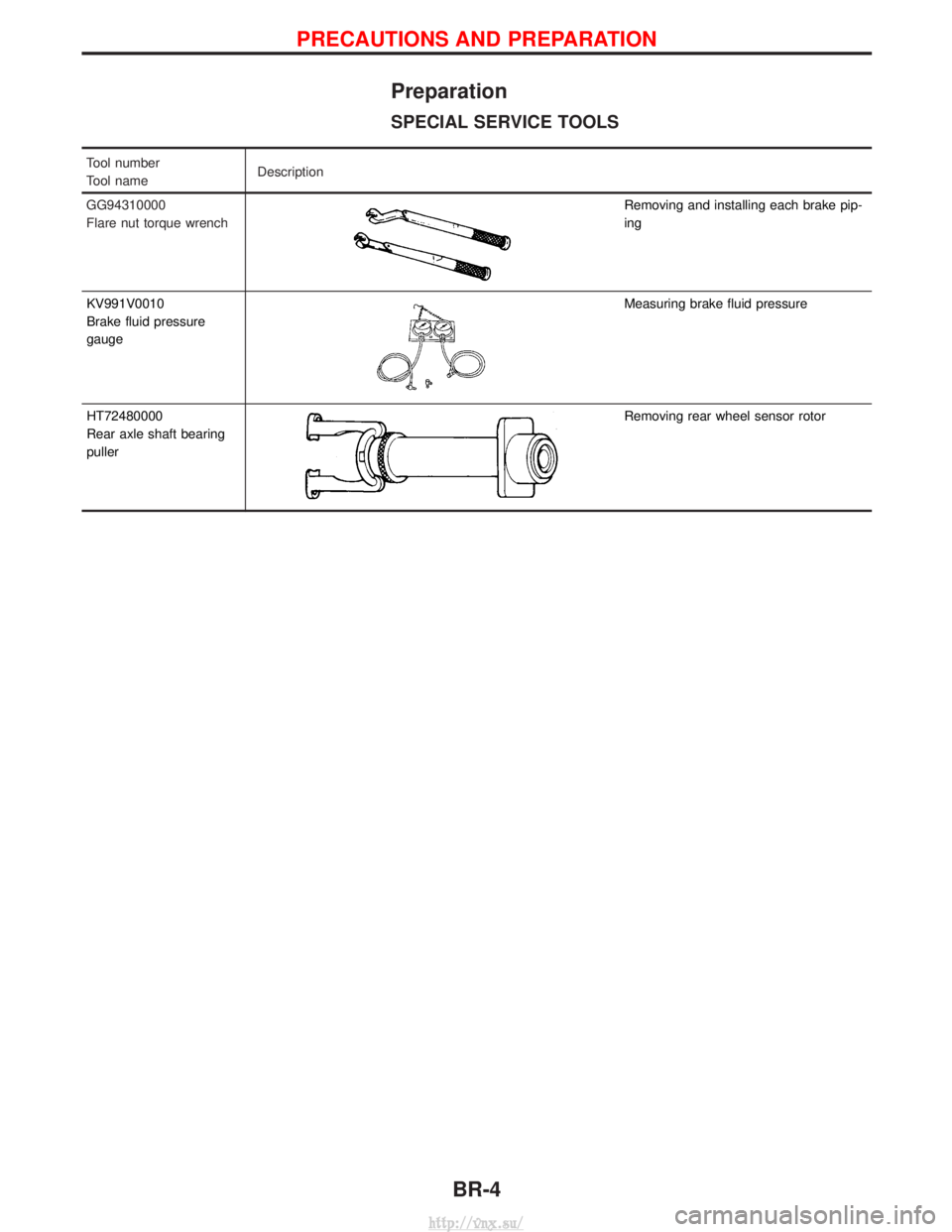
SPECIAL SERVICE TOOLS
Tool number
Tool nameDescription
GG94310000
Flare nut torque wrench
Removing and installing each brake pip-
ing
KV991V0010
Brake fluid pressure
gauge
Measuring brake fluid pressure
HT72480000
Rear axle shaft bearing
puller
Removing rear wheel sensor rotor
PRECAUTIONS AND PREPARATION
BR-4
http://vnx.su/
Page 1180 of 1833
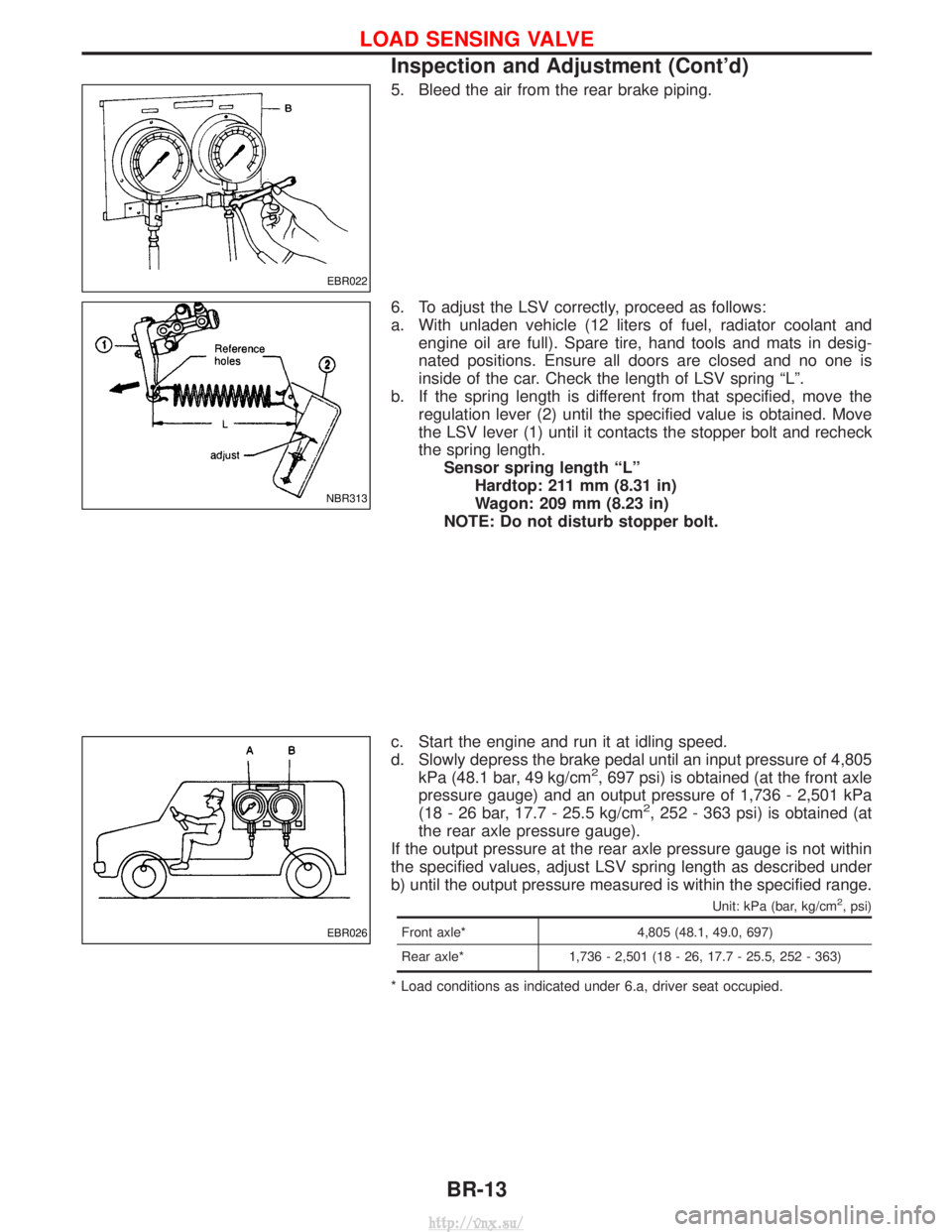
5. Bleed the air from the rear brake piping.
6. To adjust the LSV correctly, proceed as follows:
a. With unladen vehicle (12 liters of fuel, radiator coolant andengine oil are full). Spare tire, hand tools and mats in desig-
nated positions. Ensure all doors are closed and no one is
inside of the car. Check the length of LSV spring ªLº.
b. If the spring length is different from that specified, move the regulation lever (2) until the specified value is obtained. Move
the LSV lever (1) until it contacts the stopper bolt and recheck
the spring length.Sensor spring length ªLº Hardtop: 211 mm (8.31 in)
Wagon: 209 mm (8.23 in)
NOTE: Do not disturb stopper bolt.
c. Start the engine and run it at idling speed.
d. Slowly depress the brake pedal until an input pressure of 4,805 kPa (48.1 bar, 49 kg/cm
2, 697 psi) is obtained (at the front axle
pressure gauge) and an output pressure of 1,736 - 2,501 kPa
(18 - 26 bar, 17.7 - 25.5 kg/cm
2, 252 - 363 psi) is obtained (at
the rear axle pressure gauge).
If the output pressure at the rear axle pressure gauge is not within
the specified values, adjust LSV spring length as described under
b) until the output pressure measured is within the specified range.
Unit: kPa (bar, kg/cm2, psi)
Front axle* 4,805 (48.1, 49.0, 697)
Rear axle* 1,736 - 2,501 (18 - 26, 17.7 - 25.5, 252 - 363)
* Load conditions as indicated under 6.a, driver seat occupied.
EBR022
NBR313
EBR026
LOAD SENSING VALVE
Inspection and Adjustment (Cont'd)
BR-13
http://vnx.su/
Page 1206 of 1833
System Description
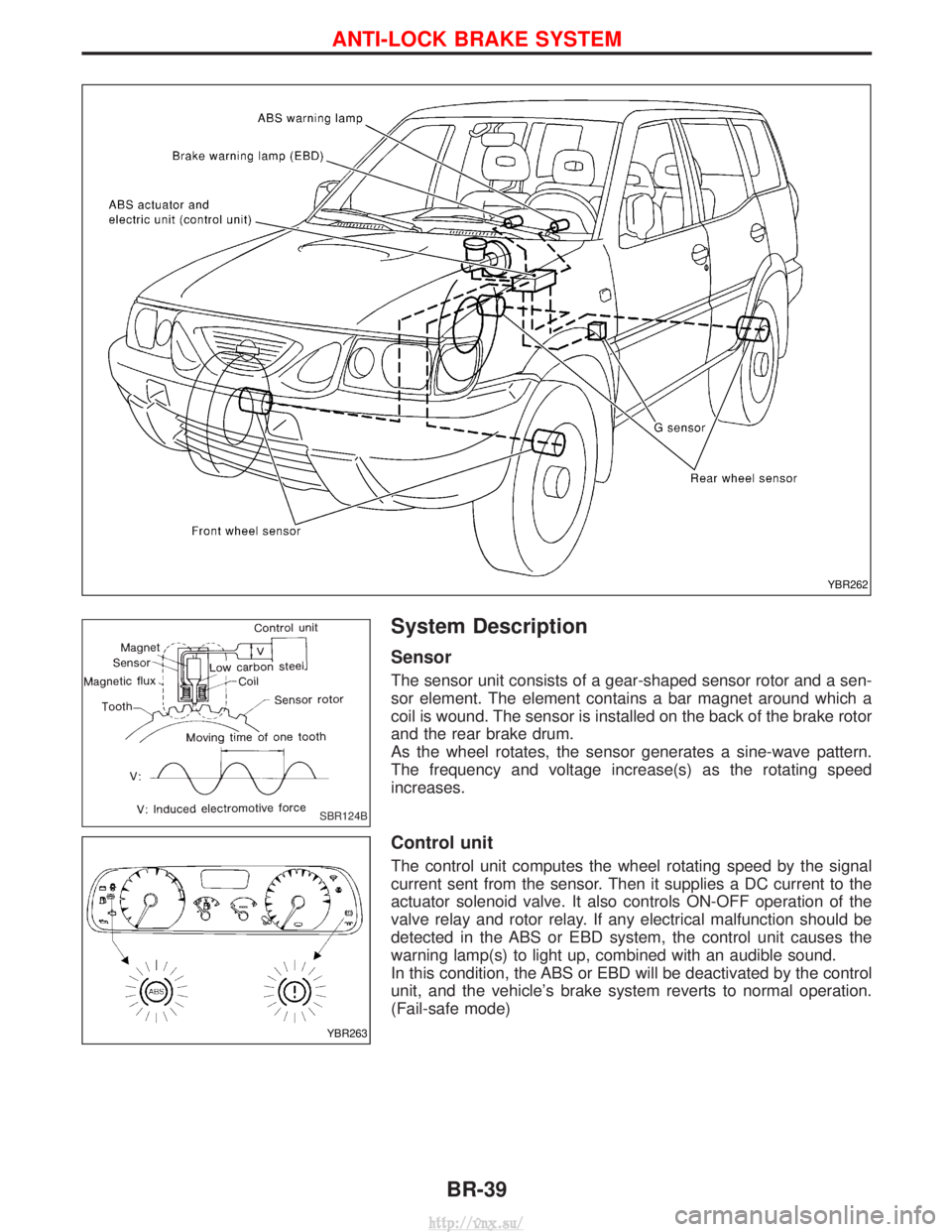
Sensor
The sensor unit consists of a gear-shaped sensor rotor and a sen-
sor element. The element contains a bar magnet around which a
coil is wound. The sensor is installed on the back of the brake rotor
and the rear brake drum.
As the wheel rotates, the sensor generates a sine-wave pattern.
The frequency and voltage increase(s) as the rotating speed
increases.
Control unit
The control unit computes the wheel rotating speed by the signal
current sent from the sensor. Then it supplies a DC current to the
actuator solenoid valve. It also controls ON-OFF operation of the
valve relay and rotor relay. If any electrical malfunction should be
detected in the ABS or EBD system, the control unit causes the
warning lamp(s) to light up, combined with an audible sound.
In this condition, the ABS or EBD will be deactivated by the control
unit, and the vehicle's brake system reverts to normal operation.
(Fail-safe mode)
YBR262
SBR124B
YBR263
ANTI-LOCK BRAKE SYSTEM
BR-39
http://vnx.su/
Page 1207 of 1833
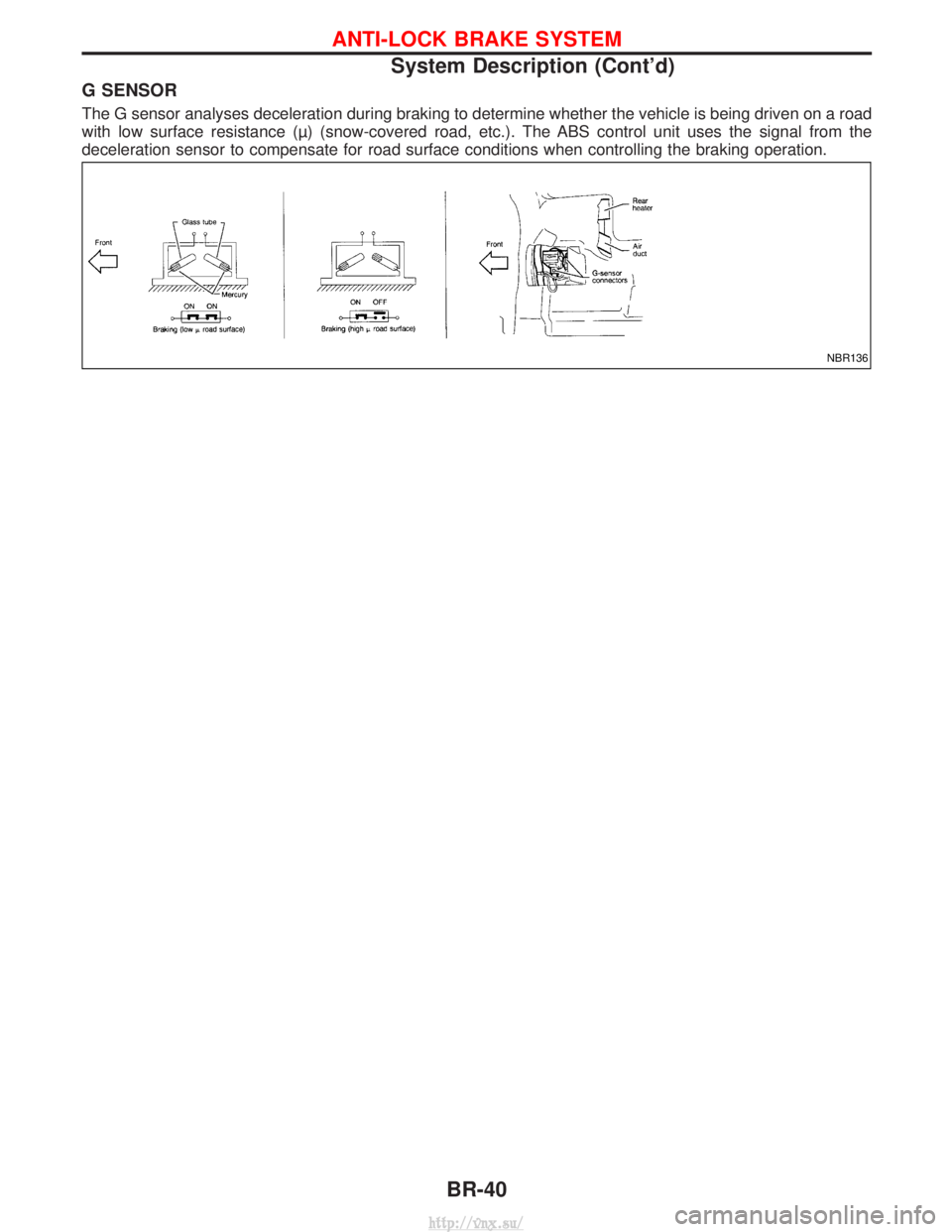
G SENSOR
The G sensor analyses deceleration during braking to determine whether the vehicle is being driven on a road
with low surface resistance () (snow-covered road, etc.). The ABS control unit uses the signal from the
deceleration sensor to compensate for road surface conditions when controlling the braking operation.
NBR136
ANTI-LOCK BRAKE SYSTEM
System Description (Cont'd)BR-40
http://vnx.su/