system NISSAN TERRANO 2004 Service Repair Manual
[x] Cancel search | Manufacturer: NISSAN, Model Year: 2004, Model line: TERRANO, Model: NISSAN TERRANO 2004Pages: 1833, PDF Size: 53.42 MB
Page 756 of 1833
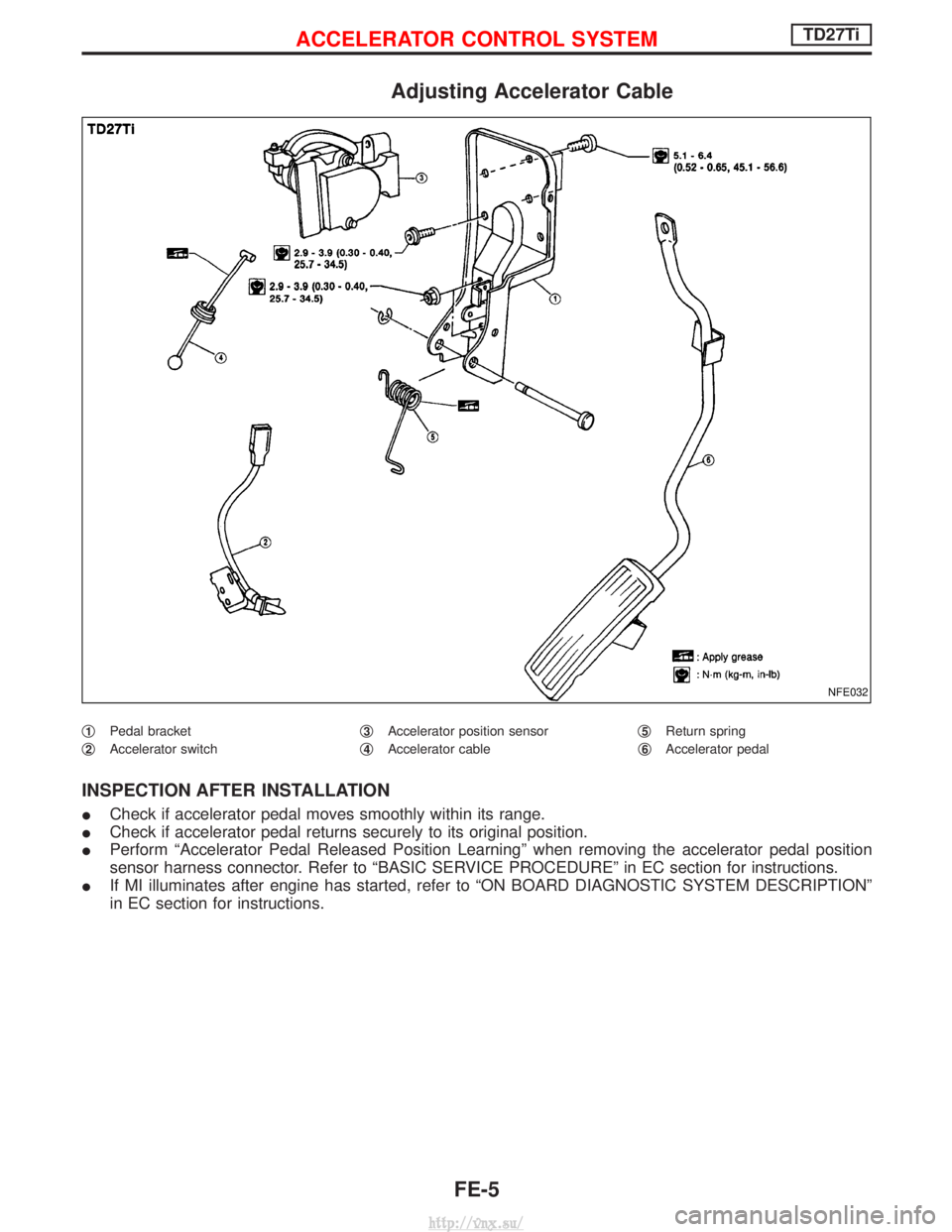
Adjusting Accelerator Cable
q1Pedal bracket
q
2Accelerator switch q
3Accelerator position sensor
q
4Accelerator cable q
5Return spring
q
6Accelerator pedal
INSPECTION AFTER INSTALLATION
I Check if accelerator pedal moves smoothly within its range.
I Check if accelerator pedal returns securely to its original position.
I Perform ªAccelerator Pedal Released Position Learningº when removing the accelerator pedal position
sensor harness connector. Refer to ªBASIC SERVICE PROCEDUREº in EC section for instructions.
I If MI illuminates after engine has started, refer to ªON BOARD DIAGNOSTIC SYSTEM DESCRIPTIONº
in EC section for instructions.
NFE032
ACCELERATOR CONTROL SYSTEMTD27Ti
FE-5
http://vnx.su/
Page 757 of 1833
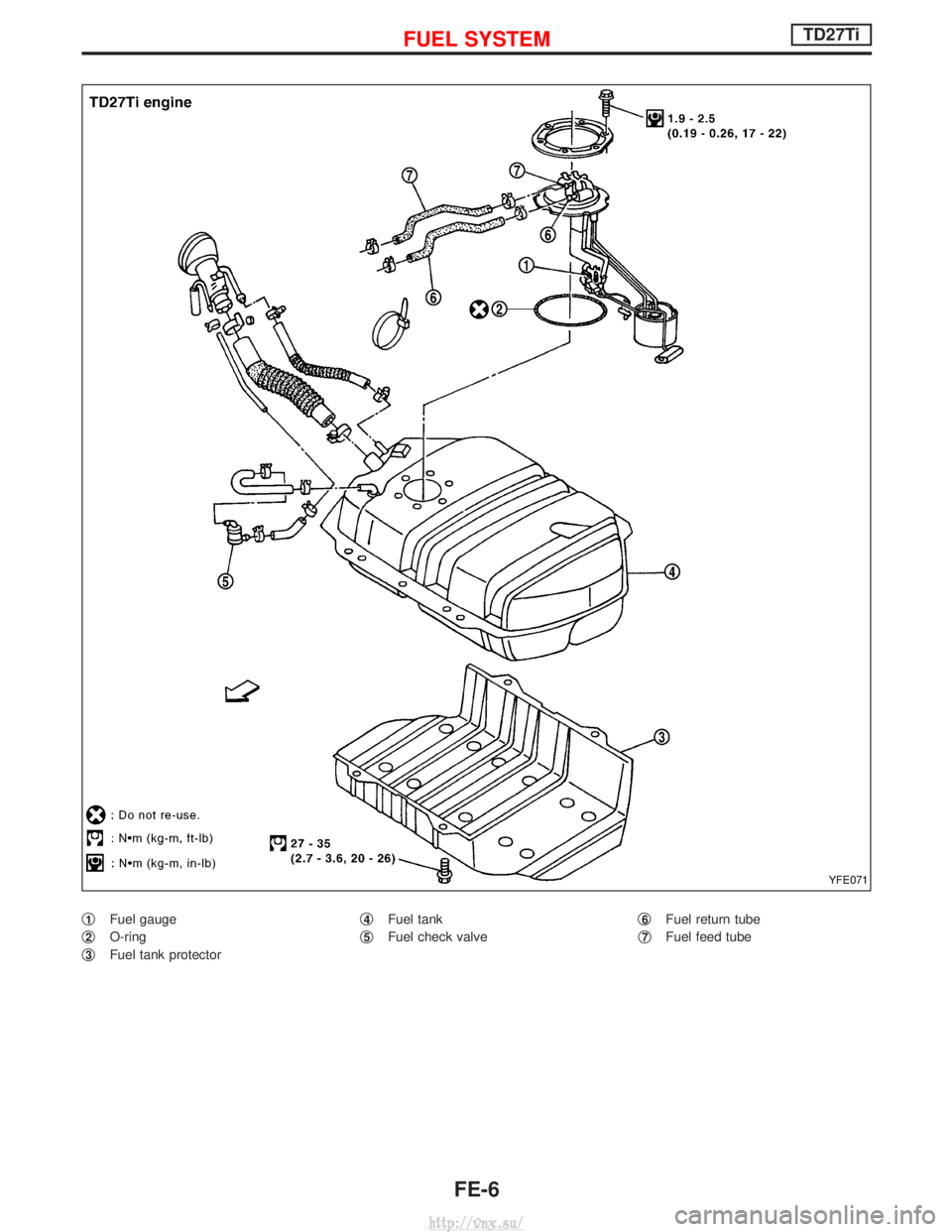
q1Fuel gauge
q
2O-ring
q
3Fuel tank protector q
4Fuel tank
q
5Fuel check valve q
6Fuel return tube
q
7Fuel feed tube
YFE071
FUEL SYSTEMTD27Ti
FE-6
http://vnx.su/
Page 758 of 1833
WARNING:
When replacing fuel line parts, be sure to observe the following:
IDisplay a ªCAUTION: INFLAMMABLEº sign in workshop.
I Be sure to furnish workshop with a CO
2fire extinguisher service.
I Do not smoke while servicing fuel system. Keep open flames and sparks away from work area.
I Be sure to disconnect battery ground cable before conducting operations.
I Pour drained fuel into an explosion-proof container, then ensure container lid is installed securely.
CAUTION:
I For ECM models, release fuel pressure from fuel line. Refer to EC section (ªFuel Pressure Releaseº,
ªBASIC SERVICE PROCEDUREº).
I Do not disconnect any fuel line unless absolutely necessary.
I Plug hose and pipe openings to prevent entry of dust or dirt.
I Always replace top lid seal and hose clamps with new ones.
I Do not kink or twist hoses and tubes during installation.
I Do not tighten hose clamps excessively because this could cause damage to the hose.
I Ensure fuel check valve is installed in the correct orientation.
I Refer to EC section (ªFUEL CHECK VALVEº, ªEVAPORATIVE EMISSION SYSTEMº).
I After installation, run engine and check for fuel leaks at connections.
Fuel Pump and Gauge
REMOVAL
Petrol engine
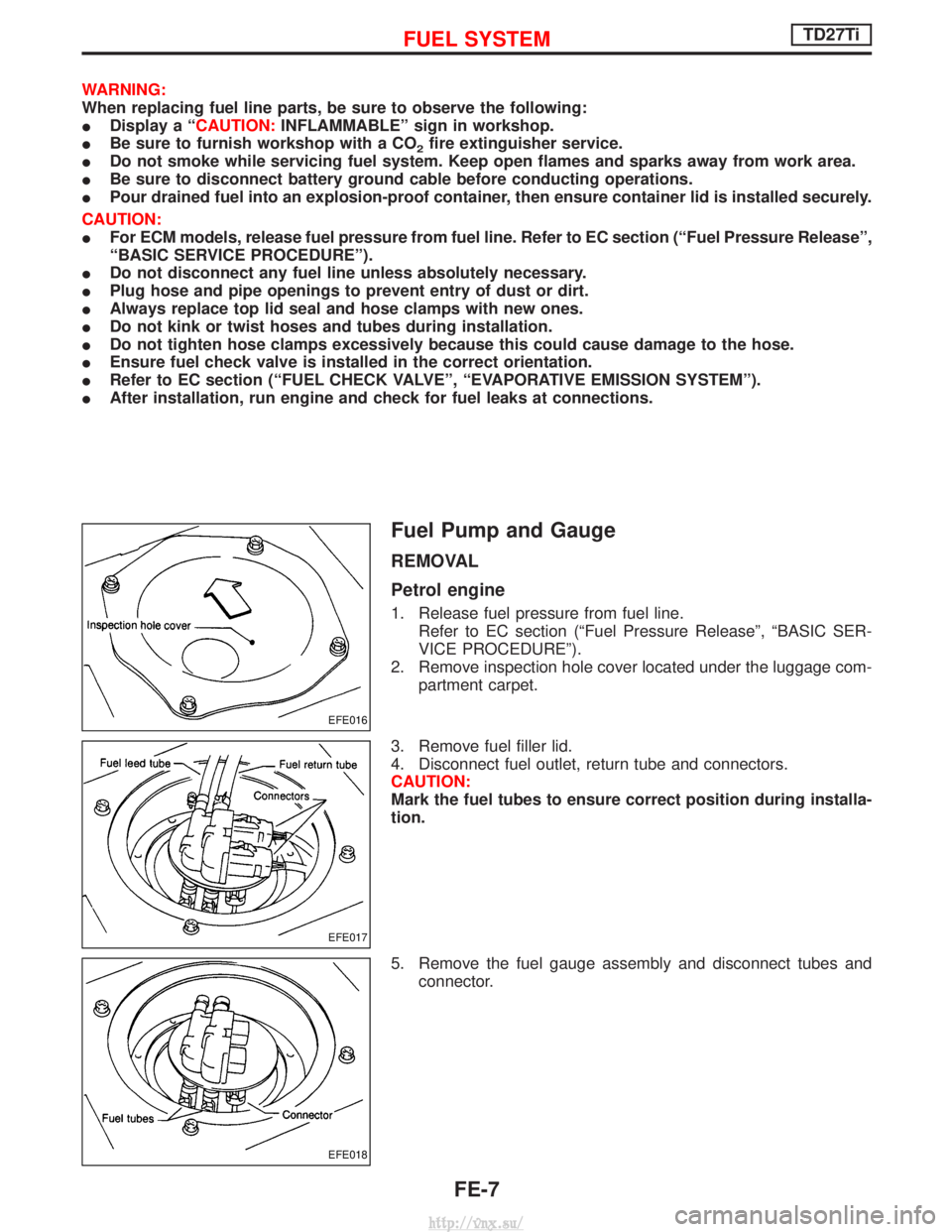
1. Release fuel pressure from fuel line.
Refer to EC section (ªFuel Pressure Releaseº, ªBASIC SER-
VICE PROCEDUREº).
2. Remove inspection hole cover located under the luggage com- partment carpet.
3. Remove fuel filler lid.
4. Disconnect fuel outlet, return tube and connectors.
CAUTION:
Mark the fuel tubes to ensure correct position during installa-
tion.
5. Remove the fuel gauge assembly and disconnect tubes and connector.
EFE016
EFE017
EFE018
FUEL SYSTEMTD27Ti
FE-7
http://vnx.su/
Page 759 of 1833
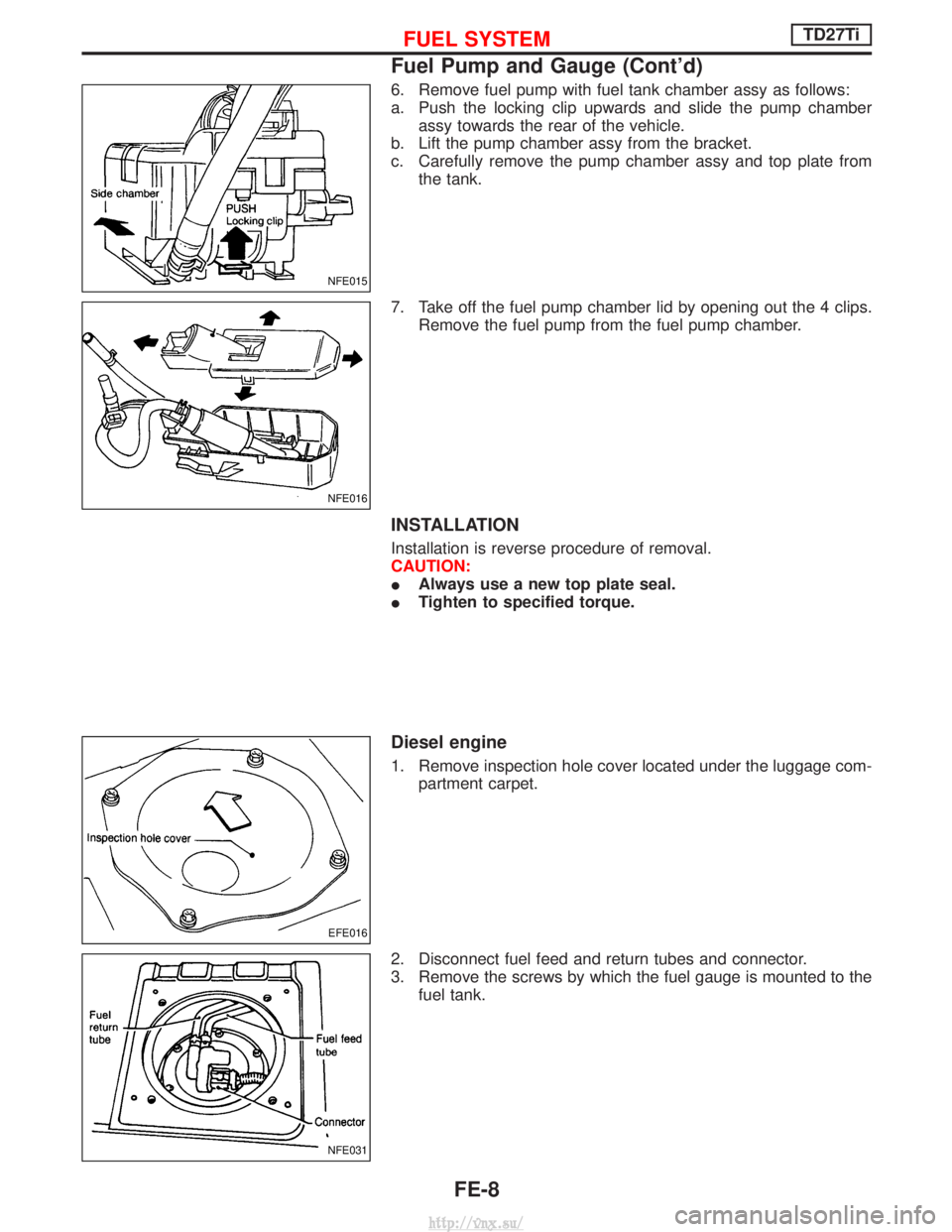
6. Remove fuel pump with fuel tank chamber assy as follows:
a. Push the locking clip upwards and slide the pump chamberassy towards the rear of the vehicle.
b. Lift the pump chamber assy from the bracket.
c. Carefully remove the pump chamber assy and top plate from the tank.
7. Take off the fuel pump chamber lid by opening out the 4 clips. Remove the fuel pump from the fuel pump chamber.
INSTALLATION
Installation is reverse procedure of removal.
CAUTION:
IAlways use a new top plate seal.
I Tighten to specified torque.
Diesel engine
1. Remove inspection hole cover located under the luggage com-
partment carpet.
2. Disconnect fuel feed and return tubes and connector.
3. Remove the screws by which the fuel gauge is mounted to the fuel tank.
NFE015
NFE016
EFE016
NFE031
FUEL SYSTEMTD27Ti
Fuel Pump and Gauge (Cont'd)
FE-8
http://vnx.su/
Page 760 of 1833
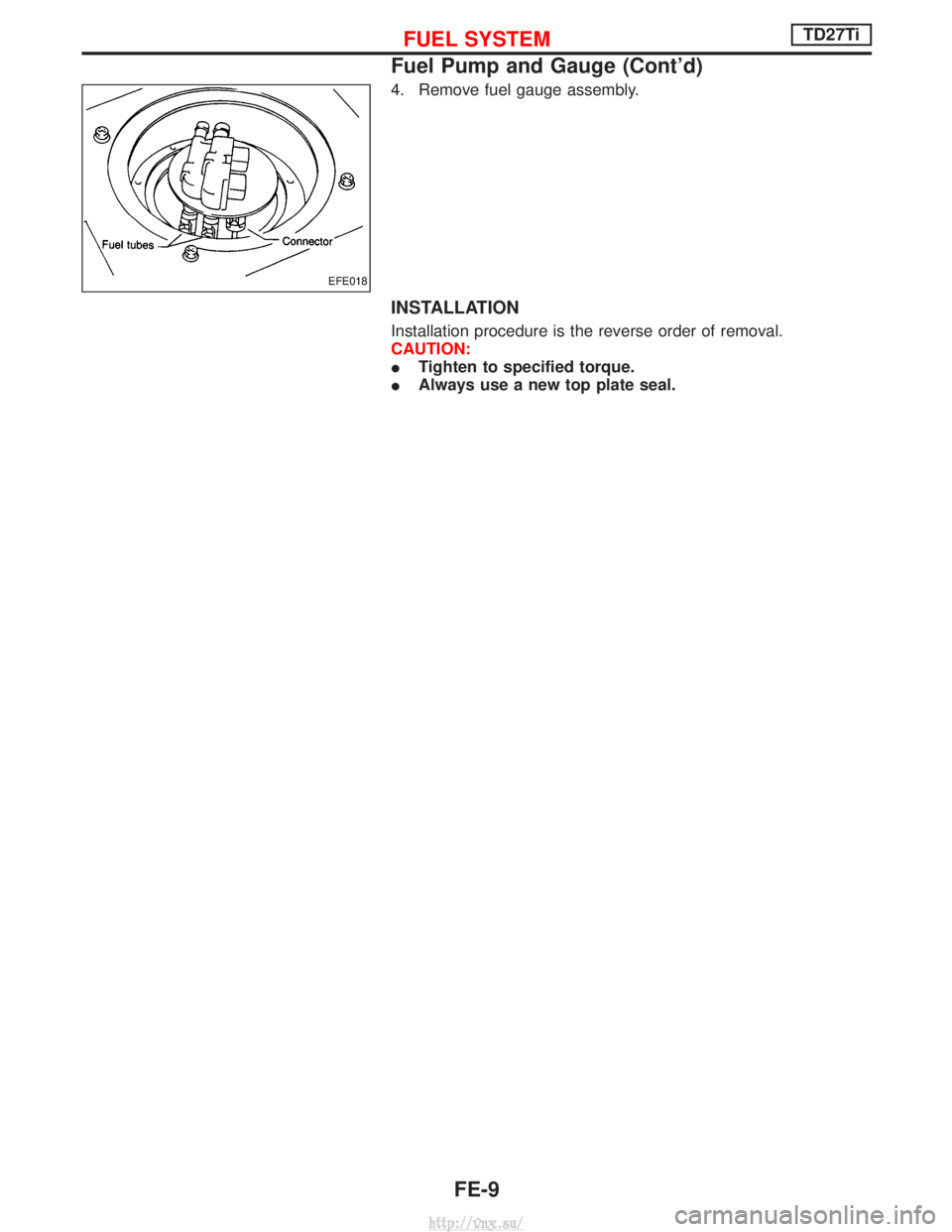
4. Remove fuel gauge assembly.
INSTALLATION
Installation procedure is the reverse order of removal.
CAUTION:
ITighten to specified torque.
I Always use a new top plate seal.
EFE018
FUEL SYSTEMTD27Ti
Fuel Pump and Gauge (Cont'd)
FE-9
http://vnx.su/
Page 761 of 1833
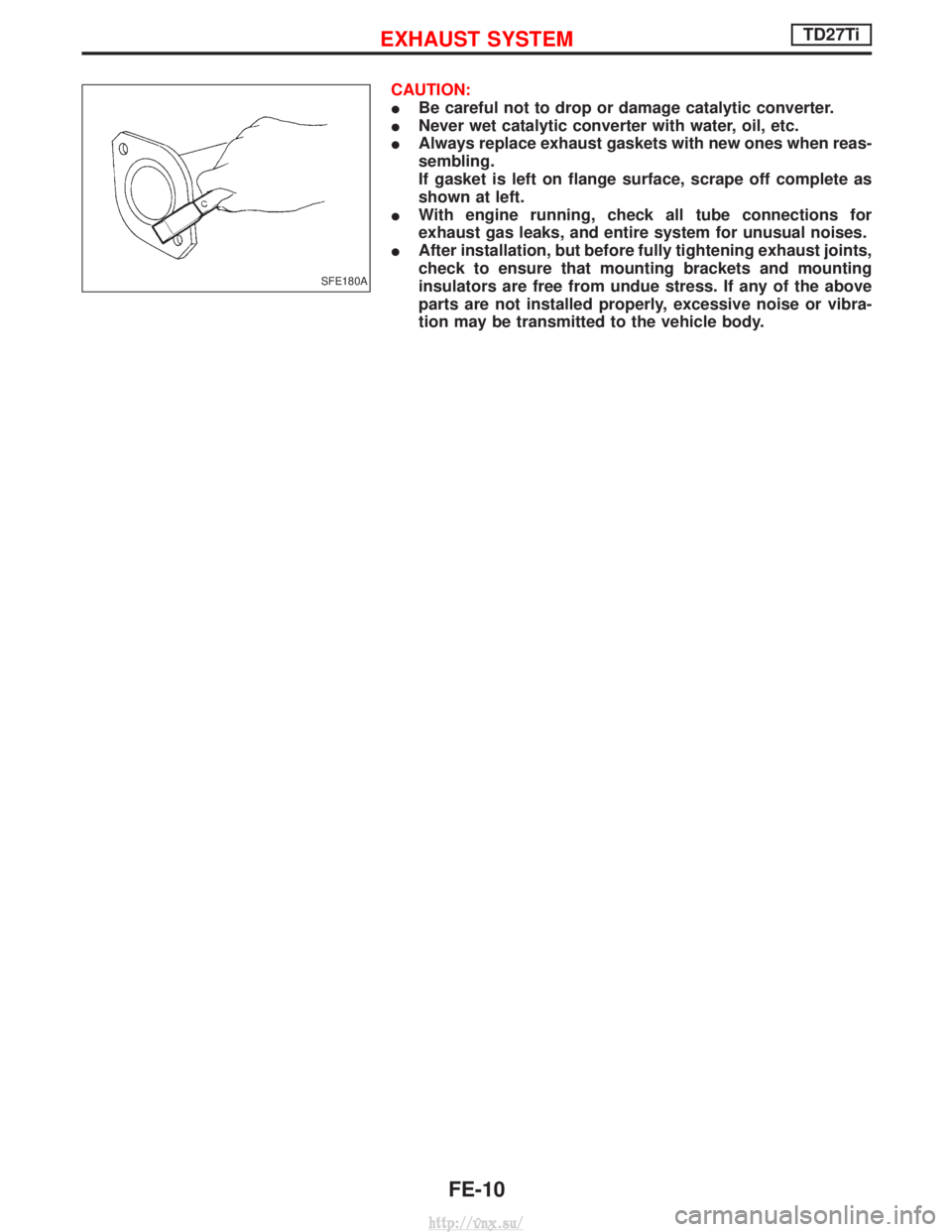
CAUTION:
IBe careful not to drop or damage catalytic converter.
I Never wet catalytic converter with water, oil, etc.
I Always replace exhaust gaskets with new ones when reas-
sembling.
If gasket is left on flange surface, scrape off complete as
shown at left.
I With engine running, check all tube connections for
exhaust gas leaks, and entire system for unusual noises.
I After installation, but before fully tightening exhaust joints,
check to ensure that mounting brackets and mounting
insulators are free from undue stress. If any of the above
parts are not installed properly, excessive noise or vibra-
tion may be transmitted to the vehicle body.
SFE180A
EXHAUST SYSTEMTD27Ti
FE-10
http://vnx.su/
Page 762 of 1833
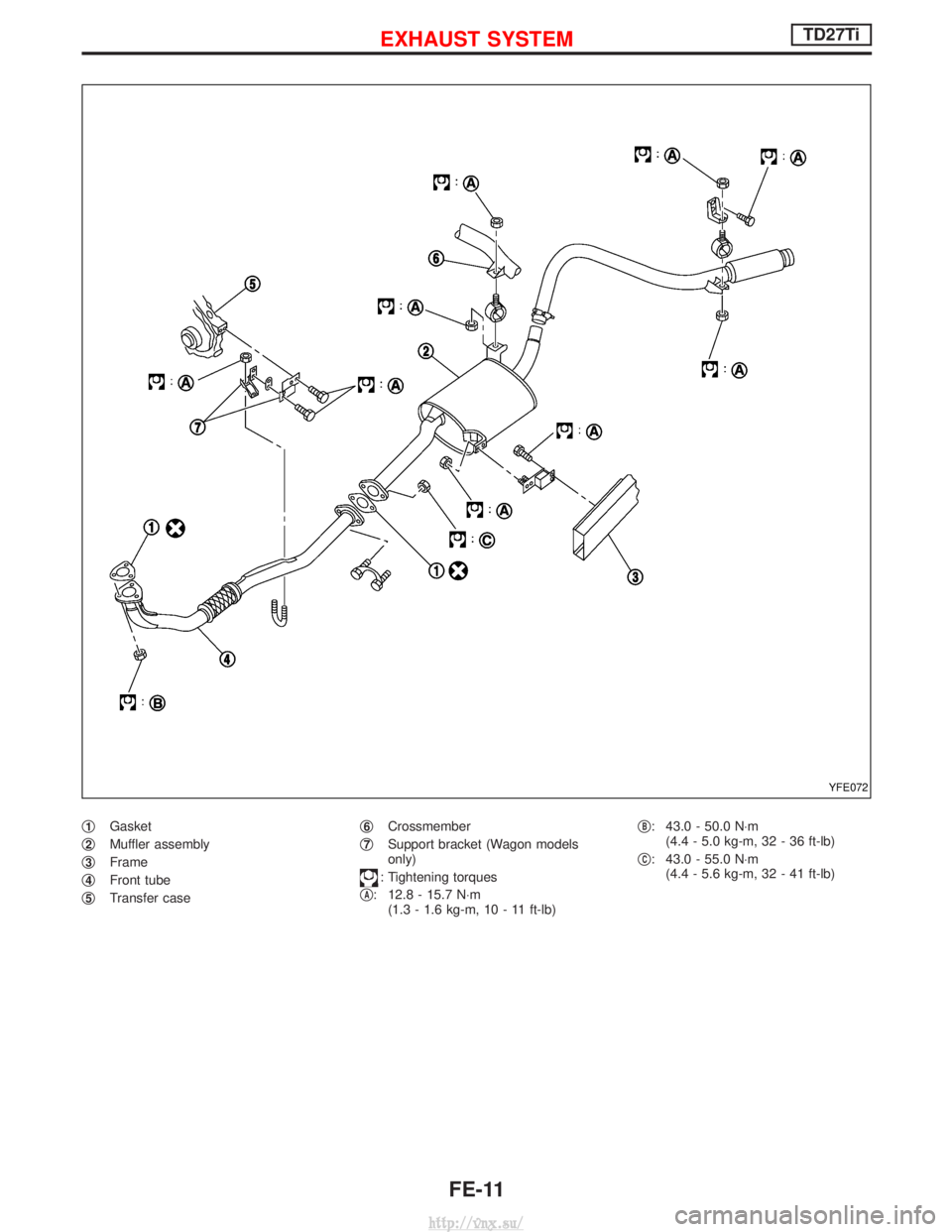
q1Gasket
q
2Muffler assembly
q
3Frame
q
4Front tube
q
5Transfer case q
6Crossmember
q
7Support bracket (Wagon models
only)
: Tightening torques
q
A: 12.8 - 15.7 N ×m
(1.3 - 1.6 kg-m, 10 - 11 ft-lb) q
B: 43.0 - 50.0 N
×m
(4.4 - 5.0 kg-m, 32 - 36 ft-lb)
q
C: 43.0 - 55.0 N ×m
(4.4 - 5.6 kg-m, 32 - 41 ft-lb)
YFE072
EXHAUST SYSTEMTD27Ti
FE-11
http://vnx.su/
Page 764 of 1833
CLUTCH
SECTION
CL
CONTENTS
PRECAUTIONS AND PREPARATION ............................2
Precautions ..................................................................2
Preparation ..................................................................2
CLUTCH SYSTEM ...........................................................3
Clutch Pedal ................................................................4
INSPECTION AND ADJUSTMENT .................................5
Adjusting Clutch Pedal ................................................5
Bleeding Procedure .....................................................6
CLUTCH MASTER CYLINDER .......................................7
HYDRAULIC CLUTCH CONTROL .................................8Clutch Master Cylinder ................................................8
Clutch Operating Cylinder ...........................................8
CLUTCH RELEASE MECHANISM .................................9
CLUTCH DISC AND CLUTCH COVER ........................ 11
Clutch Disc................................................................. 11
Clutch Cover and Flywheel .......................................12
SERVICE DATA AND SPECIFICATIONS (SDS) ..........14
General Specifications ...............................................14
Inspection and Adjustment ........................................14
http://vnx.su/
Page 765 of 1833
Precautions
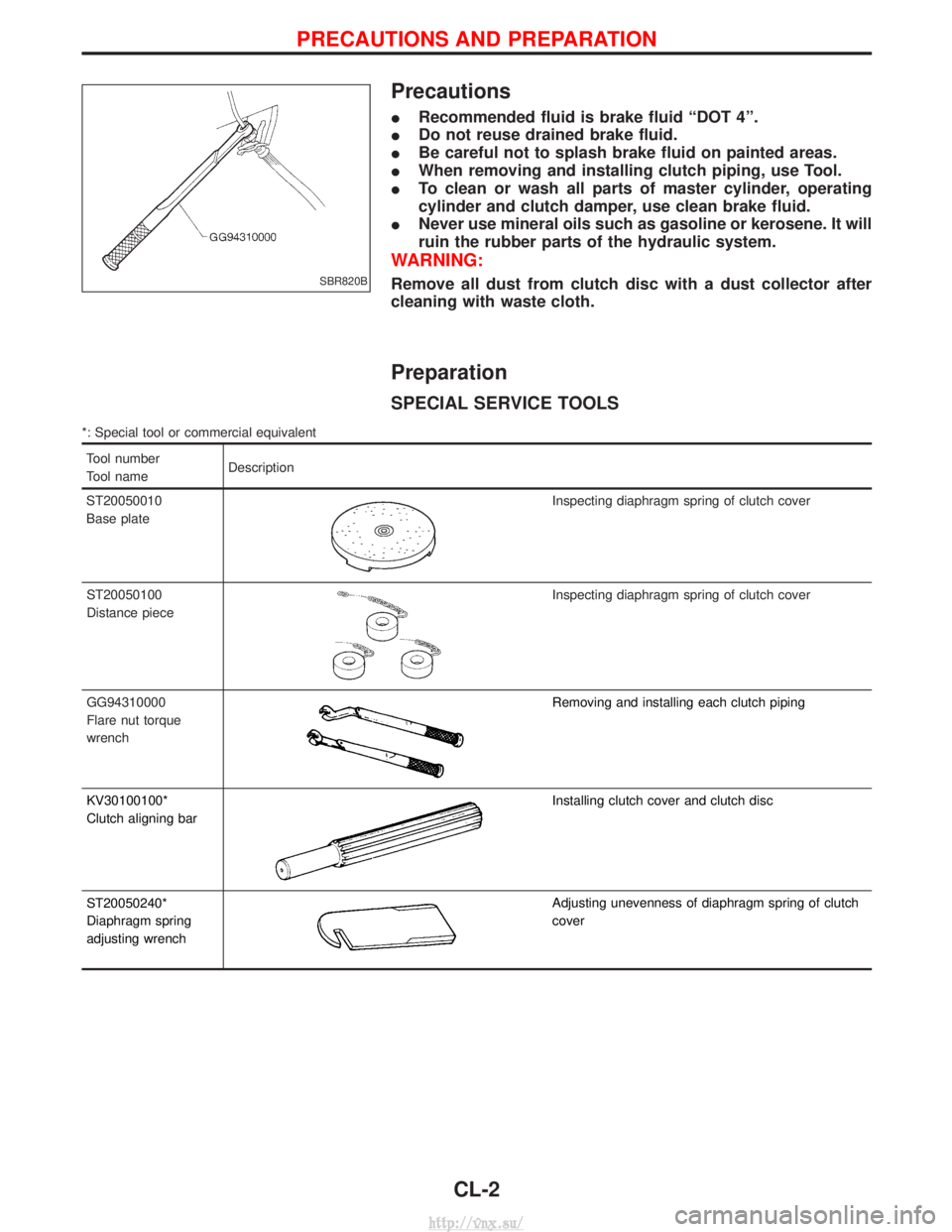
IRecommended fluid is brake fluid ªDOT 4º.
I Do not reuse drained brake fluid.
I Be careful not to splash brake fluid on painted areas.
I When removing and installing clutch piping, use Tool.
I To clean or wash all parts of master cylinder, operating
cylinder and clutch damper, use clean brake fluid.
I Never use mineral oils such as gasoline or kerosene. It will
ruin the rubber parts of the hydraulic system.
WARNING:
Remove all dust from clutch disc with a dust collector after
cleaning with waste cloth.
Preparation
SPECIAL SERVICE TOOLS
*: Special tool or commercial equivalent
Tool number
Tool name Description
ST20050010
Base plate
Inspecting diaphragm spring of clutch cover
ST20050100
Distance piece
Inspecting diaphragm spring of clutch cover
GG94310000
Flare nut torque
wrench
Removing and installing each clutch piping
KV30100100*
Clutch aligning bar
Installing clutch cover and clutch disc
ST20050240*
Diaphragm spring
adjusting wrench
Adjusting unevenness of diaphragm spring of clutch
cover
SBR820B
PRECAUTIONS AND PREPARATION
CL-2
http://vnx.su/
Page 766 of 1833

YCL022
CLUTCH SYSTEM
CL-3
http://vnx.su/