system NISSAN TERRANO 2004 Service Repair Manual
[x] Cancel search | Manufacturer: NISSAN, Model Year: 2004, Model line: TERRANO, Model: NISSAN TERRANO 2004Pages: 1833, PDF Size: 53.42 MB
Page 833 of 1833
Diagnosis by CONSULT-II
NOTICE
1. The CONSULT-II electrically displays shift timing and lock-up timing (that is, operation timing of eachsolenoid).
Check for time difference between actual shift timing and the CONSULT-II display. If the difference is
noticeable, mechanical parts (except solenoids, sensors, etc.) may be malfunctioning. Check mechanical
parts using applicable diagnostic procedures.
2. Shift schedule (which implies gear position) displayed on CONSULT-II and that indicated in Service Manual may differ slightly. This occurs because of the following reasons:
IActual shift schedule has more or less tolerance or allowance,
I Shift schedule indicated in Service Manual refers to the point where shifts start. Gear position displayed
on CONSULT-II indicates the point where shifts are completed.
3. Shift solenoid valve ªAº or ªBº is displayed on CONSULT-II at the start of shifting. Gear position is displayed upon completion of shifting (which is computed by TCM).
4. Additional CONSULT-II information can be found in the Operation Manual supplied with the CONSULT-II unit.
SELF-DIAGNOSTIC RESULT TEST MODE
Refer to AT-14.
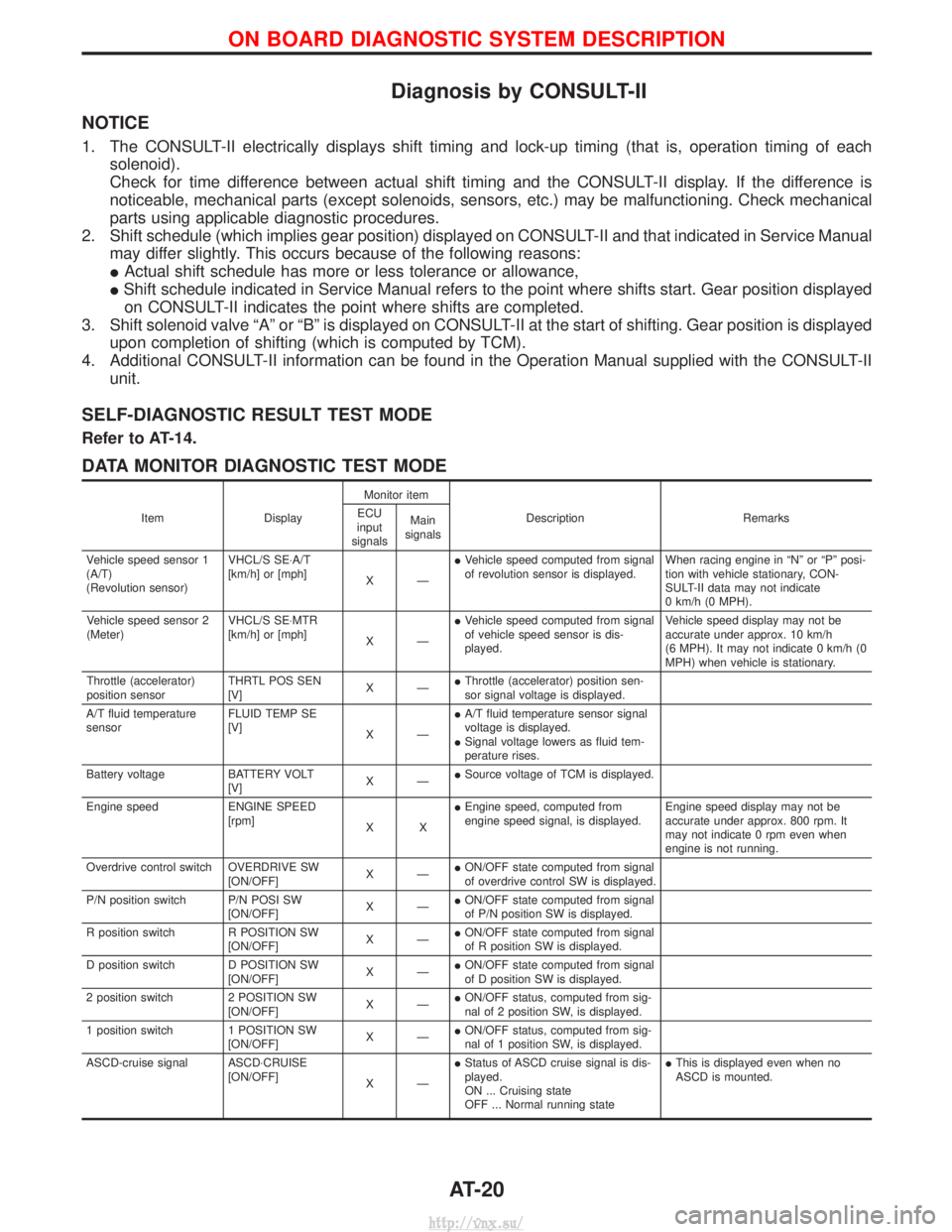
DATA MONITOR DIAGNOSTIC TEST MODE
Item DisplayMonitor item
Description Remarks
ECU
input
signals Main
signals
Vehicle speed sensor 1
(A/T)
(Revolution sensor) VHCL/S SE×A/T
[km/h] or [mph]
XÐI
Vehicle speed computed from signal
of revolution sensor is displayed. When racing engine in ªNº or ªPº posi-
tion with vehicle stationary, CON-
SULT-II data may not indicate
0 km/h (0 MPH).
Vehicle speed sensor 2
(Meter) VHCL/S SE×MTR
[km/h] or [mph]
XÐI
Vehicle speed computed from signal
of vehicle speed sensor is dis-
played. Vehicle speed display may not be
accurate under approx. 10 km/h
(6 MPH). It may not indicate 0 km/h (0
MPH) when vehicle is stationary.
Throttle (accelerator)
position sensor THRTL POS SEN
[V]
XÐI
Throttle (accelerator) position sen-
sor signal voltage is displayed.
A/T fluid temperature
sensor FLUID TEMP SE
[V]
XÐI
A/T fluid temperature sensor signal
voltage is displayed.
I Signal voltage lowers as fluid tem-
perature rises.
Battery voltage BATTERY VOLT [V]XÐI
Source voltage of TCM is displayed.
Engine speed ENGINE SPEED [rpm]XXI
Engine speed, computed from
engine speed signal, is displayed. Engine speed display may not be
accurate under approx. 800 rpm. It
may not indicate 0 rpm even when
engine is not running.
Overdrive control switch OVERDRIVE SW [ON/OFF]XÐI
ON/OFF state computed from signal
of overdrive control SW is displayed.
P/N position switch P/N POSI SW [ON/OFF]XÐI
ON/OFF state computed from signal
of P/N position SW is displayed.
R position switch R POSITION SW [ON/OFF]XÐI
ON/OFF state computed from signal
of R position SW is displayed.
D position switch D POSITION SW [ON/OFF]XÐI
ON/OFF state computed from signal
of D position SW is displayed.
2 position switch 2 POSITION SW [ON/OFF]XÐI
ON/OFF status, computed from sig-
nal of 2 position SW, is displayed.
1 position switch 1 POSITION SW [ON/OFF]XÐI
ON/OFF status, computed from sig-
nal of 1 position SW, is displayed.
ASCD-cruise signal ASCD×CRUISE [ON/OFF]XÐI
Status of ASCD cruise signal is dis-
played.
ON ... Cruising state
OFF ... Normal running state I
This is displayed even when no
ASCD is mounted.
ON BOARD DIAGNOSTIC SYSTEM DESCRIPTION
AT-20
http://vnx.su/
Page 834 of 1833
![NISSAN TERRANO 2004 Service Repair Manual ItemDisplayMonitor item
Description Remarks
ECU
input
signals Main
signals
ASCD-OD cut signal ASCD×OD CUT [ON/OFF]XÐI
Status of ASCD×OD release signal is
displayed.
ON ... OD released
OFF ... OD no](/img/5/57394/w960_57394-833.png "NISSAN TERRANO 2004 Service Repair Manual ItemDisplayMonitor item
Description Remarks
ECU
input
signals Main
signals
ASCD-OD cut signal ASCD×OD CUT [ON/OFF]XÐI
Status of ASCD×OD release signal is
displayed.
ON ... OD released
OFF ... OD no")
ItemDisplayMonitor item
Description Remarks
ECU
input
signals Main
signals
ASCD-OD cut signal ASCD×OD CUT [ON/OFF]XÐI
Status of ASCD×OD release signal is
displayed.
ON ... OD released
OFF ... OD not released I
This is displayed even when no
ASCD is mounted.
Kickdown switch KICKDOWN SW [ON/OFF]XÐI
ON/OFF status, computed from sig-
nal of kickdown SW, is displayed. I
This is displayed even when no
kickdown switch is equipped.
A/T mode switch POWER SHIFT SW [ON/OFF]XÐI
ON/OFF state computed from signal
of SPORT shift SW is displayed.
Closed throttle position
switch CLOSED THL/SW
[ON/OFF]
X ÐI
ON/OFF status, computed from sig-
nal of closed throttle (accelerator)
position SW, is displayed.
Wide open throttle posi-
tion switch W/O THRL/P-SW
[ON/OFF]
X ÐI
ON/OFF status, computed from sig-
nal of wide open throttle (accelera-
tor) position SW, is displayed.
A/T mode switch HOLD SW [ON/OFF]XÐI
ON/OFF status, computed from sig-
nal of SNOW shift SW, is displayed.
Gear position GEAR
ÐXI
Gear position data used for compu-
tation by TCM, is displayed.
Selector lever position SLCT LVR POSI ÐXI
Selector lever position data, used
for computation by TCM, is dis-
played. I
A specific value used for control is
displayed if fail-safe is activated due
to error.
Vehicle speed VEHICLE SPEED
[km/h] or [mph] ÐXI
Vehicle speed data, used for com-
putation by TCM, is displayed.
Throttle (accelerator)
position THROTTLE POSI
[/8]
Ð XI
Throttle (accelerator) position data,
used for computation by TCM, is
displayed. I
A specific value used for control is
displayed if fail-safe is activated due
to error.
Line pressure duty LINE PRES DTY [%]Ð XI
Control value of line pressure sole-
noid valve, computed by TCM from
each input signal, is displayed.
Torque converter clutch
solenoid valve duty TCC S/V DUTY
[%]
ÐXI
Control value of torque converter
clutch solenoid valve, computed by
TCM from each input signal, is dis-
played.
Shift solenoid valve A SHIFT S/V A [ON/OFF]Ð XI
Control value of shift solenoid valve
A, computed by TCM from each
input signal, is displayed. Control value of solenoid is displayed
even if solenoid circuit is discon-
nected.
The ªOFFº signal is displayed if sole-
noid circuit is shorted.
Shift solenoid valve B SHIFT S/V B
[ON/OFF]Ð XI
Control value of shift solenoid valve
B, computed by TCM from each
input signal, is displayed.
Overrun clutch solenoid
valve OVERRUN/C S/V
[ON/OFF]
Ð XI
Control value of overrun clutch sole-
noid valve computed by TCM from
each input signal is displayed.
Self-diagnosis display
lamp
(SPORT indicator lamp) SELF-D DP LMP
[ON/OFF]
Ð XI
Control status of SPORT indicator
lamp is displayed.
X: Applicable
Ð: Not applicable
ON BOARD DIAGNOSTIC SYSTEM DESCRIPTION
Diagnosis by CONSULT-II (Cont'd)
AT-21
http://vnx.su/
Page 835 of 1833
Introduction
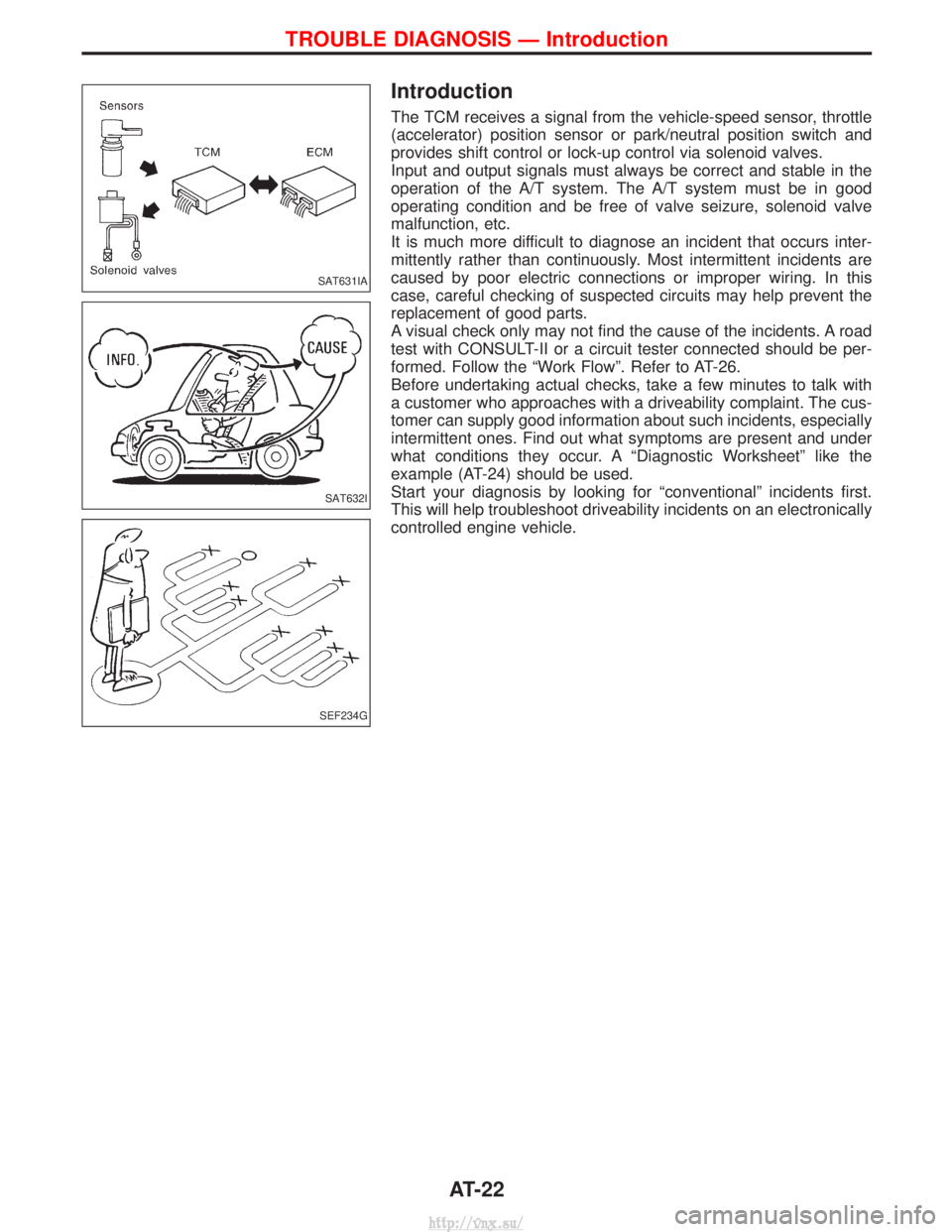
The TCM receives a signal from the vehicle-speed sensor, throttle
(accelerator) position sensor or park/neutral position switch and
provides shift control or lock-up control via solenoid valves.
Input and output signals must always be correct and stable in the
operation of the A/T system. The A/T system must be in good
operating condition and be free of valve seizure, solenoid valve
malfunction, etc.
It is much more difficult to diagnose an incident that occurs inter-
mittently rather than continuously. Most intermittent incidents are
caused by poor electric connections or improper wiring. In this
case, careful checking of suspected circuits may help prevent the
replacement of good parts.
A visual check only may not find the cause of the incidents. A road
test with CONSULT-II or a circuit tester connected should be per-
formed. Follow the ªWork Flowº. Refer to AT-26.
Before undertaking actual checks, take a few minutes to talk with
a customer who approaches with a driveability complaint. The cus-
tomer can supply good information about such incidents, especially
intermittent ones. Find out what symptoms are present and under
what conditions they occur. A ªDiagnostic Worksheetº like the
example (AT-24) should be used.
Start your diagnosis by looking for ªconventionalº incidents first.
This will help troubleshoot driveability incidents on an electronically
controlled engine vehicle.
SAT631IA
SAT632I
SEF234G
TROUBLE DIAGNOSIS Ð Introduction
AT-22
http://vnx.su/
Page 839 of 1833
Work Flow
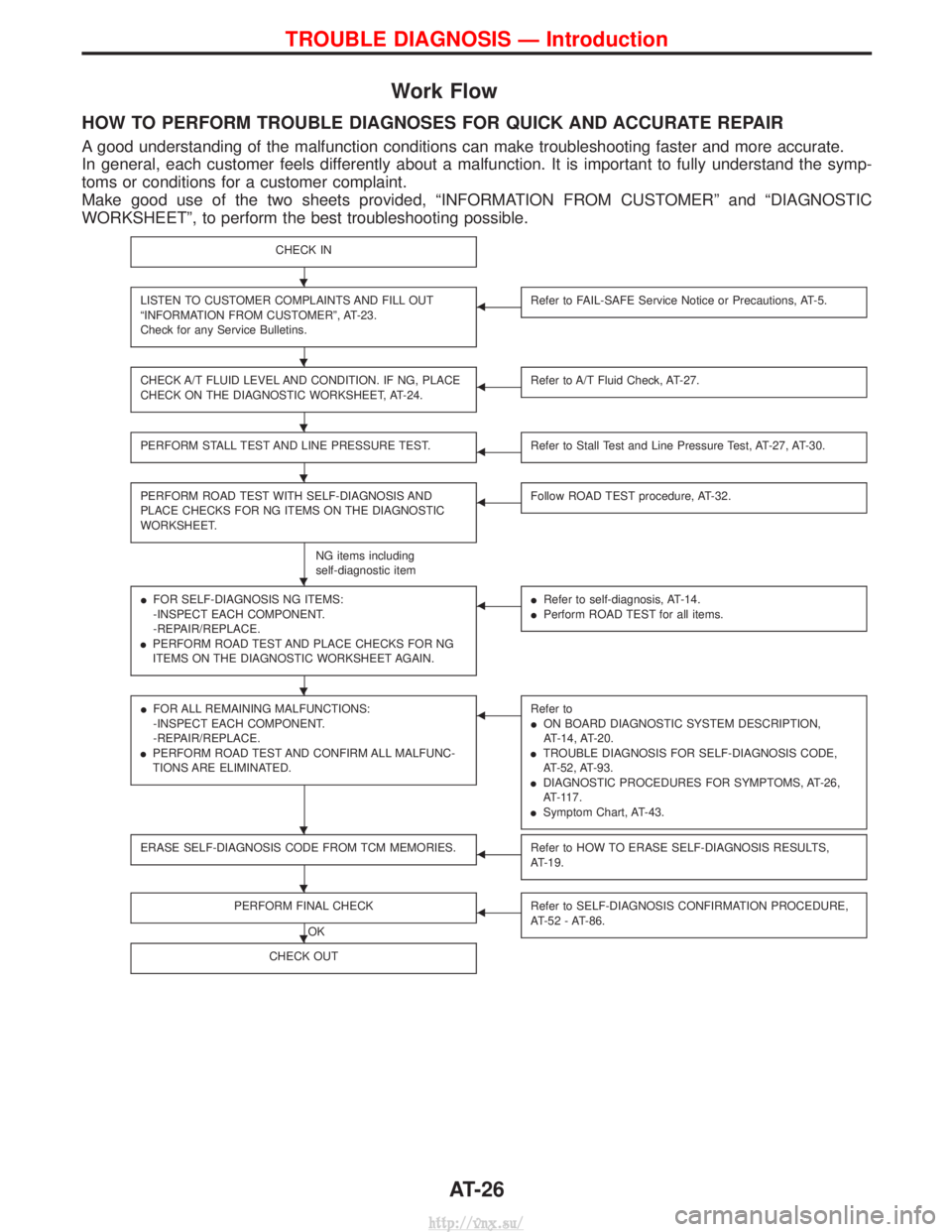
HOW TO PERFORM TROUBLE DIAGNOSES FOR QUICK AND ACCURATE REPAIR
A good understanding of the malfunction conditions can make troubleshooting faster and more accurate.
In general, each customer feels differently about a malfunction. It is important to fully understand the symp-
toms or conditions for a customer complaint.
Make good use of the two sheets provided, ªINFORMATION FROM CUSTOMERº and ªDIAGNOSTIC
WORKSHEETº, to perform the best troubleshooting possible.
CHECK IN
LISTEN TO CUSTOMER COMPLAINTS AND FILL OUT
ªINFORMATION FROM CUSTOMERº, AT-23.
Check for any Service Bulletins.FRefer to FAIL-SAFE Service Notice or Precautions, AT-5.
CHECK A/T FLUID LEVEL AND CONDITION. IF NG, PLACE
CHECK ON THE DIAGNOSTIC WORKSHEET, AT-24.FRefer to A/T Fluid Check, AT-27.
PERFORM STALL TEST AND LINE PRESSURE TEST.FRefer to Stall Test and Line Pressure Test, AT-27, AT-30.
PERFORM ROAD TEST WITH SELF-DIAGNOSIS AND
PLACE CHECKS FOR NG ITEMS ON THE DIAGNOSTIC
WORKSHEET.
NG items including
self-diagnostic item
FFollow ROAD TEST procedure, AT-32.
IFOR SELF-DIAGNOSIS NG ITEMS:
-INSPECT EACH COMPONENT.
-REPAIR/REPLACE.
I PERFORM ROAD TEST AND PLACE CHECKS FOR NG
ITEMS ON THE DIAGNOSTIC WORKSHEET AGAIN.FIRefer to self-diagnosis, AT-14.
I Perform ROAD TEST for all items.
IFOR ALL REMAINING MALFUNCTIONS:
-INSPECT EACH COMPONENT.
-REPAIR/REPLACE.
I PERFORM ROAD TEST AND CONFIRM ALL MALFUNC-
TIONS ARE ELIMINATED.FRefer to
ION BOARD DIAGNOSTIC SYSTEM DESCRIPTION,
AT-14, AT-20.
I TROUBLE DIAGNOSIS FOR SELF-DIAGNOSIS CODE,
AT-52, AT-93.
I DIAGNOSTIC PROCEDURES FOR SYMPTOMS, AT-26,
AT-117.
I Symptom Chart, AT-43.
ERASE SELF-DIAGNOSIS CODE FROM TCM MEMORIES.FRefer to HOW TO ERASE SELF-DIAGNOSIS RESULTS,
AT-19.
PERFORM FINAL CHECK
OK
FRefer to SELF-DIAGNOSIS CONFIRMATION PROCEDURE,
AT-52 - AT-86.
CHECK OUT
H
H
H
H
H
H
H
H
H
TROUBLE DIAGNOSIS Ð Introduction
AT-26
http://vnx.su/
Page 845 of 1833
Road Test
DESCRIPTION
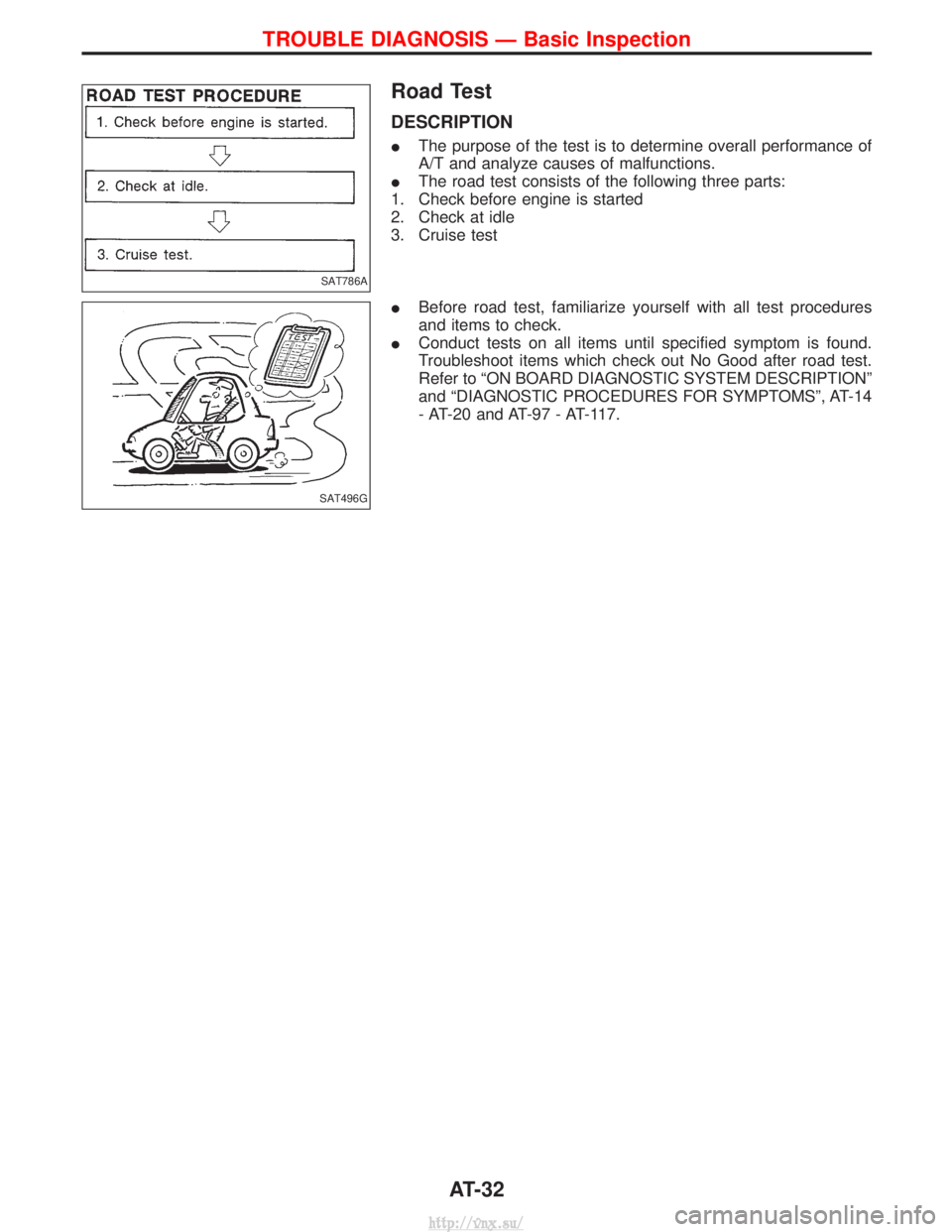
IThe purpose of the test is to determine overall performance of
A/T and analyze causes of malfunctions.
I The road test consists of the following three parts:
1. Check before engine is started
2. Check at idle
3. Cruise test
I Before road test, familiarize yourself with all test procedures
and items to check.
I Conduct tests on all items until specified symptom is found.
Troubleshoot items which check out No Good after road test.
Refer to ªON BOARD DIAGNOSTIC SYSTEM DESCRIPTIONº
and ªDIAGNOSTIC PROCEDURES FOR SYMPTOMSº, AT-14
- AT-20 and AT-97 - AT-117.
SAT786A
SAT496G
TROUBLE DIAGNOSIS Ð Basic Inspection
AT-32
http://vnx.su/
Page 876 of 1833
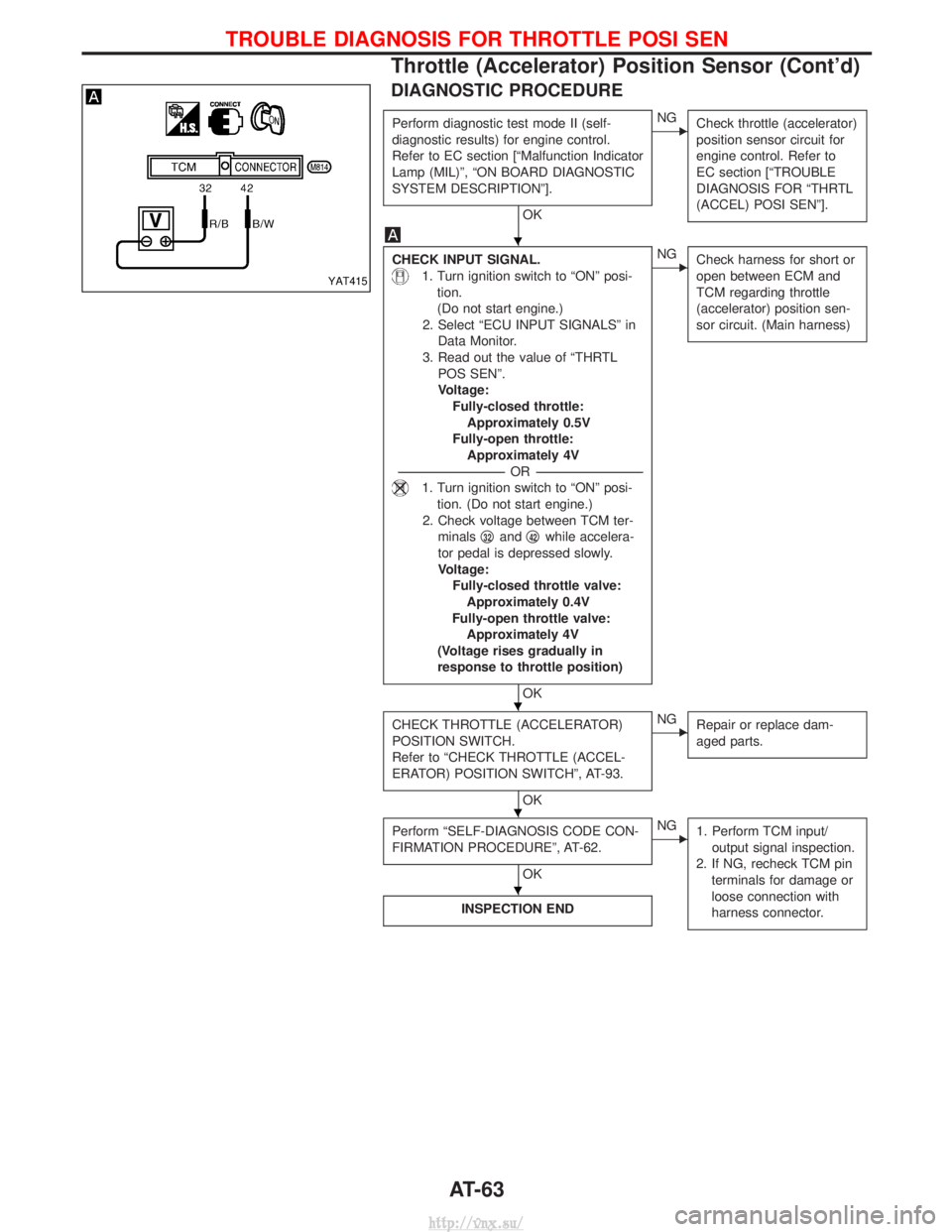
DIAGNOSTIC PROCEDURE
Perform diagnostic test mode II (self-
diagnostic results) for engine control.
Refer to EC section [ªMalfunction Indicator
Lamp (MIL)º, ªON BOARD DIAGNOSTIC
SYSTEM DESCRIPTIONº].
OK
ENGCheck throttle (accelerator)
position sensor circuit for
engine control. Refer to
EC section [ªTROUBLE
DIAGNOSIS FOR ªTHRTL
(ACCEL) POSI SENº].
CHECK INPUT SIGNAL.
1. Turn ignition switch to ªONº posi-
tion.
(Do not start engine.)
2. Select ªECU INPUT SIGNALSº in Data Monitor.
3. Read out the value of ªTHRTL POS SENº.
Voltage:Fully-closed throttle:Approximately 0.5V
Fully-open throttle: Approximately 4V
---------------------------------------------------------------------------------------------------------------------- -OR -----------------------------------------------------------------------------------------------------------------------
1. Turn ignition switch to ªONº posi-
tion. (Do not start engine.)
2. Check voltage between TCM ter- minals q
32andq42while accelera-
tor pedal is depressed slowly.
Voltage: Fully-closed throttle valve:Approximately 0.4V
Fully-open throttle valve: Approximately 4V
(Voltage rises gradually in
response to throttle position)
OK
ENG Check harness for short or
open between ECM and
TCM regarding throttle
(accelerator) position sen-
sor circuit. (Main harness)
CHECK THROTTLE (ACCELERATOR)
POSITION SWITCH.
Refer to ªCHECK THROTTLE (ACCEL-
ERATOR) POSITION SWITCHº, AT-93.
OK
ENGRepair or replace dam-
aged parts.
Perform ªSELF-DIAGNOSIS CODE CON-
FIRMATION PROCEDUREº, AT-62.
OK
ENG1. Perform TCM input/
output signal inspection.
2. If NG, recheck TCM pin terminals for damage or
loose connection with
harness connector.
INSPECTION END
YAT415
H
H
H
H
TROUBLE DIAGNOSIS FOR THROTTLE POSI SEN
Throttle (Accelerator) Position Sensor (Cont'd)
AT-63
http://vnx.su/
Page 915 of 1833
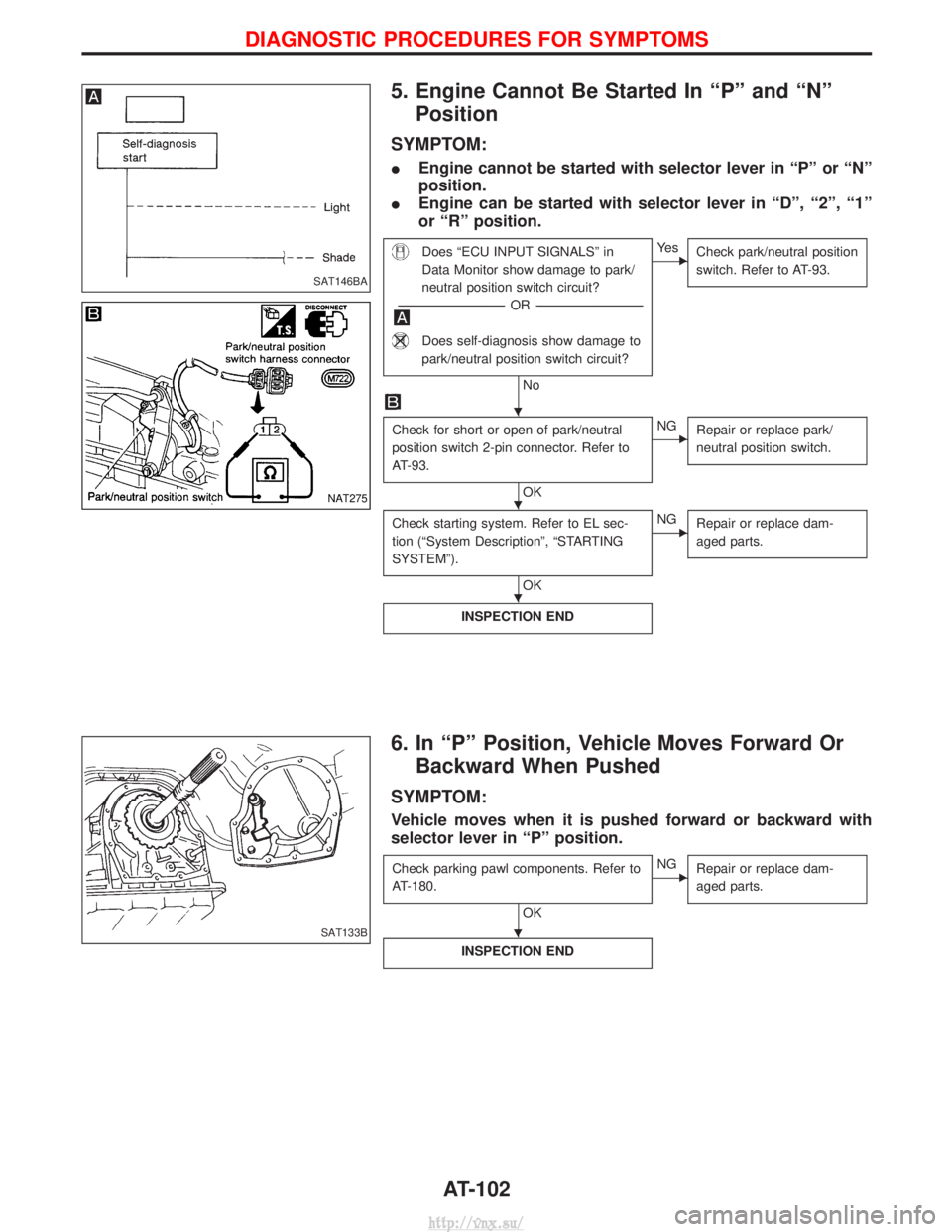
5. Engine Cannot Be Started In ªPº and ªNºPosition
SYMPTOM:
I Engine cannot be started with selector lever in ªPº or ªNº
position.
I Engine can be started with selector lever in ªDº, ª2º, ª1º
or ªRº position.
Does ªECU INPUT SIGNALSº in
Data Monitor show damage to park/
neutral position switch circuit?
---------------------------------------------------------------------------------------------------------------------- -OR -----------------------------------------------------------------------------------------------------------------------
Does self-diagnosis show damage to
park/neutral position switch circuit?
No
EYe s
Check park/neutral position
switch. Refer to AT-93.
Check for short or open of park/neutral
position switch 2-pin connector. Refer to
AT-93.
OK
ENGRepair or replace park/
neutral position switch.
Check starting system. Refer to EL sec-
tion (ªSystem Descriptionº, ªSTARTING
SYSTEMº).
OK
ENGRepair or replace dam-
aged parts.
INSPECTION END
6. In ªPº Position, Vehicle Moves Forward Or
Backward When Pushed
SYMPTOM:
Vehicle moves when it is pushed forward or backward with
selector lever in ªPº position.
Check parking pawl components. Refer to
AT-180.
OK
ENG Repair or replace dam-
aged parts.
INSPECTION END
SAT146BA
NAT275
SAT133B
H
H
H
H
DIAGNOSTIC PROCEDURES FOR SYMPTOMS
AT-102
http://vnx.su/
Page 942 of 1833
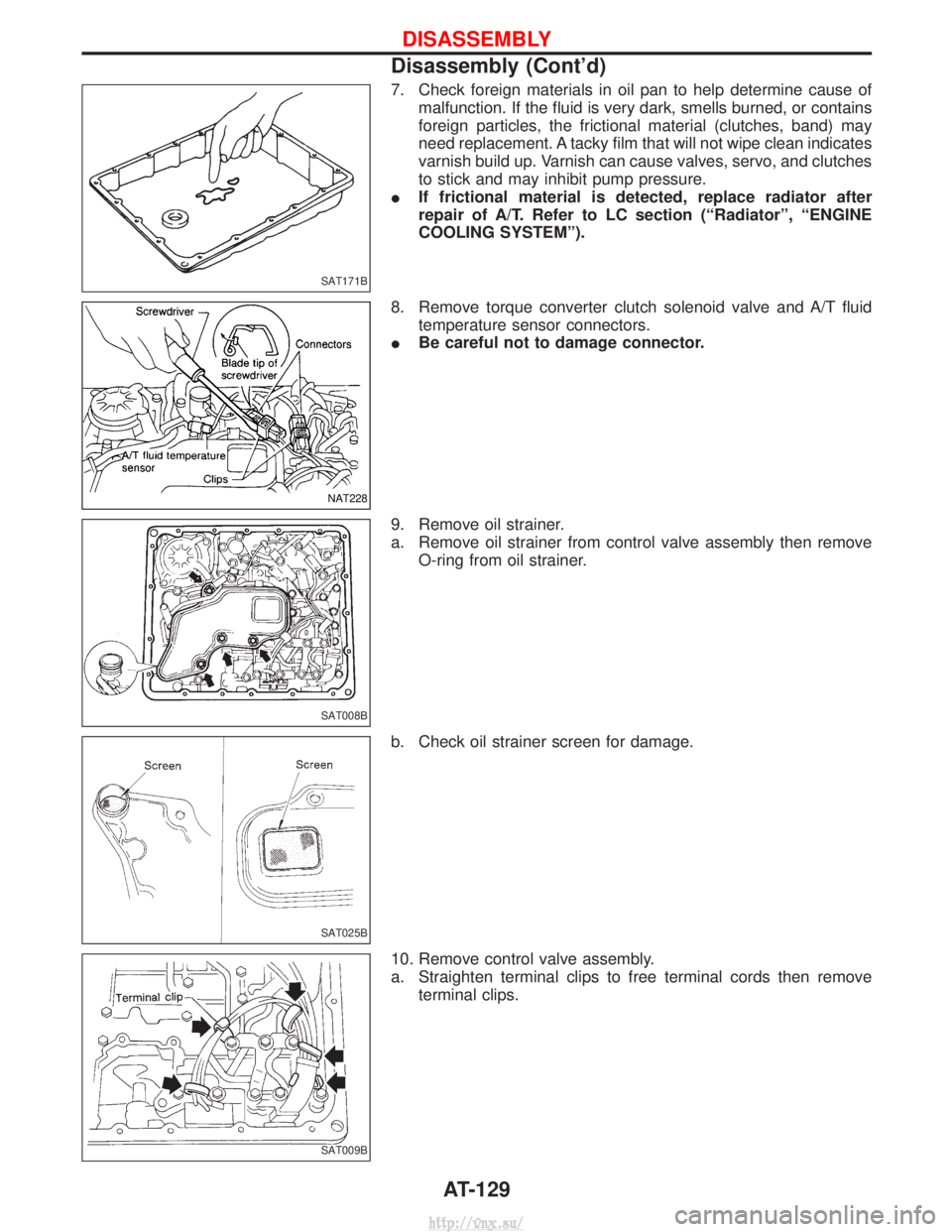
7. Check foreign materials in oil pan to help determine cause ofmalfunction. If the fluid is very dark, smells burned, or contains
foreign particles, the frictional material (clutches, band) may
need replacement. A tacky film that will not wipe clean indicates
varnish build up. Varnish can cause valves, servo, and clutches
to stick and may inhibit pump pressure.
I If frictional material is detected, replace radiator after
repair of A/T. Refer to LC section (ªRadiatorº, ªENGINE
COOLING SYSTEMº).
8. Remove torque converter clutch solenoid valve and A/T fluid temperature sensor connectors.
I Be careful not to damage connector.
9. Remove oil strainer.
a. Remove oil strainer from control valve assembly then remove O-ring from oil strainer.
b. Check oil strainer screen for damage.
10. Remove control valve assembly.
a. Straighten terminal clips to free terminal cords then remove terminal clips.
SAT171B
NAT228
SAT008B
SAT025B
SAT009B
DISASSEMBLY
Disassembly (Cont'd)
AT-129
http://vnx.su/
Page 1013 of 1833
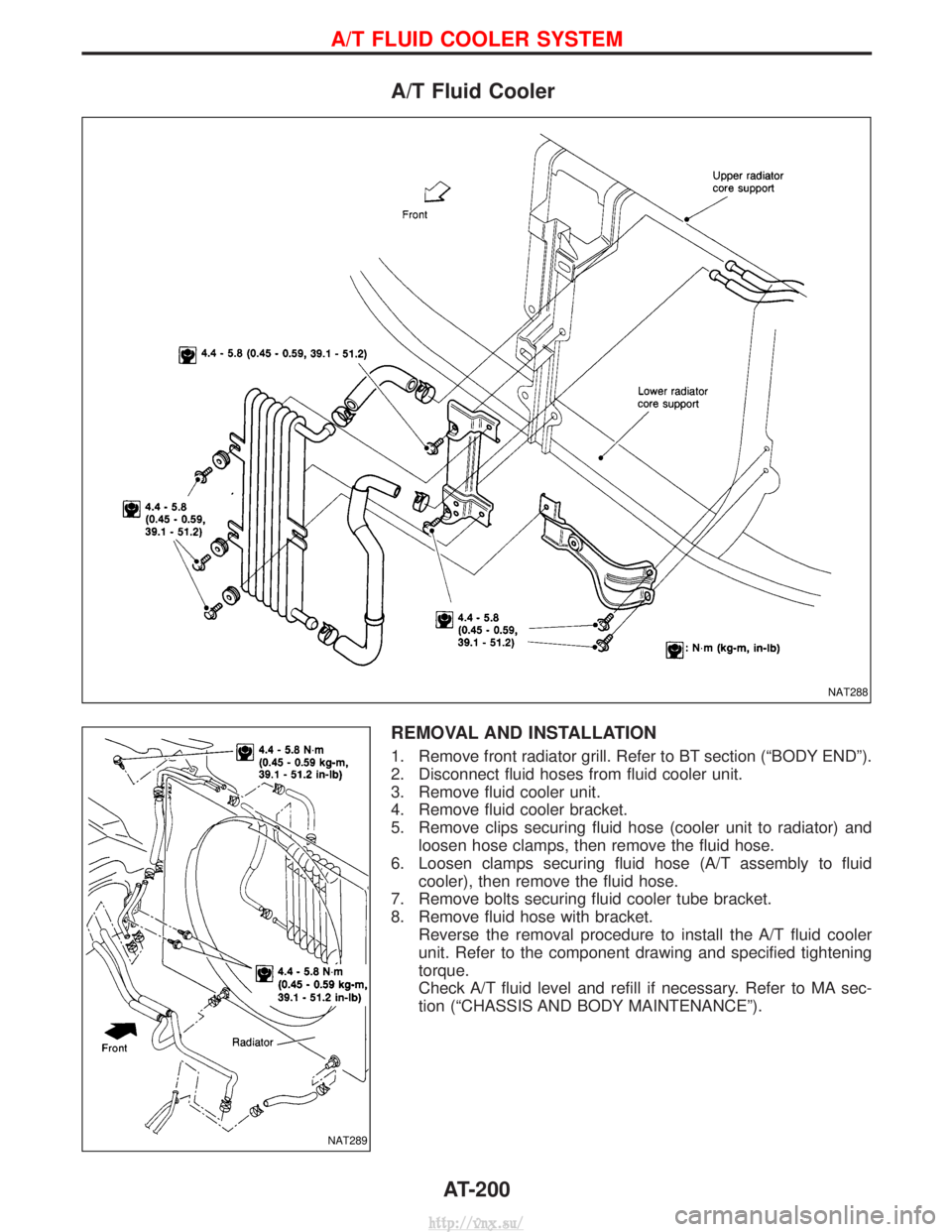
A/T Fluid Cooler
REMOVAL AND INSTALLATION
1. Remove front radiator grill. Refer to BT section (ªBODY ENDº).
2. Disconnect fluid hoses from fluid cooler unit.
3. Remove fluid cooler unit.
4. Remove fluid cooler bracket.
5. Remove clips securing fluid hose (cooler unit to radiator) andloosen hose clamps, then remove the fluid hose.
6. Loosen clamps securing fluid hose (A/T assembly to fluid cooler), then remove the fluid hose.
7. Remove bolts securing fluid cooler tube bracket.
8. Remove fluid hose with bracket. Reverse the removal procedure to install the A/T fluid cooler
unit. Refer to the component drawing and specified tightening
torque.
Check A/T fluid level and refill if necessary. Refer to MA sec-
tion (ªCHASSIS AND BODY MAINTENANCEº).
NAT288
NAT289
A/T FLUID COOLER SYSTEM
AT-200
http://vnx.su/
Page 1072 of 1833
To avoid confusion while calculating bearing shims, it is absolutely
necessary to stay with the metric system. If you measure anything
in inches, the results MUST be converted to the metric system.
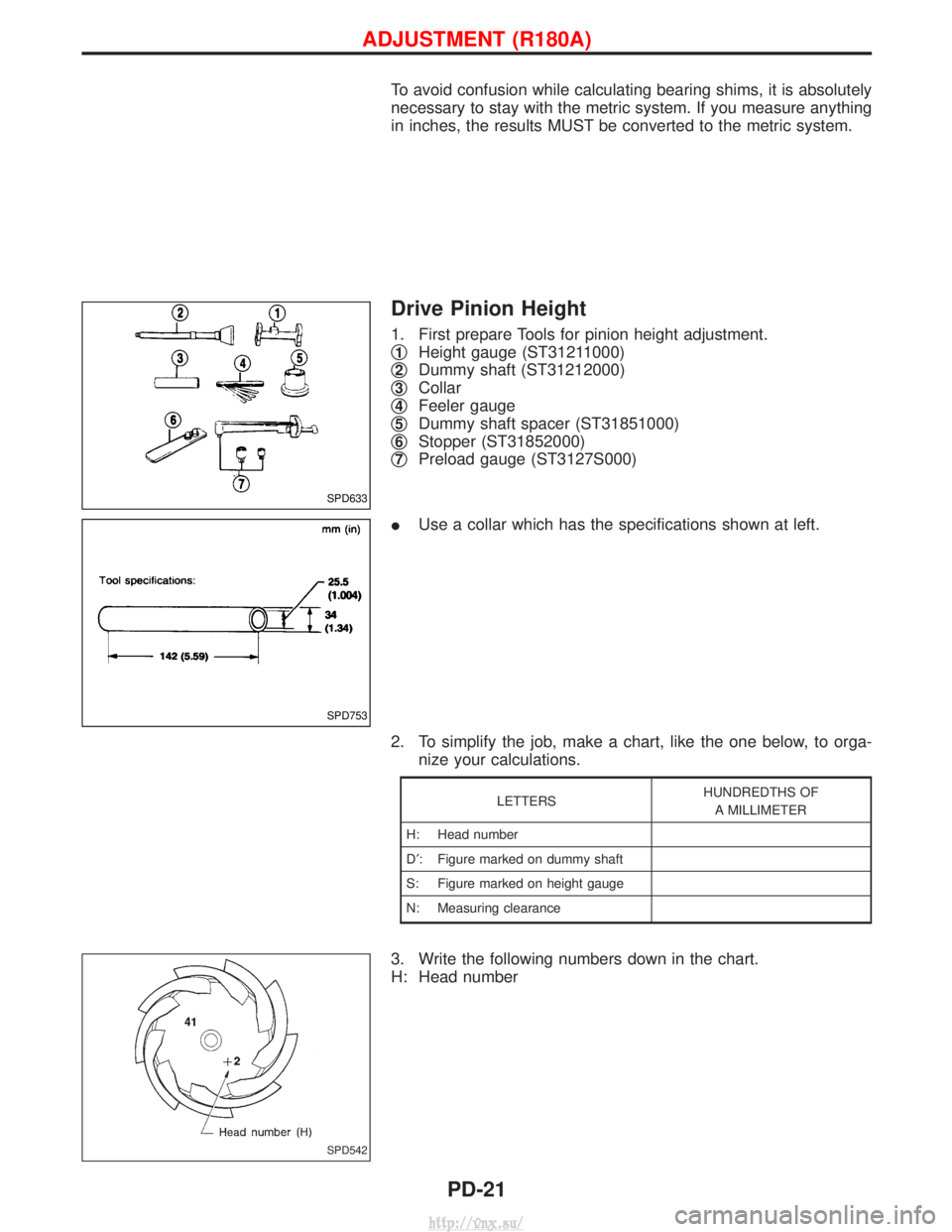
Drive Pinion Height
1. First prepare Tools for pinion height adjustment.
q
1Height gauge (ST31211000)
q
2Dummy shaft (ST31212000)
q
3Collar
q
4Feeler gauge
q
5Dummy shaft spacer (ST31851000)
q
6Stopper (ST31852000)
q
7Preload gauge (ST3127S000)
I Use a collar which has the specifications shown at left.
2. To simplify the job, make a chart, like the one below, to orga- nize your calculations.
LETTERS HUNDREDTHS OF
A MILLIMETER
H: Head number
D¢ : Figure marked on dummy shaft
S: Figure marked on height gauge
N: Measuring clearance
3. Write the following numbers down in the chart.
H: Head number
SPD633
SPD753
SPD542
ADJUSTMENT (R180A)
PD-21
http://vnx.su/