engine control system NISSAN TIIDA 2009 Service Repair Manual
[x] Cancel search | Manufacturer: NISSAN, Model Year: 2009, Model line: TIIDA, Model: NISSAN TIIDA 2009Pages: 4331, PDF Size: 58.04 MB
Page 2383 of 4331
EC
NP
O
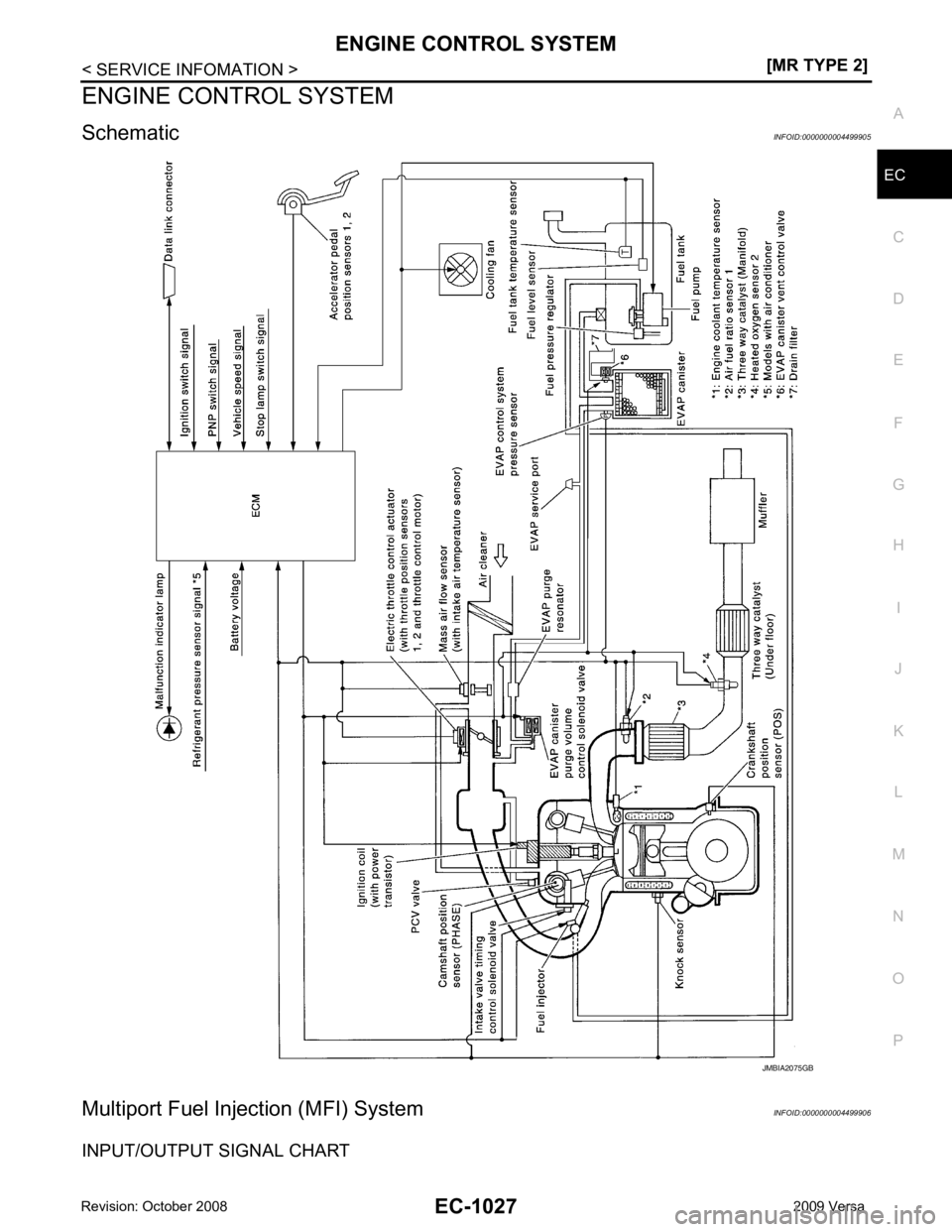
ENGINE CONTROL SYSTEM
Schematic INFOID:0000000004499905
Multiport Fuel Inje ction (MFI) System INFOID:0000000004499906
INPUT/OUTPUT SIGNAL CHART
Page 2384 of 4331
![NISSAN TIIDA 2009 Service Repair Manual EC-1028< SERVICE INFOMATION >
[MR TYPE 2]
ENGINE CONTROL SYSTEM
*1: This sensor is not used to control the engine system under normal conditions.
*2: This signal is sent to the ECM through CAN communi](/img/5/57398/w960_57398-2383.png "NISSAN TIIDA 2009 Service Repair Manual EC-1028< SERVICE INFOMATION >
[MR TYPE 2]
ENGINE CONTROL SYSTEM
*1: This sensor is not used to control the engine system under normal conditions.
*2: This signal is sent to the ECM through CAN communi")
EC-1028< SERVICE INFOMATION >
[MR TYPE 2]
ENGINE CONTROL SYSTEM
*1: This sensor is not used to control the engine system under normal conditions.
*2: This signal is sent to the ECM through CAN communication line.
*3: ECM determines the start signal status by the signals of engine speed and battery voltage.
SYSTEM DESCRIPTION
The amount of fuel injected from the fuel injector is determined by the ECM. The ECM controls the length of
time the valve remains open (injection pulse duration). T he amount of fuel injected is a program value in the
ECM memory. The program value is preset by engi ne operating conditions. These conditions are determined
by input signals (for engine speed and intake air) from t he crankshaft position sensor (POS), camshaft position
sensor (PHASE) and the ma ss air flow sensor.
VARIOUS FUEL INJECTION I NCREASE/DECREASE COMPENSATION
In addition, the amount of fuel injected is compens ated to improve engine performance under various operat-
ing conditions as listed below.
• During warm-up
• When starting the engine
• During acceleration
• Hot-engine operation
• When selector lever is changed from N to D (A/T and CVT models)
• High-load, high-speed operation
• During deceleration
• During high engine speed operation
MIXTURE RATIO FEEDBACK CONTROL (CLOSED LOOP CONTROL) Sensor Input Signal to ECM ECM function Actuator
Crankshaft position sensor (POS) Engine speed*3
Piston position
Fuel injection
& mixture ratio
control Fuel injector
Camshaft position sensor (PHASE)
Mass air flow sensor Amount of intake air
Engine coolant temperature sensor Engine coolant temperature
Air fuel ratio (A/F) sensor 1 Density of oxygen in exhaust gas
Throttle position sensor Throttle position
Accelerator pedal position sensor Accelerator pedal position
Park/neutral position (PNP) switch Gear position
Battery Battery voltage*3
Knock sensor Engine knocking condition
EPS control unit Power steering operation*2
Heated oxygen sensor 2* 1
Density of oxygen in exhaust gas
Air conditioner switch Air conditioner operation*2
ABS actuator and electric unit (control unit)
Vehicle speed*2
Combination meter PBIB3020E
Page 2385 of 4331
![NISSAN TIIDA 2009 Service Repair Manual ENGINE CONTROL SYSTEM
EC-1029
< SERVICE INFOMATION >
[MR TYPE 2] C
D E
F
G H
I
J
K L
M A EC
NP
O
The mixture ratio feedback system provides the best air/
fuel mixture ratio for drivability and emissio](/img/5/57398/w960_57398-2384.png "NISSAN TIIDA 2009 Service Repair Manual ENGINE CONTROL SYSTEM
EC-1029
< SERVICE INFOMATION >
[MR TYPE 2] C
D E
F
G H
I
J
K L
M A EC
NP
O
The mixture ratio feedback system provides the best air/
fuel mixture ratio for drivability and emissio")
ENGINE CONTROL SYSTEM
EC-1029
< SERVICE INFOMATION >
[MR TYPE 2] C
D E
F
G H
I
J
K L
M A EC
NP
O
The mixture ratio feedback system provides the best air/
fuel mixture ratio for drivability and emission control.
The three way catalyst (manifold) can then better r educe CO, HC and NOx emissions. This system uses air
fuel ratio (A/F) sensor 1 in the exhaust manifold to monitor whether the engine operation is rich or lean. The
ECM adjusts the injection pulse width according to the sensor voltage signal. For more information about air
fuel ratio (A/F) sensor 1, refer to EC-1210 . This maintains the mixture ratio within the range of stoichiometric
(ideal air/fuel mixture).
This stage is referred to as the closed loop control condition.
Heated oxygen sensor 2 is located downstream of the th ree way catalyst (manifold). Even if the switching
characteristics of air fuel ratio (A/F) sensor 1 shift, the air/fuel ratio is controlled to stoichiometric by the signal
from heated oxygen sensor 2.
Open Loop Control The open loop system condition refers to when the ECM detects any of the following conditions. Feedback
control stops in order to maintain stabilized fuel combustion.
• Deceleration and acceleration
• High-load, high-speed operation
• Malfunction of air fuel ratio (A/F) sensor 1 or its circuit
• Insufficient activation of air fuel ratio (A /F) sensor 1 at low engine coolant temperature
• High engine coolant temperature
• During warm-up
• After shifting from N to D (A/T and CVT models)
• When starting the engine
MIXTURE RATIO SELF-LEARNING CONTROL The mixture ratio feedback control system monitors the mixture ratio signal transmitted from air fuel ratio (A/F)
sensor 1. This feedback signal is then sent to the ECM. The ECM controls the basic mixture ratio as close to
the theoretical mixture ratio as possible. However, the bas ic mixture ratio is not necessarily controlled as orig-
inally designed. Both manufacturing differences (i.e., mass air flow sensor hot wire) and characteristic
changes during operation (i.e., fuel injector clogging) directly affect mixture ratio.
Accordingly, the difference between the basic and theoretical mixture ratios is monitored in this system. This is
then computed in terms of “injection pulse duration” to automatically compensate for the difference between
the two ratios.
“Fuel trim” refers to the feedback compensation value co mpared against the basic injection duration. Fuel trim
includes short term fuel trim and long term fuel trim.
“Short term fuel trim” is the short-term fuel compensati on used to maintain the mixture ratio at its theoretical
value. The signal from air fuel ratio (A/F) sensor 1 i ndicates whether the mixture ratio is RICH or LEAN com-
pared to the theoretical value. The signal then triggers a r eduction in fuel volume if the mixture ratio is rich, and
an increase in fuel volume if it is lean.
“Long term fuel trim” is overall fuel compensation ca rried out long-term to compensate for continual deviation
of the short term fuel trim from the central value. Such deviation will occur due to individual engine differences,
wear over time and changes in the usage environment.
FUEL INJECTION TIMING
Two types of systems are used.
Sequential Multiport Fuel Injection System
Fuel is injected into each cylinder during each engine cycl e according to the firing order. This system is used
when the engine is running.
Simultaneous Multiport Fuel Injection System Fuel is injected simultaneously into all four cylinders twice each engine cycle. In other words, pulse signals of
the same width are simultaneously transmitted from the ECM.
The four fuel injectors will then receive the signals two times for each engine cycle. SEF337W
Page 2387 of 4331

EC
NP
O
*: This signal is sent to the ECM through CAN communication line.
SYSTEM DESCRIPTION If the engine speed is above 2,400 rpm under no load [for ex ample, the shift lever position is P or N (A/T,
CVT), Neutral (M/T) and engine speed is over 2,400 rpm] f uel will be cut off after some time. The exact time
when the fuel is cut off varies based on engine speed.
Fuel cut will be operated until the engine speed reaches 1,500 rpm, then fuel cut will be cancelled.
NOTE:
This function is different from deceleration control listed under EC-1027, " Multiport Fuel Injection (MFI) Sys-
tem " .
Page 2389 of 4331

EC
NP
O
AUTOMATIC SPEED CONTROL DEVICE (ASCD)
System Description INFOID:0000000004499911
INPUT/OUTPUT SIGNAL CHART
*: This signal is sent to the ECM through CAN communication line.
BASIC ASCD SYSTEM Refer to Owner's Manual for ASCD operating instructions.
Automatic Speed Control Device (ASCD) allows a driver to keep vehicle at predetermined constant speed
without depressing accelerator pedal. Driver can set vehicle speed in advance between approximately 40 km/
h (25 MPH) and 144 km/h (89 MPH).
ECM controls throttle angle of electric thro ttle control actuator to regulate engine speed.
Operation status of ASCD is indicated by CRUISE i ndicator and SET indicator in combination meter. If any
malfunction occurs in ASCD system, it automatically deactivates control.
NOTE:
Always drive vehicle in safe manner according to traffic conditions and obey all traffic laws.
SET OPERATION Press MAIN switch. (The CRUISE indicato r in combination meter illuminates.)
When vehicle speed reaches a desired speed between appr oximately 40 km/h (25 MPH) and 144 km/h (89
MPH), press SET/COAST switch. (Then SET indi cator in combination meter illuminates.)
ACCELERATE OPERATION If the RESUME/ACCELERATE switch is depressed during cruise control driving, increase the vehicle speed
until the switch is released or vehicle speed reaches maximum speed controlled by the system.
And then ASCD will keep the new set speed.
CANCEL OPERATION When any of following conditions exis t, cruise operation will be canceled.
• CANCEL switch is pressed
• More than two switches at ASCD steering switch are pressed at the same time (Set speed will be cleared)
• Brake pedal is depressed
• Clutch pedal is depressed or gear position is changed to the neutral position (M/T models)
• Selector lever is changed to N, P, R position (A/T and CVT models)
• Vehicle speed decreased to 13 km/h (8 MPH) lower than the set speed
When the ECM detects any of the following conditions, the ECM will cancel the cruise operation and inform
the driver by blinking indicator lamp.
• Engine coolant temperature is slightly higher than the normal operating temperature, CRUISE lamp may
blink slowly.
When the engine coolant temperature decreases to t he normal operating temperature, CRUISE lamp will
stop blinking and the cruise operation will be able to work by pressing SET/COAST switch or RESUME/
ACCELERATE switch.
• Malfunction for some self-diagnoses regarding ASCD control: SET lamp will blink quickly.
If MAIN switch is turned to OFF during ASCD is activated, all of ASCD operations will be canceled and vehicle
speed memory will be erased.
COAST OPERATION Sensor Input signal to ECM ECM function Actuator
ASCD brake switch Brake pedal operation
ASCD vehicle speed controlElectric throttle control
actuator
Stop lamp switch Brake pedal operation
ASCD clutch switch (M/T models) Clutch pedal operation
ASCD steering switch ASCD steering switch operation
Park/neutral position (PNP) switch Gear position
ABS actuator and electric unit (con-
trol unit) Vehicle speed*
Combination meter
TCM Powertrain revolution*
Page 2392 of 4331
![NISSAN TIIDA 2009 Service Repair Manual EC-1036< SERVICE INFOMATION >
[MR TYPE 2]
EVAPORATIVE EMISSION SYSTEM
EVAPORATIVE EMISSION SYSTEM
Description INFOID:0000000004499914
SYSTEM DESCRIPTION
The evaporative emission system is used t](/img/5/57398/w960_57398-2391.png "NISSAN TIIDA 2009 Service Repair Manual EC-1036< SERVICE INFOMATION >
[MR TYPE 2]
EVAPORATIVE EMISSION SYSTEM
EVAPORATIVE EMISSION SYSTEM
Description INFOID:0000000004499914
SYSTEM DESCRIPTION
The evaporative emission system is used t")
EC-1036< SERVICE INFOMATION >
[MR TYPE 2]
EVAPORATIVE EMISSION SYSTEM
EVAPORATIVE EMISSION SYSTEM
Description INFOID:0000000004499914
SYSTEM DESCRIPTION
The evaporative emission system is used to reduce hydr ocarbons emitted into the atmosphere from the fuel
system. This reduction of hydrocarbons is accomplis hed by activated charcoals in the EVAP canister.
The fuel vapor in the sealed fuel tank is led into t he EVAP canister which contains activated carbon and the
vapor is stored there when the engine is not oper ating or when refueling to the fuel tank.
The vapor in the EVAP canister is purged by the air through the purge line to the intake manifold when the
engine is operating. EVAP canister purge volume contro l solenoid valve is controlled by ECM. When the
engine operates, the flow rate of vapor controlled by EVAP canister purge volume control solenoid valve is
proportionally regulated as the air flow increases.
EVAP canister purge volume control solenoid valve al so shuts off the vapor purge line during decelerating.
EVAPORATIVE EMISSION LINE DRAWING PBIB3639E
Page 2396 of 4331
![NISSAN TIIDA 2009 Service Repair Manual EC-1040< SERVICE INFOMATION >
[MR TYPE 2]
EVAPORATIVE EMISSION SYSTEM
Positive pressure is delivered to the EVAP system through the EVAP
service port. If fuel vapor leak age in the EVAP system occurs,](/img/5/57398/w960_57398-2395.png "NISSAN TIIDA 2009 Service Repair Manual EC-1040< SERVICE INFOMATION >
[MR TYPE 2]
EVAPORATIVE EMISSION SYSTEM
Positive pressure is delivered to the EVAP system through the EVAP
service port. If fuel vapor leak age in the EVAP system occurs,")
EC-1040< SERVICE INFOMATION >
[MR TYPE 2]
EVAPORATIVE EMISSION SYSTEM
Positive pressure is delivered to the EVAP system through the EVAP
service port. If fuel vapor leak age in the EVAP system occurs, use a
leak detector to locate the leak.
Removal and Installation INFOID:0000000004499916
EVAP CANISTER
Tighten EVAP canister as shown in the figure.
EVAP CANISTER VENT CONTROL VALVE
1. Turn EVAP canister vent control valve counterclockwise.
• Lock (A)
• Unlock (B)
2. Remove the EVAP canister vent control valve.
Always replace O-ring with a new one.
How to Detect Fuel Vapor Leakage INFOID:0000000004499917
CAUTION:
• Never use compressed air or a high pressure pump.
• Do not exceed 4.12 kPa (0.042 kg/cm 2
, 0.6 psi) of pressure in EVAP system.
NOTE:
• Do not start engine.
• Improper installation of EVAP service port adapter to the EVAP service port may cause a leak.
WITH CONSULT-III
1. Attach the EVAP service port adapter securely to the EVAP service port.
2. Also attach the pressure pump and hose to the EVAP service port adapter. SEF462UC
PBIB1214E
PBIB3091E
Page 2398 of 4331
![NISSAN TIIDA 2009 Service Repair Manual EC-1042< SERVICE INFOMATION >
[MR TYPE 2]
ON BOARD REFUELING VAPOR RECOVERY (ORVR)
ON BOARD REFUELING VAPOR RECOVERY (ORVR)
System Description INFOID:0000000004499918
From the beginning of refueli](/img/5/57398/w960_57398-2397.png "NISSAN TIIDA 2009 Service Repair Manual EC-1042< SERVICE INFOMATION >
[MR TYPE 2]
ON BOARD REFUELING VAPOR RECOVERY (ORVR)
ON BOARD REFUELING VAPOR RECOVERY (ORVR)
System Description INFOID:0000000004499918
From the beginning of refueli")
EC-1042< SERVICE INFOMATION >
[MR TYPE 2]
ON BOARD REFUELING VAPOR RECOVERY (ORVR)
ON BOARD REFUELING VAPOR RECOVERY (ORVR)
System Description INFOID:0000000004499918
From the beginning of refueling, the air and vapor insi de the fuel tank go through refueling EVAP vapor cut
valve and EVAP/ORVR line to the EVAP canister. The vapor is absorbed by the EVAP canister and the air is
released to the atmosphere.
When the refueling has reached the full level of the fuel tank, the refueling EVAP vapor cut valve is closed and
refueling is stopped because of auto shut-off. The vapor which was absorbed by the EVAP canister is purged
during driving.
WARNING:
When conducting inspections below, be sure to observe the following:
• Put a “CAUTION: FLAMMABLE” sign in workshop.
• Do not smoke while servicing fuel system. Keep open flames and sparks away from work area.
• Be sure to furnish the workshop with a CO 2
fire extinguisher.
CAUTION:
• Before removing fuel line parts, carry out the following procedures:
- Put drained fuel in an explosion-pr oof container and put lid on securely.
- Release fuel pressure from fuel line. Refer to EC-1086, " Fuel Pressure Check " .
- Disconnect negative battery cable.
• Always replace O-ring when the fu el gauge retainer is removed.
• Do not kink or twist hose and tube when they are installed.
• Do not tighten hose and clamps excessively to avoid damaging hoses.
• After installation, run engine an d check for fuel leaks at connection.
• Do not attempt to top off the fuel tank afte r the fuel pump nozzle shuts off automatically.
Continued refueling may cause fuel overflow, r esulting in fuel spray and possibly a fire.
Diagnosis Procedure INFOID:0000000004499919
SYMPTOM: FUEL ODOR FROM EVAP CANISTER IS STRONG. 1.
CHECK EVAP CANISTER
1. Remove EVAP canister with EVAP canister vent control valve and EVAP control system pressure sensor
attached.
2. Weigh the EVAP canister with EVAP canister vent control valve and EVAP control system pressure sensor
attached.
The weight should be l ess than 1.9 kg (4.2 lb).
OK or NG OK >> GO TO 2.
NG >> GO TO 3. 2.
CHECK IF EVAP CANISTER SATURATED WITH WATER PBIB1387E
Page 2407 of 4331

EC
NP
O
ON BOARD DIAGNOSTIC (OBD) SYSTEM
Introduction INFOID:0000000004499924
The ECM has an on board diagnostic system, which detects malfunctions related to engine sensors or actua-
tors. The ECM also records various emis sion-related diagnostic information including:
The above information can be checked using procedures listed in the table below. ×: Applicable —: Not applicable
*: When DTC and 1st trip DTC simultaneously appear on the display, they cannot be clearly distinguished from each other.
The malfunction indicator lamp (MIL) on the instrument panel lights up when the same malfunction is detected
in two consecutive trips (Two trip detection logic), or when the ECM enters fail-safe mode.
(Refer to EC-1094, " Fail-Safe Chart " .)
Two Trip Detection Logic INFOID:0000000004499925
When a malfunction is detected for the first time, 1st tr ip DTC and 1st trip Freeze Frame data are stored in the
ECM memory. The MIL will not light up at this stage. <1st trip>
If the same malfunction is detected again during the next drive, the DTC and Freeze Frame data are stored in
the ECM memory, and the MIL lights up. The MIL lights up at the same time when the DTC is stored. <2nd
trip> The “trip” in the “Two Trip Detection Logic” m eans a driving mode in which self-diagnosis is performed
during vehicle operation. Specific on board diagnostic item s will cause the ECM to light up or blink the MIL,
and store DTC and Freeze Frame data, even in the 1st trip, as shown below.
×: Applicable —: Not applicable
When there is an open circuit on MIL circuit, the ECM c annot warn the driver by MIL lighting up when there is
malfunction on engine control system. Emission-related diagnostic information Diagnostic service
Diagnostic Tr ouble Code (DTC) Service $03 of SAE J1979
Freeze Frame data Service $02 of SAE J1979
System Readiness Test (SRT) code Service $01 of SAE J1979
1st Trip Diagnostic Trou ble Code (1st Trip DTC) Service $07 of SAE J1979
1st Trip Freeze Frame data
Test values and Test limi ts Service $06 of SAE J1979
Calibration ID Servic e $09 of SAE J1979
DTC 1st trip DTC Freeze Frame
data 1st trip Freeze
Frame data SRT code SRT status Test value
CONSULT-III × × × × × × —
GST × × × —× × ×
ECM × ×* — — — ×— Items
MIL DTC 1st trip DTC
1st trip 2nd trip 1st trip
displaying 2nd trip
displaying 1st trip
displaying 2nd trip
display-
ing
Blinking Lighting
up Blinking
Lighting
up
Misfire (Possible three way catalyst
damage) — DTC: P0300 - P0304 is
being detected ×
— — — — — ×—
Misfire (Possible three way catalyst
damage) — DTC: P0300 - P0304 is
being detected — —
×— — ×— —
One trip detection diagnoses
(Refer to EC-1052, " Emission-relat-
ed Diagnostic Information " .)
—
×— — ×— — —
Except above — — — ×— × × —
Page 2418 of 4331
![NISSAN TIIDA 2009 Service Repair Manual EC-1062< SERVICE INFOMATION >
[MR TYPE 2]
ON BOARD DIAGNOSTIC (OBD) SYSTEM
• Sea level
• Flat road
• Ambient air temperature: 20 - 30 °C (68 - 86 °F)
• Diagnosis is performed as quickly as](/img/5/57398/w960_57398-2417.png "NISSAN TIIDA 2009 Service Repair Manual EC-1062< SERVICE INFOMATION >
[MR TYPE 2]
ON BOARD DIAGNOSTIC (OBD) SYSTEM
• Sea level
• Flat road
• Ambient air temperature: 20 - 30 °C (68 - 86 °F)
• Diagnosis is performed as quickly as")
EC-1062< SERVICE INFOMATION >
[MR TYPE 2]
ON BOARD DIAGNOSTIC (OBD) SYSTEM
• Sea level
• Flat road
• Ambient air temperature: 20 - 30 °C (68 - 86 °F)
• Diagnosis is performed as quickly as possible under normal conditions.
Under different conditions [For example: ambient air temperature other than 20 - 30 °C (68 - 86 °F)], diagno-
sis may also be performed.
Pattern 1:
• The engine is started at the engine coolant temperature of −10 to 35 °C (14 to 95 °F)
(where the voltage between the ECM te rminal 38 and ground is 3.0 - 4.3V).
• The engine must be operated at idle speed until the engine coolant temperature is greater than 70°C
(158 °F) (where the voltage between the ECM te rminal 38 and ground is lower than 1.4V).
• The engine is started at the fuel tank temperature of warmer than 0 °C (32 °F) (where the voltage
between the ECM terminal 43 and ground is less than 4.1V).
Pattern 2:
• When steady-state driving is performed again even afte r it is interrupted, each diagnosis can be conducted.
In this case, the time required for diagnosis may be extended.
Pattern 3:
• Operate vehicle following the driving pattern shown in the figure.
• Release the accelerator pedal during decelerating vehicle speed
from 90 km/h (56 MPH) to 0 km/h (0 MPH).
Pattern 4:
• The accelerator pedal must be held very steady during steady-
state driving.
• If the accelerator pedal is moved, the test must be conducted all
over again.
*1: Depress the accelerator pedal until vehicle speed is 90 km/h (56
MPH), then release the accelerator pedal and keep it released for
more than 10 seconds. Depress the accelerator pedal until vehicle
speed is 90 km/h (56 MPH) again.
*2: Checking the vehicle speed with GST is advised.
Suggested Transmission Gear Po sition for A/T and CVT Models
Set the selector lever in the D position (CVT), D position with the overdrive switch turned ON (A/T).
Suggested upshift speeds for M/T models
Shown below are suggested vehicle speeds for shifting into a higher gear. These suggestions relate to fuel
economy and vehicle performance. Actual upshift speeds will vary according to road conditions, the weather
and individual driving habits.
Suggested Maximum Speed in Each Gear
Downshift to a lower gear if the engine is not running smoothly, or if you need to accelerate.
Do not exceed the maximum suggested speed (shown below) in any gear. For level road driving, use the high-
est gear suggested for that speed. Always observe post ed speed limits and drive according to the road condi-
tions to ensure safe operation. Do not over-rev the engine when shifting to a lower gear as it may cause
engine damage or loss of vehicle control. PBIB2244E
For normal accelera
tion in low alti-
tude areas
[less than 1,219 m (4,000 ft)]: For quick acceleration in low alti-
tude areas For high attitude areas
[over 1,219m (4,000 ft)]:
Gear change ACCEL shift point km/h (MPH) km/h (MPH) km/h (MPH)
1st to 2nd 13 (8) 24 (15) 24 (15)
2nd to 3rd 27 (17) 40 (25) 40 (25)
3rd to 4th 40 (25) 53 (33) 65 (40)
4th to 5th 58 (36) 71 (44) 73 (45)
5th to 6th 82 (51) 82 (51) 82 (51)