engine control system NISSAN TIIDA 2009 Service Repair Manual
[x] Cancel search | Manufacturer: NISSAN, Model Year: 2009, Model line: TIIDA, Model: NISSAN TIIDA 2009Pages: 4331, PDF Size: 58.04 MB
Page 2445 of 4331
![NISSAN TIIDA 2009 Service Repair Manual TROUBLE DIAGNOSIS
EC-1089
< SERVICE INFOMATION >
[MR TYPE 2] C
D E
F
G H
I
J
K L
M A EC
NP
O
TROUBLE DIAGNOSIS
Trouble Diagnosis Introduction INFOID:0000000004499937
INTRODUCTION The engine has an ECM](/img/5/57398/w960_57398-2444.png "NISSAN TIIDA 2009 Service Repair Manual TROUBLE DIAGNOSIS
EC-1089
< SERVICE INFOMATION >
[MR TYPE 2] C
D E
F
G H
I
J
K L
M A EC
NP
O
TROUBLE DIAGNOSIS
Trouble Diagnosis Introduction INFOID:0000000004499937
INTRODUCTION The engine has an ECM")
TROUBLE DIAGNOSIS
EC-1089
< SERVICE INFOMATION >
[MR TYPE 2] C
D E
F
G H
I
J
K L
M A EC
NP
O
TROUBLE DIAGNOSIS
Trouble Diagnosis Introduction INFOID:0000000004499937
INTRODUCTION The engine has an ECM to control major systems such as fuel con-
trol, ignition control, idle air control system, etc. The ECM accepts
input signals from sensors and instantly drives actuators. It is essen-
tial that both input and output signals are proper and stable. At the
same time, it is important that there are no malfunctions such as vac-
uum leaks, fouled spark plugs, or other malfunctions with the engine.
It is much more difficult to diagnose an incident that occurs intermit-
tently rather than continuously. Most intermittent incidents are
caused by poor electric connections or improper wiring. In this case,
careful checking of suspected circuits may help prevent the replace-
ment of good parts.
A visual check only may not find t he cause of the incidents. A road
test with CONSULT-III (or GST) or a circuit tester connected should
be performed. Follow the Work Flow on "WORK FLOW".
Before undertaking actual checks, take a few minutes to talk with a
customer who approaches with a driv ability complaint. The customer
can supply good information about such incidents, especially inter-
mittent ones. Find out what symptoms are present and under what
conditions they occur. A Diagnosti c Worksheet like the example on
"Worksheet Sample" should be used.
Start your diagnosis by looking for conventional malfunctions first.
This will help troubleshoot drivability malfunctions on an electroni-
cally controlled engine vehicle.
WORK FLOW MEF036D
SEF233G
SEF234G
Page 2451 of 4331

EC
NP
O
• When there is an open circuit on MIL circuit, the ECM c
annot warn the driver by lighting up MIL when there
is malfunction on engine control system.
Therefore, when electrical controlled throttle and pa rt of ECM related diagnoses are continuously detected
as NG for 5 trips, ECM warns the driver that engine control system malfunctions and MIL circuit is open by
means of operating fail-safe function.
The fail-safe function also operates when above diagnos es except MIL circuit are detected and demands the
driver to repair the malfunction.
Symptom Matrix Chart INFOID:0000000004499940
SYSTEM — BASIC ENGINE CONTROL SYSTEM P0117
P0118 Engine coolant temperature
sensor circuit Engine coolant temperature will be determined by ECM based on the following condi-
tion.
CONSULT-III displays the engine coolant temperature decided by ECM.
Condition Engine coolant temperature decided
(CONSULT-III display)
Just as ignition switch is turned ON
or START 40
°C (104 °F)
Approx. 4 minutes or more after
engine sarting. 80
°C (176 °F)
Except as shown above 40 - 80
°C (104 - 176 °F)
(Depends on the time)
When the fail-safe system for engine coolant temperature sensor is activated, the cool-
ing fan operates while engine is running.
P0122
P0123
P0222
P0223
P2135 Throttle position sensor The ECM controls the electric throttle control actuator in regulating the throttle opening
in order for the idle position to be within +10 degrees.
The ECM regulates the opening speed of the throttle valve to be slower than the normal
condition.
So, the acceleration will be poor.
P0643 Sensor power supply ECM stops the electric throttle control actuator control, throttle valve is maintained at a fixed opening (approx. 5 degrees) by the return spring.
P2100
P2103 Throttle control relay ECM stops the electric throttle control actuator control, throttle valve is maintained at a
fixed opening (approx. 5 degrees) by the return spring.
P2101 Electric throttle control func- tion ECM stops the electric throttle control actuator control, throttle valve is maintained at a
fixed opening (approx. 5 degrees) by the return spring.
P2118 Throttle control motor ECM stops the electric throttle control actuator control, throttle valve is maintained at a fixed opening (approx. 5 degrees) by the return spring.
P2119 Electric throttle control actu- ator (When electric throttle control actuator does not function properly due to the return
spring malfunction:)
ECM controls the electric throttle actuator by regulating the throttle opening around the
idle position. The engine speed will not rise more than 2,000 rpm.
(When throttle valve opening angle in fail-safe mode is not in specified range:)
ECM controls the electric throttle control ac tuator by regulating the throttle opening to
20 degrees or less.
(When ECM detects the throttle valve is stuck open:)
While the vehicle is driving, it slows down gradually by fuel cut. After the vehicle stops,
the engine stalls.
The engine can restart in N or P (A/T, CVT), Neutral (M/T) position, and engine speed
will not exceed 1,000 rpm or more.
P2122
P2123
P2127
P2128
P2138 Accelerator pedal position
sensor The ECM controls the electric throttle control actuator in regulating the throttle opening
in order for the idle position to be within +10 degrees.
The ECM regulates the opening speed of the throttle valve to be slower than the normal
condition.
So, the acceleration will be poor.
DTC No. Detected items Engine operating condition in fail-safe mode
Engine operating condition in fail-safe mode Engine speed will not rise more than 2,500 rpm due to the fuel cut
Page 2452 of 4331

Fuel pressure regulator system 3 3 4 4 4 4 4 4 4 4
EC-1086Fuel injector circuit 1 1 2 3 2 2 2 2
EC-1508Evaporative emission system 3 3 4 4 4 4 4 4 4 4
EC-1036Air Positive crankcase ventilation sys-
tem 3 34 4 4 4 4 4 4 4 1
EC-1048Incorrect idle speed adjustment 1 1 1 1 1
EC-1078Electric throttle control actuator 1 1 2 3 3 2 2 2 2 2 2
EC-1451 ,
EC-1462 Ignition Incorrect ignition timing adjustment 3 3 1 1 1 1 1 1
EC-1078Ignition circuit 1 1 2 2 2 2 2 2
EC-1518Main power supply and ground circuit 2 2 3 3 3 3 3 2 3
EC-1139Mass air flow sensor circuit
1
1 2 2
2 2 2 2 EC-1170 ,
EC-1178 Engine coolant temperature sensor circuit
33 3
EC-1189 ,
EC-1192 ,
EC-1202 Air fuel ratio (A/F) sensor 1 circuit
EC-1210 ,
EC-1216 ,
EC-1222 ,
EC-1228 ,
EC-1488 Throttle position sensor circuit
2 2EC-1197 ,
EC-1278 ,
EC-1417 ,
EC-1419 ,
EC-1476 Accelerator pedal position sensor circuit 3 2 1
EC-1396 ,
EC-1464 ,
EC-1469 ,
EC-1481 Knock sensor circuit 2 3
EC-1289Crankshaft position sensor (POS) circuit 2 2
EC-1293Camshaft position sens
or (PHASE) circuit 3 2 EC-1299Vehicle speed signal circuit 2 3 3 3
EC-1387ECM 2 2 3 3 3 3 3 3 3 3 3
EC-1393
Page 2453 of 4331

EC
NP
O
1 - 6: The numbers refer to the order of inspection.
(continued on next table)
SYSTEM — ENGINE MECHANICAL & OTHER Intake valve timing control solenoid valve cir-
cuit 3 2 1 3 2 2 3 3
EC-1165Park/neutral position (P
NP) switch circuit 3 3 3 3 3 EC-1401Refrigerant pressure sensor circuit 2 3 3 4
EC-1527Electrical load signal circuit 3
EC-1506Air conditioner circuit 2 2 3 3 3 3 3 3 3 3 2
MTC-22ABS actuator and electric unit (control unit) 4
BRC-8SYMPTOM
ReferenceHARD/NO START/RESTART (EXCP. HA)
ENGINE STALL
HESITATION/SURGING/FLAT SPOT
SPARK KNOCK/DETONATION
LACK OF POWER/POOR ACCELERATION
HIGH IDLE/LOW IDLE
ROUGH IDLE/HUNTING
IDLING VIBRATION
SLOW/NO RETURN TO IDLE
OVERHEATS/WATER TEMPERATURE HIGH
EXCESSIVE FUEL CONSUMPTION
EXCESSIVE OIL CONSUMPTION
BATTERY DEAD (UNDER CHARGE)
Warranty symptom code AA AB AC AD AE AF AG AH AJ AK AL AM HA SYMPTOM
Reference
HARD/NO START/RESTART (EXCP. HA)
ENGINE STALL
HESITATION/SURGING/FLAT SPOT
SPARK KNOCK/DETONATION
LACK OF POWER/POOR ACCELERATION
HIGH IDLE/LOW IDLE
ROUGH IDLE/HUNTING
IDLING VIBRATION
SLOW/NO RETURN TO IDLE
OVERHEATS/WATER TEMPERATURE HIGH
EXCESSIVE FUEL CONSUMPTION
EXCESSIVE OIL CONSUMPTION
BATTERY DEAD (UNDER CHARGE)
Warranty symptom code AA AB AC AD AE AF AG AH AJ AK AL AM HA
Fuel Fuel tank 5
5 FL-9Fuel piping 5 5 5 5 5 5
EM-156Vapor lock
—
Valve deposit 5 5 5 5 5 5 5 —
Poor fuel (Heavy weight gasoline,
Low octane) —
Page 2455 of 4331

EC
NP
O
1 - 6: The numbers refer to the order of inspection.
Cooling Radiator/Hose/Radiator filler cap
5 5 5 5 5 5 5 4 5 CO-38Thermostat
5CO-45 Water control valve
CO-47Water pump
CO-43Water gallery
CO-34Cooling fan
5CO-42 Coolant level (Low)/Contaminat-
ed coolant CO-35NVIS (NISSAN Vehicle
Immobilizer System-
NATS) 1 1
BL-257 SYMPTOM
ReferenceHARD/NO START/RESTART (EXCP. HA)
ENGINE STALL
HESITATION/SURGING/FLAT SPOT
SPARK KNOCK/DETONATION
LACK OF POWER/POOR ACCELERATION
HIGH IDLE/LOW IDLE
ROUGH IDLE/HUNTING
IDLING VIBRATION
SLOW/NO RETURN TO IDLE
OVERHEATS/WATER TEMPERATURE HIGH
EXCESSIVE FUEL CONSUMPTION
EXCESSIVE OIL CONSUMPTION
BATTERY DEAD (UNDER CHARGE)
Warranty symptom code AA AB AC AD AE AF AG AH AJ AK AL AM HA
Page 2469 of 4331
![NISSAN TIIDA 2009 Service Repair Manual TROUBLE DIAGNOSIS
EC-1113
< SERVICE INFOMATION >
[MR TYPE 2] C
D E
F
G H
I
J
K L
M A EC
NP
O
50 W Heated oxygen sensor 2
[Engine is running]
• Revving engine from idle to 3,000 rpm quickly after th](/img/5/57398/w960_57398-2468.png "NISSAN TIIDA 2009 Service Repair Manual TROUBLE DIAGNOSIS
EC-1113
< SERVICE INFOMATION >
[MR TYPE 2] C
D E
F
G H
I
J
K L
M A EC
NP
O
50 W Heated oxygen sensor 2
[Engine is running]
• Revving engine from idle to 3,000 rpm quickly after th")
TROUBLE DIAGNOSIS
EC-1113
< SERVICE INFOMATION >
[MR TYPE 2] C
D E
F
G H
I
J
K L
M A EC
NP
O
50 W Heated oxygen sensor 2
[Engine is running]
• Revving engine from idle to 3,000 rpm quickly after the following conditions are
met.
- Engine: After warming up
- Keeping the engine speed between 3,500
and 4,000 rpm for 1 minute and at idle for 1
minute under no load. 0 - Approximately 1.0V
51 O Sensor ground
(EVAP control system pres-
sure sensor) [Engine is running]
• Warm-up condition
• Idle speed Approximately 0V
52 LG Sensor ground
(Mass air flow sensor) [Engine is running]
• Warm-up condition
• Idle speed Approximately 0V
53 B A/F sensor 1 [Ignition switch: ON]Approximately 2.2V
55 O Sensor ground
(Intake air temperature sen-
sor) [Engine is running]
• Warm-up condition
• Idle speed Approximately 0V
59 O Sensor ground
(Heated oxygen sensor 2) [Engine is running]
• Warm-up condition
• Idle speed Approximately 0V
61 W Crankshaft position sensor
(POS) [Engine is running]
• Warm-up condition
• Idle speed NOTE:
The pulse cycle changes depending on rpm
at idle. Approximately 4.0V
[Engine is running]
• Engine speed: 2,000 rpm Approximately 4.0V
62 R Sensor ground
[Crankshaft position sensor
(POS)] [Engine is running]
• Warm-up condition
• Idle speed Approximately 0V
63 BR Sensor ground
[Camshaft position sensor
(PHASE)] [Engine is running]
• Warm-up condition
• Idle speed Approximately 0V
TERMI-
NAL
NO. WIRE
COLOR ITEM CONDITION DATA (DC Voltage) PBIB2998E
PBIB2999E
Page 2470 of 4331
![NISSAN TIIDA 2009 Service Repair Manual EC-1114< SERVICE INFOMATION >
[MR TYPE 2]
TROUBLE DIAGNOSIS
65 G Camshaft position sensor
(PHASE) [Engine is running]
• Warm-up condition
• Idle speed
NOTE:
The pulse cycle changes depending on r](/img/5/57398/w960_57398-2469.png "NISSAN TIIDA 2009 Service Repair Manual EC-1114< SERVICE INFOMATION >
[MR TYPE 2]
TROUBLE DIAGNOSIS
65 G Camshaft position sensor
(PHASE) [Engine is running]
• Warm-up condition
• Idle speed
NOTE:
The pulse cycle changes depending on r")
EC-1114< SERVICE INFOMATION >
[MR TYPE 2]
TROUBLE DIAGNOSIS
65 G Camshaft position sensor
(PHASE) [Engine is running]
• Warm-up condition
• Idle speed
NOTE:
The pulse cycle changes depending on rpm
at idle. 1.0 - 2.0V
[Engine is running]
• Engine speed: 2,000 rpm. 1.0 - 2.0V
69 L Park/neutral position (PNP)
switch [Ignition switch: ON]
• Shift lever: P or N (A/T, CVT), Neutral (M/T) BATTERY VOLTAGE
(11 - 14V)
[Ignition switch: ON]
• Except above Approximately 0V
72 V Sensor power supply
(Throttle position sensor) [Ignition switch: ON]
Approximately 5V
73 P Intake valve timing control
solenoid valve [Engine is running]
• Warm-up condition
• Idle speed BATTERY VOLTAGE
(11 - 14V)
[Engine is running]
• Warm-up condition
• When revving engine up to 2,000 rpm quick-
ly 7 - 10V
74 W Sensor power supply
(Refrigerant pressure
sensor) [Ignition switch: ON]
Approximately 5V
75 BR Sensor power supply
[Crankshaft position sensor
(POS)] [Ignition switch: ON]
Approximately 5V
76 W EVAP control system pres-
sure sensor power supply [Ignition switch: ON]
Approximately 5V
78 O Sensor power supply
[Camshaft position sensor
(PHASE)] [Ignition switch: ON]
Approximately 5V
83 P CAN communication line — —
84 L CAN communication line — —
88 LG DATA link connector — —
93 O Ignition switch [Ignition switch: OFF]
0V
[Ignition switch: ON] BATTERY VOLTAGE
(11 - 14V)
TERMI-
NAL
NO. WIRE
COLOR ITEM CONDITION DATA (DC Voltage) PBIB2986E
PBIB2987E
PBIA4937J
Page 2473 of 4331

EC
NP
O
Item
DIAGNOSTIC TEST MODE
WORK SUP-
PORT SELF DIAGNOSTIC
RESULT DATA
MONI-
TOR ACTIVE
TEST DTC & SRT
CONFIRMATION
DTC* 1 FREEZE
FRAME
DATA* 2 SRT
STATUS DTC
WORK
SUP-
PORTENGINE CONTROL COMPONENT PARTS
INPUT
Crankshaft position sensor (POS) × × ×
Camshaft position sensor (PHASE) × × ×
Mass air flow sensor × ×
Engine coolant temperature sensor × × × ×
Air fuel ratio (A/F) sensor 1 × × × ×
Heated oxygen sensor 2 × × × ×
Vehicle speed signal × × ×
Accelerator pedal position sensor × ×
Throttle position sensor × × ×
Fuel tank temperature sensor × × ×
EVAP control system pressure sen-
sor × ×
Intake air temperature sensor × × ×
Knock sensor ×
Refrigerant pressure sensor ×
Closed throttle position switch (Ac-
celerator pedal position sensor sig-
nal) ×
Air conditioner switch ×
Park/neutral position (PNP) switch × ×
Stop lamp switch × ×
Battery voltage ×
Load signal ×
Fuel level sensor × ×
ASCD steering switch × ×
ASCD brake switch × ×
ASCD clutch switch × ×
Power steering operation signal ×
Page 2475 of 4331
EC
NP
O
*: This function is not necessary in the usual service procedure.
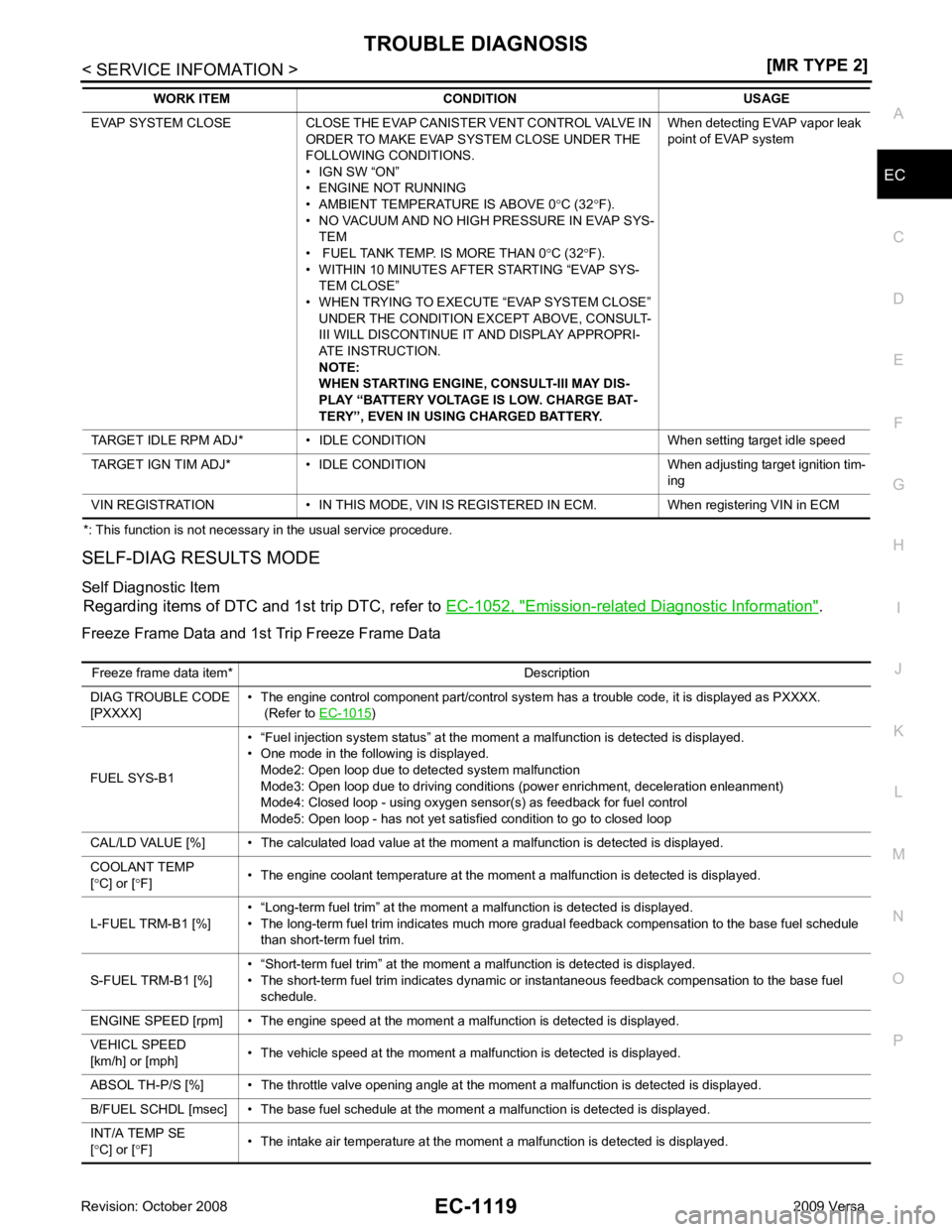
SELF-DIAG RESULTS MODE
Self Diagnostic Item Regarding items of DTC and 1st trip DTC, refer to EC-1052, " Emission-related Diagnostic Information " .
Freeze Frame Data and 1st Trip Freeze Frame Data EVAP SYSTEM CLOSE CLOSE THE EVAP CANISTER VENT CONTROL VALVE IN
ORDER TO MAKE EVAP SYSTEM CLOSE UNDER THE
FOLLOWING CONDITIONS.
• IGN SW “ON”
• ENGINE NOT RUNNING
• AMBIENT TEMPERATURE IS ABOVE 0 °C (32 °F).
• NO VACUUM AND NO HIGH PRESSURE IN EVAP SYS- TEM
• FUEL TANK TEMP. IS MORE THAN 0 °C (32 °F).
• WITHIN 10 MINUTES AFTER STARTING “EVAP SYS- TEM CLOSE”
• WHEN TRYING TO EXECUTE “EVAP SYSTEM CLOSE” UNDER THE CONDITION EXCEPT ABOVE, CONSULT-
III WILL DISCONTINUE IT AND DISPLAY APPROPRI-
ATE INSTRUCTION.
NOTE:
WHEN STARTING ENGINE, CONSULT-III MAY DIS-
PLAY “BATTERY VOLTAGE IS LOW. CHARGE BAT-
TERY”, EVEN IN USING CHARGED BATTERY. When detecting EVAP vapor leak
point of EVAP system
TARGET IDLE RPM ADJ* • IDLE CONDITION When setting target idle speed
TARGET IGN TIM ADJ* • IDLE CONDITION Wh en adjusting target ignition tim-
ing
VIN REGISTRATION • IN THIS MODE, VIN IS REGISTERED IN ECM. When registering VIN in ECM WORK ITEM CONDITION USAGE )
FUEL SYS-B1 • “Fuel injection system status” at the moment a malfunction is detected is displayed.
• One mode in the following is displayed.
Mode2: Open loop due to detected system malfunction
Mode3: Open loop due to driving conditions (power enrichment, deceleration enleanment)
Mode4: Closed loop - using oxygen sensor(s) as feedback for fuel control
Mode5: Open loop - has not yet satisfied condition to go to closed loop
CAL/LD VALUE [%] • The calculated load value at the moment a malfunction is detected is displayed.
COOLANT TEMP
[ ° C] or [ °F] • The engine coolant temperature at the moment a malfunction is detected is displayed.
L-FUEL TRM-B1 [%] • “Long-term fuel trim” at the moment a malfunction is detected is displayed.
• The long-term fuel trim indicates much more gradual feedback compensation to the base fuel schedule than short-term fuel trim.
S-FUEL TRM-B1 [%] • “Short-term fuel trim” at the moment a malfunction is detected is displayed.
• The short-term fuel trim indicates dynamic or instantaneous feedback compensation to the base fuel schedule.
ENGINE SPEED [rpm] • The engine sp eed at the moment a malfunction is de tected is displayed.
VEHICL SPEED
[km/h] or [mph] • The vehicle speed at the moment a malfunction is detected is displayed.
ABSOL TH-P/S [%] • The throttle valve opening angle at the moment a malfunction is detected is displayed.
B/FUEL SCHDL [msec] • The ba se fuel schedule at the moment a malfunctio n is detected is displayed.
INT/A TEMP SE
[ ° C] or [ °F] • The intake air temperature at the moment a malfunction is detected is displayed.
Page 2477 of 4331
![NISSAN TIIDA 2009 Service Repair Manual EC
NP
O
FUEL T/TMP SE
[ ° C] or [ °F] • The fuel temperature (determined by the signal voltage of the
fuel tank temperature sensor) is displayed.
INT/A TEMP SE
[ ° C] or [ °F] • The intake ai](/img/5/57398/w960_57398-2476.png "NISSAN TIIDA 2009 Service Repair Manual EC
NP
O
FUEL T/TMP SE
[ ° C] or [ °F] • The fuel temperature (determined by the signal voltage of the
fuel tank temperature sensor) is displayed.
INT/A TEMP SE
[ ° C] or [ °F] • The intake ai")
EC
NP
O
FUEL T/TMP SE
[ ° C] or [ °F] • The fuel temperature (determined by the signal voltage of the
fuel tank temperature sensor) is displayed.
INT/A TEMP SE
[ ° C] or [ °F] • The intake air temperature (determined by the signal voltage
of the intake air temperature sensor) is indicated.
EVAP SYS PRES
[V] • The signal voltage of EVAP control system pressure sensor
is displayed.
FUEL LEVEL SE
[V] • The signal voltage of the fuel level sensor is displayed.
START SIGNAL
[ON/OFF] • Indicates start signal status [ON/OFF] computed by the ECM
according to the signals of engine speed and battery voltage. • After starting the engine, [OFF] is displayed
regardless of the starter signal.
CLSD THL POS
[ON/OFF] • Indicates idle position [ON/OFF] computed by the ECM ac-
cording to the accelerator pedal position sensor signal.
AIR COND SIG
[ON/OFF] • Indicates [ON/OFF] condition of the air conditioner switch as
determined by the air conditioner signal.
P/N POSI SW
[ON/OFF] • Indicates [ON/OFF] condition from the park/neutral position
(PNP) switch signal.
PW/ST SIGNAL
[ON/OFF] • [ON/OFF] condition of the power steering system (deter-
mined by the signal sent from EPS control unit) is indicated.
LOAD SIGNAL
[ON/OFF] • Indicates [ON/OFF] condition from the electrical load signal.
ON: Rear window defogger switch is ON and/or lighting
switch is in 2nd position.
OFF: Both rear window defogger switch and lighting switch
are OFF.
IGNITION SW
[ON/OFF] • Indicates [ON/OFF] condition from ignition switch.
HEATER FAN SW
[ON/OFF] • Indicates [ON/OFF] condition from the heater fan switch sig-
nal.
BRAKE SW
[ON/OFF] • Indicates [ON/OFF] condition from the stop lamp switch sig-
nal.
INJ PULSE-B1
[msec] • Indicates the actual fuel injection pulse width compensated
by ECM according to the input signals. • When the engine is stopped, a certain com-
puted value is indicated.
IGN TIMING
[BTDC] • Indicates the ignition timing computed by ECM according to
the input signals. • When the engine is stopped, a certain value
is indicated.
CAL/LD VALUE
[%] • “Calculated load value” indicates the value of the current air-
flow divided by peak airflow.
MASS AIRFLOW
[g·m/s] • Indicates the mass airflow computed by ECM according to
the signal voltage of the mass air flow sensor.
PURG VOL C/V
[%] • Indicates the EVAP canister purge volume control solenoid
valve control value computed by the ECM according to the in-
put signals.
• The opening becomes larger as the value increases.
INT/V TIM (B1)
[ ° CA] • Indicates [
°CA] of intake camshaft advanced angle.
INT/V SOL (B1)
[%] • The control value of the intake valve timing control solenoid
valve (determined by ECM according to the input signal) is in-
dicated.
• The advance angle becomes larger as the value increases
AIR COND RLY
[ON/OFF] • The air conditioner relay control condition (determined by
ECM according to the input signals) is indicated.
FUEL PUMP RLY
[ON/OFF] • Indicates the fuel pump relay control condition determined by
ECM according to the input signals.
Monitored item [Unit] Description Remarks