fuel pressure NISSAN TIIDA 2009 Service Owner's Guide
[x] Cancel search | Manufacturer: NISSAN, Model Year: 2009, Model line: TIIDA, Model: NISSAN TIIDA 2009Pages: 4331, PDF Size: 58.04 MB
Page 1471 of 4331

EC
NP
O
NOTE:
Check “A/F ALPHA-B1” for approximately 1 minute because it may fluctuate. It is NG if the indication is
out of the SP value even a little.
Is the measurement value within the SP value? YES >> GO TO 17.
NO-1 >> Less than the SP value: GO TO 2.
NO-2 >> More than the SP value: GO TO 3. YES >> GO TO 4.
NO >> More than the SP value: GO TO 19. YES >> GO TO 6.
NO-1 >> More than the SP value: GO TO 6.
NO-2 >> Less than the SP value: GO TO 25. YES >> GO TO 5.
NO >> GO TO 6. Inspection " .)
Is the inspection result normal? YES >> GO TO 9.
NO-1 >> Fuel pressure is too high: Replace “fuel filter and fuel pump assembly” and then GO TO 8.
NO-2 >> Fuel pressure is too low: GO TO 7. YES >> Replace “fuel filter and fuel pump assembly” and then GO TO 8.
NO >> Repair or replace and then GO TO 8.
Page 1472 of 4331
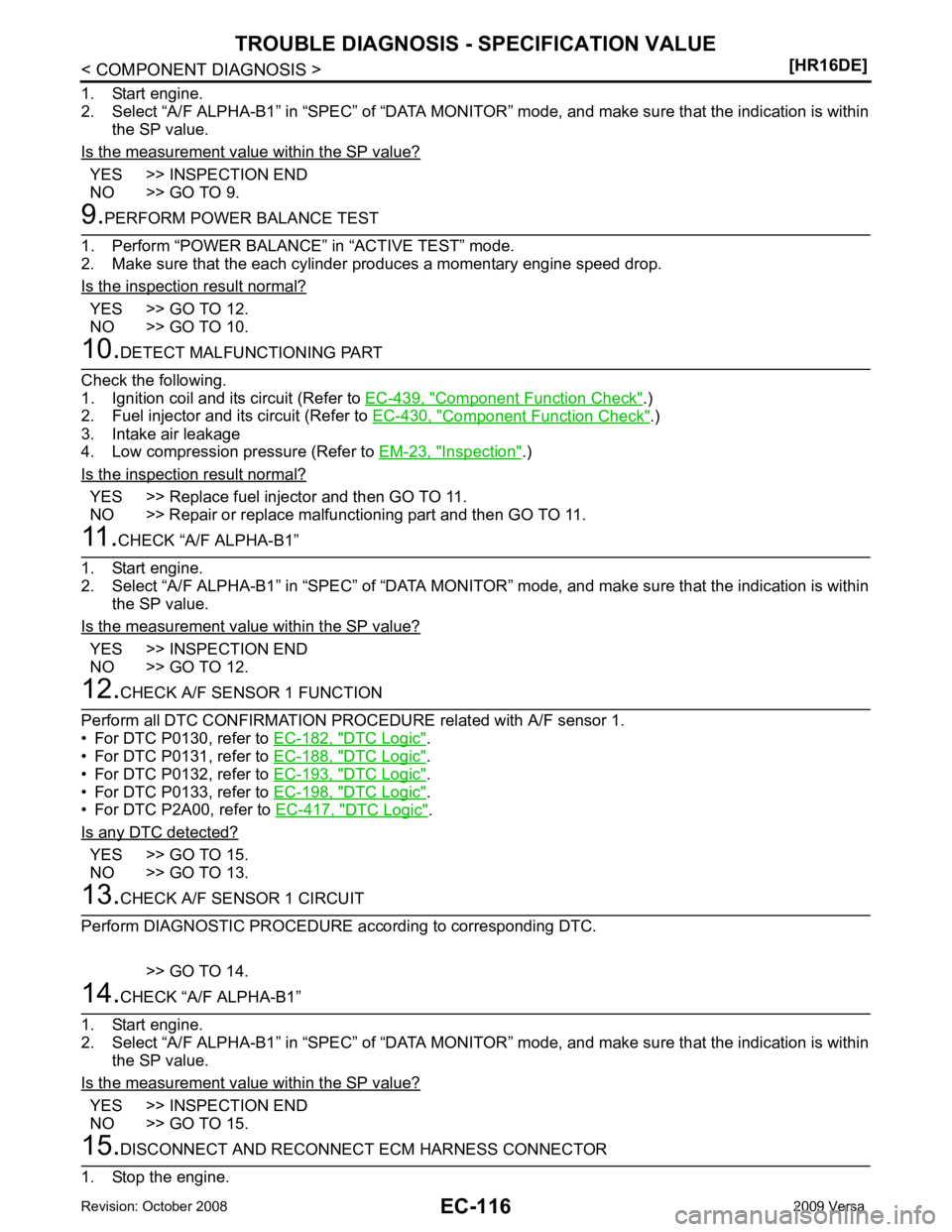
YES >> INSPECTION END
NO >> GO TO 9. YES >> GO TO 12.
NO >> GO TO 10. Component Function Check " .)
2. Fuel injector and its circuit (Refer to EC-430, " Component Function Check " .)
3. Intake air leakage
4. Low compression pressure (Refer to EM-23, " Inspection " .)
Is the inspection result normal? YES >> Replace fuel injector and then GO TO 11.
NO >> Repair or replace malfunctioning part and then GO TO 11. YES >> INSPECTION END
NO >> GO TO 12. DTC Logic " .
• For DTC P0131, refer to EC-188, " DTC Logic " .
• For DTC P0132, refer to EC-193, " DTC Logic " .
• For DTC P0133, refer to EC-198, " DTC Logic " .
• For DTC P2A00, refer to EC-417, " DTC Logic " .
Is any DTC detected? YES >> GO TO 15.
NO >> GO TO 13. YES >> INSPECTION END
NO >> GO TO 15.
Page 1554 of 4331
![NISSAN TIIDA 2009 Service Owners Guide EC-198< COMPONENT DIAGNOSIS >
[HR16DE]
P0133 A/F SENSOR 1
P0133 A/F SENSOR 1
Description INFOID:0000000004780117
The air fuel ratio (A/F) sensor 1 is a planar one-cell limit current sen-
sor. The se](/img/5/57398/w960_57398-1553.png "NISSAN TIIDA 2009 Service Owners Guide EC-198< COMPONENT DIAGNOSIS >
[HR16DE]
P0133 A/F SENSOR 1
P0133 A/F SENSOR 1
Description INFOID:0000000004780117
The air fuel ratio (A/F) sensor 1 is a planar one-cell limit current sen-
sor. The se")
EC-198< COMPONENT DIAGNOSIS >
[HR16DE]
P0133 A/F SENSOR 1
P0133 A/F SENSOR 1
Description INFOID:0000000004780117
The air fuel ratio (A/F) sensor 1 is a planar one-cell limit current sen-
sor. The sensor element of the A/F sensor 1 is composed an elec-
trode layer, which transports ions. It has a heater in the element.
The sensor is capable of precise measurement = 1, but also in the
lean and rich range. Together with its control electronics, the sensor
outputs a clear, continuous signal throughout a wide range.
The exhaust gas components diffuse through the diffusion layer at
the sensor cell. An electrode layer is applied voltage, and this current
relative oxygen density in lean. Also this current relative hydrocar-
bon density in rich.
Therefore, the A/F sensor 1 is able to indicate air fuel ratio by this
electrode layer of current. In additi on, a heater is integrated in the
sensor to ensure the required operating temperature of about 800 °C
(1,472 °F).
DTC Logic INFOID:0000000004780118
DTC DETECTION LOGIC
To judge the malfunction of A/F sensor 1, this diagnosis measures response time of the A/F signal computed
by ECM from the A/F sensor 1 signal. The time is compensated by engine operating (speed and load), fuel
feedback control constant, and the A/F sensor 1 temper ature index. Judgment is based on whether the com-
pensated time (the A/F signal cycling time index) is inordinately long or not.
DTC CONFIRMATION PROCEDURE 1.
PRECONDITIONING
If DTC Confirmation Procedure has been previously conduc ted, always turn ignition switch OFF and wait at
least 10 seconds before conducting the next test.
TESTING CONDITION:
Before performing the following procedure, confirm that battery voltage is more than 11 V at idle.
Do you have CONSULT-III? YES >> GO TO 2.
NO >> GO TO 5. 2.
PERFORM DTC CONFIRMATION PROCEDURE-I JMBIA0112GB
PBIB3354E
DTC No. Trouble diagnosis name DTC detecting condition Possible Cause
P0133 Air fuel ratio (A/F) sensor
1 circuit slow response • The response of the A/F signal computed
by ECM from A/F sensor 1 signal takes
more than the specified time. • Harness or connectors
(The A/F sensor 1 circuit is open or shorted.)
• A/F sensor 1
• A/F sensor 1 heater
• Fuel pressure
• Fuel injector
• Intake air leaks
• Exhaust gas leaks
• PCV
• Mass air flow sensor
Page 1568 of 4331
![NISSAN TIIDA 2009 Service Owners Guide EC-212< COMPONENT DIAGNOSIS >
[HR16DE]
P0138 HO2S2
P0138 HO2S2
Description INFOID:0000000004780125
The heated oxygen sensor 2, after three way catalyst (manifold),
monitors the oxygen level i](/img/5/57398/w960_57398-1567.png "NISSAN TIIDA 2009 Service Owners Guide EC-212< COMPONENT DIAGNOSIS >
[HR16DE]
P0138 HO2S2
P0138 HO2S2
Description INFOID:0000000004780125
The heated oxygen sensor 2, after three way catalyst (manifold),
monitors the oxygen level i")
EC-212< COMPONENT DIAGNOSIS >
[HR16DE]
P0138 HO2S2
P0138 HO2S2
Description INFOID:0000000004780125
The heated oxygen sensor 2, after three way catalyst (manifold),
monitors the oxygen level in the exhaust gas on each bank.
Even if switching characteristics of the air fuel ratio (A/F) sensor 1
are shifted, the air-fuel ratio is cont rolled to stoichiometric, by the sig-
nal from the heated oxygen sensor 2.
This sensor is made of ceramic zirconia. The zirconia generates volt-
age from approximately 1 V in richer conditions to 0 V in leaner con-
ditions.
Under normal conditions the heated ox ygen sensor 2 is not used for
engine control operation.
DTC Logic INFOID:0000000004780126
DTC DETECTION LOGIC
The heated oxygen sensor 2 has a much longer switching time between rich and lean than the air fuel ratio (A/
F) sensor 1. The oxygen storage capa city of the three way catalyst (manifold) causes the longer switching
time.
MALFUNCTION A
To judge the malfunctions of heated oxygen sensor 2, ECM monitors
whether the voltage is unusually high during the various driving con-
dition such as fuel-cut.
MALFUNCTION B
To judge the malfunctions of heated oxygen sensor 2, ECM monitors
whether the minimum voltage of sensor is sufficiently low during the
various driving condition such as fuel-cut. SEF327R
PBIB1848E
PBIB2376E
DTC No. Trouble diagnosis name DTC detecting condition Possible cause
P0138 Heated oxygen sensor 2
circuit high voltage A)
An excessively high voltage from the
sensor is sent to ECM. • Harness or connectors
(The sensor circuit is open or shorted)
• Heated oxygen sensor 2
B) The minimum voltage from the sensor is
not reached to the specified voltage. • Harness or connectors
(The sensor circuit is open or shorted)
• Heated oxygen sensor 2
• Fuel pressure
• Fuel injector
Page 1577 of 4331
![NISSAN TIIDA 2009 Service Owners Guide P0139 HO2S2
EC-221
< COMPONENT DIAGNOSIS >
[HR16DE] C
D E
F
G H
I
J
K L
M A EC
NP
O
P0139 HO2S2
Description INFOID:0000000004780130
The heated oxygen sensor 2, after three way catalyst (manif](/img/5/57398/w960_57398-1576.png "NISSAN TIIDA 2009 Service Owners Guide P0139 HO2S2
EC-221
< COMPONENT DIAGNOSIS >
[HR16DE] C
D E
F
G H
I
J
K L
M A EC
NP
O
P0139 HO2S2
Description INFOID:0000000004780130
The heated oxygen sensor 2, after three way catalyst (manif")
P0139 HO2S2
EC-221
< COMPONENT DIAGNOSIS >
[HR16DE] C
D E
F
G H
I
J
K L
M A EC
NP
O
P0139 HO2S2
Description INFOID:0000000004780130
The heated oxygen sensor 2, after three way catalyst (manifold),
monitors the oxygen level in the exhaust gas on each bank.
Even if switching characteristics of the air fuel ratio (A/F) sensor 1
are shifted, the air-fuel ratio is controlled to stoichiometric, by the sig-
nal from the heated oxygen sensor 2.
This sensor is made of ceramic zirconia. The zirconia generates volt-
age from approximately 1 V in richer conditions to 0 V in leaner con-
ditions.
Under normal conditions the heated oxygen sensor 2 is not used for
engine control operation.
DTC Logic INFOID:0000000004780131
DTC DETECTION LOGIC The heated oxygen sensor 2 has a much longer switching time
between rich and lean than the air fuel ratio (A/F) sensor 1. The oxy-
gen storage capacity of the three way catalyst (manifold) causes the
longer switching time. To judge the malfunctions of heated oxygen
sensor 2, ECM monitors whether the switching response of the sen-
sor's voltage is faster than specified during the various driving condi-
tion such as fuel-cut.
DTC CONFIRMATION PROCEDURE 1.
INSPECTION START
Do you have CONSULT-III?
Do you have CONSULT-III? YES >> GO TO 2.
NO >> GO TO 5. 2.
PRECONDITIONING
If DTC Confirmation Procedure has been previously conduc ted, always turn ignition switch OFF and wait at
least 10 seconds before conducting the next test.
>> GO TO 3. 3.
PERFORM DTC CONFIRMATION PROCEDURE
With CONSULT-III
1. Turn ignition switch ON and select “DATA MONITOR” mode with CONSULT-III.
2. Start engine and warm it up to normal operating temperature. SEF327R
SEF302U
DTC No. Trouble diagnosis name DTC detecting condition Possible cause
P0139 Heated oxygen sensor 2
circuit slow response It takes more time for the sensor to respond
between rich and lean than the specified
time. • Harness or connectors
(The sensor circuit is open or shorted)
• Heated oxygen sensor 2
• Fuel pressure
• Fuel injector
• Intake air leaks
Page 1585 of 4331
EC
NP
O
P0171 FUEL INJECTION SYSTEM FUNCTION
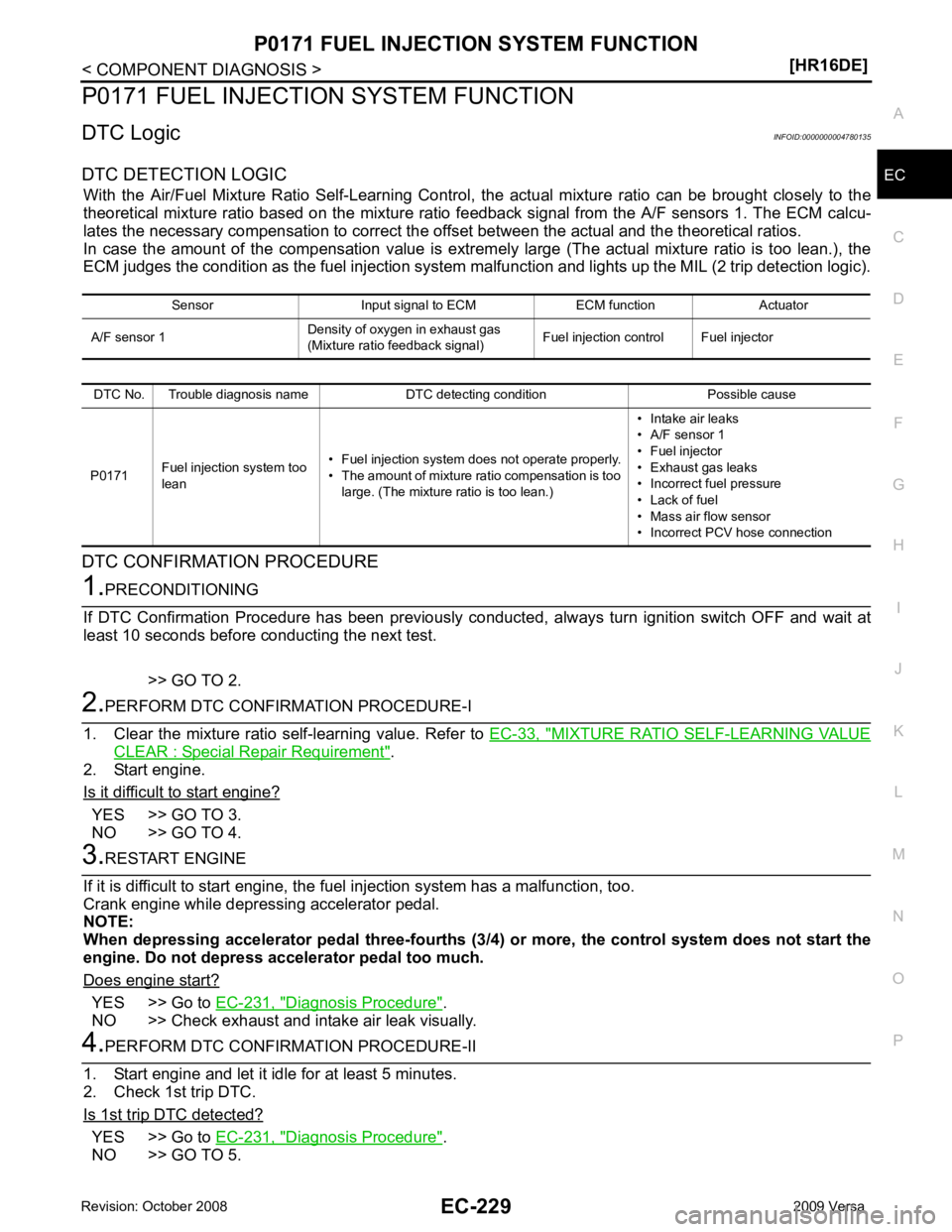
DTC Logic INFOID:0000000004780135
DTC DETECTION LOGIC With the Air/Fuel Mixture Ratio Self-Learning Control, the actual mixture ratio can be brought closely to the
theoretical mixture ratio based on the mixture ratio f eedback signal from the A/F sensors 1. The ECM calcu-
lates the necessary compensation to correct the of fset between the actual and the theoretical ratios.
In case the amount of the compensation value is extrem ely large (The actual mixture ratio is too lean.), the
ECM judges the condition as the fuel injection system malfunction and lights up the MIL (2 trip detection logic).
DTC CONFIRMATION PROCEDURE MIXTURE RATIO SELF-LEARNING VALUE
CLEAR : Special Repair Requirement " .
2. Start engine.
Is it difficult to start engine? YES >> GO TO 3.
NO >> GO TO 4. YES >> Go to
EC-231, " Diagnosis Procedure " .
NO >> Check exhaust and intake air leak visually. YES >> Go to
EC-231, " Diagnosis Procedure " .
NO >> GO TO 5. Sensor Input signal to ECM ECM function Actuator
A/F sensor 1 Density of oxygen in exhaust gas
(Mixture ratio feedback signal) Fuel injection control Fuel injectorDTC No. Trouble diagnosis name DTC detecting condition Possible cause
P0171 Fuel injection system too
lean • Fuel injection system does not operate properly.
• The amount of mixture ratio compensation is too large. (The mixture ratio is too lean.) • Intake air leaks
• A/F sensor 1
• Fuel injector
• Exhaust gas leaks
• Incorrect fuel pressure
• Lack of fuel
• Mass air flow sensor
• Incorrect PCV hose connection
Page 1588 of 4331
![NISSAN TIIDA 2009 Service Owners Guide EC-232< COMPONENT DIAGNOSIS >
[HR16DE]
P0171 FUEL INJECTION SYSTEM FUNCTION
2. Listen for an exhaust gas leak before three way catalyst (manifold).
Is exhaust gas leak detected? YES >> Repair or repla](/img/5/57398/w960_57398-1587.png "NISSAN TIIDA 2009 Service Owners Guide EC-232< COMPONENT DIAGNOSIS >
[HR16DE]
P0171 FUEL INJECTION SYSTEM FUNCTION
2. Listen for an exhaust gas leak before three way catalyst (manifold).
Is exhaust gas leak detected? YES >> Repair or repla")
EC-232< COMPONENT DIAGNOSIS >
[HR16DE]
P0171 FUEL INJECTION SYSTEM FUNCTION
2. Listen for an exhaust gas leak before three way catalyst (manifold).
Is exhaust gas leak detected? YES >> Repair or replace.
NO >> GO TO 2. 2.
CHECK FOR INTAKE AIR LEAK
1. Listen for an intake air leak after the mass air flow sensor.
2. Check PCV hose connection.
Intake air leak detected? YES >> Repair or replace.
NO >> GO TO 3. 3.
CHECK A/F SENSOR 1 INPUT SIGNAL CIRCUIT
1. Turn ignition switch OFF.
2. Disconnect corresponding A/F sensor 1 harness connector.
3. Disconnect ECM harness connector.
4. Check the continuity between A/F sensor 1 harness connector and ECM harness connector.
5. Check the continuity between A/F sensor 1 harness connector and ground, or ECM harness connector
and ground.
6. Also check harness for short to power.
Is the inspection result normal? YES >> GO TO 4.
NO >> Repair open circuit or short to ground or short to power in harness or connectors. 4.
CHECK FUEL PRESSURE
1. Check fuel pressure. Refer to EC-498, " Inspection " .
Is the inspection result normal? YES >> GO TO 6. PBIB1216E
A/F sensor 1 ECM
Continuity
Connector Terminal Connector Terminal
F12 1
F11 49
Existed
2 53
A/F sensor 1 Ground Continuity
Connector Terminal
F12 1
Ground Not existed
2
ECM Ground Continuity
Connector Terminal
F11 49
Ground Not existed
53
Page 1591 of 4331
EC
NP
O
P0172 FUEL INJECTION SYSTEM FUNCTION
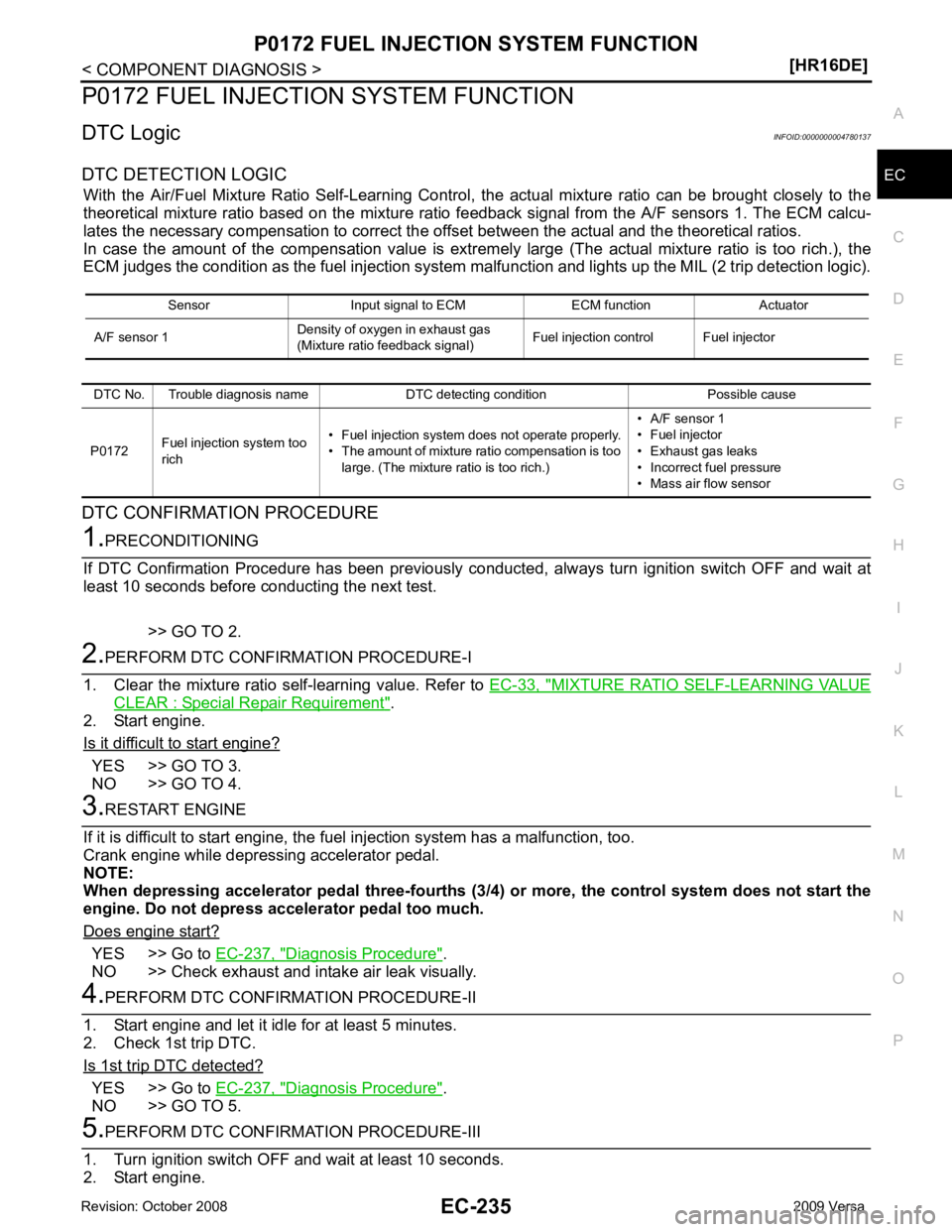
DTC Logic INFOID:0000000004780137
DTC DETECTION LOGIC With the Air/Fuel Mixture Ratio Self-Learning Control, the actual mixture ratio can be brought closely to the
theoretical mixture ratio based on the mixture ratio f eedback signal from the A/F sensors 1. The ECM calcu-
lates the necessary compensation to correct the of fset between the actual and the theoretical ratios.
In case the amount of the compensation value is extrem ely large (The actual mixture ratio is too rich.), the
ECM judges the condition as the fuel injection system malfunction and lights up the MIL (2 trip detection logic).
DTC CONFIRMATION PROCEDURE MIXTURE RATIO SELF-LEARNING VALUE
CLEAR : Special Repair Requirement " .
2. Start engine.
Is it difficult to start engine? YES >> GO TO 3.
NO >> GO TO 4. YES >> Go to
EC-237, " Diagnosis Procedure " .
NO >> Check exhaust and intake air leak visually. YES >> Go to
EC-237, " Diagnosis Procedure " .
NO >> GO TO 5. DTC No. Trouble diagnosis name DTC detecting condition Possible cause
P0172 Fuel injection system too
rich • Fuel injection system does not operate properly.
• The amount of mixture ratio compensation is too large. (The mixture ratio is too rich.) • A/F sensor 1
• Fuel injector
• Exhaust gas leaks
• Incorrect fuel pressure
• Mass air flow sensor
Page 1594 of 4331
![NISSAN TIIDA 2009 Service Owners Guide EC-238< COMPONENT DIAGNOSIS >
[HR16DE]
P0172 FUEL INJECTION SYSTEM FUNCTION
2. Listen for an exhaust gas leak before three way catalyst (manifold).
Is exhaust gas leak detected? YES >> Repair or repla](/img/5/57398/w960_57398-1593.png "NISSAN TIIDA 2009 Service Owners Guide EC-238< COMPONENT DIAGNOSIS >
[HR16DE]
P0172 FUEL INJECTION SYSTEM FUNCTION
2. Listen for an exhaust gas leak before three way catalyst (manifold).
Is exhaust gas leak detected? YES >> Repair or repla")
EC-238< COMPONENT DIAGNOSIS >
[HR16DE]
P0172 FUEL INJECTION SYSTEM FUNCTION
2. Listen for an exhaust gas leak before three way catalyst (manifold).
Is exhaust gas leak detected? YES >> Repair or replace.
NO >> GO TO 2. 2.
CHECK FOR INTAKE AIR LEAK
Listen for an intake air leak after the mass air flow sensor.
Is intake air leak detected? YES >> Repair or replace.
NO >> GO TO 3. 3.
CHECK A/F SENSOR 1 INPUT SIGNAL CIRCUIT
1. Turn ignition switch OFF.
2. Disconnect corresponding A/F sensor 1 harness connector.
3. Disconnect ECM harness connector.
4. Check the continuity between A/F sensor 1 harness connector and ECM harness connector.
5. Check the continuity between A/F sensor 1 harness connector and ground, or ECM harness connector
and ground.
6. Also check harness for short to power.
Is the inspection result normal? YES >> GO TO 4.
NO >> Repair open circuit or short to ground or short to power in harness or connectors. 4.
CHECK FUEL PRESSURE
1. Check fuel pressure. Refer to EC-498, " Inspection " .
Is the inspection result normal? YES >> GO TO 6.
NO >> GO TO 5. PBIB1216E
A/F sensor 1 ECM
Continuity
Connector Terminal Connector Terminal
F12 1
F11 49
Existed
2 53
A/F sensor 1 Ground Continuity
Connector Terminal
F12 1
Ground Not existed
2
ECM Ground Continuity
Connector Terminal
F11 49
Ground Not existed
53
Page 1609 of 4331

EC
NP
O
P0300, P0301, P0302, P0303, P0304 MISFIRE
DTC Logic INFOID:0000000004780152
DTC DETECTION LOGIC When a misfire occurs, engine speed will fluctuate. If the engine speed fluctuates enough to cause the crank-
shaft position (CKP) sensor (POS) signal to vary , ECM can determine that a misfire is occurring.
The misfire detection logic consists of the following two conditions.
1. One Trip Detection Logic (Three Way Catalyst Damage) On the 1st trip , when a misfire condition occurs that can damage the three way catalyst (TWC) due to
overheating, the MIL will blink.
When a misfire condition occurs, the ECM monitors the CKP sensor signal every 200 engine revolutions
for a change.
When the misfire condition decreases to a level t hat will not damage the TWC, the MIL will turn off.
If another misfire condition occurs that can damage the TWC on a second trip, the MIL will blink.
When the misfire condition decreases to a level t hat will not damage the TWC, the MIL will remain on.
If another misfire condition occurs that can damage the TWC, the MIL will begin to blink again.
2. Two Trip Detection Logic (Exhaust quality deterioration) For misfire conditions that will not damage the TWC (but will affect vehicle emissions), the MIL will only
light when the misfire is detected on a second trip. Du ring this condition, the ECM monitors the CKP sen-
sor signal every 1,000 engine revolutions.
A misfire malfunction can be detected on any one cylinder or on multiple cylinders.
DTC CONFIRMATION PROCEDURE YES >> Go to
EC-254, " Diagnosis Procedure " .
NO >> GO TO 3. DTC No. Trouble diagnosis name DTC detecting condition Possible cause
P0300 Multiple cylinder misfire detected Multiple cylinders misfire. • Improper spark plug • Insufficient compression
• Incorrect fuel pressure
• The fuel injector circuit is open or shorted
• Fuel injector
• Intake air leak
• The ignition signal circuit is open or shorted
• Lack of fuel
• Signal plate
• A/F sensor 1
• Incorrect PCV hose connection
P0301 No.1 cylinder misfire detected No. 1 cylinder misfires.
P0302 No. 2 cylinder misfire detected No. 2 cylinder misfires.
P0303 No. 3 cylinder misfire detected No. 3 cylinder misfires.
P0304 No. 4 cylinder misfire detected No. 4 cylinder misfires.