engine NISSAN TIIDA 2009 Service Repair Manual
[x] Cancel search | Manufacturer: NISSAN, Model Year: 2009, Model line: TIIDA, Model: NISSAN TIIDA 2009Pages: 4331, PDF Size: 58.04 MB
Page 1678 of 4331
![NISSAN TIIDA 2009 Service Repair Manual EC-322< COMPONENT DIAGNOSIS >
[HR16DE]
P0453 EVAP CONTROL SYSTEM PRESSURE SENSOR
P0453 EVAP CONTROL SYSTEM PRESSURE SENSOR
Description INFOID:0000000004780199
The EVAP control system pressure s e](/img/5/57398/w960_57398-1677.png "NISSAN TIIDA 2009 Service Repair Manual EC-322< COMPONENT DIAGNOSIS >
[HR16DE]
P0453 EVAP CONTROL SYSTEM PRESSURE SENSOR
P0453 EVAP CONTROL SYSTEM PRESSURE SENSOR
Description INFOID:0000000004780199
The EVAP control system pressure s e")
EC-322< COMPONENT DIAGNOSIS >
[HR16DE]
P0453 EVAP CONTROL SYSTEM PRESSURE SENSOR
P0453 EVAP CONTROL SYSTEM PRESSURE SENSOR
Description INFOID:0000000004780199
The EVAP control system pressure s ensor detects pressure in the
purge line. The sensor output voltage to the ECM increases as pres-
sure increases.
DTC Logic INFOID:0000000004780200
DTC DETECTION LOGIC
DTC CONFIRMATION PROCEDURE 1.
PRECONDITIONING
If DTC Confirmation Procedure has been previously conduc ted, always turn ignition switch OFF and wait at
least 10 seconds before conducting the next test.
TESTING CONDITION:
Always perform test at a temperature of 5 °C (41 °F) or more.
>> GO TO 2. 2.
PERFORM DTC CONFIRMATION PROCEDURE
With CONSULT-III
1. Start engine and warm it up to normal operating temperature.
2. Turn ignition switch OFF and wait at least 10 seconds.
3. Turn ignition switch ON.
4. Select “DATA MONITOR” mode with CONSULT-III.
5. Make sure that “FUEL T/TMP SE” indication is more than 0°C (32 °F).
6. Start engine and wait at least 20 seconds.
7. Check 1st trip DTC.
With GST
1. Start engine and warm it up to normal operating temperature. PBIB3370E
DTC No. Trouble diagnosis name DTC detecting condition Possible cause
P0453 EVAP control system pres-
sure sensor high input An excessively high voltage from the sensor
is sent to ECM. • Harness or connectors
(EVAP control system pressure sensor
circuit is open or shorted.)
[Crankshaft position sensor (POS) circuit
is shorted.]
(Accelerator pedal circuit is shorted.)
(Refrigerant pressure sensor circuit is
shorted.)
• EVAP control system pressure sensor
• Crankshaft position sensor (POS)
• Accelerator pedal position sensor
• Refrigerant pressure sensor
• EVAP canister vent control valve
• EVAP canister
• Rubber hose from EVAP canister vent control valve to vehicle frame
Page 1679 of 4331
![NISSAN TIIDA 2009 Service Repair Manual P0453 EVAP CONTROL SYSTEM PRESSURE SENSOR
EC-323
< COMPONENT DIAGNOSIS >
[HR16DE] C
D E
F
G H
I
J
K L
M A EC
NP
O
2. Set voltmeter probes to ECM harness connector and ground as
per the following.
3.](/img/5/57398/w960_57398-1678.png "NISSAN TIIDA 2009 Service Repair Manual P0453 EVAP CONTROL SYSTEM PRESSURE SENSOR
EC-323
< COMPONENT DIAGNOSIS >
[HR16DE] C
D E
F
G H
I
J
K L
M A EC
NP
O
2. Set voltmeter probes to ECM harness connector and ground as
per the following.
3.")
P0453 EVAP CONTROL SYSTEM PRESSURE SENSOR
EC-323
< COMPONENT DIAGNOSIS >
[HR16DE] C
D E
F
G H
I
J
K L
M A EC
NP
O
2. Set voltmeter probes to ECM harness connector and ground as
per the following.
3. Make sure that the voltage is less than 4.2 V.
4. Turn ignition switch OFF and wait at least 10 seconds.
5. Start engine and wait at least 20 seconds.
6. Check 1st trip DTC.
Is 1st trip DTC detected? YES >> Go to
EC-324, " Diagnosis Procedure " .
NO >> INSPECTION END ECM
Ground
Connector Terminal
F11 43
(Fuel tank temperature sensor signal) Ground SEF113U
Page 1686 of 4331
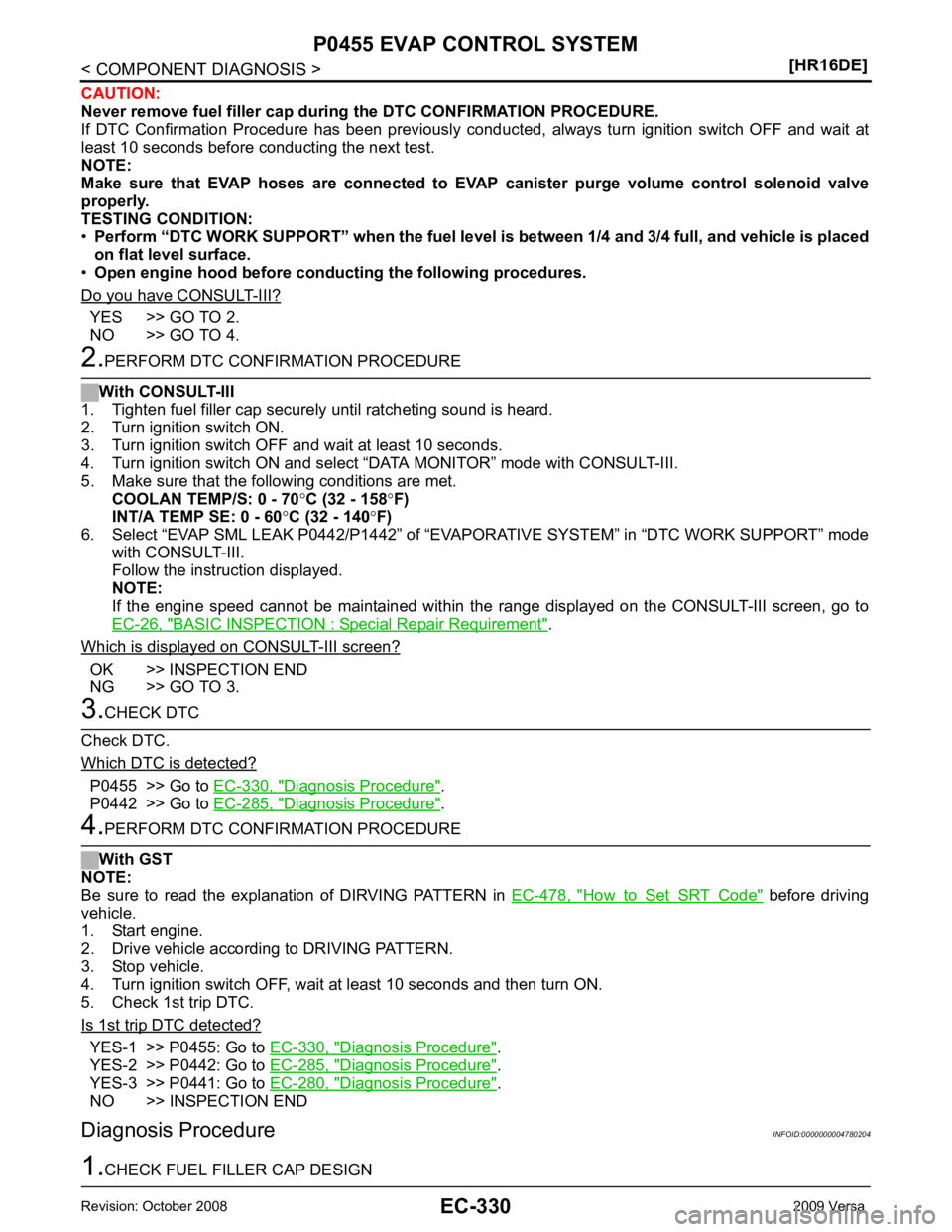
YES >> GO TO 2.
NO >> GO TO 4. BASIC INSPECTION : Special Repair Requirement " .
Which is displayed on CONSULT-III screen? OK >> INSPECTION END
NG >> GO TO 3. P0455 >> Go to
EC-330, " Diagnosis Procedure " .
P0442 >> Go to EC-285, " Diagnosis Procedure " .
How to Set SRT Code " before driving
vehicle.
1. Start engine.
2. Drive vehicle according to DRIVING PATTERN.
3. Stop vehicle.
4. Turn ignition switch OFF, wait at least 10 seconds and then turn ON.
5. Check 1st trip DTC.
Is 1st trip DTC detected? YES-1 >> P0455: Go to
EC-330, " Diagnosis Procedure " .
YES-2 >> P0442: Go to EC-285, " Diagnosis Procedure " .
YES-3 >> P0441: Go to EC-280, " Diagnosis Procedure " .
NO >> INSPECTION END
Diagnosis Procedure INFOID:0000000004780204
Page 1705 of 4331
EC
NP
O
P0506 ISC SYSTEM
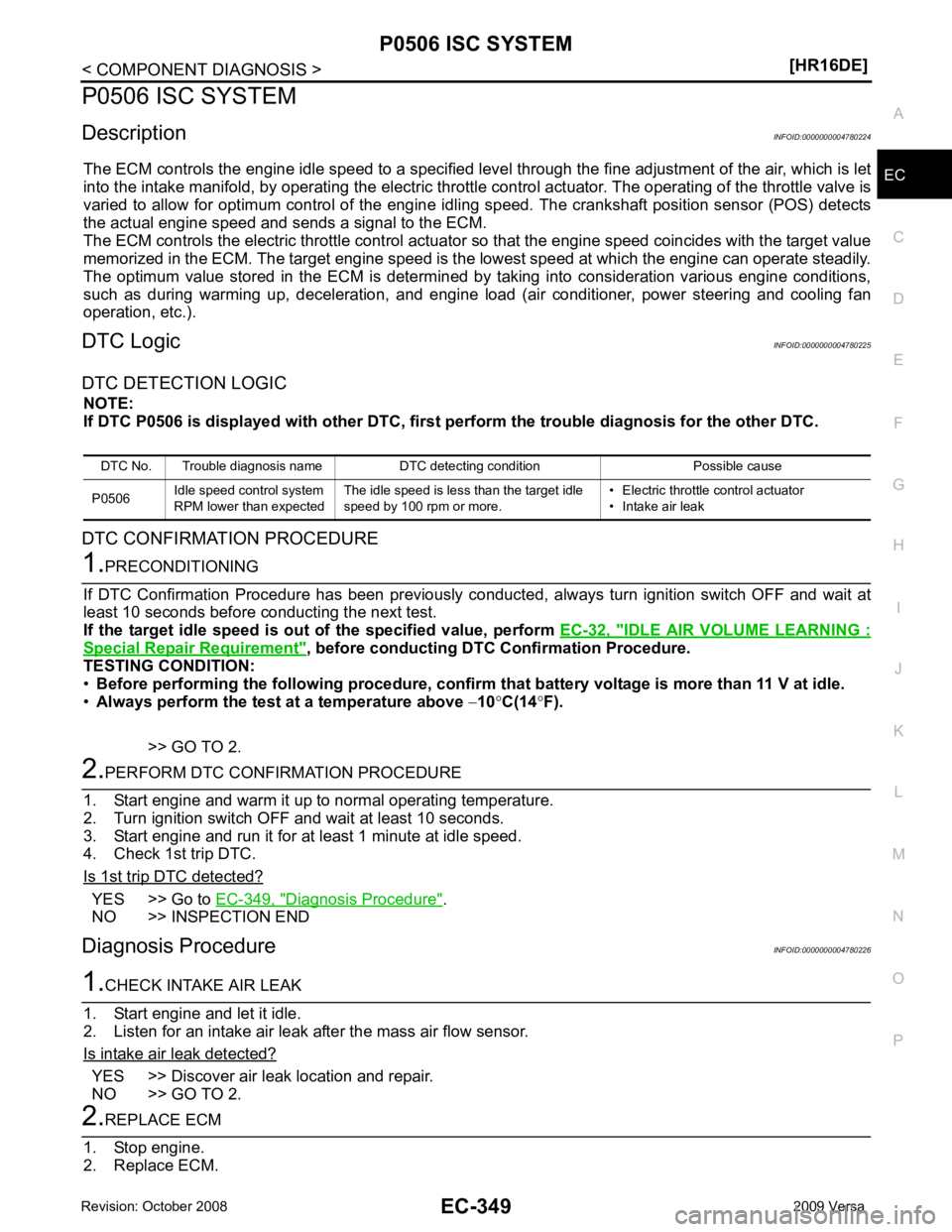
Description INFOID:0000000004780224
The ECM controls the engine idle speed to a specified leve l through the fine adjustment of the air, which is let
into the intake manifold, by operating the electric thrott le control actuator. The operating of the throttle valve is
varied to allow for optimum control of the engine idli ng speed. The crankshaft position sensor (POS) detects
the actual engine speed and sends a signal to the ECM.
The ECM controls the electric throttle control actuator so that the engine speed coincides with the target value
memorized in the ECM. The target engine speed is t he lowest speed at which the engine can operate steadily.
The optimum value stored in the ECM is determined by taking into consideration various engine conditions,
such as during warming up, deceleration, and engine load (air conditioner, power steering and cooling fan
operation, etc.).
DTC Logic INFOID:0000000004780225
DTC DETECTION LOGIC NOTE:
If DTC P0506 is displayed with ot her DTC, first perform the trouble diagnosis for the other DTC.
DTC CONFIRMATION PROCEDURE IDLE AIR VOLUME LEARNING :
Special Repair Requirement " , before conducting DTC Confirmation Procedure.
TESTING CONDITION:
• Before performing the following procedure, confirm that battery voltage is more than 11 V at idle.
• Always perform the test at a temperature above −10 °C(14 °F).
>> GO TO 2. YES >> Go to
EC-349, " Diagnosis Procedure " .
NO >> INSPECTION END
Diagnosis Procedure INFOID:0000000004780226YES >> Discover air leak location and repair.
NO >> GO TO 2.
Page 1707 of 4331
EC
NP
O
P0507 ISC SYSTEM
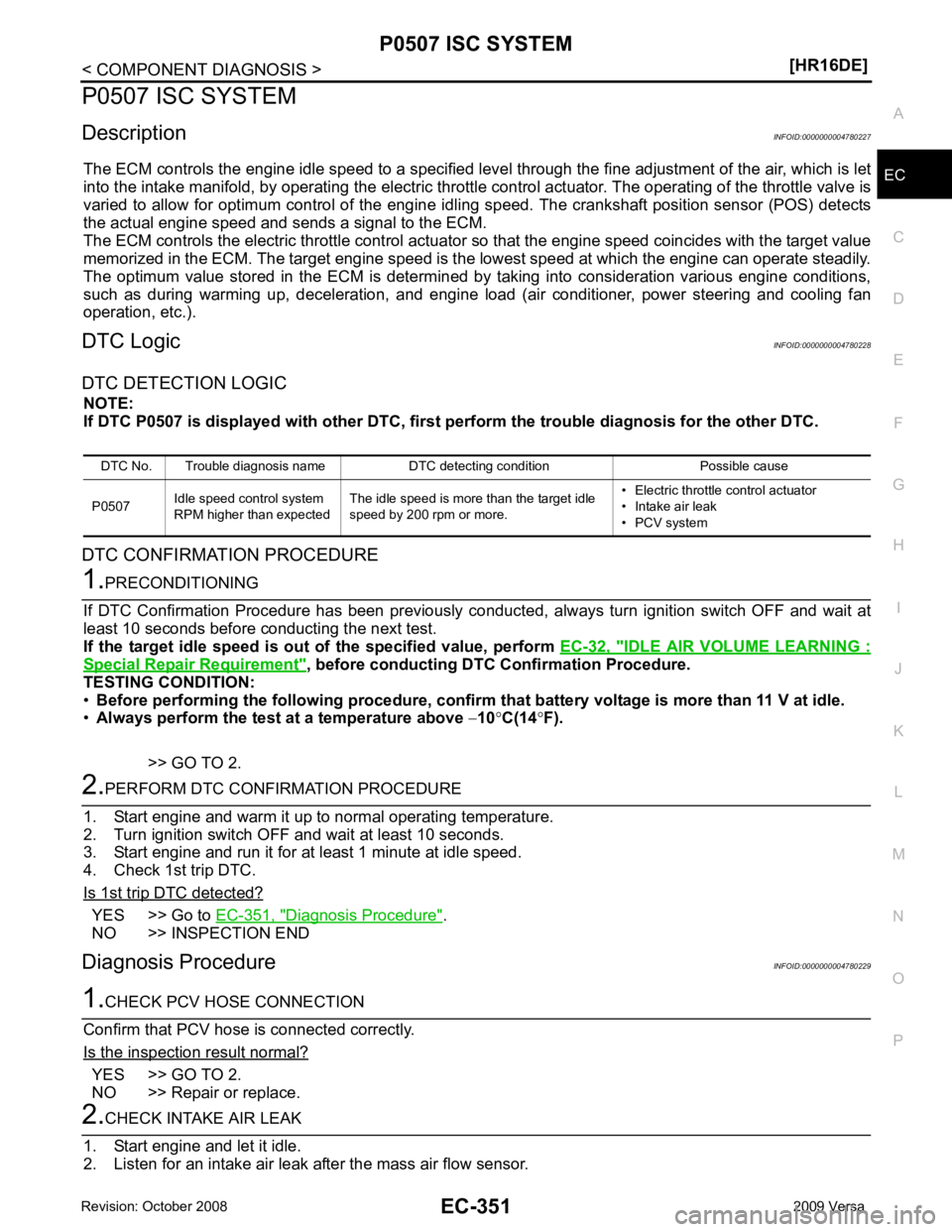
Description INFOID:0000000004780227
The ECM controls the engine idle speed to a specified leve l through the fine adjustment of the air, which is let
into the intake manifold, by operating the electric thrott le control actuator. The operating of the throttle valve is
varied to allow for optimum control of the engine idli ng speed. The crankshaft position sensor (POS) detects
the actual engine speed and sends a signal to the ECM.
The ECM controls the electric throttle control actuator so that the engine speed coincides with the target value
memorized in the ECM. The target engine speed is t he lowest speed at which the engine can operate steadily.
The optimum value stored in the ECM is determined by taking into consideration various engine conditions,
such as during warming up, deceleration, and engine load (air conditioner, power steering and cooling fan
operation, etc.).
DTC Logic INFOID:0000000004780228
DTC DETECTION LOGIC NOTE:
If DTC P0507 is displayed with ot her DTC, first perform the trouble diagnosis for the other DTC.
DTC CONFIRMATION PROCEDURE IDLE AIR VOLUME LEARNING :
Special Repair Requirement " , before conducting DTC Confirmation Procedure.
TESTING CONDITION:
• Before performing the following procedure, confirm that battery voltage is more than 11 V at idle.
• Always perform the test at a temperature above −10 °C(14 °F).
>> GO TO 2. YES >> Go to
EC-351, " Diagnosis Procedure " .
NO >> INSPECTION END
Diagnosis Procedure INFOID:0000000004780229YES >> GO TO 2.
NO >> Repair or replace.
Page 1711 of 4331
![NISSAN TIIDA 2009 Service Repair Manual P0605 ECM
EC-355
< COMPONENT DIAGNOSIS >
[HR16DE] C
D E
F
G H
I
J
K L
M A EC
NP
O
P0605 ECM
Description INFOID:0000000004780237
The ECM consists of a microcomputer and connectors for signal
i](/img/5/57398/w960_57398-1710.png "NISSAN TIIDA 2009 Service Repair Manual P0605 ECM
EC-355
< COMPONENT DIAGNOSIS >
[HR16DE] C
D E
F
G H
I
J
K L
M A EC
NP
O
P0605 ECM
Description INFOID:0000000004780237
The ECM consists of a microcomputer and connectors for signal
i")
P0605 ECM
EC-355
< COMPONENT DIAGNOSIS >
[HR16DE] C
D E
F
G H
I
J
K L
M A EC
NP
O
P0605 ECM
Description INFOID:0000000004780237
The ECM consists of a microcomputer and connectors for signal
input and output and for power supply. The ECM controls the engine.
DTC Logic INFOID:0000000004780238
DTC DETECTION LOGIC
DTC CONFIRMATION PROCEDURE 1.
PRECONDITIONING
If DTC Confirmation Procedure has been previously conduc ted, always turn ignition switch OFF and wait at
least 10 seconds before conducting the next test.
>> GO TO 2. 2.
PERFORM DTC CONFIRMATION PROCEDURE FOR MALFUNCTION A
1. Turn ignition switch ON.
2. Check 1st trip DTC.
Is 1st trip DTC detected? YES >> Go to
EC-356, " Diagnosis Procedure " .
NO >> GO TO 3. 3.
PERFORM DTC CONFIRMATION PROCEDURE FOR MALFUNCTION B
1. Turn ignition switch ON and wait at least 1 second.
2. Turn ignition switch OFF, wait at least 10 seconds and then turn ON.
3. Check 1st trip DTC.
Is 1st trip DTC detected? YES >> Go to
EC-356, " Diagnosis Procedure " .
NO >> GO TO 4. 4.
PERFORM DTC CONFIRMATION PROCEDURE FOR MALFUNCTION C
1. Turn ignition switch ON and wait at least 1 second.
2. Turn ignition switch OFF, wait at least 10 seconds and then turn ON.
3. Repeat step 2 for 32 times.
4. Check 1st trip DTC.
Is 1st trip DTC detected? YES >> Go to
EC-356, " Diagnosis Procedure " .
NO >> INSPECTION END PBIA9222J
DTC No. Trouble diagnosis name DTC detecting condition Possible cause
P0605 Engine control module A) ECM calculation function is malfunctioning.
• ECM
B) ECM EEP-ROM system is malfunctioning.
C) ECM self shut-off function is malfunctioning.
Page 1724 of 4331
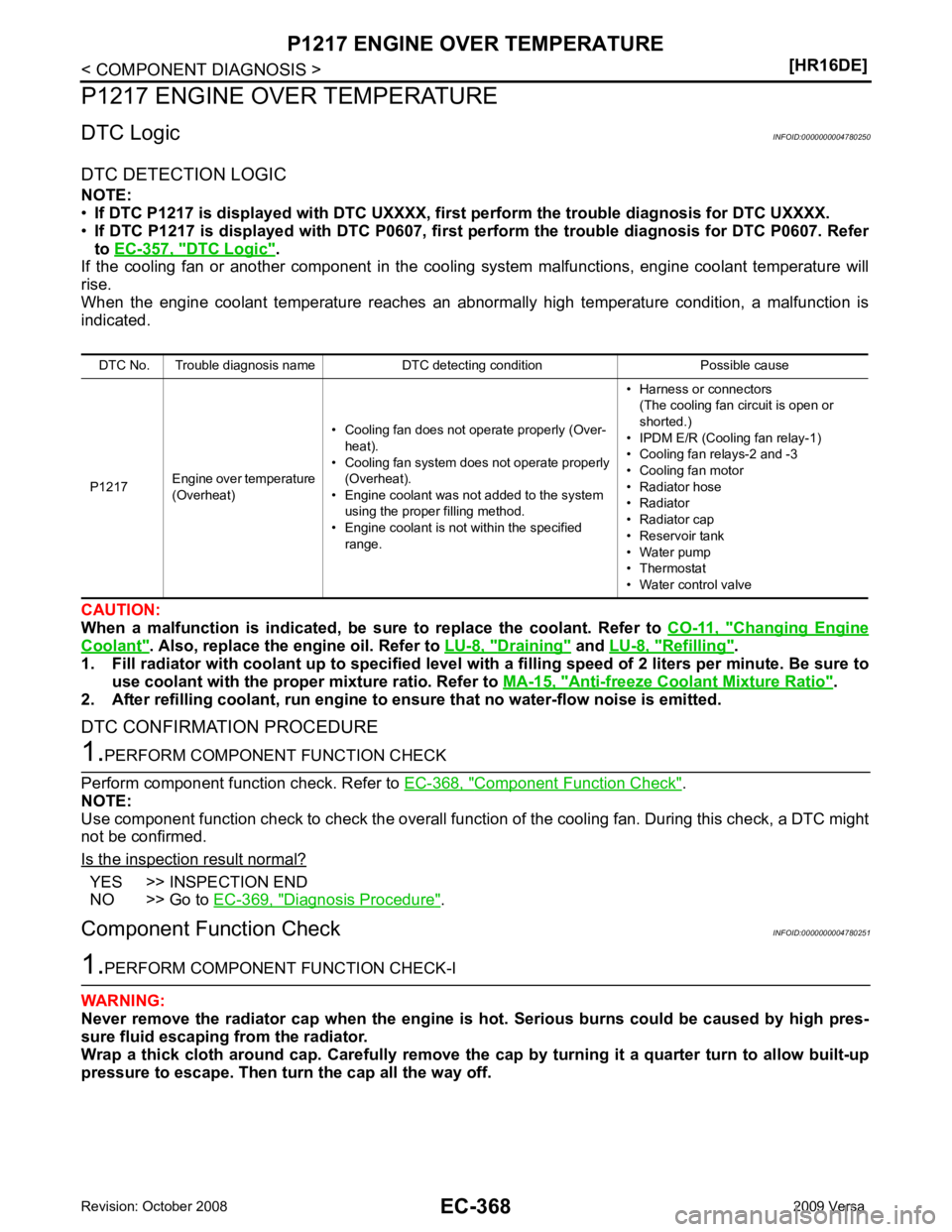
DTC Logic " .
If the cooling fan or another component in the coo ling system malfunctions, engine coolant temperature will
rise.
When the engine coolant temperature reaches an abnorma lly high temperature condition, a malfunction is
indicated.
CAUTION:
When a malfunction is indicated, be su re to replace the coolant. Refer to CO-11, " Changing Engine
Coolant " . Also, replace the engine oil. Refer to
LU-8, " Draining " and
LU-8, " Refilling " .
1. Fill radiator with coolant up to specified level with a filling speed of 2 liters per minute. Be sure to
use coolant with the proper mixture ratio. Refer to MA-15, " Anti-freeze Coolant Mixture Ratio " .
2. After refilling coolant, run engine to en sure that no water-flow noise is emitted.
DTC CONFIRMATION PROCEDURE Component Function Check " .
NOTE:
Use component function check to check the overall functi on of the cooling fan. During this check, a DTC might
not be confirmed.
Is the inspection result normal? YES >> INSPECTION END
NO >> Go to EC-369, " Diagnosis Procedure " .
Component Function Check INFOID:0000000004780251
Page 1725 of 4331
EC
NP
O
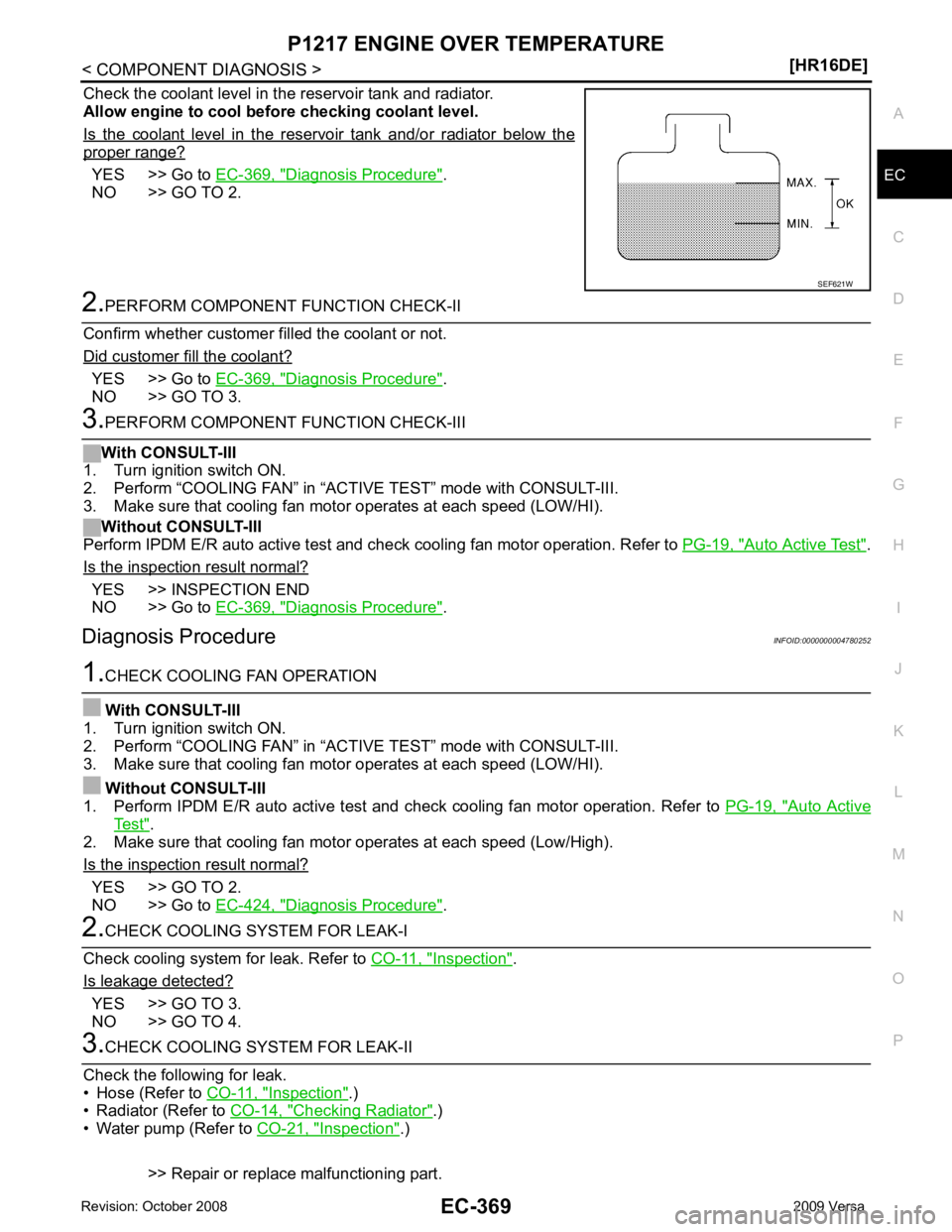
Check the coolant level in the reservoir tank and radiator.
Allow engine to cool befo re checking coolant level.
Is the coolant level in the reservoir tank and/or radiator below the proper range?
YES >> Go to
EC-369, " Diagnosis Procedure " .
NO >> GO TO 2. YES >> Go to
EC-369, " Diagnosis Procedure " .
NO >> GO TO 3. Auto Active Test " .
Is the inspection result normal? YES >> INSPECTION END
NO >> Go to EC-369, " Diagnosis Procedure " .
Diagnosis Procedure INFOID:0000000004780252 Auto Active
Test " .
2. Make sure that cooling fan motor operates at each speed (Low/High).
Is the inspection result normal? YES >> GO TO 2.
NO >> Go to EC-424, " Diagnosis Procedure " .
Inspection " .
Is leakage detected? YES >> GO TO 3.
NO >> GO TO 4. Inspection " .)
• Radiator (Refer to CO-14, " Checking Radiator " .)
• Water pump (Refer to CO-21, " Inspection " .)
>> Repair or replace malfunctioning part.
Page 1726 of 4331
Checking Radiator Cap " .
Is the inspection result normal? YES >> GO TO 5.
NO >> Replace radiator cap. Inspection " .
Is the inspection result normal? YES >> GO TO 6.
NO >> Replace thermostat. Inspection " .
Is the inspection result normal? YES >> GO TO 7.
NO >> Replace water control valve Component Inspection " .
Is the inspection result normal? YES >> GO TO 8.
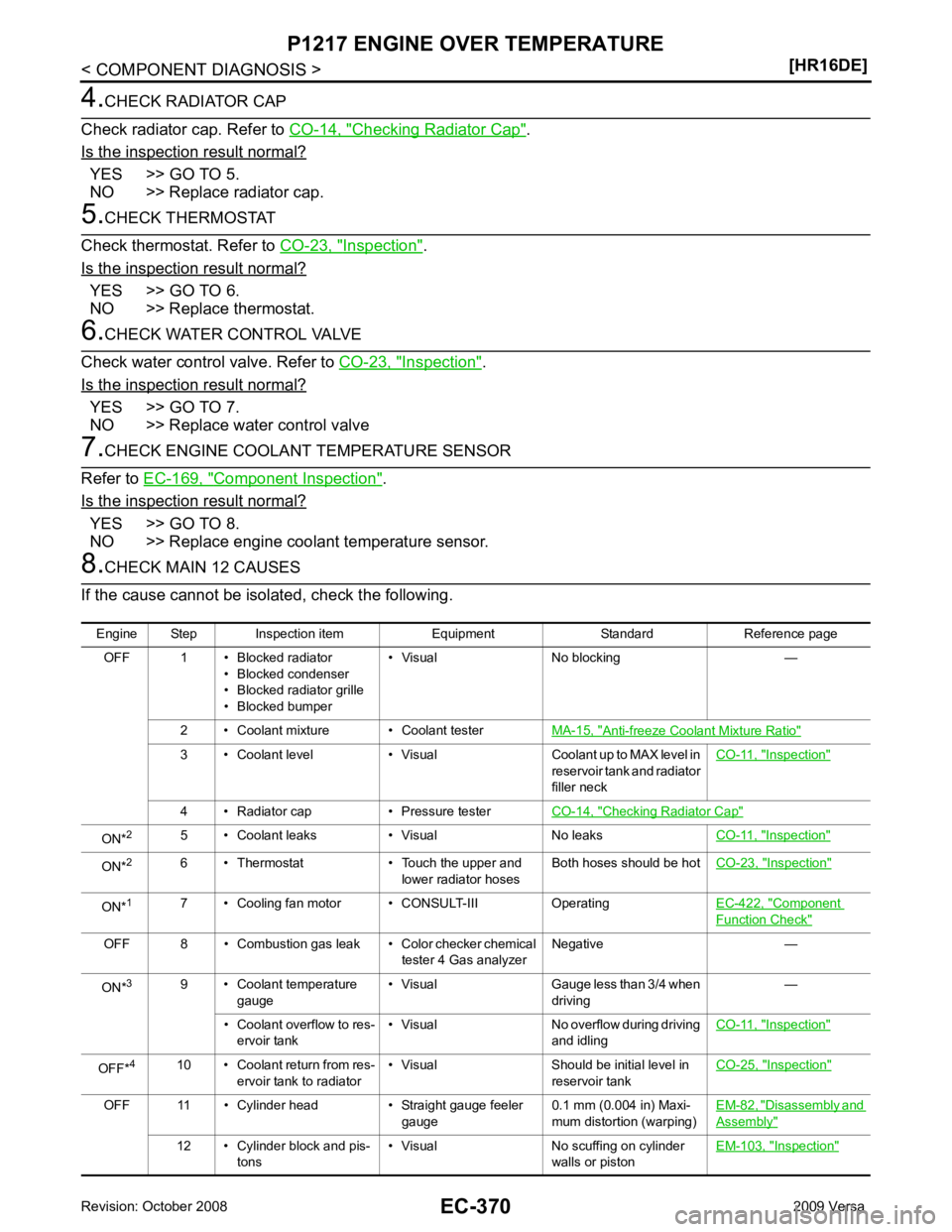
NO >> Replace engine coolant temperature sensor. Anti-freeze Coolant Mixture Ratio "
3 • Coolant level • Visual Coolant up to MAX level in
reservoir tank and radiator
filler neck CO-11, " Inspection "
4 • Radiator cap • Pressure tester
CO-14, " Checking Radiator Cap "
ON*
2
5 • Coolant leaks • Visual No leaks CO-11, " Inspection "
ON*
2
6 • Thermostat • Touch the upper and
lower radiator hosesBoth hoses should be hot
CO-23, " Inspection "
ON*
1
7 • Cooling fan motor • CONSULT-III Operating EC-422, " Component
Function Check "
OFF 8 • Combustion gas leak • Color checker chemical
tester 4 Gas analyzerNegative —
ON* 3
9 • Coolant temperature
gauge • Visual Gauge less than 3/4 when
driving —
• Coolant overflow to res- ervoir tank • Visual No overflow during driving
and idling CO-11, " Inspection "
OFF*
4
10 • Coolant return from res-
ervoir tank to radiator • Visual Should be initial level in
reservoir tank CO-25, " Inspection "
OFF 11 • Cylinder head • Straight gauge feeler
gauge0.1 mm (0.004 in) Maxi-
mum distortion (warping) EM-82, " Disassembly and
Assembly "
12 • Cylinder block and pis-
tons • Visual No scuffing on cylinder
walls or piston EM-103, " Inspection "
Page 1727 of 4331

EC
NP
O
*1: Turn the ignition switch ON.
*2: Engine running at 3,000 rpm for 10 minutes.
*3: Drive at 90 km/h (56 MPH) for 30 minutes and then let idle for 10 minutes.
*4: After 60 minutes of cool down time.
For more information, refer to CO-7, " Troubleshooting Chart " .
>> INSPECTION END