engine NISSAN TIIDA 2009 Service Repair Manual
[x] Cancel search | Manufacturer: NISSAN, Model Year: 2009, Model line: TIIDA, Model: NISSAN TIIDA 2009Pages: 4331, PDF Size: 58.04 MB
Page 1597 of 4331

EC
NP
O
With CONSULT-III
1. Cool engine down until “COOLAN TE MP/S” indication is less than 60°C (140 °F).
2. Wait at least 10 seconds.
3. Check 1st trip DTC.
With GST
Follow the procedure “With CONSULT-III” above.
Is 1st trip DTC detected? YES >> Go to
EC-242, " Diagnosis Procedure " .
NO >> INSPECTION END
Page 1605 of 4331
![NISSAN TIIDA 2009 Service Repair Manual P0222, P0223 TP SENSOR
EC-249
< COMPONENT DIAGNOSIS >
[HR16DE] C
D E
F
G H
I
J
K L
M A EC
NP
O
P0222, P0223 TP SENSOR
Description INFOID:0000000004780147
Electric throttle control actuator consis](/img/5/57398/w960_57398-1604.png "NISSAN TIIDA 2009 Service Repair Manual P0222, P0223 TP SENSOR
EC-249
< COMPONENT DIAGNOSIS >
[HR16DE] C
D E
F
G H
I
J
K L
M A EC
NP
O
P0222, P0223 TP SENSOR
Description INFOID:0000000004780147
Electric throttle control actuator consis")
P0222, P0223 TP SENSOR
EC-249
< COMPONENT DIAGNOSIS >
[HR16DE] C
D E
F
G H
I
J
K L
M A EC
NP
O
P0222, P0223 TP SENSOR
Description INFOID:0000000004780147
Electric throttle control actuator consists of throttle control motor,
throttle position sensor, etc. The throttle position sensor responds to
the throttle valve movement.
The throttle position sensor has two sensors. These sensors are a
kind of potentiometer which transform the throttle valve position into
output voltage, and emit the voltage signals to the ECM. The ECM
judges the current opening angle of the throttle valve from these sig-
nals and controls the throttle valve opening angle in response to
driving conditions via the throttle control motor.
DTC Logic INFOID:0000000004780148
DTC DETECTION LOGIC
DTC CONFIRMATION PROCEDURE 1.
PRECONDITIONING
If DTC Confirmation Procedure has been previously conduc ted, always turn ignition switch OFF and wait at
least 10 seconds before conducting the next test.
TESTING CONDITION:
Before performing the following procedure, confirm that battery voltage is more than 8 V at idle.
>> GO TO 2. 2.
PERFORM DTC CONFIRMATION PROCEDURE
1. Start engine and let it idle for 1 second.
2. Check DTC.
Is DTC detected? YES >> Go to
EC-250, " Diagnosis Procedure " .
NO >> INSPECTION END PBIB0145E
DTC No. Trouble diagnosis name DTC detecting condition Possible cause
P0222 Throttle position sensor
1 circuit low input An excessively low voltage from the TP sensor
1 is sent to ECM. • Harness or connectors
(TP sensor 1 circuit is open or shorted.)
• Electric throttle control actuator (TP sensor 1)
P0223 Throttle position sensor
1 circuit high input An excessively high voltage from the TP sensor
1 is sent to ECM.
Page 1609 of 4331

EC
NP
O
P0300, P0301, P0302, P0303, P0304 MISFIRE
DTC Logic INFOID:0000000004780152
DTC DETECTION LOGIC When a misfire occurs, engine speed will fluctuate. If the engine speed fluctuates enough to cause the crank-
shaft position (CKP) sensor (POS) signal to vary , ECM can determine that a misfire is occurring.
The misfire detection logic consists of the following two conditions.
1. One Trip Detection Logic (Three Way Catalyst Damage) On the 1st trip , when a misfire condition occurs that can damage the three way catalyst (TWC) due to
overheating, the MIL will blink.
When a misfire condition occurs, the ECM monitors the CKP sensor signal every 200 engine revolutions
for a change.
When the misfire condition decreases to a level t hat will not damage the TWC, the MIL will turn off.
If another misfire condition occurs that can damage the TWC on a second trip, the MIL will blink.
When the misfire condition decreases to a level t hat will not damage the TWC, the MIL will remain on.
If another misfire condition occurs that can damage the TWC, the MIL will begin to blink again.
2. Two Trip Detection Logic (Exhaust quality deterioration) For misfire conditions that will not damage the TWC (but will affect vehicle emissions), the MIL will only
light when the misfire is detected on a second trip. Du ring this condition, the ECM monitors the CKP sen-
sor signal every 1,000 engine revolutions.
A misfire malfunction can be detected on any one cylinder or on multiple cylinders.
DTC CONFIRMATION PROCEDURE YES >> Go to
EC-254, " Diagnosis Procedure " .
NO >> GO TO 3. DTC No. Trouble diagnosis name DTC detecting condition Possible cause
P0300 Multiple cylinder misfire detected Multiple cylinders misfire. • Improper spark plug • Insufficient compression
• Incorrect fuel pressure
• The fuel injector circuit is open or shorted
• Fuel injector
• Intake air leak
• The ignition signal circuit is open or shorted
• Lack of fuel
• Signal plate
• A/F sensor 1
• Incorrect PCV hose connection
P0301 No.1 cylinder misfire detected No. 1 cylinder misfires.
P0302 No. 2 cylinder misfire detected No. 2 cylinder misfires.
P0303 No. 3 cylinder misfire detected No. 3 cylinder misfires.
P0304 No. 4 cylinder misfire detected No. 4 cylinder misfires.
Page 1611 of 4331
![NISSAN TIIDA 2009 Service Repair Manual P0300, P0301, P0302,
P0303, P0304 MISFIRE
EC-255
< COMPONENT DIAGNOSIS >
[HR16DE] C
D E
F
G H
I
J
K L
M A EC
NP
O
2. Listen to each fuel injector operating sound.
Is the inspection result normal? YES](/img/5/57398/w960_57398-1610.png "NISSAN TIIDA 2009 Service Repair Manual P0300, P0301, P0302,
P0303, P0304 MISFIRE
EC-255
< COMPONENT DIAGNOSIS >
[HR16DE] C
D E
F
G H
I
J
K L
M A EC
NP
O
2. Listen to each fuel injector operating sound.
Is the inspection result normal? YES")
P0300, P0301, P0302,
P0303, P0304 MISFIRE
EC-255
< COMPONENT DIAGNOSIS >
[HR16DE] C
D E
F
G H
I
J
K L
M A EC
NP
O
2. Listen to each fuel injector operating sound.
Is the inspection result normal? YES >> GO TO 5.
NO >> Perform trouble diagnosis for FUEL INJECTOR, refer to EC-432, " Component Inspection " .
5.
CHECK FUNCTION OF IGNITION COIL-I
CAUTION:
Do the following procedure in the place where ventilation is good without the combustible.
1. Turn ignition switch OFF.
2. Remove fuel pump fuse in IPDM E/R to release fuel pressure. NOTE:
Do not use CONSULT-III to release fuel pressure, or fuel pressure applies again during the following pro-
cedure.
3. Start engine.
4. After engine stalls, crank it two or three times to release all fuel pressure.
5. Turn ignition switch OFF.
6. Remove all ignition coil harness connectors to avoid the electrical discharge from the ignition coils.
7. Remove ignition coil and spark plug of the cylinder to be checked.
8. Crank engine for 5 seconds or more to remove combustion gas in the cylinder.
9. Connect spark plug and harness connector to ignition coil.
10. Fix ignition coil using a rope etc. with gap of 13 - 17 mm (0.52 -
0.66 in) between the edge of the spark plug and grounded metal
portion as shown in the figure.
11. Crank engine for about 3 seconds, and check whether spark is
generated between the spark plug and the grounded metal por-
tion.
CAUTION:
• During the operation, alw ays stay 0.5 m (19.7 in) away
from the spark plug and the ig nition coil within. Be careful
not to get an electrical sh ock while checking, because the
electrical discharge voltage becomes 20 kV or more.
• It might cause to damage the igni tion coil if the gap of more than 17 mm (0.66 in) is taken.
NOTE:
When the gap is less than 13 mm (0.52 in), the sp ark might be generated even if the coil is mal-
functioning.
Is the inspection result normal? YES >> GO TO 9.
NO >> GO TO 6. 6.
CHECK FUNCTION OF IGNITION COIL-II
1. Turn ignition switch OFF.
2. Disconnect spark plug and connect a known-good spark plug.
3. Crank engine for about 3 seconds, and recheck whether spark is generated between the spark plug and the grounded metal portion.
Is the inspection result normal? YES >> GO TO 7.
NO >> Check ignition coil, power transistor and their circuits. Refer to EC-439, " Component Function
Check " .
Clicking noise should be heard.
PBIB3332E
Spark should be generated.
JMBIA0066GB
Spark should be generated.
Page 1615 of 4331

EC
NP
O
P0327, P0328 KS
Description INFOID:0000000004780154
The knock sensor is attached to the cylinder block. It senses engine knocking using a piezoelectric element. A
knocking vibration from the cylinder blo ck is sensed as vibrational pressure. This pressure is converted into a
voltage signal and sent to the ECM.
DTC Logic INFOID:0000000004780155
DTC DETECTION LOGIC
DTC CONFIRMATION PROCEDURE YES >> Go to
EC-260, " Diagnosis Procedure " .
NO >> INSPECTION END DTC No. Trouble diagnosis name DTC detected condition Possible cause
P0327 Knock sensor circuit low
input An excessively low voltage from the sensor is
sent to ECM. • Harness or connectors
(The sensor circuit is open or shorted.)
• Knock sensor
P0328 Knock sensor circuit high
input An excessively high voltage from the sensor is
sent to ECM.
Page 1619 of 4331
EC
NP
O
P0335 CKP SENSOR (POS)
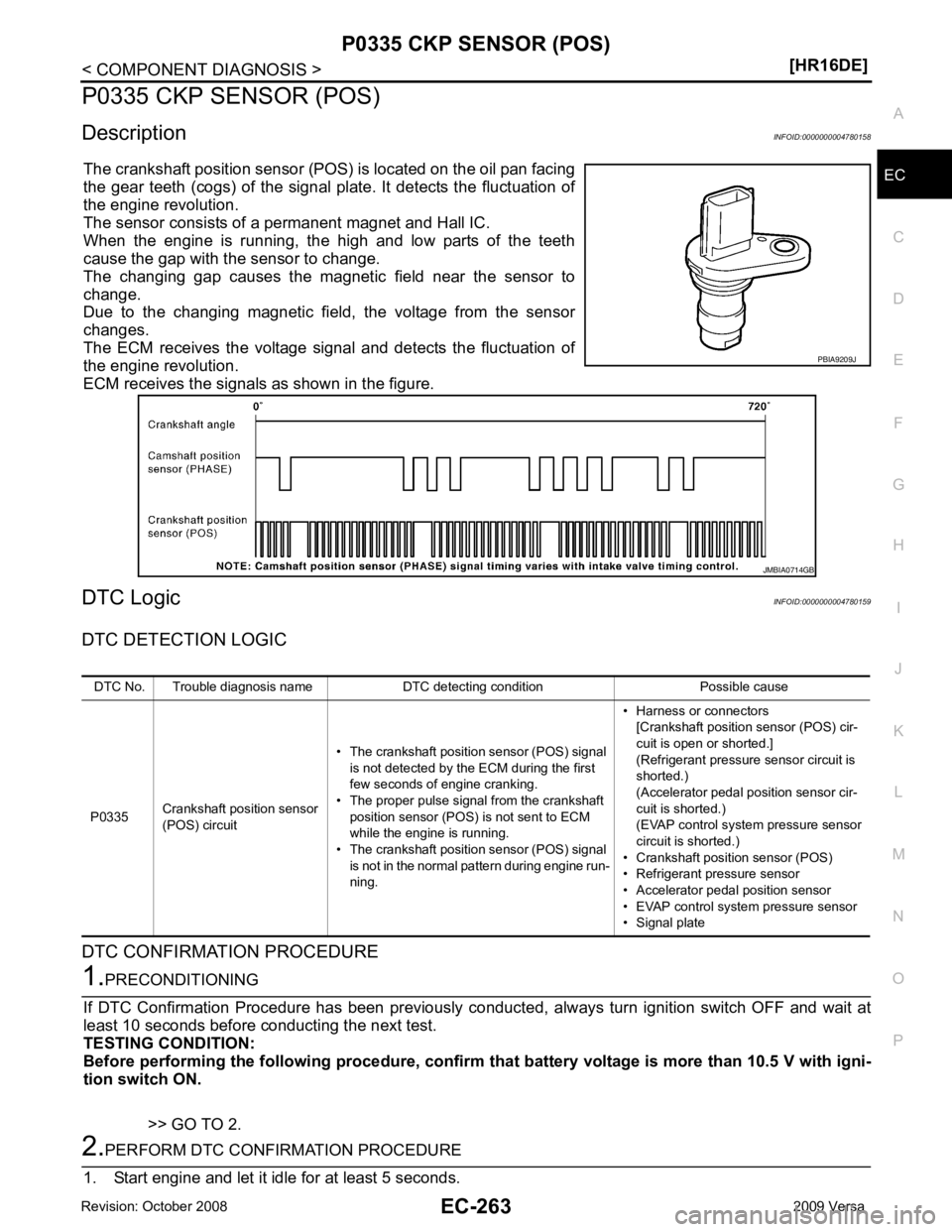
Description INFOID:0000000004780158
The crankshaft position sensor (POS ) is located on the oil pan facing
the gear teeth (cogs) of the signal pl ate. It detects the fluctuation of
the engine revolution.
The sensor consists of a permanent magnet and Hall IC.
When the engine is running, the high and low parts of the teeth
cause the gap with the sensor to change.
The changing gap causes the magnet ic field near the sensor to
change.
Due to the changing magnetic fiel d, the voltage from the sensor
changes.
The ECM receives the voltage signal and detects the fluctuation of
the engine revolution.
ECM receives the signals as shown in the figure.
DTC Logic INFOID:0000000004780159
DTC DETECTION LOGIC
DTC CONFIRMATION PROCEDURE
Page 1624 of 4331
![NISSAN TIIDA 2009 Service Repair Manual EC-268< COMPONENT DIAGNOSIS >
[HR16DE]
P0340 CMP SENSOR (PHASE)
P0340 CMP SENSOR (PHASE)
Description INFOID:0000000004780162
The camshaft position sensor (P HASE) senses the retraction of
cams](/img/5/57398/w960_57398-1623.png "NISSAN TIIDA 2009 Service Repair Manual EC-268< COMPONENT DIAGNOSIS >
[HR16DE]
P0340 CMP SENSOR (PHASE)
P0340 CMP SENSOR (PHASE)
Description INFOID:0000000004780162
The camshaft position sensor (P HASE) senses the retraction of
cams")
EC-268< COMPONENT DIAGNOSIS >
[HR16DE]
P0340 CMP SENSOR (PHASE)
P0340 CMP SENSOR (PHASE)
Description INFOID:0000000004780162
The camshaft position sensor (P HASE) senses the retraction of
camshaft (INT) to identify a particular cylinder. The camshaft position
sensor (PHASE) senses the piston position.
When the crankshaft position sensor (POS) system becomes inoper-
ative, the camshaft position sensor (PHASE) provides various con-
trols of engine parts instead, utilizing timing of cylinder identification
signals.
The sensor consists of a permanent magnet and Hall IC.
When engine is running, the high and low parts of the teeth cause
the gap with the sensor to change.
The changing gap causes the magnetic field near the sensor to
change.
Due to the changing magnetic field, the voltage from the sensor changes.
ECM receives the signals as shown in the figure.
DTC Logic INFOID:0000000004780163
DTC DETECTION LOGIC
NOTE:
If DTC P0340 is displayed with DTC P0643, first pe rform the trouble diagnosis for DTC P0643. Refer to
EC-358, " DTC Logic " .
DTC CONFIRMATION PROCEDURE 1.
PRECONDITIONING
If DTC Confirmation Procedure has been previously conduc ted, always turn ignition switch OFF and wait at
least 10 seconds before conducting the next test.
TESTING CONDITION:
Before performing the following procedure, confirm that battery voltage is more than 10.5 V with igni-
tion switch ON.
>> GO TO 2. 2.
PERFORM DTC CONFIRMATION PROCEDURE-I
1. Start engine and let it idle for at least 5 seconds. If engine does not start, crank engine for at least 2 seconds.
2. Check 1st trip DTC. PBIA9875J
JMBIA0714GB
DTC No. Trouble diagnosis name DTC detecting condition Possible cause
P0340 Camshaft position sensor
(PHASE) circuit • The cylinder No. signal is not sent to ECM for
the first few seconds during engine cranking.
• The cylinder No. signal is not sent to ECM during engine running.
• The cylinder No. signal is not in the normal pattern during engine running. • Harness or connectors
(The sensor circuit is open or shorted)
• Camshaft position sensor (PHASE)
• Camshaft (INT)
• Starter motor
• Starting system circuit
• Dead (Weak) battery
Page 1630 of 4331
![NISSAN TIIDA 2009 Service Repair Manual EC-274< COMPONENT DIAGNOSIS >
[HR16DE]
P0420 THREE WAY CATALYST FUNCTION
CMPLT >> GO TO 6.
INCMP >> GO TO 4. 4.
PERFORM DTC CONFIRMATION PROCEDURE-II
1. Wait 5 seconds at idle.
2. Rev engine up to 2,0](/img/5/57398/w960_57398-1629.png "NISSAN TIIDA 2009 Service Repair Manual EC-274< COMPONENT DIAGNOSIS >
[HR16DE]
P0420 THREE WAY CATALYST FUNCTION
CMPLT >> GO TO 6.
INCMP >> GO TO 4. 4.
PERFORM DTC CONFIRMATION PROCEDURE-II
1. Wait 5 seconds at idle.
2. Rev engine up to 2,0")
EC-274< COMPONENT DIAGNOSIS >
[HR16DE]
P0420 THREE WAY CATALYST FUNCTION
CMPLT >> GO TO 6.
INCMP >> GO TO 4. 4.
PERFORM DTC CONFIRMATION PROCEDURE-II
1. Wait 5 seconds at idle.
2. Rev engine up to 2,000 to 3,000 rpm and maintain it unt il “INCMP” of “CATALYST” changes to “CMPLT” (It
will take approximately 5 minutes).
Does the indication change to “ CMPLT ” ?
YES >> GO TO 6.
NO >> GO TO 5. 5.
PERFORM DTC CONFIRMATION PROCEDURE AGAIN
1. Stop engine and cool it down to less than 70 °C (158 °F).
2. Perform DTC CONFIRMATION PROCEDURE again.
>> GO TO 3. 6.
PERFORM DTC CONFIRMATION PROCEDURE-III
Check 1st trip DTC.
Is 1st trip DTC detected? YES >> Go to
EC-275, " Diagnosis Procedure " .
NO >> INSPECTION END 7.
PERFORM COMPONENT FUNCTION CHECK
Perform component function check. Refer to EC-274, " Component Function Check " .
NOTE:
Use component function check to check the overall functi on of the three way catalyst (manifold). During this
check, a 1st trip DTC might not be confirmed.
Is the inspection result normal? YES >> INSPECTION END
NO >> Go to EC-275, " Diagnosis Procedure " .
Component Function Check INFOID:00000000047801671.
PERFORM COMPONENT FUNCTION CHECK
Without CONSULT-III
1. Start engine and warm it up to normal operating temperature.
2. Turn ignition switch OFF and wait at least 10 seconds.
3. Start engine and keep the engine speed between 3,500 and 4,000 rpm for at least 1 minute under no load.
4. Let engine idle for 1 minute.
5. Open engine hood.
6. Check the voltage between ECM harness connector and ground under the following condition.
Is the inspection result normal? YES >> INSPECTION END
NO >> Go to EC-275, " Diagnosis Procedure " .
ECM
Ground Condition Voltage
Con-
nector Terminal
F11 50
(HO2S2 signal) GroundKeeping engine speed
at 2,500 rpm constant
under no load The voltage fluctuation cy-
cle takes more than 5 sec-
onds.
1 cycle: 0.6 - 1.0 → 0 - 0.3
→ 0.6 - 1.0 PBIB2996E
Page 1631 of 4331
![NISSAN TIIDA 2009 Service Repair Manual P0420 THREE WAY CATALYST FUNCTION
EC-275
< COMPONENT DIAGNOSIS >
[HR16DE] C
D E
F
G H
I
J
K L
M A EC
NP
O
Diagnosis Procedure
INFOID:00000000047801681.
CHECK EXHAUST SYSTEM
Visually check exhaust tube](/img/5/57398/w960_57398-1630.png "NISSAN TIIDA 2009 Service Repair Manual P0420 THREE WAY CATALYST FUNCTION
EC-275
< COMPONENT DIAGNOSIS >
[HR16DE] C
D E
F
G H
I
J
K L
M A EC
NP
O
Diagnosis Procedure
INFOID:00000000047801681.
CHECK EXHAUST SYSTEM
Visually check exhaust tube")
P0420 THREE WAY CATALYST FUNCTION
EC-275
< COMPONENT DIAGNOSIS >
[HR16DE] C
D E
F
G H
I
J
K L
M A EC
NP
O
Diagnosis Procedure
INFOID:00000000047801681.
CHECK EXHAUST SYSTEM
Visually check exhaust tubes and muffler for dent.
Is the inspection result normal? YES >> GO TO 2.
NO >> Repair or replace. 2.
CHECK EXHAUST GAS LEAK
1. Start engine and run it at idle.
2. Listen for an exhaust gas leak before the three way catalyst (manifold).
Is exhaust gas leak detected? YES >> Repair or replace.
NO >> GO TO 3. 3.
CHECK INTAKE AIR LEAK
Listen for an intake air leak after the mass air flow sensor.
Is intake air leak detected? YES >> Repair or replace.
NO >> GO TO 4. 4.
CHECK IDLE SPEED AND IGNITION TIMING
For procedure, refer to EC-30, " IGNITION TIMING : Special Repair Requirement " .
For specification, refer to EC-504, " Idle Speed " and
EC-504, " Ignition Timing " .
Is the inspection result normal? YES >> GO TO 5.
NO >> Follow the instruction of EC-26, " BASIC INSPECTION : Special Repair Requirement " .
5.
CHECK FUEL INJECTOR
1. Stop engine and then turn ignition switch ON.
2. Check the voltage between ECM harness connector and ground.
Is the inspection result normal? YES >> GO TO 6.
NO >> Perform EC-431, " Diagnosis Procedure " .
6.
CHECK FUNCTION OF IGNITION COIL-I
CAUTION: PBIB1216E
ECM
Ground Voltage
Connector Terminal
F10 25
Ground Battery voltage
29
30
31 JMBIA2201GB
Page 1632 of 4331
![NISSAN TIIDA 2009 Service Repair Manual EC-276< COMPONENT DIAGNOSIS >
[HR16DE]
P0420 THREE WAY CATALYST FUNCTION
Do the following procedure in the place where ventilation is good without the combustible.
1. Turn ignition switch OFF.
2. Rem](/img/5/57398/w960_57398-1631.png "NISSAN TIIDA 2009 Service Repair Manual EC-276< COMPONENT DIAGNOSIS >
[HR16DE]
P0420 THREE WAY CATALYST FUNCTION
Do the following procedure in the place where ventilation is good without the combustible.
1. Turn ignition switch OFF.
2. Rem")
EC-276< COMPONENT DIAGNOSIS >
[HR16DE]
P0420 THREE WAY CATALYST FUNCTION
Do the following procedure in the place where ventilation is good without the combustible.
1. Turn ignition switch OFF.
2. Remove fuel pump fuse in IPDM E/R to release fuel pressure.
NOTE:
Do not use CONSULT-III to release fuel pressure, or fuel pressure applies again during the following pro-
cedure.
3. Start engine.
4. After engine stalls, crank it two or three times to release all fuel pressure.
5. Turn ignition switch OFF.
6. Remove all ignition coil harness connectors to avoi d the electrical discharge from the ignition coils.
7. Remove ignition coil and spark plug of the cylinder to be checked.
8. Crank engine for 5 seconds or more to remove combustion gas in the cylinder.
9. Connect spark plug and harness connector to ignition coil.
10. Fix ignition coil using a rope etc. with gap of 13 - 17 mm (0.52 - 0.66 in) between the edge of the spark plug and grounded metal
portion as shown in the figure.
11. Crank engine for about 3 seconds, and check whether spark is
generated between the spark plug and the grounded metal por-
tion.
CAUTION:
• During the operation, always stay 0.5 m (19.7 in) away from the spark plug and the ig nition coil. Be careful not to
get an electrical shock wh ile checking, because the elec-
trical discharge voltage becomes 20 kV or more.
• It might cause to damage the igni tion coil if the gap of more than 17 mm (0.66 in) is taken.
NOTE:
When the gap is less than 13 mm (0.52 in), the sp ark might be generated even if the coil is mal-
functioning.
Is the inspection result normal? YES >> GO TO 10.
NO >> GO TO 7. 7.
CHECK FUNCTION OF IGNITION COIL-II
1. Turn ignition switch OFF.
2. Disconnect spark plug and connect a known-good spark plug.
3. Crank engine for about 3 seconds, and recheck whether spark is generated between the spark plug and
the grounded metal portion.
Is the inspection result normal? YES >> GO TO 8.
NO >> Check ignition coil, power transistor and their circuits. Refer to EC-441, " Diagnosis Procedure " .
8.
CHECK SPARK PLUG
Check the initial spark plug for fouling, etc.
Is the inspection result normal? YES >> Replace spark plug(s) with standard type one(s). For
spark plug type, refer to EM-117, " Spark Plug " .
NO >> Repair or clean spark plug. Then GO TO 9. 9.
CHECK FUNCTION OF IGNITION COIL-III Spark should be generated. JMBIA0066GB
Spark should be generated.
SEF156I