ESP NISSAN TIIDA 2009 Service Manual PDF
[x] Cancel search | Manufacturer: NISSAN, Model Year: 2009, Model line: TIIDA, Model: NISSAN TIIDA 2009Pages: 4331, PDF Size: 58.04 MB
Page 1909 of 4331

EC
NP
O
HO2S
05H
Air fuel ratio (A/F) sensor 1
(Bank 2) P0151 83H 0BH
Minimum sensor output voltage for test
cycle
P0151 84H 0BH Maximum sensor output voltage for test
cycle
P0150 85H 0BH Minimum sensor output voltage for test
cycle
P0150 86H 0BH Maximum sensor output voltage for test
cycle
P0153 87H 04H Response rate: Response ratio (Lean to
Rich)
P0153 88H 04H Response rate: Response ratio (Rich to
Lean)
P2A03 89H 84H The amount of shift in air fuel ratio
P2A03 8AH 84H The amount of shift in air fuel ratio P0150 8BH 0BH Difference in sensor output voltage
P0153 8CH 83H Response gain at the limited frequency
06H Heated oxygen sensor 2
(Bank 2) P0158 07H 0CH
Minimum sensor output voltage for test
cycle
P0157 08H 0CH Maximum sensor output voltage for test
cycle
P0158 80H 0CH Sensor output voltage
P0159 81H 0CH Difference in sensor output voltage
07H Heated oxygen sensor 3
(Bank2) P0163 07H 0CH
Minimum sensor output voltage for test
cycle
P0164 08H 0CH Maximum sensor output voltage for test
cycle
P0166 80H 0CH Sensor output voltage
P0165 81H 0CH Difference in sensor output voltage
CATA-
LYST 21H
Three way catalyst function
(Bank1) P0420 80H 01H O2 storage index
P0420 82H 01H Switching time lag engine exhaust index
value
P2423 83H 0CH Difference in 3rd O2 sensor output volt-
age
P2423 84H 84H O2 storage index in HC trap catalyst
22H Three way catalyst function
(Bank2) P0430 80H 01H O2 storage index
P0430 82H 01H Switching time lag engine exhaust index
value
P2424 83H 0CH Difference in 3rd O2 sensor output volt-
age
P2424 84H 84H O2 storage index in HC trap catalyst
Item
OBD-
MID Self-diagnostic test item DTC Test value and Test
limit
(GST display) Description
TID Unit and
Scaling ID
Page 1922 of 4331
![NISSAN TIIDA 2009 Service Manual PDF EC-566< SERVICE INFOMATION >
[MR TYPE 1]
BASIC SERVICE PROCEDURE
BASIC SERVICE PROCEDURE
Basic Inspection INFOID:00000000045370431.
INSPECTION START
1. Check service records for any recent repairs tha](/img/5/57398/w960_57398-1921.png "NISSAN TIIDA 2009 Service Manual PDF EC-566< SERVICE INFOMATION >
[MR TYPE 1]
BASIC SERVICE PROCEDURE
BASIC SERVICE PROCEDURE
Basic Inspection INFOID:00000000045370431.
INSPECTION START
1. Check service records for any recent repairs tha")
EC-566< SERVICE INFOMATION >
[MR TYPE 1]
BASIC SERVICE PROCEDURE
BASIC SERVICE PROCEDURE
Basic Inspection INFOID:00000000045370431.
INSPECTION START
1. Check service records for any recent repairs that ma y indicate a related malfunction, or a current need for
scheduled maintenance.
2. Open engine hood and check the following:
- Harness connectors for improper connections
- Wiring harness for improper connections, pinches and cut
- Vacuum hoses for splits, kinks and improper connections
- Hoses and ducts for leaks
- Air cleaner clogging
- Gasket
3. Confirm that electrical or mechanical loads are not applied.
- Headlamp switch is OFF.
- Air conditioner switch is OFF.
- Rear window defogger switch is OFF.
- Steering wheel is in the straight-ahead position, etc.
4. Start engine and warm it up until engine coolant temperature indicator points the middle of gauge.
Ensure engine stays below 1,000 rpm.
5. Run engine at about 2,000 rpm for about 2 minutes under no load.
6. Make sure that no DTC is displayed with CONSULT-III or GST.
OK or NG OK >> GO TO 3.
NG >> GO TO 2. 2.
REPAIR OR REPLACE
Repair or replace components as necessary according to corresponding Diagnostic Procedure.
>> GO TO 3. 3.
CHECK TARGET IDLE SPEED
With CONSULT-III
1. Run engine at about 2,000 rpm for about 2 minutes under no load. SEF983U
SEF976U
SEF977U
Page 1933 of 4331
![NISSAN TIIDA 2009 Service Manual PDF TROUBLE DIAGNOSIS
EC-577
< SERVICE INFOMATION >
[MR TYPE 1] C
D E
F
G H
I
J
K L
M A EC
NP
O
TROUBLE DIAGNOSIS
Trouble Diagnosis Introduction INFOID:0000000004537051
INTRODUCTION The engine has an ECM](/img/5/57398/w960_57398-1932.png "NISSAN TIIDA 2009 Service Manual PDF TROUBLE DIAGNOSIS
EC-577
< SERVICE INFOMATION >
[MR TYPE 1] C
D E
F
G H
I
J
K L
M A EC
NP
O
TROUBLE DIAGNOSIS
Trouble Diagnosis Introduction INFOID:0000000004537051
INTRODUCTION The engine has an ECM")
TROUBLE DIAGNOSIS
EC-577
< SERVICE INFOMATION >
[MR TYPE 1] C
D E
F
G H
I
J
K L
M A EC
NP
O
TROUBLE DIAGNOSIS
Trouble Diagnosis Introduction INFOID:0000000004537051
INTRODUCTION The engine has an ECM to control major systems such as fuel con-
trol, ignition control, idle air control system, etc. The ECM accepts
input signals from sensors and instantly drives actuators. It is essen-
tial that both input and output signals are proper and stable. At the
same time, it is important that there are no malfunctions such as vac-
uum leaks, fouled spark plugs, or other malfunctions with the engine.
It is much more difficult to diagnose an incident that occurs intermit-
tently rather than continuously. Most intermittent incidents are
caused by poor electric connections or improper wiring. In this case,
careful checking of suspected circuits may help prevent the replace-
ment of good parts.
A visual check only may not find t he cause of the incidents. A road
test with CONSULT-III (or GST) or a circuit tester connected should
be performed. Follow the Work Flow on "WORK FLOW".
Before undertaking actual checks, take a few minutes to talk with a
customer who approaches with a driveability complaint. The cus-
tomer can supply good information about such incidents, especially
intermittent ones. Find out what symptoms are present and under
what conditions they occur. A Diagnostic Worksheet like the example
on "Worksheet Sample" should be used.
Start your diagnosis by looking for conventional malfunctions first.
This will help troubleshoot driveability malfunctions on an electroni-
cally controlled engine vehicle.
WORK FLOW MEF036D
SEF233G
SEF234G
Page 1968 of 4331
![NISSAN TIIDA 2009 Service Manual PDF EC-612< SERVICE INFOMATION >
[MR TYPE 1]
TROUBLE DIAGNOSIS
*: Leaving cooling fan OFF with CONSULT-III while engine is running may cause the engine to overheat.
DTC & SRT CONFIRMATION MODE
SRT STATUS](/img/5/57398/w960_57398-1967.png "NISSAN TIIDA 2009 Service Manual PDF EC-612< SERVICE INFOMATION >
[MR TYPE 1]
TROUBLE DIAGNOSIS
*: Leaving cooling fan OFF with CONSULT-III while engine is running may cause the engine to overheat.
DTC & SRT CONFIRMATION MODE
SRT STATUS")
EC-612< SERVICE INFOMATION >
[MR TYPE 1]
TROUBLE DIAGNOSIS
*: Leaving cooling fan OFF with CONSULT-III while engine is running may cause the engine to overheat.
DTC & SRT CONFIRMATION MODE
SRT STATUS Mode
For details, refer to EC-542, " Emission-related Diagnostic Information " .
SRT WORK SUPPORT Mode
This mode enables a technician to drive a vehicle to set the SRT while monitoring the SRT status.
DTC WORK SUPPORT Mode
*: DTC P1442 and P1456 does not apply to C11 models but appears in DTC Work Support Mode screens.
Generic Scan Tool (GST) Function INFOID:0000000004537061
DESCRIPTION
Generic Scan Tool (OBDII scan tool) complying with SAE J1978 has
8 different functions explained below.
ISO 15765-4 is used as the protocol.
The name GST or Generic Scan Tool is used in this service manual.
FUNCTION VENT CON-
TROL/V • Ignition switch: ON
(Engine stopped)
• Turn solenoid valve “ON” and “OFF” with the CONSULT-III and
listen to operating sound. Solenoid valve makes an operating
sound. • Harness and connectors
• EVAP canister vent control valve
V/T ASSIGN AN-
GLE • Engine: Return to the original
trouble condition
• Change intake valve timing using CONSULT-III. If trouble symptom disappears, see
CHECK ITEM. • Harness and connectors
• Intake valve timing control sole-
noid valve
TEST ITEM CONDITION JUDGEMENT CHECK ITEM (REMEDY) Test mode Test item Corresponding DTC No. Reference page
EVAPORATIVE SYS-
TEM PURG FLOW P0441 P0441
EC-792EVP SML LEAK P0442/P1442*
P0442
EC-797 P0455
EC-847 EVP V/S LEAK P0456/P1456* P0456
EC-853PURG VOL CN/V P1444 P0443
EC-804A/F SEN1
A/F SEN1 (B1) P1276 P0130
EC-692A/F SEN1 (B1) P1278/P1279 P0133
EC-710HO2S2
HO2S2 (B1) P0139 P0139
EC-733HO2S2 (B1) P1146 P0138
EC-724HO2S2 (B1) P1147 P0137
EC-717 SEF139P
Page 2001 of 4331

EC
NP
O
DTC P0037, P0038 HO2S2 HEATER
Description INFOID:0000000004537096
SYSTEM DESCRIPTION
The ECM performs ON/OFF control of the heated oxygen sensor 2 heater corresponding to the engine speed,
amount of intake air and engine coolant temperature.
OPERATION
CONSULT-III Reference Val ue in Data Monitor Mode INFOID:0000000004537097
Specification data are reference values.
On Board Diagnosis Logic INFOID:0000000004537098
DTC Confirmation Procedure INFOID:0000000004537099
NOTE:
If DTC Confirmation Procedure has been previously conduc ted, always turn ignition switch OFF and wait at
least 10 seconds before conducting the next test.
TESTING CONDITION:
Before performing the following procedure, confi rm that battery voltage is between 10.5V and 16V at
idle.
1. Start engine and warm it up to the normal operating temperature. Sensor Input Signal to ECM ECM Function Actuator
Camshaft position sensor (PHASE) Engine speed
Heated oxygen sensor 2
heater control Heated oxygen sensor 2 heater
Crankshaft position sensor (POS)
Engine coolant temperature sensor Engine coolant tempera-
ture
Mass air flow sensor Amount of intake air Engine speed rpm Heated oxygen sensor 2 heater
Above 3,600 OFF
• Below 3,600 rpm after the following conditions are met.
- Engine: After warming up
- Keeping the engine speed between 3,500 and 4,000 rpm for 1 minute and at idle for 1 minute under no load ONMONITOR ITEM CONDITION SPECIFICATION
HO2S2 HTR (B1) • Engine speed: Below 3,600 rpm after the following conditions are met
- Engine: After warming up
- Keeping the engine speed between 3,500 and 4,000 rpm for 1 minute and
at idle for 1 minute under no load. ON
• Engine speed: Above 3,600 rpm OFF DTC No.
Trouble diagnosis
name DTC detecting condition Possible cause
P0037
0037 Heated oxygen
sensor 2 heater
control circuit low The current amperage in the heated oxygen sensor
2 heater circuit is out of the normal range.
(An excessively low voltage signal is sent to ECM
through the heated oxygen sensor 2 heater.) • Harness or connectors
(Heated oxygen sensor 2 heater circuit is
open or shorted.)
• Heated oxygen sensor 2 heater
P0038
0038 Heated oxygen
sensor 2 heater
control circuit high The current amperage in the heated oxygen sensor
2 heater circuit is out of the normal range.
(An excessively high voltage signal is sent to ECM
through the heated oxygen sensor 2 heater.) • Harness or connectors
(Heated oxygen sensor 2 heater circuit is
shorted.)
• Heated oxygen sensor 2 heater
Page 2012 of 4331
![NISSAN TIIDA 2009 Service Manual PDF EC-656< SERVICE INFOMATION >
[MR TYPE 1]
DTC P0101 MAF SENSOR
PROCEDURE FOR MALFUNCTION A
NOTE:
If engine will not start or stops soon, wait at leas t 10 seconds with engine stopped (Ignition switch O](/img/5/57398/w960_57398-2011.png "NISSAN TIIDA 2009 Service Manual PDF EC-656< SERVICE INFOMATION >
[MR TYPE 1]
DTC P0101 MAF SENSOR
PROCEDURE FOR MALFUNCTION A
NOTE:
If engine will not start or stops soon, wait at leas t 10 seconds with engine stopped (Ignition switch O")
EC-656< SERVICE INFOMATION >
[MR TYPE 1]
DTC P0101 MAF SENSOR
PROCEDURE FOR MALFUNCTION A
NOTE:
If engine will not start or stops soon, wait at leas t 10 seconds with engine stopped (Ignition switch ON) instead
of running engine at idle speed.
1. Start engine and warm it up to normal operating temperature.
2. Run engine for at least 10 seconds at idle speed.
3. Check 1st trip DTC.
4. If 1st trip DTC is detected, go to EC-659, " Diagnosis Procedure " .
PROCEDURE FOR MALFUNCTION B
CAUTION:
Always drive vehicle at a safe speed.
With CONSULT-III
1. Turn ignition switch ON.
2. Start engine and warm it up to normal operating temperature.
If engine cannot be started, go to EC-659, " Diagnosis Procedure " .
3. Select “DATA MONITOR” mode with CONSULT-III.
4. Check the voltage of “MAS A/F SE-B1” with “DATA MONITOR”.
5. Increases engine speed to about 4,000 rpm.
6. Monitor the linear voltage rise in response to engine speed
increases.
If NG, go to EC-659, " Diagnosis Procedure " .
If OK, go to following step.
7. Maintain the following conditions for at least 10 consecutive seconds.
8. Check 1st trip DTC.
9. If 1st trip DTC is detected, go to EC-659, " Diagnosis Procedure " .
Overall Function Check INFOID:0000000004537116
PROCEDURE FOR MALFUNCTION B
Use this procedure to check the overall function of the ma ss air flow sensor circuit. During this check, a 1st
DTC might not be confirmed.
With GST PBIB3457E
ENG SPEED More than 2,000 rpm
THRTL SEN 1 More than 3V
THRTL SEN 2 More than 3V
Shift lever Suitable position
Driving location Driving vehicle uphill (Increased engine load) will help
maintain the driving conditions required for this test.
Page 2013 of 4331
![NISSAN TIIDA 2009 Service Manual PDF DTC P0101 MAF SENSOR
EC-657
< SERVICE INFOMATION >
[MR TYPE 1] C
D E
F
G H
I
J
K L
M A EC
NP
O
1. Start engine and warm it up to normal operating temperature.
2. Select Service $01 with GST.
3. Check](/img/5/57398/w960_57398-2012.png "NISSAN TIIDA 2009 Service Manual PDF DTC P0101 MAF SENSOR
EC-657
< SERVICE INFOMATION >
[MR TYPE 1] C
D E
F
G H
I
J
K L
M A EC
NP
O
1. Start engine and warm it up to normal operating temperature.
2. Select Service $01 with GST.
3. Check")
DTC P0101 MAF SENSOR
EC-657
< SERVICE INFOMATION >
[MR TYPE 1] C
D E
F
G H
I
J
K L
M A EC
NP
O
1. Start engine and warm it up to normal operating temperature.
2. Select Service $01 with GST.
3. Check the mass air flow sensor signal with Service $01.
4. Check for linear mass air flow sensor signal value rise in response to increases to about 4,000 rpm in engine speed.
5. If NG, go to EC-659, " Diagnosis Procedure " .
SEF534P
Page 2017 of 4331
EC
NP
O
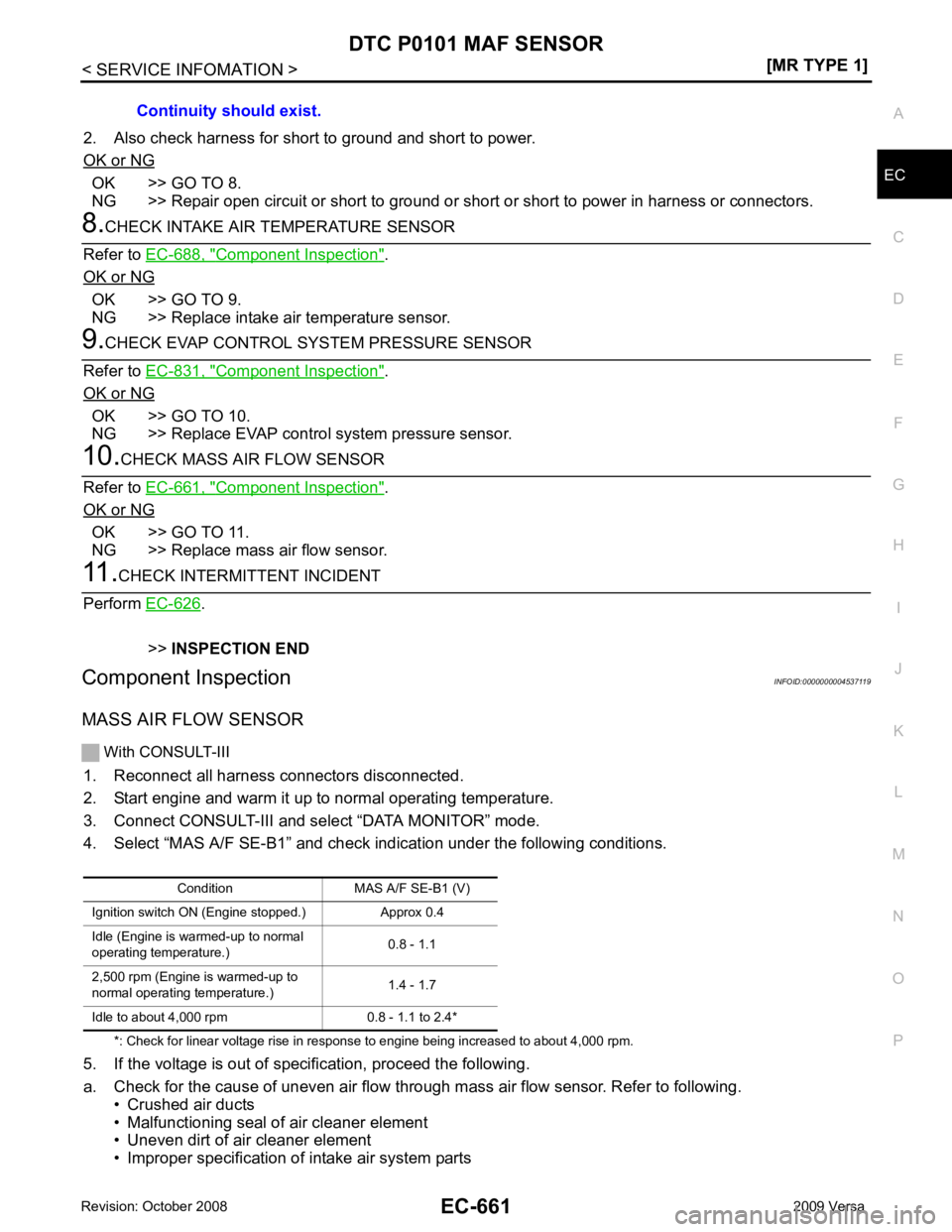
2. Also check harness for short to ground and short to power.
OK or NG OK >> GO TO 8.
NG >> Repair open circuit or short to ground or short or short to power in harness or connectors. Component Inspection " .
OK or NG OK >> GO TO 9.
NG >> Replace intake air temperature sensor. Component Inspection " .
OK or NG OK >> GO TO 10.
NG >> Replace EVAP control system pressure sensor. Component Inspection " .
OK or NG OK >> GO TO 11.
NG >> Replace mass air flow sensor. .
>> INSPECTION END
Component Inspection INFOID:0000000004537119
MASS AIR FLOW SENSOR With CONSULT-III
1. Reconnect all harness connectors disconnected.
2. Start engine and warm it up to normal operating temperature.
3. Connect CONSULT-III and select “DATA MONITOR” mode.
4. Select “MAS A/F SE-B1” and check i ndication under the following conditions.
*: Check for linear voltage rise in response to engine being increased to about 4,000 rpm.
5. If the voltage is out of spec ification, proceed the following.
a. Check for the cause of uneven air flow through mass air flow sensor. Refer to following. • Crushed air ducts
• Malfunctioning seal of air cleaner element
• Uneven dirt of air cleaner element
• Improper specification of intake air system parts Continuity should exist.
Page 2018 of 4331
![NISSAN TIIDA 2009 Service Manual PDF EC-662< SERVICE INFOMATION >
[MR TYPE 1]
DTC P0101 MAF SENSOR
b. If NG, repair or replace malfunc tioning part and perform step 2 to 4 again.
If OK, go to next step.
6. Turn ignition switch OFF.
7. Di](/img/5/57398/w960_57398-2017.png "NISSAN TIIDA 2009 Service Manual PDF EC-662< SERVICE INFOMATION >
[MR TYPE 1]
DTC P0101 MAF SENSOR
b. If NG, repair or replace malfunc tioning part and perform step 2 to 4 again.
If OK, go to next step.
6. Turn ignition switch OFF.
7. Di")
EC-662< SERVICE INFOMATION >
[MR TYPE 1]
DTC P0101 MAF SENSOR
b. If NG, repair or replace malfunc tioning part and perform step 2 to 4 again.
If OK, go to next step.
6. Turn ignition switch OFF.
7. Disconnect mass air flow sensor harness connector and reconnect it again.
8. Perform step 2 to 4 again.
9. If NG, clean or replace mass air flow sensor.
Without CONSULT-III
1. Reconnect all harness connectors disconnected.
2. Start engine and warm it up to normal operating temperature.
3. Check voltage between ECM terminal 45 (Mass air flow sensor signal) and ground.
*: Check for linear voltage rise in response to engine being increased to about 4,000 rpm.
4. If the voltage is out of spec ification, proceed the following.
a. Check for the cause of uneven air flow through mass air flow sensor. Refer to following. • Crushed air ducts
• Malfunctioning seal of air cleaner element
• Uneven dirt of air cleaner element
• Improper specification of intake air system parts
b. If NG, repair or replace malfunc tioning part and perform step 2 and 3 again.
If OK, go to next step.
5. Turn ignition switch OFF.
6. Disconnect mass air flow sensor harness connector and reconnect it again.
7. Perform step 2 and 3 again.
8. If NG, clean or replace mass air flow sensor.
Removal and Installation INFOID:0000000004537120
MASS AIR FLOW SENSOR
Refer to EM-139 .Condition Voltage V
Ignition switch ON (Engine stopped.) Approx 0.4
Idle (Engine is warmed-up to normal
operating temperature.) 0.8 - 1.1
2,500 rpm (Engine is warmed-up to
normal operating temperature.) 1.4 - 1.7
Idle to about 4,000 rpm 0.8 - 1.1 to 2.4* PBIA9564J
Page 2024 of 4331

OK >> GO TO 8.
NG >> Repair open circuit or short to ground or short to power in harness or connectors. Component Inspection " .
OK or NG OK >> GO TO 9.
NG >> Replace mass air flow sensor. .
>> INSPECTION END
Component Inspection INFOID:0000000004537127
MASS AIR FLOW SENSOR With CONSULT-III
1. Reconnect all harness connectors disconnected.
2. Start engine and warm it up to normal operating temperature.
3. Connect CONSULT-III and select “DATA MONITOR” mode.
4. Select “MAS A/F SE-B1” and check i ndication under the following conditions.
*: Check for linear voltage rise in response to engine being increased to about 4,000 rpm.
5. If the voltage is out of spec ification, proceed the following.
a. Check for the cause of uneven air flow through mass air flow sensor. Refer to following. • Crushed air ducts
• Malfunctioning seal of air cleaner element
• Uneven dirt of air cleaner element
• Improper specification of intake air system parts
b. If NG, repair or replace malfunc tioning part and perform step 2 to 4 again.
If OK, go to next step.
6. Turn ignition switch OFF.
7. Disconnect mass air flow sensor harness connector and reconnect it again.
8. Perform step 2 to 4 again.
9. If NG, clean or replace mass air flow sensor.
Without CONSULT-III
1. Reconnect all harness connectors disconnected.
2. Start engine and warm it up to normal operating temperature. Continuity should exist.