change wheel NISSAN TIIDA 2010 Service User Guide
[x] Cancel search | Manufacturer: NISSAN, Model Year: 2010, Model line: TIIDA, Model: NISSAN TIIDA 2010Pages: 3745, PDF Size: 73.67 MB
Page 953 of 3745
![NISSAN TIIDA 2010 Service User Guide TROUBLE DIAGNOSISBRC-63
< SERVICE INFORMATION > [VDC/TCS/ABS]
C
D
E
G H
I
J
K L
M A
B
BRC
N
O P
Note 1. If wheel sensor 2 for each wheel is indicated, check ABS actuator and electric unit (control un](/img/5/57397/w960_57397-952.png "NISSAN TIIDA 2010 Service User Guide TROUBLE DIAGNOSISBRC-63
< SERVICE INFORMATION > [VDC/TCS/ABS]
C
D
E
G H
I
J
K L
M A
B
BRC
N
O P
Note 1. If wheel sensor 2 for each wheel is indicated, check ABS actuator and electric unit (control un")
TROUBLE DIAGNOSISBRC-63
< SERVICE INFORMATION > [VDC/TCS/ABS]
C
D
E
G H
I
J
K L
M A
B
BRC
N
O P
Note 1. If wheel sensor 2 for each wheel is indicated, check ABS actuator and electric unit (control unit) power
supply voltage in addition to wheel sensor circuit check.
Note 2. If multiple malfunctions are detected including CAN communication line [U1000], perform diagnosis for
CAN communication line first.
DATA MONITOR
Display Item List
USV LINE [FL-RR]
[C1147] Front side VDC switch-over solenoid valve (cut valve) is open or
shorted, or control line is open or shorted to power supply or
ground.
BRC-72, "
Solenoid and
VDC Change-Over Valve
System Inspection"
USV LINE [FR-RL]
[C1148]Rear side VDC switch-over solenoid valve (cut valve) is open or
shorted, or control line is open or shorted to power supply or
ground.
HSV LINE [FL-RR]
[C1149] Front side VDC switch-over solenoid valve (suction valve) is open
or shorted, or control line is open or shorted to power supply or
ground.
HSV LINE [FR-RL]
[C1150] Rear side VDC switch-over solenoid valve (suction valve) is open
or shorted, or control line is open or shorted to power supply or
ground.
EMERGENCY BRAKE
[C1153] When ABS actuator and el
ectric unit (control unit) is malfunction-
ing. (Pressure increase is too much or too little) BRC-68, "
ABS/TCS/VDC
Control Unit Inspection"
PNP POS SIG
[C1154]Transmission range switch signal or communication line between
the ABS actuator and electric unit (control unit) and TCM is open
or shorted. BRC-78, "Transmission
Range Switch System In-
spection"
BR FLUID LEVEL LOW
[C1155]
Brake fluid level drops or circuit between ABS actuator and elec-
tric unit (control unit) and brake fluid level switch is open or
shorted. BRC-76, "Brake Fluid
Level Switch System In-
spection"
ST ANG SEN COM CIR
[C1156]
CAN communication line or steering angle sensor has generated
an error. BRC-79, "
CAN Commu-
nication System Inspec-
tion"
(Note 2)
VARIANT CODING
[C1170] In case where VARIANT CODING is different. BRC-68, "
ABS/TCS/VDC
Control Unit Inspection"
CAN COMM CIRCUIT
[U1000]• CAN communication line is open or shorted.
• ABS actuator and electric unit (control unit) internal malfunction
• Battery voltage for ECM is suddenly interrupted for approxi-
mately 0.5 seconds or more. BRC-79, "
CAN Commu-
nication System Inspec-
tion"
(Note 2)
Self-diagnostic item
Malfunction detecting condition Check system
Item
(Unit) Data monitor item selection
Remarks
ECU INPUT
SIGNALS MAIN
SIGNALS SELECTION
FROM MENU
FR LH SENSOR
(km/h, mph) ××× Wheel speed (km/h, mph) calculated by front LH
wheel sensor signal is displayed.
FR RH SENSOR
(km/h, mph) ××× Wheel speed (km/h, mph) calculated by front RH
wheel sensor signal is displayed.
RR LH SENSOR
(km/h, mph) ×××
Wheel speed (km/h, mph) calculated by rear LH
wheel sensor signal is displayed.
RR RH SENSOR
(km/h, mph) ××× Wheel speed (km/h, mph) calculated by rear RH
wheel sensor signal is displayed.
FR RH IN SOL
(On/Off) —
×× Front RH IN ABS solenoid (On/Off) status is dis-
played.
FR RH OUT SOL
(On/Off) —
×× Front RH OUT ABS solenoid (On/Off) status is
displayed.
FR LH IN SOL
(On/Off) —
×× Front LH IN ABS solenoid (On/Off) status is dis-
played.
Revision: January 20102010 Versa
Page 1437 of 3745
![NISSAN TIIDA 2010 Service User Guide EC-172
< COMPONENT DIAGNOSIS >[HR16DE]
P0127 IAT SENSOR
P0127 IAT SENSOR
DescriptionINFOID:0000000005398353
The intake air temperature sensor
is built-into mass air flow sensor
(1). The sensor detect](/img/5/57397/w960_57397-1436.png "NISSAN TIIDA 2010 Service User Guide EC-172
< COMPONENT DIAGNOSIS >[HR16DE]
P0127 IAT SENSOR
P0127 IAT SENSOR
DescriptionINFOID:0000000005398353
The intake air temperature sensor
is built-into mass air flow sensor
(1). The sensor detect")
EC-172
< COMPONENT DIAGNOSIS >[HR16DE]
P0127 IAT SENSOR
P0127 IAT SENSOR
DescriptionINFOID:0000000005398353
The intake air temperature sensor
is built-into mass air flow sensor
(1). The sensor detects intake air temperature and transmits a signal
to the ECM.
The temperature sensing unit uses a thermistor which is sensitive to
the change in temperature. Electrical resistance of the thermistor
decreases in response to the temperature rise.
*: These data are reference values and are measured between ECM terminal 46
(Intake air temperature sensor) and ground.
CAUTION:
Do not use ECM ground terminals when measuring input/output voltage. Doing
so may result in damage to the ECM's transistor. Use a ground other than ECM
terminals, such as the ground.
DTC LogicINFOID:0000000005398354
DTC DETECTION LOGIC
DTC CONFIRMATION PROCEDURE
1.PRECONDITIONING
If DTC Confirmation Procedure has been previously conducted, always turn ignition switch OFF and wait at
least 10 seconds before conducting the next test.
TESTING CONDITION:
This test may be conducted with the drive wheels lifted in the shop or by driving the vehicle. If a road
test is expected to be easier, it is unnecessary to lift the vehicle.
>> GO TO 2.
2.PERFORM DTC CONFIRMATION PROCEDURE
With CONSULT-III
1. Wait until engine coolant temperature is less than 96 °C (205 °F)
- Turn ignition switch ON.
- Select “DATA MONITOR” mode with CONSULT-III.
- Check the engine coolant temperature.
- If the engine coolant temperature is not less than 96° C (205°F), turn ignition switch OFF and cool down
engine.
PBIA9559J
Intake air temperature
[° C ( °F)] Voltage* (V)
Resistance (kΩ)
25 (77) 3.31.800 - 2.200
80 (176) 1.20.283 - 0.359
SEF012P
DTC No. Trouble diagnosis name DTC detecting condition Possible cause
P0127 Intake air temperature
too high Rationally incorrect voltage from the sensor is
sent to ECM, compared with the voltage signal
from engine coolant temperature sensor. • Harness or connectors
(The sensor circuit is open or shorted)
• Intake air temperature sensor
Revision: January 20102010 Versa
Page 1538 of 3745
![NISSAN TIIDA 2010 Service User Guide P0441 EVAP CONTROL SYSTEMEC-273
< COMPONENT DIAGNOSIS > [HR16DE]
C
D
E
F
G H
I
J
K L
M A
EC
NP
O
TESTING CONDITION:
Always perform test at a temperature of 5
°C (41° F) or more.
>> GO TO 3.
3.PERFOR](/img/5/57397/w960_57397-1537.png "NISSAN TIIDA 2010 Service User Guide P0441 EVAP CONTROL SYSTEMEC-273
< COMPONENT DIAGNOSIS > [HR16DE]
C
D
E
F
G H
I
J
K L
M A
EC
NP
O
TESTING CONDITION:
Always perform test at a temperature of 5
°C (41° F) or more.
>> GO TO 3.
3.PERFOR")
P0441 EVAP CONTROL SYSTEMEC-273
< COMPONENT DIAGNOSIS > [HR16DE]
C
D
E
F
G H
I
J
K L
M A
EC
NP
O
TESTING CONDITION:
Always perform test at a temperature of 5
°C (41° F) or more.
>> GO TO 3.
3.PERFORM DTC CONFIRMATION PROCEDURE-I
With CONSULT-III
1. Start engine and warm it up to normal operating temperature.
2. Turn ignition switch OFF and wait at least 10 seconds.
3. Start engine and let it idle for at least 70 seconds.
4. Select “PURG FLOW P0441” of “EVAPORATIVE SYS TEM” in “DTC WORK SUPPORT” mode with CON-
SULT-III.
5. Touch “START”.
Is COMPLETED displayed on CONSULT-III screen?
YES >> GO TO 5.
NO >> GO TO 4.
4.PERFORM DTC CONFIRMATION PROCEDURE-II
When the following conditions are met, “TESTING” will be displayed on the CONSULT-III screen. Maintain the
conditions continuously until “TESTING” changes to “COMPLETED”. (It will take at least 35 seconds.)
CAUTION:
Always drive vehicle at a safe speed.
If “TESTING” is not changed for a long time, retry from step 2.
Is
“COMPLETED” displayed on CONSULT-III screen?
YES >> GO TO 5.
NO >> Perform DTC CONFIRMATION PROCEDURE again. GO TO 3.
5.PERFORM DTC CONFIRMATION PROCEDURE-II
Touch “SELF-DIAG RESULT”.
Which is displayed on CONSULT-III screen?
OK >> INSPECTION END
NG >> Go to EC-274, "
Diagnosis Procedure".
6.PERFORM COMPONENT FUNCTION CHECK
Perform component function check. Refer to EC-273, "
Component Function Check".
NOTE:
Use component function check to check the overall m onitoring function of the EVAP control system purge flow
monitoring. During this check, a 1s t trip DTC might not be confirmed.
Is the inspection result normal?
YES >> INSPECTION END
NO >> Go to EC-274, "
Diagnosis Procedure".
Component Function CheckINFOID:0000000005398438
1.PERFORM COMPONENT FUNCTION CHECK
Without CONSULT-III
1. Lift up drive wheels.
2. Start engine and warm it up to normal operating temperature.
3. Turn ignition switch OFF and wait at least 10 seconds.
4. Start engine and wait at least 70 seconds.
Selector lever Suitable position
VHCL SPEED SE 32 - 120 km/h (20 - 75 mph)
ENG SPEED 500 - 3,800 rpm
B/FUEL SCHDL 1.0 - 10.0 msec
COOLAN TEMP/S More than 0°C (32 °F)
Revision: January 20102010 Versa
Page 1964 of 3745
![NISSAN TIIDA 2010 Service User Guide DTC P0127 IAT SENSOREC-699
< SERVICE INFORMATION > [MR18DE]
C
D
E
F
G H
I
J
K L
M A
EC
NP
O
DTC P0127 IAT SENSOR
Component DescriptionINFOID:0000000005532530
The intake air temperature sensor is built](/img/5/57397/w960_57397-1963.png "NISSAN TIIDA 2010 Service User Guide DTC P0127 IAT SENSOREC-699
< SERVICE INFORMATION > [MR18DE]
C
D
E
F
G H
I
J
K L
M A
EC
NP
O
DTC P0127 IAT SENSOR
Component DescriptionINFOID:0000000005532530
The intake air temperature sensor is built")
DTC P0127 IAT SENSOREC-699
< SERVICE INFORMATION > [MR18DE]
C
D
E
F
G H
I
J
K L
M A
EC
NP
O
DTC P0127 IAT SENSOR
Component DescriptionINFOID:0000000005532530
The intake air temperature sensor is built-into mass air flow sensor
(1). The sensor detects intake air temperature and transmits a signal
to the ECM.
The temperature sensing unit uses a
thermistor which is sensitive to
the change in temperature. Electrical resistance of the thermistor
decreases in response to the temperature rise.
*: This data is reference value and is measured between ECM terminal 46 (Intake air
temperature sensor) and ground.
CAUTION:
Do not use ECM ground terminals when measuring input/output
voltage. Doing so may result in damage to the ECM's transistor.
Use a ground other than ECM te rminals, such as the ground.
On Board Diagnosis LogicINFOID:0000000005532531
DTC Confirmation ProcedureINFOID:0000000005532532
CAUTION:
Always drive vehicle at a safe speed.
NOTE:
If DTC Confirmation Procedure has been previously conducted, always turn ignition switch OFF and wait at
least 10 seconds before conducting the next test.
TESTING CONDITION:
This test may be conducted with the drive wheels lifted in the shop or by driving the vehicle. If a road
test is expected to be easier, it is unnecessary to lift the vehicle.
WITH CONSULT-III
1. Wait until engine coolant temperature is less than 96 °C (205 °F)
a. Turn ignition switch ON.
b. Select “DATA MONITOR” mode with CONSULT-III.
c. Check the engine coolant temperature.
d. If the engine coolant temperature is not less than 96 °C (205° F), turn ignition switch OFF and cool down
engine.
• Perform the following steps before engine coolant temperature is above 96 °C (205° F).
PBIA9559J
Intake air temperature
[° C ( °F)] Voltage* (V)
Resistance (kΩ)
25 (77) 3.31.800 - 2.200
80 (176) 1.20.283 - 0.359
SEF012P
DTC No. Trouble diagnosis name DTC detecting condition Possible cause
P0127
0127 Intake air temperature
too high Rationally incorrect voltage from the sensor is
sent to ECM, compared with the voltage signal
from engine coolant temperature sensor. • Harness or connectors
(Intake temperature sensor circuit is open
or shorted)
• Intake air temperature sensor
Revision: January 20102010 Versa
Page 2048 of 3745
![NISSAN TIIDA 2010 Service User Guide DTC P0300 - P0304 MULTIPLE CYLINDER MISFIRE, NO. 1 - 4 CYLINDER MIS-
FIRE
EC-783
< SERVICE INFORMATION > [MR18DE]
C
D
E
F
G H
I
J
K L
M A
EC
NP
O
DTC P0300 - P0304 MULTIPLE CYLINDER
MISFIRE, NO. 1 -](/img/5/57397/w960_57397-2047.png "NISSAN TIIDA 2010 Service User Guide DTC P0300 - P0304 MULTIPLE CYLINDER MISFIRE, NO. 1 - 4 CYLINDER MIS-
FIRE
EC-783
< SERVICE INFORMATION > [MR18DE]
C
D
E
F
G H
I
J
K L
M A
EC
NP
O
DTC P0300 - P0304 MULTIPLE CYLINDER
MISFIRE, NO. 1 -")
DTC P0300 - P0304 MULTIPLE CYLINDER MISFIRE, NO. 1 - 4 CYLINDER MIS-
FIRE
EC-783
< SERVICE INFORMATION > [MR18DE]
C
D
E
F
G H
I
J
K L
M A
EC
NP
O
DTC P0300 - P0304 MULTIPLE CYLINDER
MISFIRE, NO. 1 - 4 CYLINDER
MISFIRE
On Board Diagnosis LogicINFOID:0000000005532627
When a misfire occurs, engine speed will fluctuate. If the engine speed fluctuates enough to cause the crank-
shaft position (CKP) sensor (POS) signal to vary, ECM can determine that a misfire is occurring.
The misfire detection logic consists of the following two conditions.
1. One Trip Detection Logic (Three Way Catalyst Damage) On the 1st trip, when a misfire condition occurs that can damage the three way catalyst (TWC) due to
overheating, the MIL will blink.
When a misfire condition occurs, the ECM monitors the CKP sensor (POS) signal every 200 engine revo-
lutions for a change.
When the misfire condition decreases to a level t hat will not damage the TWC, the MIL will turn off.
If another misfire condition occurs that can damage the TWC on a second trip, the MIL will blink.
When the misfire condition decreases to a level t hat will not damage the TWC, the MIL will remain on.
If another misfire condition occurs that can damage the TWC, the MIL will begin to blink again.
2. Two Trip Detection Logic (Exhaust quality deterioration) For misfire conditions that will not damage the TWC (but will affect vehicle emissions), the MIL will only
light when the misfire is detected on a second trip. Du ring this condition, the ECM monitors the CKP sen-
sor signal every 1,000 engine revolutions.
A misfire malfunction can be detected on any one cylinder or on multiple cylinders.
DTC Confirmation ProcedureINFOID:0000000005532628
CAUTION:
Always drive vehicle in safe manner according to traf fic conditions and obey all traffic laws when driv-
ing.
NOTE:
If DTC Confirmation Procedure has been previously conducted, always turn ignition switch OFF and wait at
least 10 seconds before conducting the next test.
1. Start engine and warm it up to normal operating temperature.
2. Turn ignition switch OFF and wait at least 10 seconds.
3. Restart engine and let it idle for about 15 minutes.
4. Check 1st trip DTC.
5. If 1st trip DTC is detected, go to EC-784, "
Diagnosis Procedure".
NOTE:
If 1st trip DTC is not detected during above proc edure, performing the following procedure is advised.
a. Turn ignition switch OFF and wait at least 10 seconds.
b. Start engine and drive the vehicle under the similar conditi ons to (1st trip) Freeze Frame Data for a certain
time. Refer to table below.
Sensor Input Signal to ECM ECM function
Crankshaft position sensor (POS) Engine speedOn board diagnosis of misfire
DTC No. Trouble diagnosis name DTC detecting condition Possible cause
P0300
0300 Multiple cylinder misfire
detected
Multiple cylinder misfire.
• Improper spark plug
• Insufficient compression
• Incorrect fuel pressure
• Fuel injector circuit is open or shorted
• Fuel injector
• Intake air leak
• The ignition signal circuit is open or shorted
• Lack of fuel
• Drive plate or flywheel
• Air fuel ratio (A/F) sensor 1
• Incorrect PCV hose connection
P0301
0301
No.1 cylinder misfire de-
tected
No. 1 cylinder misfires.
P0302
0302 No. 2 cylinder misfire
detected
No. 2 cylinder misfires.
P0303
0303 No. 3 cylinder misfire
detected
No. 3 cylinder misfires.
P0304
0304 No. 4 cylinder misfire
detected
No. 4 cylinder misfires.
Revision: January 20102010 Versa
Page 2076 of 3745
![NISSAN TIIDA 2010 Service User Guide DTC P0441 EVAP CONTROL SYSTEMEC-811
< SERVICE INFORMATION > [MR18DE]
C
D
E
F
G H
I
J
K L
M A
EC
NP
O
1. Start engine and warm it up to normal operating temperature.
2. Turn ignition switch OFF and wai](/img/5/57397/w960_57397-2075.png "NISSAN TIIDA 2010 Service User Guide DTC P0441 EVAP CONTROL SYSTEMEC-811
< SERVICE INFORMATION > [MR18DE]
C
D
E
F
G H
I
J
K L
M A
EC
NP
O
1. Start engine and warm it up to normal operating temperature.
2. Turn ignition switch OFF and wai")
DTC P0441 EVAP CONTROL SYSTEMEC-811
< SERVICE INFORMATION > [MR18DE]
C
D
E
F
G H
I
J
K L
M A
EC
NP
O
1. Start engine and warm it up to normal operating temperature.
2. Turn ignition switch OFF and wait at least 10 seconds.
3. Start engine and let it idle for at least 70 seconds.
4. Select “PURG FLOW P0441” of “EVAPORATIVE
SYSTEM” in “DTC CONFIRMATION” mode with CON-
SULT-III.
5. Touch “START”.
If “COMPLETED” is displayed, go to step 7.
6. When the following conditions are met, “TESTING” will be displayed on the CONSULT-III screen. Maintain the conditions continuously until “TES TING” changes to “COMPLETED”. (It will take at least 35 seconds.)
If TESTING is not changed for a long time, retry from step 2.
7. Make sure that “OK” is displayed after touching “S ELF-DIAG RESULTS”. If “NG” is displayed, refer to EC-
811, "Diagnosis Procedure".
Overall Function CheckINFOID:0000000005532660
Use this procedure to check the overall monitoring function of the EVAP control system purge flow monitoring.
During this check, a 1st trip DTC might not be confirmed.
WITH GST
1. Lift up drive wheels.
2. Start engine and warm it up to normal operating temperature.
3. Turn ignition switch OFF and wait at least 10 seconds.
4. Start engine and wait at least 70 seconds.
5. Set voltmeter probes to ECM terminals 42 (EVAP control system
pressure sensor signal) and ground.
6. Check EVAP control system pressure sensor value at idle speed and note it.
7. Establish and maintain the following conditions for at least 1 minute.
8. Verify that EVAP control system pressure sensor va lue stays 0.1 V less than the value at idle speed (mea-
sured at step 6) for at least 1 second.
9. If NG, go to EC-811, "
Diagnosis Procedure".
Diagnosis ProcedureINFOID:0000000005532661
1.CHECK EVAP CANISTER
1. Turn ignition switch OFF.
2. Check EVAP canister for cracks.
OK or NG
OK (With CONSULT-III)>>GO TO 2.
OK (Without CONSULT-III)>>GO TO 3.
NG >> Replace EVAP canister.
2.CHECK PURGE FLOW
Shift lever Suitable position
VHCL SPEED SE 32 - 120 km/h (20 - 75 MPH)
ENG SPEED 500 - 3,800 rpm
B/FUEL SCHDL 1.0 - 10.0 msec
COOLAN TEMP/S More than 0°C
Air conditioner switch ON
Headlamp switch ON
Rear window defogger switch ON
Engine speed Approx. 3,000 rpm
Shift lever Any position other than P, N or R
PBIB3313E
Revision: January 20102010 Versa
Page 2704 of 3745
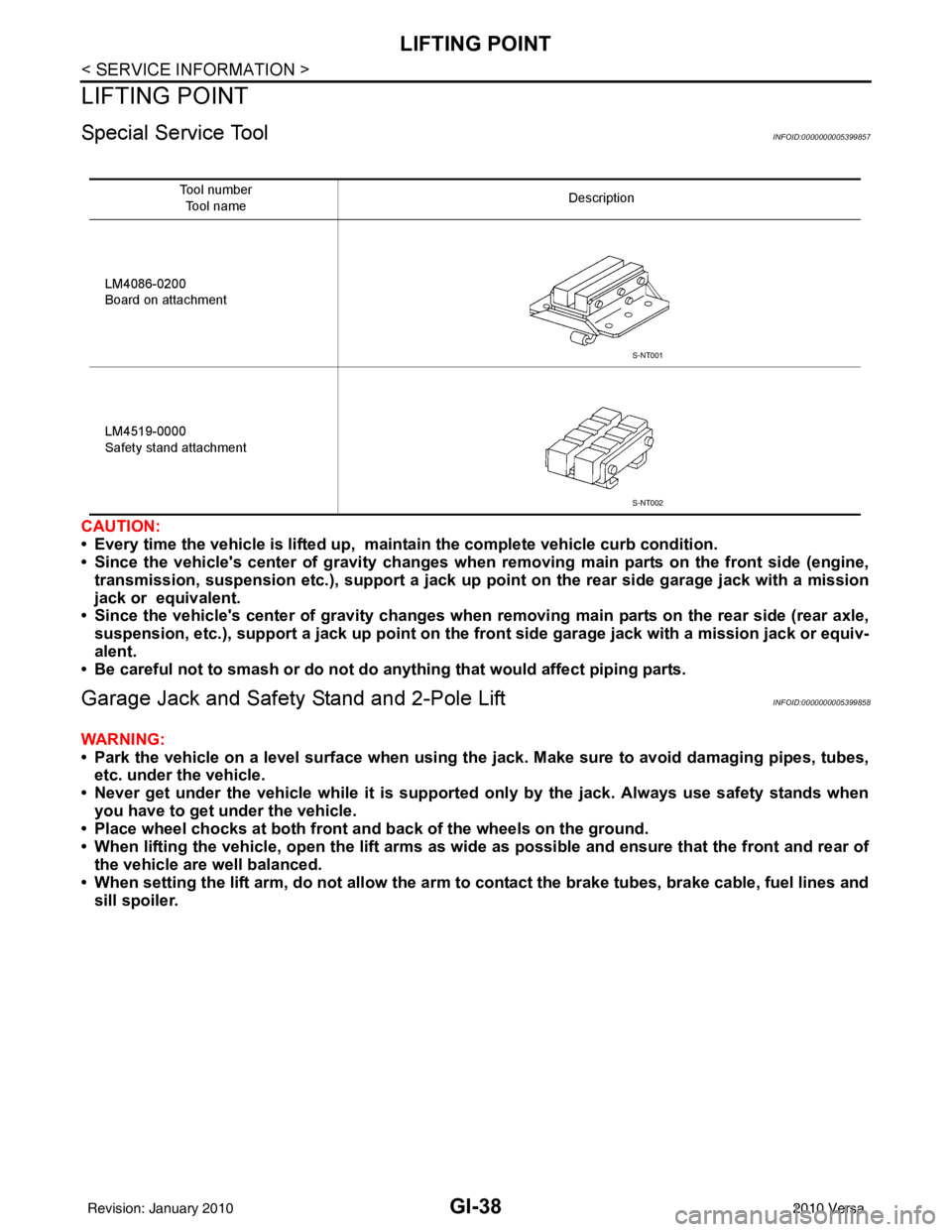
GI-38
< SERVICE INFORMATION >
LIFTING POINT
LIFTING POINT
Special Service ToolINFOID:0000000005399857
CAUTION:
• Every time the vehicle is lifted up, maintain the complete vehicle curb condition.
• Since the vehicle's center of gravity changes when removing main parts on the front side (engine,
transmission, suspension etc.), support a jack up point on the rear side garage jack with a mission
jack or equivalent.
• Since the vehicle's center of gravity changes when removing main parts on the rear side (rear axle,
suspension, etc.), support a jack up point on the front side garage jack with a mission jack or equiv-
alent.
• Be careful not to smash or do not do an ything that would affect piping parts.
Garage Jack and Safety Stand and 2-Pole LiftINFOID:0000000005399858
WARNING:
• Park the vehicle on a level surface when using the jack. Make sure to avoid damaging pipes, tubes,
etc. under the vehicle.
• Never get under the vehicle while it is supported only by the jack. Always use safety stands when you have to get under the vehicle.
• Place wheel chocks at both front an d back of the wheels on the ground.
• When lifting the vehicle, open the lift arms as wid e as possible and ensure that the front and rear of
the vehicle are well balanced.
• When setting the lift arm, do not allow the arm to contact the brake tubes, brake cable, fuel lines and
sill spoiler.
Tool number
Tool name Description
LM4086-0200
Board on attachment
LM4519-0000
Safety stand attachment
S-NT001
S-NT002
Revision: January 20102010 Versa
Page 3142 of 3745

GENERAL MAINTENANCEMA-7
< SERVICE INFORMATION >
C
DE
F
G H
I
J
K
M A
B
MA
N
O P
GENERAL MAINTENANCE
Explanation of Gene ral MaintenanceINFOID:0000000005394793
General MaintenanceINFOID:0000000005394794
General maintenance includes those items which shoul d be checked during the normal day-to-day operation
of the vehicle. They are essential if the vehicle is to continue operating properly. The owners can perform
checks and inspections themselves or they can have their NISSAN dealers do them.
OUTSIDE THE VEHICLE
The maintenance items listed here should be performed from time to time, unless otherwise specified.
INSIDE THE VEHICLE The maintenance items listed here should be checked on a regular basis, such as when performing periodic maintenance, cleaning the vehicle,
etc.
Item Reference page
Tires Check the pressure with a gauge often and always prior to long distance trips.
Adjust the pressure in all tires, including the spare, to the specified pressure.
Check carefully for damage, cuts or excessive wear. WT-28
Wheel nuts
When checking the tires, make sure no nuts are missing, and check for any loose
nuts. Tighten if necessary. WT-7
WindshieldClean the windshield on a regular basis. Check the windshield at least every six
months for cracks or other damage. Repair as necessary.
—
Tire rotation Tires should be rotated every 12,000 km (7,500 miles). WT-7
Transmitter compo-
nents in tire pressure
monitoring system
(TPMS)Replace the TPMS transmitter grommet seal, valve core and cap when the tires
are replaced due to wear or age.
WT-9
Wheel alignment and
balanceIf the vehicle pulls to either side while driving on a straight and level road, or if
you detect uneven or abnormal tire wear, there may be a need for wheel align-
ment. If the steering wheel or seat vibrates at normal highway speeds, wheel bal-
ancing may be needed. FSU-7
and
WT-7
Windshield wiper
blades Check for cracks or wear if they do not wipe properly.
—
Doors and engine
hood Check that all doors and the engine hood operate smoothly as well as the trunk
lid and back hatch. Also make sure that all latches lock securely. Lubricate if nec-
essary. Make sure that the secondary latch keeps the hood from opening when
the primary latch is released.
When driving in areas using road salt or other corrosive materials, check lubrica-
tion frequently. MA-48
Lamps
Make sure that the headlamps, stop lamps, tail lamps, turn signal lamps, and oth-
er lamps are all operating properly and installed securely. Also check headlamp
aim. Clean the headlamps on a regular basis. —
Item
Reference page
Warning lamps and
buzzers/chimes Make sure that all warning lamps and chimes are operating properly.
—
Windshield wiper and
washer Check that the wipers and washer operate properly and that the wipers do not
streak.
—
Windshield defroster Check that the air comes out of the defroster outlets properly and in sufficient
quantity when operating the heater or air conditioning. —
Steering wheel Check that it has the specified play. Be sure to check for changes in the steering
condition, such as excessive play, hard steering or strange noises.
Free play: Less than 35 mm (1.38 in) —
Seats Check seat position controls such as seat adjusters, seat back recliner, etc. to
make sure they operate smoothly and that all latches lock securely in every po-
sition. Check that the head restraints move up and down smoothly and that the
locks (if equipped) hold securely in all latched positions. Check that the latches
lock securely for folding-down rear seat backs. —
Revision: January 20102010 Versa
Page 3651 of 3745
![NISSAN TIIDA 2010 Service User Guide EPS SYSTEMSTC-5
< SYSTEM DESCRIPTION > [EPS]
C
D
E
F
H I
J
K L
M A
B
STC
N
O P
SYSTEM DESCRIPTION
EPS SYSTEM
System DiagramINFOID:0000000005600156
System DescriptionINFOID:0000000005600157
• EPS con](/img/5/57397/w960_57397-3650.png "NISSAN TIIDA 2010 Service User Guide EPS SYSTEMSTC-5
< SYSTEM DESCRIPTION > [EPS]
C
D
E
F
H I
J
K L
M A
B
STC
N
O P
SYSTEM DESCRIPTION
EPS SYSTEM
System DiagramINFOID:0000000005600156
System DescriptionINFOID:0000000005600157
• EPS con")
EPS SYSTEMSTC-5
< SYSTEM DESCRIPTION > [EPS]
C
D
E
F
H I
J
K L
M A
B
STC
N
O P
SYSTEM DESCRIPTION
EPS SYSTEM
System DiagramINFOID:0000000005600156
System DescriptionINFOID:0000000005600157
• EPS control unit performs an arithmetical operation on data, such as steering wheel turning force (sensor
signal) from the torque sensor, vehicle speed signal, etc. Then it generates an optimum assist torque signal
to the EPS motor according to the driving condition.
• EPS control unit decreases the output signal to EPS mo tor while extremely using the power steering func-
tion (e.g., full steering) consecutively for protec ting EPS motor and EPS control unit (Overload protection
control). While activating overload protection control, the assist torque gradually decreases, and the steering
wheel turning force becomes heavy. The normal assist torque reactivates by no steering.
• In case of an error in the electrical system, the fail- safe function stops output signals to the EPS motor. Then
the previous state is changed to the manual steering state.
• Self-diagnosis can be done with CONSULT-III.
• EPS control unit will decrease assistance under the following 2 conditions.
- Extensive steering at low speed will cause the ECU and MOTOR to heat up, once temperature reaches crit-
ical point ECU will reduce current to reduce heat up. System will recover as temperature lowers (reduced or
no assistance).
- Holding steering on rack-end (full lock) for 1 second will cause the system to engage rack-end protection. This reduces assistance down to 50% in order to prevent heat up. Assistance is immediately returned to
100% when steering released or turned away from rack-end.
- Communicates the signal from each control unit via CAN communication.
WGIA0187E
Control unit Signal status
ECM Transmits mainly the follow
ing signals to EPS control uni t via CAN communication.
Engine status signal
ABS actuator and electric unit
(control unit) Transmits mainly the follow
ing signals to EPS control uni t via CAN communication.
Vehicle speed signal
Revision: January 20102010 Versa
Page 3667 of 3745
![NISSAN TIIDA 2010 Service User Guide EPS CONTROL UNITSTC-21
< ECU DIAGNOSIS INFORMATION > [EPS]
C
D
E
F
H I
J
K L
M A
B
STC
N
O P
Te r m i n a l N o . (Wire Color) Description
ConditionVa l u e
(Approx.)
+ − Signal name Input/Output
4](/img/5/57397/w960_57397-3666.png "NISSAN TIIDA 2010 Service User Guide EPS CONTROL UNITSTC-21
< ECU DIAGNOSIS INFORMATION > [EPS]
C
D
E
F
H I
J
K L
M A
B
STC
N
O P
Te r m i n a l N o . (Wire Color) Description
ConditionVa l u e
(Approx.)
+ − Signal name Input/Output
4")
EPS CONTROL UNITSTC-21
< ECU DIAGNOSIS INFORMATION > [EPS]
C
D
E
F
H I
J
K L
M A
B
STC
N
O P
Te r m i n a l N o . (Wire Color) Description
ConditionVa l u e
(Approx.)
+ − Signal name Input/Output
4
(V) Ground Torque sensor sub Input Ignition switch: ON
Steering wheel: Not
steering (There is no
steering force) 2.5 V
Engine running Steering wheel: steer-
ing 1.6 V – 3.4 V
(The value is changed according to steering
left or right)
5
(BR −) Ground
Torque sensor power
supply Output
Ignition switch: ON 5 V
6
(− ) Ground Torque sensor main Input Ignition switch: ON
Steering wheel: Not
steering (There is no
steering force) 2.5 V
Engine running Steering wheel: steer-
ing 1.6 V – 3.4 V
(The value is changed according to steering
left or right)
7
(R) Ground Torque sensor ground —
Always0 V
9
(L) Ground CAN-H
Input/Output ——
10
(O) Ground Ignition power supply Input Ignition switch: ON
Battery voltage
Ignition switch: OFF 0 V
16
(P) Ground CAN-L
Input/Output ——
17
(R) Ground Battery power supply Input
AlwaysBattery voltage
18
(B) Ground Ground
—Always 0 V
19 — Motor —— —
20 — Motor —— —
Revision: January 20102010 Versa