Accelerator NISSAN TIIDA 2010 Service Repair Manual
[x] Cancel search | Manufacturer: NISSAN, Model Year: 2010, Model line: TIIDA, Model: NISSAN TIIDA 2010Pages: 3745, PDF Size: 73.67 MB
Page 2252 of 3745
![NISSAN TIIDA 2010 Service Repair Manual DTC P2138 APP SENSOREC-987
< SERVICE INFORMATION > [MR18DE]
C
D
E
F
G H
I
J
K L
M A
EC
NP
O
OK or NG
OK >> GO TO 6.
NG >> Repair short to ground or short to power in harness or connectors.
6.CHECK COM](/img/5/57397/w960_57397-2251.png "NISSAN TIIDA 2010 Service Repair Manual DTC P2138 APP SENSOREC-987
< SERVICE INFORMATION > [MR18DE]
C
D
E
F
G H
I
J
K L
M A
EC
NP
O
OK or NG
OK >> GO TO 6.
NG >> Repair short to ground or short to power in harness or connectors.
6.CHECK COM")
DTC P2138 APP SENSOREC-987
< SERVICE INFORMATION > [MR18DE]
C
D
E
F
G H
I
J
K L
M A
EC
NP
O
OK or NG
OK >> GO TO 6.
NG >> Repair short to ground or short to power in harness or connectors.
6.CHECK COMPONENTS
Check the following.
• Crankshaft position sensor (POS) (Refer to EC-798, "
Component Inspection".)
• EVAP control system pressure sensor (Refer to EC-850, "
Component Inspection".)
• Refrigerant pressure sensor (Refer to MTC-38
.)
OK or NG
OK >> GO TO 11.
NG >> Replace malfunctioning component.
7.CHECK APP SENSOR GROUND CIRCUIT FOR OPEN AND SHORT
1. Turn ignition switch OFF.
2. Disconnect ECM harness connector.
3. Check harness continuity between the following; ECM terminal 111 and APP sensor terminal 2,
ECM terminal 104 and APP sensor terminal 1.
Refer to Wiring Diagram.
4. Also check harness for short to ground and short to power.
OK or NG
OK >> GO TO 8.
NG >> Repair open circuit or short to ground or short to power in harness or connectors.
8.CHECK APP SENSOR INPUT SIGNAL CIRCUIT FOR OPEN AND SHORT
1. Check harness continuity between the following; ECM terminal 110 and APP sensor terminal 3,
ECM terminal 103 and APP sensor terminal 6.
Refer to Wiring Diagram.
2. Also check harness for short to ground and short to power.
OK or NG
OK >> GO TO 9.
NG >> Repair open circuit or short to ground or short to power in harness or connectors.
9.CHECK APP SENSOR
Refer to EC-988, "
Component Inspection".
OK or NG
OK >> GO TO 11.
NG >> GO TO 10.
10.REPLACE ACCELERATOR PEDAL ASSEMBLY
1. Replace accelerator pedal assembly.
2. Perform EC-580, "
Accelerator Pedal Released Position Learning".
3. Perform EC-580, "
Throttle Valve Closed Position Learning".
4. Perform EC-580, "
Idle Air Volume Learning".
ECM terminal Sensor terminalReference Wiring Diagram
74 Refrigerant pressure sensor terminal 3 EC-1029, "
Wiring Diagram"
75Crankshaft position sensor (POS) terminal 1 EC-794, "Wiring Diagram"
76EVAP control system pressure sensor terminal 3 EC-853, "Wiring Diagram"
102APP sensor terminal 5 EC-984, "Wiring Diagram"
Continuity should exist.
Continuity should exist.
Revision: January 20102010 Versa
Page 2253 of 3745
![NISSAN TIIDA 2010 Service Repair Manual EC-988
< SERVICE INFORMATION >[MR18DE]
DTC P2138 APP SENSOR
>>
INSPECTION END
11 .CHECK INTERMITTENT INCIDENT
Refer to EC-632
.
>> INSPECTION END
Component InspectionINFOID:0000000005532884
ACCELERAT](/img/5/57397/w960_57397-2252.png "NISSAN TIIDA 2010 Service Repair Manual EC-988
< SERVICE INFORMATION >[MR18DE]
DTC P2138 APP SENSOR
>>
INSPECTION END
11 .CHECK INTERMITTENT INCIDENT
Refer to EC-632
.
>> INSPECTION END
Component InspectionINFOID:0000000005532884
ACCELERAT")
EC-988
< SERVICE INFORMATION >[MR18DE]
DTC P2138 APP SENSOR
>>
INSPECTION END
11 .CHECK INTERMITTENT INCIDENT
Refer to EC-632
.
>> INSPECTION END
Component InspectionINFOID:0000000005532884
ACCELERATOR PEDAL POSITION SENSOR
1. Reconnect all harness connectors disconnected.
2. Turn ignition switch ON.
3. Check voltage between ECM terminals 110 (APP sensor 1 sig-
nal), 103 (APP sensor 2 signal) and ground under the following
conditions.
4. If NG, replace accelerator pedal assembly and go to next step.
5. Perform EC-580, "
Accelerator Pedal Released Position Learning".
6. Perform EC-580, "
Throttle Valve Closed Position Learning".
7. Perform EC-580, "
Idle Air Volume Learning".
Removal and InstallationINFOID:0000000005532885
ACCELERATOR PEDAL
Refer to ACC-4.
Terminal Accelerator pedal Voltage
11 0
(Accelerator pedal position
sensor 1) Fully released
0.6 - 0.9 V
Fully depressed 3.9 - 4.7 V
103
(Accelerator pedal position sensor 2) Fully released
0.3 - 0.6 V
Fully depressed 1.95 - 2.4 V
PBIA9572J
Revision: January 20102010 Versa
Page 2382 of 3745
![NISSAN TIIDA 2010 Service Repair Manual COMPRESSION PRESSUREEM-23
< ON-VEHICLE MAINTENANCE > [HR16DE]
C
D
E
F
G H
I
J
K L
M A
EM
NP
O
COMPRESSION PRESSURE
InspectionINFOID:0000000005398044
1. Warm up engine thoroughly. Then, stop it.
2. Rel](/img/5/57397/w960_57397-2381.png "NISSAN TIIDA 2010 Service Repair Manual COMPRESSION PRESSUREEM-23
< ON-VEHICLE MAINTENANCE > [HR16DE]
C
D
E
F
G H
I
J
K L
M A
EM
NP
O
COMPRESSION PRESSURE
InspectionINFOID:0000000005398044
1. Warm up engine thoroughly. Then, stop it.
2. Rel")
COMPRESSION PRESSUREEM-23
< ON-VEHICLE MAINTENANCE > [HR16DE]
C
D
E
F
G H
I
J
K L
M A
EM
NP
O
COMPRESSION PRESSURE
InspectionINFOID:0000000005398044
1. Warm up engine thoroughly. Then, stop it.
2. Release fuel pressure. Refer to
EC-496, "
Inspection".
3. Remove ignition coil and spark plug from each cylinder. Refer to EM-46, "
Exploded View".
4. Connect an engine tachometer (not required in use of CONSULT-III).
5. Install a compression tester (B) with an adapter (commercial service tool) (A) onto spark plug hole.
• Use the adapter whose picking up end inserted to spark plughole is smaller than 20 mm (0.79 in) in diameter. Otherwise, it
may be caught by cylinder head during removal.
6. With accelerator pedal fully depressed, turn ignition switch to “START” for cranking. When the gauge pointer stabilizes, read the compression pressure and the engine rpm. Perform these steps to check each
cylinder.
CAUTION:
Always use fully a charged battery to obtain the specified engine speed.
• If the engine speed is out of the specified range, check battery liquid for proper gravity. Check engine speed again with normal battery gravity.
• If compression pressure is below minimum value, check valve clearances and parts associated with combustion chamber (Valve, valve seat, piston, pi ston ring, cylinder bore, cylinder head, cylinder head
gasket). After the checking, measure the compression pressure again.
• If some cylinder has low compression pressure, pour small amount of engine oil into the spark plug hole
of the cylinder to re-check it for compression.
- If the added engine oil improves the compression, piston rings may be worn out or damaged. Check pis-
ton rings and replace if necessary.
- If the compression pressure remains at low level despite the addition of engine oil, valves may be mal- functioning. Check valves for damage. Replace valve or valve seat accordingly.
• If two adjacent cylinders have respectively low compression pressure and their compression remains low even after the addition of engine oil, cylinder head gasket is leaking. In such a case, replace cylinder
head gasket.
7. After inspection is completed, install removed parts.
8. Start the engine, and confirm that the engine runs smoothly.
9. Perform trouble diagnosis. If DTC appears, erase it. Refer to EC-106, "
Description".
PBIC3730E
SBIA0533E
Compression Pressure: Refer to E M - 111 , "General Specification".
Revision: January 20102010 Versa
Page 2540 of 3745
![NISSAN TIIDA 2010 Service Repair Manual CYLINDER HEADEM-181
< SERVICE INFORMATION > [MR18DE]
C
D
E
F
G H
I
J
K L
M A
EM
NP
O
CYLINDER HEAD
On-Vehicle ServiceINFOID:0000000005398137
CHECKING COMPRESSION PRESSURE
1. Warm up engine thoroughly.](/img/5/57397/w960_57397-2539.png "NISSAN TIIDA 2010 Service Repair Manual CYLINDER HEADEM-181
< SERVICE INFORMATION > [MR18DE]
C
D
E
F
G H
I
J
K L
M A
EM
NP
O
CYLINDER HEAD
On-Vehicle ServiceINFOID:0000000005398137
CHECKING COMPRESSION PRESSURE
1. Warm up engine thoroughly.")
CYLINDER HEADEM-181
< SERVICE INFORMATION > [MR18DE]
C
D
E
F
G H
I
J
K L
M A
EM
NP
O
CYLINDER HEAD
On-Vehicle ServiceINFOID:0000000005398137
CHECKING COMPRESSION PRESSURE
1. Warm up engine thoroughly. Then, stop it.
2. Release fuel pressure. Refer to
EC-582, "
Fuel Pressure Check".
3. Disconnect fuel pump fuse (1) to avoid fuel injection during mea- surement.
4. Remove engine room cover.
5. Remove ignition coil and spark plug from each cylinder. Refer to EM-149
.
6. Connect an engine tachometer (not required in use of CONSULT-III).
7. Install a suitable compression tester (B) with an adapter (A) onto spark plug hole.
• Use the adapter whose picking up end inserted to spark plughole is smaller than 20 mm (0.79 in) in diameter. Otherwise, it
may be caught by cylinder head during removal.
8. With accelerator pedal fully depressed, turn ignition switch to “START” for cranking. When the gauge pointer stabilizes, read the compression pressure and the engine rpm. Perform these steps to check each
cylinder.
Compression pressure:
Unit: kPa (bar, kg/cm2 psi) /rpm
CAUTION:
Always use a fully charged battery to obtain the specified engine speed.
: Vehicle front
PBIA9861J
LBIA0459E
SBIA0533E
Standard MinimumDifferential limit between cylinders
1,500 (15.0, 15.3, 217.6) / 250 1,200 (12.0, 12.2, 174) / 250 100 (1.0, 1.0, 15) / 250
Revision: January 20102010 Versa
Page 2836 of 3745
![NISSAN TIIDA 2010 Service Repair Manual CAN COMMUNICATION SYSTEMLAN-27
< SERVICE INFORMATION > [CAN]
C
D
E
F
G H
I
J
L
M A
B
LAN
N
O P
CAN Communication Signal ChartINFOID:0000000005395135
Refer to LAN-16, "How to Use CAN Communication Sig](/img/5/57397/w960_57397-2835.png "NISSAN TIIDA 2010 Service Repair Manual CAN COMMUNICATION SYSTEMLAN-27
< SERVICE INFORMATION > [CAN]
C
D
E
F
G H
I
J
L
M A
B
LAN
N
O P
CAN Communication Signal ChartINFOID:0000000005395135
Refer to LAN-16, \"How to Use CAN Communication Sig")
CAN COMMUNICATION SYSTEMLAN-27
< SERVICE INFORMATION > [CAN]
C
D
E
F
G H
I
J
L
M A
B
LAN
N
O P
CAN Communication Signal ChartINFOID:0000000005395135
Refer to LAN-16, "How to Use CAN Communication Signal Chart" for how to use CAN communication signal
chart.
NOTE:
Refer to LAN-22, "
Abbreviation List" for the abbreviations of the connecting units.
T: Transmit R: Receive
Signal name/Connecting unitECM
BCM
EPS
I-KEY M&A
STRG ABS
TCM
*1
TCM
*2
IPDM-E
A/C compressor request signal T R
Accelerator pedal position signal T
R
*3RR
ASCD CRUISE lamp signal T R
ASCD SET lamp signal T R
Closed throttle position signal T R R
Cooling fan motor operation signal T R
Engine coolant temperature signal TR
Engine speed signal TR
R
*3R
Engine status signal T R R R
Fuel consumption monitor signal T R
Malfunction indicator lamp signal TR
Wide open throttle position signal T R R
A/C switch signal R T
Blower fan motor switch signal R T
Buzzer output signal TR
TR
Day time running light request signal
*4TR
Door lock/unlock status signal TR
Door switch signal TR R R
Front wiper request signal T R
High beam request signal TR R
Horn chirp signal T R
Ignition switch signal T R
Low beam request signal T R
Position lights request signal TR R
Rear window defogger switch signal T R
Sleep/wake up signal TRR
R
RT
Theft warning horn request signal T R
Tire pressure signal
*5TR
Trunk open/close status signal TR
Turn indicator signal TR
EPS operation signal TR
EPS warning lamp signal TR
Door lock/unlock/trunk open request signal RT
Hazard request signal RT
Ignition knob switch signal RT
Revision: January 20102010 Versa
Page 3143 of 3745
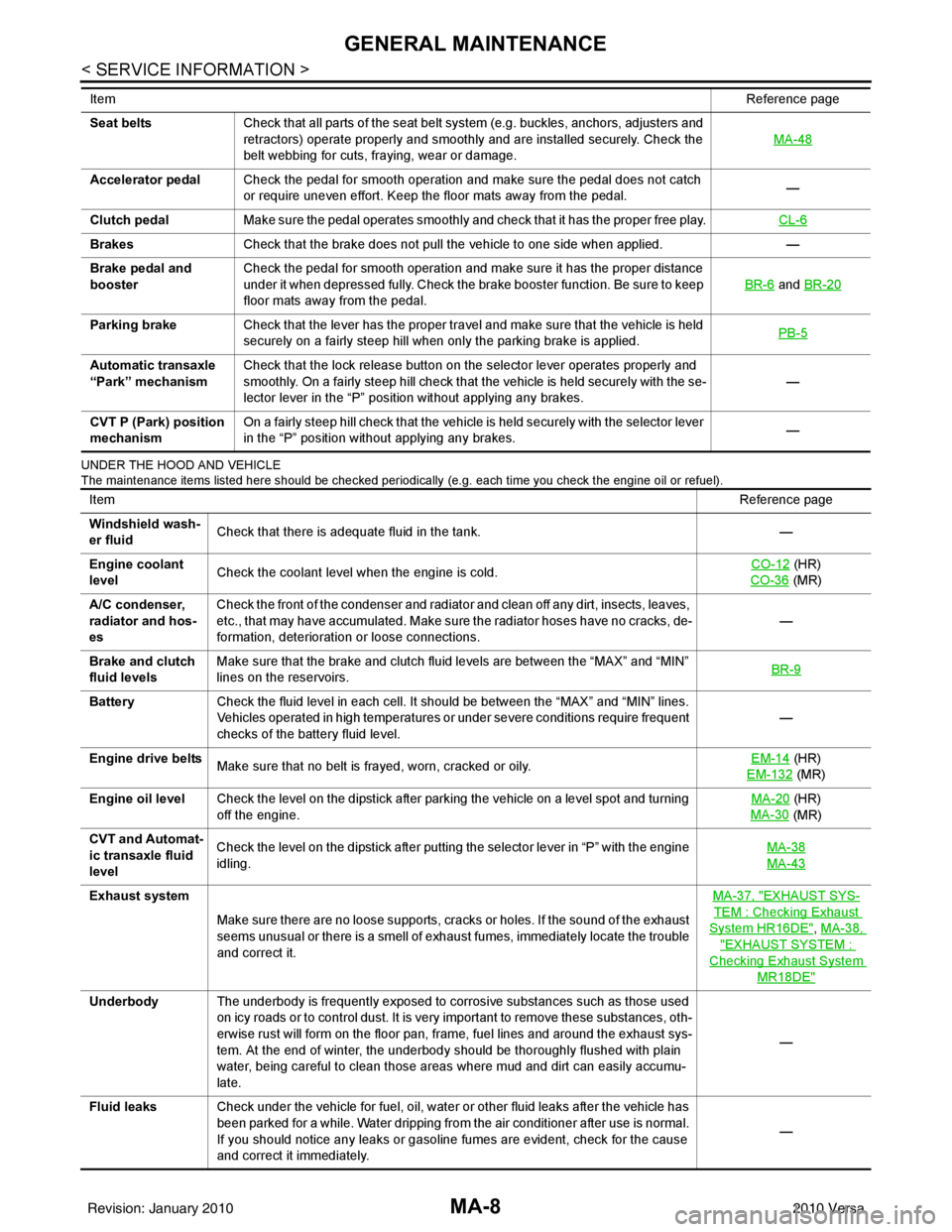
MA-8
< SERVICE INFORMATION >
GENERAL MAINTENANCE
UNDER THE HOOD AND VEHICLE
The maintenance items listed here should be checked periodically (e.g. each time you check the engine oil or refuel).
Seat beltsCheck that all parts of the seat belt system (e.g. buckles, anchors, adjusters and
retractors) operate properly and smoothly and are installed securely. Check the
belt webbing for cuts, fraying, wear or damage. MA-48
Accelerator pedal
Check the pedal for smooth operation and make sure the pedal does not catch
or require uneven effort. Keep the floor mats away from the pedal. —
Clutch pedal Make sure the pedal operates smoothly and check that it has the proper free play. CL-6
BrakesCheck that the brake does not pull the vehicle to one side when applied. —
Brake pedal and
booster Check the pedal for smooth operation and make sure it has the proper distance
under it when depressed fully. Check the brake booster function. Be sure to keep
floor mats away from the pedal. BR-6
and
BR-20
Parking brake Check that the lever has the proper travel and make sure that the vehicle is held
securely on a fairly steep hill when only the parking brake is applied. PB-5
Automatic transaxle
“Park” mechanismCheck that the lock release button on the selector lever operates properly and
smoothly. On a fairly steep hill check that the vehicle is held securely with the se-
lector lever in the “P” position without applying any brakes. —
CVT P (Park) position
mechanism On a fairly steep hill check that the vehicle is held securely with the selector lever
in the “P” position without applying any brakes.
—
Item
Reference page
ItemReference page
Windshield wash-
er fluid Check that there is adequate fluid in the tank.
—
Engine coolant
level Check the coolant level when the engine is cold. CO-12
(HR)
CO-36
(MR)
A/C condenser,
radiator and hos-
es Check the front of the condenser and radiator and clean off any dirt, insects, leaves,
etc., that may have accumulated. Make sure the radiator hoses have no cracks, de-
formation, deterioration or loose connections.
—
Brake and clutch
fluid levels Make sure that the brake and clutch fluid levels are between the “MAX” and “MIN”
lines on the reservoirs.
BR-9
Battery
Check the fluid level in each cell. It should be between the “MAX” and “MIN” lines.
Vehicles operated in high temperatures or under severe conditions require frequent
checks of the battery fluid level. —
Engine drive belts Make sure that no belt is frayed, worn, cracked or oily. EM-14
(HR)
EM-132
(MR)
Engine oil level Check the level on the dipstick after parking the vehicle on a level spot and turning
off the engine. MA-20
(HR)
MA-30
(MR)
CVT and Automat-
ic transaxle fluid
level Check the level on the dipstick after putting the selector lever in “P” with the engine
idling.
MA-38
MA-43
Exhaust system
Make sure there are no loose supports, cracks or holes. If the sound of the exhaust
seems unusual or there is a smell of exhaust fumes, immediately locate the trouble
and correct it. MA-37, "EXHAUST SYS-
TEM : Checking Exhaust
System HR16DE", MA-38,
"EXHAUST SYSTEM :
Checking Exhaust System
MR18DE"
Underbody
The underbody is frequently exposed to corrosive substances such as those used
on icy roads or to control dust. It is very important to remove these substances, oth-
erwise rust will form on the floor pan, frame, fuel lines and around the exhaust sys-
tem. At the end of winter, the underbody should be thoroughly flushed with plain
water, being careful to clean those areas where mud and dirt can easily accumu-
late. —
Fluid leaks Check under the vehicle for fuel, oil, water or other fluid leaks after the vehicle has
been parked for a while. Water dripping from the air conditioner after use is normal.
If you should notice any leaks or gasoline fumes are evident, check for the cause
and correct it immediately. —
Revision: January 20102010 Versa
Page 3426 of 3745
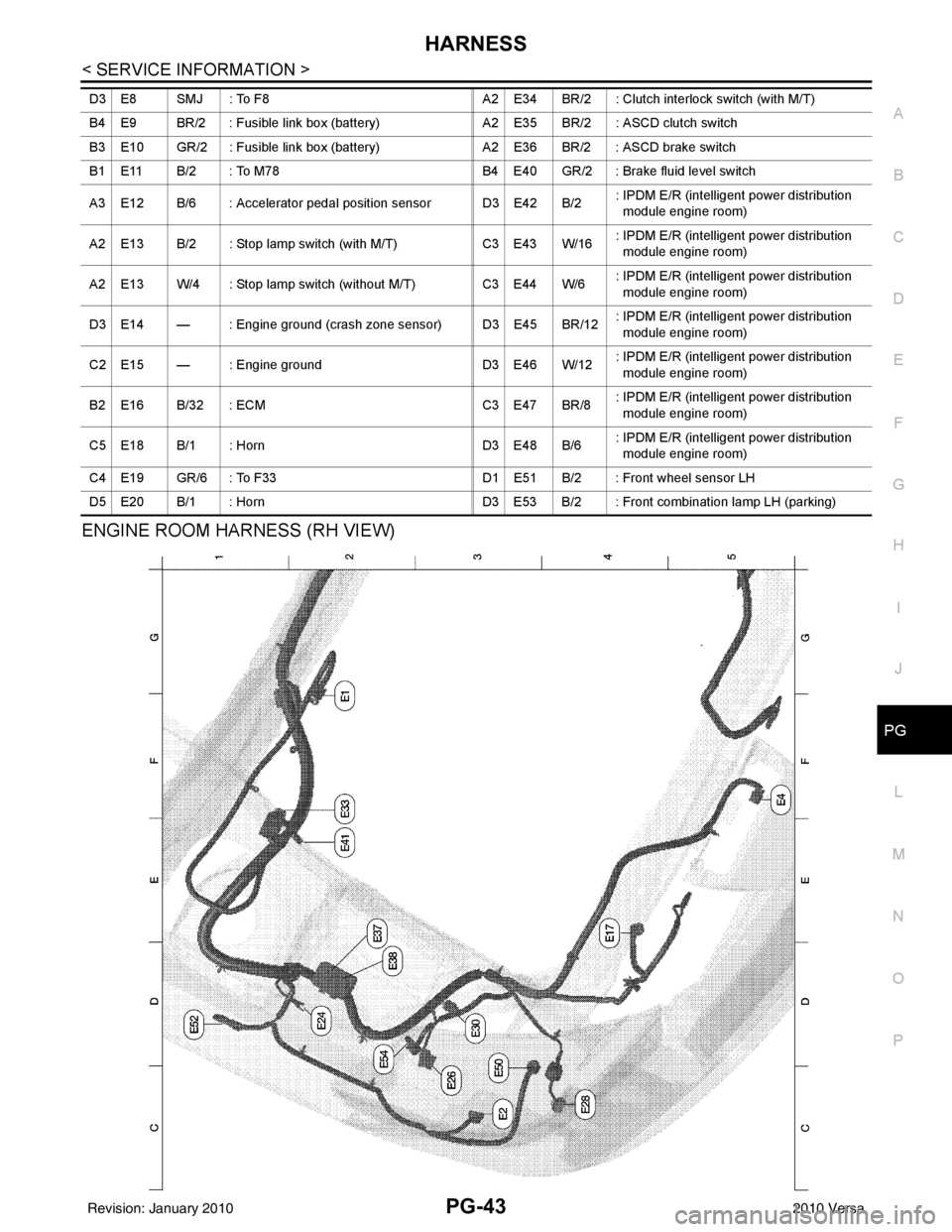
HARNESSPG-43
< SERVICE INFORMATION >
C
DE
F
G H
I
J
L
M A
B
PG
N
O P
ENGINE ROOM HARNESS (RH VIEW)
D3 E8 SMJ : To F8 A2 E34 BR/2 : Clutch interlock switch (with M/T)
B4 E9 BR/2 : Fusible link box (battery) A2 E35 BR/2 : ASCD clutch switch
B3 E10 GR/2 : Fusible link box (battery) A2 E36 BR/2 : ASCD brake switch
B1 E11 B/2 : To M78 B4 E40 GR/2 : Brake fluid level switch
A3 E12 B/6 : Accelerator pedal position sensor D3 E42 B/2 : IPDM E/R (intelligent power distribution
module engine room)
A2 E13 B/2 : Stop lamp switch (with M/T) C3 E43 W/16: IPDM E/R (intelligent power distribution
module engine room)
A2 E13 W/4 : Stop lamp switch (without M/T) C3 E44 W/6: IPDM E/R (intelligent power distribution
module engine room)
D3 E14 — : Engine ground (crash zone sensor) D3 E45 BR/12 : IPDM E/R (intelligent power distribution
module engine room)
C2 E15 — : Engine ground D3 E46 W/12: IPDM E/R (intelligent power distribution
module engine room)
B2 E16 B/32 : ECM C3 E47 BR/8: IPDM E/R (intelligent power distribution
module engine room)
C5 E18 B/1 : Horn D3 E48 B/6: IPDM E/R (intelligent power distribution
module engine room)
C4 E19 GR/6 : To F33 D1 E51 B/2 : Front wheel sensor LH
D5 E20 B/1 : Horn D3 E53 B/2 : Front combination lamp LH (parking)
Revision: January 20102010 Versa
Page 3442 of 3745

HARNESSPG-59
< SERVICE INFORMATION >
C
DE
F
G H
I
J
L
M A
B
PG
N
O P
Wiring Diagram Codes (Cell Codes)INFOID:0000000005395367
Use the chart below to find out what each wiring diagram code stands for.
Refer to the wiring diagram code in the alphabetical index to find the location (page number) of each wiring
diagram.
D4 D405 W/4 : Back door lock assembly C2 D413 B/1 : Rear window defogger (-)
D4 D406 W/2 : Back door request switch F3 D414 — : Body ground
E2 D407 W/2 : High mounted stop lamp
Code Section Wiring Diagram Name
ABS BRC Anti-lock Brake System
A/C,M MTC Manual Air Conditioner
APPS1 EC Accelerator Pedal Position Sensor
A/F EC Air Fuel Ratio Sensor 1
A/FH EC Air Fuel Ratio Sensor 1 Heater
APPS2 EC Accelerator Pedal Position Sensor
APPS3 EC Accelerator Pedal Position Sensor
ASC/BS EC ASCD Brake Switch
ASC/SW EC ASCD Steering Switch
ASCBOF EC ASCD Brake Switch
ASCIND EC ASCD Indicator
AT/IND DI A/T Indicator Lamp
AUDIO AV Audio
BACK/L LT Back-up Lamp
BA/FTS AT A/T Fluid Temperature Sensor and TCM Power Supply
B/DOOR BL Back Door Opener
BRK/SW EC Brake Switch
CAN AT CAN Communication Line
CAN CVT CAN Communication Line
CAN EC CAN Communication Line
CAN LAN CAN System
CHARGE SC Charging System
CHIME DI Warning Chime
COOL/F EC Cooling Fan Control
COMBSW LT Combination Switch
COMM AV Audio Visual Communication System
CVTIND DI CVT Indicator Lamp
D/LOCK BL Power Door Lock
DEF GW Rear Window Defogger
DTRL LT Headlamp - Wi th Daytime Light System
ECTS EC Engine Coolant Temperature Sensor
ENGSS AT Engine Speed Signal
EPS STC Electronic Controlled Power Steering
ETC1 EC Electric Throttle Control Function
ETC2 EC Throttle Control Motor Relay
ETC3 EC Throttle Control Motor
F/FOG LT Front Fog Lamp
F/PUMP EC Fuel Pump
FTS AT A/T Fluid Temperature Sensor
FTS CVT CVT Fluid Temperature Sensor Circuit
FTTS EC Fuel Tank Temperature Sensor
FUEL EC Fuel Ignition System Function
Revision: January 20102010 Versa