engine NISSAN TIIDA 2010 Service Service Manual
[x] Cancel search | Manufacturer: NISSAN, Model Year: 2010, Model line: TIIDA, Model: NISSAN TIIDA 2010Pages: 3745, PDF Size: 73.67 MB
Page 54 of 3745

A/T CONTROL SYSTEMAT-37
< SERVICE INFORMATION >
DE
F
G H
I
J
K L
M A
B
AT
N
O P
Control ValveINFOID:0000000005397228
FUNCTION OF CONTROL VALVES
Centrifugal Cancel MechanismINFOID:0000000005397229
FUNCTION
The centrifugal cancel mechanism is a mechanism to c ancel the centrifugal hydraulic pressure instead of the
conventional check balls. It cancels the centrifugal hy draulic pressure which is generated as high clutch drum
rotates, and it allows for preventing high clutch from dragging and for providing stable high clutch piston press-
ing force in all revolution speeds.
STRUCTURE/OPERATION
Valve name Function
Pressure regulator valve, plug and sleeve
plug Regulates oil discharged from the oil pump to provide optimum line pressure for all driving
conditions.
Pressure modifier valve and sleeve Used as a signal supplementary valve to the pressure regulator valve. Regulates pres- sure-modifier pressure (signal pressure) which controls optimum line pressure for all driv-
ing conditions.
Pilot valve Regulates line pressure to maintain a constant pilot pressure level which controls lock-up
mechanism, overrun clutch, shift timing.
Accumulator control valve Regulates accumulator back-pressure to pressure suited to driving conditions.
Manual valve Directs line pressure to oil circuits corresponding to select positions.
Hydraulic pressure drains when the shift lever is in Neutral.
Shift valve A Simultaneously switches three oil circuits using output pressure of shift solenoid valve A
to meet driving conditions (vehicle speed, throttle opening, etc.).
Provides automatic downshifting and upshifting (1GR → 2GR → 3GR → 4GR/4GR →
3GR → 2GR → 1GR) in combination with shift valve B.
Shift valve B Simultaneously switches two oil circuits using output pressure of shift solenoid valve B in
relation to driving conditions (vehicle speed, throttle opening, etc.).
Provides automatic downshifting and upshifting (1GR → 2GR → 3GR → 4GR/4GR →
3GR → 2GR → 1GR) in combination with shift valve A.
Overrun clutch control valve Switches hydraulic circuits to prevent engagement of the overrun clutch simultaneously
with application of the brake band in D
4. (Interlocking occurs if the overrun clutch engages
during D
4.)
1st reducing valve Reduces low & reverse brake pressure to dampen engine-brake shock when downshift-
ing from the 1st position 1
2 to 11.
Overrun clutch reducing valve Reduces oil pressure directed to the overrun clutch and prevents engine-brake shock.
In the 1st and 2nd positions, line pressure acts on the overrun clutch reducing valve to
increase the pressure-regulating point, with resultant engine brake capability.
Torque converter relief valve Prevents an excessive rise in torque converter pressure.
Torque converter clutch control valve, plug
and sleeve Activates or inactivates the lock-up function.
Also provides smooth lock-up through transient application and release of the lock-up
system.
1-2 accumulator valve and piston Lessens the shock find when the 2GR band servo contracts, and provides smooth shift-
ing.
3-2 timing valve Switches the pace that oil pressure is released depending on vehicle speed; maximizes
the high clutch release timing, and allows for soft downshifting.
Shuttle valve Determines if the overrun clutch solenoid valve should control the 3-2 timing valve or the
overrun clutch control valve and switches between the two.
Cooler check valve At low speeds and with a small load when a little heat is generated, saves the volume of
cooler flow, and stores the oil pressure for lock-up.
Revision: January 20102010 Versa
Page 56 of 3745
ON BOARD DIAGNOSTIC (OBD) SYSTEMAT-39
< SERVICE INFORMATION >
DE
F
G H
I
J
K L
M A
B
AT
N
O P
ON BOARD DIAGNOSTIC (OBD) SYSTEM
IntroductionINFOID:0000000005397230
A/T system has two self-diagnostic systems.
The first is emission-related on board diagnostic system (OBD-II) performed by the TCM in combination with
the ECM. The malfunction is indicated by the MIL (malf unction indicator lamp) and is stored as a DTC in the
ECM memory but not the TCM memory.
The second is the TCM original self-diagnosis indicated by the OD OFF indicator lamp. The malfunction is
stored in the TCM memory. The detected items are ov erlapped with OBD-II self-diagnostic items. For detail,
refer to AT-77, "
CONSULT-III Function (TRANSMISSION)" .
OBD-II Function for A/T SystemINFOID:0000000005397231
The ECM provides emission-related on board diagnostic (O BD-II) functions for the A/T system. One function
is to receive a signal from the TCM used with OBD-rela ted parts of the A/T system. The signal is sent to the
ECM when a malfunction occurs in the corresponding OBD-re lated part. The other function is to indicate a
diagnostic result by means of the MIL (malfunction indica tor lamp) on the instrument panel. Sensors, switches
and solenoid valves are used as sensing elements.
The MIL automatically illuminates in One or Two Trip Detection Logic when a malfunction is sensed in relation
to A/T system parts.
One or Two Trip Detection Logic of OBD-IIINFOID:0000000005397232
ONE TRIP DETECTION LOGIC
If a malfunction is sensed during the first test drive, the MIL will illuminate and the malfunction will be stored in
the ECM memory as a DTC. The TCM is not provided with such a memory function.
TWO TRIP DETECTION LOGIC
When a malfunction is sensed during the first test drive, it is stored in the ECM memory as a 1st trip DTC
(diagnostic trouble code) or 1st trip freeze frame data. At this point, the MIL will not illuminate. — 1st trip
If the same malfunction as that experienced during the fi rst test drive is sensed during the second test drive,
the MIL will illuminate. — 2nd trip
The “trip” in the “One or Two Trip Detection Logic” m eans a driving mode in which self-diagnosis is performed
during vehicle operation.
OBD-II Diagnostic Trouble Code (DTC)INFOID:0000000005397233
HOW TO READ DTC AND 1ST TRIP DTC
DTC and 1st trip DTC can be read by the following methods.
( with CONSULT-III or GST) CONSULT-III or GST (Generic Scan Tool) Examples: P0705, P0720 etc.
These DTC are prescribed by SAE J2012.
(CONSULT-III also displays the malfunctioning component or system.)
• 1st trip DTC No. is the same as DTC No.
• Output of the diagnostic trouble code indicates that the indicated circuit has a malfunction. How-
ever, in case of the Mode II and GST, they do not indicate whether the malfunction is still occurring or
occurred in the past and returned to normal.
CONSULT-III can identify them as shown below, therefore, CONS ULT-III (if available) is recom-
mended.
DTC or 1st trip DTC of a malfunction is displayed in SELF-DIAGNOSTIC RESULTS mode for “ENGINE” with
CONSULT-III. Time data indicates how many times the vehicle was driven after the last detection of a DTC.
If the DTC is being detected curr ently, the time data will be “0”.
If a 1st trip DTC is stored in the ECM, the time data will be “1t”.
Freeze Frame Data and 1st Trip Freeze Frame Data
The ECM has a memory function, which stores the driv ing condition such as fuel system status, calculated
load value, engine coolant temperature, short term f uel trim, long term fuel trim, engine speed and vehicle
speed at the moment the ECM detects a malfunction.
Revision: January 20102010 Versa
Page 57 of 3745

AT-40
< SERVICE INFORMATION >
ON BOARD DIAGNOSTIC (OBD) SYSTEM
Data which are stored in the ECM memory, along with the 1st trip DTC, are called 1st trip freeze frame data,
and the data, stored together with the DTC data, are called freeze frame data and displayed on CONSULT-III
or GST. The 1st trip freeze frame data can only be disp layed on the CONSULT-III screen, not on the GST. For
detail, refer to EC-98, "
CONSULT-III Function" (HR16DE), EC-612, "CONSULT-III Function (ENGINE)"
(MR18DE).
Only one set of freeze frame data (either 1st trip freeze frame data of freeze frame data) can be stored in the
ECM. 1st trip freeze frame data is stored in the ECM memory along with the 1st trip DTC. There is no priority
for 1st trip freeze frame data and it is updated each time a different 1st trip DTC is detected. However, once
freeze frame data (2nd trip detection/MIL on) is stored in the ECM memory, 1st trip freeze frame data is no
longer stored. Remember, only one set of freeze frame data can be stored in the ECM. The ECM has the fol-
lowing priorities to update the data.
Both 1st trip freeze frame data and freeze frame dat a (along with the DTC) are cleared when the ECM mem-
ory is erased.
HOW TO ERASE DTC
The diagnostic trouble code can be erased by CONSULT- III, GST or ECM DIAGNOSTIC TEST MODE as
described following.
• If the battery cable is disconnected, the diagnosti c trouble code will be cleared within 24 hours.
• When you erase the DTC, using CONSULT-III or GS T is easier and quicker than switching the mode
selector on the ECM.
The following emission-related diagnostic information is cleared from the ECM memory when erasing DTC
related to OBD-II. For details, refer to EC-84, "
Diagnosis Description" (HR16DE), EC-542, "Emission-related
Diagnostic Information" (MR18DE).
• Diagnostic trouble codes (DTC)
• 1st trip diagnostic trou ble codes (1st trip DTC)
• Freeze frame data
• 1st trip freeze frame data
• System readiness test (SRT) codes
• Test values
HOW TO ERASE DTC (WITH CONSULT-III)
•If a DTC is displayed for both ECM and TCM, it is necessary to be erased for both ECM and TCM.
1. If the ignition switch stays ON after repair work, be sure to turn ignition switch OFF once. Wait at least 10 seconds and then turn it ON (engine stopped) again.
2. Turn CONSULT-III “ON” and touch “TRANSMISSION”.
3. Touch “SELF-DIAG RESULTS”.
4. Touch “ERASE”. (The DTC in the TCM will be erased.) Then touch “BACK” twice.
5. Touch “ENGINE”.
6. Touch “SELF-DIAG RESULTS”.
7. Touch “ERASE”. (The DTC in the ECM will be erased.)
HOW TO ERASE DTC (WITH GST)
1. If the ignition switch stays ON after repair work, be sure to turn ignition switch OFF once. Wait at least 10 seconds and then turn it ON (engine stopped) again.
2. Perform “TCM SELF-DIAGNOSTIC PROCEDURE (No Tools)”. Refer to AT-82, "
Diagnosis Procedure
without CONSULT-III". (The engine warm-up step can be skipped when performing the diagnosis only\
to
erase the DTC.)
3. Select Mode 4 with Generic Scan Tool (GST). For details, refer to EC-104, "
DiagnosisToolFunction"
(HR16DE), EC-618, "Generic Scan Tool (GST) Function" (MR18DE).
HOW TO ERASE DTC (NO TOOLS)
Priority Items
1 Freeze frame data Misfire — DTC: P0300 - P0306
Fuel Injection System Function — DTC: P0171, P0172, P0174, P0175
2 Except the above items (Includes A/T related items)
3 1st trip freeze frame data
Revision: January 20102010 Versa
Page 58 of 3745
ON BOARD DIAGNOSTIC (OBD) SYSTEMAT-41
< SERVICE INFORMATION >
DE
F
G H
I
J
K L
M A
B
AT
N
O P
The OD OFF indicator lamp is located on the combination meter.
1. If the ignition switch stays ON after repair work, be su re to turn ignition switch OFF once. Wait at least 10
seconds and then turn it ON (engine stopped) again.
2. Perform “TCM SELF-DIAGNOSTIC PR OCEDURE (No Tools)”. Refer to AT-82, "
Diagnosis Procedure
without CONSULT-III". (The engine warm-up step can be skipped when performing the diagnosis only to
erase the DTC.)
3. Perform “OBD-II SELF-DIAGNOSTIC PROCEDURE (No tools)”. Refer to EC-84, "
Diagnosis Description"
(HR16DE), EC-542, "Emission-related Diagnostic Information" (MR18DE).
Malfunction Indicator Lamp (MIL)INFOID:0000000005397234
DESCRIPTION
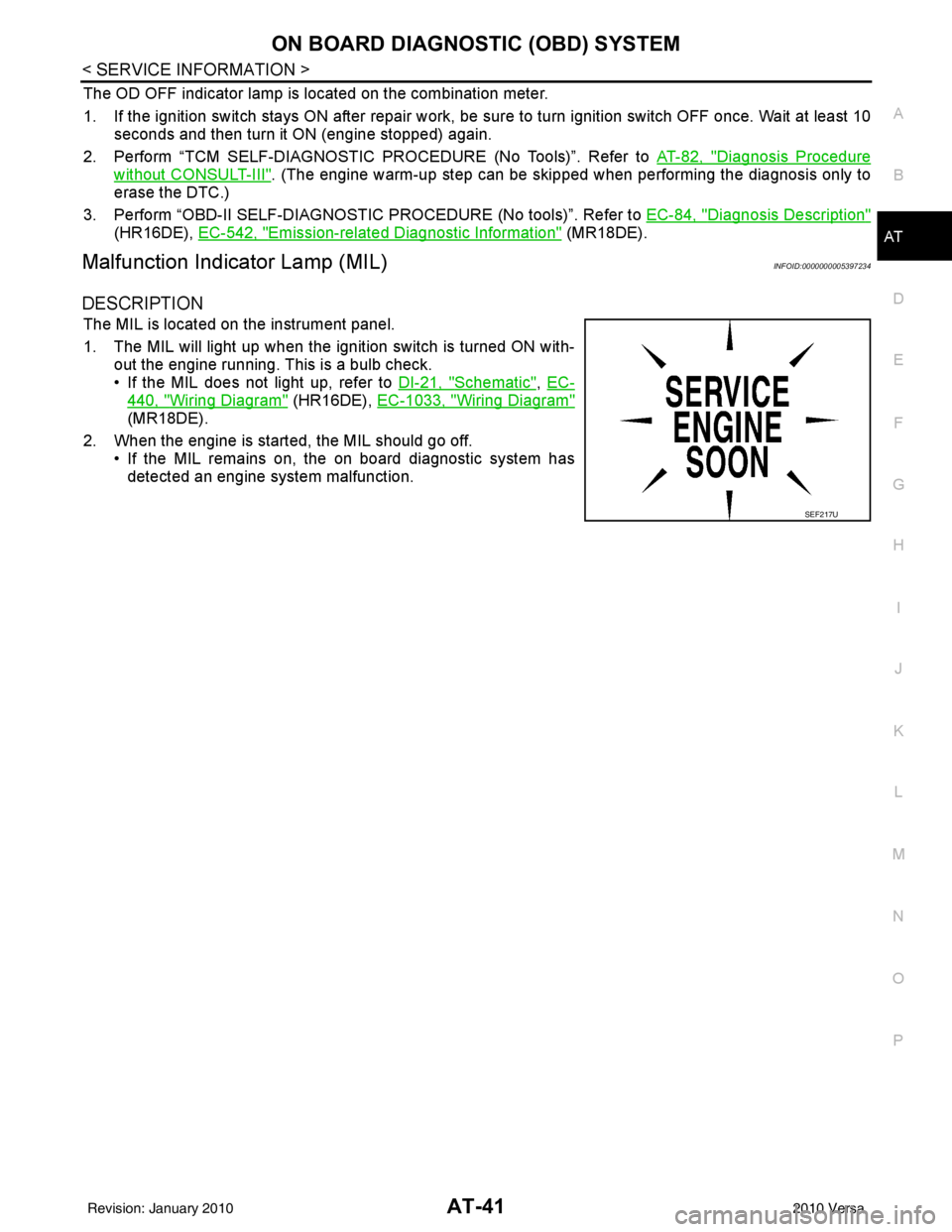
The MIL is located on the instrument panel.
1. The MIL will light up when the ignition switch is turned ON with-
out the engine running. This is a bulb check.
• If the MIL does not light up, refer to DI-21, "
Schematic", EC-
440, "Wiring Diagram" (HR16DE), EC-1033, "Wiring Diagram"
(MR18DE).
2. When the engine is start ed, the MIL should go off.
• If the MIL remains on, the on board diagnostic system has detected an engine system malfunction.
SEF217U
Revision: January 20102010 Versa
Page 60 of 3745
TROUBLE DIAGNOSISAT-43
< SERVICE INFORMATION >
DE
F
G H
I
J
K L
M A
B
AT
N
O P
z : Solenoid ON
× : Solenoid OFF
–: Non-standard condition
Line Pressure Solenoid Valve
If non-standard solenoid signal is sent to TCM, line pre ssure solenoid valve is turned OFF to achieve maxi-
mum oil pressure.
Torque Converter Clutch Solenoid Valve
If non-standard solenoid signal is sent to TCM, torque conv erter clutch solenoid valve is turned OFF to release
lock-up.
Overrun Clutch Solenoid Valve
If non-standard solenoid signal is sent to TCM, overr un clutch solenoid valve is turned OFF to engage overrun
clutch. This will result in more effective engine brake during deceleration.
How to Perform Trouble Diagnosis for Quick and Accurate RepairINFOID:0000000005397237
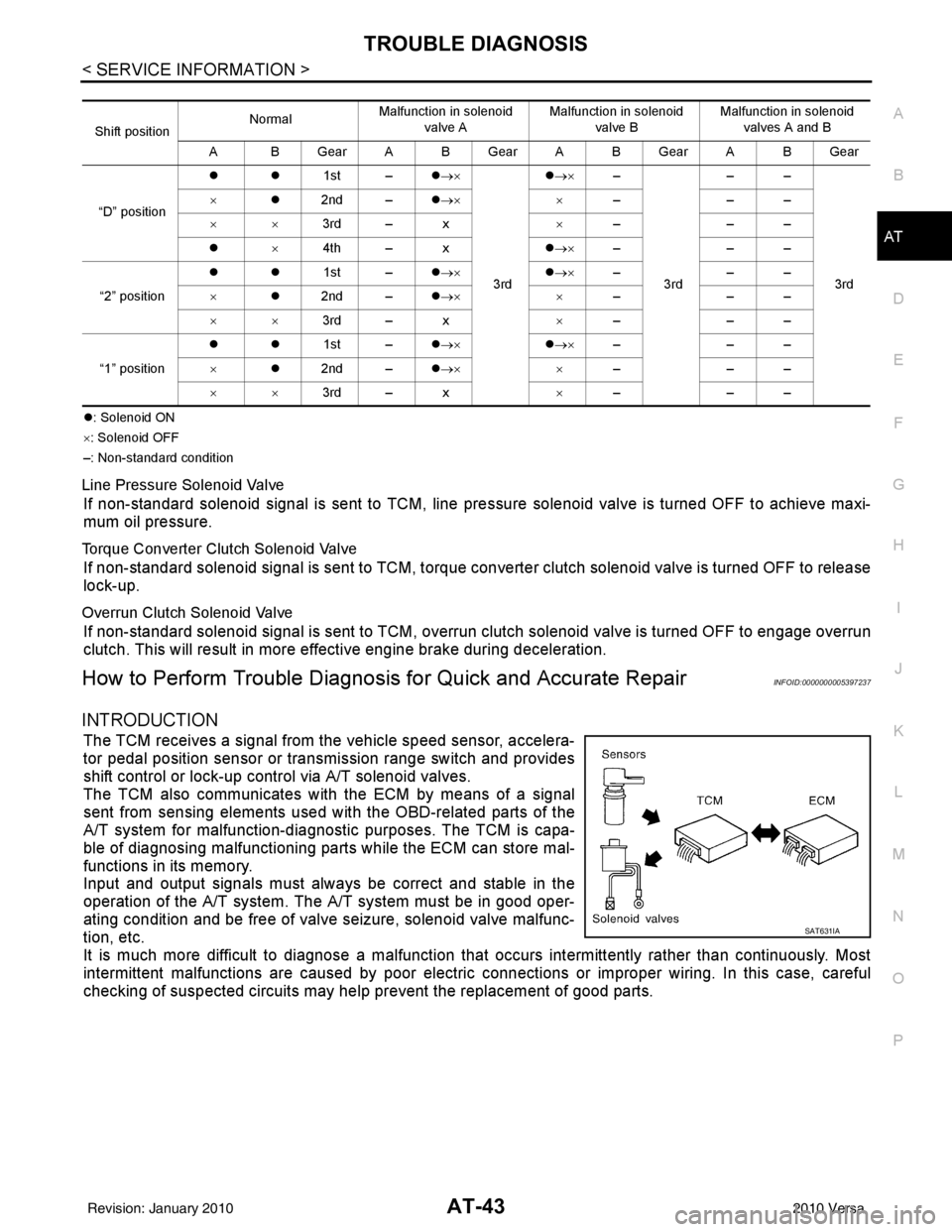
INTRODUCTION
The TCM receives a signal from the vehicle speed sensor, accelera-
tor pedal position sensor or transmission range switch and provides
shift control or lock-up control via A/T solenoid valves.
The TCM also communicates with the ECM by means of a signal
sent from sensing elements used wit h the OBD-related parts of the
A/T system for malfunction-diagnostic purposes. The TCM is capa-
ble of diagnosing malfunctioning parts while the ECM can store mal-
functions in its memory.
Input and output signals must always be correct and stable in the
operation of the A/T system. T he A/T system must be in good oper-
ating condition and be free of valve seizure, solenoid valve malfunc-
tion, etc.
It is much more difficult to diagnose a malfunction that occurs intermittently rather than continuously. Most
intermittent malfunctions are caused by poor electric c onnections or improper wiring. In this case, careful
checking of suspected circuits may hel p prevent the replacement of good parts.
Shift positionNormal
Malfunction in solenoid
valve A Malfunction in solenoid
valve B Malfunction in solenoid
valves A and B
A BGearABGearABGearABGear
“D” position zz
1st –z→×
3rd z
→× –
3rd ––
3rd
×
z2nd – z→× ×–––
×× 3rd – x ×–––
z ×4th – x z→× –––
“2” position zz
1st –z→× z→× –––
× z2nd – z→× ×–––
×× 3rd – x ×–––
“1” position zz
1st –z→× z→× –––
× z2nd – z→× ×–––
×× 3rd – x ×–––
SAT631IA
Revision: January 20102010 Versa
Page 61 of 3745
AT-44
< SERVICE INFORMATION >
TROUBLE DIAGNOSIS
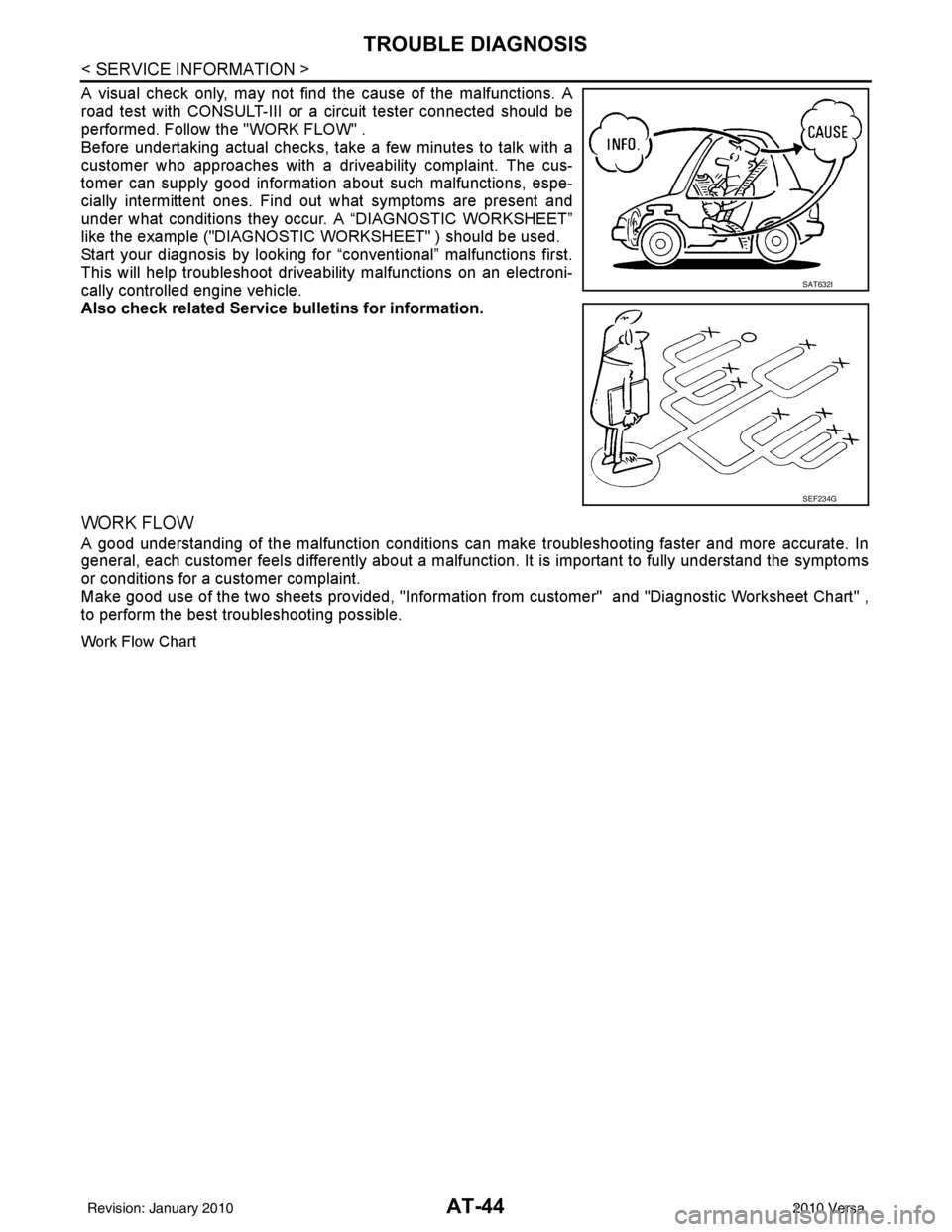
A visual check only, may not find the cause of the malfunctions. A
road test with CONSULT-III or a circuit tester connected should be
performed. Follow the "WORK FLOW" .
Before undertaking actual checks, take a few minutes to talk with a
customer who approaches with a driveability complaint. The cus-
tomer can supply good information about such malfunctions, espe-
cially intermittent ones. Find out what symptoms are present and
under what conditions they occu r. A “DIAGNOSTIC WORKSHEET”
like the example ("DIAGNOSTIC WORKSHEET" ) should be used.
Start your diagnosis by looking for “conventional” malfunctions first.
This will help troubleshoot driveability malfunctions on an electroni-
cally controlled engine vehicle.
Also check related Service bulletins for information.
WORK FLOW
A good understanding of the malfunction conditions can make troubleshooting faster and more accurate. In
general, each customer feels differently about a malfuncti on. It is important to fully understand the symptoms
or conditions for a customer complaint.
Make good use of the two sheets provided, "Information from customer" and "Diagnostic Worksheet Chart" ,
to perform the best troubleshooting possible.
Work Flow Chart
SAT632I
SEF234G
Revision: January 20102010 Versa
Page 63 of 3745

AT-46
< SERVICE INFORMATION >
TROUBLE DIAGNOSIS
Diagnostic Worksheet Chart
Customer name MR./MS Model & YearVIN
Trans. model EngineMileage
Incident Date Manuf. DateIn Service Date
Frequency † Continuous † Intermittent ( times a day)
Symptoms † Vehicle does not move. ( † Any position † Particular position)
† No up-shift ( † 1st → 2nd † 2nd → 3rd † 3rd → 4th)
† No down-shift ( † 4th → 3rd † 3rd → 2nd† 2nd → 1st)
† Lock-up malfunction
† Shift point too high or too low.
† Shift shock or slip ( † N → D † Lock-up † Any drive position)
† Noise or vibration
† No kick down
† No pattern select
† Others
()
Malfunction indicator lamp (MIL) † Continuously lit † Not lit
1. † Read the Fail-safe and listen to customer complaints. AT- 4 2,
"Information
from
customer"
2. † Check A/T fluid AT- 1 7
† Leakage (Follow specified procedure)
† Fluid condition
† Fluid level
3. † Perform “STALL TEST” and “LINE PRESSURE TEST”. AT- 5 1
†“STALL TEST”— Mark possible damaged components/others.
† Torque converter one-way clutch
† Reverse clutch
† Forward clutch
† Overrun clutch
† Forward one-way clutch †
Low & reverse brake
† Low one-way clutch
† Engine
† Line pressure is low
† Clutches and brakes except high clutch and
brake band are OK
† “LINE PRESSURE TEST”— Suspected parts:
Revision: January 20102010 Versa
Page 64 of 3745
TROUBLE DIAGNOSISAT-47
< SERVICE INFORMATION >
DE
F
G H
I
J
K L
M A
B
AT
N
O P
4. † Perform “Road Test”. AT- 5 5
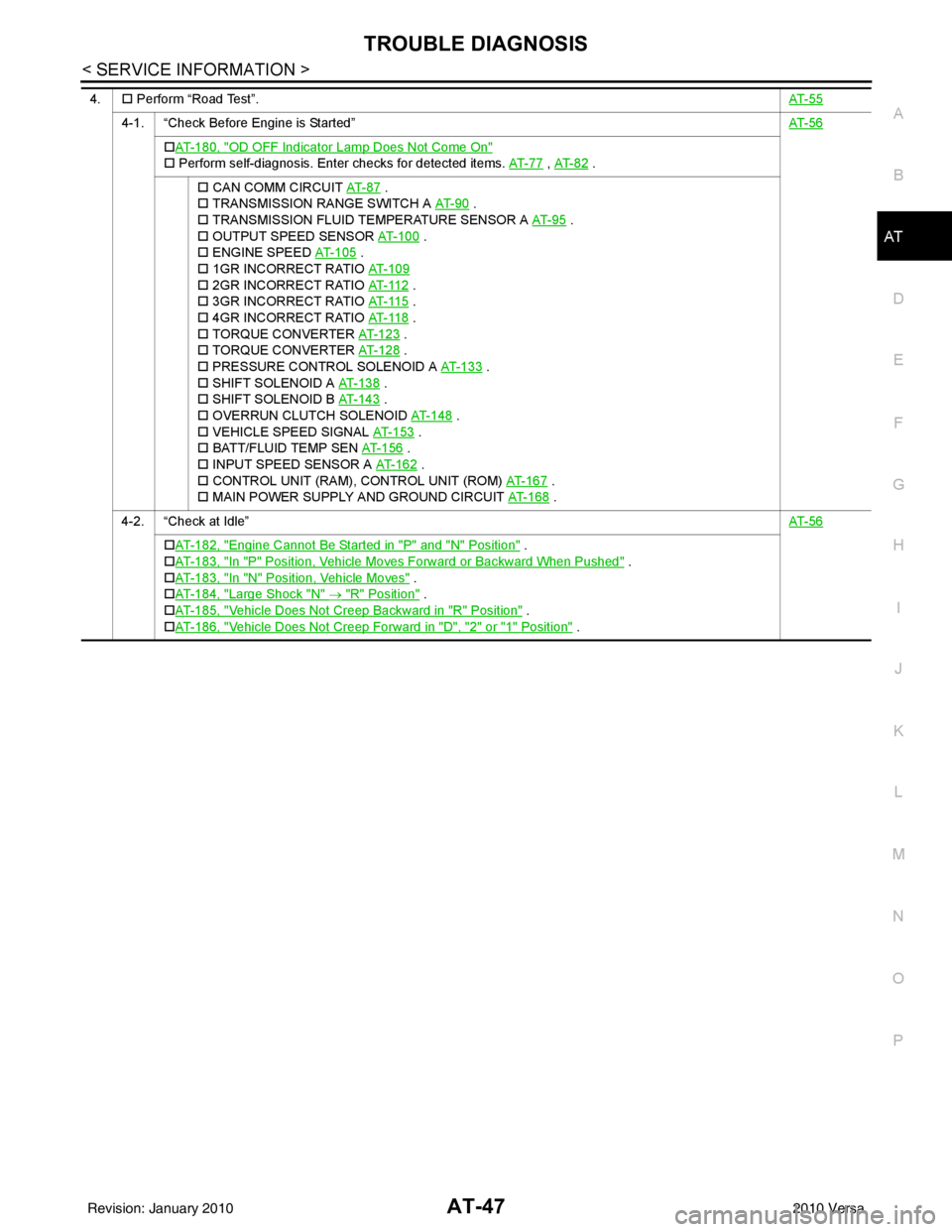
4-1. “Check Before Engine is Started” AT- 5 6
†AT- 1 8 0 , "OD OFF Indicator Lamp Does Not Come On"
† Perform self-diagnosis. Enter checks for detected items. AT- 7 7 , AT- 8 2 .
† CAN COMM CIRCUIT AT- 8 7
.
† TRANSMISSION RANGE SWITCH A AT- 9 0
.
† TRANSMISSION FLUID TEMPERATURE SENSOR A AT- 9 5
.
† OUTPUT SPEED SENSOR AT- 1 0 0
.
† ENGINE SPEED AT- 1 0 5
.
† 1GR INCORRECT RATIO AT- 1 0 9
† 2GR INCORRECT RATIO AT- 11 2 .
† 3GR INCORRECT RATIO AT- 11 5
.
† 4GR INCORRECT RATIO AT- 11 8
.
† TORQUE CONVERTER AT- 1 2 3
.
† TORQUE CONVERTER AT- 1 2 8
.
† PRESSURE CONTROL SOLENOID A AT- 1 3 3
.
† SHIFT SOLENOID A AT- 1 3 8
.
† SHIFT SOLENOID B AT- 1 4 3
.
† OVERRUN CLUTCH SOLENOID AT- 1 4 8
.
† VEHICLE SPEED SIGNAL AT- 1 5 3
.
† BATT/FLUID TEMP SEN AT- 1 5 6
.
† INPUT SPEED SENSOR A AT- 1 6 2
.
† CONTROL UNIT (RAM), CONTROL UNIT (ROM) AT- 1 6 7
.
† MAIN POWER SUPPLY AND GROUND CIRCUIT AT- 1 6 8
.
4-2. “Check at Idle” AT- 5 6
†AT- 1 8 2 , "Engine Cannot Be Started in "P" and "N" Position" .
† AT- 1 8 3 , "
In "P" Position, Vehicle Moves Forward or Backward When Pushed" .
† AT- 1 8 3 , "
In "N" Position, Vehicle Moves" .
† AT- 1 8 4 , "
Large Shock "N" → "R" Position" .
† AT- 1 8 5 , "
Vehicle Does Not Creep Backward in "R" Position" .
† AT- 1 8 6 , "
Vehicle Does Not Creep Forward in "D", "2" or "1" Position" .
Revision: January 20102010 Versa
Page 65 of 3745
AT-48
< SERVICE INFORMATION >
TROUBLE DIAGNOSIS
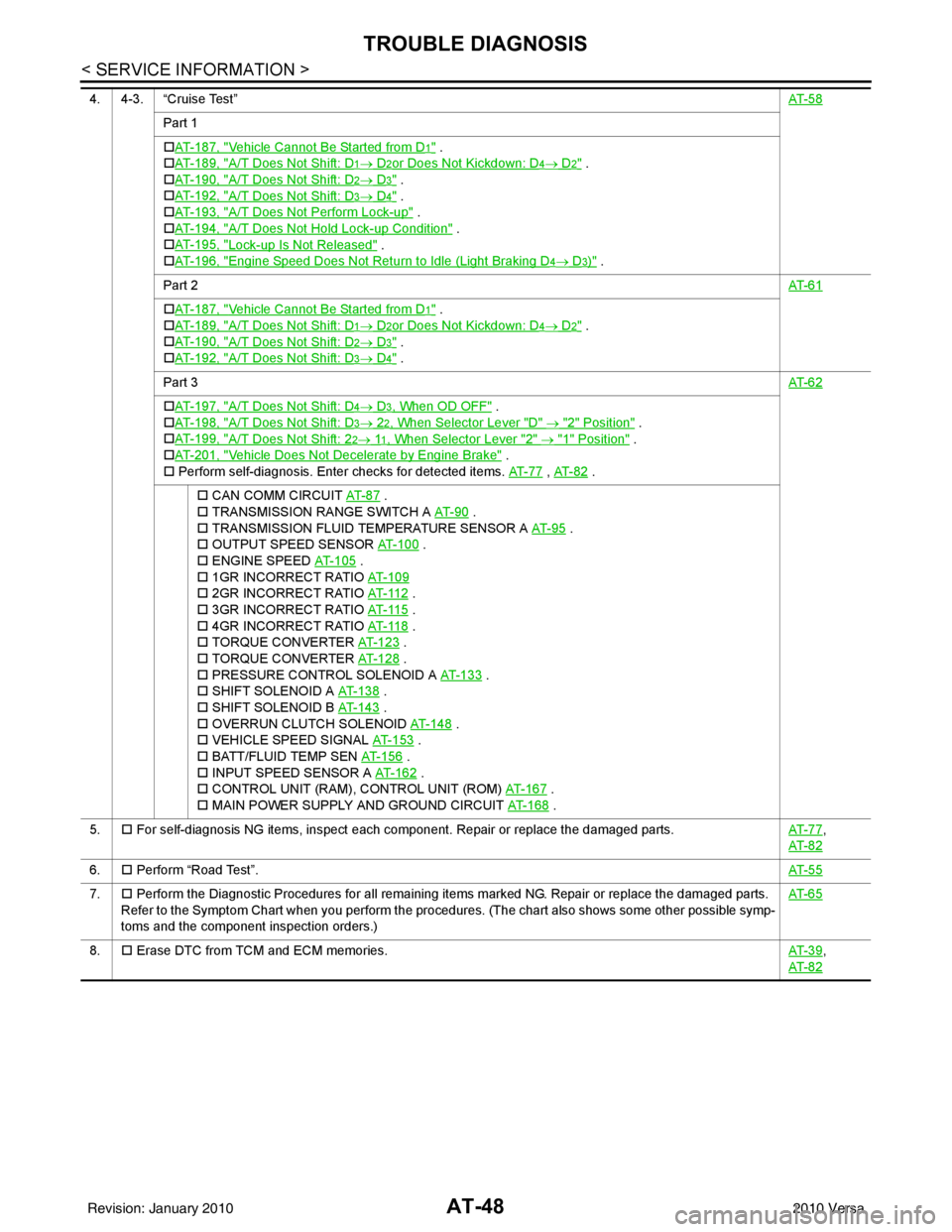
4. 4-3. “Cruise Test”AT- 5 8
Part 1
†AT- 1 8 7 , "
Vehicle Cannot Be Started from D1" .
† AT- 1 8 9 , "
A/T Does Not Shift: D1→ D2or Does Not Kickdown: D4→ D2" .
† AT- 1 9 0 , "
A/T Does Not Shift: D2→ D3" .
† AT- 1 9 2 , "
A/T Does Not Shift: D3→ D4" .
† AT- 1 9 3 , "
A/T Does Not Perform Lock-up" .
† AT- 1 9 4 , "
A/T Does Not Hold Lock-up Condition" .
† AT- 1 9 5 , "
Lock-up Is Not Released" .
† AT- 1 9 6 , "
Engine Speed Does Not Return to Idle (Light Braking D4→ D3)" .
Part 2 AT- 6 1
†AT- 1 8 7 , "Vehicle Cannot Be Started from D1" .
† AT- 1 8 9 , "
A/T Does Not Shift: D1→ D2or Does Not Kickdown: D4→ D2" .
† AT- 1 9 0 , "
A/T Does Not Shift: D2→ D3" .
† AT- 1 9 2 , "
A/T Does Not Shift: D3→ D4" .
Part 3 AT- 6 2
†AT- 1 9 7 , "A/T Does Not Shift: D4→ D3, When OD OFF" .
† AT- 1 9 8 , "
A/T Does Not Shift: D3→ 22, When Selector Lever "D" → "2" Position" .
† AT- 1 9 9 , "
A/T Does Not Shift: 22→ 11, When Selector Lever "2" → "1" Position" .
† AT- 2 0 1 , "
Vehicle Does Not Decelerate by Engine Brake" .
† Perform self-diagnosis. Enter checks for detected items. AT- 7 7
, AT- 8 2 .
† CAN COMM CIRCUIT AT- 8 7
.
† TRANSMISSION RANGE SWITCH A AT- 9 0
.
† TRANSMISSION FLUID TEMPERATURE SENSOR A AT- 9 5
.
† OUTPUT SPEED SENSOR AT- 1 0 0
.
† ENGINE SPEED AT- 1 0 5
.
† 1GR INCORRECT RATIO AT- 1 0 9
† 2GR INCORRECT RATIO AT- 11 2 .
† 3GR INCORRECT RATIO AT- 11 5
.
† 4GR INCORRECT RATIO AT- 11 8
.
† TORQUE CONVERTER AT-123
.
† TORQUE CONVERTER AT-128
.
† PRESSURE CONTROL SOLENOID A AT- 1 3 3
.
† SHIFT SOLENOID A AT- 1 3 8
.
† SHIFT SOLENOID B AT- 1 4 3
.
† OVERRUN CLUTCH SOLENOID AT- 1 4 8
.
† VEHICLE SPEED SIGNAL AT- 1 5 3
.
† BATT/FLUID TEMP SEN AT-156
.
† INPUT SPEED SENSOR A AT- 1 6 2
.
† CONTROL UNIT (RAM), CONTROL UNIT (ROM) AT-167
.
† MAIN POWER SUPPLY AND GROUND CIRCUIT AT- 1 6 8
.
5. † For self-diagnosis NG items, inspect each component. Repair or replace the damaged parts. AT- 7 7
,
AT- 8 2
6. † Perform “Road Test”. AT- 5 5
7.† Perform the Diagnostic Procedures for all remaining items marked NG. Repair or replace the damaged parts.
Refer to the Symptom Chart when you perform the procedures. (The chart also shows some other possible symp-
toms and the component inspection orders.) AT- 6 5
8.
† Erase DTC from TCM and ECM memories. AT- 3 9,
AT- 8 2
Revision: January 20102010 Versa
Page 68 of 3745
TROUBLE DIAGNOSISAT-51
< SERVICE INFORMATION >
DE
F
G H
I
J
K L
M A
B
AT
N
O P
Inspections Before Trouble DiagnosisINFOID:0000000005397240
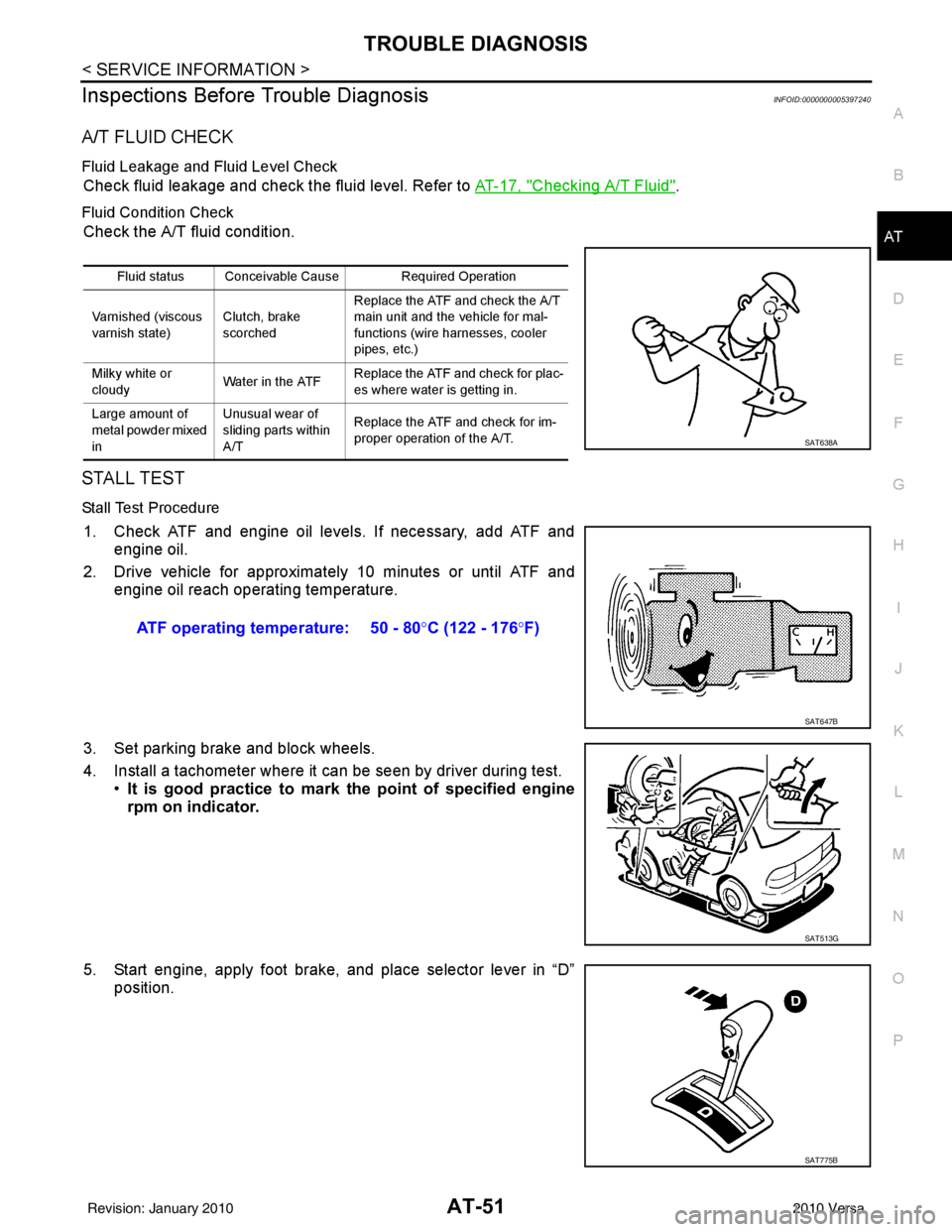
A/T FLUID CHECK
Fluid Leakage and Fluid Level Check
Check fluid leakage and check the fluid level. Refer to AT-17, "Checking A/T Fluid".
Fluid Condition Check
Check the A/T fluid condition.
STALL TEST
Stall Test Procedure
1. Check ATF and engine oil levels. If necessary, add ATF and engine oil.
2. Drive vehicle for approximately 10 minutes or until ATF and engine oil reach operating temperature.
3. Set parking brake and block wheels.
4. Install a tachometer where it can be seen by driver during test. •It is good practice to mark the point of specified engine
rpm on indicator.
5. Start engine, apply foot brake, and place selector lever in “D” position.
Fluid status Conceivable Cause Required Operation
Varnished (viscous
varnish state) Clutch, brake
scorchedReplace the ATF and check the A/T
main unit and the vehicle for mal-
functions (wire harnesses, cooler
pipes, etc.)
Milky white or
cloudy Water in the ATFReplace the ATF and check for plac-
es where water is getting in.
Large amount of
metal powder mixed
in Unusual wear of
sliding parts within
A/T
Replace the ATF and check for im-
proper operation of the A/T.
SAT638A
ATF operating temperature: 50 - 80
°C (122 - 176 °F)
SAT647B
SAT513G
SAT775B
Revision: January 20102010 Versa