engine NISSAN TIIDA 2010 Service Repair Manual
[x] Cancel search | Manufacturer: NISSAN, Model Year: 2010, Model line: TIIDA, Model: NISSAN TIIDA 2010Pages: 3745, PDF Size: 73.67 MB
Page 2279 of 3745
![NISSAN TIIDA 2010 Service Repair Manual EC-1014
< SERVICE INFORMATION >[MR18DE]
FUEL PUMP
FUEL PUMP
DescriptionINFOID:0000000005532910
SYSTEM DESCRIPTION
*: ECM determines the start signal status by the signals of engine speed and battery v](/img/5/57397/w960_57397-2278.png "NISSAN TIIDA 2010 Service Repair Manual EC-1014
< SERVICE INFORMATION >[MR18DE]
FUEL PUMP
FUEL PUMP
DescriptionINFOID:0000000005532910
SYSTEM DESCRIPTION
*: ECM determines the start signal status by the signals of engine speed and battery v")
EC-1014
< SERVICE INFORMATION >[MR18DE]
FUEL PUMP
FUEL PUMP
DescriptionINFOID:0000000005532910
SYSTEM DESCRIPTION
*: ECM determines the start signal status by the signals of engine speed and battery voltage.
The ECM activates the fuel pump for several seconds after the ignition switch is turned ON to improve engine
start ability. If the ECM receives a engine speed signal
from the crankshaft position sensor (POS) and cam-
shaft position sensor (PHASE), it knows that the engine is rotating, and causes the pump to operate. If the
engine speed signal is not received when the ignition switch is ON, the engine stalls. The ECM stops pump
operation and prevents battery discharging, thereby improving safety. The ECM does not directly drive the fuel
pump. It controls the ON/OFF fuel pump relay, which in turn controls the fuel pump.
COMPONENT DESCRIPTION
A turbine type design fuel pump is used in the fuel tank.
• Fuel level sensor unit and fuel pump (1)
• Fuel pressure regulator (2)
• Fuel level sensor (3)
• Fuel tank temperature sensor (4)
CONSULT-III Reference Value in Data Monitor ModeINFOID:0000000005532911
Specification data are reference values.
Sensor Input Signal to ECM ECM Function Actuator
Crankshaft position sensor (POS)
Camshaft position sensor (PHASE) Engine speed*
Fuel pump control Fuel pump relay
Battery Battery voltage*
Condition Fuel pump operation
Ignition switch is turned to ON Operates for 1 second
Engine running and cranking Operates
Engine: Stopped Stops in 1.5 seconds
Except as shown above St ops
BBIA0704E
Monitor itemCondition Specification
FUEL PUMP RLY • For 1 second after turning ignition switch ON
• Engine running or cranking
ON
• Except above conditions OFF
Revision: January 20102010 Versa
Page 2281 of 3745
![NISSAN TIIDA 2010 Service Repair Manual EC-1016
< SERVICE INFORMATION >[MR18DE]
FUEL PUMP
Diagnosis Procedure
INFOID:0000000005532913
1.CHECK OVERALL FUNCTION
1. Turn ignition switch ON.
2. Pinch fuel feed hose (1) with two fingers.
- Illus](/img/5/57397/w960_57397-2280.png "NISSAN TIIDA 2010 Service Repair Manual EC-1016
< SERVICE INFORMATION >[MR18DE]
FUEL PUMP
Diagnosis Procedure
INFOID:0000000005532913
1.CHECK OVERALL FUNCTION
1. Turn ignition switch ON.
2. Pinch fuel feed hose (1) with two fingers.
- Illus")
EC-1016
< SERVICE INFORMATION >[MR18DE]
FUEL PUMP
Diagnosis Procedure
INFOID:0000000005532913
1.CHECK OVERALL FUNCTION
1. Turn ignition switch ON.
2. Pinch fuel feed hose (1) with two fingers.
- Illustration shows the view with intake air duct removed.
OK or NG
OK >> INSPECTION END
NG >> GO TO 2.
2.CHECK FUEL PUMP POWER SUPPLY CIRCUIT-I
1. Turn ignition switch OFF.
2. Disconnect ECM harness connector.
3. Turn ignition switch ON.
4. Check voltage between ECM terminal 23 and ground with CON- SULT-III or tester.
OK or NG
OK >> GO TO 5.
NG >> GO TO 3.
3.CHECK FUEL PUMP POWER SUPPLY CIRCUIT-II
1. Turn ignition switch OFF.
2. Disconnect IPDM E/R harness connector E46.
3. Turn ignition switch ON.
4. Check voltage between IPDM E/R terminal 47 and ground with CONSULT-III or tester.
OK or NG
OK >> GO TO 4.
NG >> GO TO 11.
TERMI- NAL NO. WIRE
COLOR ITEM
CONDITION DATA (DC Voltage)
23 GR Fuel pump relay [Ignition switch: ON]
• For 1 second after turning ignition switch ON
[Engine is running]
0 - 1.0 V
[Ignition switch: ON]
• More than 1 second after turning ignition switch ON BATTERY VOLTAGE
(11 - 14 V)
Fuel pressure pulsation should be felt on the fuel feed
hose for 1 second after ignition switch is turned ON.
BBIA0712E
Voltage: Battery voltage
PBIA9573J
Voltage: Battery voltage
PBIB3319E
Revision: January 20102010 Versa
Page 2286 of 3745
![NISSAN TIIDA 2010 Service Repair Manual IGNITION SIGNALEC-1021
< SERVICE INFORMATION > [MR18DE]
C
D
E
F
G H
I
J
K L
M A
EC
NP
O
TER-
MI-
NAL
NO. WIRE
COLOR ITEM
CONDITION DATA (DC Voltage)
32 P ECM relay
(Self shut-off) [Engine is running](/img/5/57397/w960_57397-2285.png "NISSAN TIIDA 2010 Service Repair Manual IGNITION SIGNALEC-1021
< SERVICE INFORMATION > [MR18DE]
C
D
E
F
G H
I
J
K L
M A
EC
NP
O
TER-
MI-
NAL
NO. WIRE
COLOR ITEM
CONDITION DATA (DC Voltage)
32 P ECM relay
(Self shut-off) [Engine is running")
IGNITION SIGNALEC-1021
< SERVICE INFORMATION > [MR18DE]
C
D
E
F
G H
I
J
K L
M A
EC
NP
O
TER-
MI-
NAL
NO. WIRE
COLOR ITEM
CONDITION DATA (DC Voltage)
32 P ECM relay
(Self shut-off) [Engine is running]
[Ignition switch: OFF]
• For a few seconds after turning ignition
switch OFF 0 - 1.0 V
[Ignition switch: OFF]
• More than a few seconds after turning igni- tion switch OFF BATTERY VOLTAGE
(11 - 14 V)
105 G Power supply for ECM [Ignition switch: ON] BATTERY VOLTAGE
(11 - 14 V)
Revision: January 20102010 Versa
Page 2288 of 3745
![NISSAN TIIDA 2010 Service Repair Manual IGNITION SIGNALEC-1023
< SERVICE INFORMATION > [MR18DE]
C
D
E
F
G H
I
J
K L
M A
EC
NP
O
: Average voltage for pulse signal (Actual pulse signal can be confirmed by oscilloscope.)
Diagnosis ProcedureIN](/img/5/57397/w960_57397-2287.png "NISSAN TIIDA 2010 Service Repair Manual IGNITION SIGNALEC-1023
< SERVICE INFORMATION > [MR18DE]
C
D
E
F
G H
I
J
K L
M A
EC
NP
O
: Average voltage for pulse signal (Actual pulse signal can be confirmed by oscilloscope.)
Diagnosis ProcedureIN")
IGNITION SIGNALEC-1023
< SERVICE INFORMATION > [MR18DE]
C
D
E
F
G H
I
J
K L
M A
EC
NP
O
: Average voltage for pulse signal (Actual pulse signal can be confirmed by oscilloscope.)
Diagnosis ProcedureINFOID:0000000005532918
1.CHECK ENGINE START
Turn ignition switch OFF, and restart engine.
Is engine running?
Ye s o r N o
Yes (With CONSULT-III)>>GO TO 2.
Yes (Without CONSULT-III)>>GO TO 3.
No >> GO TO 4.
2.CHECK OVERALL FUNCTION
With CONSULT-III
1. Perform “POWER BALANCE” in “A CTIVE TEST” mode with CONSULT-III.
2. Make sure that each circuit produces a momentary engine speed drop.
OK or NG
OK >> INSPECTION END
NG >> GO TO 10.
3.CHECK OVERALL FUNCTION
Without CONSULT-III
1. Let engine idle.
2. Read the voltage signal between ECM terminals 17, 18, 21, 22 and ground with an oscilloscope.
3. Verify that the oscilloscope screen shows the signal wave as shown below.
NOTE:
The pulse cycle changes depending on rpm at idle.
OK or NG
TER- MI-
NAL
NO. WIRE
COLOR ITEM
CONDITION DATA (DC Voltage)
17
18
21
22 R
LG
G
SB Ignition signal No. 1
Ignition signal No. 2
Ignition signal No. 4
Ignition signal No. 3 [Engine is running]
•
Warm-up condition
• Idle speed
NOTE:
The pulse cycle changes depending on rpm
at idle 0 - 0.3 V
[Engine is running]
• Warm-up condition
• Engine speed: 2,500 rpm 0.2 - 0.5 V
PBIA9265J
PBIA9266J
PBIA9567J
PBIA9265J
Revision: January 20102010 Versa
Page 2292 of 3745
![NISSAN TIIDA 2010 Service Repair Manual IGNITION SIGNALEC-1027
< SERVICE INFORMATION > [MR18DE]
C
D
E
F
G H
I
J
K L
M A
EC
NP
O
7. Remove fuel pump fuse (1) in IPDM E/R (2) to release fuel pres-
sure.
NOTE:
Do not use CONSULT-III to release](/img/5/57397/w960_57397-2291.png "NISSAN TIIDA 2010 Service Repair Manual IGNITION SIGNALEC-1027
< SERVICE INFORMATION > [MR18DE]
C
D
E
F
G H
I
J
K L
M A
EC
NP
O
7. Remove fuel pump fuse (1) in IPDM E/R (2) to release fuel pres-
sure.
NOTE:
Do not use CONSULT-III to release")
IGNITION SIGNALEC-1027
< SERVICE INFORMATION > [MR18DE]
C
D
E
F
G H
I
J
K L
M A
EC
NP
O
7. Remove fuel pump fuse (1) in IPDM E/R (2) to release fuel pres-
sure.
NOTE:
Do not use CONSULT-III to release fuel pressure, or fuel pres-
sure applies again during the following procedure.
- : Vehicle front
8. Start engine.
9. After engine stalls, crank it two or three times to release all fuel pressure.
10. Turn ignition switch OFF.
11. Remove all ignition coil harness connectors to avoid the electri- cal discharge from the ignition coils.
12. Remove ignition coil and spark plug of the cylinder to be checked.
13. Crank engine for 5 seconds or more to remove combustion gas in the cylinder.
14. Connect spark plug and harness connector to ignition coil.
15. Fix ignition coil using a rope etc. with gap of 13 - 17 mm (0.52 - 0.66 in) between the edge of the spark plug and grounded metal
portion as shown in the figure.
16. Crank engine for about 3 seconds, and check whether spark is generated between the spark plug and the grounded metal por-
tion.
CAUTION:
• Do not approach to the spark plug and the ignition coilwithin 50 cm. Be careful not to get an electrical shock
while checking, because the el ectrical discharge voltage
becomes 20 kV or more.
• It might cause to damage the igni tion coil if the gap of more than 17 mm (0.66 in) is taken.
NOTE:
When the gap is less than 13 mm (0.52 in), the sp ark might be generated even if the coil is mal-
functioning.
17. If NG, replace ignition coil with power transistor.
CONDENSER-2
1. Turn ignition switch OFF.
2. Disconnect condenser-2 harness connector.
3. Check resistance between condenser-2 terminals 1 and 2.
4. If NG, replace condenser-2.
Removal and InstallationINFOID:0000000005532920
IGNITION COIL WITH POWER TRANSISTOR
Refer to EM-149.
Spark should be generated.
PBIB2958E
PBIB2325E
Resistance: Above 1 M
Ω [at 25 °C (77° F)]
PBIB0794E
Revision: January 20102010 Versa
Page 2295 of 3745
![NISSAN TIIDA 2010 Service Repair Manual EC-1030
< SERVICE INFORMATION >[MR18DE]
REFRIGERANT PRESSURE SENSOR
Diagnosis Procedure
INFOID:0000000005532923
1.CHECK REFRIGERANT PRESSURE SENSOR OVERALL FUNCTION
1. Start engine and warm it up to n](/img/5/57397/w960_57397-2294.png "NISSAN TIIDA 2010 Service Repair Manual EC-1030
< SERVICE INFORMATION >[MR18DE]
REFRIGERANT PRESSURE SENSOR
Diagnosis Procedure
INFOID:0000000005532923
1.CHECK REFRIGERANT PRESSURE SENSOR OVERALL FUNCTION
1. Start engine and warm it up to n")
EC-1030
< SERVICE INFORMATION >[MR18DE]
REFRIGERANT PRESSURE SENSOR
Diagnosis Procedure
INFOID:0000000005532923
1.CHECK REFRIGERANT PRESSURE SENSOR OVERALL FUNCTION
1. Start engine and warm it up to normal operating temperature.
2. Turn A/C switch and blower fan switch ON.
3. Check voltage between ECM terminal 41 and ground with CON- SULT-III or tester.
OK or NG
OK >> INSPECTION END
NG >> GO TO 2.
2.CHECK GROUND CONNECTIONS
1. Turn A/C switch and blower fan switch OFF.
2. Stop engine and turn ignition switch OFF.
3. Loosen and retighten ground screw on the body. Refer to EC-638, "
Ground Inspection".
OK or NG
OK >> GO TO 3.
NG >> Repair or replace ground connections.
3.CHECK REFRIGERANT PRESSURE SENSOR POWER SUPPLY CIRCUIT
TERMI- NAL NO. WIRE
COLOR ITEM
CONDITIONDATA (DC Voltage)
41 GR Refrigerant pressure sensor [Engine is running]
•
Warm-up condition
• Both A/C switch and blower fan switch: ON
(Compressor operates) 1.0 - 4.0 V
48 BR Sensor ground
(Refrigerant pressure sensor) [Engine is running]
•
Warm-up condition
• Idle speed Approximately 0 V
74 W Sensor power supply
(Refrigerant pressure sensor) [Ignition switch: ON]
Approximately 5 V
Voltage: 1.0 - 4.0 V
PBIA9574J
:Vehicle front
1. Body ground E24 2. Engine ground F9 3. Engine ground F16
4. Body ground E15
BBIA0698E
Revision: January 20102010 Versa
Page 2300 of 3745
![NISSAN TIIDA 2010 Service Repair Manual SERVICE DATA AND SPECIFICATIONS (SDS)EC-1035
< SERVICE INFORMATION > [MR18DE]
C
D
E
F
G H
I
J
K L
M A
EC
NP
O
SERVICE DATA AND SPECIFICATIONS (SDS)
Fuel PressureINFOID:0000000005532926
Idle Speed and](/img/5/57397/w960_57397-2299.png "NISSAN TIIDA 2010 Service Repair Manual SERVICE DATA AND SPECIFICATIONS (SDS)EC-1035
< SERVICE INFORMATION > [MR18DE]
C
D
E
F
G H
I
J
K L
M A
EC
NP
O
SERVICE DATA AND SPECIFICATIONS (SDS)
Fuel PressureINFOID:0000000005532926
Idle Speed and")
SERVICE DATA AND SPECIFICATIONS (SDS)EC-1035
< SERVICE INFORMATION > [MR18DE]
C
D
E
F
G H
I
J
K L
M A
EC
NP
O
SERVICE DATA AND SPECIFICATIONS (SDS)
Fuel PressureINFOID:0000000005532926
Idle Speed and Ignition TimingINFOID:0000000005532927
*: Under the following conditions:
• Air conditioner switch: OFF
• Electric load: OFF (Lights, heater fan & rear window defogger)
• Steering wheel: Kept in straight-ahead position
Calculated Load ValueINFOID:0000000005532928
Mass Air Flow SensorINFOID:0000000005532929
*: Engine is warmed up to normal operating temperature and running under no load.
Intake Air Temperature SensorINFOID:0000000005532930
Engine Coolant Temperature SensorINFOID:0000000005532931
Fuel pressure at idle
Approximately 350 kPa (3.57 kg/cm2, 51 psi)
Target idle speedA/T No load* (in P or N position)
700 ± 50 rpm
CVT No load* (In P or N position)
M/T No load* (in Neutral position)
Air conditioner: ON A/T In P or N position
850 rpm or more
CVT In P or N position
M/T In Neutral position
Ignition timing A/T In P or N position
13 ± 5 ° BTDC
CVT In P or N position
M/T In Neutral position
Calculated load value (Using CONSULT-III or GST)
At idle 10 - 35 %
At 2,500 rpm 10 - 35 %
Supply voltageBattery voltage (11 - 14 V )
Output voltage at idle 1.0 - 1.3* V
Mass air flow (Using CONSULT-III or GST) 1.0 - 4.0 g·m/sec at idle*
2.0 - 10.0 g·m/sec at 2,500 rpm*
Temperature [ °C ( °F)] Resistance (k Ω)
25 (77) 1.800 - 2.200
Temperature [°C ( °F)] Resistance (k Ω)
20 (68) 2.1 - 2.9
50 (122) 0.68 - 1.00
90 (194) 0.236 - 0.260
Revision: January 20102010 Versa
Page 2304 of 3745

PRECAUTIONSEI-3
< PRECAUTION >
C
DE
F
G H
J
K L
M A
B
EI
N
O P
PRECAUTION
PRECAUTIONS
Precaution for Supplemental Restraint System (SRS) "AIR BAG" and "SEAT BELT
PRE-TENSIONER"
INFOID:0000000005714352
The Supplemental Restraint System such as “AIR BAG” and “SEAT BELT PRE-TENSIONER”, used along
with a front seat belt, helps to reduce the risk or severi ty of injury to the driver and front passenger for certain
types of collision. This system includes seat belt switch inputs and dual stage front air bag modules. The SRS
system uses the seat belt switches to determine the front air bag deployment, and may only deploy one front
air bag, depending on the severity of a collision and w hether the front occupants are belted or unbelted.
Information necessary to service the system safely is included in the SRS and SB section of this Service Man-
ual.
WARNING:
• To avoid rendering the SRS inoper ative, which could increase the risk of personal injury or death in
the event of a collision which would result in air bag inflation, all maintenance must be performed by
an authorized NISSAN/INFINITI dealer.
• Improper maintenance, including in correct removal and installation of the SRS, can lead to personal
injury caused by unintentional act ivation of the system. For removal of Spiral Cable and Air Bag
Module, see the SRS section.
• Do not use electrical test equipm ent on any circuit related to the SRS unless instructed to in this
Service Manual. SRS wiring harnesses can be identi fied by yellow and/or orange harnesses or har-
ness connectors.
PRECAUTIONS WHEN USING POWER TOOLS (AIR OR ELECTRIC) AND HAMMERS
WARNING:
• When working near the Airbag Diagnosis Sensor Un it or other Airbag System sensors with the Igni-
tion ON or engine running, DO NOT use air or el ectric power tools or strike near the sensor(s) with a
hammer. Heavy vibration could activate the sensor( s) and deploy the air bag(s), possibly causing
serious injury.
• When using air or electric power tools or hammers, always switch the Ignition OFF, disconnect the battery, and wait at least 3 minutes before performing any service.
Precaution Necessary for Steering Wheel Rotation After Battery Disconnect
INFOID:0000000005396814
NOTE:
• This Procedure is applied only to models with Intelligent Key system and NATS (NISSAN ANTI-THEFT SYS-
TEM).
• Remove and install all control units after disconnecti ng both battery cables with the ignition knob in the
″ LOCK ″ position.
• Always use CONSULT-III to perform self-diagnosis as a part of each function inspection after finishing work.
If DTC is detected, perform trouble diagnosis according to self-diagnostic results.
For models equipped with the Intelligent Key system and NATS , an electrically controlled steering lock mech-
anism is adopted on the key cylinder.
For this reason, if the battery is disconnected or if the battery is discharged, the steering wheel will lock and
steering wheel rotation will become impossible.
If steering wheel rotation is required when battery power is interrupted, follow the procedure below before
starting the repair operation.
OPERATION PROCEDURE
1. Connect both battery cables. NOTE:
Supply power using jumper cables if battery is discharged.
2. Use the Intelligent Key or mechanical key to turn the ignition switch to the ″ACC ″ position. At this time, the
steering lock will be released.
3. Disconnect both battery cables. The steering lock will remain released and the steering wheel can be
rotated.
4. Perform the necessary repair operation.
Revision: January 20102010 Versa
Page 2306 of 3745
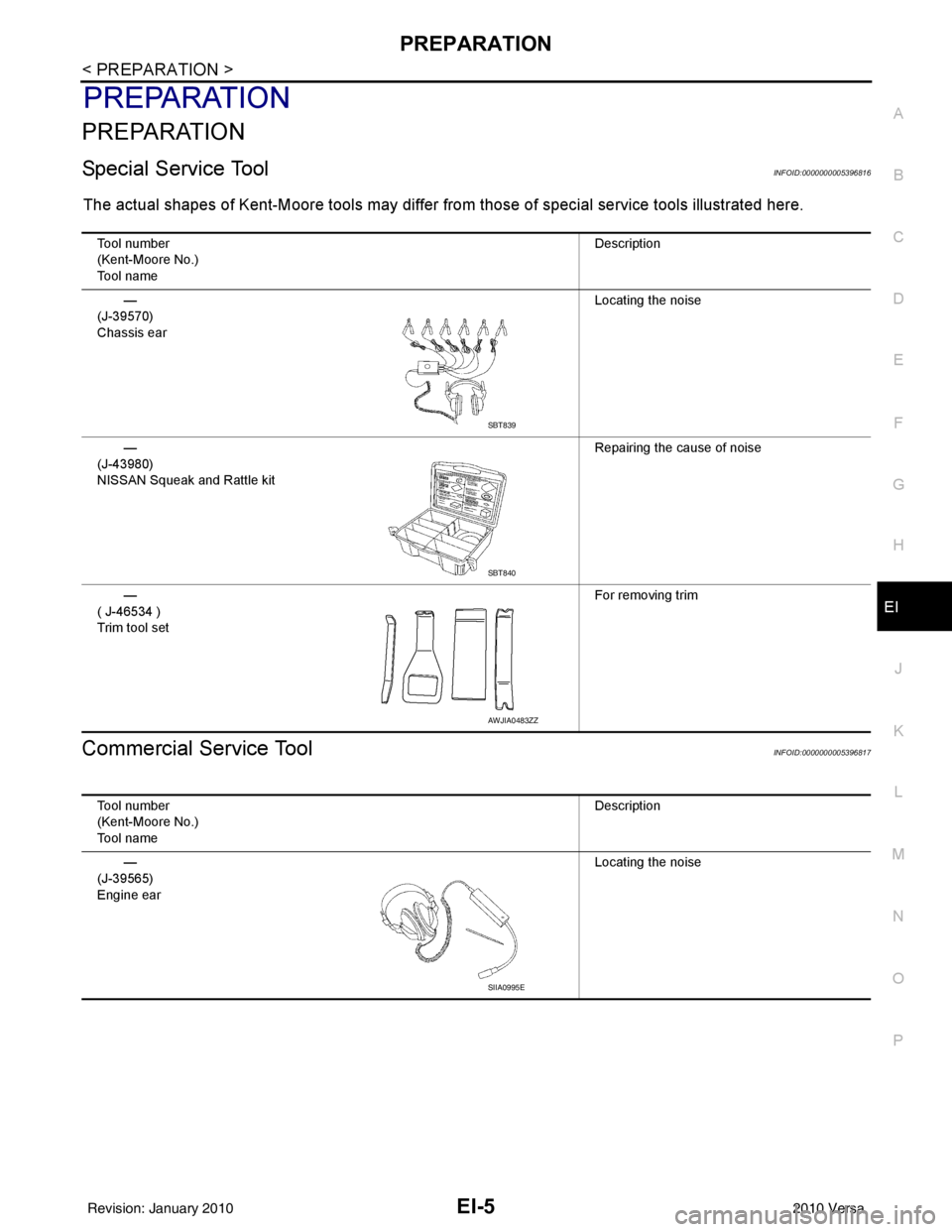
PREPARATIONEI-5
< PREPARATION >
C
DE
F
G H
J
K L
M A
B
EI
N
O P
PREPARATION
PREPARATION
Special Service ToolINFOID:0000000005396816
The actual shapes of Kent-Moore tools may differ from those of special service tools illustrated here.
Commercial Service ToolINFOID:0000000005396817
Tool number
(Kent-Moore No.)
Tool name Description
—
(J-39570)
Chassis ear Locating the noise
—
(J-43980)
NISSAN Squeak and Rattle kit Repairing the cause of noise
—
( J-46534 )
Trim tool set For removing trim
SBT839
SBT840
AWJIA0483ZZ
Tool number
(Kent-Moore No.)
Tool nameDescription
—
(J-39565)
Engine ear Locating the noise
SIIA0995E
Revision: January 20102010 Versa
Page 2308 of 3745

SQUEAK AND RATTLE TROUBLE DIAGNOSISEI-7
< SYMPTOM DIAGNOSIS >
C
DE
F
G H
J
K L
M A
B
EI
N
O P
If possible, drive the vehicle with the customer until the noise is duplicated. Note any additional information on
the Diagnostic Worksheet regarding the conditions or lo cation of the noise. This information can be used to
duplicate the same conditions when you confirm the repair.
If the noise can be duplicated easily during the test drive, to help identify the source of the noise, try to dupli-
cate the noise with the vehicle stopped by doing one or all of the following:
• Close a door.
• Tap or push/pull around the area where the noise appears to be coming from.
• Rev the engine.
• Use a floor jack to recreate vehicle “twist”.
• At idle, apply engine load (electrical load, half-clutch on M/T model, drive position on A/T and CVT models).
• Raise the vehicle on a hoist and hit a tire with a rubber hammer.
• Drive the vehicle and attempt to duplicate the conditions the customer states exist when the noise occurs.
• If it is difficult to duplicate the noise, drive the vehicle slowly on an undulating or rough road to stress the
vehicle body.
CHECK RELATED SERVICE BULLETINS
After verifying the customer concern or symptom, check ASIST for Technical Service Bulletins (TSBs) related
to that concern or symptom.
If a TSB relates to the symptom, follow the procedure to repair the noise.
LOCATE THE NOISE AND IDENTIFY THE ROOT CAUSE
1. Narrow down the noise to a general area. To help pinpoint the source of the noise, use a listening tool (Chassis Ear: J-39570, Engine Ear: J-39565 and mechanics stethoscope).
2. Narrow down the noise to a more specific area and identify the cause of the noise by: • Removing the components in the area that you suspect the noise is coming from.
Do not use too much force when removing clips and fasteners, otherwise clips and fasteners
can be broken or lost during the repair , resulting in the creation of new noise.
• Tapping or pushing/pulling the component that you suspect is causing the noise.
Do not tap or push/pull the component with excessi ve force, otherwise the noise will be elimi-
nated only temporarily.
• Feeling for a vibration with your hand by touching t he component(s) that you suspect is (are) causing
the noise.
• Placing a piece of paper between components that you suspect are causing the noise.
• Looking for loose components and contact marks.
Refer to EI-8, "
Generic Squeak and Rattle Troubleshooting".
REPAIR THE CAUSE
• If the cause is a loose component, tighten the component securely.
• If the cause is insufficient clearance between components:
- Separate components by repositioning or loosening and retightening the component, if possible.
- Insulate components with a suitable insulator such as urethane pads, foam blocks, felt cloth tape or ure-
thane tape. A NISSAN Squeak and Rattle Kit (J-43980) is available through your authorized NISSAN Parts
Department.
CAUTION:
Do not use excessive force as many components are constructed of plastic and may be damaged.
Always check with the Parts Department for the latest parts information.
The following materials are contained in the NISSA N Squeak and Rattle Kit (J-43980). Each item can be
ordered separately as needed.
URETHANE PADS [1.5 mm (0.059 in) thick]
Insulates connectors, harness, etc.
76268-9E005: 100 x 135 mm (3.94 x 5.31 in)/76884-71L01: 60 x 85 mm (2.36 x 3.35 in)/76884-71L02: 15 x 25
mm (0.59 x 0.98 in)
INSULATOR (Foam blocks)
Insulates components from contact. Can be used to fill space behind a panel.
73982-9E000: 45 mm (1.77 in) thick, 50 x 50 mm (1.97 x 1.97 in)/73982-50Y00: 10 mm (0.39 in) thick, 50 x 50
mm (1.97 x 1.97 in)
INSULATOR (Light foam block)
80845-71L00: 30 mm (1.18 in) thick, 30 x 50 mm (1.18 x 1.97 in)
FELT CLOTH TAPE
Used to insulate where movement does not occur. Ideal for instrument panel applications.
68370-4B000: 15 x 25 mm (0.59 x 0.98 in) pad/ 68239-13E00: 5 mm (0.20 in) wide tape roll
Revision: January 20102010 Versa