Panel NISSAN TIIDA 2011 Service Manual PDF
[x] Cancel search | Manufacturer: NISSAN, Model Year: 2011, Model line: TIIDA, Model: NISSAN TIIDA 2011Pages: 3787, PDF Size: 78.35 MB
Page 2763 of 3787

SQUEAK AND RATTLE TROUBLE DIAGNOSESGW-9
< SERVICE INFORMATION >
C
DE
F
G H
J
K L
M A
B
GW
N
O P
Most of these incidents can be repaired by adjusting, se curing or insulating the item(s) or component(s) caus-
ing the noise.
SUNROOF/HEADLINING
Noises in the sunroof/headlining area can often be traced to one of the following:
1. Sunroof lid, rail, linkage or seals making a rattle or light knocking noise
2. Sun visor shaft shaking in the holder
3. Front or rear windshield touching headliner and squeaking
Again, pressing on the components to stop the noise while duplicating the conditions can isolate most of these
incidents. Repairs usually consist of insulating with felt cloth tape.
OVERHEAD CONSOLE (FRONT AND REAR)
Overhead console noises are often caused by the cons ole panel clips not being engaged correctly. Most of
these incidents are repaired by pushing up on the c onsole at the clip locations until the clips engage.
In addition look for:
1. Loose harness or harness connectors.
2. Front console map/reading lamp lense loose.
3. Loose screws at console attachment points.
SEATS
When isolating seat noise it's important to note the position the seat is in and the load placed on the seat when
the noise is present. These conditions should be duplicated when verifying and isolating the cause of the
noise.
Cause of seat noise include:
1. Headrest rods and holder
2. A squeak between the seat pad cushion and frame
3. The rear seatback lock and bracket
These noises can be isolated by moving or pressing on the suspected components while duplicating the con-
ditions under which the noise occurs. Most of thes e incidents can be repaired by repositioning the component
or applying urethane tape to the contact area.
UNDERHOOD
Some interior noise may be caused by components under the hood or on the engine wall. The noise is then
transmitted into the passenger compartment.
Causes of transmitted underhood noise include:
1. Any component mounted to the engine wall
2. Components that pass through the engine wall
3. Engine wall mounts and connectors
4. Loose radiator mounting pins
5. Hood bumpers out of adjustment
6. Hood striker out of adjustment
These noises can be difficult to isolate since they cannot be reached from the interior of the vehicle. The best
method is to secure, move or insulate one component at a time and test drive the vehicle. Also, engine RPM
or load can be changed to isolate the noise. Repairs can usually be made by moving, adjusting, securing, or
insulating the component causing the noise.
Revision: May 2010 2011 Versa
Page 2766 of 3787
GW-12
< SERVICE INFORMATION >
WINDSHIELD GLASS
WINDSHIELD GLASS
Removal and InstallationINFOID:0000000005929465
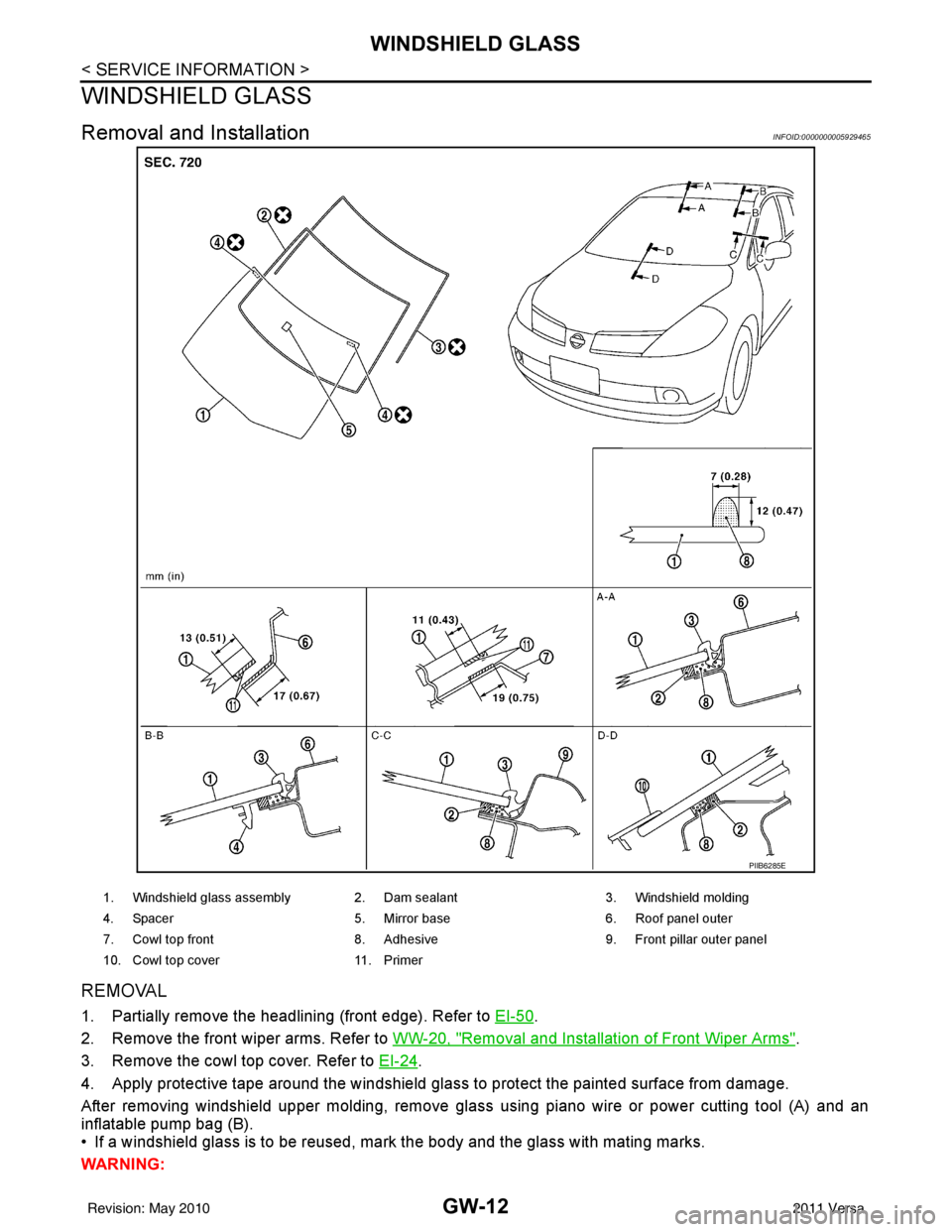
REMOVAL
1. Partially remove the headlining (front edge). Refer to EI-50.
2. Remove the front wiper arms. Refer to WW-20, "
Removal and Installation of Front Wiper Arms".
3. Remove the cowl top cover. Refer to EI-24
.
4. Apply protective tape around the windshield glas s to protect the painted surface from damage.
After removing windshield upper molding, remove glass using piano wire or power cutting tool (A) and an
inflatable pump bag (B).
• If a windshield glass is to be reused, mark the body and the glass with mating marks.
WARNING:
PIIB6285E
1. Windshield glass assembly 2. Dam sealant 3. Windshield molding
4. Spacer 5. Mirror base 6. Roof panel outer
7. Cowl top front 8. Adhesive 9. Front pillar outer panel
10. Cowl top cover 11. Primer
Revision: May 2010 2011 Versa
Page 2768 of 3787
GW-14
< SERVICE INFORMATION >
OPERA WINDOW GLASS
OPERA WINDOW GLASS
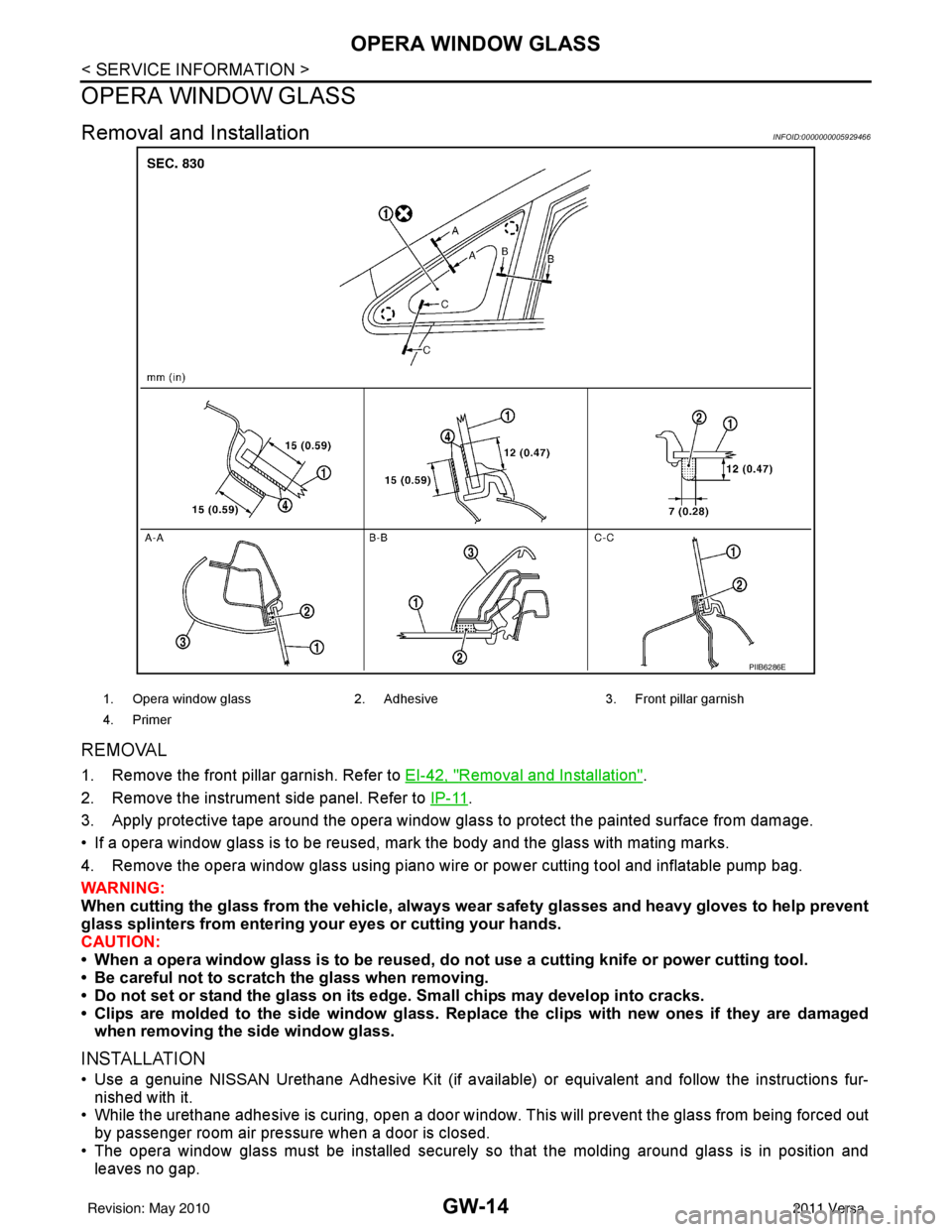
Removal and InstallationINFOID:0000000005929466
REMOVAL
1. Remove the front pillar garnish. Refer to EI-42, "Removal and Installation".
2. Remove the instrument side panel. Refer to IP-11
.
3. Apply protective tape around the opera window glas s to protect the painted surface from damage.
• If a opera window glass is to be reused, mark the body and the glass with mating marks.
4. Remove the opera window glass using piano wire or power cutting tool and inflatable pump bag.
WARNING:
When cutting the glass from the vehicle, always wear safety glasses and heavy gloves to help prevent
glass splinters from entering your eyes or cutting your hands.
CAUTION:
• When a opera window glass is to be reused, do not use a cutting knife or power cutting tool.
• Be careful not to scratch the glass when removing.
• Do not set or stand the glass on its edge. Small chips may develop into cracks.
• Clips are molded to the side window glass. Re place the clips with new ones if they are damaged
when removing the side window glass.
INSTALLATION
• Use a genuine NISSAN Urethane Adhesive Kit (if available) or equivalent and follow the instructions fur- nished with it.
• While the urethane adhesive is curing, open a door window . This will prevent the glass from being forced out
by passenger room air pressure when a door is closed.
• The opera window glass must be installed securely so that the molding around glass is in position and
leaves no gap.
PIIB6286E
1. Opera window glass 2. Adhesive3. Front pillar garnish
4. Primer
Revision: May 2010 2011 Versa
Page 2770 of 3787
GW-16
< SERVICE INFORMATION >
REAR WINDOW GLASS AND MOLDING
REAR WINDOW GLASS AND MOLDING
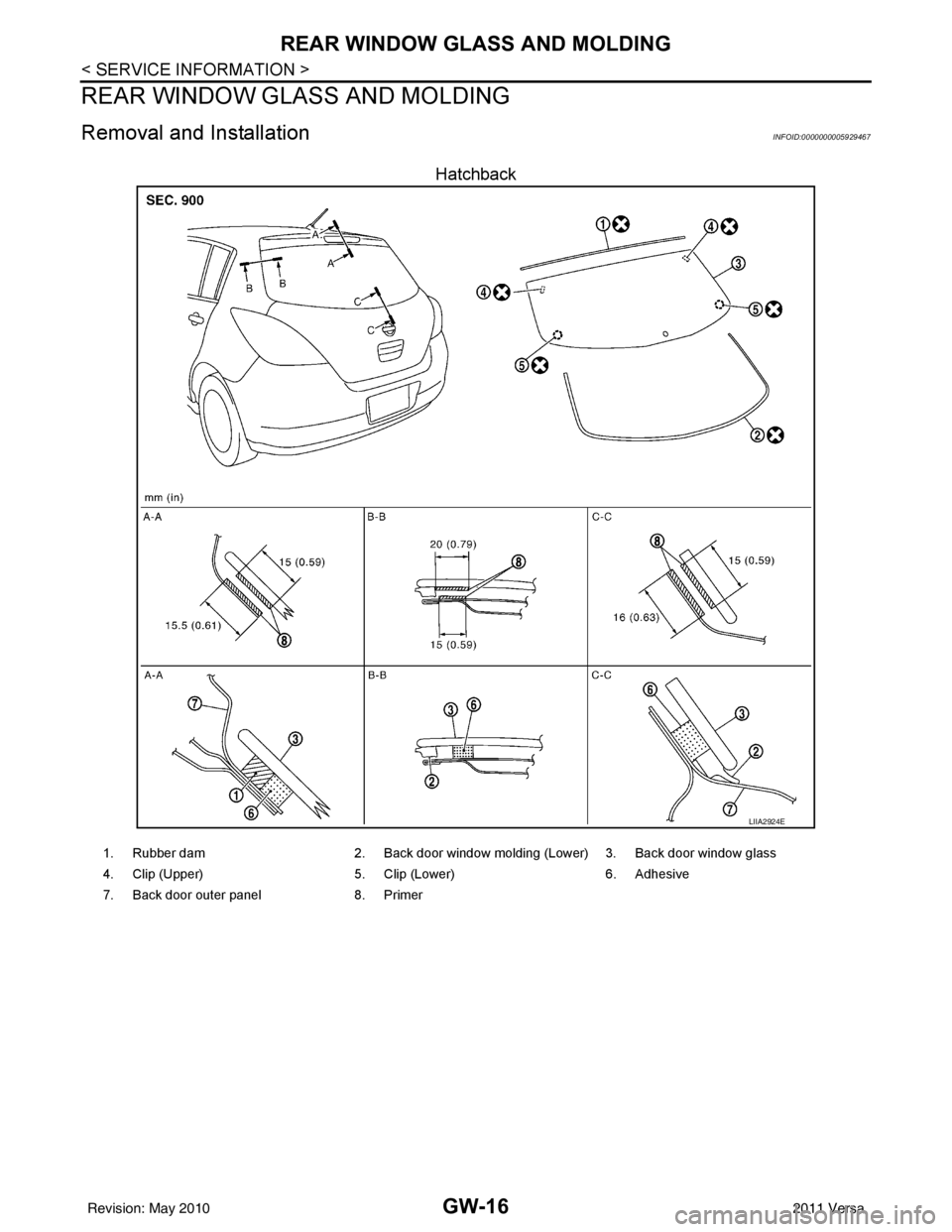
Removal and InstallationINFOID:0000000005929467
Hatchback
LIIA2924E
1. Rubber dam2. Back door window molding (Lower) 3. Back door window glass
4. Clip (Upper) 5. Clip (Lower) 6. Adhesive
7. Back door outer panel 8. Primer
Revision: May 2010 2011 Versa
Page 2771 of 3787
REAR WINDOW GLASS AND MOLDINGGW-17
< SERVICE INFORMATION >
C
DE
F
G H
J
K L
M A
B
GW
N
O P
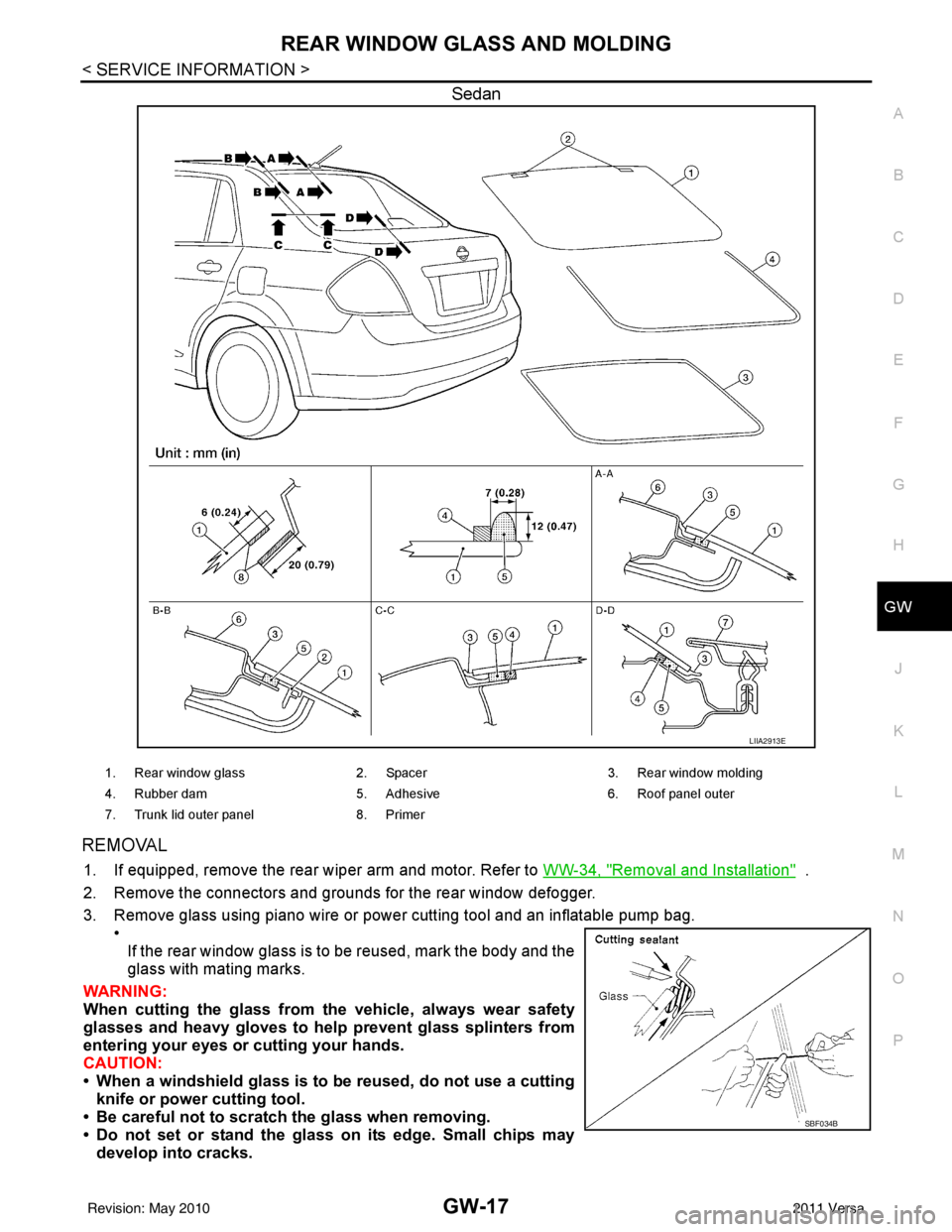
Sedan
REMOVAL
1. If equipped, remove the rear wiper arm and motor. Refer to WW-34, "Removal and Installation" .
2. Remove the connectors and grounds for the rear window defogger.
3. Remove glass using piano wire or power cutting tool and an inflatable pump bag. •
If the rear window glass is to be reused, mark the body and the
glass with mating marks.
WARNING:
When cutting the glass from th e vehicle, always wear safety
glasses and heavy gloves to help prevent glass splinters from
entering your eyes or cutting your hands.
CAUTION:
• When a windshield glass is to be reused, do not use a cutting
knife or power cutting tool.
• Be careful not to scratch the glass when removing.
• Do not set or stand the glass on its edge. Small chips may
develop into cracks.
LIIA2913E
1. Rear window glass 2. Spacer3. Rear window molding
4. Rubber dam 5. Adhesive 6. Roof panel outer
7. Trunk lid outer panel 8. Primer
SBF034B
Revision: May 2010 2011 Versa
Page 2798 of 3787
GW-44
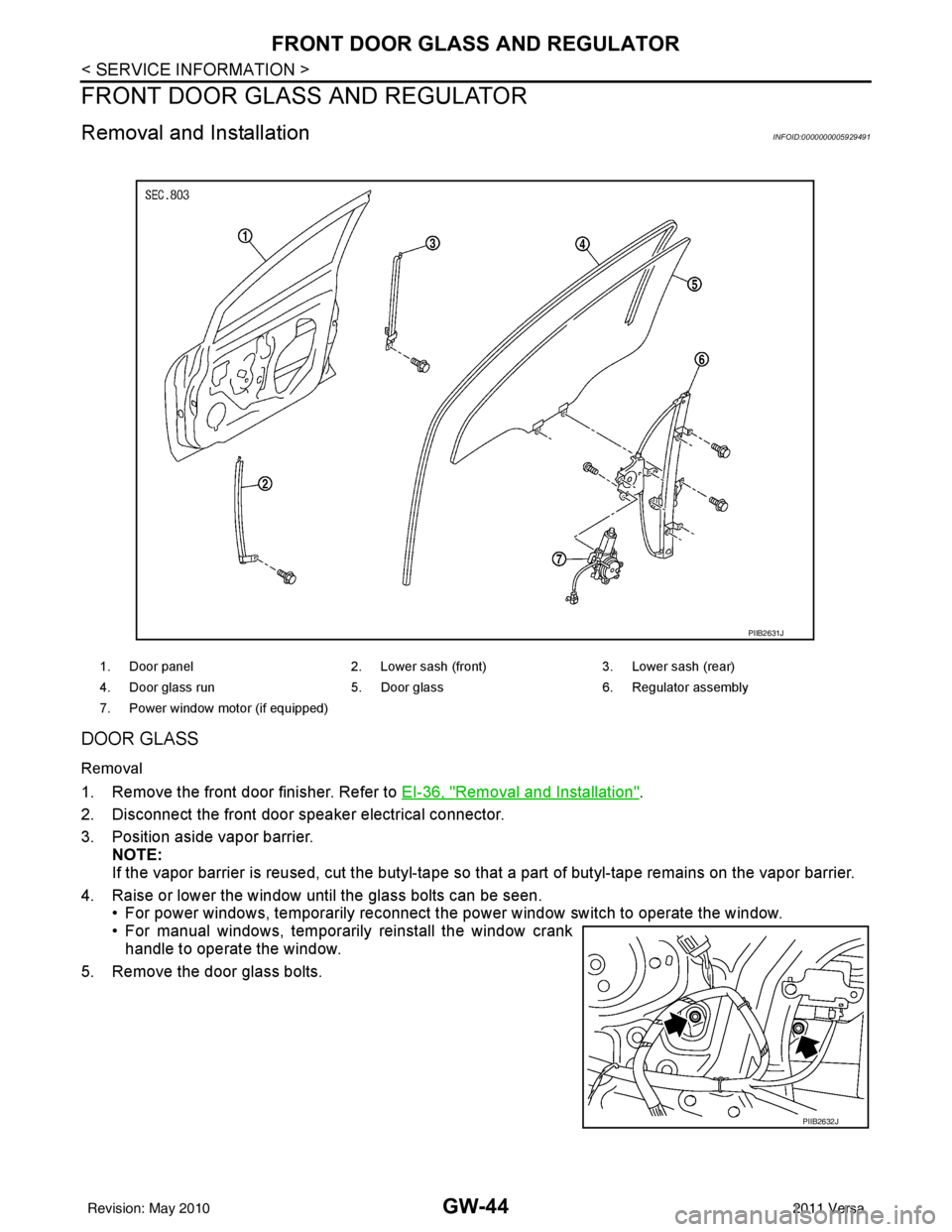
< SERVICE INFORMATION >
FRONT DOOR GLASS AND REGULATOR
FRONT DOOR GLASS AND REGULATOR
Removal and InstallationINFOID:0000000005929491
DOOR GLASS
Removal
1. Remove the front door finisher. Refer to EI-36, "Removal and Installation".
2. Disconnect the front door speaker electrical connector.
3. Position aside vapor barrier. NOTE:
If the vapor barrier is reused, cut the butyl-tape so that a part of butyl-tape remains on the vapor barrier.
4. Raise or lower the window until the glass bolts can be seen. • For power windows, temporarily reconnect the power window switch to operate the window.
• For manual windows, temporarily reinstall the window crankhandle to operate the window.
5. Remove the door glass bolts.
1. Door panel 2. Lower sash (front) 3. Lower sash (rear)
4. Door glass run 5. Door glass6. Regulator assembly
7. Power window motor (if equipped)
PIIB2631J
PIIB2632J
Revision: May 2010 2011 Versa
Page 2799 of 3787
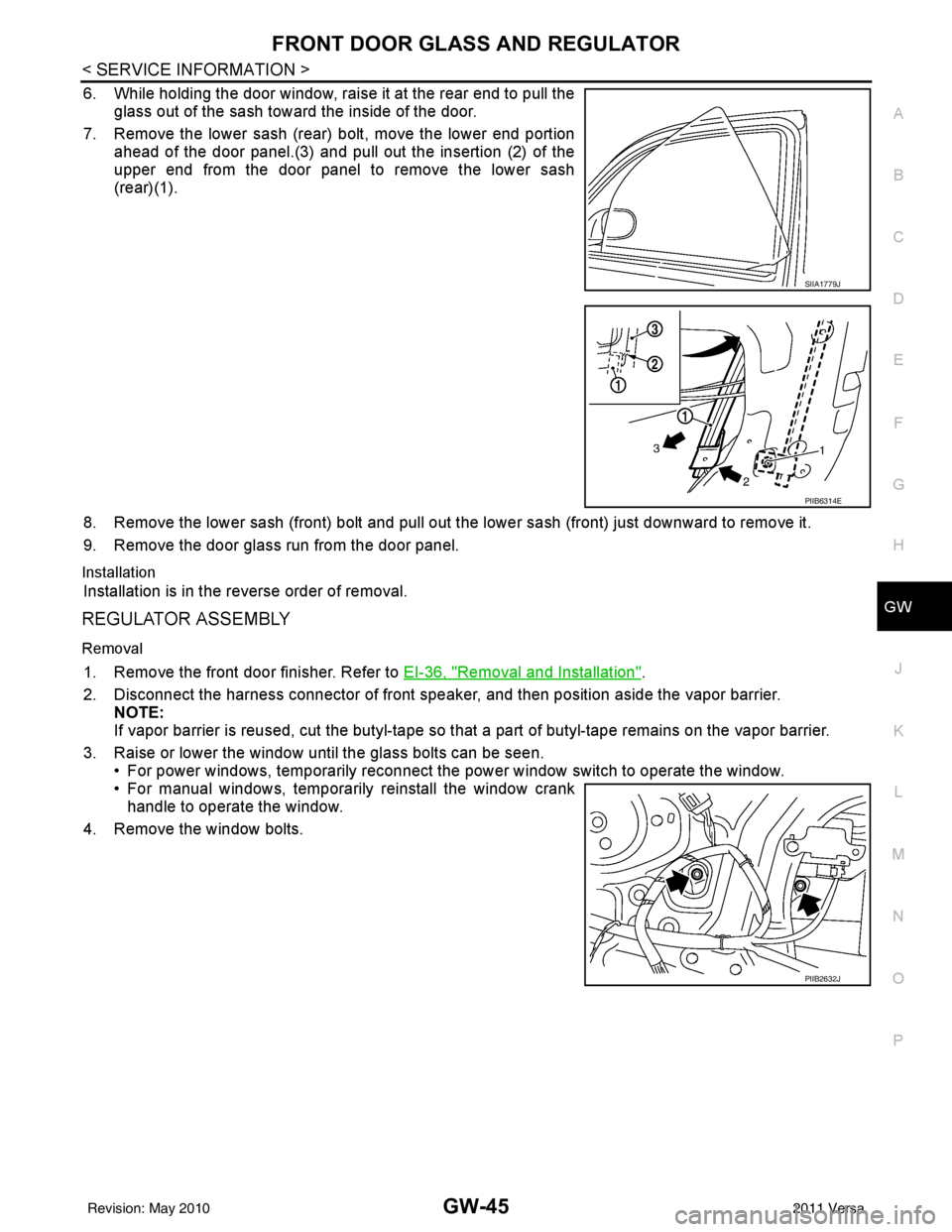
FRONT DOOR GLASS AND REGULATORGW-45
< SERVICE INFORMATION >
C
DE
F
G H
J
K L
M A
B
GW
N
O P
6. While holding the door window, raise it at the rear end to pull the glass out of the sash toward the inside of the door.
7. Remove the lower sash (rear) bolt, move the lower end portion ahead of the door panel.(3) and pull out the insertion (2) of the
upper end from the door panel to remove the lower sash
(rear)(1).
8. Remove the lower sash (front) bolt and pull out the lower sash (front) just downward to remove it.
9. Remove the door glass run from the door panel.
Installation
Installation is in the reverse order of removal.
REGULATOR ASSEMBLY
Removal
1. Remove the front door finisher. Refer to EI-36, "Removal and Installation".
2. Disconnect the harness connector of front speak er, and then position aside the vapor barrier.
NOTE:
If vapor barrier is reused, cut the butyl-tape so that a part of butyl-tape remains on the vapor barrier.
3. Raise or lower the window until the glass bolts can be seen. • For power windows, temporarily reconnect the power window switch to operate the window.
• For manual windows, temporarily reinstall the window crankhandle to operate the window.
4. Remove the window bolts.
SIIA1779J
PIIB6314E
PIIB2632J
Revision: May 2010 2011 Versa
Page 2802 of 3787
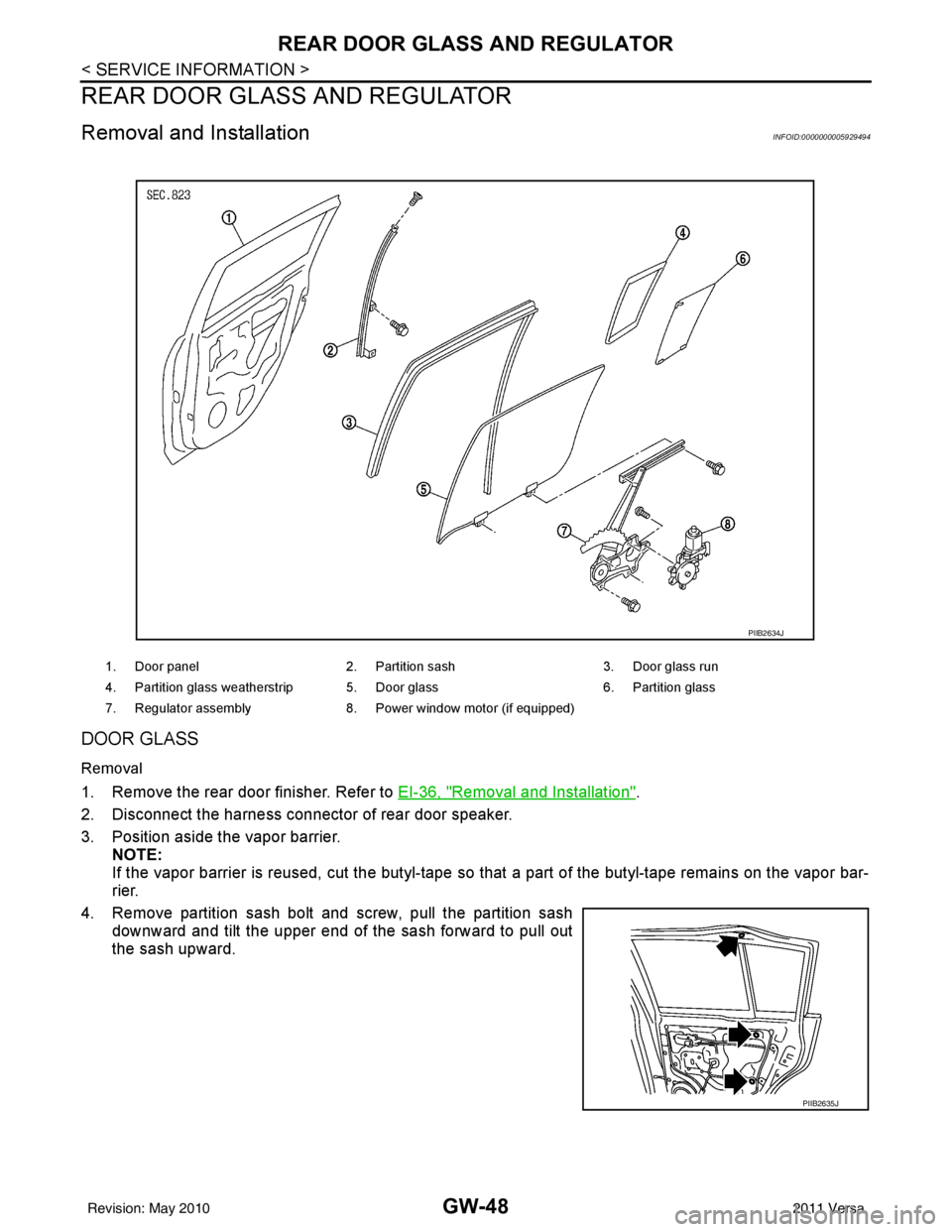
GW-48
< SERVICE INFORMATION >
REAR DOOR GLASS AND REGULATOR
REAR DOOR GLASS AND REGULATOR
Removal and InstallationINFOID:0000000005929494
DOOR GLASS
Removal
1. Remove the rear door finisher. Refer to EI-36, "Removal and Installation".
2. Disconnect the harness connector of rear door speaker.
3. Position aside the vapor barrier. NOTE:
If the vapor barrier is reused, cut the butyl-tape so that a part of the butyl-tape remains on the vapor bar-
rier.
4. Remove partition sash bolt and screw, pull the partition sash downward and tilt the upper end of the sash forward to pull out
the sash upward.
1. Door panel 2. Partition sash 3. Door glass run
4. Partition glass weatherstrip 5. Door glass 6. Partition glass
7. Regulator assembly 8. Power window motor (if equipped)
PIIB2634J
PIIB2635J
Revision: May 2010 2011 Versa
Page 2803 of 3787
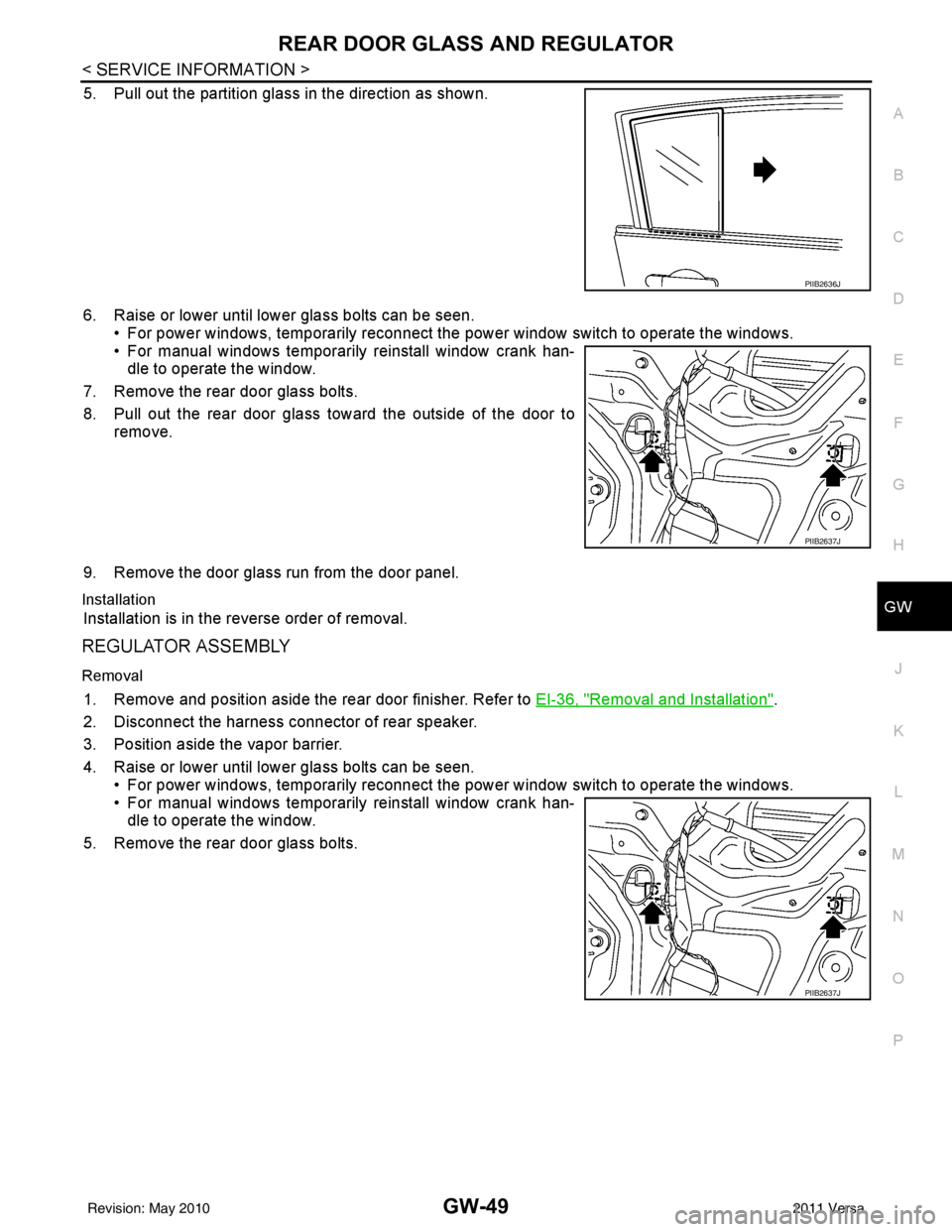
REAR DOOR GLASS AND REGULATORGW-49
< SERVICE INFORMATION >
C
DE
F
G H
J
K L
M A
B
GW
N
O P
5. Pull out the partition glass in the direction as shown.
6. Raise or lower until lower glass bolts can be seen. • For power windows, temporarily reconnect the power window switch to operate the windows.
• For manual windows temporarily reinstall window crank han- dle to operate the window.
7. Remove the rear door glass bolts.
8. Pull out the rear door glass toward the outside of the door to remove.
9. Remove the door glass run from the door panel.
Installation
Installation is in the reverse order of removal.
REGULATOR ASSEMBLY
Removal
1. Remove and position aside the rear door finisher. Refer to EI-36, "Removal and Installation".
2. Disconnect the harness connector of rear speaker.
3. Position aside the vapor barrier.
4. Raise or lower until lower glass bolts can be seen. • For power windows, temporarily reconnect the power window switch to operate the windows.
• For manual windows temporarily reinstall window crank han- dle to operate the window.
5. Remove the rear door glass bolts.
PIIB2636J
PIIB2637J
PIIB2637J
Revision: May 2010 2011 Versa
Page 2804 of 3787
GW-50
< SERVICE INFORMATION >
REAR DOOR GLASS AND REGULATOR
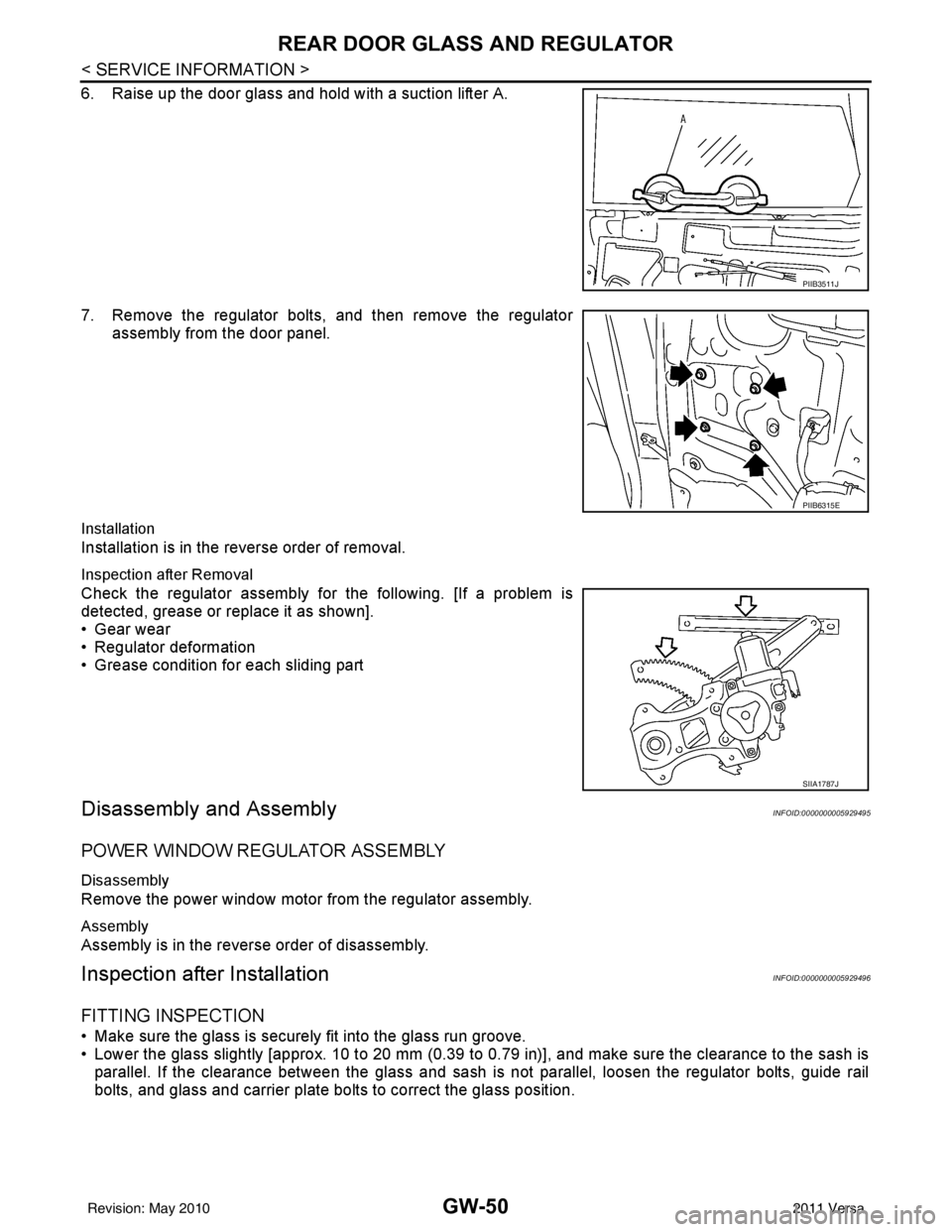
6. Raise up the door glass and hold with a suction lifter A.
7. Remove the regulator bolts, and then remove the regulatorassembly from the door panel.
Installation
Installation is in the reverse order of removal.
Inspection after Removal
Check the regulator assembly fo r the following. [If a problem is
detected, grease or replace it as shown].
• Gear wear
• Regulator deformation
• Grease condition for each sliding part
Disassembly and AssemblyINFOID:0000000005929495
POWER WINDOW REGULATOR ASSEMBLY
Disassembly
Remove the power window motor from the regulator assembly.
Assembly
Assembly is in the reverse order of disassembly.
Inspection after InstallationINFOID:0000000005929496
FITTING INSPECTION
• Make sure the glass is securely fit into the glass run groove.
• Lower the glass slightly [approx. 10 to 20 mm (0.39 to 0.79 in)], and make sure the clearance to the sash is
parallel. If the clearance between the glass and sash is not parallel, loosen the regulator bolts, guide rail
bolts, and glass and carrier plate bolts to correct the glass position.
PIIB3511J
PIIB6315E
SIIA1787J
Revision: May 2010 2011 Versa