service schedule NISSAN TITAN 2017 2.G User Guide
[x] Cancel search | Manufacturer: NISSAN, Model Year: 2017, Model line: TITAN, Model: NISSAN TITAN 2017 2.GPages: 671, PDF Size: 7.96 MB
Page 532 of 671
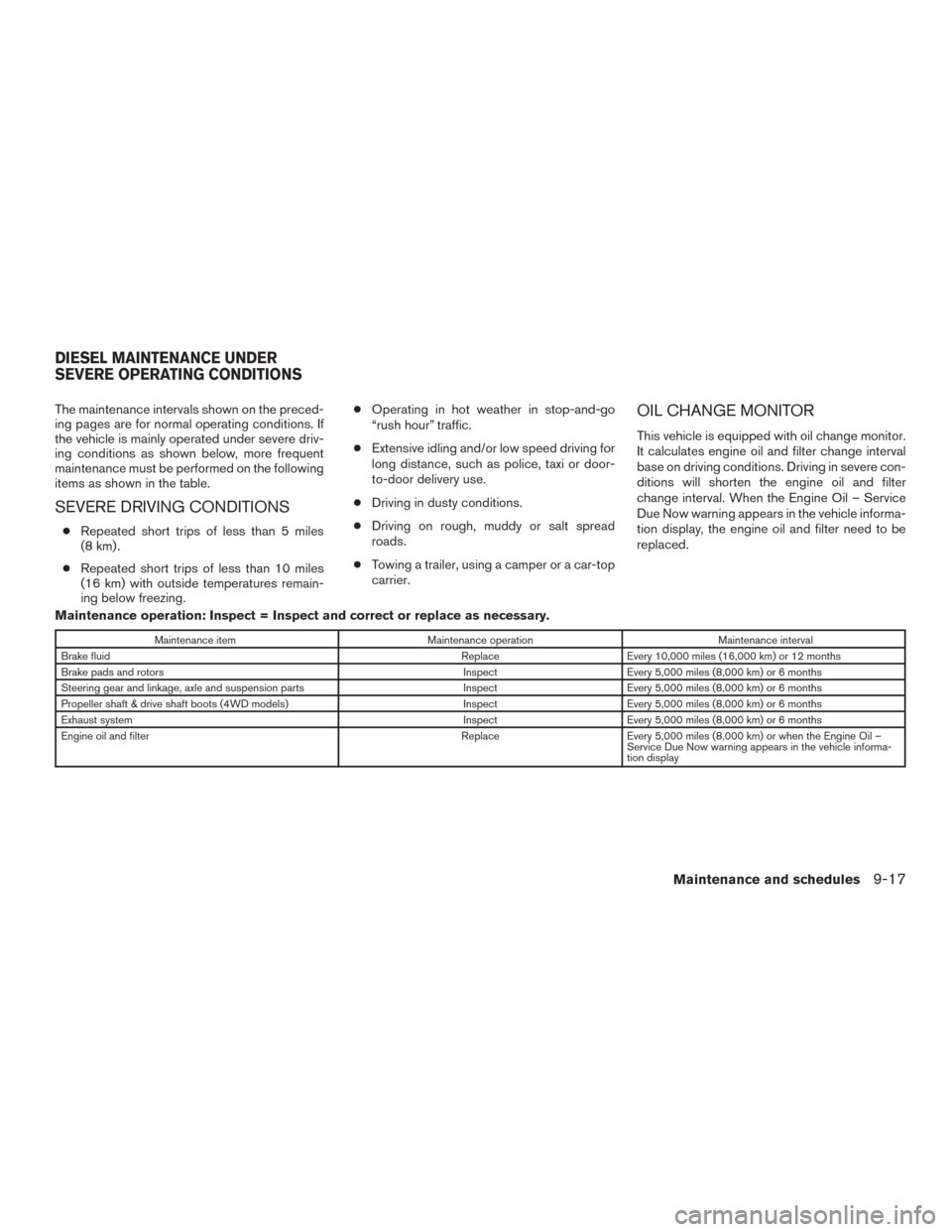
The maintenance intervals shown on the preced-
ing pages are for normal operating conditions. If
the vehicle is mainly operated under severe driv-
ing conditions as shown below, more frequent
maintenance must be performed on the following
items as shown in the table.
SEVERE DRIVING CONDITIONS
●Repeated short trips of less than 5 miles
(8 km) .
● Repeated short trips of less than 10 miles
(16 km) with outside temperatures remain-
ing below freezing. ●
Operating in hot weather in stop-and-go
“rush hour” traffic.
● Extensive idling and/or low speed driving for
long distance, such as police, taxi or door-
to-door delivery use.
● Driving in dusty conditions.
● Driving on rough, muddy or salt spread
roads.
● Towing a trailer, using a camper or a car-top
carrier.
OIL CHANGE MONITOR
This vehicle is equipped with oil change monitor.
It calculates engine oil and filter change interval
base on driving conditions. Driving in severe con-
ditions will shorten the engine oil and filter
change interval. When the Engine Oil – Service
Due Now warning appears in the vehicle informa-
tion display, the engine oil and filter need to be
replaced.
Maintenance operation: Inspect = Inspect and correct or replace as necessary.
Maintenance item Maintenance operation Maintenance interval
Brake fluid ReplaceEvery 10,000 miles (16,000 km) or 12 months
Brake pads and rotors InspectEvery 5,000 miles (8,000 km) or 6 months
Steering gear and linkage, axle and suspension parts InspectEvery 5,000 miles (8,000 km) or 6 months
Propeller shaft & drive shaft boots (4WD models) InspectEvery 5,000 miles (8,000 km) or 6 months
Exhaust system InspectEvery 5,000 miles (8,000 km) or 6 months
Engine oil and filter ReplaceEvery 5,000 miles (8,000 km) or when the Engine Oil –
Service Due Now warning appears in the vehicle informa-
tion display
DIESEL MAINTENANCE UNDER
SEVERE OPERATING CONDITIONS
Maintenance and schedules9-17
Page 543 of 671
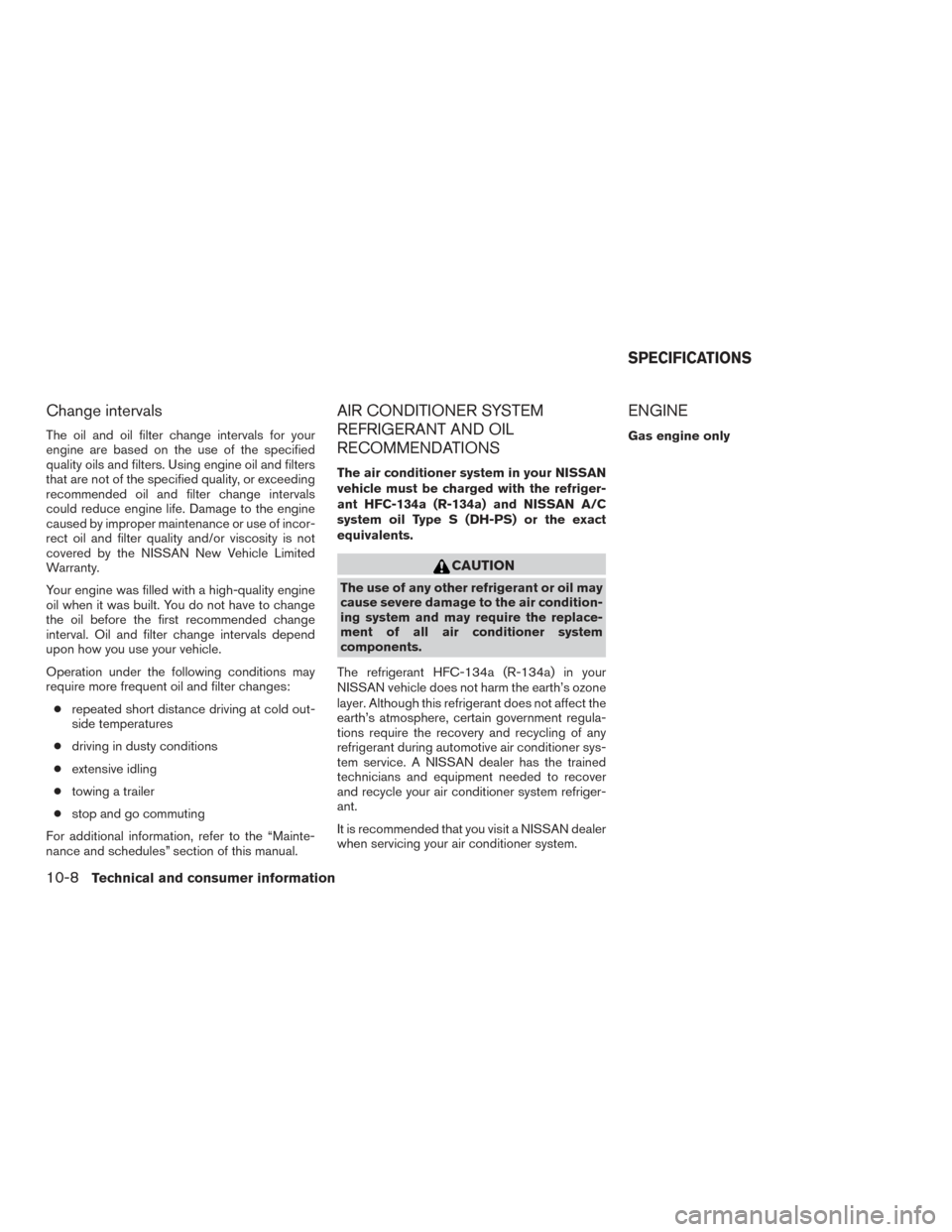
Change intervals
The oil and oil filter change intervals for your
engine are based on the use of the specified
quality oils and filters. Using engine oil and filters
that are not of the specified quality, or exceeding
recommended oil and filter change intervals
could reduce engine life. Damage to the engine
caused by improper maintenance or use of incor-
rect oil and filter quality and/or viscosity is not
covered by the NISSAN New Vehicle Limited
Warranty.
Your engine was filled with a high-quality engine
oil when it was built. You do not have to change
the oil before the first recommended change
interval. Oil and filter change intervals depend
upon how you use your vehicle.
Operation under the following conditions may
require more frequent oil and filter changes:● repeated short distance driving at cold out-
side temperatures
● driving in dusty conditions
● extensive idling
● towing a trailer
● stop and go commuting
For additional information, refer to the “Mainte-
nance and schedules” section of this manual.
AIR CONDITIONER SYSTEM
REFRIGERANT AND OIL
RECOMMENDATIONS
The air conditioner system in your NISSAN
vehicle must be charged with the refriger-
ant HFC-134a (R-134a) and NISSAN A/C
system oil Type S (DH-PS) or the exact
equivalents.
CAUTION
The use of any other refrigerant or oil may
cause severe damage to the air condition-
ing system and may require the replace-
ment of all air conditioner system
components.
The refrigerant HFC-134a (R-134a) in your
NISSAN vehicle does not harm the earth’s ozone
layer. Although this refrigerant does not affect the
earth’s atmosphere, certain government regula-
tions require the recovery and recycling of any
refrigerant during automotive air conditioner sys-
tem service. A NISSAN dealer has the trained
technicians and equipment needed to recover
and recycle your air conditioner system refriger-
ant.
It is recommended that you visit a NISSAN dealer
when servicing your air conditioner system.
ENGINE
Gas engine only
SPECIFICATIONS
10-8Technical and consumer information
Page 590 of 671
●While going downhill, the weight of the
trailer pushing on the tow vehicle may de-
crease overall stability. Therefore, to main-
tain adequate control, reduce your speed
and shift to a lower gear. Avoid long or
repeated use of the brakes when descend-
ing a hill, as this reduces their effectiveness
and could cause overheating. Shifting to a
lower gear instead provides “engine brak-
ing” and reduces the need to brake as fre-
quently.
● If the engine coolant temperature rises to a
high temperature, refer to “If your vehicle
overheats” in the “In case of emergency”
section of this owner’s manual.
● Trailer towing requires more fuel than normal
circumstances.
● Avoid towing a trailer for your vehicle’s first
500 miles (805 km) .
● For the first 500 miles (805 km) that you do
tow, do not drive over 50 mph (80 km/h).
● Have your vehicle serviced more often than
at intervals specified. For additional informa-
tion, refer to “Maintenance schedules” in the
“Maintenance and schedule” section of this
manual. ●
When making a turn, your trailer wheels will
be closer to the inside of the turn than your
vehicle wheels. To compensate for this,
make a larger than normal turning radius
during the turn.
● Crosswinds and rough roads will adversely
affect vehicle/trailer handling, possibly caus-
ing vehicle sway. When being passed by
larger vehicles, be prepared for possible
changes in crosswinds that could affect ve-
hicle handling.
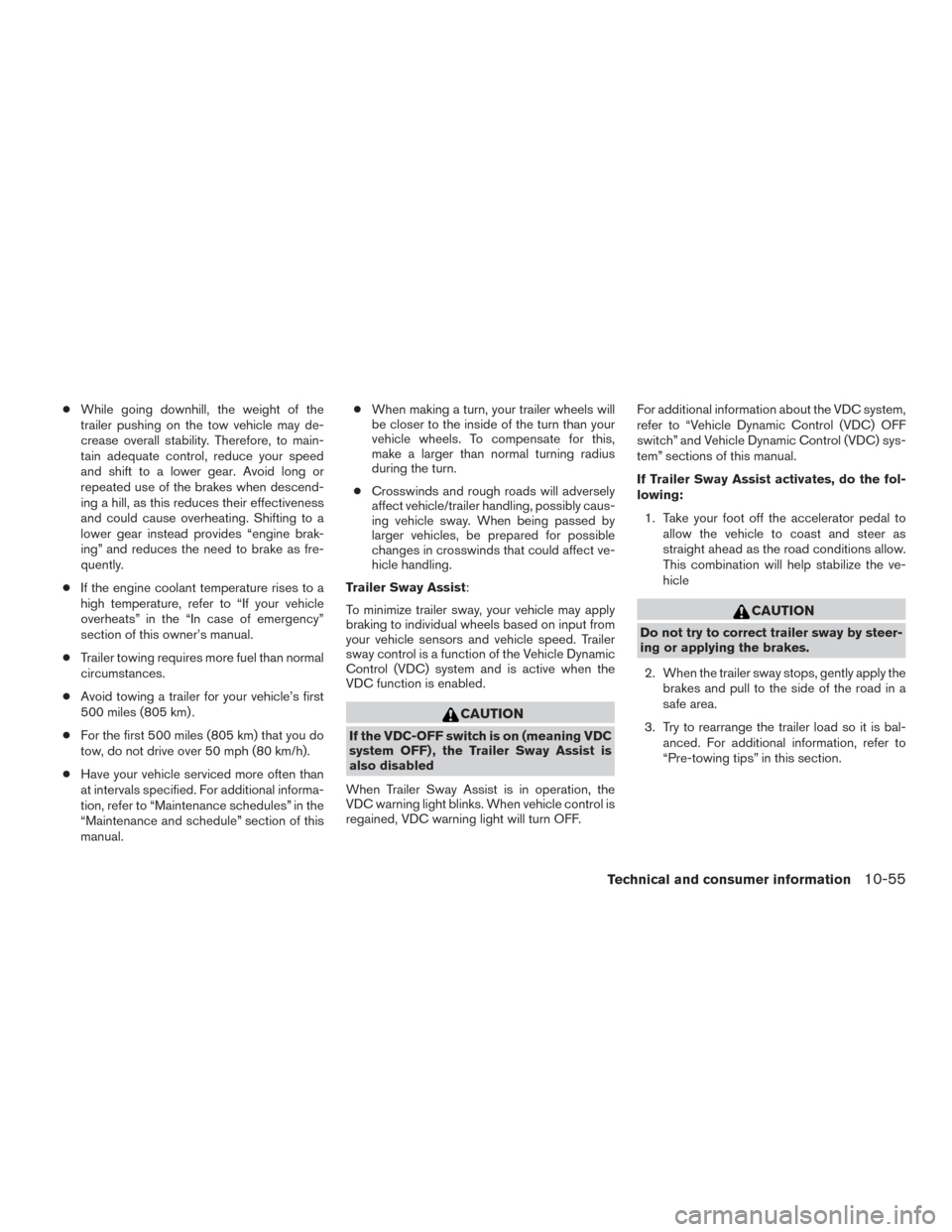
Trailer Sway Assist:
To minimize trailer sway, your vehicle may apply
braking to individual wheels based on input from
your vehicle sensors and vehicle speed. Trailer
sway control is a function of the Vehicle Dynamic
Control (VDC) system and is active when the
VDC function is enabled.
CAUTION
If the VDC-OFF switch is on (meaning VDC
system OFF) , the Trailer Sway Assist is
also disabled
When Trailer Sway Assist is in operation, the
VDC warning light blinks. When vehicle control is
regained, VDC warning light will turn OFF. For additional information about the VDC system,
refer to “Vehicle Dynamic Control (VDC) OFF
switch” and Vehicle Dynamic Control (VDC) sys-
tem” sections of this manual.
If Trailer Sway Assist activates, do the fol-
lowing:
1. Take your foot off the accelerator pedal to allow the vehicle to coast and steer as
straight ahead as the road conditions allow.
This combination will help stabilize the ve-
hicle
CAUTION
Do not try to correct trailer sway by steer-
ing or applying the brakes.
2. When the trailer sway stops, gently apply the brakes and pull to the side of the road in a
safe area.
3. Try to rearrange the trailer load so it is bal- anced. For additional information, refer to
“Pre-towing tips” in this section.
Technical and consumer information10-55
Page 602 of 671
Maintenance log.................9-18
Maintenance requirements ............9-2
Maintenance schedules ..............9-7
Malfunction indicator light ........2-27,2-30
Manual front seat adjustment ...........1-4
Maplights ....................2-88
Map pocket ................2-74,2-75
Memory Seat ...............3-37,3-39
Meters and gauges .............2-6,2-11
Instrument brightness control ........2-56
Mirror Automatic anti-glare inside mirror . .3-28, 3-29
Outside mirrors ...............3-29
Rearview ...................3-28
Vanity mirror .................3-27
Mirrors ......................3-28
Mobileapps ...................4-83
Moving Object Detection (MOD) ........4-28
N
NissanConnect
SM................4-83
NissanConnectSMServices...........4-84
NISSAN Intelligent Key® ..........3-2,3-8
NISSAN mobile entertainment system
(MES) .......................4-88
NISSAN Vehicle Immobilizer System . .2-48, 5-14
NISSAN voice recognition system ......4-135
O
Octanerating(Seefueloctanerating).....10-6
Odometer .....................2-8 Oil
Capacities and recommended
fuel/lubricants ................10-2
Changingengineoil..............8-8
Changing engine oil filter ...........8-9
Checking engine oil level ...........8-7
Engine oil ...................8-7
Engine oil and oil filter recommendation . .10-7
Engine oil viscosity ..............10-7
Oneshotcall .........4- 116, 4-117, 4-128
Outside mirrors .................3-29
Overheat If your vehicle overheats ...........6-13
Owner’s manual order form ..........10-61
Owner’s manual/service manual order
information ...................10-61
P
Parking Parking brake operation ...........5-22
Parking/parking on hills ...........5-54
Parking brake ...................5-22
Personallights..................2-89
Phone, Bluetooth® hands-free system . . .4-114, 4-126
Power Front seat adjustment .............1-5
Power door locks ............3-6,3-7
Power outlet ..........2-69,2-69,2-72
Power rear windows .............2-84
Power steering fluid .............8-12
Power steering system ...........5-54
Power windows ...............2-83
Rear power windows ............2-84 Power inverter switch
..............2-67
Power outlet ............2-69,2-69,2-72
Power steering ..................5-54
Power steering fluid ...............8-12
Precautions Maintenance precautions ...........8-2
On-pavement and off-road driving
precautions ..................5-6
Precautions on booster
seats .......1-26,1-33,1-39,1-43,1-48
Precautions on child
restraints .....1-26,1-33,1-39,1-43,1-48
Precautions on seat belt usage .......1-15
Precautions on supplemental
restraint
system .................1-51,1-65
Precautions when starting and
driving ...................5-2,5-8
Push starting ...................6-13
R
Radio CarphoneorCBradio...........4-113
FM/AM radio with compact disc (CD)
player .....................4-54
FM/AM/SAT radio with compact disc (CD)
player .................4-58,4-64
Steering wheel audio control switch . . . .4-82
Rainsensor....................2-51
Readiness for inspection maintenance (I/M)
test .......................10-60
Rear Cross Traffic Alert (RCTA) ........5-32
Rear power windows ..............2-84
Rearseat......................1-4
11-5
Page 614 of 671
Preventive maintenance is the easiest and least
expensive type of maintenance. Keep records of
regularly scheduled maintenance and follow the
maintenance schedule recommendations out-
lined in the “Titan Owner’s Manual”.
Use the correct fuel, lubricating oil, and coolant in
your engine. Blending engine oil with fuel is pro-
hibited for engines with an aftertreatment system.
For additional information, refer to the “Capaci-
ties and Specifications” section in this manual.
A NISSAN dealership knows your vehicle. When
you require any service or have any questions,
they will be glad to assist you with the extensive
resources available to them.
DIESEL ENGINE OPERATION
The operation of the diesel engine in your new
vehicle varies from the operation of traditional
gasoline engines found in other vehicles. Read-
ing this supplement will familiarize you and other
operators of the vehicle with the unique mainte-
nance and operating procedures that will prolong
the life of the diesel engine and related systems.
ENGINE BREAK-IN
RECOMMENDATIONS
●Warm up the engine before operating it un-
der load
● Do not operate the engine at idle for ex-
tended periods
● Prevent engine lugging by selecting the ap-
propriate transmission gear
● Monitor the vehicle oil pressure and tem-
perature gauges
● Check fluid levels frequently (Oil & Coolant)
● Vary the throttle position at highway speeds
when carrying weight or towing
NOTE:
Extended light or no load operation will
extend the time before the engine reaches
its full efficiency. If the engine is operated
in this manner, reduced fuel economy and
power may be observed.
The aforementioned procedure should be ob-
served for the first 6,000 miles. The engine run-in
is improved by operating the vehicle under load.
DIESEL FUEL SYSTEM
The diesel engine fuel system is a pressurized
two-stage filtration system and consists of: ● A frame-mounted primary (stage 1) fuel filter
containing water/fuel separator, electric fuel
pump, and water in fuel drain valve
● An engine-mounted secondary (stage 2)
fuel filter
● A fuel injector for each cylinder (8 total)
● A high-pressure fuel pump
● A high-pressure fuel rail for each cylinder
bank (2 total)
● High-pressure fuel lines from the high-
pressure fuel pump to the right bank fuel rail,
right bank fuel rail to the left bank fuel rail,
and fuel rails to fuel injectors.
The stage 1 fuel filter separates water and filters
impurities from the fuel. The stage 2 fuel filter
filters finer impurities from the diesel fuel. The
stage 1 and stage 2 fuel filters should be
changed at the recommended service interval or
when indicated by the information display. For
additional information, refer to the “Titan Owner’s
Manual”.
GENERAL INFORMATION
1-2Introduction
Page 654 of 671
AUTOMATIC REGENERATION
Automatic regeneration occurs when the control
module detects the exhaust filter needs to be
cleaned. This is a normal process and will not
typically require any operator interaction.
If the automatic regeneration is not able to clean
the exhaust filter the vehicle information display
will display the following messages in order of
severity:● Exhaust Filter Overloaded See Owners
Manual for Drive Pattern
● Exhaust Filter Overloaded Engine Power
Reduced See Owners Manual
● Exhaust Filter Overloaded Immediate Ser-
vice Required
The instructions for these messages in the “Me-
ters and Gauges” section of this manual will
inform the driver to modify their driving pattern to
enable the automatic regeneration process.
1. Idler pulley
2. Cooling fan pulley
3. Idler pulley
4. Power steering fluid pump pulley
5. Air conditioner compressor pulley
6. Water pump pulley
7. Crankshaft pulley
8. Automatic belt tensioner pulley
9. Generator pulley
WARNING
To avoid the risk of personal injury, be
sure the ignition switch is in the OFF or
LOCK position before servicing drive belt.
The engine could rotate unexpectedly.
1. Visually inspect the belt for signs of unusual wear, cuts, fraying or looseness. If the belt is
in poor condition or is loose, have it re-
placed. It is recommended that you visit a
NISSAN dealer for this service.
2. Have the belt checked regularly for condi- tion and tension in accordance with the
maintenance schedule found in the “Titan
Owner’s Manual”.
LDI2881
DRIVE BELT
6-18Do-it-yourself