maintenance NISSAN TITAN 2018 Owner´s Manual
[x] Cancel search | Manufacturer: NISSAN, Model Year: 2018, Model line: TITAN, Model: NISSAN TITAN 2018Pages: 650, PDF Size: 7.54 MB
Page 575 of 650
Change intervals
The oil and oil filter change intervals for
your engine are based on the use of the
specified quality oils and filters. Using en-
gine oil and filters that are not of the speci-
fied quality, or exceeding recommended oil
and filter change intervals could reduce
engine life. Damage to the engine caused
by improper maintenance or use of incor-
rect oil and filter quality and/or viscosity is
not covered by the NISSAN New Vehicle
Limited Warranty.
Your engine was filled with a high-quality
engine oil when it was built. You do not have
to change the oil before the first recom-
mended change interval. Oil and filter
change intervals depend upon how you
use your vehicle.
Operation under the following conditions
may require more frequent oil and filter
changes:∙ repeated short distance driving at cold outside temperatures
∙ driving in dusty conditions
∙ extensive idling
∙ towing a trailer
∙ stop and go commuting For additional information, refer to the
“Maintenance and schedules” section of
this manual.
AIR CONDITIONER SYSTEM
REFRIGERANT AND OIL
RECOMMENDATIONS
The air conditioner system in your
NISSAN vehicle must be charged with the
refrigerant HFC-134a (R-134a) and
NISSAN A/C system oil Type S (DH-PS) or
the exact equivalents.
CAUTION
The use of any other refrigerant or oil
may cause severe damage to the air
conditioning system and may require
the replacement of all air conditioner
system components.
The refrigerant HFC-134a (R-134a) in your
NISSAN vehicle does not harm the earth’s
ozone layer. Although this refrigerant does
not affect the earth’s atmosphere, certain
government regulations require the recov-
ery and recycling of any refrigerant during
automotive air conditioner system service.
A NISSAN dealer has the trained techni- cians and equipment needed to recover
and recycle your air conditioner system re-
frigerant.
It is recommended that you visit a NISSAN
dealer when servicing your air conditioner
system.
10-8Technical and consumer information
Page 626 of 650
∙ While going downhill, the weight of thetrailer pushing on the tow vehicle may
decrease overall stability. Therefore, to
maintain adequate control, reduce your
speed and shif t to a lower gear. Avoid
long or repeated use of the brakes
when descending a hill, as this reduces
their effectiveness and could cause
overheating. Shif ting to a lower gear in-
stead provides “engine braking” and re-
duces the need to brake as frequently.
∙ If the engine coolant temperature rises to a high temperature, refer to “If your
vehicle overheats” in the “In case of
emergency” section of this owner’s
manual.
∙ Trailer towing requires more fuel than normal circumstances.
∙ Avoid towing a trailer for your vehicle’s first 500 miles (805 km).
∙ For the first 500 miles (805 km) that you do tow, do not drive over 50 mph
(80 km/h).
∙ Have your vehicle serviced more of ten than at intervals specified. For addi-
tional information, refer to “Mainte-
nance schedules” in the “Maintenance
and schedule” section of this manual. ∙ When making a turn, your trailer wheels
will be closer to the inside of the turn
than your vehicle wheels. To compen-
sate for this, make a larger than normal
turning radius during the turn.
∙ Crosswinds and rough roads will ad- versely affect vehicle/trailer handling,
possibly causing vehicle sway. When
being passed by larger vehicles, be pre-
pared for possible changes in cross-
winds that could affect vehicle han-
dling.
Trailer Sway Assist :
To minimize trailer sway, your vehicle may
apply braking to individual wheels based
on input from your vehicle sensors and ve-
hicle speed. Trailer sway control is a func-
tion of the Vehicle Dynamic Control (VDC)
system and is active when the VDC func-
tion is enabled.
CAUTION
If the VDC-OFF switch is on (meaning
VDC system OFF), the Trailer Sway As-
sist is also disabled When Trailer Sway Assist is in operation, the
VDC warning light blinks. When vehicle con-
trol is regained, VDC warning light will turn
OFF.
For additional information about the VDC
system, refer to “Vehicle Dynamic Control
(VDC) OFF switch” in the “Instruments and
controls” section and “Vehicle Dynamic
Control (VDC) system” in the “Starting and
driving” section of this manual.
If Trailer Sway Assist activates, do the fol-
lowing:
1. Take your foot off the accelerator pedal to allow the vehicle to coast and steer
as straight ahead as the road condi-
tions allow. This combination will help
stabilize the vehicle
CAUTION
Do not try to correct trailer sway by
steering or applying the brakes.
2. When the trailer sway stops, gently ap- ply the brakes and pull to the side of the
road in a safe area.
3. Try to rearrange the trailer load so it is balanced. For additional information,
refer to “Pre-towing tips” in this section.
Technical and consumer information10-59
Page 632 of 650
WARNING
A vehicle equipped with 4-Wheel Drive
(4WD) should never be tested using a
two wheel dynamometer (such as the
dynamometers used by some states for
emissions testing), or similar equip-
ment. Make sure you inform the test fa-
cility personnel that your vehicle is
equipped with 4WD before it is placed
on a dynamometer. Using the wrong
test equipment may result in transmis-
sion damage or unexpected vehicle
movement which could result in serious
vehicle damage or personal injury.
Due to legal requirements in some states
and Canadian Provinces, your vehicle may
be required to be in what is called the
“ready condition” for an
Inspection/Maintenance (I/M) test of the
emission control system.
The vehicle is set to the “ready condition”
when it is driven through certain driving
patterns. Usually, the ready condition can
be obtained by ordinary usage of the ve-
hicle. If a powertrain system component is re-
paired or the battery is disconnected, the
vehicle may be reset to a “not ready” condi-
tion. Before taking the I/M test, check the
vehicle’s inspection/maintenance test
readiness condition. Place the ignition
switch in the ON position without starting
the engine. If the Malfunction Indicator
Light (MIL) comes on steady for 20 seconds
and then blinks for 10 seconds, the I/M test
condition is “not ready”. If the MIL does not
blink af ter 20 seconds, the I/M test condi-
tion is “ready”. It is recommended that you
visit a NISSAN dealer to set the “ready con-
dition” or to prepare the vehicle for testing.
diesel engine only
For additional information, refer to the “Ti-
tan Diesel Owner’s Manual”.
This vehicle is equipped with an Event Data
Recorder (EDR). The main purpose of an
EDR is to record, in certain crash or near
crash-like situations, such as an air bag
deployment or hitting a road obstacle, data
that will assist in understanding how a ve-
hicle’s systems performed. The EDR is de-
signed to record data related to vehicle dy-
namics and safety systems for a short
period of time, typically 30 seconds or less.
The EDR in this vehicle is designed to re-
cord such data as:
∙ How various systems in your vehicle were operating;
∙ Whether or not the driver and passen- ger safety belts were buckled/fastened;
∙ How far (if at all) the driver was depress- ing the accelerator and/or brake pedal;
and,
∙ How fast the vehicle was traveling.
∙ Sounds are not recorded.
These data can help provide a better un-
derstanding of the circumstances in which
crashes and injuries occur. NOTE: EDR data
are recorded by your vehicle only if a non-
trivial crash situation occurs; no data are
recorded by the EDR under normal driving
conditions and no personal data (e.g.
READINESS FOR INSPECTION/
MAINTENANCE (I/M) TEST (gas
engine only) EVENT DATA RECORDERS (EDR)
Technical and consumer information10-65
Page 636 of 650
EngineBefore starting the engine ........5-14
Blockheater.................5-71
Capacities and recommended
fuel/lubricants...............10-2
Changing engine coolant .........8-6
Changing engine oil ............8-8
Changing engine oil filter .........8-9
Checking engine coolant level ......8-6
Checking engine oil level .........8-7
Engine compartment check
locations...................8-3
Engine coolant temperature gauge . .2-9
Engine cooling system ..........8-5
Engine oil ...................8-7
Engine oil and oil filter
recommendation .............10-7
Engine oil pressure gauge .....2-11, 2-12
Engine oil pressure warning light . . .2-25
Engine oil viscosity .............10-7
Engine serial number ..........10-18
Engine specifications ...........10-9
Engine coolant temperature gauge ....2-9
Engine oil pressure gauge .......2-11, 2-12
Enterbutton...................4-4
EventDatarecorders............10-65
Exhaust gas (Carbon monoxide) .......5-2
Explanation of maintenance items .....9-2
Explanation of scheduled maintenance
items .......................9-5
Extended storage switch ..........2-74
Eyeglasscase..................2-81 F
Flashers
(See hazard warning flasher switch) ....6-2
Flattire......................6-3
Floormatpositioningaid...........7-6
Fluid Brakefluid..................8-13
Capacities and recommended
fuel/lubricants...............10-2
Engine coolant ...............8-5
Engine oil ...................8-7
Powersteeringfluid............8-12
Windshield-washer fluid .........8-14
F.M.V.S.S. certification label .........10-18
Foglightswitch................2-59
Four-Wheel Drive ...............5-45
Front air bag system (See supplemental
restraint system) .............1-60, 1-75
Front and rear sonar system ........5-64
Front-door pocket ...............2-75
Front power seat adjustment ........1-5
Frontseats....................1-2
Fuel Capacities and recommended
fuel/lubricants...............10-2
Fuel economy ...............5-45
Fuel gauge .................2-10
Fueloctanerating.............10-6
Fuel recommendation ..........10-4
Loose fuel cap warning .........2-45
Fuel Cell Vehicle (FCV) System Tire pressure ................8-34
Fuel efficient driving tips ...........5-43
Fuel-filler door .................3-25 Fuel gauge
...................2-10
Fuses.......................8-22
Fusiblelinks...................8-24
G
Garage door opener, HomeLink® Universal
Transceiver . .2-93, 2-94, 2-95, 2-96, 2-96, 2-97
Gauge Automatic transmission fluid
temperature gauge ............2-11
Engine coolant temperature gauge . .2-9
Engine oil pressure gauge .....2-11, 2-12
Fuel gauge .................2-10
Odometer ..................2-8
Speedometer ................
2
-8
Tachometer .................2-9
Trip computer ...............2-13
Trip odometer ................2-8
Voltmeter..................2-12
General maintenance .............9-2
Glovebox....................2-78
Grocery hooks .................2-85
H
Hands-free phone system,
Bluetooth®...............4-120,4-133
Hazardwarningflasherswitch........6-2
Headlightaimingcontrol...........2-57
Headlight and turn signal switch ......2-54
Headlightcontrolswitch...........2-54
Headlights...................8-28
Headlights,aimingcontrol..........2-57
11-3
Page 638 of 650
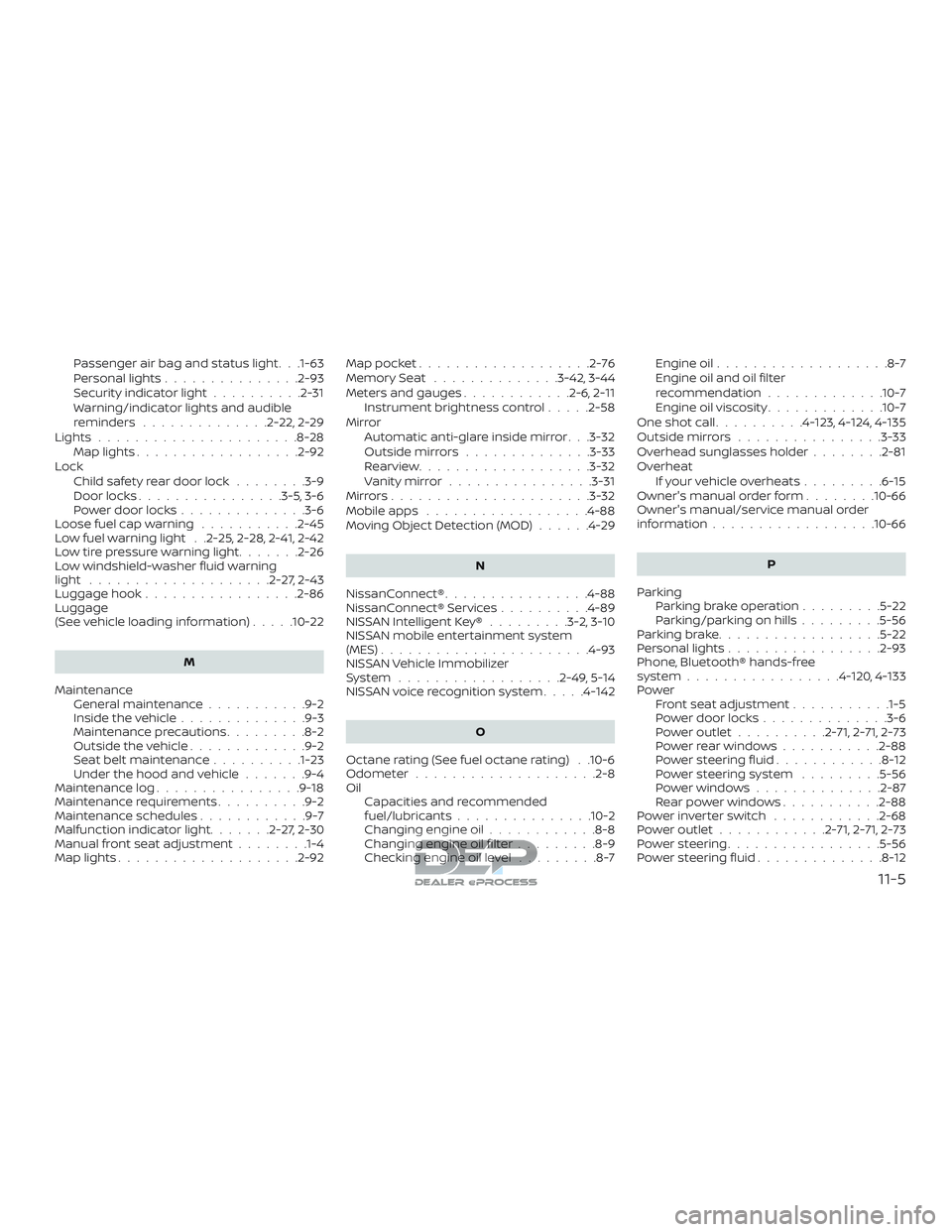
Passenger air bag and status light . . .1-63
Personal lights...............2-93
Security indicator light ..........2-31
Warning/indicator lights and audible
reminders ..............2-22,2-29
Lights......................8-28 Maplights..................2-92
Lock Child safety rear door lock ........3-9
Door locks ................3-5,3-6
Power door locks ..............3-6
Loose fuel cap warning ...........2-45
Low fuel warning light . .2-25, 2-28, 2-41, 2-42
Low tire pressure warning light .......2-26
Low windshield-washer fluid warning
light ....................2-27,2-43
Luggage hook .................2-86
Luggage
(See vehicle loading information) .....10-22
M
Maintenance General maintenance ...........9-2
Insidethevehicle..............9-3
Maintenance precautions .........8-2
Outsidethevehicle.............9-2
Seat belt maintenance ..........1-23
Under the hood and vehicle .......9-4
Maintenance log ................9-18
Maintenance requirements ..........9-2
Maintenance schedules ............9-7
Malfunctionindicatorlight.......2-27,2-30
Manual front seat adjustment ........1-4
Maplights....................2-92 Map pocket
...................2-76
Memory Seat ..............3-42,3-44
Meters and gauges ............2-6,2-11
Instrument brightness control .....2-58
Mirror Automatic anti-glare inside mirror . . .3-32
Outsidemirrors..............3-33
Rearview...................3-32
Vanitymirror................3-31
Mirrors......................3-32
Mobile apps ..................4-88
Moving Object Detection (MOD) ......4-29
N
NissanConnect® ................4-88
NissanConnect® Services ..........4-89
NISSAN Intelligent Key® .........3-2,3-10
NISSAN mobile entertainment system
(MES) .......................4-93
NISSAN Vehicle Immobilizer
System ..................2-49,5-14
NISSAN voice recognition system .....4-142
O
Octane rating (See fuel octane rating) . .10-6
Odometer ....................2-8
Oil Capacities and recommended
fuel/lubricants...............10-2
Changing engine oil ............8-8
Changing engine oil filter .........8-9
Checking engine oil level .........8-7Engine oil
...................8-7
Engine oil and oil filter
recommendation .............10-7
Engine oil viscosity .............10-7
One shot call ..........4-123,4 -124, 4-135
Outsidemirrors................3-33
Overhead sunglasses holder ........2-81
Overheat Ifyourvehicleoverheats.........6-15
Owner's manual order form ........10-66
Owner's manual/service manual order
information..................10-66
P
Parking Parking brake operation .........5-22
P a
rking/parkingonhills.........5-56
Parkingbrake................. .5-22
Personal lights .................2-93
Phone, Bluetooth® hands-free
system.................4-120,4-133
Power Front seat adjustment ...........1-5
Power door locks ..............3-6
Poweroutlet..........2-71,2-71,2-73
Powerrearwindows...........2-88
Powersteeringfluid............8-12
Power steering system .........5-56
Powerwindows..............2-87
Rearpowerwindows...........2-88
Powerinverterswitch ............2-68
Poweroutlet............2 -71, 2-71, 2-73
Powersteering................ .5-56
Powersteeringfluid..............8-12
11-5
Page 639 of 650
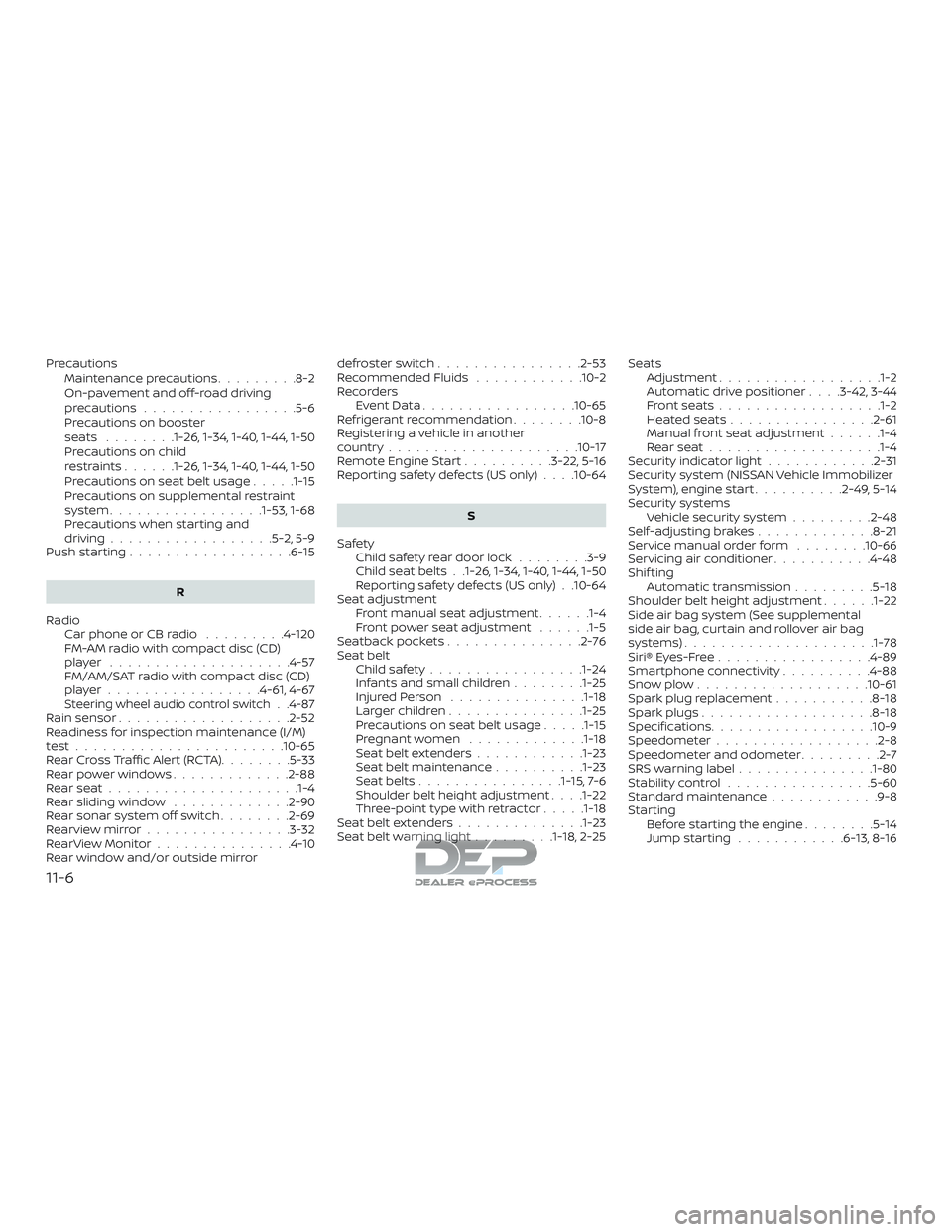
PrecautionsMaintenance precautions .........8-2
On-pavement and off-road driving
precautions .................5-6
Precautions on booster
seats ........1-26, 1-34, 1-40, 1-44, 1-50
Precautions on child
restraints......1-26, 1-34, 1-40, 1-44, 1-50
Precautions on seat belt usage .....1-15
Precautions on supplemental restraint
system .................1-53, 1-68
Precautions when starting and
driving ..................5-2,5-9
Push starting ..................6-15
R
Radio Car phone or CB radio .........4-120
FM-AM radio with compact disc (CD)
player ....................4-57
FM/AM/SAT radio with compact disc (CD)
player.................4-61,4-67
Steering wheel audio control switch. .4-87
Rain sensor ...................2-52
Readiness for inspection maintenance (I/M)
test.......................10-65
RearCrossTrafficAlert(RCTA)........5-33
Rearpowerwindows.............2-88
Rearseat.....................1-4
Rearslidingwindow .............2-90
Rear sonar system off switch ........2-69
Rearviewmirror................3-32
RearViewMonitor...............4-10
Rear window and/or outside mirror defrosterswitch................2-53
Recommended Fluids
............10-2
Recorders EventData.................10-65
Refrigerant recommendation ........10-8
Registering a vehicle in another
country .....................10-17
Remote Engine Start ..........3-22,5-16
Reporting safety defects (US only) . . . .10-64
S
Safety Child safety rear door lock ........3-9
Child seat belts . .1-26, 1-34, 1-40, 1-44, 1-50
Reporting safety defects (US only) . .10-64
Seat adjustment Front manual seat adjustment ......1-4
Front power seat adjustment ......1-5
Seatback pockets ...............2-76
Seat belt Childsafety.................1-24
Infants and small children ........1-25
InjuredPerson ...............1-18
Largerchildren.............. .1-25
Precautions on seat belt usage .....1-15
Pregnant women .............1-18
Seat belt extenders ............1-23
Seat belt maintenance ..........1-23
Seatbelts................1-15, 7-6
Shoulder belt height adjustment . . . .1-22
Three-pointtypewithretractor.....1-18
Seat belt extenders ..............1-23
Seatbeltwarninglight.........1-18, 2-25 Seats
Adjustment ..................1-2
Automatic drive positioner ....3-42,3-44
Frontseats..................1-2
Heatedseats................2-61
Manual front seat adjustment ......1-4
Rearseat...................1-4
Security indicator light ............2-31
Security system (NISSAN Vehicle Immobilizer
System), engine start ..........2-49,5-14
Security systems Vehicle security system .........2-48
Self-adjusting brakes .............8-21
Service manual order form ........10-66
Servicing air conditioner ...........4-48
Shif ting Automatic transmission .........5-18
Shoulder belt height adjustment ......1-22
Side air bag system (See supplemental
side air
bag, curtain and rollover air bag
systems) .................... .1-78
Siri® Eyes-Free .................4-89
Smartphone connectivity ..........4-88
Snowplow...................10-61
Spark plug replacement ...........8-18
Spark plugs ...................8-18
Specifications ..................10-9
Speedometer ..................2-8
Speedometer and odometer .........2-7
SRS warning label ...............1-80
Stability control ................5-60
Standard maintenance ............9-8
Starting Before starting the engine ........5-14
Jumpstarting ............6-13, 8-16
11-6
Page 650 of 650
2018 TITAN
OWNER’S MANUAL
and MAINTENANCE INFORMATION
For your safety, read carefully and keep in this vehicle.
2018 NISSAN TITAN A61-D
A61-D
Printing : August 2017
Publication No.:
Printed in U.S.A. OM18EA 0A61U0