engine NISSAN TITAN 2019 Owner´s Manual
[x] Cancel search | Manufacturer: NISSAN, Model Year: 2019, Model line: TITAN, Model: NISSAN TITAN 2019Pages: 682, PDF Size: 7.99 MB
Page 668 of 682
FUEL RECOMMENDATION
Diesel engine
Commercially available diesel fuel is ad-
justed seasonally for cold temperatures.
NISSAN recommends the use of diesel fuel
that has been seasonally adjusted for tem-
peratures below 32°F (0°C)
Diesel fuel of above 42 cetane minimum
above 32°F (0°C); 45 cetane minimum be-
low 32°F (0°C) and with less than 15 ppm of
sulfur must be used.
A cetane number below 42 can cause poor
starting, excessive white smoke, and poor
idling. A cetane number above 55 can in-
crease smoke at peak torque conditions.
If two types of diesel fuel are available, use
summer or winter fuel properly according
to the following temperature conditions.∙ Above 32°F (0°C) . . . Summer type diesel
fuel.
∙ Below 32°F (0°C) . . . Winter type diesel fuel.
If you are in any doubt, it is recommended
that you consult a NISSAN dealer.
CAUTION
∙ Do not use home heating oil, petro- leum, biodiesel (more than 10%) or
other alternate fuels in your diesel en-
gine. The use of those can cause en-
gine damage.
∙ Do not use summer fuel at tempera- tures below 20°F (- 7°C). The cold tem-
peratures will cause wax to form in
the fuel. As a result, it may prevent the
engine from running smoothly.
B10 fuel
B10 fuel is a mixture of approximately 10%
biodiesel and 90% petroleum diesel. Your
vehicle was designed to run on blends of
biodiesel up to B10 (B1-B10). Operating your
vehicle on higher blends is not recom-
mended. Your vehicle’s engine, exhaust
catalyst filter and particulate filter, and fuel
system components may be damaged if
any of these blends are used.
U.S. government regulations require that
biodiesel blends between B6 and B10 are
identified at fuel dispensing pumps by a
label with the common abbreviation or the
appropriate percentage for that region. B6
--B10 blends must meet prescribed quality
standards specified by ASTM D7467.
B10 fuel storage
Biodiesel degrades more quickly than pure
petroleum-based diesel. When storing a
vehicle that runs on a biodiesel blend, it is
important to keep the following in mind:
∙ If storing a vehicle for longer than one month, empty the fuel tank of biodiesel.
∙ To prepare a vehicle to run af ter pro- longed storage, fill the fuel tank with a
pure petroleum-based diesel fuel and
run your vehicle for at least half an hour.
∙ Fuel system seals, plastics and steel parts can be damaged by degraded or
oxidized biodiesel.
During cold weather, biodiesel fuel may
need to be stored in a heated storage tank
in order to prevent it from gelling or solidi-
f ying.
Diesel Exhaust Fluid (DEF)
DEF is a solution composed of urea and
de-ionized water. In diesel vehicles, it is
used as part of the exhaust system to
break down harmful NOx emissions into
nitrogen and water. It is important to keep
your vehicle’s DEF tank filled properly.
Capacities and Specifications8-3
Page 670 of 682

ENGINE OIL AND OIL FILTER
RECOMMENDATIONS
Selecting the correct oil
NOTE:
The factory fill oil may include a red dye
that that is added for manufacturing
quality processes. The dye makes the oil
appear to be red. This is normal. The red
dye will be flushed from the engine af ter
approximately 4-5 oil changes.It is essential to choose the correct grade,
quality and viscosity engine oil to ensure
satisfactory engine life and performance.
For additional information, refer to “Recom-
mended fluids/lubricants and capacities”
in this section. NISSAN recommends the
use of an energy conserving oil in order to
improve fuel economy.Select only engine oils that meet the Cum-
mins® Engineering Standard (CES) classifi-
cation (CES 20081) and American Petro-
leum Institute (API) certification (API CJ-4,
Low Ash Oil) and SAE viscosity standard
(10W-30 or 5W-40). These oils have the API
certification mark and CES 20081 on the
container. Oils which do not have the
specified information on the label should
not be used as they could cause engine
damage.
Oil additives
NISSAN does not recommend the use of oil
additives. The use of an oil additive is not
necessary when the proper oil type is used
and maintenance intervals are followed.
Oil which may contain foreign matter or
has been previously used should not be
used.LTI2207
Capacities and Specifications8-5
Page 671 of 682
Oil viscosity
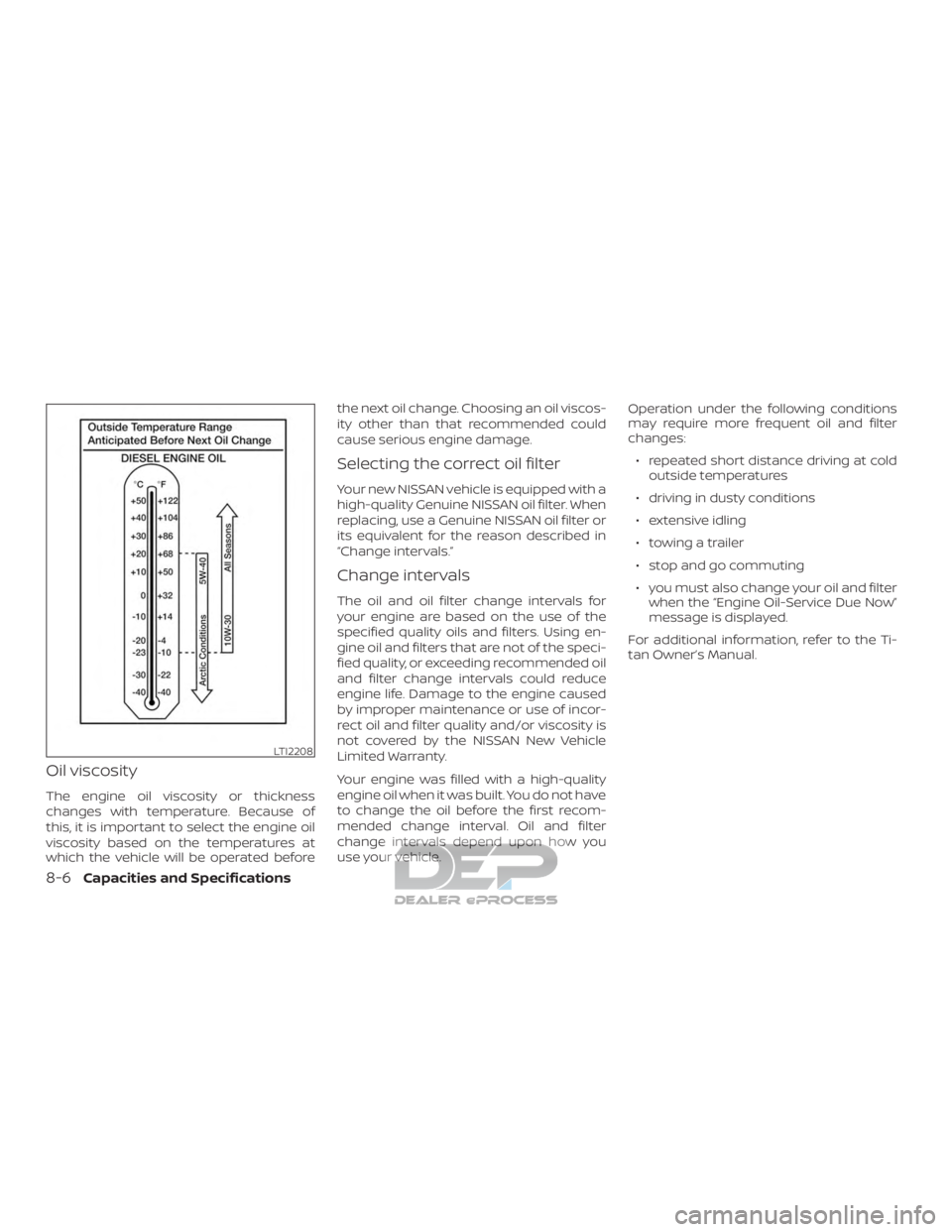
The engine oil viscosity or thickness
changes with temperature. Because of
this, it is important to select the engine oil
viscosity based on the temperatures at
which the vehicle will be operated beforethe next oil change. Choosing an oil viscos-
ity other than that recommended could
cause serious engine damage.
Selecting the correct oil filter
Your new NISSAN vehicle is equipped with a
high-quality Genuine NISSAN oil filter. When
replacing, use a Genuine NISSAN oil filter or
its equivalent for the reason described in
“Change intervals.”
Change intervals
The oil and oil filter change intervals for
your engine are based on the use of the
specified quality oils and filters. Using en-
gine oil and filters that are not of the speci-
fied quality, or exceeding recommended oil
and filter change intervals could reduce
engine life. Damage to the engine caused
by improper maintenance or use of incor-
rect oil and filter quality and/or viscosity is
not covered by the NISSAN New Vehicle
Limited Warranty.
Your engine was filled with a high-quality
engine oil when it was built. You do not have
to change the oil before the first recom-
mended change interval. Oil and filter
change intervals depend upon how you
use your vehicle.
Operation under the following conditions
may require more frequent oil and filter
changes:
∙ repeated short distance driving at cold outside temperatures
∙ driving in dusty conditions
∙ extensive idling
∙ towing a trailer
∙ stop and go commuting
∙ you must also change your oil and filter when the “Engine Oil-Service Due Now”
message is displayed.
For additional information, refer to the Ti-
tan Owner’s Manual.
LTI2208
8-6Capacities and Specifications
Page 672 of 682
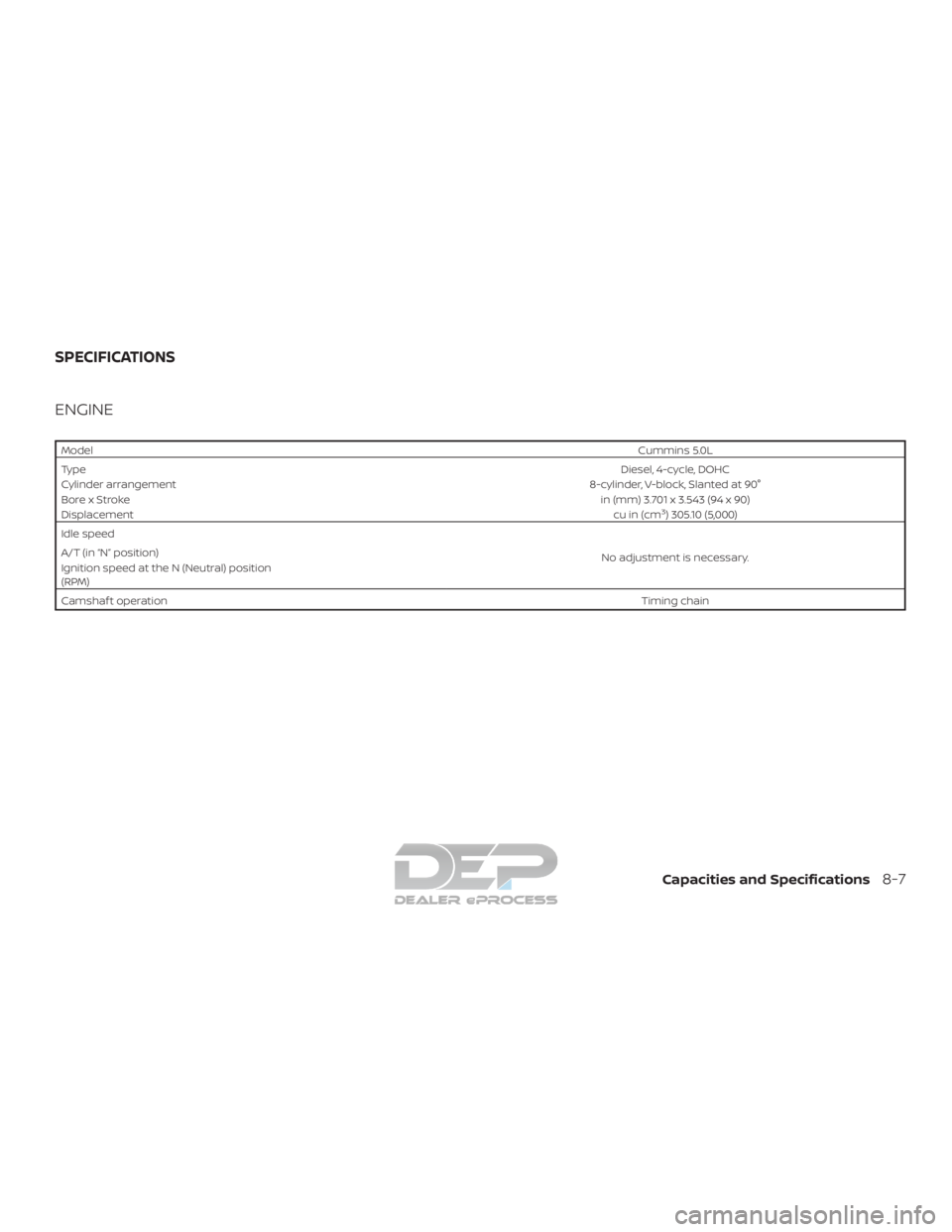
ENGINE
ModelCummins 5.0L
Type Diesel, 4-cycle, DOHC
Cylinder arrangement 8-cylinder, V-block, Slanted at 90°
Bore x Stroke in (mm) 3.701 x 3.543 (94 x 90)
Displacement cu in (cm
3) 305.10 (5,000)
Idle speed
No adjustment is necessary.
A/T (in “N” position)
Ignition speed at the N (Neutral) position
(RPM)
Camshaf t operation
Timing chain
SPECIFICATIONS
Capacities and Specifications8-7
Page 673 of 682
WARNING
A vehicle equipped with Four-Wheel
Drive (4WD) should never be tested us-
ing a two wheel dynamometer (such as
the dynamometers used by some
states for emissions testing), or similar
equipment. Make sure you inform the
test facility personnel that your vehicle
is equipped with 4WD before it is placed
on a dynamometer. Using the wrong
test equipment may result in transmis-
sion damage or unexpected vehicle
movement which could result in serious
vehicle damage or personal injury.
Due to legal requirements in some states
and Canadian Provinces, your vehicle may
be required to be in what is called the
“ready condition” for an
Inspection/Maintenance (I/M) test of the
emission control system.
If a powertrain system component is re-
paired or the battery is disconnected, the
vehicle may be reset to a “not ready” condi-
tion.
The vehicle is set to the “ready condition”
when it is driven through certain driving
patterns. Usually, the ready condition can
be obtained by ordinary usage of the ve-
hicle.
READINESS FOR INSPECTION/
MAINTENANCE (I/M) TEST (diesel
engine only)
8-8Capacities and Specifications
Page 674 of 682
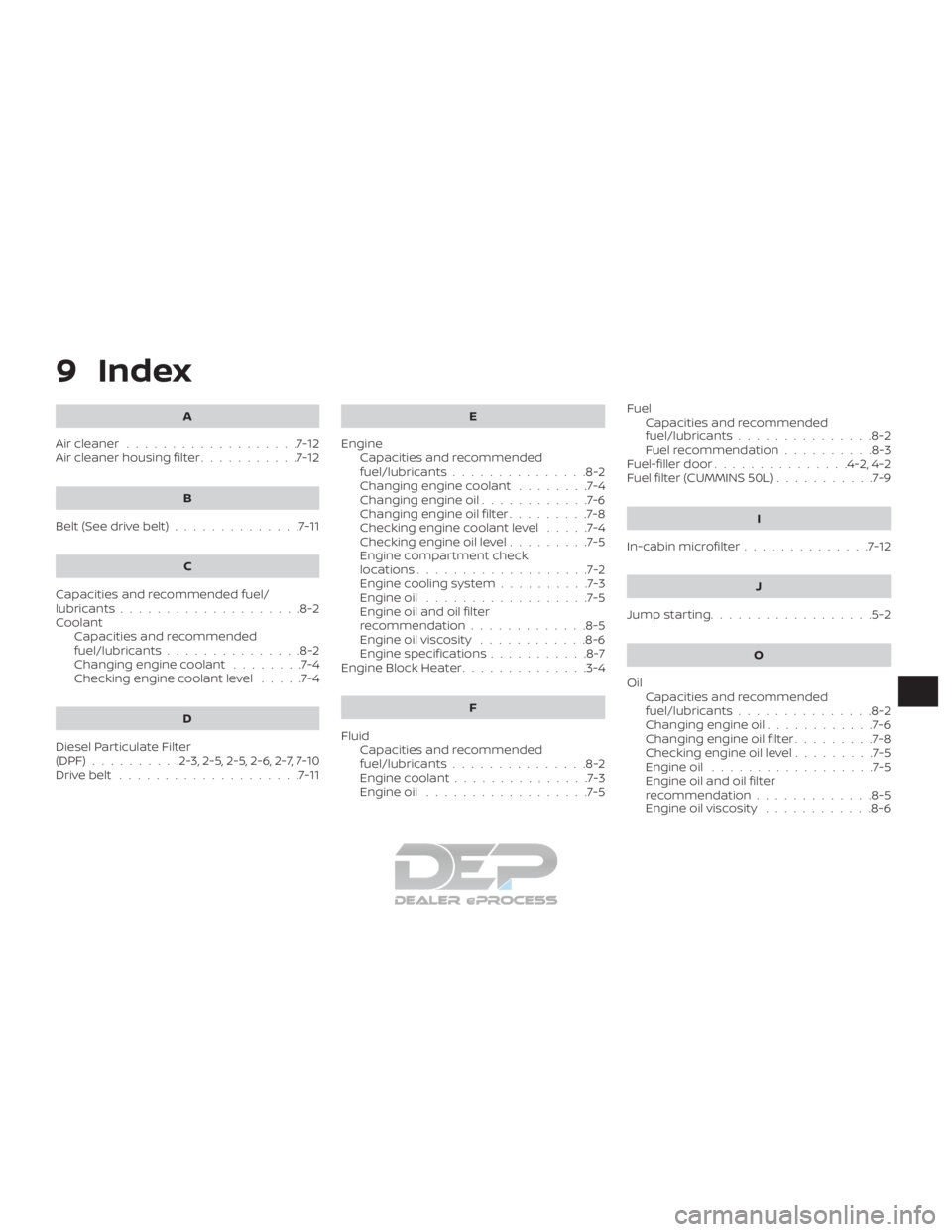
9 Index
A
Air cleaner ...................7-12
Air cleaner housing filter ...........7-12
B
Belt(Seedrivebelt)..............7-11
C
Capacities and recommended fuel/
lubricants....................8-2
Coolant Capacities and recommended
fuel/lubricants...............8-2
Changing engine coolant ........7-4
Checking engine coolant level .....7-4
D
Diesel Particulate Filter
(DPF) ..........2-3,2-5,2-5,2-6,2-7,7-10
Drivebelt ....................7-11 E
Engine Capacities and recommended
fuel/lubricants...............8-2
Changing engine coolant ........7-4
Changing engine oil ............7-6
Changing engine oil filter .........7-8
Checking engine coolant level .....7-4
Checking engine oil level .........7-5
Engine compartment check
locations...................7-2
Engine cooling system ..........7-3
Engine oil ..................7-5
Engine oil and oil filter
recommendation .............8-5
Engine oil viscosity ............8-6
Engine specifications ...........8-7
Engine Block Heater ..............3-4
F
Fluid Capacities and recommended
fuel/lubricants...............8-2
Engine coolant ...............7-3
Engine oil ..................7-5 Fuel
Capacities and recommended
fuel/lubricants...............8-2
Fuel recommendation ..........8-3
Fuel-filler door ...............4-2,4-2
Fuel filter (CUMMINS 50L) ...........7-9
I
In-cabinmicrofilter..............7-12
J
Jumpstarting..................5-2
O
Oil Capacities and recommended
fuel/lubricants...............8-2
Changing engine oil ............7-6
Changing engine oil filter .........7-8
Checking engine oil level .........7-5
Engine oil ..................7-5
Engine oil and oil filter
recommendation .............8-5
Engine oil viscosity ............8-6
Page 675 of 682
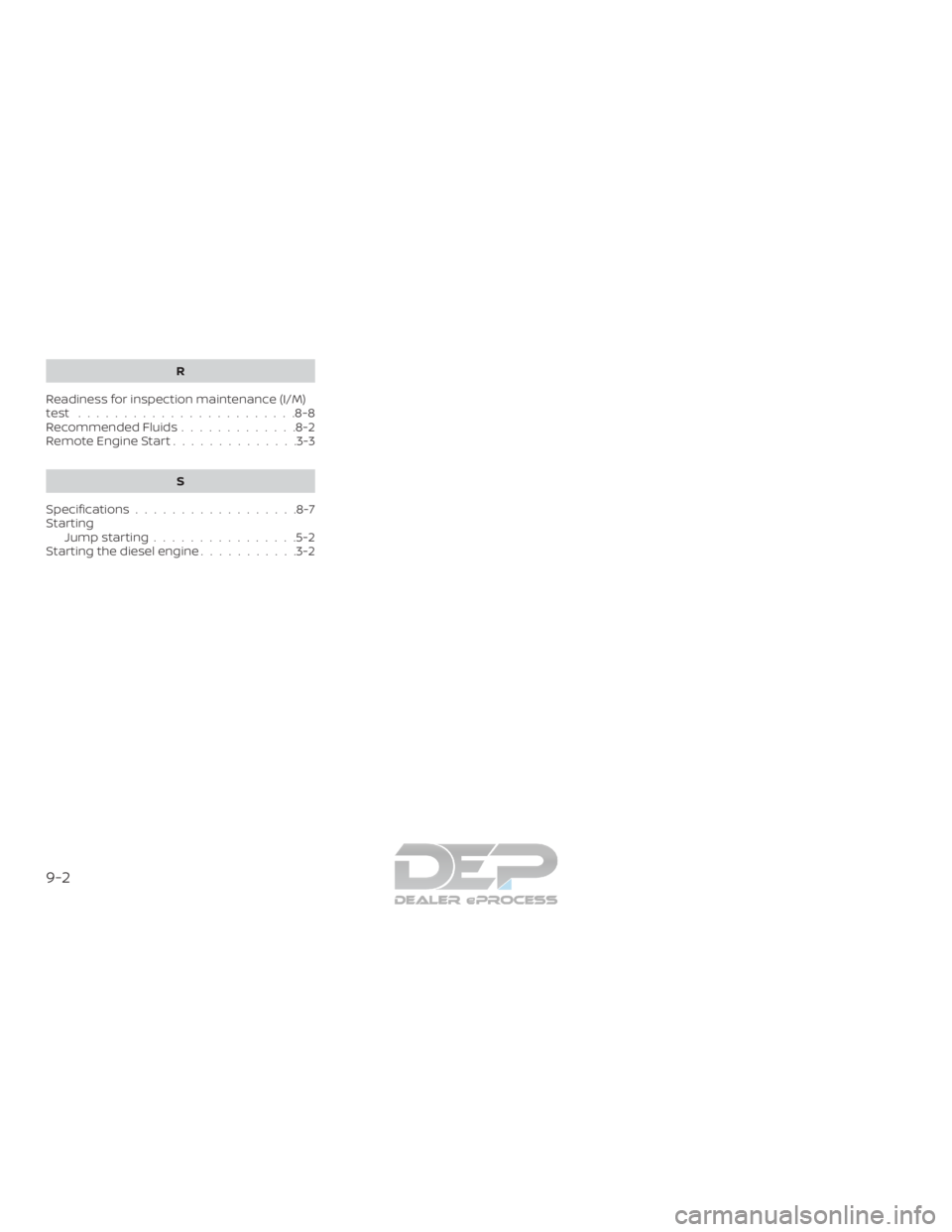
R
Readiness for inspection maintenance (I/M)
test ........................8-8
Recommended Fluids .............8-2
Remote Engine Start ..............3-3
S
Specifications ..................8-7
Starting Jumpstarting................5-2
Starting the diesel engine ...........3-2
9-2
Page 681 of 682
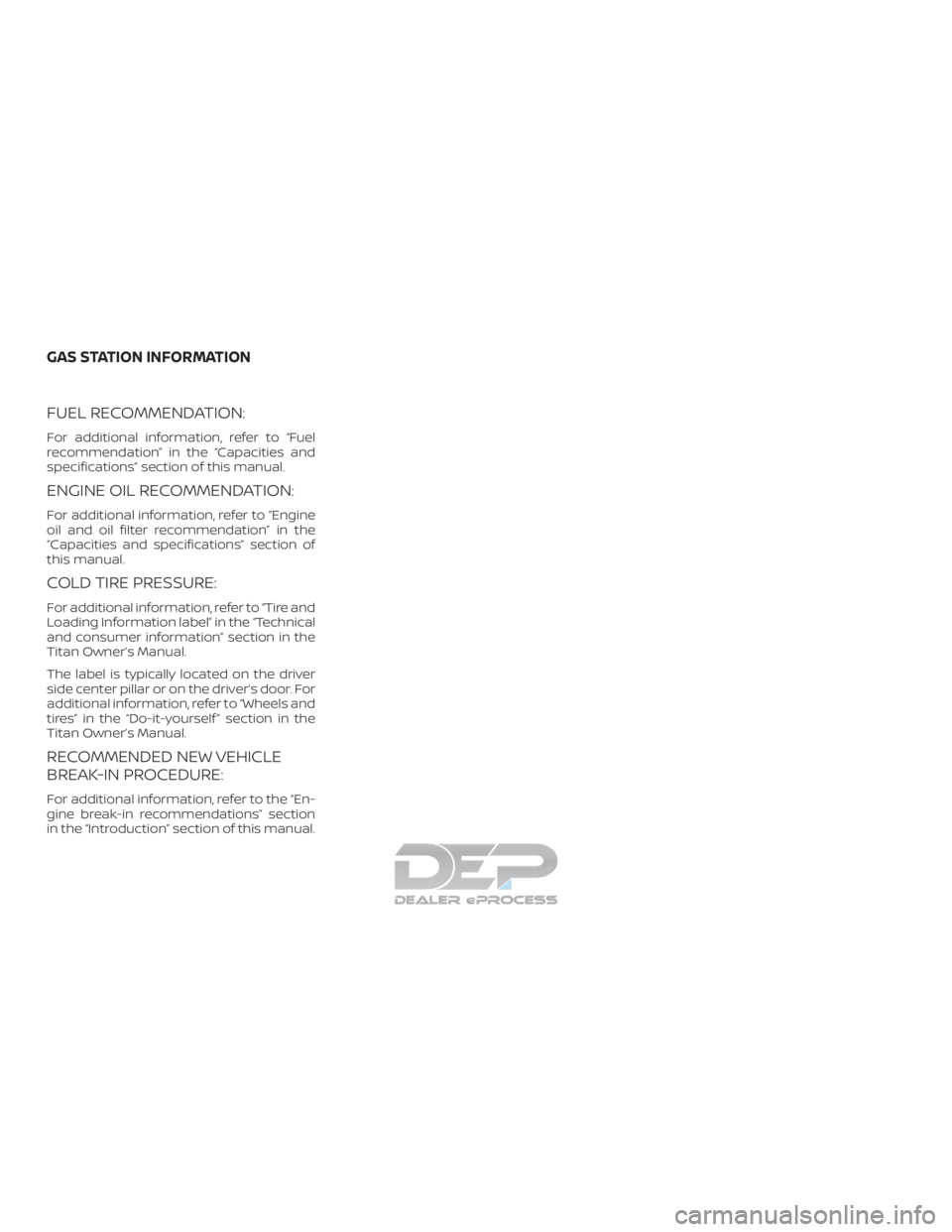
FUEL RECOMMENDATION:
For additional information, refer to “Fuel
recommendation” in the “Capacities and
specifications” section of this manual.
ENGINE OIL RECOMMENDATION:
For additional information, refer to “Engine
oil and oil filter recommendation” in the
“Capacities and specifications” section of
this manual.
COLD TIRE PRESSURE:
For additional information, refer to “Tire and
Loading Information label” in the “Technical
and consumer information” section in the
Titan Owner’s Manual.
The label is typically located on the driver
side center pillar or on the driver’s door. For
additional information, refer to “Wheels and
tires” in the “Do-it-yourself ” section in the
Titan Owner’s Manual.
RECOMMENDED NEW VEHICLE
BREAK-IN PROCEDURE:
For additional information, refer to the “En-
gine break-in recommendations” section
in the “Introduction” section of this manual.
GAS STATION INFORMATION