ABS NISSAN TITAN 2020 Owner´s Manual
[x] Cancel search | Manufacturer: NISSAN, Model Year: 2020, Model line: TITAN, Model: NISSAN TITAN 2020Pages: 657, PDF Size: 5.1 MB
Page 451 of 657
WARNING
The Brake Assist is only an aid to assist
braking operation and is not a collision
warning or avoidance device. It is the
driver’s responsibility to stay alert,
drive safely and be in control of the ve-
hicle at all times. • The ABLS system uses automatic brak-
ing to transfer power from a slipping drive
wheel to the wheel on the same axle with
more traction. The ABLS system applies
braking to the slipping wheel, which helps
redirect power to the other wheel.
• On 4–Wheel Drive (4WD) models the ABLS system operates in both 4H and 4LO
modes. If 4WD mode is engaged, the
ABLS system operates for both drive ax-
les. On 2–Wheel Drive vehicles, the ABLS
system operates on the drive axle only.
• The ABLS system is always on. In some conditions, the system may automati-
cally turn the ABLS system off. If the sys-
tem is automatically turned off, normal
brake function will continue. ABLS will
function even when the Vehicle Dynamic
Control system is turned off.
• The ABLS system does not operate if both wheels on a drive axle are slipping.WARNING
• The ABLS system helps provide in-
creased traction, but will not prevent
accidents due to abrupt steering op-
eration or by careless driving or dan-
gerous driving practices. Reduce ve-
hicle speed and be especially careful
when driving and cornering on slip-
pery surfaces. Always drive carefully.
• Do not modif y the vehicle’s suspen-
sion. If suspension parts such as
shock absorbers, struts, springs, sta-
bilizer bars, bushings and wheels are
not NISSAN approved for your vehicle
or are extremely deteriorated, the
ABLS system may not operate prop-
erly. This could adversely affect ve-
hicle handling performance, and the
slip indicator light may illuminate.
• If brake related parts such as brake
pads, rotors and calipers are not
NISSAN recommended or are ex-
tremely deteriorated, the ABLS sys-
tem may not operate properly and
the slip indicator light may
illuminate.
ACTIVE BRAKE LIMITED SLIP (ABLS)
SYSTEM
5-118Starting and driving
Page 453 of 657
When the VDC OFF switch is used to turn off
the system, the VDC system still operates
to prevent one drive wheel from slipping by
transferring power to a non-slipping drive
wheel. The
indicator light flashes if this
occurs. All other VDC functions are off and
the
indicator light will not flash.
The VDC system is automatically reset to
ON when the ignition switch is placed in the
OFF position then back to the ON position.
The computer has a built-in diagnostic fea-
ture that tests the system each time you
start the engine and move the vehicle for-
ward or in reverse at a slow speed. When
the self-test occurs, you may hear a clunk
noise and/or feel a pulsation in the brake
pedal. This is normal and is not an indica-
tion of a malfunction.
WARNING
• The VDC system is designed to help
the driver maintain stability but does
not prevent accidents due to abrupt
steering operation at high speeds or
by careless or dangerous driving
techniques. Reduce vehicle speed
and be especially careful when driv-
ing and cornering on slippery sur-
faces and always drive carefully. •
Do not modif y the vehicle's suspen-
sion. If suspension parts such as
shock absorbers, struts, springs, sta-
bilizer bars, bushings and wheels are
not NISSAN recommended for your
vehicle or are extremely deterio-
rated, the VDC system may not oper-
ate properly. This could adversely af-
fect vehicle handling performance,
and the
indicator light may flash
or theindicator light may
illuminate.
• If brake related parts such as brake
pads, rotors and calipers are not
NISSAN recommended or are ex-
tremely deteriorated, the VDC sys-
tem may not operate properly and
the
indicator light may
illuminate.
• If engine control related parts are not
NISSAN recommended or are ex-
tremely deteriorated, the
indica-
tor light may illuminate.
• When driving on extremely inclined
surfaces such as higher banked cor-
ners, the VDC system may not oper-
ate properly and the
indicator
light may flash or theindicator
light may illuminate. Do not drive on
these types of roads. •
When driving on an unstable surface
such as a turntable, ferry, elevator or
ramp, the
indicator light may
flash or theindicator light may
illuminate. This is not a malfunction.
Restart the engine af ter driving onto
a stable surface.
• If wheels or tires other than the
NISSAN recommended ones are
used, the VDC system may not oper-
ate properly and the
indicator
light may flash or theindicator
light may illuminate.
• The VDC system is not a substitute
for winter tires or tire chains on a
snow covered road.
BRAKE FORCE DISTRIBUTION
During braking while driving through turns,
the system optimizes the distribution of
force to each of the front and rear wheels
depending on the radius of the turn.
5-120Starting and driving
Page 454 of 657
WARNING
• The VDC system is designed to help
the driver maintain stability but does
not prevent accidents due to abrupt
steering operation at high speeds or
by careless or dangerous driving
techniques. Reduce vehicle speed
and be especially careful when driv-
ing and cornering on slippery sur-
faces and always drive carefully.
• Do not modif y the vehicle's suspen-
sion. If suspension parts such as
shock absorbers, struts, springs, sta-
bilizer bars, bushings and wheels are
not NISSAN recommended for your
vehicle or are extremely deterio-
rated, the VDC system may not oper-
ate properly. This could adversely af-
fect vehicle handling performance,
and the
indicator light may flash
or theindicator light may
illuminate.
• If brake related parts such as brake
pads, rotors and calipers are not
NISSAN recommended or are ex-
tremely deteriorated, the VDC sys-
tem may not operate properly and
the
indicator light may
illuminate. •
If engine control related parts are not
NISSAN recommended or are ex-
tremely deteriorated, the
indica-
tor light may illuminate.
• When driving on extremely inclined
surfaces such as higher banked cor-
ners, the VDC system may not oper-
ate properly and the
indicator
light may flash or theindicator
light may illuminate. Do not drive on
these types of roads.
• When driving on an unstable surface
such as a turntable, ferry, elevator or
ramp, the
indicator light may
flash or theindicator light may
illuminate. This is not a malfunction.
Restart the engine af ter driving onto
a stable surface.
• If wheels or tires other than the
NISSAN recommended ones are
used, the VDC system may not oper-
ate properly and the
indicator
light may flash or theindicator
light may illuminate.
• The VDC system is not a substitute
for winter tires or tire chains on a
snow covered road.
WARNING
• Never rely solely on the hill descent
control system to control vehicle
speed when driving on steep down-
hill grades. Always drive carefully and
attentively when using the hill de-
scent control system and decelerate
the vehicle speed by depressing the
brake pedal if necessary. Be espe-
cially careful when driving on frozen,
muddy or extremely steep downhill
roads. Failure to control vehicle
speed may result in a loss of control
of the vehicle and possible serious
injury or death.
• The hill descent control may not con-
trol the vehicle speed on a hill under
all load or road conditions. Always be
prepared to depress the brake pedal
to control vehicle speed. Failure to do
so may result in a collision or serious
personal injury.
The hill descent control system can only be
activated when the 4H or 4LO position is
engaged.
HILL DESCENT CONTROL SYSTEM (if
so equipped)
Starting and driving5-121
Page 506 of 657
WARNING
• Operating the engine with the air
cleaner removed can cause you or
others to be burned. The air cleaner
not only cleans the air, it stops the
flame if the engine backfires. If it isn't
there, and the engine backfires, you
could be burned. Do not drive with
the air cleaner removed, and be care-
ful when working on the engine with
the air cleaner removed. •
Never pour fuel into the throttle body
or attempt to start the engine with
the air cleaner removed. Doing so
could result in serious injury.
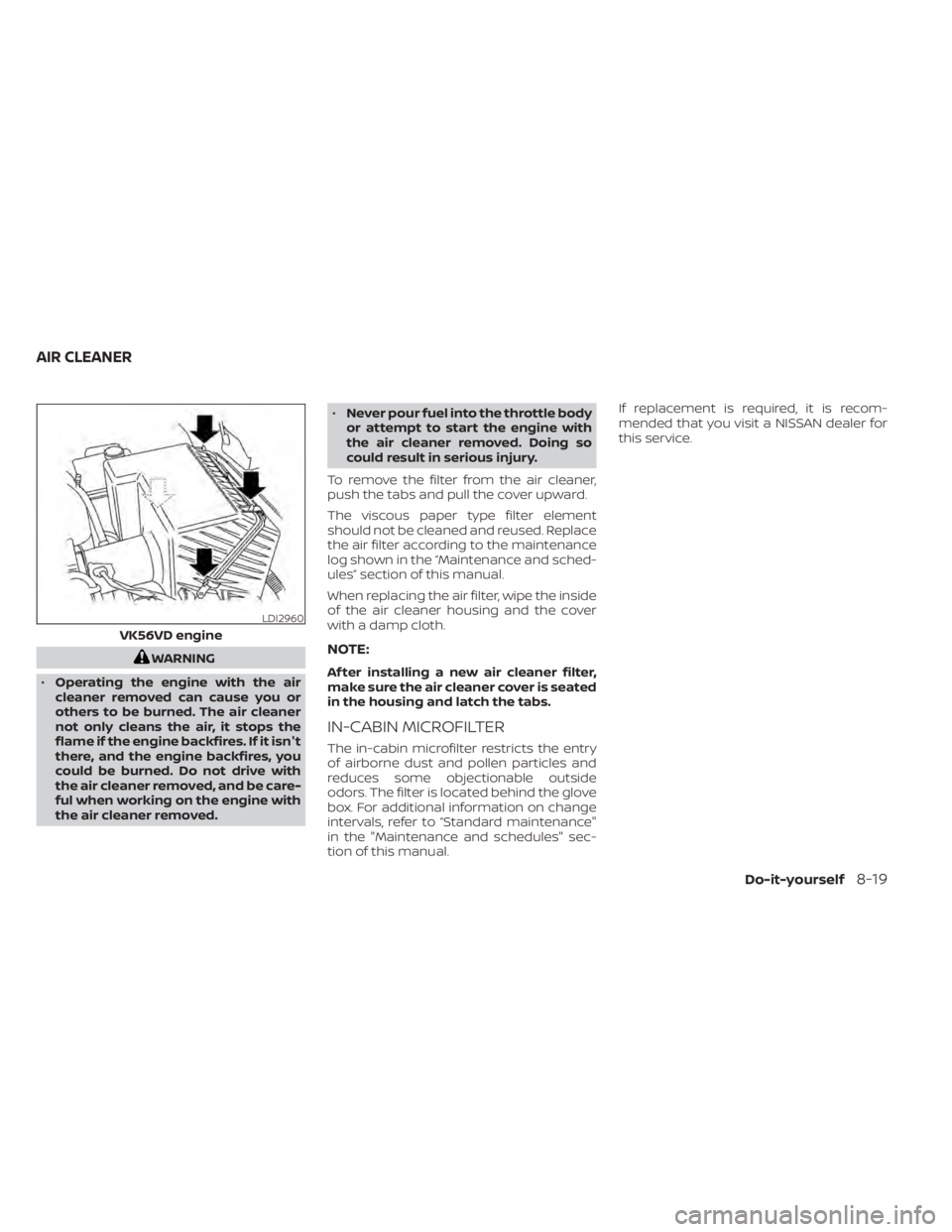
To remove the filter from the air cleaner,
push the tabs and pull the cover upward.
The viscous paper type filter element
should not be cleaned and reused. Replace
the air filter according to the maintenance
log shown in the “Maintenance and sched-
ules” section of this manual.
When replacing the air filter, wipe the inside
of the air cleaner housing and the cover
with a damp cloth.NOTE:
Af ter installing a new air cleaner filter,
make sure the air cleaner cover is seated
in the housing and latch the tabs.
IN-CABIN MICROFILTER
The in-cabin microfilter restricts the entry
of airborne dust and pollen particles and
reduces some objectionable outside
odors. The filter is located behind the glove
box. For additional information on change
intervals, refer to “Standard maintenance"
in the "Maintenance and schedules" sec-
tion of this manual. If replacement is required, it is recom-
mended that you visit a NISSAN dealer for
this service.
LDI2960
VK56VD engine
AIR CLEANER
Do-it-yourself8-19
Page 591 of 657
1,000 lbs. (453 kg). Class IV hitches used for
weight distributing are rated up to 14,000
lbs. (6,350 kg) gross trailer weight (GTW)
with a maximum trailer tongue weight (TW)
of 1,400 lbs. (635 kg). A Class IV hitch usually
has a 2" square receiver opening. A higher
class drawbar does not increase the tow-
ing capacity of the hitch. To use this class of
hitch for weight distribution requires a
weight distribution system. Class IV hitches
attach to the vehicle frame only. A weight
distributing hitch should be used to tow
trailers that weigh over 5,000 lbs. (2,268 kg).
Your vehicle may be equipped with Class IV
weigh distributing trailer hitch that has a
14,000 lbs. (6,350 kg) maximum weight rat-
ing, but your vehicle is only capable of tow-
ing the maximum trailer weights shown in
the “Towing load/specification” chart in this
section.
5th wheel/gooseneck
A 5th wheel or gooseneck trailer can be
towed by installing a 5th wheel or goose-
neck trailer hitch. These types of hitches
are mounted in the bed of the pick-up. A
professional trailer equipment supplier
should install these hitches as it is very im-
portant to mount the hitch correctly to dis-tribute the king pin weight for the proper
load carrying and sway control perfor-
mance.
The king pin weight should be 15% of the
fully loaded trailer. Make sure the king pin
weight does not cause the gross vehicle
weight to exceed the Gross Maximum
Weight Rating or the rear axle weight to
exceed the Rear Gross Axle Weight rating.
For additional information, refer to “Maxi-
mum load limits” in this section.
The weight of the trailer should not exceed
the maximum towing capacity for the ve-
hicle. For additional information, refer to
“Towing load/specification” chart in this
section.
Make sure the trailer design allows for the
correct vehicle to trailer clearances before
purchasing a 5th wheel trailer.
WARNING
• The hitch should not be attached to
or affect the operation of the impact-
absorbing bumper.
• Do not use axle-mounted hitches.
• Do not modif y the vehicle exhaust
system, brake system, etc. to install a
trailer hitch. •
To reduce the possibility of addi-
tional damage if your vehicle is
struck from the rear, where practical,
remove the receiver when not in use.
• Regularly check that all trailer hitch
mounting bolts are securely
mounted.
• When towing with the hitch ball
mounted to the rear bumper, do not
make sharp turns. The trailer may
contact the bumper and cause dam-
age to the bumper or trailer.
• When towing a 5th wheel trailer, do
not make sharp turns while driving or
backing. The trailer may contact the
vehicle and cause damage to both
the trailer and vehicle.
10-42Technical and consumer information
Page 601 of 657
• Be certain your rearview mirrors conformto all federal, state or local regulations. If
not, install any mirrors required for towing
before driving the vehicle.
• Determine the overall height of the ve- hicle and trailer so the required clearance
is known.
Trailer towing tips
In order to gain skill and an understanding
of the vehicle's behavior, you should prac-
tice turning, stopping and backing up in an
area which is free from traffic. Steering sta-
bility and braking performance will be
somewhat different than under normal
driving conditions.
• Always secure items in the trailer to pre-vent load shif t while driving.
• Lock the trailer hitch coupler with a pin or lock to prevent the coupler from inadver-
tently becoming unlatched.
• Avoid abrupt starts, acceleration or stops.
• Avoid sharp turns or lane changes.
• Always drive your vehicle at a moderate speed. • When backing up, hold the bottom of the
steering wheel with one hand. Move your
hand in the direction in which you want
the trailer to go. Make small corrections
and back up slowly. If possible, have
someone guide you when you are back-
ing up.
Always block the wheels on both vehicle
and trailer when parking. Parking on a
slope is not recommended; however, if you
must do so:
CAUTION
If you move the shif t selector to the P
(Park) position before blocking the
wheels and applying the parking brake,
transmission damage could occur.
1. Apply and hold the brake pedal.
2. Have someone place blocks on the downhill side of the vehicle and trailer
wheels.
3. Af ter the wheel blocks are in place, slowly release the brake pedal until the
blocks absorb the vehicle load.
4. Apply the parking brake.
5. Shif t the transmission into P (Park). 6. Make sure the
indicator light (if so
equipped) indicates the transfer case is
in 4H, 4LO, or 2H and that the ATP light is
off. If the
indicator light is flashing,
or the ATP light is ON, make sure the
transmission is in P (Park) (A/T) and turn
the 4WD switch to 2WD or 4H. For addi-
tional information, refer to “Automatic
transmission park warning light” in the
“Instruments and controls” section and
“Using 4-wheel drive (4WD)” in the “Start-
ing and driving” section of this manual.
7. Turn off the engine.
To drive away:
1. Start the vehicle.
2. Apply and hold the brake pedal.
3. Shif t the transmission into gear.
4. Release the parking brake.
5. Drive slowly until the vehicle and trailer are clear from the blocks.
6. Apply and hold the brake pedal.
7. Have someone retrieve and store the blocks.
10-52Technical and consumer information
Page 610 of 657
11 Index
A
Active Brake Limited Slip (ABLS)
system....................5-118Aiming control, headlights.........2-52Air bag (See supplemental restraint
system).....................1-52Air bag system
Front (See supplemental front
impact air bag system)
......1-59, 1-74Air bag warning labels............1-81Air bag warning light.........1-81, 2-18Air bag warning light,
supplemental..............1-81, 2-18Air cleaner...................8-19Air cleaner housing filter..........8-19Air conditionerAir conditioner operation. . . .4-32, 4-38Air conditioner specification label. .10-20Air conditioner system refrigerant
recommendations............10-8Air conditioner system refrigerant
and oil recommendations.......10-8Heater and air conditioner
(automatic) (if so equipped)......4-37Heater and air conditioner
controls.................. .4-38Servicing air conditioner........4-42Air flow charts................4-33Alarm system
(See vehicle security system).......2-40
Anchor point locations...........1-32Antenna................... .4-42Anti-lock brake warning light.......2-13Anti-lock Braking System (ABS)......5-116Antifreeze...................5-128Autolight switch...............2-48Automatic
Automatic drive positioner.......3-40Automatic power window switch. . .2-85Driving with automatic
transmission................5-18Automatic anti-glare inside mirror. . . .3-30Automatic door locks.............3-8Automatic drive positioner........3-40Automatic Emergency Braking
(AEB)...................2-13,2-17Automatic Emergency Braking (AEB)
with Pedestrian Detection.........5-80Automatic transmission fluid
temperature gauge.............2-10
B
Battery.................5- 128, 8-14Charge warning light...........2-15Battery replacement............8-25Key fob...................8-25NISSAN Intelligent Key®.........8-26Before starting the engine.........5-16Belt (See drive belt)..............8-17
Blind Spot Warning (BSW)..........5-32Block heater
Engine...................5-129Booster seats................ .1-48Brake
Anti-lock Braking System (ABS). . . .5-116Brake fluid.................8-12Brake light (See stop light).......8-30Brake system...............5-116Brake warning light............2-14Brake wear indicators.......2-21,8-21Parking brake operation.........5-23Self-adjusting brakes...........8-21Brake Assist..................5-117Brake fluid...................8-12Brake system................5-116Brakes.....................8-21Break-in schedule.............5-104Brightness controlInstrument panel.............2-53Bulb check/instrument panel.......2-13Bulb replacement..............8-30
C
C.M.V.S.S. certification label........10-18Capacities and recommended
fuel/lubricants................10-2Car phone or CB radio...........4-86