ECU NISSAN TITAN 2020 Owner´s Manual
[x] Cancel search | Manufacturer: NISSAN, Model Year: 2020, Model line: TITAN, Model: NISSAN TITAN 2020Pages: 657, PDF Size: 5.1 MB
Page 588 of 657
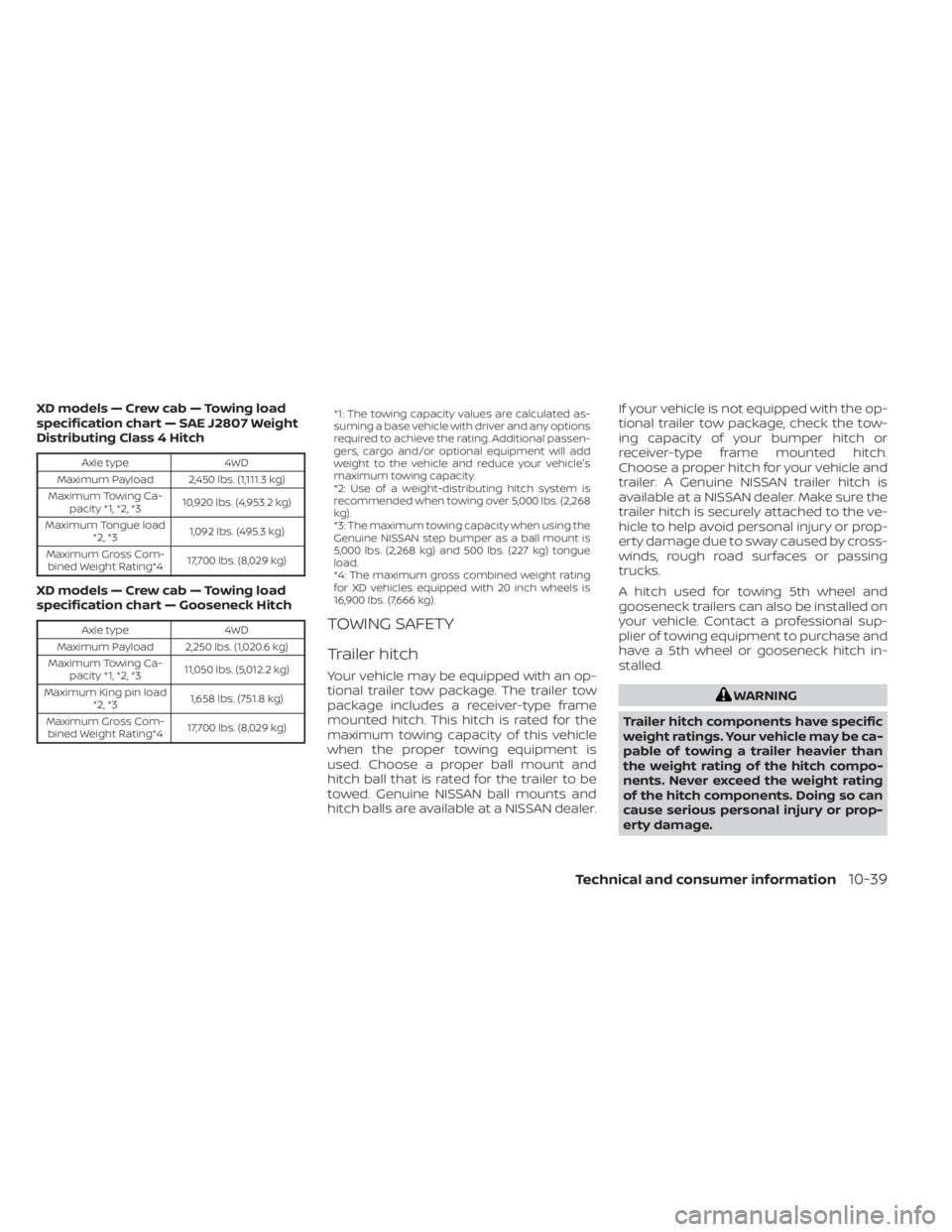
XD models — Crew cab — Towing load
specification chart — SAE J2807 Weight
Distributing Class 4 Hitch
Axle type4WD
Maximum Payload 2,450 lbs. (1,111.3 kg)
Maximum Towing Ca- pacity *1, *2, *3 10,920 lbs. (4,953.2 kg)
Maximum Tongue load *2, *3 1,092 lbs. (495.3 kg)
Maximum Gross Com- bined Weight Rating*4 17,700 lbs. (8,029 kg)
XD models — Crew cab — Towing load
specification chart — Gooseneck Hitch
Axle type
4WD
Maximum Payload 2,250 lbs. (1,020.6 kg)
Maximum Towing Ca- pacity *1, *2, *3 11,050 lbs. (5,012.2 kg)
Maximum King pin load *2, *3 1,658 lbs. (751.8 kg)
Maximum Gross Com- bined Weight Rating*4 17,700 lbs. (8,029 kg) *1: The towing capacity values are calculated as-
suming a base vehicle with driver and any options
required to achieve the rating. Additional passen-
gers, cargo and/or optional equipment will add
weight to the vehicle and reduce your vehicle's
maximum towing capacity.
*2: Use of a weight-distributing hitch system is
recommended when towing over 5,000 lbs. (2,268
kg).
*3: The maximum towing capacity when using the
Genuine NISSAN step bumper as a ball mount is
5,000 lbs. (2,268 kg) and 500 lbs. (227 kg) tongue
load.
*4: The maximum gross combined weight rating
for XD vehicles equipped with 20 inch wheels is
16,900 lbs. (7,666 kg).TOWING SAFETY
Trailer hitch
Your vehicle may be equipped with an op-
tional trailer tow package. The trailer tow
package includes a receiver-type frame
mounted hitch. This hitch is rated for the
maximum towing capacity of this vehicle
when the proper towing equipment is
used. Choose a proper ball mount and
hitch ball that is rated for the trailer to be
towed. Genuine NISSAN ball mounts and
hitch balls are available at a NISSAN dealer. If your vehicle is not equipped with the op-
tional trailer tow package, check the tow-
ing capacity of your bumper hitch or
receiver-type frame mounted hitch.
Choose a proper hitch for your vehicle and
trailer. A Genuine NISSAN trailer hitch is
available at a NISSAN dealer. Make sure the
trailer hitch is securely attached to the ve-
hicle to help avoid personal injury or prop-
erty damage due to sway caused by cross-
winds, rough road surfaces or passing
trucks.
A hitch used for towing 5th wheel and
gooseneck trailers can also be installed on
your vehicle. Contact a professional sup-
plier of towing equipment to purchase and
have a 5th wheel or gooseneck hitch in-
stalled.
WARNING
Trailer hitch components have specific
weight ratings. Your vehicle may be ca-
pable of towing a trailer heavier than
the weight rating of the hitch compo-
nents. Never exceed the weight rating
of the hitch components. Doing so can
cause serious personal injury or prop-
erty damage.
Technical and consumer information10-39
Page 589 of 657
Hitch ball
Choose a hitch ball of the proper size and
weight rating for your trailer:
• The required hitch ball size is stamped onmost trailer couplers. Most hitch balls
also have the size printed on the top of
the ball.
• Choose the proper class hitch ball based on the trailer weight.
• The diameter of the threaded shank of the hitch ball must be matched to the ball
mount hole diameter. The hitch ball
shank should be no more than 1/16”
smaller than the hole in the ball mount.
• The threaded shank of the hitch ball must be long enough to be properly secured to
the ball mount. There should be at least 2
threads showing beyond the lock washer
and nut.
Ball mount
The hitch ball is attached to the ball mount
and the ball mount is inserted into the
hitch receiver. Choose a proper class ball
mount based on the trailer weight. Addi-
tionally, the ball mount should be chosen to
keep the trailer tongue level with the
ground.
Bumper towing
The Genuine NISSAN step bumper has pro-
visions to install a trailer hitch ball and is
designed to tow trailers of a maximum
weight of 5,000 lbs. (2,268 kg).
NOTE:
The trailer hitch ball cannot be installed
on the step bumper if the receiver-type
frame mounted hitch is installed on the
vehicle.
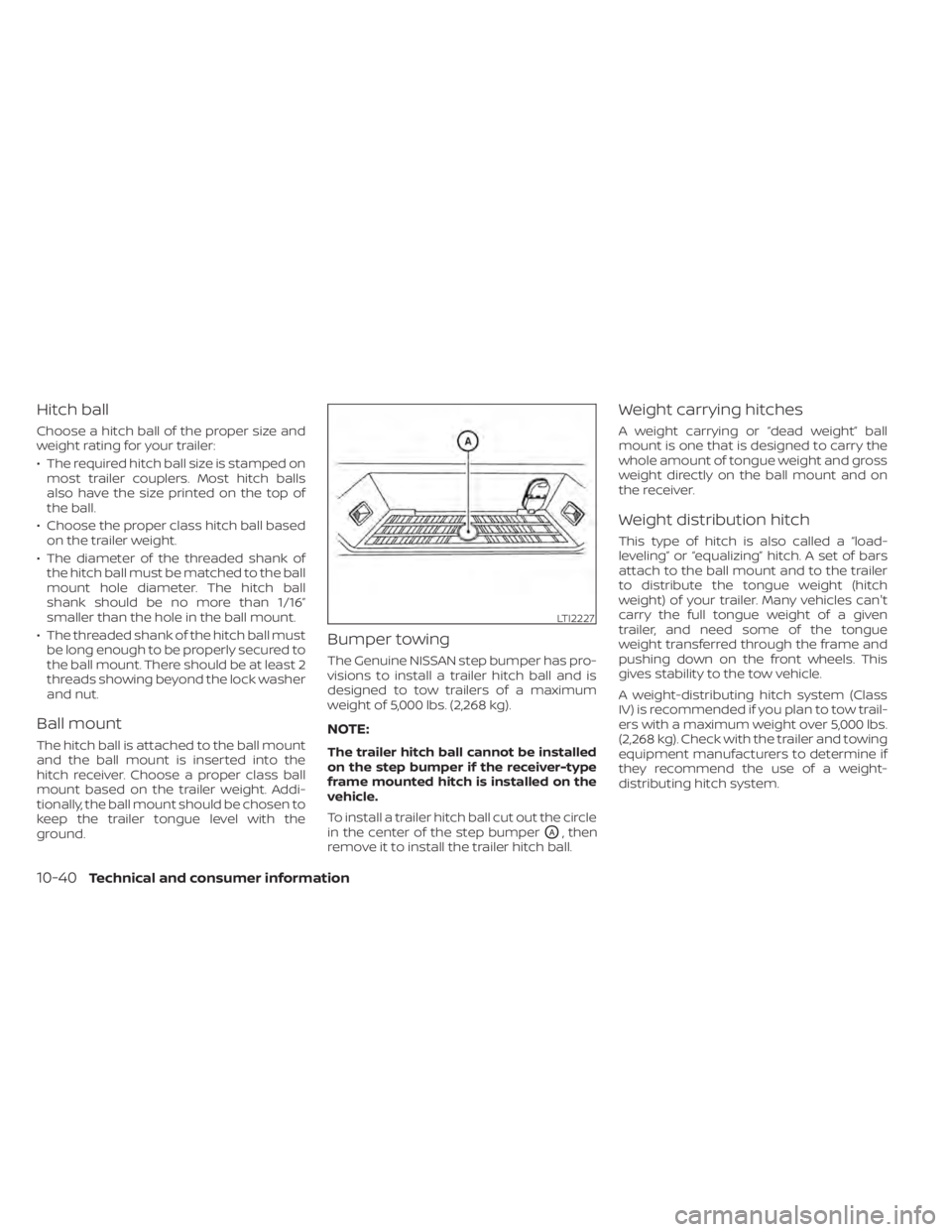
To install a trailer hitch ball cut out the circle
in the center of the step bumper
OA, then
remove it to install the trailer hitch ball.
Weight carrying hitches
A weight carrying or “dead weight” ball
mount is one that is designed to carry the
whole amount of tongue weight and gross
weight directly on the ball mount and on
the receiver.
Weight distribution hitch
This type of hitch is also called a “load-
leveling” or “equalizing” hitch. A set of bars
attach to the ball mount and to the trailer
to distribute the tongue weight (hitch
weight) of your trailer. Many vehicles can't
carry the full tongue weight of a given
trailer, and need some of the tongue
weight transferred through the frame and
pushing down on the front wheels. This
gives stability to the tow vehicle.
A weight-distributing hitch system (Class
IV) is recommended if you plan to tow trail-
ers with a maximum weight over 5,000 lbs.
(2,268 kg). Check with the trailer and towing
equipment manufacturers to determine if
they recommend the use of a weight-
distributing hitch system.
LTI2227
10-40Technical and consumer information
Page 591 of 657
1,000 lbs. (453 kg). Class IV hitches used for
weight distributing are rated up to 14,000
lbs. (6,350 kg) gross trailer weight (GTW)
with a maximum trailer tongue weight (TW)
of 1,400 lbs. (635 kg). A Class IV hitch usually
has a 2" square receiver opening. A higher
class drawbar does not increase the tow-
ing capacity of the hitch. To use this class of
hitch for weight distribution requires a
weight distribution system. Class IV hitches
attach to the vehicle frame only. A weight
distributing hitch should be used to tow
trailers that weigh over 5,000 lbs. (2,268 kg).
Your vehicle may be equipped with Class IV
weigh distributing trailer hitch that has a
14,000 lbs. (6,350 kg) maximum weight rat-
ing, but your vehicle is only capable of tow-
ing the maximum trailer weights shown in
the “Towing load/specification” chart in this
section.
5th wheel/gooseneck
A 5th wheel or gooseneck trailer can be
towed by installing a 5th wheel or goose-
neck trailer hitch. These types of hitches
are mounted in the bed of the pick-up. A
professional trailer equipment supplier
should install these hitches as it is very im-
portant to mount the hitch correctly to dis-tribute the king pin weight for the proper
load carrying and sway control perfor-
mance.
The king pin weight should be 15% of the
fully loaded trailer. Make sure the king pin
weight does not cause the gross vehicle
weight to exceed the Gross Maximum
Weight Rating or the rear axle weight to
exceed the Rear Gross Axle Weight rating.
For additional information, refer to “Maxi-
mum load limits” in this section.
The weight of the trailer should not exceed
the maximum towing capacity for the ve-
hicle. For additional information, refer to
“Towing load/specification” chart in this
section.
Make sure the trailer design allows for the
correct vehicle to trailer clearances before
purchasing a 5th wheel trailer.
WARNING
• The hitch should not be attached to
or affect the operation of the impact-
absorbing bumper.
• Do not use axle-mounted hitches.
• Do not modif y the vehicle exhaust
system, brake system, etc. to install a
trailer hitch. •
To reduce the possibility of addi-
tional damage if your vehicle is
struck from the rear, where practical,
remove the receiver when not in use.
• Regularly check that all trailer hitch
mounting bolts are securely
mounted.
• When towing with the hitch ball
mounted to the rear bumper, do not
make sharp turns. The trailer may
contact the bumper and cause dam-
age to the bumper or trailer.
• When towing a 5th wheel trailer, do
not make sharp turns while driving or
backing. The trailer may contact the
vehicle and cause damage to both
the trailer and vehicle.
10-42Technical and consumer information
Page 600 of 657
WARNING
Do not exceed Gross Combined Weight
Rating (GVWR). For additional informa-
tion about GVWR, refer to “Towing load/
specification” in this section of the
manual.
Pre-towing tips
• Be certain your vehicle maintains a level position when a loaded and/or unloaded
trailer is hitched. Do not drive the vehicle if
it has an abnormal nose-up or nose-
down condition; check for improper
tongue load, overload, worn suspension
or other possible causes of either condi-
tion.
• Always secure items in the trailer to pre- vent load shif t while driving.
• Keep the cargo load as low as possible in the trailer to keep the trailer center of
gravity low.
• Load the trailer so approximately 60% of the trailer load is in the front half and 40%
is in the back half. Also make sure the load
is balanced side to side.
• Check your hitch, trailer tire pressure, ve- hicle tire pressure, trailer light operation,
and trailer wheel lug nuts every time you
attach a trailer to the vehicle.
LTI2156
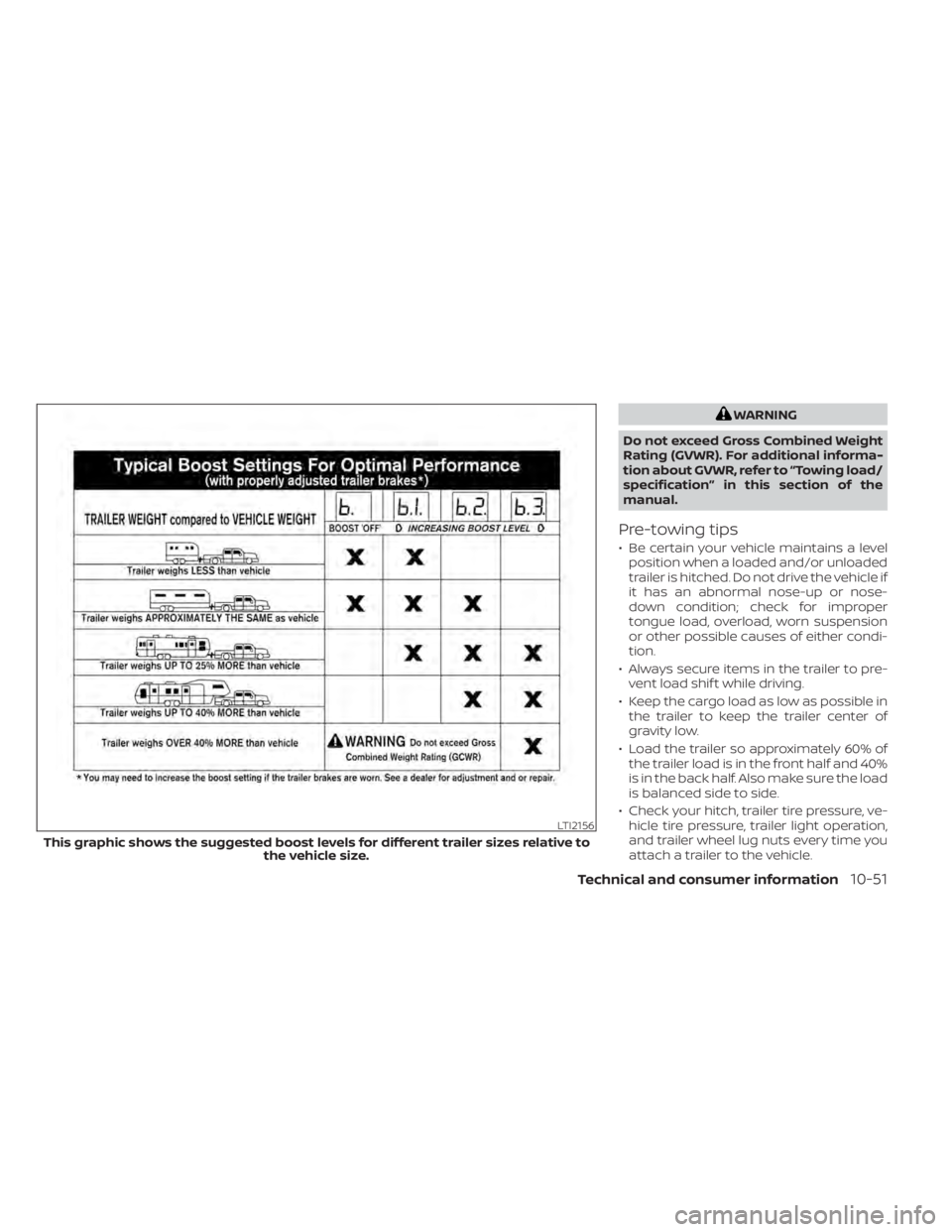
This graphic shows the suggested boost levels for different trailer sizes relative to the vehicle size.
Technical and consumer information10-51
Page 601 of 657
• Be certain your rearview mirrors conformto all federal, state or local regulations. If
not, install any mirrors required for towing
before driving the vehicle.
• Determine the overall height of the ve- hicle and trailer so the required clearance
is known.
Trailer towing tips
In order to gain skill and an understanding
of the vehicle's behavior, you should prac-
tice turning, stopping and backing up in an
area which is free from traffic. Steering sta-
bility and braking performance will be
somewhat different than under normal
driving conditions.
• Always secure items in the trailer to pre-vent load shif t while driving.
• Lock the trailer hitch coupler with a pin or lock to prevent the coupler from inadver-
tently becoming unlatched.
• Avoid abrupt starts, acceleration or stops.
• Avoid sharp turns or lane changes.
• Always drive your vehicle at a moderate speed. • When backing up, hold the bottom of the
steering wheel with one hand. Move your
hand in the direction in which you want
the trailer to go. Make small corrections
and back up slowly. If possible, have
someone guide you when you are back-
ing up.
Always block the wheels on both vehicle
and trailer when parking. Parking on a
slope is not recommended; however, if you
must do so:
CAUTION
If you move the shif t selector to the P
(Park) position before blocking the
wheels and applying the parking brake,
transmission damage could occur.
1. Apply and hold the brake pedal.
2. Have someone place blocks on the downhill side of the vehicle and trailer
wheels.
3. Af ter the wheel blocks are in place, slowly release the brake pedal until the
blocks absorb the vehicle load.
4. Apply the parking brake.
5. Shif t the transmission into P (Park). 6. Make sure the
indicator light (if so
equipped) indicates the transfer case is
in 4H, 4LO, or 2H and that the ATP light is
off. If the
indicator light is flashing,
or the ATP light is ON, make sure the
transmission is in P (Park) (A/T) and turn
the 4WD switch to 2WD or 4H. For addi-
tional information, refer to “Automatic
transmission park warning light” in the
“Instruments and controls” section and
“Using 4-wheel drive (4WD)” in the “Start-
ing and driving” section of this manual.
7. Turn off the engine.
To drive away:
1. Start the vehicle.
2. Apply and hold the brake pedal.
3. Shif t the transmission into gear.
4. Release the parking brake.
5. Drive slowly until the vehicle and trailer are clear from the blocks.
6. Apply and hold the brake pedal.
7. Have someone retrieve and store the blocks.
10-52Technical and consumer information
Page 607 of 657
For USA
If you believe that your vehicle has a
defect which could cause a crash or
could cause injury or death, you
should immediately inform the Na-
tional Highway Traffic Safety Admin-
istration (NHTSA) in addition to noti-
f ying NISSAN.
If NHTSA receives similar complaints,
it may open an investigation, and if it
finds that a safety defect exists in a
group of vehicles, it may order a re-
call and remedy campaign. However,
NHTSA cannot become involved in
individual problems between you,
your dealer, or NISSAN.
To contact NHTSA, you may call the
Vehicle Safety Hotline toll-free at
1-888-327-4236 (TTY: 1-800-424-9153);
go to http://www.safercar.gov; or
write to: Administrator, NHTSA, 400
Seventh Street, SW., Washington, D.C.
20590. You can also obtain other in-formation about motor vehicle safety
from http://www.safercar.gov.
You may notif y NISSAN by contact-
ing our Consumer Affairs Depart-
ment, toll-free, at 1-800-NISSAN-1.
For Canada
If you believe that your vehicle has a
defect which could cause a crash or
could cause injury or death, you
should immediately inform Trans-
port Canada in addition to notif ying
NISSAN.
If Transport Canada receives com-
plaints, it may open an investigation,
and if it finds that a safety defect
exists in a group of vehicles, it may
request that NISSAN conduct a recall
campaign. However, Transport
Canada cannot become involved in
individual problems between you,
your dealer, or NISSAN.
You may contact Transport Cana-
da's Defect Investigations and Re-
calls Division toll free at 1-800-333-
0510. You may also report safety
defects online at: https://
wwwapps.tc.gc.ca/Saf-Sec-Sur/7/
PCDB-BDPP/fc-cp.aspx?lang=eng
(English speakers) or https://
wwwapps.tc.gc.ca/Saf-Sec-Sur/7/
PCDB-BDPP/fc-cp.aspx?lang=fra
(French speakers)
Additional information concerning
motor vehicle safety may be ob-
tained from Transport Canada's
Road Safety Information Centre at
1-800-333-0371 or online at
www.tc.gc.ca/roadsafety (English
speakers) or www.tc.gc.ca/
securiteroutiere (French speakers).
To notif y NISSAN of any safety con-
cerns please contact our Consumer
Information Centre toll free at 1-800-
387-0122.
REPORTING SAFETY DEFECTS
10-58Technical and consumer information
Page 610 of 657
11 Index
A
Active Brake Limited Slip (ABLS)
system....................5-118Aiming control, headlights.........2-52Air bag (See supplemental restraint
system).....................1-52Air bag system
Front (See supplemental front
impact air bag system)
......1-59, 1-74Air bag warning labels............1-81Air bag warning light.........1-81, 2-18Air bag warning light,
supplemental..............1-81, 2-18Air cleaner...................8-19Air cleaner housing filter..........8-19Air conditionerAir conditioner operation. . . .4-32, 4-38Air conditioner specification label. .10-20Air conditioner system refrigerant
recommendations............10-8Air conditioner system refrigerant
and oil recommendations.......10-8Heater and air conditioner
(automatic) (if so equipped)......4-37Heater and air conditioner
controls.................. .4-38Servicing air conditioner........4-42Air flow charts................4-33Alarm system
(See vehicle security system).......2-40
Anchor point locations...........1-32Antenna................... .4-42Anti-lock brake warning light.......2-13Anti-lock Braking System (ABS)......5-116Antifreeze...................5-128Autolight switch...............2-48Automatic
Automatic drive positioner.......3-40Automatic power window switch. . .2-85Driving with automatic
transmission................5-18Automatic anti-glare inside mirror. . . .3-30Automatic door locks.............3-8Automatic drive positioner........3-40Automatic Emergency Braking
(AEB)...................2-13,2-17Automatic Emergency Braking (AEB)
with Pedestrian Detection.........5-80Automatic transmission fluid
temperature gauge.............2-10
B
Battery.................5- 128, 8-14Charge warning light...........2-15Battery replacement............8-25Key fob...................8-25NISSAN Intelligent Key®.........8-26Before starting the engine.........5-16Belt (See drive belt)..............8-17
Blind Spot Warning (BSW)..........5-32Block heater
Engine...................5-129Booster seats................ .1-48Brake
Anti-lock Braking System (ABS). . . .5-116Brake fluid.................8-12Brake light (See stop light).......8-30Brake system...............5-116Brake warning light............2-14Brake wear indicators.......2-21,8-21Parking brake operation.........5-23Self-adjusting brakes...........8-21Brake Assist..................5-117Brake fluid...................8-12Brake system................5-116Brakes.....................8-21Break-in schedule.............5-104Brightness controlInstrument panel.............2-53Bulb check/instrument panel.......2-13Bulb replacement..............8-30
C
C.M.V.S.S. certification label........10-18Capacities and recommended
fuel/lubricants................10-2Car phone or CB radio...........4-86
Page 613 of 657
Intelligent Cruise Control (ICC)
(for vehicles without ProPILOT Assist). . .5-51Intelligent Driver Alertness (I-DA).....5-101Intelligent Forward Collision Warning
(I-FCW)......................5-90Intelligent Key system
Key operating range............3-11Key operation................3-12Mechanical key................3-3Remote keyless entry operation. . . .3-15Troubleshooting guide..........3-19Warning signals...............3-19Interior light................. .2-90ISOFIX child restraints.............1-29
J
Jump starting..............6-10,8-16
K
Key.........................3-2Key fob battery replacement........8-25Keyless entry
With Intelligent Key system
(See Intelligent Key system)
.......3-15KeysNISSAN Intelligent Key®........3-2,3-9NISSAN Vehicle Immobilizer System
keys..................... .3-4
L
Labels
Air conditioner specification label. . .10-20C.M.V.S.S. certification label.......10-18Emission control information label. .10-19Engine serial number..........10-18Tire and Loading Information label. .10-19Vehicle identification number (VIN). .10-17Vehicle identification number (VIN)
plate.................... .10-17Warning labels (for SRS)..........1-81Lane Departure Warning (LDW).......5-27LATCH (Lower Anchors and Tethers for
CHildren) System...............1-29License plate
Installing the license plate........10-21LightAir bag warning light........1-81, 2-18Brake light (See stop light)........8-30Bulb check/instrument panel......2-13Bulb replacement.............8-30Charge warning light...........2-15Console light................2-91Exterior and Interior lights........8-30Fog light switch..............2-54Fog lights..................8-28Headlight and turn signal switch. . . .2-46Headlight control switch.........2-47Headlights..................8-27Interior light................ .2-90Light bulbs.................8-27Low tire pressure warning light.....2-15
Low windshield-washer fluid warning
light..................... .2-35Passenger air bag and status light. . .1-62Personal lights...............2-91Security indicator light..........2-20Warning/indicator lights and audible
reminders..................2-13Lights......................8-27Map lights..................2-91Lock
Child safety rear door lock.........3-9Door locks................. .3-4Power door locks..............3-6Loose fuel cap warning...........2-37Low fuel warning light.........2-17,2-34Low tire pressure warning light.......2-15Low windshield-washer fluid warning
light...................... .2-35Luggage (See vehicle loading
information)..................10-22Luggage hook.................2-82
M
Maintenance
General maintenance...........9-2Inside the vehicle..............9-3Maintenance precautions.........8-2Outside the vehicle.............9-2Seat belt maintenance..........1-24Under the hood and vehicle.......9-4Maintenance log................9-11Maintenance requirements..........9-2
11-4Index
Page 615 of 657
Rear window and/or outside mirror
defroster switch................2-45Rearview mirror................3-29RearView Monitor................4-3Recommended Fluids............10-2RecordersEvent Data................ .10-59Refrigerant recommendation.......10-8Registering a vehicle in another
country.................... .10-17Remote Engine Start..........3-21,5-17Reporting safety defects (US only). . . .10-58
S
Safety
Child safety rear door lock.........3-9Child seat belts. .1-27, 1-34, 1-40, 1-44, 1-48Reporting safety defects (US only). .10-58Seat adjustmentFront manual seat adjustment......1-4Front power seat adjustment.......1-6Seat beltChild safety.................1-25Infants and small children.....1-25,1-26Injured person................1-19Larger children...............1-26Precautions on seat belt usage.....1-16Pregnant women..............1-19Seat belt extenders............1-24Seat belt maintenance..........1-24Seat belts................1-16,7-7Shoulder belt height adjustment. . . .1-23
Three-point type with retractor.....1-19Seat belt extenders..............1-24Seat belt warning light.........1-19,2-18Seatback pockets...............2-72SeatsAdjustment..................1-2Automatic drive positioner.......3-40Front seats..................1-2Heated seats................2-57Manual front seat adjustment......1-4Rear seat.................. .1-4Security indicator light............2-20Security system (NISSAN Vehicle Immobilizer
System), engine start.........2-41, 5-16Security systems
Vehicle security system.........2-40Self-adjusting brakes.............8-21Service manual order form........10-60Servicing air conditioner...........4-42Shif tingAutomatic transmission.........5-20Shoulder belt height adjustment......1-23Side air bag system (See supplemental side
air bag, curtain and rollover air bag
systems)
.....................1-77Snow plow................. .10-56Spark plug replacement...........8-18Spark plugs...................8-18Specifications.................10-9Speedometer..................2-7Speedometer and odometer........2-6SRS warning label...............1-81Stability control................5-119Standard maintenance.........9-7,9-8
Starting
Before starting the engine........5-16Jump starting............6-10,8-16Precautions when starting and
driving................. .5-4, 5-10Push starting................6-12Starting the engine
(gasoline engine only)............5-16Steering
Power steering fluid............8-11Power steering system.........5-115Steering wheel.................3-26Stop light................... .8-30Storage.....................2-71Storage tray..................2-75Sun visors....................3-28Sunglasses case................2-77Sunglasses holder...............2-77Sunroof..................2-87, 7-5Supplemental air bag warning labels. . .1-81Supplemental air bag warning
light................... .1-81, 2-18Supplemental front impact air bag
system..................1-59, 1-74Supplemental restraint system
Information and warning labels.....1-81Precautions on supplemental restraint
system................ .1-52, 1-67Supplemental restraint system
(Supplemental air bag system).......1-52Switch
Autolight switch..............2-48Automatic power window switch. . .2-85
11-6Index
Page 616 of 657
Electronic locking rear differential (E-Lock)
system switch...............2-62Fog light switch..............2-54Hazard warning flasher switch......6-2Headlight aiming control.........2-52Headlight and turn signal switch. . . .2-46Headlight control switch.........2-47Hill descent control switch........2-61Instrument brightness control.....2-53Power door lock switch..........3-6Power inverter switch...........2-64Rear sonar system OFF switch.....2-64Tow mode switch.............2-65Turn signal switch.............2-54
T
Tachometer...................2-8Tailgate.................... .3-34Temperature gauge
Engine coolant temperature gauge. . .2-8Thef t (NISSAN Vehicle Immobilizer System),
engine start...............2-41, 5-16Three-way catalyst...............5-4Tie down hooks................3-38TireFlat tire................. .6-3, 6-4Spare tire...............6-5, 8-45Tire and Loading Information label. .10-19Tire chains..................8-41Tire pressure................8-33Tire rotation.................8-42Tires of 4-wheel drive...........8-45
Types of tires................8-40Uniform tire quality grading......10-56Wheel/tire size...............10-10Wheels and tires..........8-33, 10-10Tire pressure................. .8-33Low tire pressure warning light.....2-15Tire Pressure Monitoring System
(TPMS)................... .5-5, 6-3Tow mode switch...............2-65Towing
2-wheel drive models...........6-15Flat towing................ .10-55Towing load/specification.......10-37Trailer towing...............10-33Towing a trailer................10-33Towing your vehicle..............6-13Traffic Sign Recognition (TSR)........5-24Trailer Brake Controller Unit (TBCU). . . .2-66Transceiver
HomeLink® Universal
Transceiver
......2-92, 2-94, 2-95, 2-96Transfer case shif ting procedures. . . .5-106TransmissionDriving with automatic
transmission
................5-18Travel (See registering a vehicle in another
country).................... .10-17Trip odometer..................2-7Truck - camper loading...........10-31Truck box....................3-34Turn signal switch...............2-54
U
Under seat storage bin.....2-73,2-76,2-77Uniform tire quality grading........10-56USB/iPod® Charging Ports.........4-42Using 4-wheel drive.............5-105
V
Vanity mirror..................3-29Variable voltage control system......8-17Vehicle dimensions and weights.....10-11Vehicle Dynamic Control (VDC) OFF
switch..................... .2-60Vehicle Dynamic Control (VDC)
system.....................5-119Vehicle identification.............10-17Vehicle identification number (VIN). . . .10-17Vehicle identification number (VIN)
(Chassis number)...............10-17Vehicle identification number (VIN)
plate...................... .10-17Vehicle immobilizer system.....2-41, 5-16Vehicle information display.........2-22Vehicle loading information........10-22Vehicle recovery.............6-15,6-16Vehicle security system...........2-40Vehicle security system
(NISSAN Vehicle Immobilizer System),
engine start
...............2-41, 5-16Vents......................4-28Visors......................3-28Voltmeter....................2-10
Index11-7