boot NISSAN X-TRAIL 2003 Electronic User Guide
[x] Cancel search | Manufacturer: NISSAN, Model Year: 2003, Model line: X-TRAIL, Model: NISSAN X-TRAIL 2003Pages: 3066, PDF Size: 51.47 MB
Page 2209 of 3066
FRONT DRIVE SHAFT
FAX-13
C
E
F
G
H
I
J
K
L
MA
B
FA X
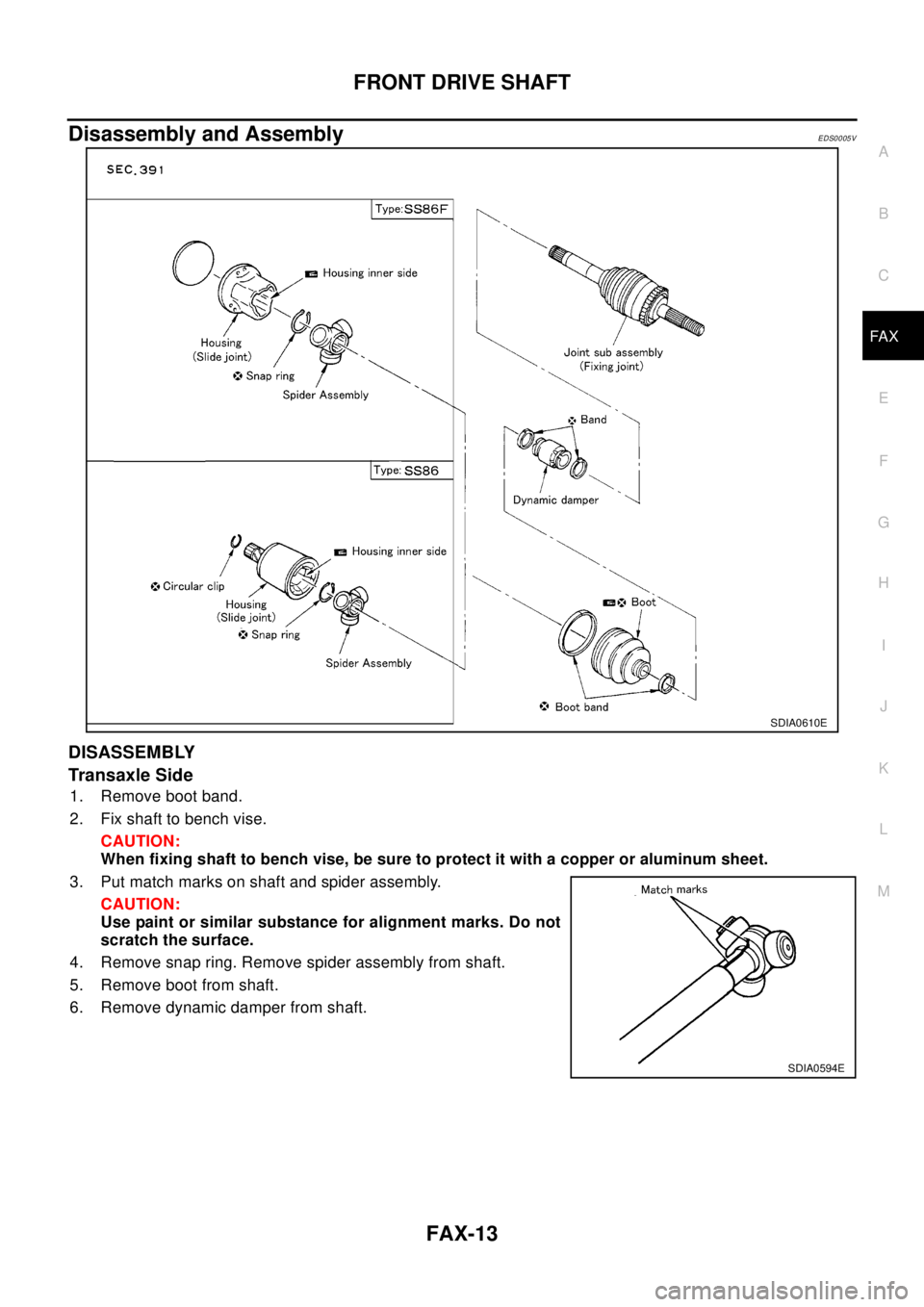
Disassembly and AssemblyEDS0005V
DISASSEMBLY
Transaxle Side
1. Remove boot band.
2. Fix shaft to bench vise.
CAUTION:
When fixing shaft to bench vise, be sure to protect it with a copper or aluminum sheet.
3. Put match marks on shaft and spider assembly.
CAUTION:
Use paint or similar substance for alignment marks. Do not
scratch the surface.
4. Remove snap ring. Remove spider assembly from shaft.
5. Remove boot from shaft.
6. Remove dynamic damper from shaft.
SDIA0610E
SDIA0594E
Page 2210 of 3066
FAX-14
FRONT DRIVE SHAFT
Wheel Side
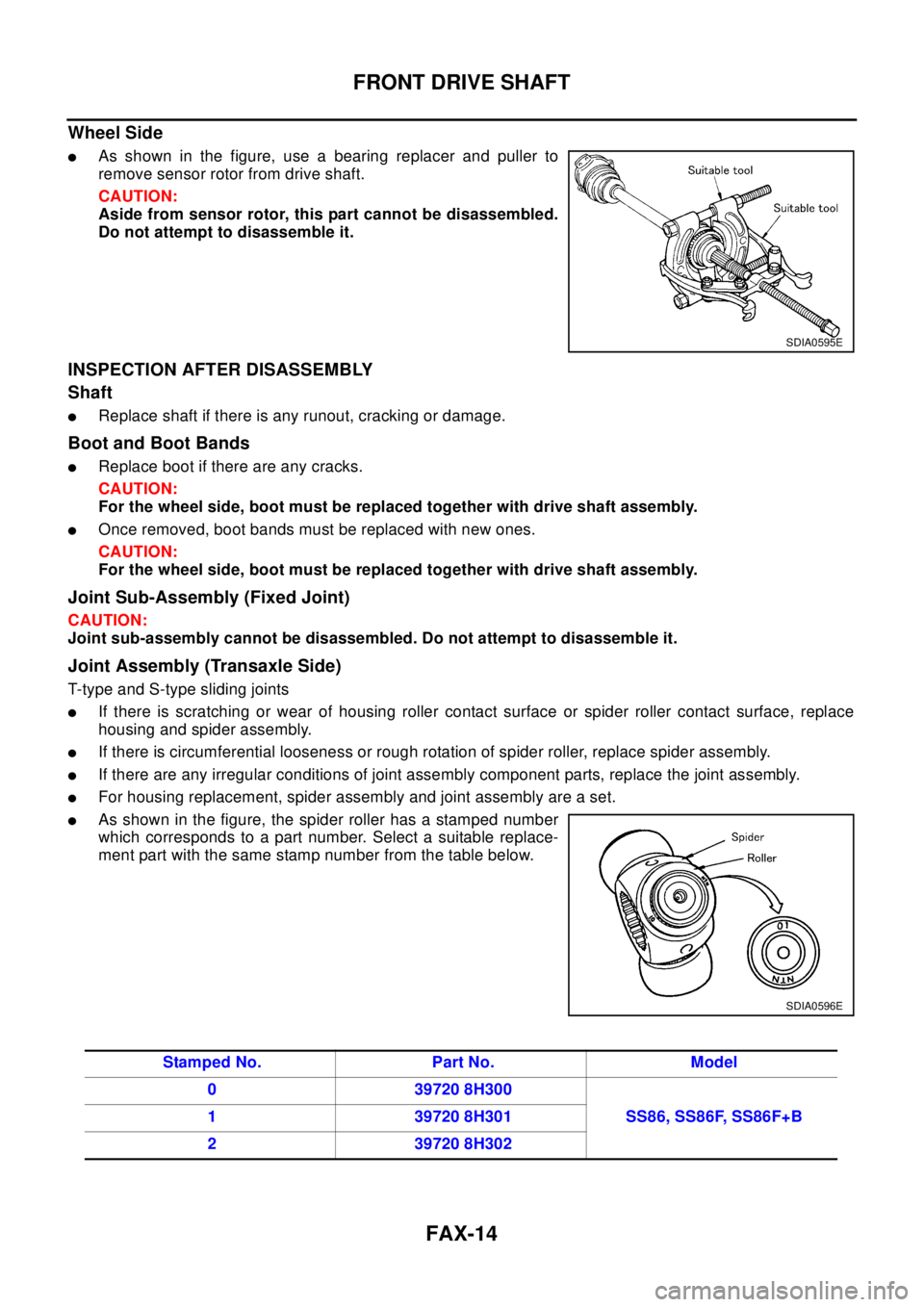
lAs shown in the figure, use a bearing replacer and puller to
remove sensor rotor from drive shaft.
CAUTION:
Aside from sensor rotor, this part cannot be disassembled.
Do not attempt to disassemble it.
INSPECTION AFTER DISASSEMBLY
Shaft
lReplace shaft if there is any runout, cracking or damage.
Boot and Boot Bands
lReplace boot if there are any cracks.
CAUTION:
For the wheel side, boot must be replaced together with drive shaft assembly.
lOnce removed, boot bands must be replaced with new ones.
CAUTION:
For the wheel side, boot must be replaced together with drive shaft assembly.
Joint Sub-Assembly (Fixed Joint)
CAUTION:
Joint sub-assembly cannot be disassembled. Do not attempt to disassemble it.
Joint Assembly (Transaxle Side)
T-typeandS-typeslidingjoints
lIf there is scratching or wear of housing roller contact surface or spider roller contact surface, replace
housing and spider assembly.
lIf there is circumferential looseness or rough rotation of spider roller, replace spider assembly.
lIf there are any irregular conditions of joint assembly component parts, replace the joint assembly.
lFor housing replacement, spider assembly and joint assembly are a set.
lAs shown in the figure, the spider roller has a stamped number
which corresponds to a part number. Select a suitable replace-
ment part with the same stamp number from the table below.
SDIA0595E
SDIA0596E
Stamped No. Part No. Model
0 39720 8H300
SS86, SS86F, SS86F+B 1 39720 8H301
2 39720 8H302
Page 2211 of 3066
FRONT DRIVE SHAFT
FAX-15
C
E
F
G
H
I
J
K
L
MA
B
FA X
Joint Assembly (Wheel Side)
CAUTION:
Joint assembly cannot be disassembled. Do not attempt to disassemble it.
ASSEMBLY
Transaxle Side
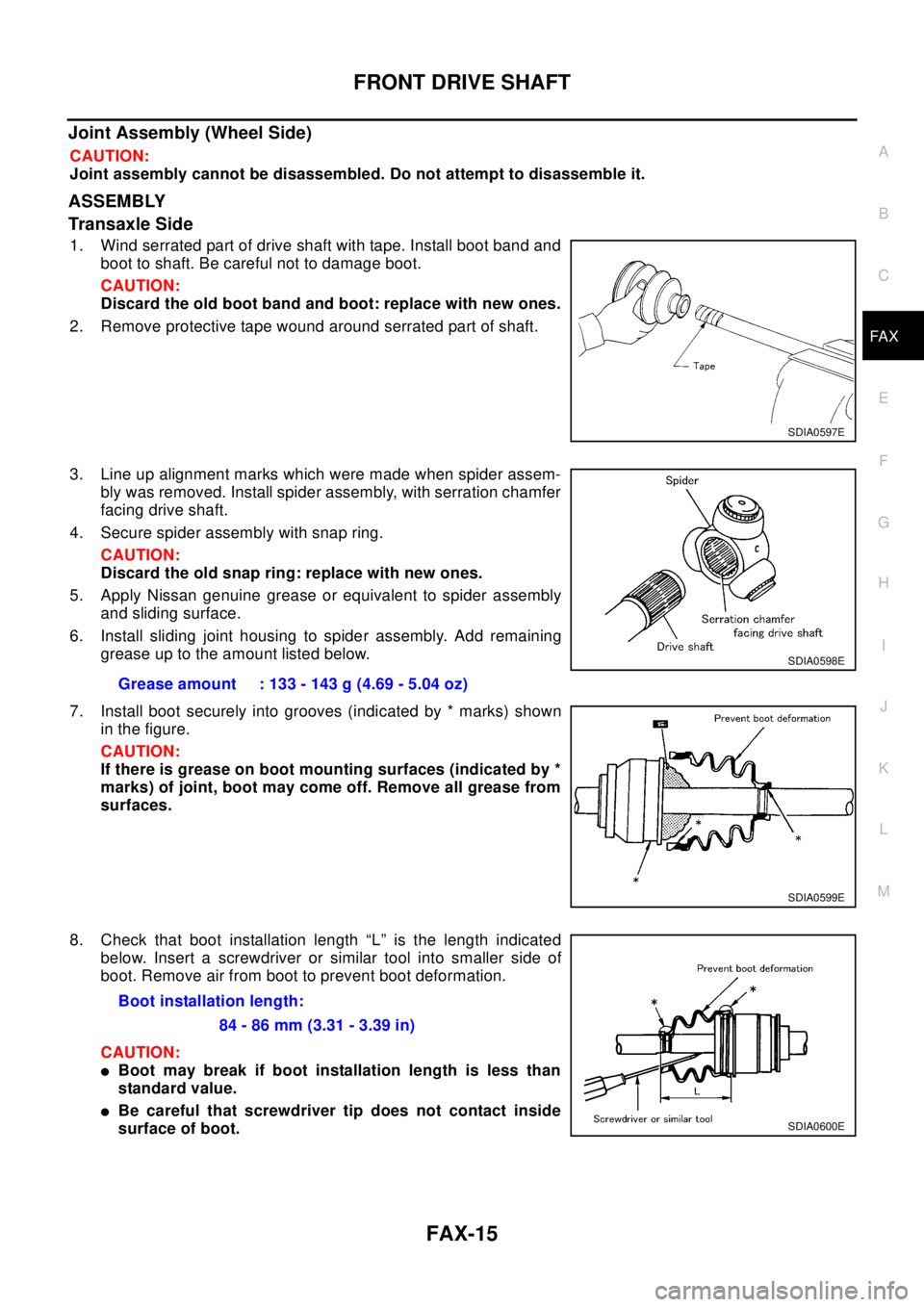
1. Wind serrated part of drive shaft with tape. Install boot band and
boot to shaft. Be careful not to damage boot.
CAUTION:
Discard the old boot band and boot: replace with new ones.
2. Remove protective tape wound around serrated part of shaft.
3. Line up alignment marks which were made when spider assem-
bly was removed. Install spider assembly, with serration chamfer
facing drive shaft.
4. Secure spider assembly with snap ring.
CAUTION:
Discard the old snap ring: replace with new ones.
5. Apply Nissan genuine grease or equivalent to spider assembly
and sliding surface.
6. Install sliding joint housing to spider assembly. Add remaining
grease up to the amount listed below.
7. Install boot securely into grooves (indicated by * marks) shown
in the figure.
CAUTION:
If there is grease on boot mounting surfaces (indicated by *
marks) of joint, boot may come off. Remove all grease from
surfaces.
8. Check that boot installation length “L” is the length indicated
below. Insert a screwdriver or similar tool into smaller side of
boot. Remove air from boot to prevent boot deformation.
CAUTION:
lBoot may break if boot installation length is less than
standard value.
lBe careful that screwdriver tip does not contact inside
surface of boot.
SDIA0597E
Grease amount : 133 - 143 g (4.69 - 5.04 oz)
SDIA0598E
SDIA0599E
Boot installation length:
84 - 86 mm (3.31 - 3.39 in)
SDIA0600E
Page 2212 of 3066
FAX-16
FRONT DRIVE SHAFT
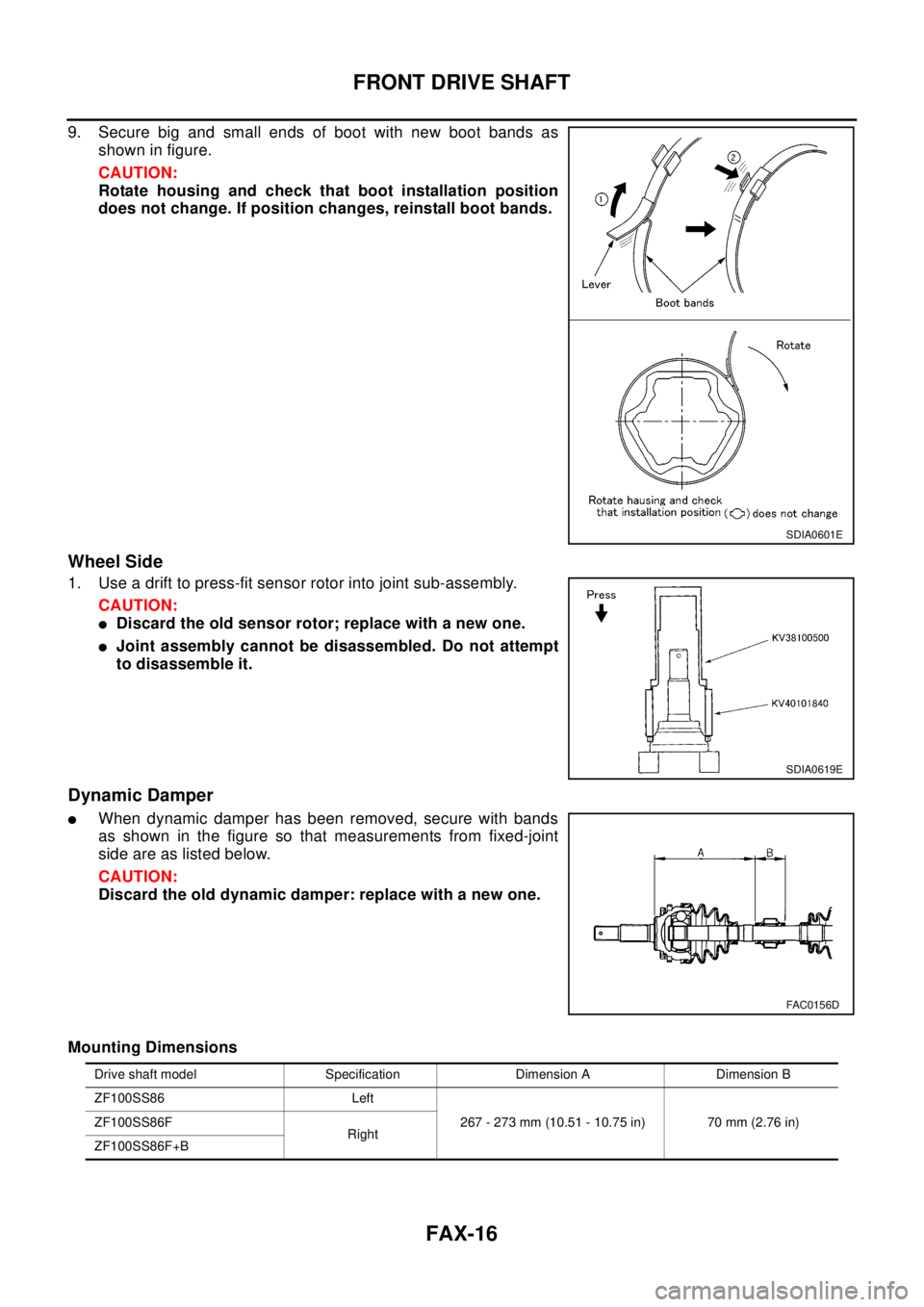
9. Secure big and small ends of boot with new boot bands as
shown in figure.
CAUTION:
Rotate housing and check that boot installation position
does not change. If position changes, reinstall boot bands.
Wheel Side
1. Use a drift to press-fit sensor rotor into joint sub-assembly.
CAUTION:
lDiscard the old sensor rotor; replace with a new one.
lJoint assembly cannot be disassembled. Do not attempt
to disassemble it.
Dynamic Damper
lWhen dynamic damper has been removed, secure with bands
as shown in the figure so that measurements from fixed-joint
side are as listed below.
CAUTION:
Discard the old dynamic damper: replace with a new one.
Mounting Dimensions
SDIA0601E
SDIA0619E
FAC0156D
Drive shaft model Specification Dimension A Dimension B
ZF100SS86 Left
267 - 273 mm (10.51 - 10.75 in) 70 mm (2.76 in) ZF100SS86F
Right
ZF100SS86F+B
Page 2213 of 3066
SERVICE DATA AND SPECIFICATIONS (SDS)
FAX-17
C
E
F
G
H
I
J
K
L
MA
B
FA X
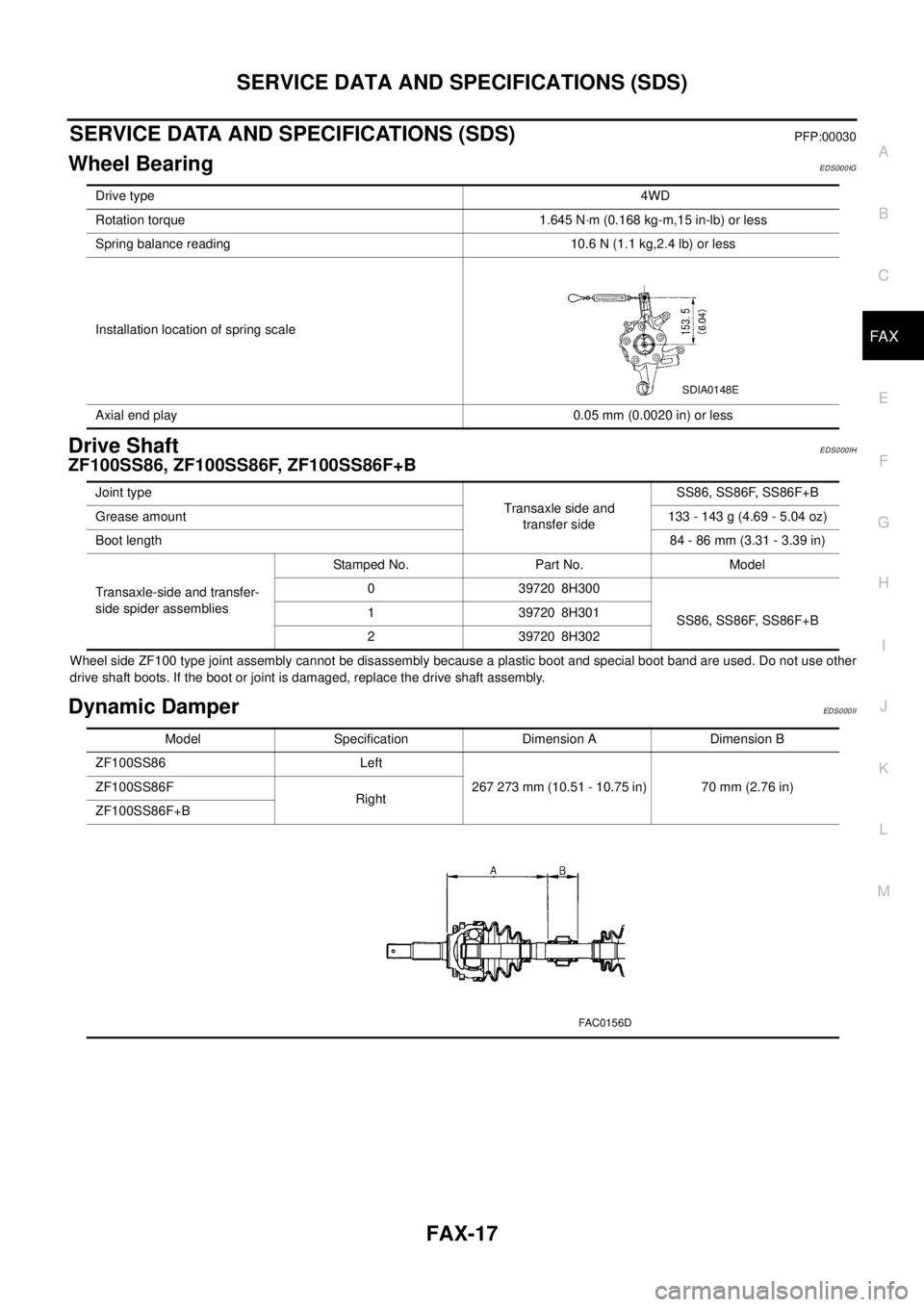
SERVICE DATA AND SPECIFICATIONS (SDS)PFP:00030
Wheel BearingEDS000IG
Drive ShaftEDS000IH
ZF100SS86, ZF100SS86F, ZF100SS86F+B
Wheel side ZF100 type joint assembly cannot be disassembly because a plastic boot and special boot band are used. Do not use other
drive shaft boots. If the boot or joint is damaged, replace the drive shaft assembly.
Dynamic DamperEDS0 00 II
Drive type4WD
Rotation torque 1.645 N·m (0.168 kg-m,15 in-lb) or less
Spring balance reading 10.6 N (1.1 kg,2.4 lb) or less
Installation location of spring scale
Axial end play 0.05 mm (0.0020 in) or less
SDIA0148E
Joint type
Transaxle side and
transfer sideSS86, SS86F, SS86F+B
Grease amount133-143g(4.69-5.04oz)
Boot length84 - 86 mm (3.31 - 3.39 in)
Transaxle-side and transfer-
side spider assembliesStamped No. Part No. Model
0 39720 8H300
SS86, SS86F, SS86F+B 1 39720 8H301
2 39720 8H302
Model Specification Dimension A Dimension B
ZF100SS86 Left
267 273 mm (10.51 - 10.75 in) 70 mm (2.76 in) ZF100SS86F
Right
ZF100SS86F+B
FAC0156D
Page 2245 of 3066
FSU-6
FRONT SUSPENSION ASSEMBLY
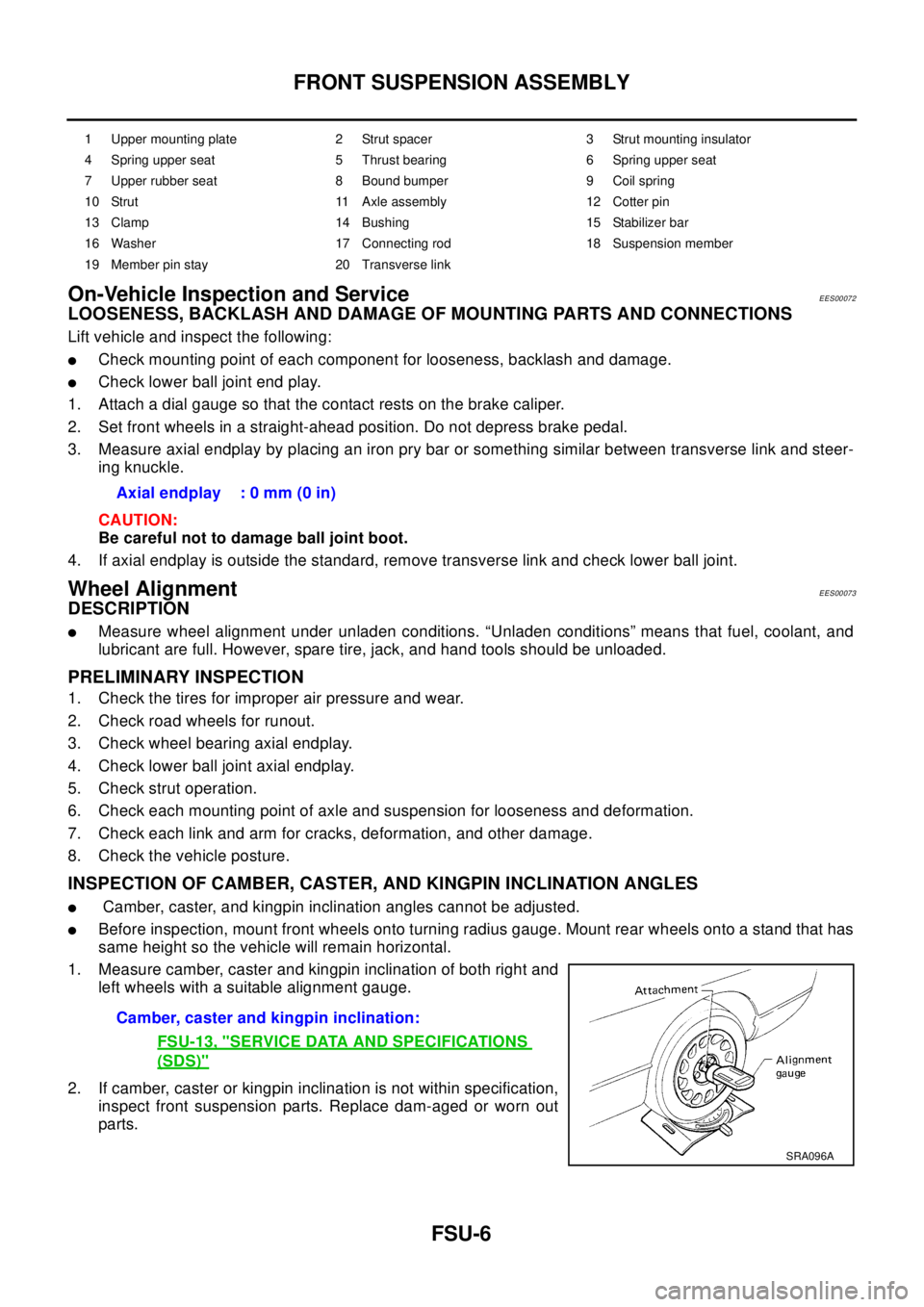
On-Vehicle Inspection and Service
EES00072
LOOSENESS, BACKLASH AND DAMAGE OF MOUNTING PARTS AND CONNECTIONS
Lift vehicle and inspect the following:
lCheck mounting point of each component for looseness, backlash and damage.
lCheck lower ball joint end play.
1. Attach a dial gauge so that the contact rests on the brake caliper.
2. Set front wheels in a straight-ahead position. Do not depress brake pedal.
3. Measure axial endplay by placing an iron pry bar or something similar between transverse link and steer-
ing knuckle.
CAUTION:
Be careful not to damage ball joint boot.
4. If axial endplay is outside the standard, remove transverse link and check lower ball joint.
Wheel AlignmentEES00073
DESCRIPTION
lMeasure wheel alignment under unladen conditions. “Unladen conditions” means that fuel, coolant, and
lubricant are full. However, spare tire, jack, and hand tools should be unloaded.
PRELIMINARY INSPECTION
1. Check the tires for improper air pressure and wear.
2. Check road wheels for runout.
3. Check wheel bearing axial endplay.
4. Check lower ball joint axial endplay.
5. Check strut operation.
6. Check each mounting point of axle and suspension for looseness and deformation.
7. Check each link and arm for cracks, deformation, and other damage.
8. Check the vehicle posture.
INSPECTION OF CAMBER, CASTER, AND KINGPIN INCLINATION ANGLES
lCamber, caster, and kingpin inclination angles cannot be adjusted.
lBefore inspection, mount front wheels onto turning radius gauge. Mount rear wheels onto a stand that has
same height so the vehicle will remain horizontal.
1. Measure camber, caster and kingpin inclination of both right and
left wheels with a suitable alignment gauge.
2. If camber, caster or kingpin inclination is not within specification,
inspect front suspension parts. Replace dam-aged or worn out
parts.
1 Upper mounting plate 2 Strut spacer 3 Strut mounting insulator
4 Spring upper seat 5 Thrust bearing 6 Spring upper seat
7 Upper rubber seat 8 Bound bumper 9 Coil spring
10 Strut 11 Axle assembly 12 Cotter pin
13 Clamp 14 Bushing 15 Stabilizer bar
16 Washer 17 Connecting rod 18 Suspension member
19 Member pin stay 20 Transverse link
Axial endplay : 0 mm (0 in)
Camber, caster and kingpin inclination:
FSU-13, "
SERVICE DATA AND SPECIFICATIONS
(SDS)"
SRA096A
Page 2532 of 3066
MA-40
CHASSIS AND BODY MAINTENANCE
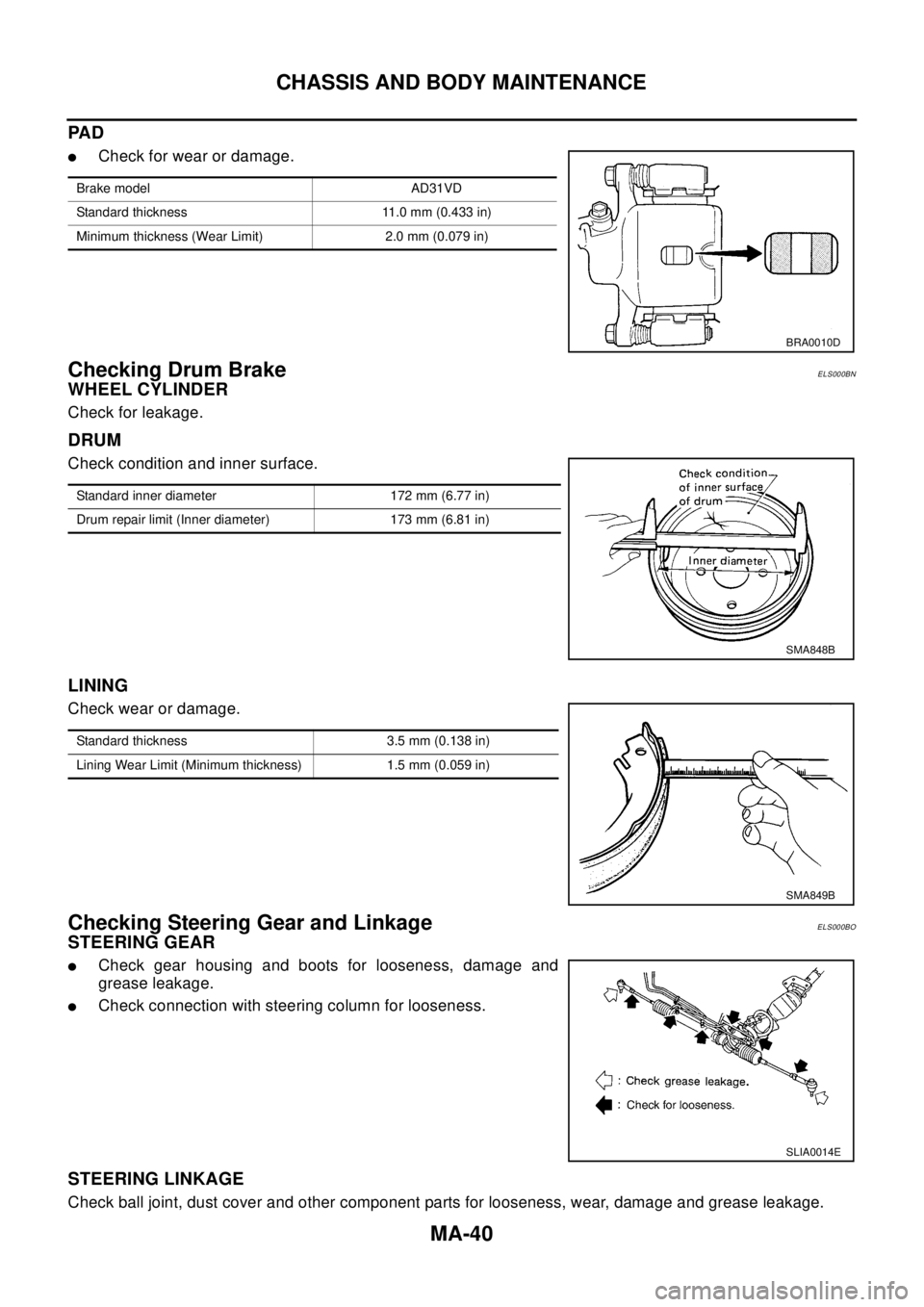
PA D
lCheck for wear or damage.
Checking Drum BrakeELS000BN
WHEEL CYLINDER
Check for leakage.
DRUM
Check condition and inner surface.
LINING
Check wear or damage.
Checking Steering Gear and LinkageELS000BO
STEERING GEAR
lCheck gear housing and boots for looseness, damage and
grease leakage.
lCheck connection with steering column for looseness.
STEERING LINKAGE
Check ball joint, dust cover and other component parts for looseness, wear, damage and grease leakage.
Brake model AD31VD
Standard thickness 11.0 mm (0.433 in)
Minimum thickness (Wear Limit) 2.0 mm (0.079 in)
BRA0010D
Standard inner diameter 172 mm (6.77 in)
Drum repair limit (Inner diameter) 173 mm (6.81 in)
SMA848B
Standard thickness 3.5 mm (0.138 in)
Lining Wear Limit (Minimum thickness) 1.5 mm (0.059 in)
SMA849B
SLIA0014E
Page 2533 of 3066
CHASSIS AND BODY MAINTENANCE
MA-41
C
D
E
F
G
H
I
J
K
MA
B
MA
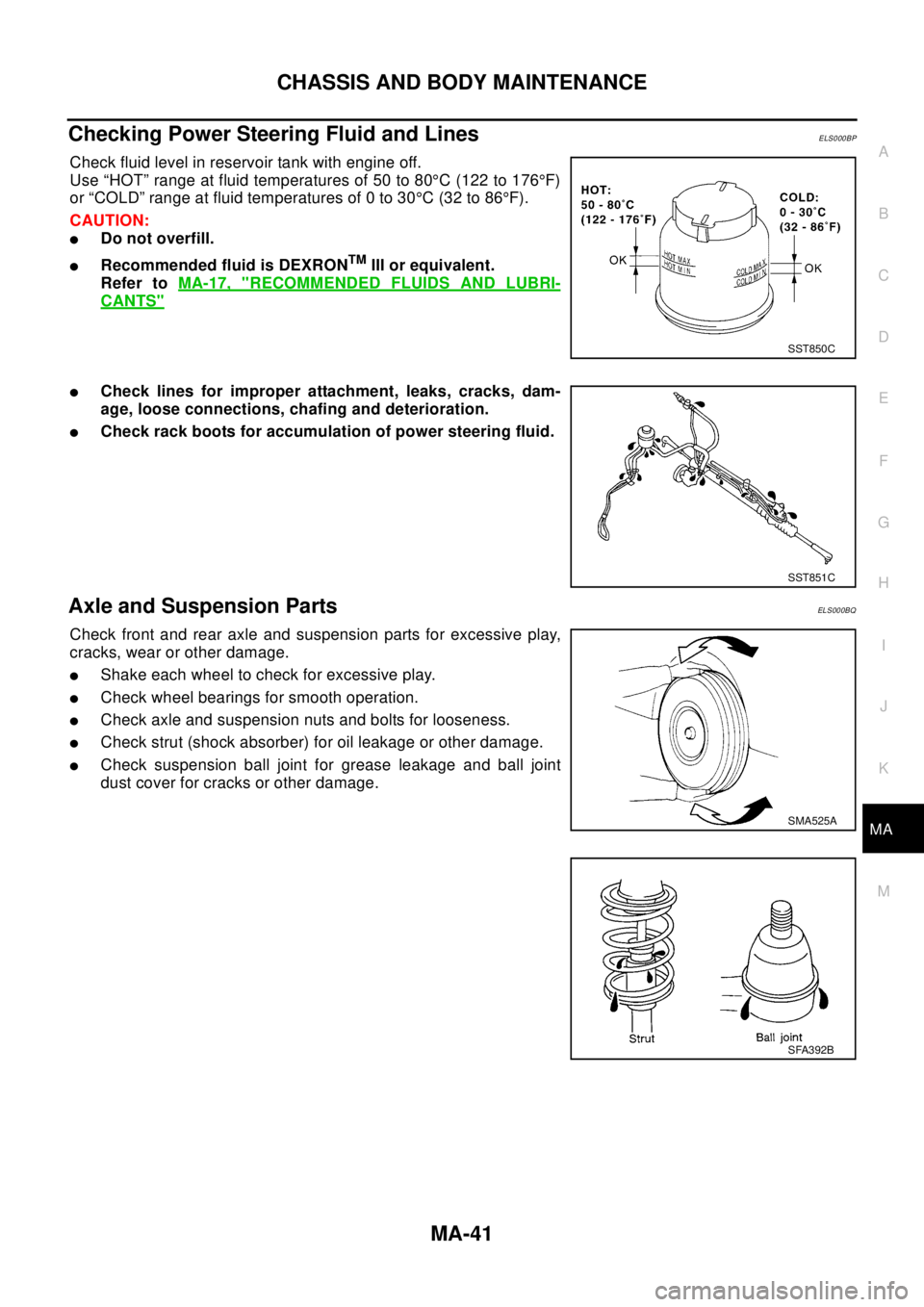
Checking Power Steering Fluid and LinesELS000BP
Check fluid level in reservoir tank with engine off.
Use “HOT” range at fluid temperatures of 50 to 80°C (122 to 176°F)
or “COLD” range at fluid temperatures of 0 to 30°C(32to86°F).
CAUTION:
lDo not overfill.
lRecommended fluid is DEXRONTMIII or equivalent.
Refer toMA-17, "
RECOMMENDED FLUIDS AND LUBRI-
CANTS"
lCheck lines for improper attachment, leaks, cracks, dam-
age, loose connections, chafing and deterioration.
lCheck rack boots for accumulation of power steering fluid.
Axle and Suspension PartsELS000BQ
Check front and rear axle and suspension parts for excessive play,
cracks, wear or other damage.
lShake each wheel to check for excessive play.
lCheck wheel bearings for smooth operation.
lCheck axle and suspension nuts and bolts for looseness.
lCheck strut (shock absorber) for oil leakage or other damage.
lCheck suspension ball joint for grease leakage and ball joint
dust cover for cracks or other damage.
SST850C
SST851C
SMA525A
SFA392B
Page 2534 of 3066
MA-42
CHASSIS AND BODY MAINTENANCE
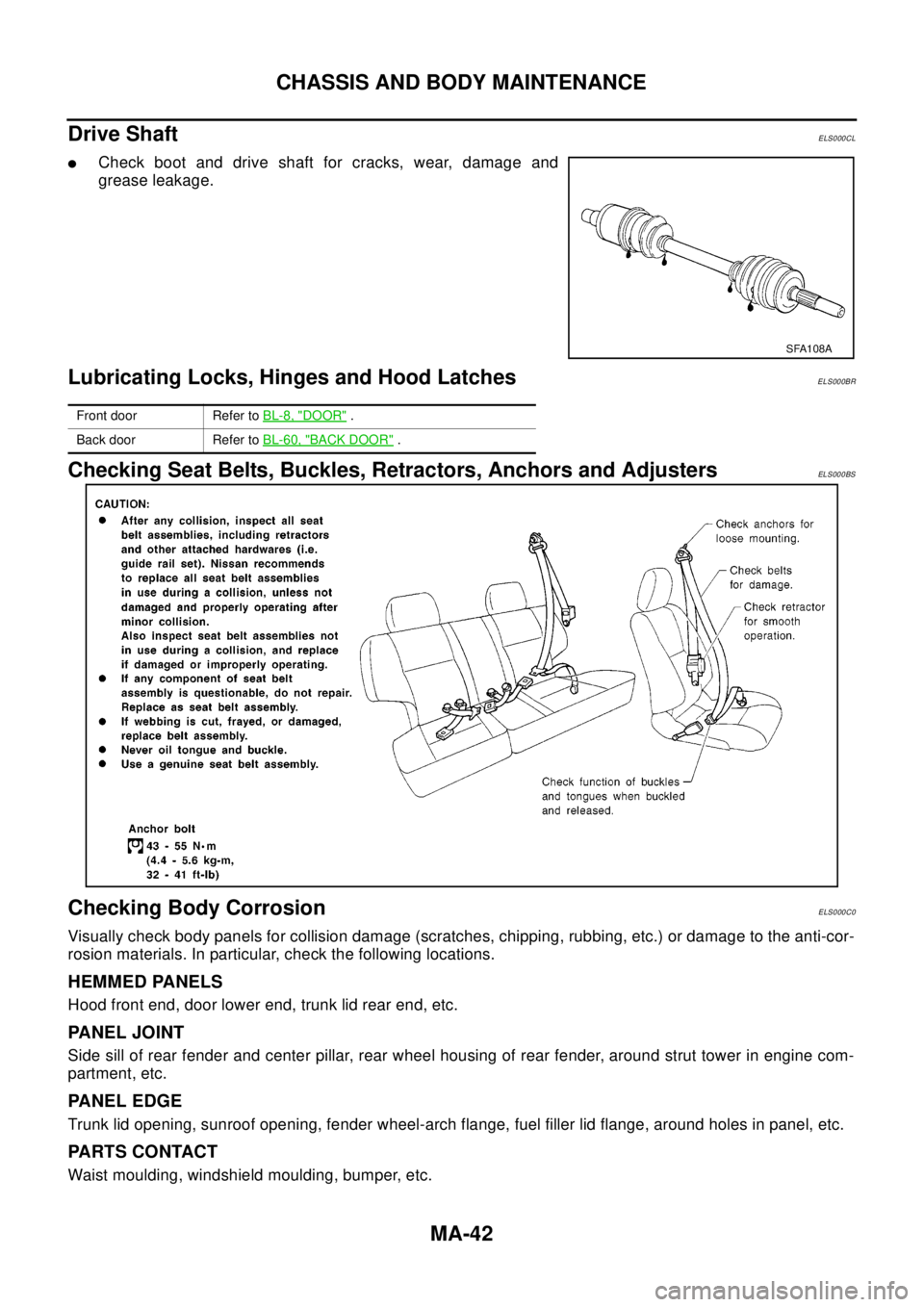
Drive Shaft
ELS000CL
lCheck boot and drive shaft for cracks, wear, damage and
grease leakage.
Lubricating Locks, Hinges and Hood LatchesELS000BR
Checking Seat Belts, Buckles, Retractors, Anchors and AdjustersELS000BS
Checking Body CorrosionELS000C0
Visually check body panels for collision damage (scratches, chipping, rubbing, etc.) or damage to the anti-cor-
rosion materials. In particular, check the following locations.
HEMMED PANELS
Hood front end, door lower end, trunk lid rear end, etc.
PANEL JOINT
Side sill of rear fender and center pillar, rear wheel housing of rear fender, around strut tower in engine com-
partment, etc.
PANEL EDGE
Trunk lid opening, sunroof opening, fender wheel-arch flange, fuel filler lid flange, around holes in panel, etc.
PA R T S C O N TA C T
Waist moulding, windshield moulding, bumper, etc.
SFA108A
Front door Refer toBL-8, "DOOR".
Back door Refer toBL-60, "
BACK DOOR".
Page 2757 of 3066
REAR PROPELLER SHAFT
PR-3
C
E
F
G
H
I
J
K
L
MA
B
PR
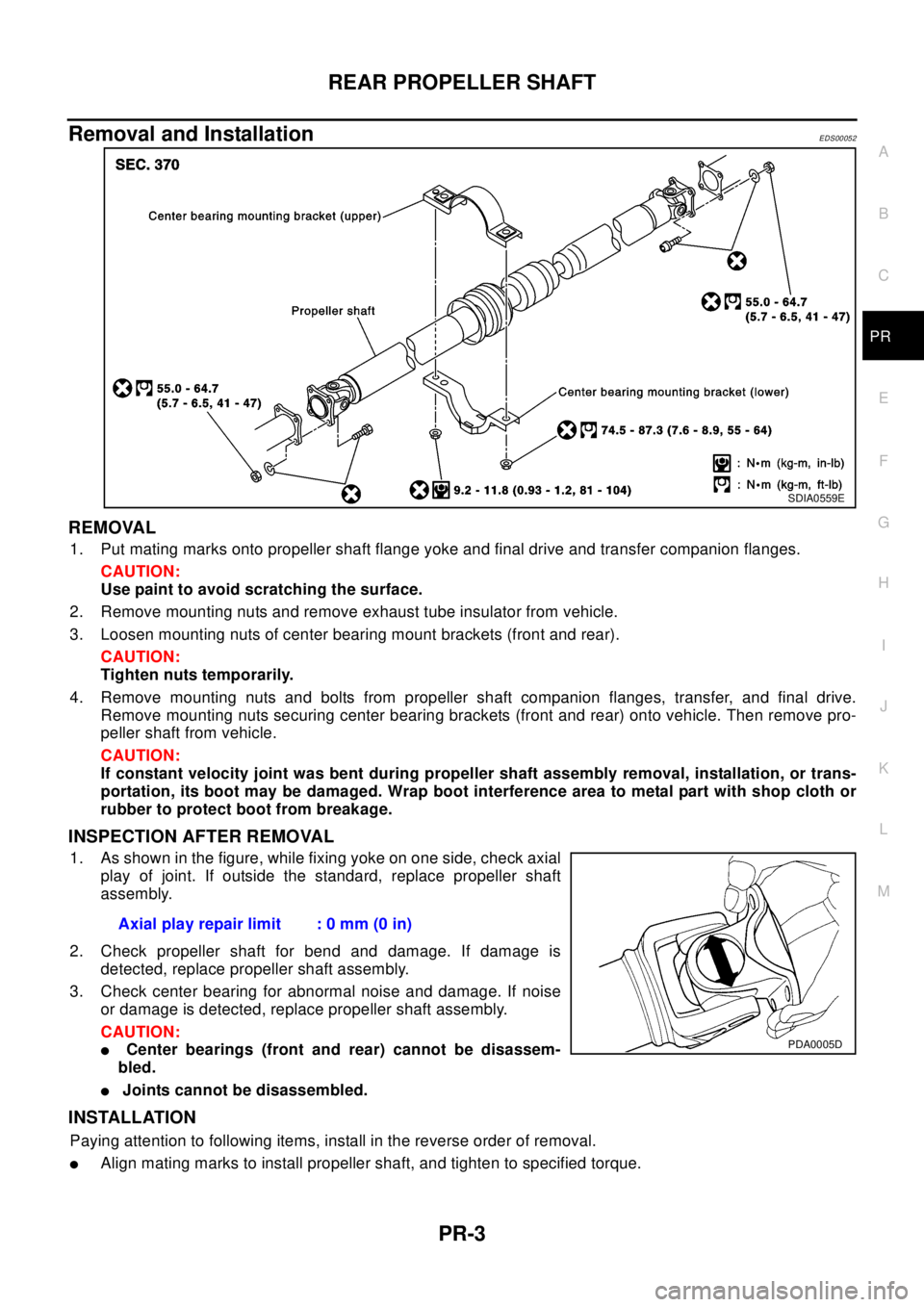
Removal and InstallationEDS00052
REMOVAL
1. Put mating marks onto propeller shaft flange yoke and final drive and transfer companion flanges.
CAUTION:
Use paint to avoid scratching the surface.
2. Remove mounting nuts and remove exhaust tube insulator from vehicle.
3. Loosen mounting nuts of center bearing mount brackets (front and rear).
CAUTION:
Tighten nuts temporarily.
4. Remove mounting nuts and bolts from propeller shaft companion flanges, transfer, and final drive.
Remove mounting nuts securing center bearing brackets (front and rear) onto vehicle. Then remove pro-
peller shaft from vehicle.
CAUTION:
If constant velocity joint was bent during propeller shaft assembly removal, installation, or trans-
portation, its boot may be damaged. Wrap boot interference area to metal part with shop cloth or
rubber to protect boot from breakage.
INSPECTION AFTER REMOVAL
1. As shown in the figure, while fixing yoke on one side, check axial
play of joint. If outside the standard, replace propeller shaft
assembly.
2. Check propeller shaft for bend and damage. If damage is
detected, replace propeller shaft assembly.
3. Check center bearing for abnormal noise and damage. If noise
or damage is detected, replace propeller shaft assembly.
CAUTION:
lCenter bearings (front and rear) cannot be disassem-
bled.
lJoints cannot be disassembled.
INSTALLATION
Paying attention to following items, install in the reverse order of removal.
lAlign mating marks to install propeller shaft, and tighten to specified torque.
SDIA0559E
Axial play repair limit : 0 mm (0 in)
PDA0005D