brake NISSAN X-TRAIL 2003 Electronic User Guide
[x] Cancel search | Manufacturer: NISSAN, Model Year: 2003, Model line: X-TRAIL, Model: NISSAN X-TRAIL 2003Pages: 3066, PDF Size: 51.47 MB
Page 29 of 3066
OVERALL SYSTEM
AT-23
D
E
F
G
H
I
J
K
L
MA
B
AT
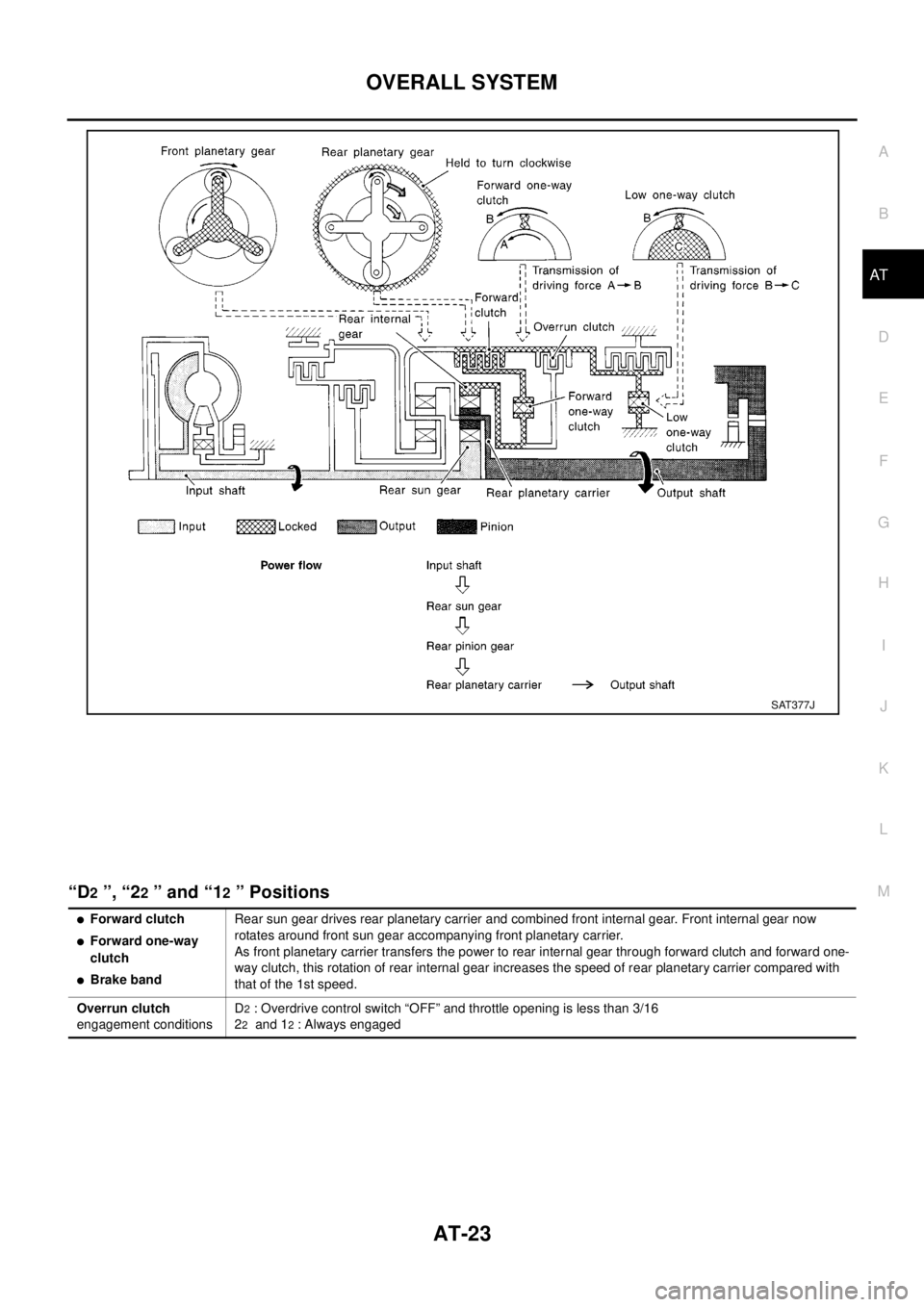
“D2”, “22”and“12” Positions
SAT377J
lForward clutch
lForward one-way
clutch
lBrake bandRear sun gear drives rear planetary carrier and combined front internal gear. Front internal gear now
rotates around front sun gear accompanying front planetary carrier.
As front planetary carrier transfers the power to rear internal gear through forward clutch and forward one-
way clutch, this rotation of rear internal gear increases the speed of rear planetary carrier compared with
that of the 1st speed.
Overrun clutch
engagement conditionsD
2: Overdrive control switch “OFF” and throttle opening is less than 3/16
2
2and 12: Always engaged
Page 31 of 3066
OVERALL SYSTEM
AT-25
D
E
F
G
H
I
J
K
L
MA
B
AT
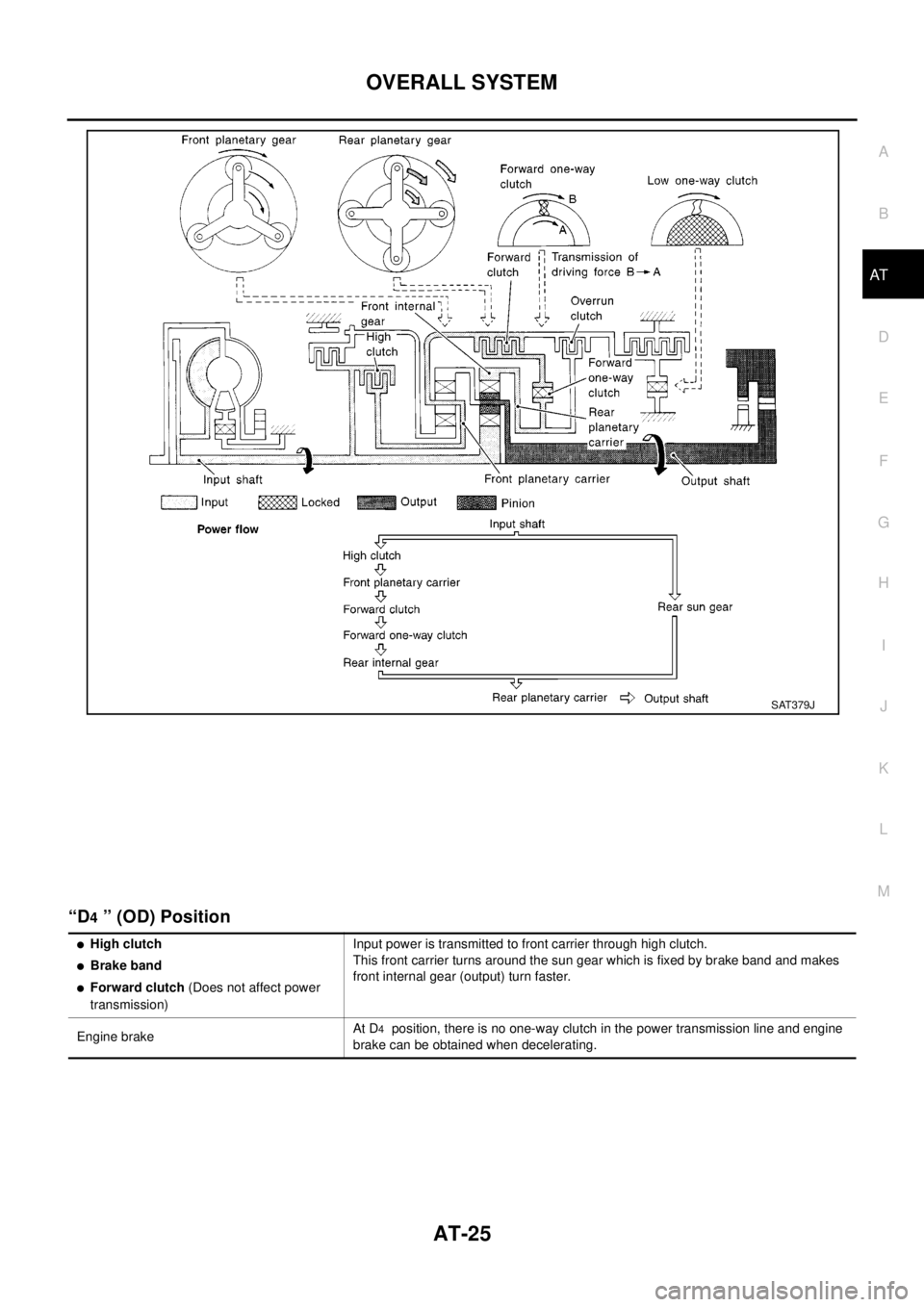
“D4” (OD) Position
SAT379J
lHigh clutch
lBrake band
lForward clutch(Does not affect power
transmission)Input power is transmitted to front carrier through high clutch.
This front carrier turns around the sun gear which is fixed by brake band and makes
front internal gear (output) turn faster.
Engine brakeAt D
4position, there is no one-way clutch in the power transmission line and engine
brake can be obtained when decelerating.
Page 32 of 3066
AT-26
OVERALL SYSTEM
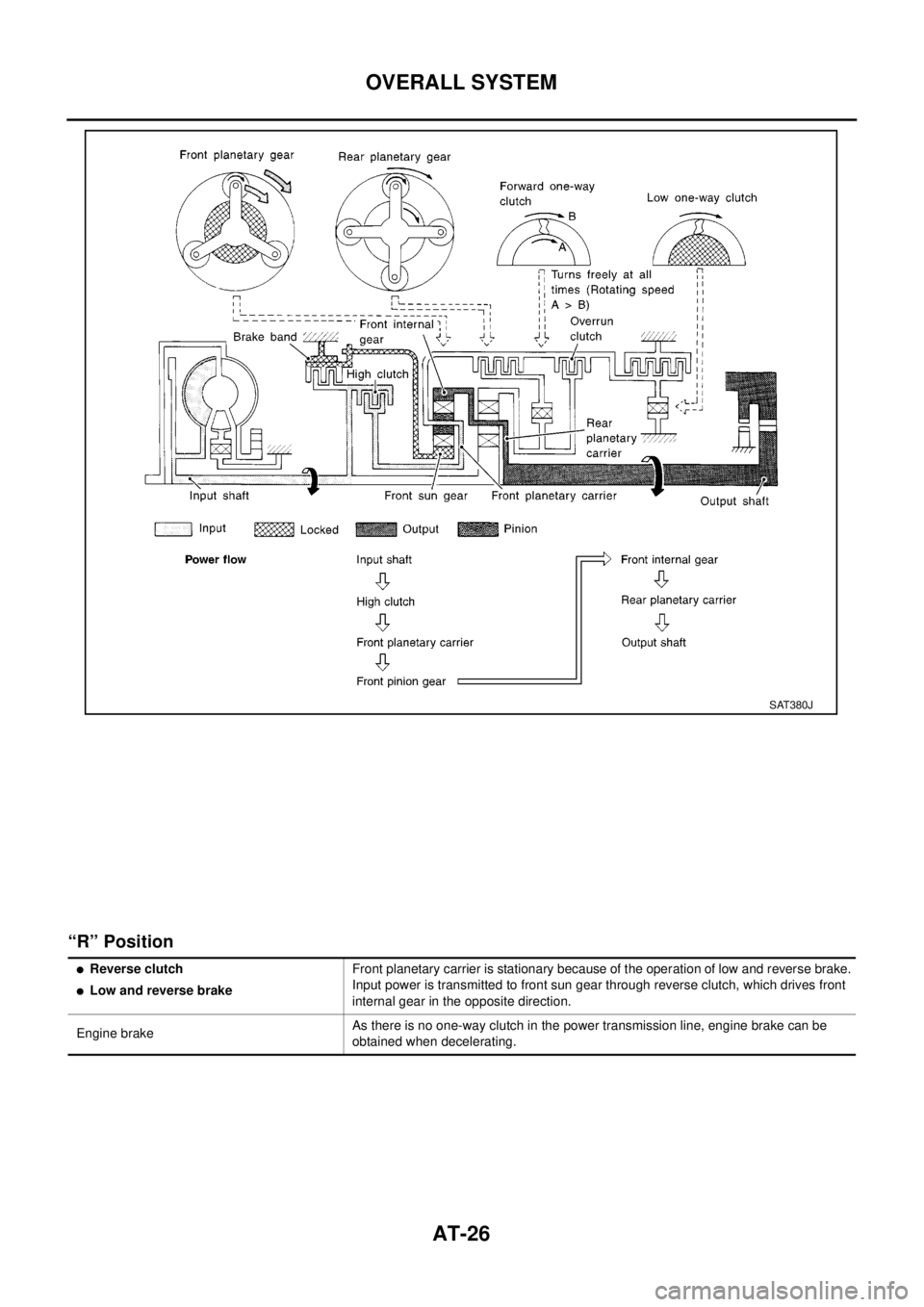
“R” Position
SAT380J
lReverse clutch
lLow and reverse brakeFront planetary carrier is stationary because of the operation of low and reverse brake.
Input power is transmitted to front sun gear through reverse clutch, which drives front
internal gear in the opposite direction.
Engine brakeAs there is no one-way clutch in the power transmission line, engine brake can be
obtained when decelerating.
Page 34 of 3066
AT-28
OVERALL SYSTEM
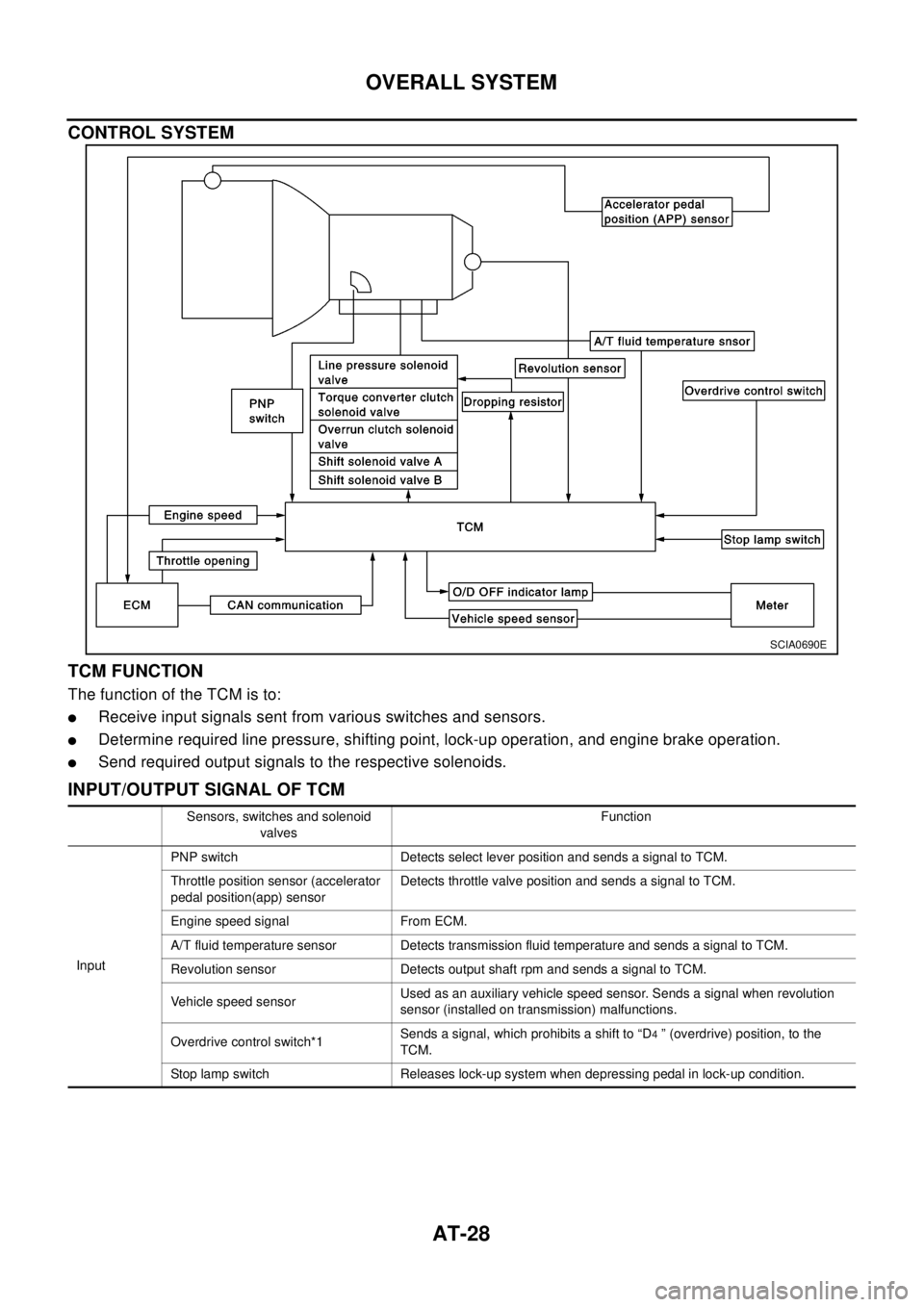
CONTROL SYSTEM
TCM FUNCTION
ThefunctionoftheTCMisto:
lReceive input signals sent from various switches and sensors.
lDetermine required line pressure, shifting point, lock-up operation, and engine brake operation.
lSend required output signals to the respective solenoids.
INPUT/OUTPUT SIGNAL OF TCM
SCIA0690E
Sensors, switches and solenoid
valvesFunction
InputPNP switch Detects select lever position and sends a signal to TCM.
Throttle position sensor (accelerator
pedal position(app) sensorDetects throttle valve position and sends a signal to TCM.
Engine speed signal From ECM.
A/T fluid temperature sensor Detects transmission fluid temperature and sends a signal to TCM.
Revolution sensor Detects output shaft rpm and sends a signal to TCM.
Vehicle speed sensorUsed as an auxiliary vehicle speed sensor. Sends a signal when revolution
sensor (installed on transmission) malfunctions.
Overdrive control switch*1Sends a signal, which prohibits a shift to “D
4” (overdrive) position, to the
TCM.
Stop lamp switch Releases lock-up system when depressing pedal in lock-up condition.
Page 35 of 3066
OVERALL SYSTEM
AT-29
D
E
F
G
H
I
J
K
L
MA
B
AT
Control MechanismECS004QF
LINE PRESSURE CONTROL
TCM has various line pressure control characteristics to match the driving conditions.
An ON-OFF duty signal is sent to the line pressure solenoid valve based on TCM characteristics.
Hydraulic pressure on the clutch and brake is electronically controlled through the line pressure solenoid valve
to accommodate engine torque. This results in smooth shift operation.
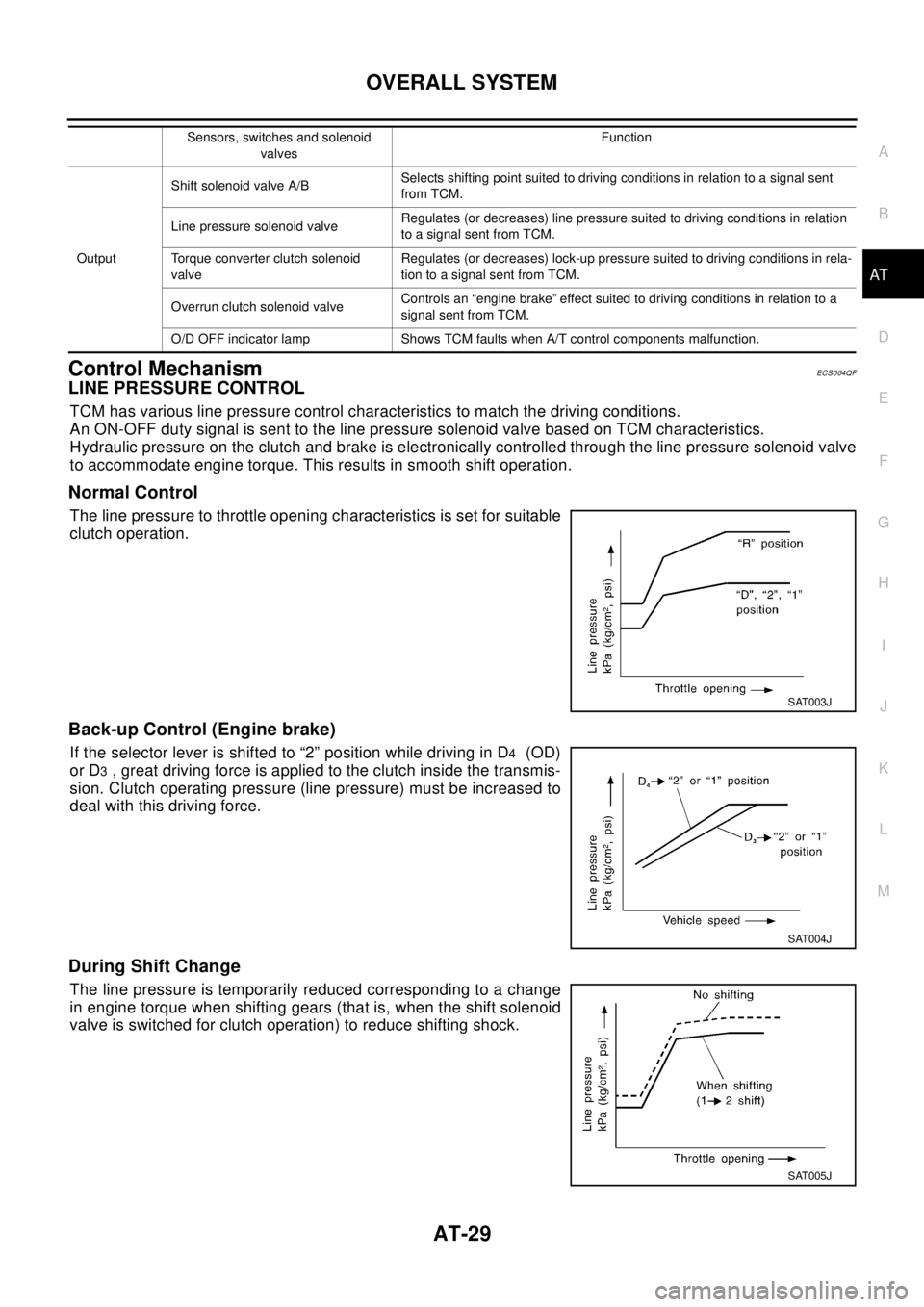
Normal Control
The line pressure to throttle opening characteristics is set for suitable
clutch operation.
Back-up Control (Engine brake)
If the selector lever is shifted to “2” position while driving in D4(OD)
or D
3, great driving force is applied to the clutch inside the transmis-
sion. Clutch operating pressure (line pressure) must be increased to
deal with this driving force.
During Shift Change
The line pressure is temporarily reduced corresponding to a change
in engine torque when shifting gears (that is, when the shift solenoid
valve is switched for clutch operation) to reduce shifting shock.
OutputShift solenoid valve A/BSelects shifting point suited to driving conditions in relation to a signal sent
from TCM.
Line pressure solenoid valveRegulates (or decreases) line pressure suited to driving conditions in relation
to a signal sent from TCM.
Torque converter clutch solenoid
valveRegulates (or decreases) lock-up pressure suited to driving conditions in rela-
tion to a signal sent from TCM.
Overrun clutch solenoid valveControls an “engine brake” effect suited to driving conditions in relation to a
signal sent from TCM.
O/D OFF indicator lamp Shows TCM faults when A/T control components malfunction.Sensors, switches and solenoid
valvesFunction
SAT003J
SAT004J
SAT005J
Page 36 of 3066
AT-30
OVERALL SYSTEM
At Low Fluid Temperature
lFluid viscosity and frictional characteristics of the clutch facing change with fluid temperature. Clutch
engaging or band-contacting pressure is compensated for, according to fluid temperature, to stabilize
shifting quality.
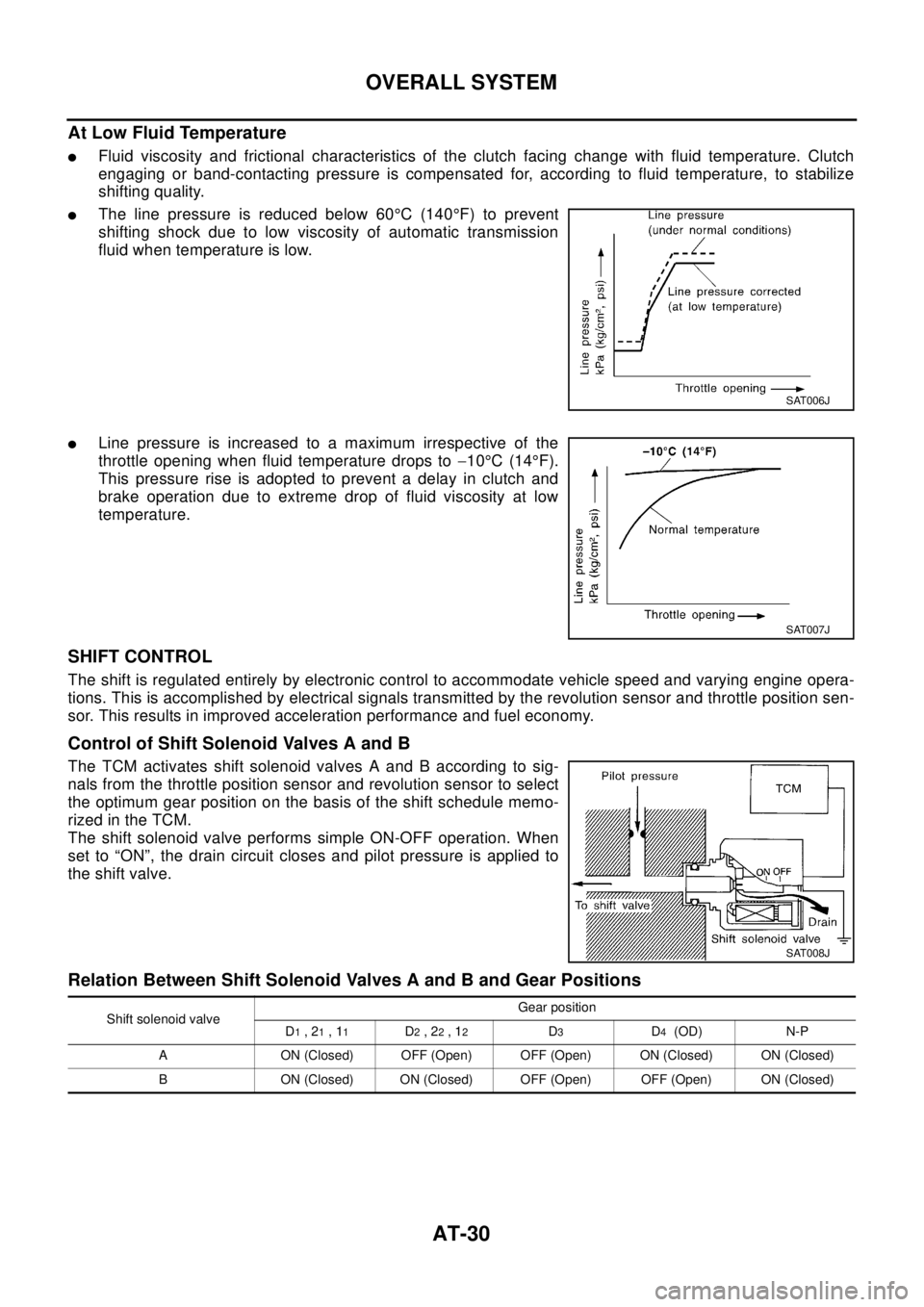
lThe line pressure is reduced below 60°C(140°F) to prevent
shifting shock due to low viscosity of automatic transmission
fluid when temperature is low.
lLine pressure is increased to a maximum irrespective of the
throttle opening when fluid temperature drops to-10°C(14°F).
This pressure rise is adopted to prevent a delay in clutch and
brake operation due to extreme drop of fluid viscosity at low
temperature.
SHIFT CONTROL
The shift is regulated entirely by electronic control to accommodate vehicle speed and varying engine opera-
tions. This is accomplished by electrical signals transmitted by the revolution sensor and throttle position sen-
sor. This results in improved acceleration performance and fuel economy.
Control of Shift Solenoid Valves A and B
The TCM activates shift solenoid valves A and B according to sig-
nals from the throttle position sensor and revolution sensor to select
the optimum gear position on the basis of the shift schedule memo-
rizedintheTCM.
The shift solenoid valve performs simple ON-OFF operation. When
set to “ON”, the drain circuit closes and pilot pressure is applied to
the shift valve.
Relation Between Shift Solenoid Valves A and B and Gear Positions
SAT006J
SAT007J
SAT008J
Shift solenoid valveGear position
D1,21,11D2,22,12D3D4(OD) N-P
A ON (Closed) OFF (Open) OFF (Open) ON (Closed) ON (Closed)
B ON (Closed) ON (Closed) OFF (Open) OFF (Open) ON (Closed)
Page 38 of 3066
AT-32
OVERALL SYSTEM
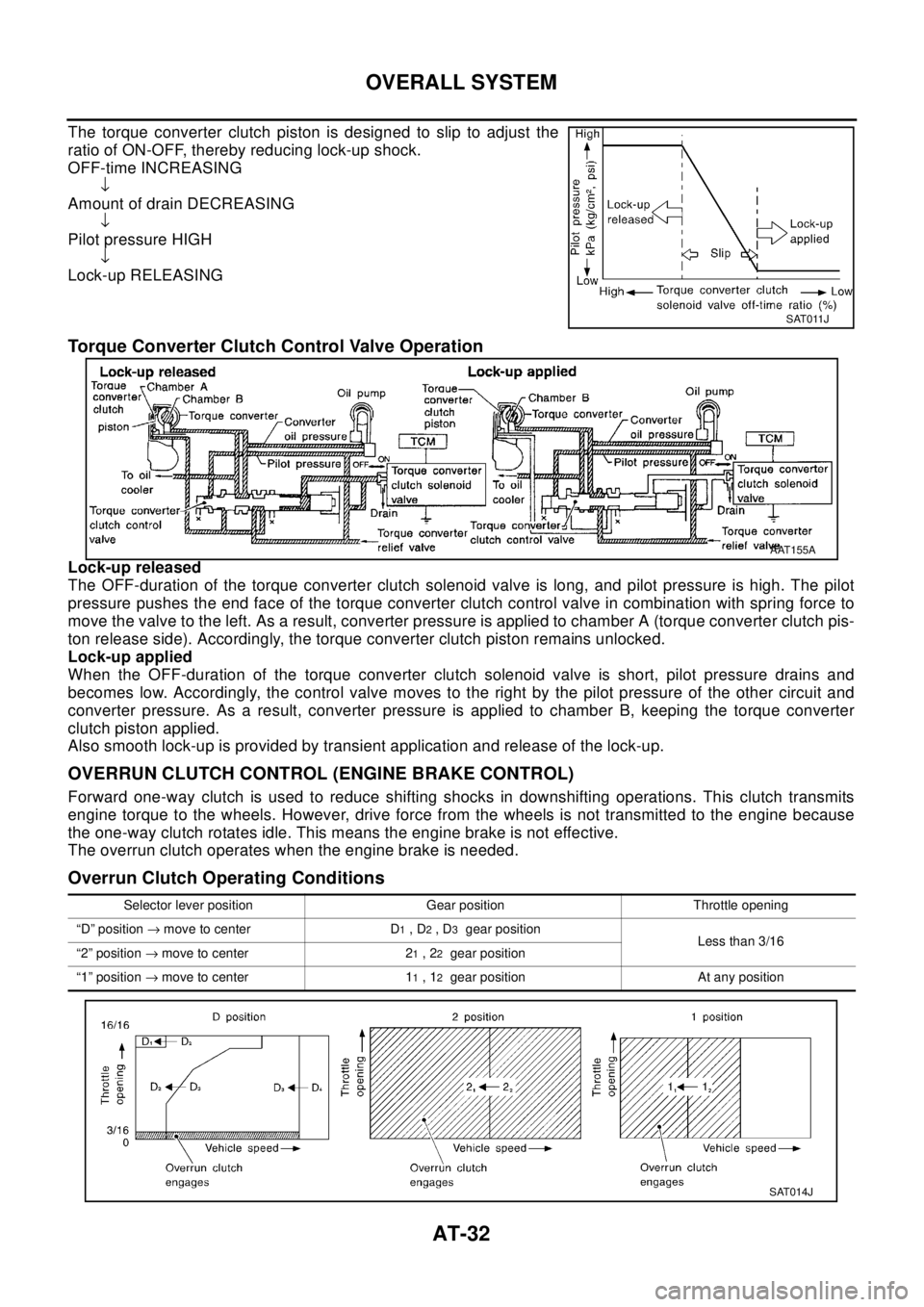
The torque converter clutch piston is designed to slip to adjust the
ratio of ON-OFF, thereby reducing lock-up shock.
OFF-time INCREASING
¯
Amount of drain DECREASING
¯
Pilot pressure HIGH
¯
Lock-up RELEASING
Torque Converter Clutch Control Valve Operation
Lock-up released
The OFF-duration of the torque converter clutch solenoid valve is long, and pilot pressure is high. The pilot
pressure pushes the end face of the torque converter clutch control valve in combination with spring force to
move the valve to the left. As a result, converter pressure is applied to chamber A (torque converter clutch pis-
ton release side). Accordingly, the torque converter clutch piston remains unlocked.
Lock-up applied
When the OFF-duration of the torque converter clutch solenoid valve is short, pilot pressure drains and
becomes low. Accordingly, the control valve moves to the right by the pilot pressure of the other circuit and
converter pressure. As a result, converter pressure is applied to chamber B, keeping the torque converter
clutch piston applied.
Also smooth lock-up is provided by transient application and release of the lock-up.
OVERRUN CLUTCH CONTROL (ENGINE BRAKE CONTROL)
Forward one-way clutch is used to reduce shifting shocks in downshifting operations. This clutch transmits
engine torque to the wheels. However, drive force from the wheels is not transmitted to the engine because
the one-way clutch rotates idle. This means the engine brake is not effective.
The overrun clutch operates when the engine brake is needed.
Overrun Clutch Operating Conditions
SAT011J
AAT155A
Selector lever position Gear position Throttle opening
“D” position®move to center D
1,D2,D3gear position
Less than 3/16
“2” position®move to center 2
1,22gear position
“1” position®move to center 1
1,12gear position At any position
SAT014J
Page 39 of 3066
OVERALL SYSTEM
AT-33
D
E
F
G
H
I
J
K
L
MA
B
AT
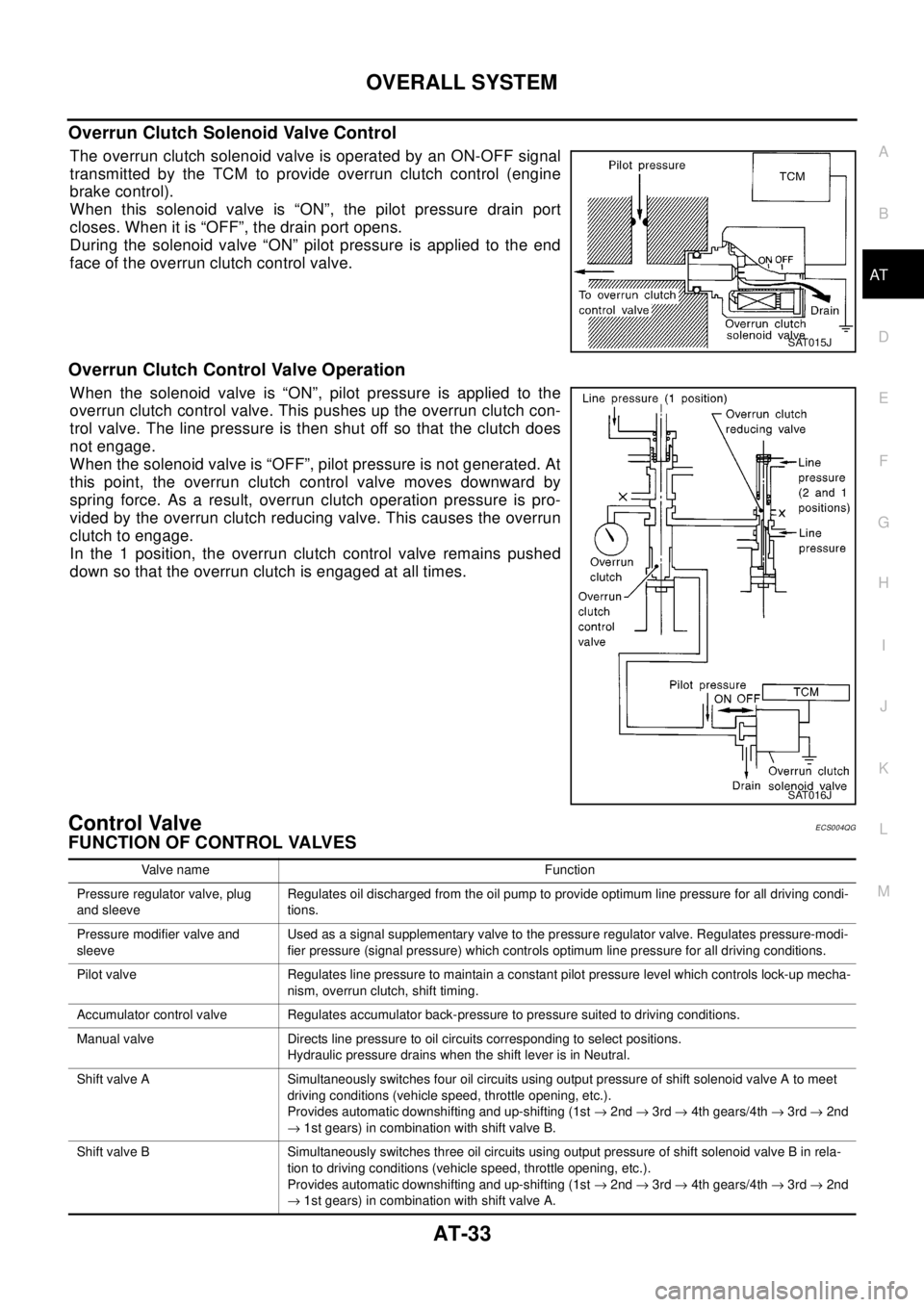
Overrun Clutch Solenoid Valve Control
TheoverrunclutchsolenoidvalveisoperatedbyanON-OFFsignal
transmitted by the TCM to provide overrun clutch control (engine
brake control).
When this solenoid valve is “ON”, the pilot pressure drain port
closes. When it is “OFF”, the drain port opens.
During the solenoid valve “ON” pilot pressure is applied to the end
face of the overrun clutch control valve.
Overrun Clutch Control Valve Operation
When the solenoid valve is “ON”, pilot pressure is applied to the
overrun clutch control valve. This pushes up the overrun clutch con-
trol valve. The line pressure is then shut off so that the clutch does
not engage.
When the solenoid valve is “OFF”, pilot pressure is not generated. At
this point, the overrun clutch control valve moves downward by
spring force. As a result, overrun clutch operation pressure is pro-
vided by the overrun clutch reducing valve. This causes the overrun
clutch to engage.
In the 1 position, the overrun clutch control valve remains pushed
down so that the overrun clutch is engaged at all times.
Control ValveECS004QG
FUNCTION OF CONTROL VALVES
SAT015J
SAT016J
Valve name Function
Pressure regulator valve, plug
and sleeveRegulates oil discharged from the oil pump to provide optimum line pressure for all driving condi-
tions.
Pressure modifier valve and
sleeveUsed as a signal supplementary valve to the pressure regulator valve. Regulates pressure-modi-
fier pressure (signal pressure) which controls optimum line pressure for all driving conditions.
Pilot valve Regulates line pressure to maintain a constant pilot pressure level which controls lock-up mecha-
nism, overrun clutch, shift timing.
Accumulator control valve Regulates accumulator back-pressure to pressure suited to driving conditions.
Manual valve Directs line pressure to oil circuits corresponding to select positions.
Hydraulic pressure drains when the shift lever is in Neutral.
Shift valve A Simultaneously switches four oil circuits using output pressure of shift solenoid valve A to meet
driving conditions (vehicle speed, throttle opening, etc.).
Provides automatic downshifting and up-shifting (1st®2nd®3rd®4th gears/4th®3rd®2nd
®1st gears) in combination with shift valve B.
Shift valve B Simultaneously switches three oil circuits using output pressure of shift solenoid valve B in rela-
tion to driving conditions (vehicle speed, throttle opening, etc.).
Provides automatic downshifting and up-shifting (1st®2nd®3rd®4th gears/4th®3rd®2nd
®1st gears) in combination with shift valve A.
Page 40 of 3066

AT-34
OVERALL SYSTEM
Overrun clutch control valve Switches hydraulic circuits to prevent engagement of the overrun clutch simultaneously with appli-
cation of the brake band in D
4. (Interlocking occurs if the overrun clutch engages during D4.)
1st reducing valve Reduces low & reverse brake pressure to dampen engine-brake shock when down-shifting from
the “1” position 1
2to 11.
Overrun clutch reducing valve Reduces oil pressure directed to the overrun clutch and prevents engine-brake shock.
In “1” and “2” positions, line pressure acts on the overrun clutch reducing valve to increase the
pressure-regulating point, with resultant engine brake capability.
Torque converter relief valve Prevents an excessive rise in torque converter pressure.
Torque converter clutch control
valve, plug and sleeveActivates or inactivates the lock-up function.
Also provides smooth lock-up through transient application and release of the lock-up system.
1-2 accumulator valve and piston Dampens the shock encountered when 2nd gear band servo contracts, and provides smooth
shifting.
3-2 timing valve Switches oil pressure with 3-2 timing valve according to throttle opening.
Shuttle control valve Reduces shock when down-shifting from 3rd to 2nd and regulates overrun clutch.
Cooler check valve Regulates oil pressure which causes lock-up when driving at low speeds.Valve name Function
Page 52 of 3066
![NISSAN X-TRAIL 2003 Electronic User Guide AT-46
[EURO-OBD]
ON BOARD DIAGNOSTIC SYSTEM DESCRIPTION
X: Applicable —: Not applicable : OptionThrottle position THROTTLE
POSI
[/8]—— X
lThrottle position data,
used for computation
by TCM, is](/img/5/57402/w960_57402-51.png "NISSAN X-TRAIL 2003 Electronic User Guide AT-46
[EURO-OBD]
ON BOARD DIAGNOSTIC SYSTEM DESCRIPTION
X: Applicable —: Not applicable : OptionThrottle position THROTTLE
POSI
[/8]—— X
lThrottle position data,
used for computation
by TCM, is")
AT-46
[EURO-OBD]
ON BOARD DIAGNOSTIC SYSTEM DESCRIPTION
X: Applicable —: Not applicable : OptionThrottle position THROTTLE
POSI
[/8]—— X
lThrottle position data,
used for computation
by TCM, is displayed.lA specific value used
for control is displayed
if fail-safe is activated
due to error.
Stop lamp switch BRAKE SW
[ON/OFF]
X——
lON/OFF status is dis-
played.
ON ... Brake pedal is
depressed.
OFF ... Brake pedal is
released.
Line pressure duty LINE PRES DTY
[%]
—— X
lControl value of line
pressure solenoid
valve, computed by
TCM from each input
signal, is displayed.
Torque converter
clutch solenoid
valve dutyTCC S/V DUTY
[%]
—— X
lControl value of torque
converter clutch sole-
noid valve, computed
by TCM from each
input signal, is dis-
played.
Shift solenoid
valve ASHIFT S/V A
[ON/OFF]
—— X
lControl value of shift
solenoid valve A, com-
puted by TCM from
each input signal, is
displayed.Control value of sole-
noid is displayed even if
solenoid circuit is dis-
connected.
The OFF signal is dis-
played if solenoid circuit
is shorted. Shift solenoid
valve BSHIFT S/V B
[ON/OFF]
—— X
lControl value of shift
solenoid valve B, com-
puted by TCM from
each input signal, is
displayed.
Overrun clutch
solenoid valveOVERRUN/C S/
V
[ON/OFF]
—— X
lControl value of over-
run clutch solenoid
valve computed by
TCM from each input
signal is displayed.
Self-diagnosis dis-
play lamp
(O/D OFF indica-
tor lamp)SELF-D DP LMP
[ON/OFF]
—— X
lControl status of O/D
OFF indicator lamp is
displayed.
Voltage [V] — — — Value measured by voltage probe is displayed.
Frequency [Hz] — — —Value measured by pulse probe is displayed. If mea-
surement is impossible, "#" sign is displayed. "#"
sign is also displayed at the final data value until the
measurement result is obtained.
DUTY-HI — — —
Duty cycle value for measurement probe is dis-
played.
DUTY-LOW — — —
PLS WIDTH-HI — — —
Measured pulse width of measurement probe is dis-
played.
PLS WIDTH-LOW — — —Item DisplayMovertocenterMonitoritems
Description Remarks TCM
Input
signalsCAN
comm
sig-
nalsMain
signalsSelection
from
menu