fuel pressure Oldsmobile Achieva 1995 Owner's Manuals
[x] Cancel search | Manufacturer: OLDSMOBILE, Model Year: 1995, Model line: Achieva, Model: Oldsmobile Achieva 1995Pages: 340, PDF Size: 16.99 MB
Page 7 of 340

Vehicle Symbols
These are some of the symbols you may find on your vehicle.
For example,
these symbols
are used on an
original battery:
POSSIBLE A
CAUTION
INJURY
PROTECT EYES BY
SHIELDING
CAUSTIC
ACID COULD BATTERY
CAUSE
BURNS
AVOID
SPARKS
OR
FLAMES
SPARK
OR ,\I/,
COULD FLAME
EXPLODE BATTERY
These symbols
are important
for you and
your passengers
whenever your
vehicle
is
driven:
DOOR LOCK
UNLOCK
FASTEN SEAT
BELTS
POWER
WINDOW
These symbols
have to do with
your lights:
SIGNALS e e
TURN
FOG LAMPS
$0
These symbols
are on some of
your controls:
WINDSHIELD
WIPER
WINDSHIELD DEFROSTER
WINDOW
DEFOGGER
VENTILATING FAN
These symbols are used on
warning and
indicator lights:
COOLANT F-
TEMP --
ENGINE
CHARGING
I-1
BATTERY SYSTEM
BRAKE
(a)
FUEL
ENGINE OIL
PRESSURE
Wd
TEMP OIL 9b
ANTI-LOCK (@)
BRAKE
Here are some
other symbols
you may see:
FUSE -%-
RELEASE
RADIO
VOLUME
CONDITIONING
A'R 43
RELEASE TRUNK e
LIGHTER n
HORN )tr
SPEAKER
b
V
Page 122 of 340
NOTICE:
If you keep driving your vehicle with this light
on, after a while the emission controls won’t
work as well, your fuel economy won’t be as good
and your engine may not run as smoothly. This
could lead to costly repairs not covered by your
warranty.
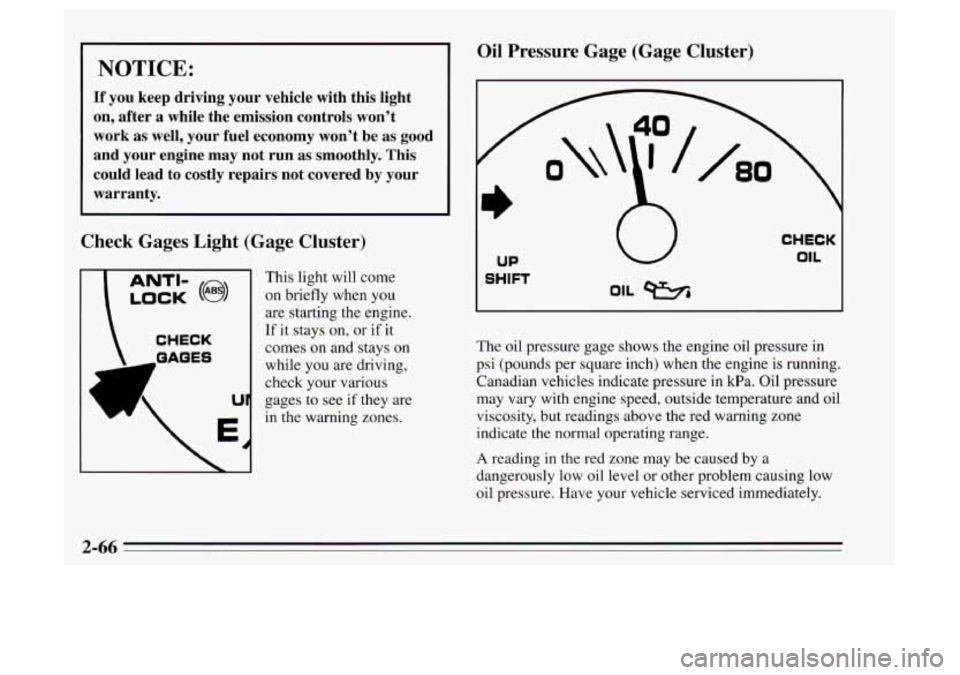
Check Gages Light (Gage Cluster)
9 ANTI-
CHECK
Q
OAOES
UI
E 4
This light will come
on briefly when you
are starting the engine.
If it stays on, or if
it
comes on and stays on
while you are driving,
check your various
gages to see if they are
in the warning zones.
Oil Pressure Gage (Gage Cluster)
UP
SHIFT
CHECK
OIL
The oil pressure gage shows the engine oil pressure in
psi (pounds per square inch) when the engine is running.
Canadian vehicles indicate pressure in kPa. Oil pressure
may vary with engine speed, outside temperature and oil
viscosity, but readings above the red warning zone
indicate the normal operating range.
A reading in the red zone may be caused by a
dangerously low oil level or other problem causing low
oil pressure. Have your vehicle serviced immediately.
2-66
Page 164 of 340
Here are some things you can check before a trip:
0
0
0
0
0
0
0
Windshield Washer Fluid: Is the reservoir full? Are
all windows clean inside and outside?
Wiper Blades: Are they in good shape?
Fuel, Engine Oil, Other Fluids: Have you checked
all levels?
Lamps: Are they all working? Are the lenses clean?
Tires: They are vitally important to a safe,
trouble-free trip. Is the tread good enough for
long-distance driving? Are the tires all inflated
to the
recommended pressure?
Weather Forecasts: What’s the weather outlook
along your route? Should you delay your trip a short
time to avoid
a major storm system?
Maps: Do you have up-to-date maps?
Highway Hypnosis
Is there actually such a condition as “highway
hypnosis?” Or
is it just plain falling asleep at the wheel?
Call
it highway hypnosis, lack of awareness, or
whatever.
There is something about an easy stretch
of road with
the same scenery, along with the hum of the tires on the
road, the drone
of the engine, and the rush of the wind
against the vehicle that can make you sleepy. Don’t let it
happen to you! If it does, your vehicle can leave the
road in
less than a second, and you could crash and be
injured.
What can you
do about highway hypnosis? First, be
aware that it can happen.
Then here are some tips:
0 Make sure your vehicle is well ventilated, with a
comfortably cool interior.
Keep your eyes moving. Scan the road ahead and to
the sides. Check your rearview mirrors and your
instruments frequently.
If you get sleepy, pull off the road into a rest, service,
or parking area and take a nap, get some exercise,
or
both. For safety, treat drowsiness on the highway as
an emergency.
4-20
Page 244 of 340
Inflation - Tire Pressure
The Tire-Loading Information label which is on the rear
edge
of the driver’s door shows the correct inflation
pressures for your tires, when they’re cold. “Cold”
means your vehicle has been sitting for at least
three
?--., hours TI-< 01 &iv_eu~o more than.a.mile.
NOTICE:
Don’t let anyone tell you that underinflation or
overinflation
is all right. It’s not. If your tires don’t
have enough
air (underinflation) you can get:
Too much flexing
0 Too much heat
Tire overloading
Bad wear
Bad handling
Bad fuel economy.
If your tires have too much air (overinflation),
you can get:
Unusual wear
0 Bad handling
Rough ride
0 Needless damage from road hazards.
___..
When to Check
Check your tires once a month or more.
Don’t forget your compact spare tire.
It should be at
60 psi (420 Wa).
How to Check
Use a good quality pocket-type gage to check tire
pressure. Simply looking at the tires will not tell you the
pressure, especially if you have radial tires
-- which
may look properly inflated even
if they’re underinflated.
If your tires have valve caps, be sure to put them back
on. They help prevent leaks by keeping out dirt and
moisture.
6-34
Page 265 of 340
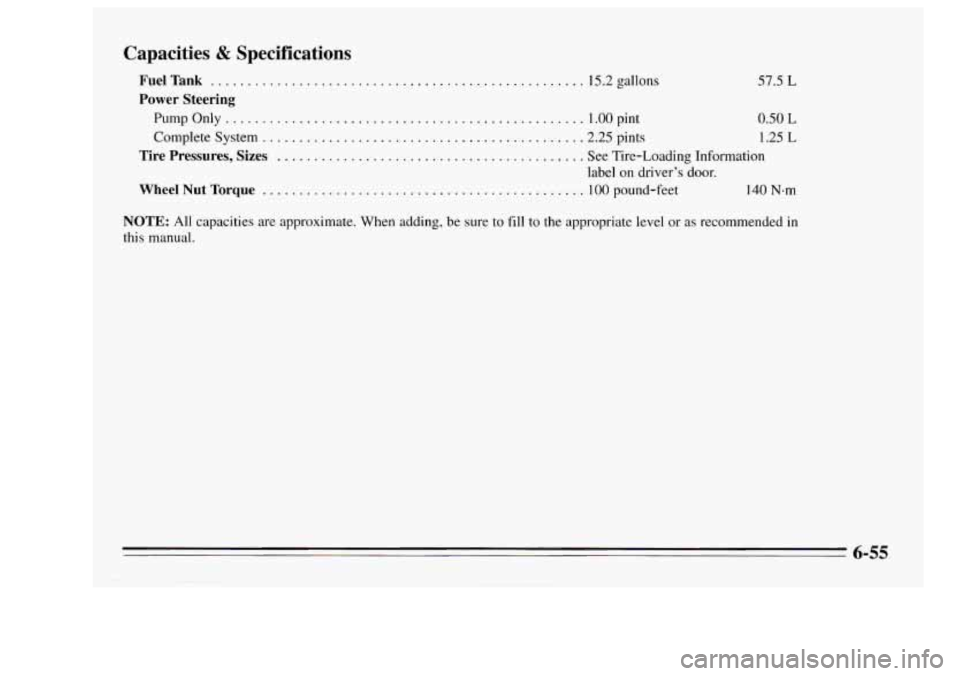
Capacities & Specifications
FuelTank ...................................................
Power Steering
PumpOnly .................................................
Complete System ............................................
Tire Pressures, Sizes ..........................................
WheelNutTorque ............................................
15.2 gallons 57.5 L
1.00 pint 0.50 L
2.25 pints 1.25 L
See Tire-Loading Information
label on driver’s door.
100 pound-feet 140 N.m
NOTE: All capacities are approximate. When adding, be sure to fill to the appropriate level or as recommended in
this manual.
6-55
Page 279 of 340
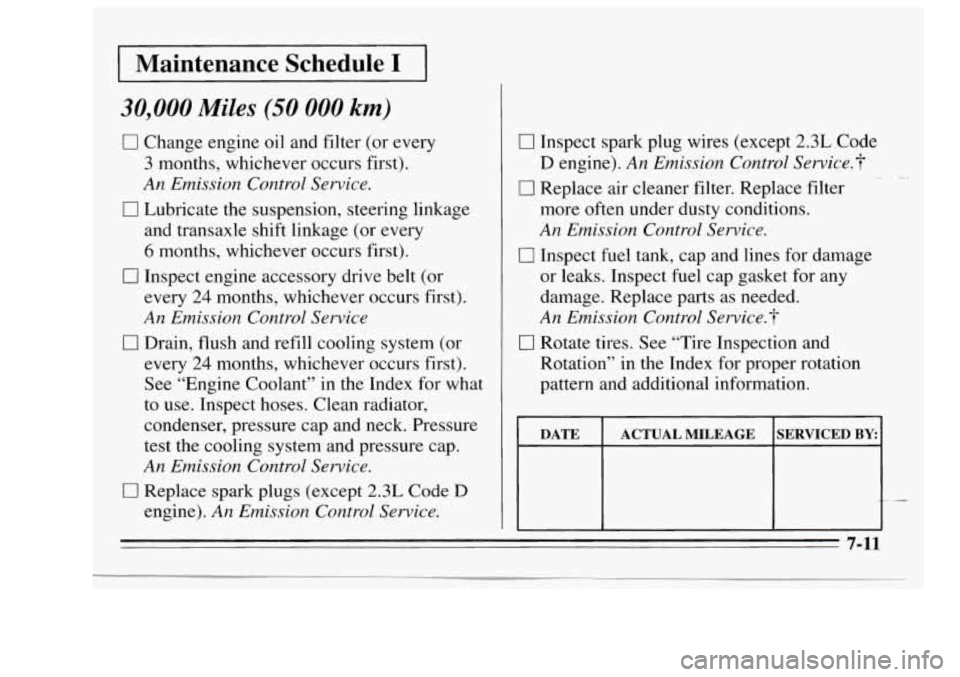
Maintenance Schedule I
30,000 Miles (50 000 km)
0 Change engine oil and filter (or every
3 months, whichever occurs first).
An Emission Control Service.
and transaxle shift linkage (or every
6 months, whichever occurs first).
0 Inspect engine accessory drive belt (or
every
24 months, whichever occurs first).
An Emission Control Service
0 Drain, flush and refill cooling system (or
every
24 months, whichever occurs first).
See “Engine Coolant” in the Index for what
to use. Inspect hoses. Clean radiator,
condenser, pressure cap and neck. Pressure
test the cooling system and pressure cap.
An Emission Control Sewice.
0 Replace spark plugs (except 2.3L Code D
engine). An Emission Control Sewice.
17 Lubricate the suspension, steering linkage
0 Inspect spark plug wires (except 2.3L Code
D engine). An Emission Control Sewice.
0 Replace air cleaner filter. Replace filter
more often under dusty conditions.
An Emission Control Service.
0 Inspect fuel tank, cap and lines for damage
or leaks. Inspect
fuel cap gasket for any
damage. Replace parts as needed.
An Emission Control Service.?
0 Rotate tires. See “Tire Inspection and
Rotation’’ in the Index for proper rotation
pattern and additional information.
DATE
SERVICED BY: ACTUAL MILEAGE
L- -
7-11
Page 285 of 340
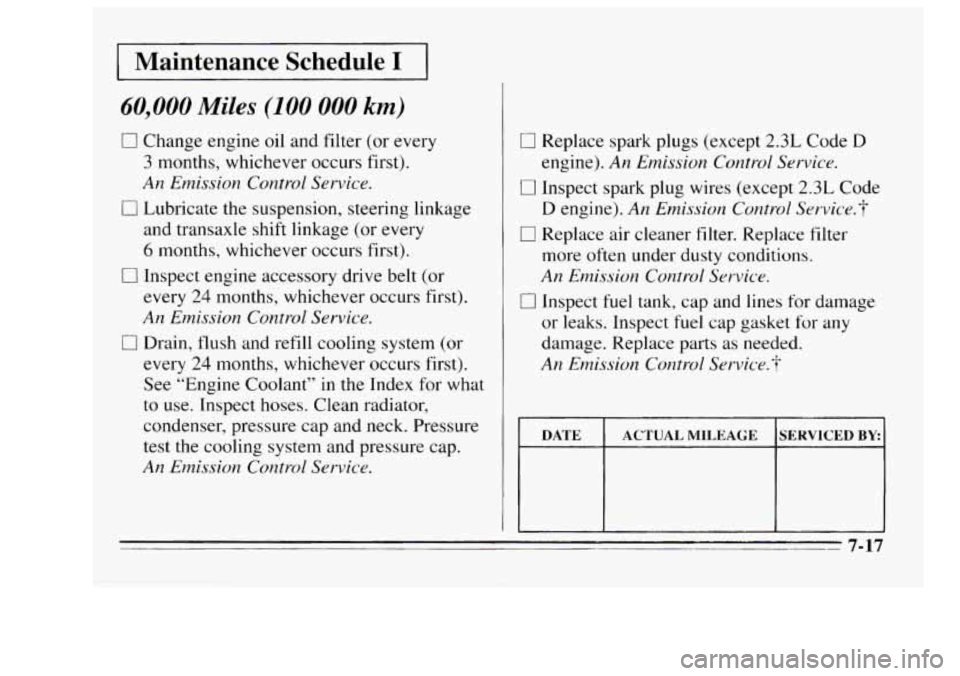
Maintenance Schedule I
60,000 Miles (100 000 km)
0 Change engine oil and filter (or every
3 months, whichever occurs first).
An Emission Control Service.
and transaxle shift linkage (or every
6 months, whichever occurs first).
0 Inspect engine accessory drive belt (or
every
24 months, whichever occurs first).
An Emission Control Service.
0 Drain, flush and refill cooling system (or
every
24 months, whichever occurs first).
See "Engine Coolant"
in the Index for what
to use. Inspect hoses. Clean radiator,
condenser, pressure cap and neck. Pressure
test the cooling system and pressure cap.
An Emission Control Service.
0 Lubricate the suspension, steering linkage
U Replace spark plugs (except 2.3L Code D
engine). An Emission Control Service.
0 Inspect spark plug wires (except 2.3L Code
D engine). An Emission Control Servic.e."f
0 Replace air cleaner filter. Replace filter
more often under dusty conditions.
An Emission Control Service.
0 Inspect fuel tank, cap and lines for damage
or leaks. Inspect fuel cap gasket for any
damage. Replace parts as needed.
An Emission Control Service.?
Page 296 of 340
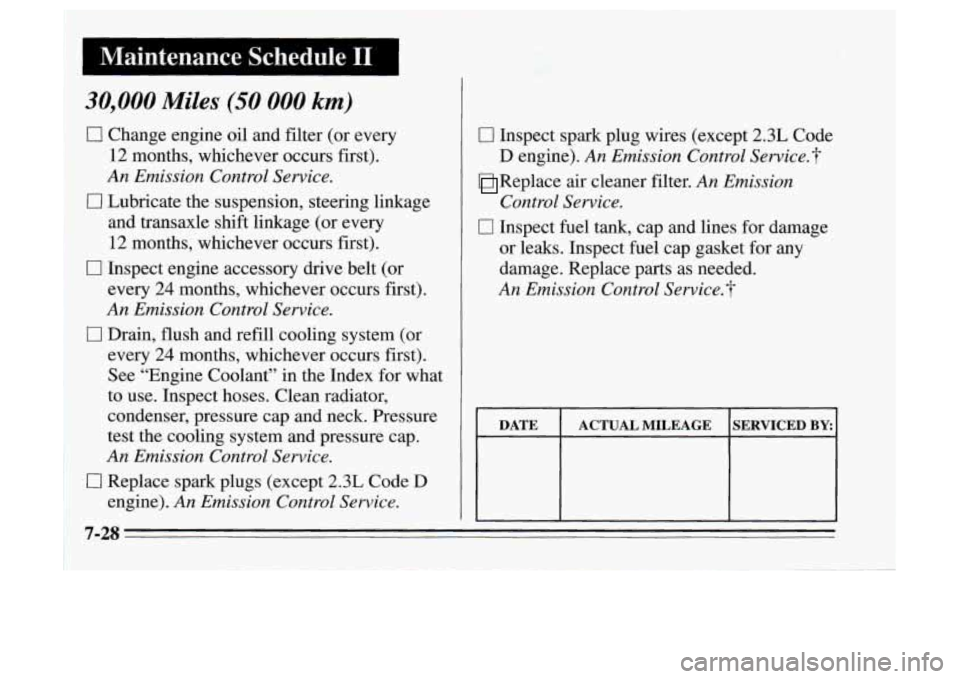
30,000 Miles (50 000 km)
0 Change engine oil and filter (or every
12 months, whichever occurs first).
An Emission Control Service.
and transaxle shift linkage (or every
12 months, whichever occurs first).
0 Inspect engine accessory drive belt (or
every
24 months, whichever occurs first).
An Emission Control Service.
0 Drain, flush and refill cooling system (or
every
24 months, whichever occurs first).
See “Engine Coolant’’ in the Index for what
to use. Inspect hoses. Clean radiator,
condenser, pressure cap and neck. Pressure
test the cooling system and pressure cap.
An Emission Control Service.
0 Replace spark plugs (except 2.3L Code D
engine). An Emission Control Service.
0 Lubricate the suspension, steering linkage
0 Inspect spark plug wires (except 2.3L Code
D engine). An Emission Control Service.?
Replace air cleaner filter. An Emission
Control Service.
0 Inspect fuel tank, cap and lines for damage
or leaks. Inspect fuel cap gasket for any
damage. Replace parts as needed.
An Emission Control Sewice.?
DATE ACTUAL MILEAGE SERVICED BY
7-28
Page 299 of 340
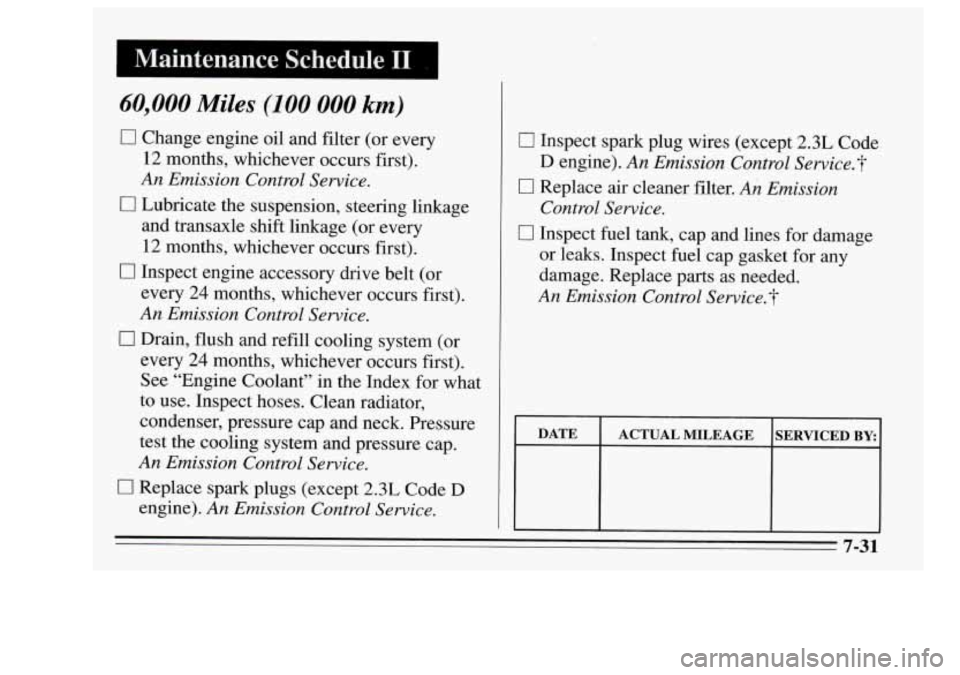
60,000 Miles (100 000 kt)
0 Change engine oil and filter (or every
12 months, whichever occurs first).
An Emission Control Service.
and transaxle shift linkage (or every
12 months, whichever occurs first).
0 Inspect engine accessory drive belt (or
every 24 months, whichever occurs first).
An Emission Control Service.
0 Drain, flush and refill cooling system (or
every 24 months, whichever occurs first).
See “Engine Coolant” in the Index for what
to use. Inspect hoses. Clean radiator,
condenser, pressure cap and neck. Pressure
test the cooling system and pressure cap.
An Emission Control Service.
0 Replace spark plugs (except 2.3L Code D
engine). An Emission Control Service.
0 Lubricate the suspension, steering linkage
0 Inspect spark plug wires (except 2.3L Code
D engine).
An Emission Control Service. 7
0 Replace air cleaner filter. An Emission
Control Service.
0 Inspect fuel tank, cap and lines for damage
or leaks. Inspect fuel cap gasket for any
damage. Replace parts as needed.
An Emission Control Service. 7
Page 304 of 340
Part B: Owner Checks and Services
Listed below are owner checks and services which
should be performed at the intervals specified to help
ensure the safety, dependability and emission control
performance
of your vehicle.
Be sure any necessary repairs are completed at once.
Whenever any fluids or lubricants are added to your
vehicle, make sure they are the proper ones, as shown
in
Part D.
At Each Fuel Fill
Engine Oil Level
Check the engine oil level and add t,he proper oil if
necessary. See “Engine Oil” in the Index for further
details.
Engine Coolant Level
Check the engine coolant level and add the proper
coolant mix if necessary. See “Coolant” in the Index for
further details.
Windshield Washer Fluid Level
Check the windshield washer tluid level in the
windshield washer tank and add the proper tluid if
necessary. See “Windshield Washer Fluid”
in the Index
for further details.
At Least Once a Month
Tire Inflation
Check tire inflation. Make sure tires are inflated to the
pressures specified
on the Tire-Loading Information
label located
on the rear edge of the driver’s door. See
“Tires”
in the Index for further details.
Cassette Deck
Clean cassette deck. Cleaning should be done every
50 hours of tape play. See “Audio Systems” in the
Index for further details.
7-36