radiator cap Oldsmobile Achieva 1995 Owner's Manuals
[x] Cancel search | Manufacturer: OLDSMOBILE, Model Year: 1995, Model line: Achieva, Model: Oldsmobile Achieva 1995Pages: 340, PDF Size: 16.99 MB
Page 197 of 340
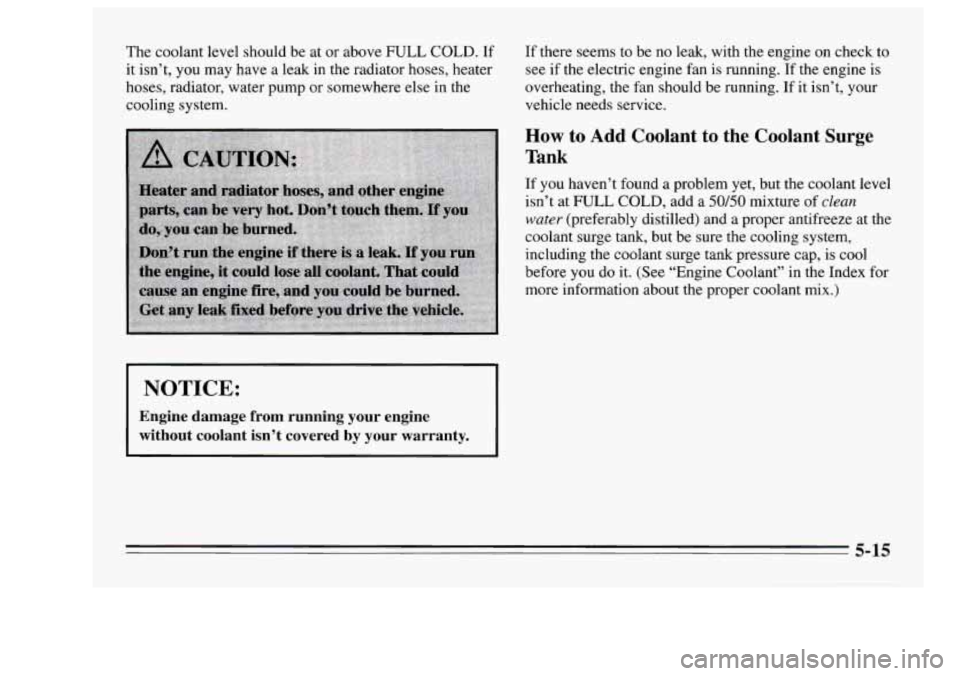
The coolant level should be at or above FULL COLD. If
it isn’t, you may have a leak in the radiator
hoses, heater
hoses, radiator, water pump or somewhere else in the
cooling system.
r
NOTICE:
Engine damage from running your engine
without coolant isn’t covered by your warranty.
If there seems to be no leak, with the engine on check to
see if the electric engine fan is running. If the engine is
overheating, the fan should be running. If it isn’t, your
vehicle needs service.
How to Add Coolant to the Coolant Surge
Tank
If you haven’t found a problem yet, but the coolant level
isn’t at
FULL COLD, add a 50/50 mixture of clean
water (preferably distilled) and a proper antifreeze at the
coolant surge tank, but be sure the cooling system,
including the coolant surge tank pressure cap,
is cool
before you do it.
(See “Engine Coolant” in the Index for
more information about the proper coolant mix.)
5-15
Page 199 of 340
NOTICE:
In cold weather, water can freeze and crack the
engine, radiator, heater core and other parts.
So use the recommended coolant.
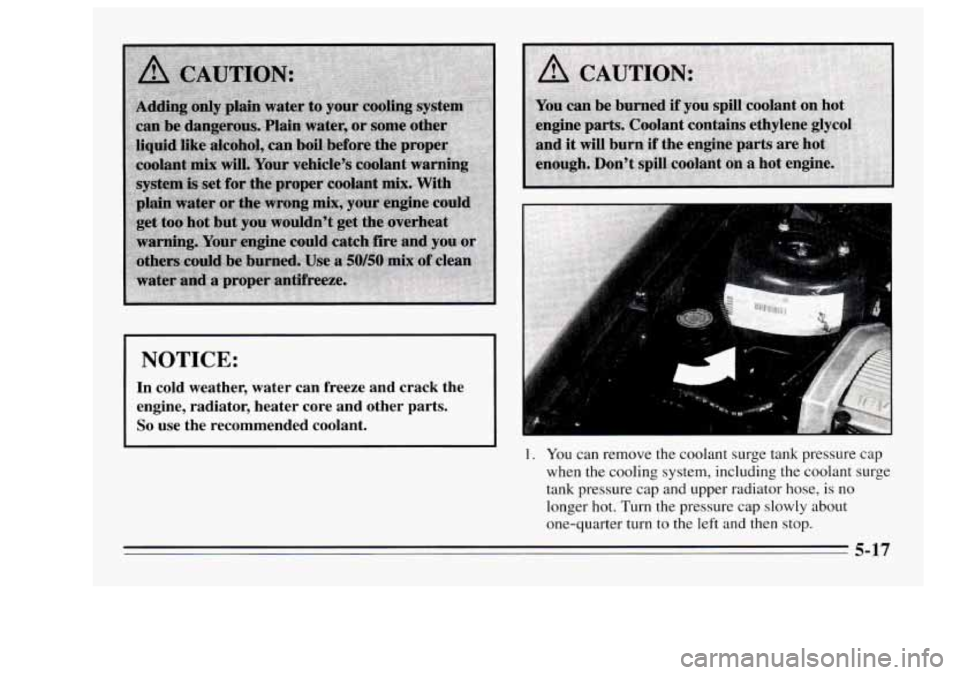
1. You can remove the coolant surge tank pressure cap
when the cooling system, including the coolant surge
tank pressure cap and upper radiator hose,
is no
longer hot. Turn the pressure cap slowly about
one-quarter turn to the left and then stop.
5-17
Page 201 of 340
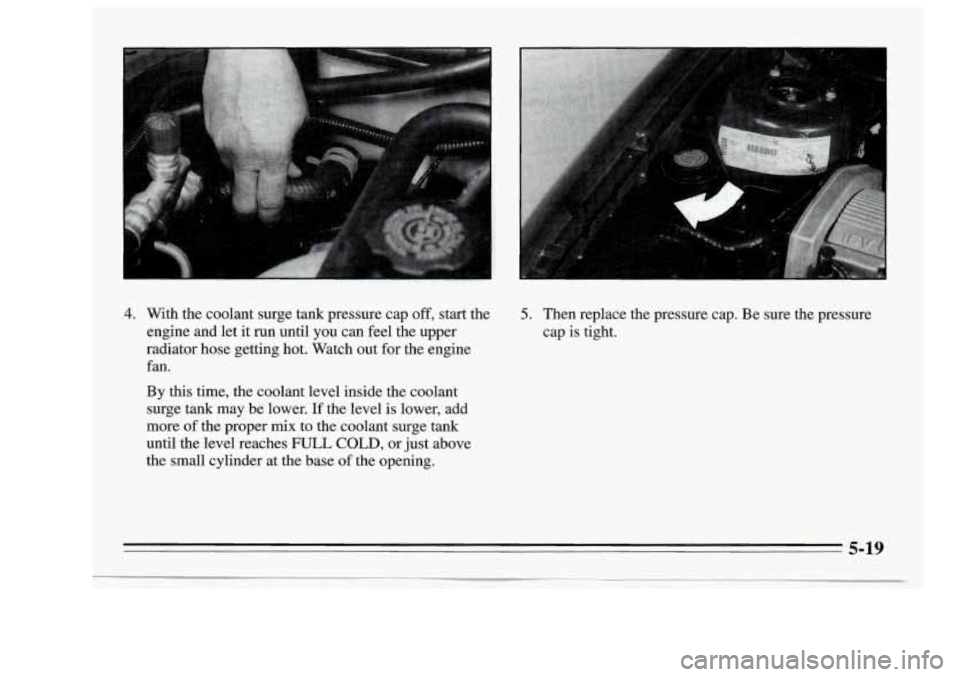
4. With the coolant surge tank pressure cap off, start the
engine and let it run until
you can feel the upper
radiator hose getting hot. Watch out for the engine
fan.
By
this time, the coolant level inside the coolant
surge tank may be lower.
If the level is lower, add
more of the proper
mix to the coolant surge tank
until the level reaches
FULL COLD, or just above
the small cylinder at the base
of the opening.
5. Then replace the pressure cap. Be sure the pressure
cap is tight.
5-19
Page 234 of 340
Thermostat
Engine coolant temperature is controlled by a thermostat
in the engine coolant system. The thermostat stops the
flow
of coolant through the radiator until the coolant
reaches
a preset temperature.
When you replace your thermostat, an AC@ thermostat
is recommended.
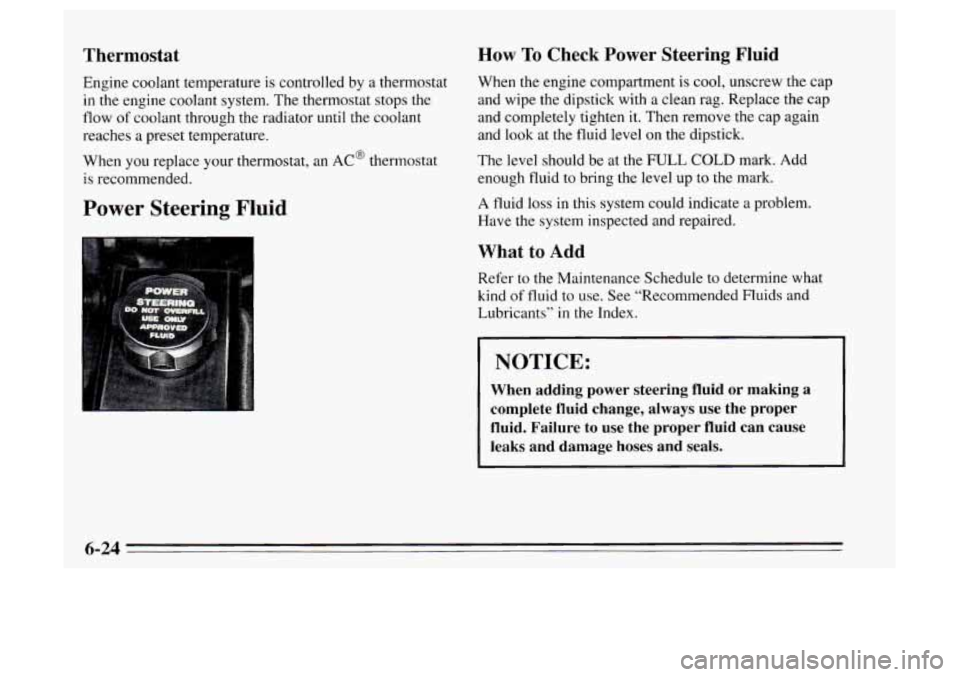
Power Steering Fluid
p .w ii
How To Check Power Steering Fluid
When the engine compartment is cool, unscrew the cap
and wipe the dipstick with
a clean rag. Replace the cap
and completely tighten it. Then remove the cap again
and look at the fluid level on the dipstick.
The level should be at the FULL COLD mark. Add
enough fluid to bring the level up to the mark.
A fluid loss in this system could indicate a problem.
Have the system inspected and repaired.
What to Add
Refer to the Maintenance Schedule to determine what
kind
of fluid to use. See “Recommended Fluids and
Lubricants”
in the Index.
I NOTICE:
When adding power steering fluid or making a
complete fluid change, always use the proper
fluid. Failure to use the proper fluid can cause
leaks and damage hoses and seals.
6-24
Page 235 of 340
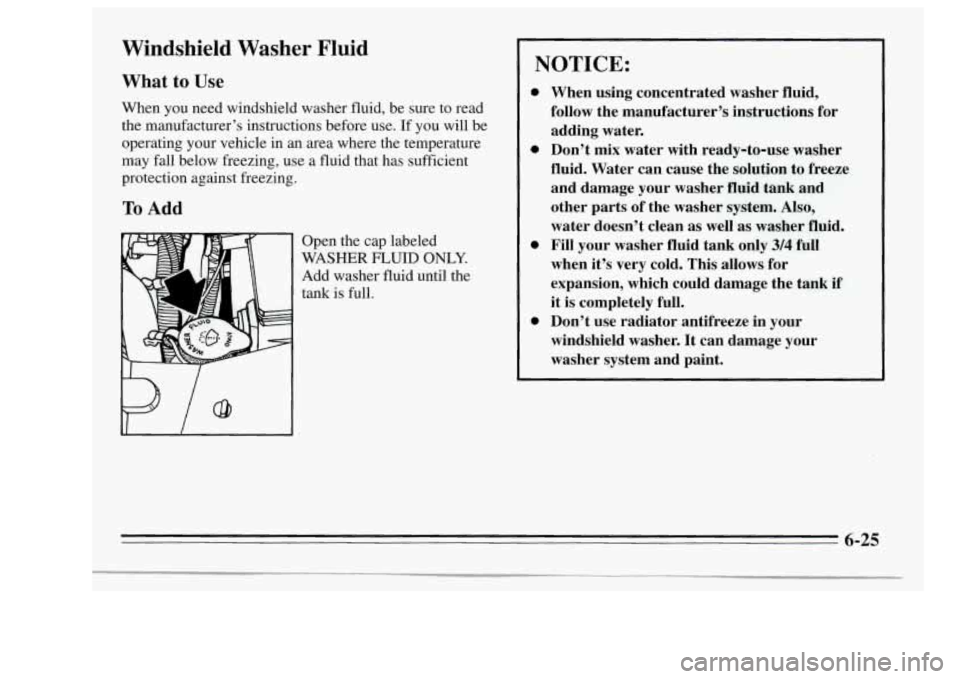
Windshield Washer Fluid
What to Use
When you need windshield washer fluid, be sure to read
the manufacturer’s instructions before use.
If you will be
operating your vehicle in an area where the temperature
may fall below freezing, use a fluid that has sufficient
protection against freezing.
To Add
Open the cap labeled
WASHER
FLUID OmY.
Add washer fluid until the
tank is full.
NOTICE:
0
0
0
0
When using concentrated washer fluid,
follow the manufacturer’s instructions for
adding water.
Don’t mix water with ready-to-use washer
fluid. Water can cause the solution
to freeze
and damage your washer fluid tank and
other parts of the washer system. Also,
water doesn’t clean as well as washer fluid.
Fill your washer fluid tank only
3/4 full
when it’s very cold. This allows for
expansion, which could damage the tank if
it is completely full.
Don’t use radiator antifreeze in your
windshield washer.
It can damage your
washer system and paint.
6-25
Page 279 of 340
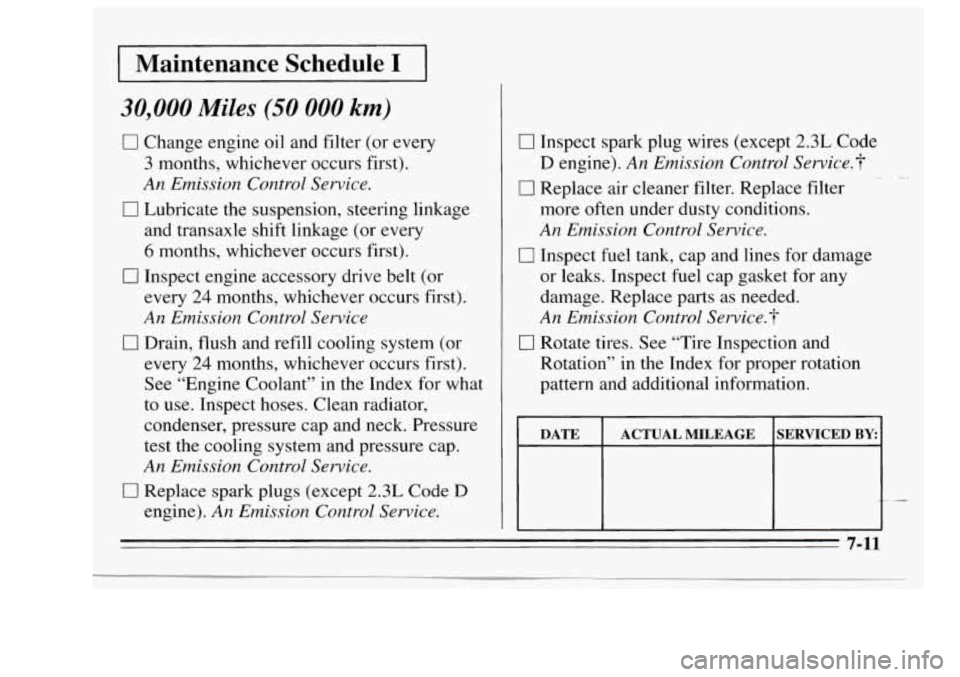
Maintenance Schedule I
30,000 Miles (50 000 km)
0 Change engine oil and filter (or every
3 months, whichever occurs first).
An Emission Control Service.
and transaxle shift linkage (or every
6 months, whichever occurs first).
0 Inspect engine accessory drive belt (or
every
24 months, whichever occurs first).
An Emission Control Service
0 Drain, flush and refill cooling system (or
every
24 months, whichever occurs first).
See “Engine Coolant” in the Index for what
to use. Inspect hoses. Clean radiator,
condenser, pressure cap and neck. Pressure
test the cooling system and pressure cap.
An Emission Control Sewice.
0 Replace spark plugs (except 2.3L Code D
engine). An Emission Control Sewice.
17 Lubricate the suspension, steering linkage
0 Inspect spark plug wires (except 2.3L Code
D engine). An Emission Control Sewice.
0 Replace air cleaner filter. Replace filter
more often under dusty conditions.
An Emission Control Service.
0 Inspect fuel tank, cap and lines for damage
or leaks. Inspect
fuel cap gasket for any
damage. Replace parts as needed.
An Emission Control Service.?
0 Rotate tires. See “Tire Inspection and
Rotation’’ in the Index for proper rotation
pattern and additional information.
DATE
SERVICED BY: ACTUAL MILEAGE
L- -
7-11
Page 285 of 340
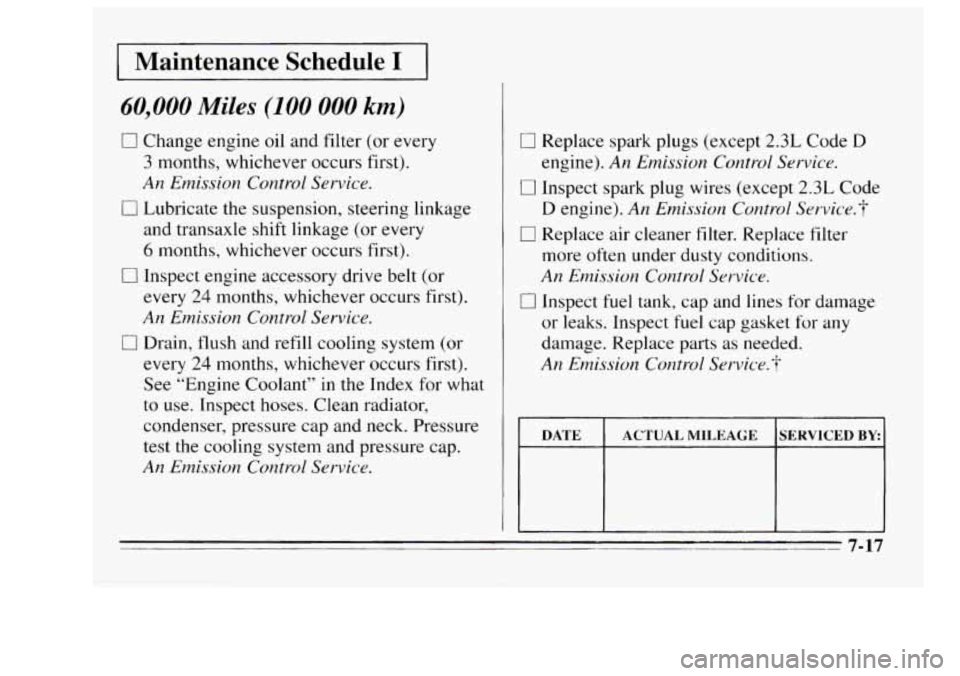
Maintenance Schedule I
60,000 Miles (100 000 km)
0 Change engine oil and filter (or every
3 months, whichever occurs first).
An Emission Control Service.
and transaxle shift linkage (or every
6 months, whichever occurs first).
0 Inspect engine accessory drive belt (or
every
24 months, whichever occurs first).
An Emission Control Service.
0 Drain, flush and refill cooling system (or
every
24 months, whichever occurs first).
See "Engine Coolant"
in the Index for what
to use. Inspect hoses. Clean radiator,
condenser, pressure cap and neck. Pressure
test the cooling system and pressure cap.
An Emission Control Service.
0 Lubricate the suspension, steering linkage
U Replace spark plugs (except 2.3L Code D
engine). An Emission Control Service.
0 Inspect spark plug wires (except 2.3L Code
D engine). An Emission Control Servic.e."f
0 Replace air cleaner filter. Replace filter
more often under dusty conditions.
An Emission Control Service.
0 Inspect fuel tank, cap and lines for damage
or leaks. Inspect fuel cap gasket for any
damage. Replace parts as needed.
An Emission Control Service.?
Page 290 of 340
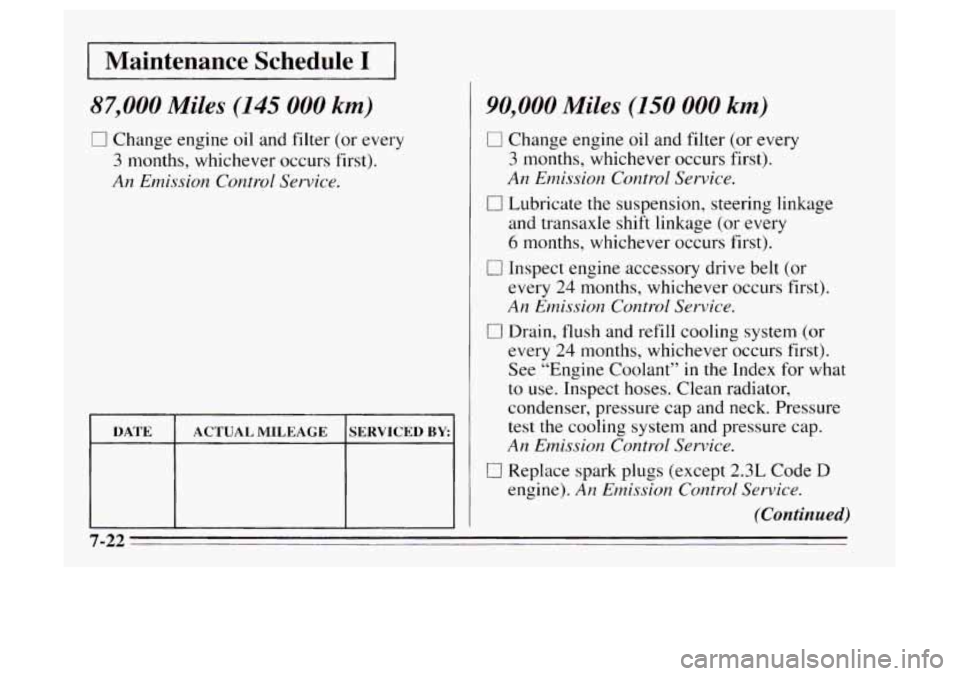
1 Maintenance Schedule I 1
87,000 Miles (145 000 km)
0 Change engine oil and filter (or every
3 months, whichever occurs first).
An Emission Control
Service.
DATE SERVICED BY ACTUAL MILEAGE
90,000 Miles (150 000 km)
0 Change engine oil and filter (or every
3 months, whichever occurs first).
An
Emission Control Service.
and transaxle shift linkage (or every
6 months, whichever occurs first).
0 Inspect engine accessory drive belt (or
every 24 months, whichever occurs first).
An
Emission Control Service.
0 Drain, flush and refill cooling system (or
every 24 months, whichever occurs first).
See “Engine Coolant” in the Index for what
to use. Inspect hoses. Clean radiator,
condenser, pressure cap and neck. Pressure
test the cooling system and pressure cap.
An Emission Control
Service.
0 Replace spark plugs (except 2.3L Code D
engine). An Emission Control Service.
0 Lubricate the suspension, steering linkage
(Continued)
7-22
Page 296 of 340
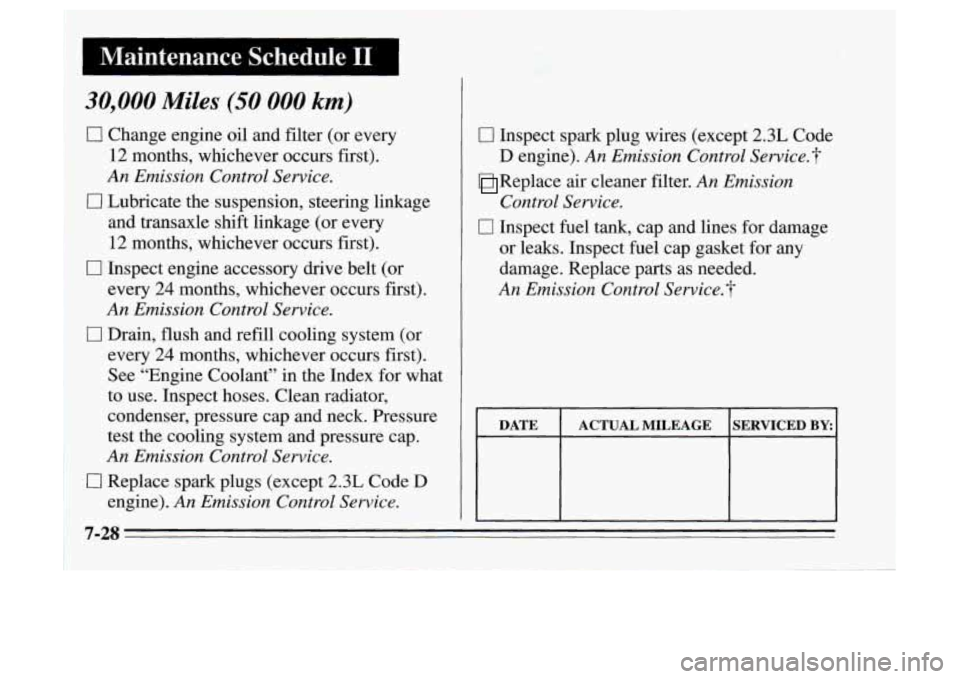
30,000 Miles (50 000 km)
0 Change engine oil and filter (or every
12 months, whichever occurs first).
An Emission Control Service.
and transaxle shift linkage (or every
12 months, whichever occurs first).
0 Inspect engine accessory drive belt (or
every
24 months, whichever occurs first).
An Emission Control Service.
0 Drain, flush and refill cooling system (or
every
24 months, whichever occurs first).
See “Engine Coolant’’ in the Index for what
to use. Inspect hoses. Clean radiator,
condenser, pressure cap and neck. Pressure
test the cooling system and pressure cap.
An Emission Control Service.
0 Replace spark plugs (except 2.3L Code D
engine). An Emission Control Service.
0 Lubricate the suspension, steering linkage
0 Inspect spark plug wires (except 2.3L Code
D engine). An Emission Control Service.?
Replace air cleaner filter. An Emission
Control Service.
0 Inspect fuel tank, cap and lines for damage
or leaks. Inspect fuel cap gasket for any
damage. Replace parts as needed.
An Emission Control Sewice.?
DATE ACTUAL MILEAGE SERVICED BY
7-28
Page 299 of 340
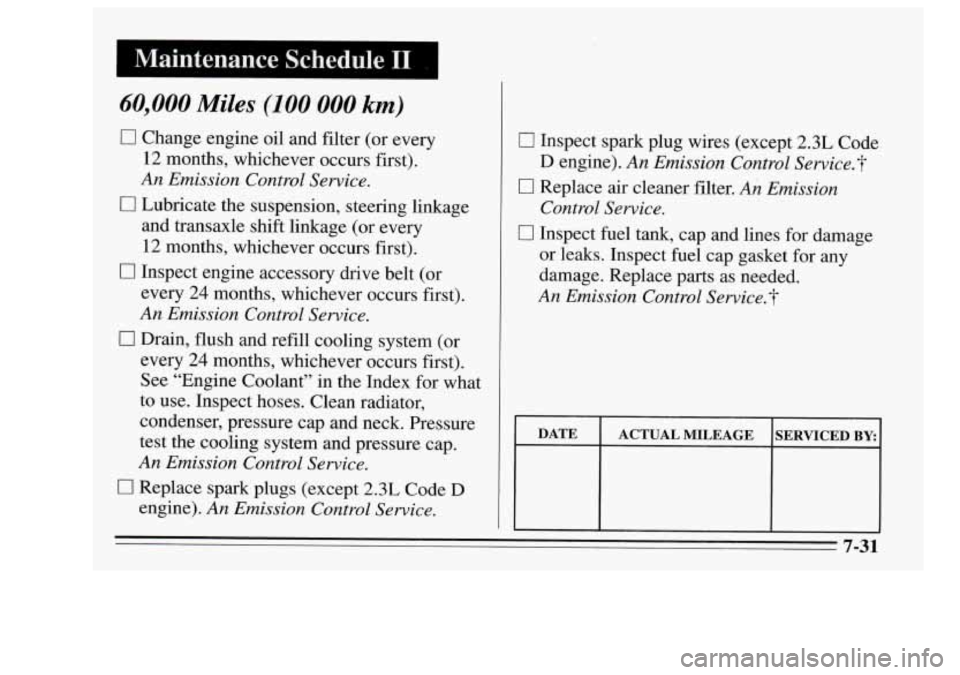
60,000 Miles (100 000 kt)
0 Change engine oil and filter (or every
12 months, whichever occurs first).
An Emission Control Service.
and transaxle shift linkage (or every
12 months, whichever occurs first).
0 Inspect engine accessory drive belt (or
every 24 months, whichever occurs first).
An Emission Control Service.
0 Drain, flush and refill cooling system (or
every 24 months, whichever occurs first).
See “Engine Coolant” in the Index for what
to use. Inspect hoses. Clean radiator,
condenser, pressure cap and neck. Pressure
test the cooling system and pressure cap.
An Emission Control Service.
0 Replace spark plugs (except 2.3L Code D
engine). An Emission Control Service.
0 Lubricate the suspension, steering linkage
0 Inspect spark plug wires (except 2.3L Code
D engine).
An Emission Control Service. 7
0 Replace air cleaner filter. An Emission
Control Service.
0 Inspect fuel tank, cap and lines for damage
or leaks. Inspect fuel cap gasket for any
damage. Replace parts as needed.
An Emission Control Service. 7