ignition Oldsmobile Achieva 1997 s User Guide
[x] Cancel search | Manufacturer: OLDSMOBILE, Model Year: 1997, Model line: Achieva, Model: Oldsmobile Achieva 1997Pages: 372, PDF Size: 18.52 MB
Page 73 of 372
Starting Your 2.4 Liter Engine
1, Without pushing the accelerator pedal, turn your
ignition key to START. When the engine starts,
let
go of the key. The idle speed will go down as your
engine gets warm.
Holding your key in START for longer than
15 seconds at a time will cause your battery to be
drained much sooner. And the excessive heat can
damage your starter motor.
2. If it doesn’t start right away, and if the weather is
very cold (below
-20” F or -29” C), push the
accelerator pedal about one-quarter
of the way down
while you turn the key to START.
Do this until the
engine starts.
As soon as it does, let go of the key.
3. If your engine still won’t start (or starts but then
stops), it could be flooded with
too much gasoline.
Try
pushing your accelerator pedal all the way to the
floor and holding it there as you hold the key
in
START for about three seconds. This clears the extra
gasoline from the engine.
If the vehicle starts briefly
but then stops again, do the same thing, but this time
keep the pedal about one-quarter
of the way down
for five or
six seconds.
NOTICE:
Your engine is designed to work with the
electronics in your vehicle.
If you add electrical
parts or accessories, you could change the way
the engine operates. Before adding electrical
equipment, check with your retailer.
If you
don’t, your engine might not perform properly.
If you ever have to have your vehicle towed, see
the part of this manual that tells how to do it
without damaging your vehicle. See “Towing
Your Vehicle” in the Index.
Page 74 of 372
Starting Your 3100 Engine
1. Without pushing the accelerator pedal, turn your
ignition key to
START. When the engine starts, let
go of the key. The idle speed will go down as your
engine gets
warm.
NOTICE:
Holding your key in START for longer than
15 seconds at a time will cause your battery to be
drained much sooner. And the excessive heat can
damage your starter motor.
2. If your engine won’t start (or starts but then stops),
it could be flooded with too much gasoline. Try
pushing your accelerator pedal all the way to the
floor and holding
it there as you hold the key in
START for
up to 15 seconds. This clears the extra
gasoline
from the engine.
NOTICE:
Your engine is designed to work with the
electronics in your vehicle.
If you add electrical
parts or accessories, you could change the way
the engine operates. Before adding electrical
equipment, check with your retailer.
If you don’t,
your engine might
not perform properly.
If you ever have to have your vehicle towed, see
the part of this manual
that tells how to do it
without damaging your vehicle. See “Towing
Your Vehicle” in the Index.
2-18
Page 78 of 372
Ensure the shift lever is fully in PARK (P) range before
starting the engine.
You Oldsmobile has a brake-trmsaxle
shift interlock. You have to apply your regular brake
before you
can shift from PARK (P) when the ignition
key
is in the RUN position. If you cannot shift out of
PARK (P), ease pressure on the shift lever -- push the shift
lever
all the way into PARK (P) -- as you maintain brake
application. Then move
the shift lever into the gear you
wish. (Press the shift lever button before moving the
shift lever.) See
“Shifting Out of PARK (P)” later in
this section.
REVERSE (R): Use this gear to back up.
NOTICE:
Shifting to REVERSE (R) while your vehicle is
moving forward could damage your transaxle.
Shift to
REVERSE (R) only after your vehicle
is stopped.
To rock your vehicle back and forth to get out of snow,
ice or sand without damaging your transaxle, see “If
You’re Stuck: In Sand, Mud, Ice or Snow” in the Index.
NEUTRAL (N): In this position, your engine
doesn’t connect with the wheels.
To restart when you’re
already
moving, use NEUTRAL (N) only. Also, use
NEUTRAL (N) when your vehicle is being towed.
r
Shifting out of PARK (P) or NEUTRAL (N) while
your engine is “racing” (running
at high speed) is
dangerous. Unless your foot is firmly on the
brake pedal, your vehicle could move very
rapidly.
You could lose control and hit people
or objects. Don’t shift out of
PARK (P) or
NEUTRAL (N) while your engine is racing.
NOTICE:
Damage to your transaxle caused by shifting out
of
PARK (P) or NEUTRAL (N) with the engine
racing isn’t covered by your warranty.
2-22
Page 84 of 372
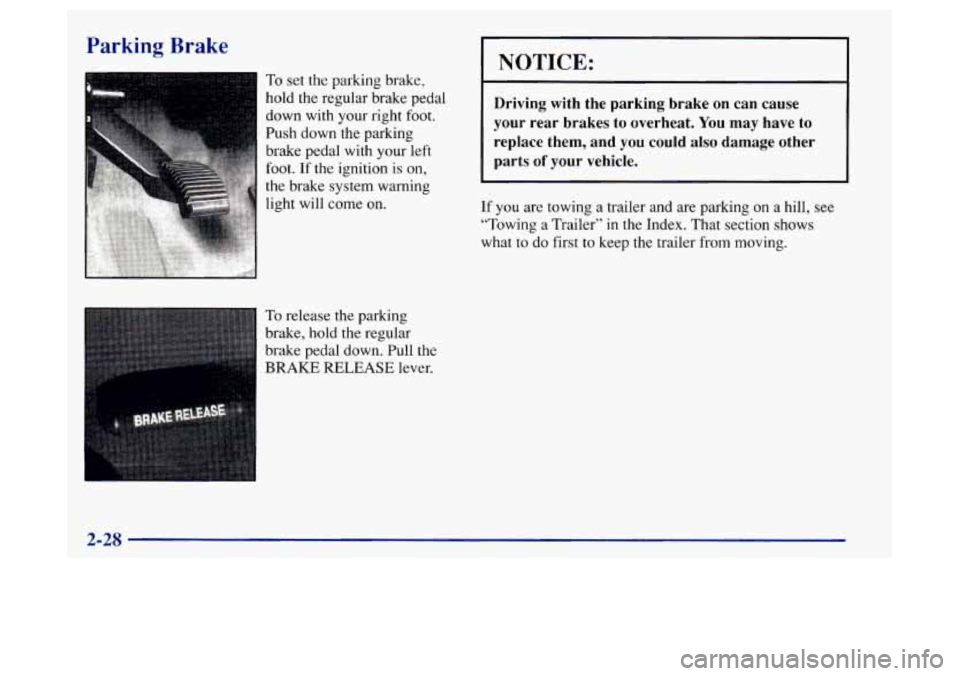
Parking Brake
To set the parking brake,
hold the regular brake pedal
down with your right foot.
Push down the parking
brake pedal with your left
foot.
If the ignition is on,
the brake system warning
ght will come on.
To release the parking
brake, hold the regular
brake pedal down. Pull the
BRAKE RELEASE lever.
NOTICE:
Driving with the parking brake on can cause
your rear brakes
to overheat. You may have to
replace them, and you could also damage other
parts
of your vehicle.
If you are towing a trailer and are parking on a hill, see
“Towing a Trailer” in t.he Index. That section shows
what to
do first to keep the trailer from moving.
2-28
Page 85 of 372
Shifting Into PARK (P)
(Automatic Transaxle Models Only)
A CAUTION:
It can be dangerous to get out of your vehicle if
the shift lever is not fully in PARK (P) with the
parking brake firmly
set. Your vehicle can roll.
If you have left the engine running, the vehicle
can move suddenly.
You or others could be
injured.
To be sure your vehicle won’t move, even
when you’re on fairly level ground, use the steps
that follow.
If you’re pulling a trailer, see
“Towing
a Trailer” in the Index.
1. Hold the brake pedal down with your right foot and
set the parking brake.
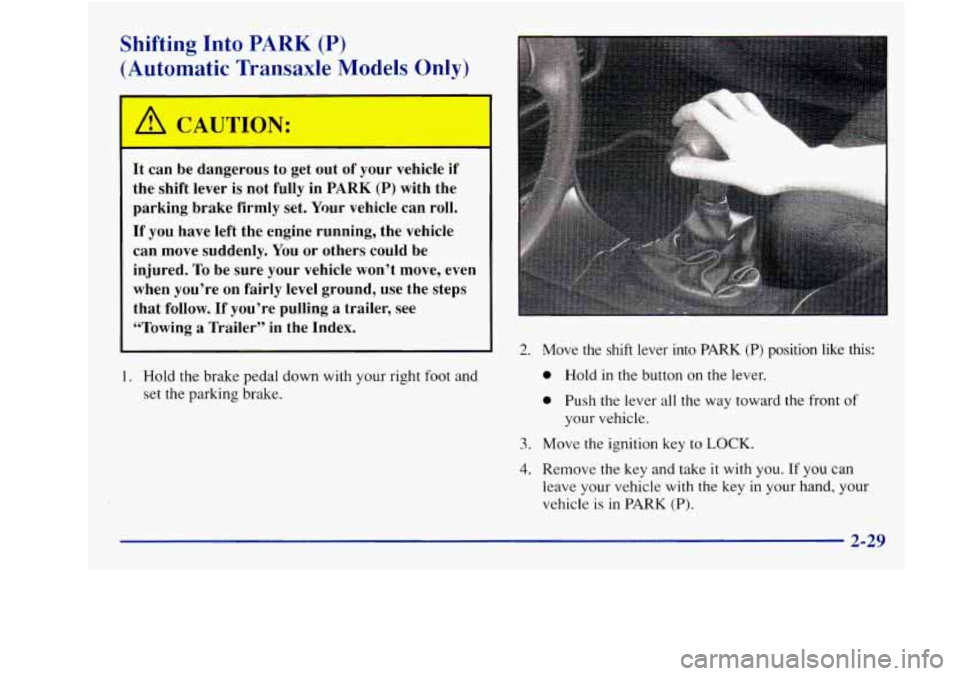
2. Move the shift lever into PARK (P) position like this:
0 Hold in the button on the lever.
0 Push the lever all the way toward the front of
your vehicle.
3. Move the ignition key to LOCK.
4. Remove the key and take it with you. If you can
leave your vehicle with the key in your hand, your
vehicle is in PARK (P).
2-29
Page 87 of 372
Shifting Out of PARK (P)
(Automatic Transaxle)
Your Oldsmobile has a brake-transaxle shift interlock.
You have to apply your regular brake before you can
shift from PARK
(P) when the ignition is in the RUN
position. See “Automatic Transaxle” in the Index.
If you cannot shift out of PARK
(P), ease pressure on
the shift lever
-- push the shift lever all the way into
PARK
(P) -- as you maintain brake application. Then
move the shift lever into the gear you wish. (Press the
shift lever button before moving the shift lever.)
If you ever hold the brake pedal down but still can’t
shift lever out of PARK (P), try this:
1, Remove the ignition key.
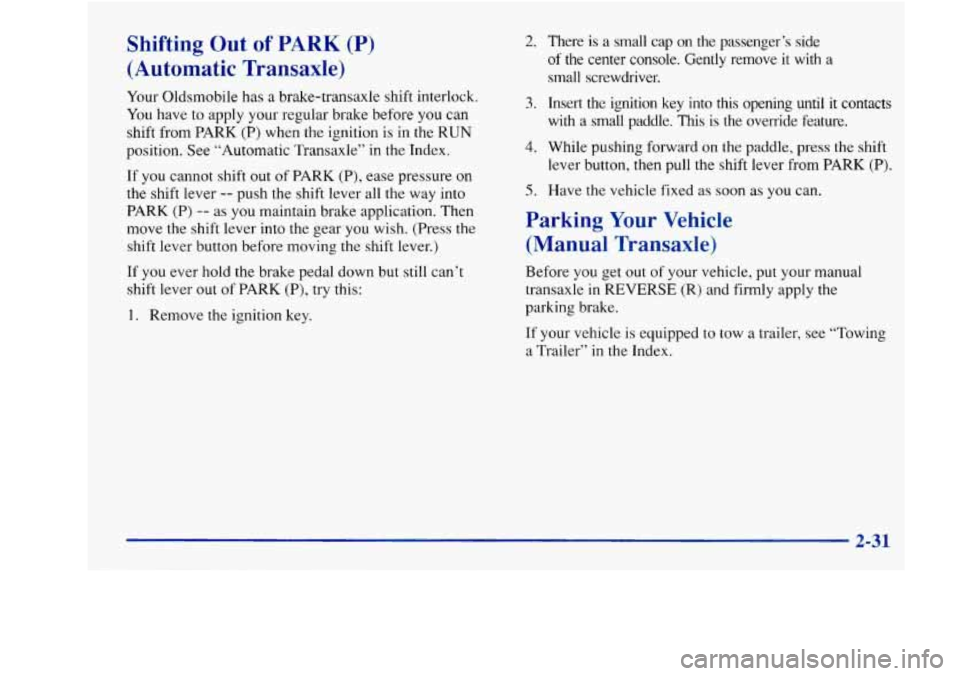
2. There is a small cap on the passenger’s side
of the center console. Gently remove it with a
small screwdriver.
3. Insert the ignition key into this opening until it contacts
with
a small paddle. This is the override feature.
4. While pushing forward on the paddle, press the shift
lever button, then pull the shift lever from PARK (P).
5. Have the vehicle fixed as soon as you can.
Parking Your Vehicle
(Manual Transaxle)
Before you get out of your vehicle, put your manual
transaxle in REVERSE (R) and firmly apply the
parking brake.
If your vehicle is equipped to tow a trailer, see “Towing
a Trailer” in the Index.
2-31
Page 90 of 372
Windows Auto-Down Feature
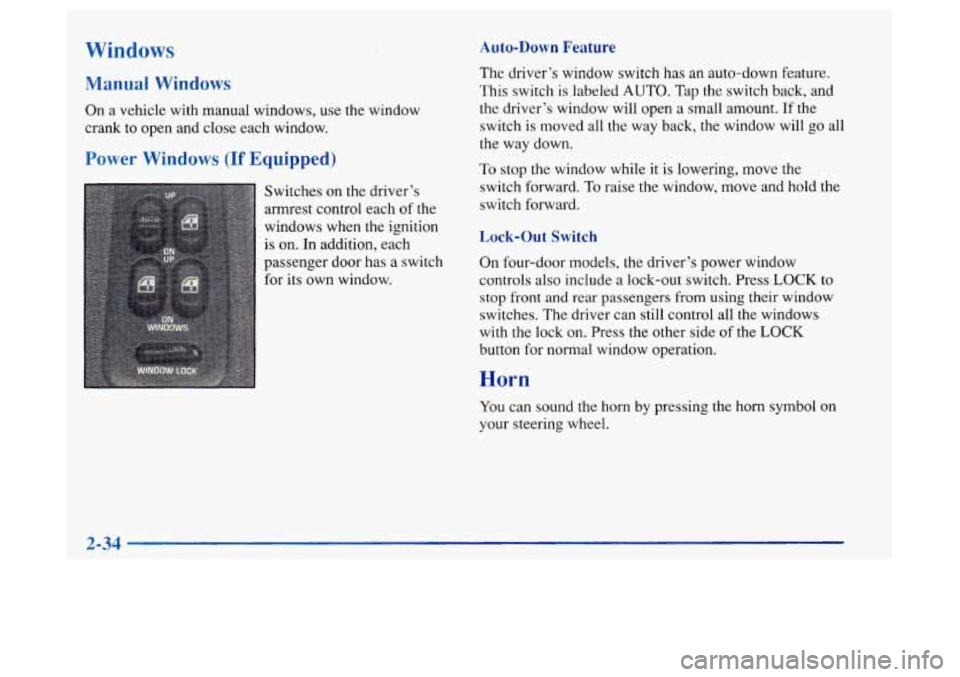
The driver’s window switch has an auto-down feature.
This switch is labeled
AUTO. Tap the switch back, and
the driver’s window will open a small amount.
If the
switch
is moved all the way back, the window will go all
the way down.
Manual Windows
On a vehicle with manual windows, use the window
crank to open and close each window.
lwer Windows (If Equipped)
Switches on the driver’s
armrest control each of the
windows when the ignition
is on. In addition, each
passenger door has a switch
for its own window.
To stop the window while it is lowering, move the
switch forward.
To raise the window, move and hold the
switch forward.
Lock-Out Switch
On four-door models, the driver’s power window
controls also include a lock-out switch. Press
LOCK to
stop front
and rear passengers from using their window
switches.
The driver can still control all the windows
with the lock
on. Press the other side of the LOCK
button for normal window operation.
Horn
You can sound the horn by pressing the horn symbol on
your steering wheel.
2-34
Page 99 of 372
accelerator pedal to maintain your speed. When going
downhill, you may have to brake or shift
to a lower gear
to keep your speed down.
Of course, applying the brake
or clutch pedal takes you out of cruise control. Many
drivers find this to be too much trouble and don’t use
cruise control on steep hills.
Ending Out of Cruise Control
There are two ways to turn off the cruise control:
0 Step lightly on the brake pedal or push the clutch
pedal, if you have a manual transaxle; OR
0 Move the cruise switch to OFF.
Erasing the Cruise Speed Memory
When you turn off the cruise control or the ignition,
your cruise control set speed memory is erased.
Exterior Lamps
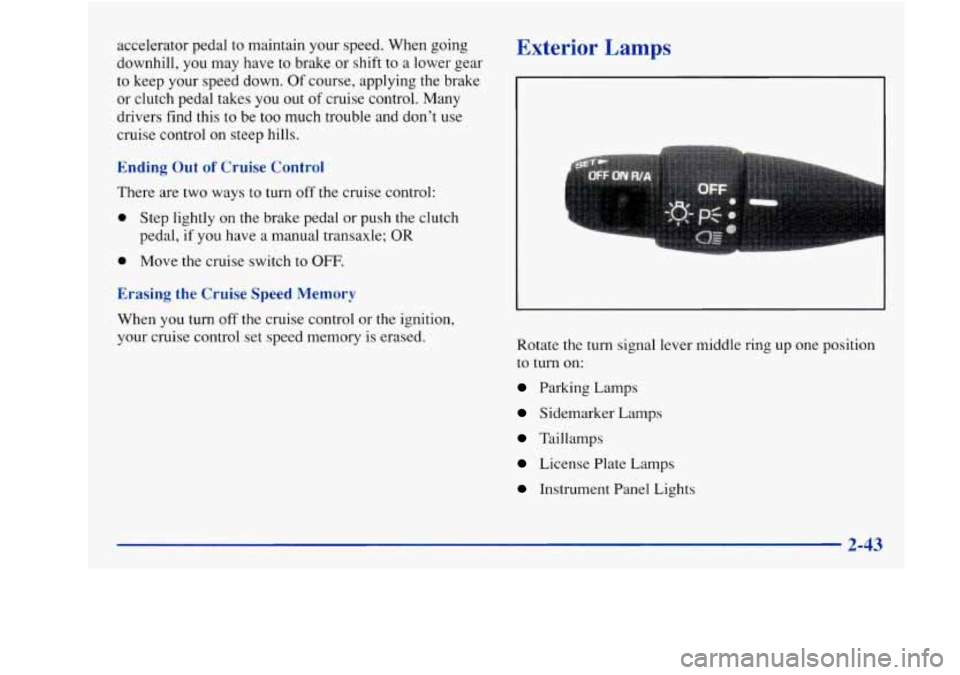
Rotate the turn signal lever middle ring up one position
to turn on:
Parking Lamps
Sidemarker Lamps
Taillamps
License Plate Lamps
Instrument Panel Lights
2-43
Page 100 of 372
Rotate the turn signal lever middle ring up two positions
to turn on:
Headlamps
Parking Lamps
Sidemarker Lamps
Taillamps
License Plate Lamps
0 Instrument Panel Lights
Rotate the switch to
OFF to turn all of the lamps off.
Lamps On Reminder
If you open the driver’s door and turn off the
ignition while leaving the lamps on, you will hear a
warning chime.
Daytime Running Lamps
Daytime Running Lamps (DRL) can make it easier for
others to see the front
of your vehicle during the day.
DRL can be helpful in many different driving
conditions, but they can be especially helpful
in the
short periods after dawn and before sunset.
The DRL system will make your high-beam headlamps
come on at a reduced brightness when:
The engine is running,
The headlamp switch is in the OFF position,
0 The light sensor detects daytime light,
0 The parking brake is released and
0 The shift lever is not in PARK (P) on an
automatic transaxle.
When the DRL system is on, the taillamps, sidemarker,
park lamps and instrument panel lights will not be
illuminated.
The DRL and the ALC systems will remain off any time
your automatic transaxle vehicle is
in PARK (P) and the
parking brake
is engaged.
The DRL and the ALC systems will remain off any time
your manual transaxle vehicle is in NEUTRAL
(N) and
the parking brake is engaged.
2-44
Page 102 of 372
Interior Lamps
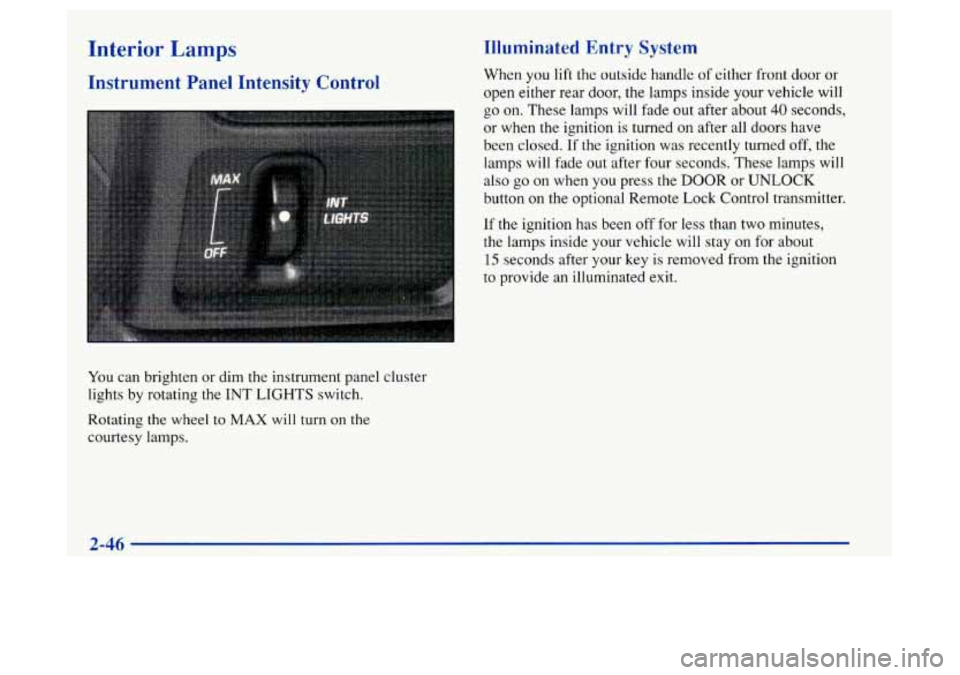
Instrument Panel Intensitv Control
You can brighten or dim the instrument panel cluster
lights by rotating the
INT LIGHTS switch.
Rotating the wheel to
MAX will turn on the
courtesy lamps.
Illuminated Entry System
When you lift the outside handle of either front door or
open either rear
door, the lamps inside your vehicle will
go on. These lamps will fade out after about 40 seconds,
or when the ignition
is turned on after all doors have
been closed. If the ignition was recently turned
off, the
lamps will fade out after four seconds. These lamps will
also
go on when you press the DOOR or UNLOCK
button
on the optional Remote Lock Control transmitter.
If the ignition has been off for less than two minutes,
the lamps inside your vehicle will stay on for about
15 seconds after your key is removed from the ignition
to provide an illuminated exit.