lock Oldsmobile Achieva 1997 s Repair Manual
[x] Cancel search | Manufacturer: OLDSMOBILE, Model Year: 1997, Model line: Achieva, Model: Oldsmobile Achieva 1997Pages: 372, PDF Size: 18.52 MB
Page 208 of 372
NOTICE:
Do not tow with sling-type equipment or the rear
bumper valance will be damaged. Use wheel-lift
or car-carrier equipment. Additional ramping
may be required for car-carrier equipment. Use
safety chains and wheel straps.
Towing
a vehicle over rough surfaces could
damage a vehicle. Damage can occur from vehicle
to ground
or vehicle to wheel-lift equipment. To
help avoid damage, install a towing dolly and
raise vehicle until adequate clearance is obtained
between the ground and/or wheel-lift equipment.
Do not attach winch cables or J-hooks to
suspension components when using car-carrier
equipment. Always use T-hooks inserted in the
T-hook slots.
NOTE: The ignition must be in the
OFF position to keep
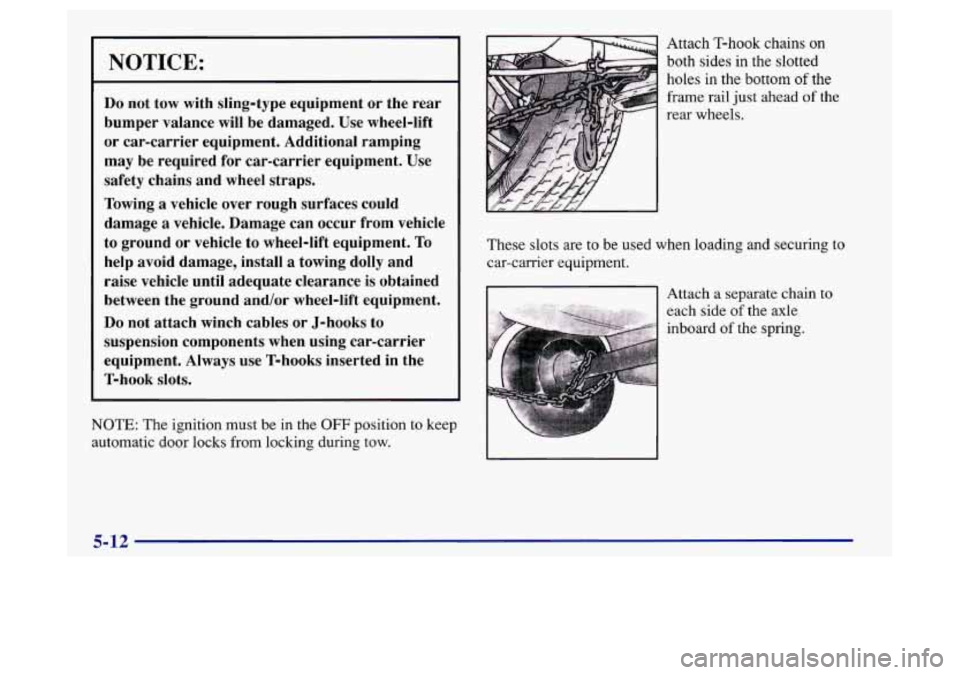
automatic door locks from locking during tow. Attach
T-hook chains on
both sides in the slotted
holes in the bottom of the
frame rail just ahead of the
rear wheels.
These slots are to be used when loading and securing to
car-carrier equipment.
11 Attach a separate chain to
5-12
Page 218 of 372
ianging a Flat Tire
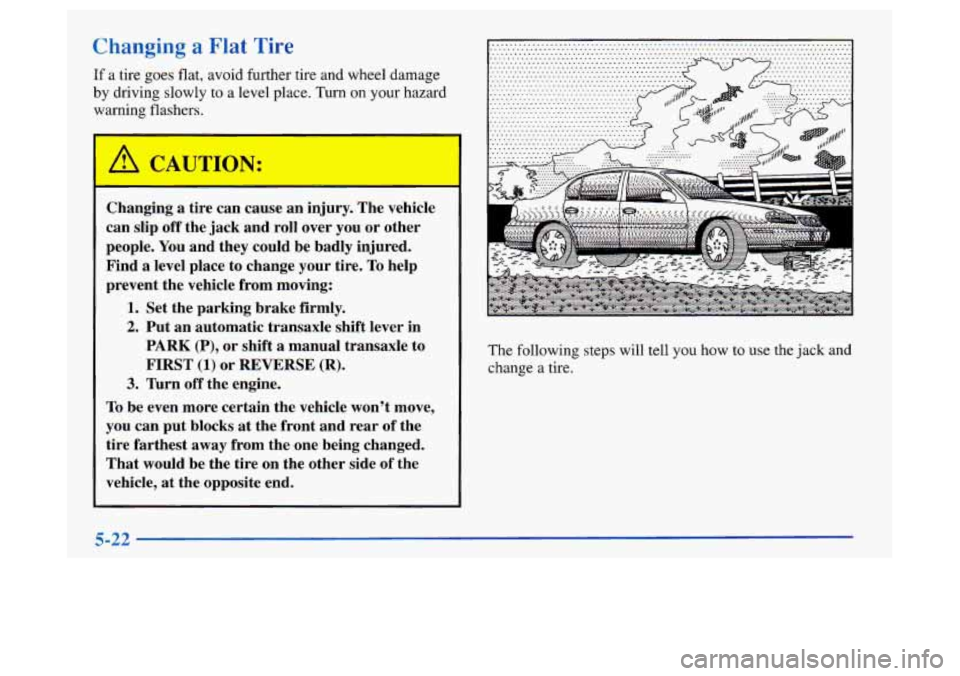
If a tire goes flat, avoid further tire and wheel damage
by driving slowly
to a level place. Turn on your hazard
warning flashers.
Changing a tire can cause an injury. The vehicle
can slip off the jack and roll over you or other
people.
You and they could be badly injured.
Find a level place to change your tire. To help
prevent the vehicle from moving:
1. Set the parking brake firmly.
2. Put an automatic transaxle shift lever in
PARK (P), or shift a manual transaxle to
FIRST
(1) or REVERSE (R).
3. I'urn off the engine.
To be even more certain the vehicle won't move,
you can put blocks at the front and rear
of the
tire farthest away from the one being changed.
That would be the tire on the other side of the
vehicle,
at the opposite end. The following
steps will tell
you how to use the jack and
change a tire.
5-22
Page 219 of 372
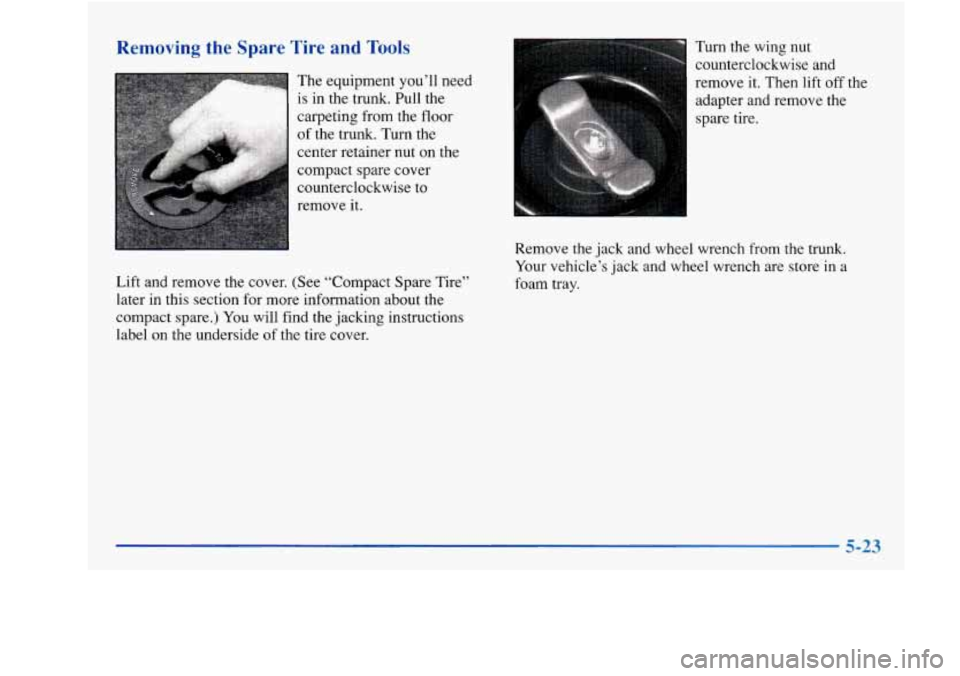
Removing the Spare Tire and Tools
Lift and remove the cover. (See “Compact Spare Tire”
later in this section for more information about the
compact spare.) You will find
the jacking instructions
label on the underside of the tire cover. Turn the wing
nut
counterclockwise and
remove it. Then lift off the
adapter and remove the
spare tire.
Remove the jack and wheel wrench
from the trunk.
Your vehicle’s jack and wheel wrench are store in
a
foam tray.
5-23
Page 222 of 372
c
Getting under a vehicle when it is jacked up is
dangerous.
If the vehicle slips off the jack, you
could be badly injured or killed. Never get under
a vehicle when it is supported only by a jack.
Raising your vehicle with the jack improperly
positioned can damage the vehicle and even
make the vehicle fall.
To help avoid personal
injury and vehicle damage, be sure
to fit the jack
lift head into the proper location before raising your vehicle.
1 NOTICE: I
Do not jack or lift the vehicle using the oil pan.
Pans could crack and begin to leak fluid.
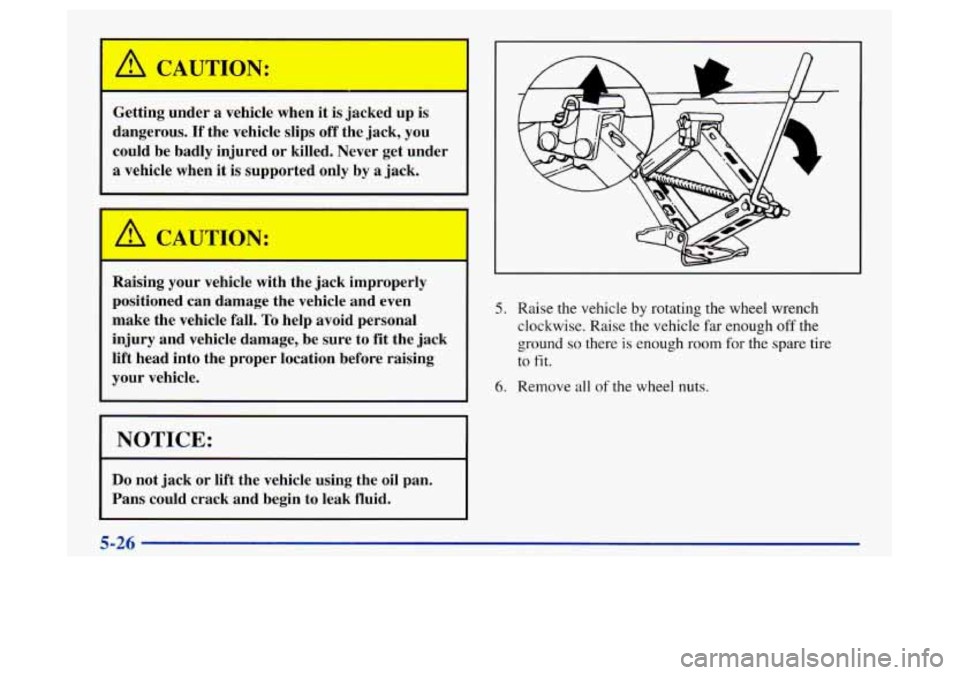
5. Raise the vehicle by rotating the wheel wrench
clockwise. Raise the vehicle far enough off the
ground so there is enough room for the spare tire
to
fit.
6. Remove all of the wheel nuts.
7-26
Page 224 of 372
Never use oil or grease on studs or nuts. If you
do, the nuts might come loose. Your wheel could
fall off, causing a serious accident.
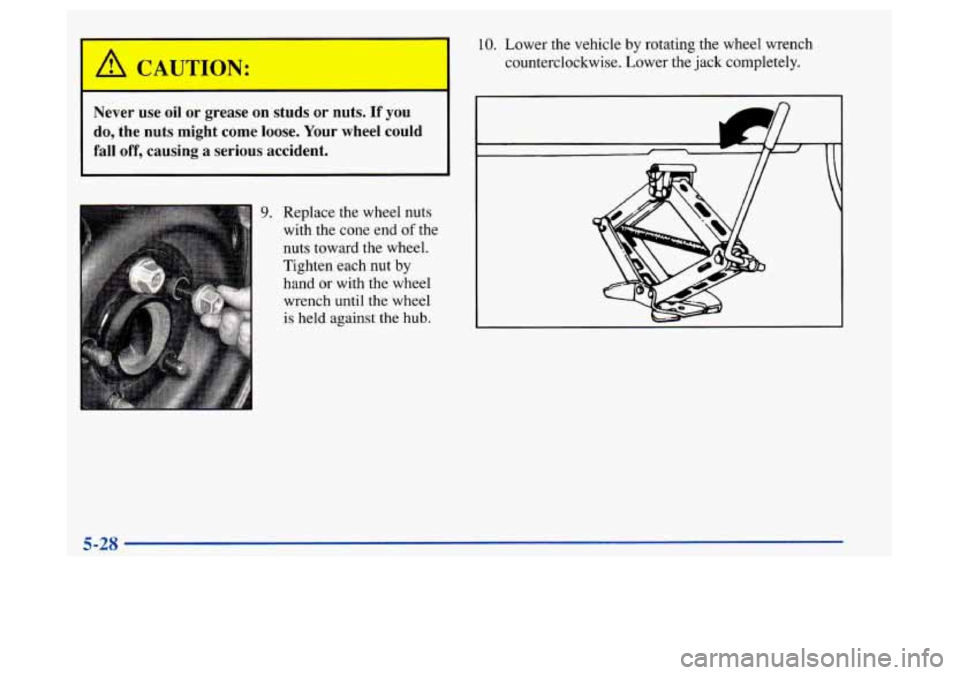
9. Replace the wheel nuts
with the cone end
of the
nuts toward the wheel.
Tighten each nut by
hand or with the wheel
wrench until the wheel
is held against the hub.
10. Lower the vehicle by rotating the wheel wrench
counterclockwise. Lower the jack completely.
5-28
Page 236 of 372
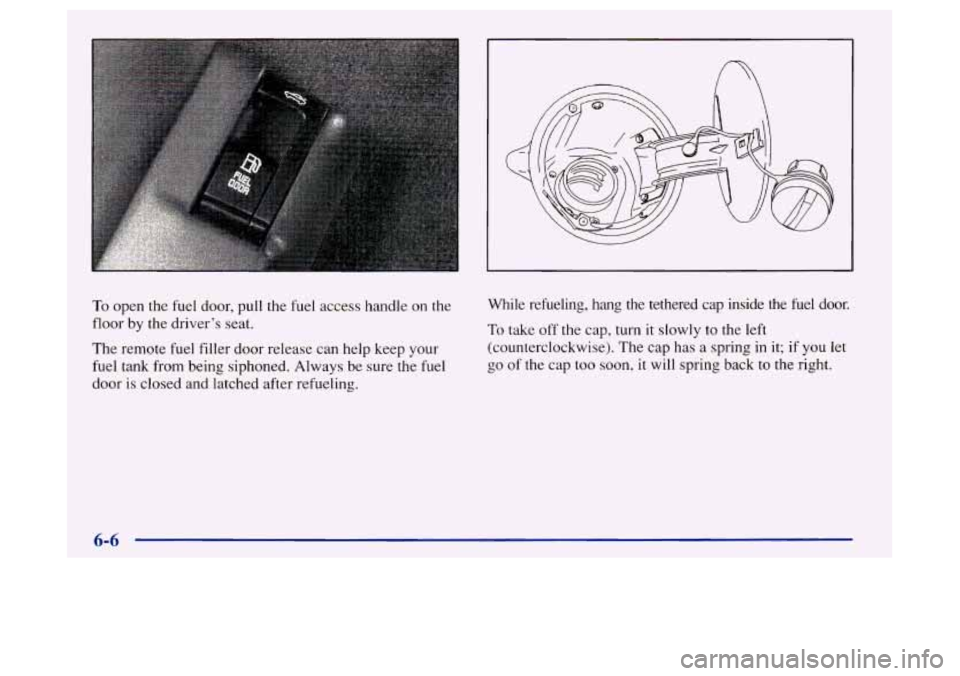
To open the fuel door, pull the fuel access handle on the
floor by the driver’s seat.
The
remote fuel filler door release can help keep your
fuel tank from being siphoned. Always be sure the fuel
door
is closed and latched after refueling. While refueling, hang the tethered
cap inside the fuel door.
To take off the cap, turn it slowly to the left
(counterclockwise). The cap has a spring in it; if
you let
go of the cap too soon, it will spring back to the right.
6-6
Page 237 of 372
1 /I C *.UJON:
If you get gasoline on yourself and then
something ignites it, you could be badly burned.
Gasoline can spray out on you if you open the
fuel filler cap too quickly. This spray can happen if your tank is nearly full, and is more likely in
hot weather. Open the fuel filler cap slowly and
wait for any
“hiss” noise to stop. Then unscrew
the cap all the way.
Be careful not to spill gasoline. Clean gasoline from
painted surfaces as soon as possible. See “Cleaning the
Outside of Your Oldsmobile” in the Index. When
you put the cap back
on, turn it to the right
(clockwise) until you hear a clicking sound. Make sure
you
fully install the cap. The diagnostic system can
determine if the fuel cap has been left off or improperly
installed. This would allow fuel
to evaporate into the
atmosphere. See “Malfunction Indicator Lamp” in
the Index.
NOTICE:
If you need a new cap, be sure to get the right
type. Your retailer can get one for you.
If you get
the wrong type, it may not fit properly. This may
cause your malfunction indicator lamp to light
and your fuel tank and emissions system may be
damaged. See “Malfunction Indicator Lamp” in
the Index.
6-7
Page 253 of 372
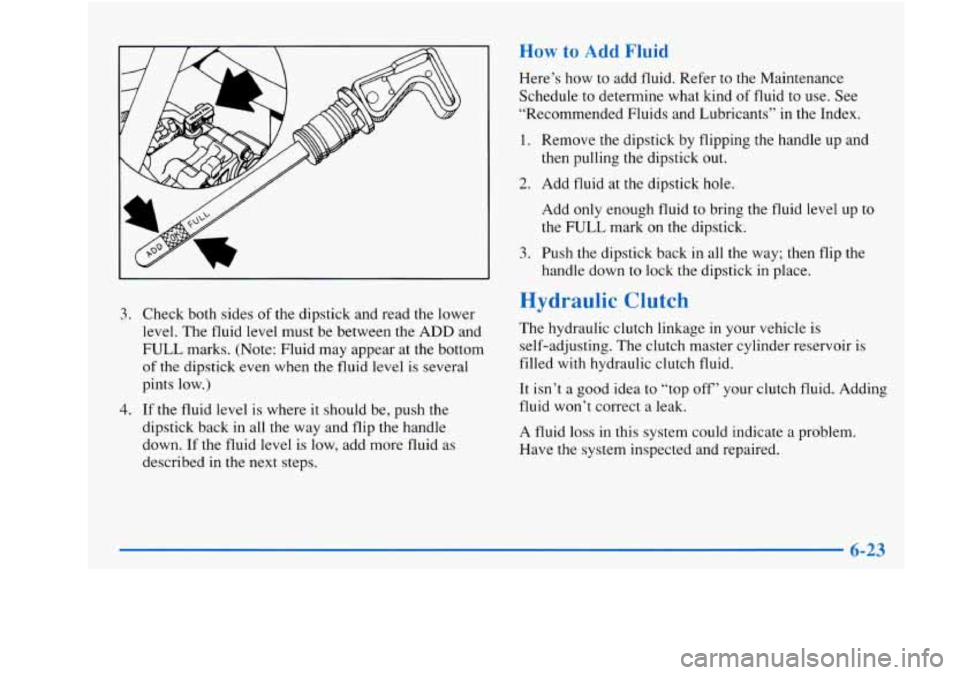
3. Check both sides of the dipstick and read the lower
level. The fluid level must be between the
ADD and
FULL marks. (Note: Fluid may appear at the bottom
of the dipstick even when the fluid level is several
pints low.)
4. If the fluid level is where it should be, push the
dipstick back in all the way and flip the handle
down.
If the fluid level is low, add more fluid as
described in the next steps.
How to Add Fluid
Here’s how to add fluid. Refer to the Maintenance
Schedule to determine what kind
of fluid to use. See
“Recommended Fluids and Lubricants” in the Index.
1. Remove the dipstick by flipping the handle up and
then pulling the dipstick out.
2. Add fluid at the dipstick hole.
Add only enough fluid to bring the fluid level up to
the FULL mark on the dipstick.
3. Push the dipstick back in all the way; then flip the
handle down to lock the dipstick in place.
Hydraulic Clutch
The hydraulic clutch linkage in your vehicle is
self-adjusting. The clutch master cylinder reservoir
is
filled with hydraulic clutch fluid.
It isn’t a good idea to “top
off’ your clutch fluid. Adding
fluid won’t correct a leak.
A fluid loss in this system could indicate a problem.
Have the system inspected and repaired.
Page 266 of 372
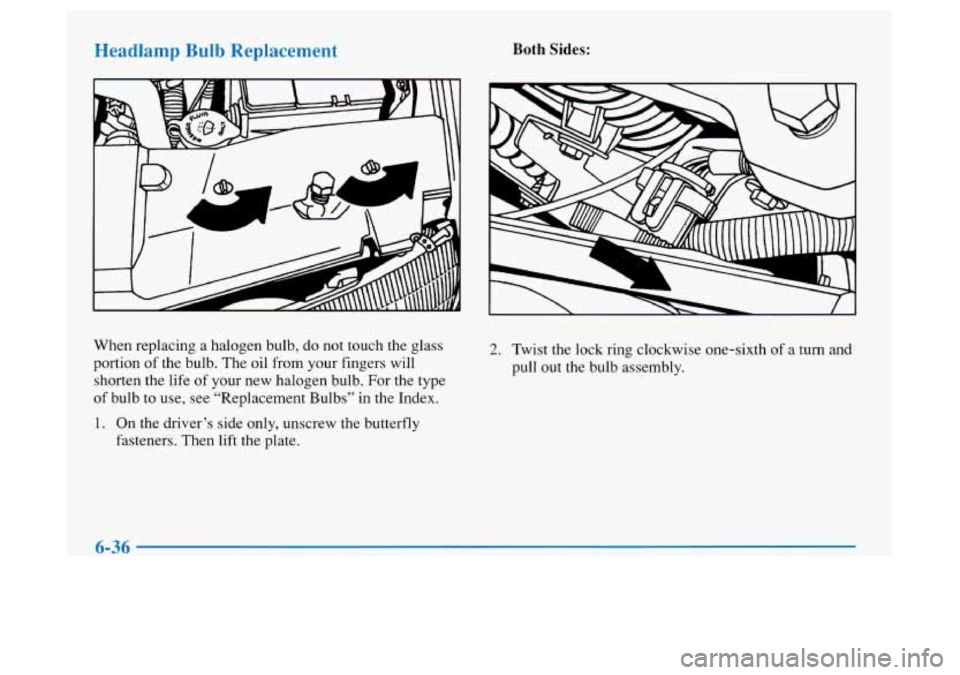
,,,adlamp Bulb RepL,.nent
When replacing a halogen bulb, do not touch the glass
portion of the bulb. The oil from your fingers will
shorten the life
of your new halogen bulb. For the type
of bulb to use, see “Replacement Bulbs” in the Index.
1. On the driver’s side only, unscrew the butterfly
fasteners. Then lift the plate.
6-36
Both Sides:
2. Twist the lock ring clockwise one-sixth of a turn and
pull out the bulb assemblv.
Page 287 of 372

Headlamp Wiring
The headlamp wiring is protected by a circuit breaker in
the fuse block. An electrical overload will cause the
lamps to
go on and off, or in some cases to remain off.
If this happens, have your headlamp wiring checked
right away.
Windshield Wipers
The windshield wiper motor is protected by an internal
circuit breaker and a fuse.
If the motor overheats due to
heavy snow, etc., the wiper will stop until the motor
cools. If the overload
is caused by some electrical
problem and not snow, etc., be sure to get it fixed.
Power Windows and Other Power Options
Circuit breakers in the fuse panel protect the power
windows and other power accessories. When the current
load is
too heavy, the circuit breaker opens and closes,
protecting the circuit until the problem is fixed or
goes away.
Fuses and Circuit Breakers
The wiring circuits in your vehicle are protected from
short circuits by
a combination of fuses, circuit breakers
and fusible thermal links in the wiring itself. This
greatly reduces the chance
of fires caused by
electrical problems.
Look at the silver-colored band inside the fuse. If the
band is broken or melted, replace the fuse. Be sure you
replace a bad fuse with
a new one of the identical size
and rating.
If you ever have a problem on the road and don’t have
a spare fuse, you can “borrow” one that has the same
amperage. Just pick a feature of your vehicle that you
can get along without
-- like the radio or cigarette
lighter
-- and use its fuse, if it is the correct amperage.
Replace
it as soon as you can.
There are two fuse blocks in your vehicle: the
instrument panel fuse block
and the engine compartment
fuse block.